 Скачать презентацию EE Lecture week 43 October 25 2006 Ronald
5b5dc9df14c4961e693500b5eefc11d1.ppt
- Количество слайдов: 37



EE Lecture week 43 October 25, 2006 Ronald Batenburg
Agenda • • • Reflection on the group discussion meetings Collection and analysis of the EE-data Setting up the EE-paper The multiple choice exam of October 13 Next
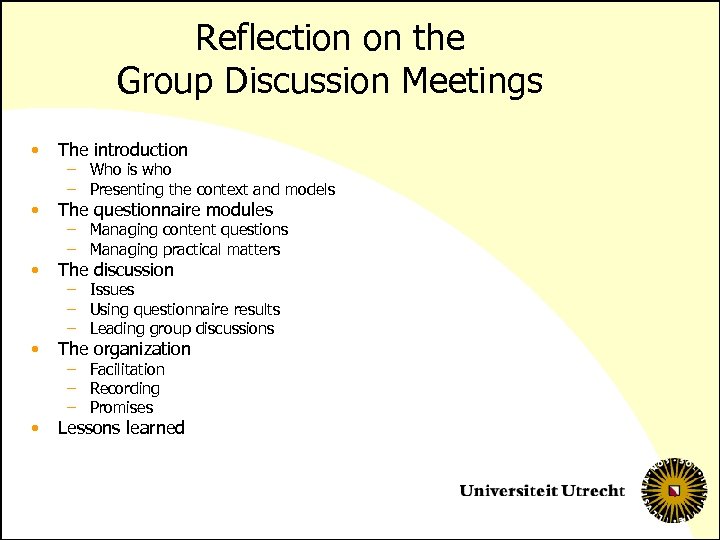
Reflection on the Group Discussion Meetings • The introduction • The questionnaire modules • The discussion • The organization • Lessons learned – Who is who – Presenting the context and models – Managing content questions – Managing practical matters – Issues – Using questionnaire results – Leading group discussions – Facilitation – Recording – Promises
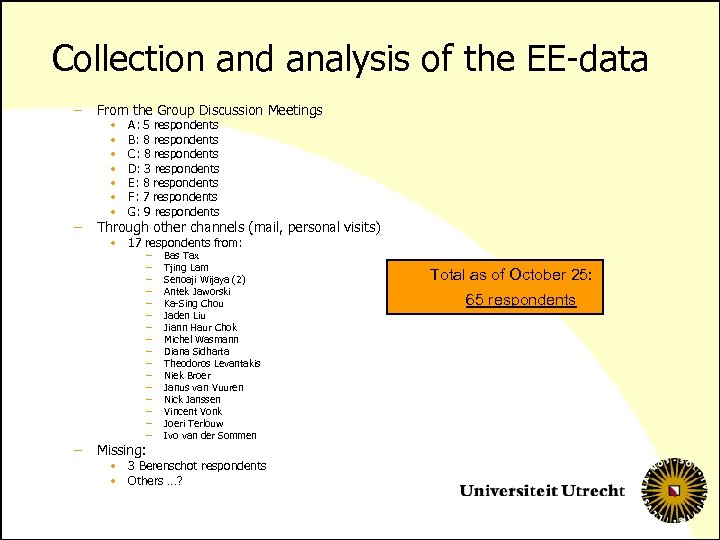
Collection and analysis of the EE-data – From the Group Discussion Meetings – Through other channels (mail, personal visits) – • • A: 5 respondents B: 8 respondents C: 8 respondents D: 3 respondents E: 8 respondents F: 7 respondents G: 9 respondents • 17 respondents from: – – – – Missing: Bas Tax Tjing Lam Senoaji Wijaya (2) Antek Jaworski Ka-Sing Chou Jaden Liu Jiann Haur Chok Michel Wasmann Diana Sidharta Theodoros Levantakis Niek Broer Janus van Vuuren Nick Janssen Vincent Vonk Joeri Terlouw Ivo van der Sommen • 3 Berenschot respondents • Others …? Total as of October 25: 65 respondents
The EE paper • • • Take an the papers that were discussed during the EE (working) lectures (e. g. Muffatto & Payaro, 2004; Kim & Umanath, 2005) Make use of our collective literature excel-base for references Your paper serves two goals: 1. A scientific contribution (what can scholars learn from the data, theory, hypothesis, validation or analysis? ) 2. A practical contribution (how can your respondent and other practitioners learn from the data and analysis? )
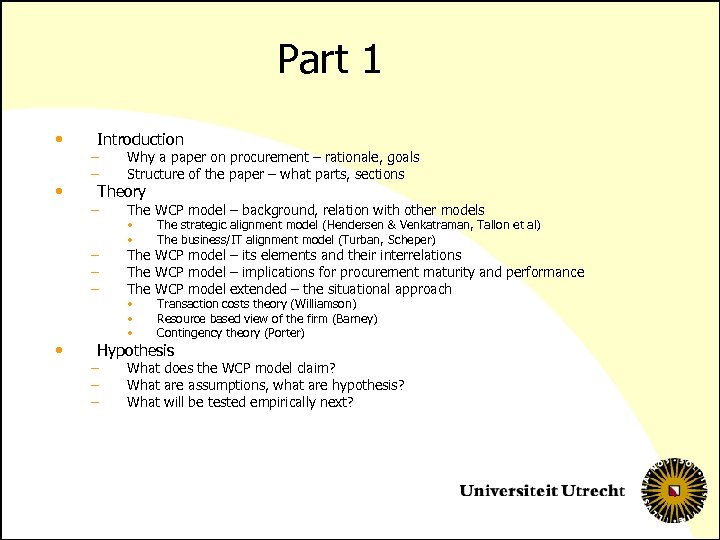
Part 1 • Introduction • Why a paper on procurement – rationale, goals Structure of the paper – what parts, sections – The WCP model – background, relation with other models – – – • – – The WCP model – its elements and their interrelations The WCP model – implications for procurement maturity and performance The WCP model extended – the situational approach Theory • • The strategic alignment model (Hendersen & Venkatraman, Tallon et al) The business/IT alignment model (Turban, Scheper) • • • Transaction costs theory (Williamson) Resource based view of the firm (Barney) Contingency theory (Porter) Hypothesis – – – What does the WCP model claim? What are assumptions, what are hypothesis? What will be tested empirically next?
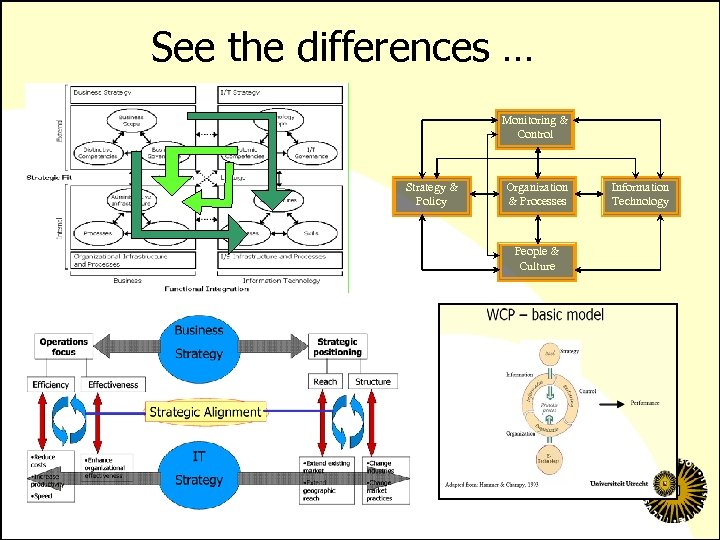
See the differences … Monitoring & Control Strategy & Policy Organization & Processes People & Culture Information Technology
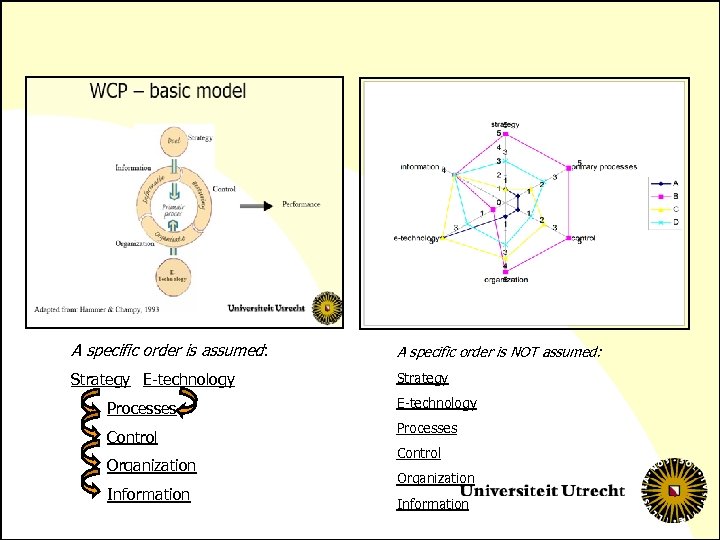
A specific order is assumed: A specific order is NOT assumed: Strategy E-technology Strategy Processes Control Organization Information E-technology Processes Control Organization Information
Part 2 • • • Description of the research – – Set-up and organization of the data collection Validation – The original questionnaire • • Questionnaire and data collection Data and sampling method Item analysis and variable construction – Description and measurement of the central items • • procurement (WCP) maturity procurement alignment procurement performance Explicative conditions Testing hypothesis – – – Which of the claims is supported by the data, which parts are not supported? What does this mean for the model? What does this mean for the data and/or method?
Validation of the questionnaire and data collection • We applied a self-completion (on-line) questionnaire containing 58 questions with mostly fixed answer categories • It took the 66 respondents, on average, 45 minutes to complete the questionnaire • 48 (26%) questionnaires were completed during 7 group discussion meetings under the guidance of the co-creators of the questionnaire • In general, the respondents confirmed that the questionnaire: – … was valid, i. e. it measured what it claims to measure – … was reliable, i. e. the measurements (questions and answered) were well-understood, clear and convenient to answer – … was relevant, i. e. it fits the knowledge and experience of the respondents
Validation of the data and sampling method • Respondents are spread over different sectors, sizes and other background characteristics – Bias compared to Dutch statistics? (check STATLINE (http: //www. cbs. nl/nl. NL/menu/cijfers/statline/toegang/default. htm) • Recruitment of respondents – What sampling method was used? – Is it a reliable or biased method? • Respondents as information source for organizational procurement practices – The right level?
Part 2 • • • Description of the research – – Set-up and organization of the data collection Validation – The original questionnaire • • Questionnaire and data collection Data and sampling method Item analysis and variable construction – Description and measurement of the central items • • procurement (WCP) maturity procurement alignment procurement performance Explicative conditions Testing hypothesis – – – Which of the claims is supported by the data, which parts are not supported? What does this mean for the model? What does this mean for the data and/or method?
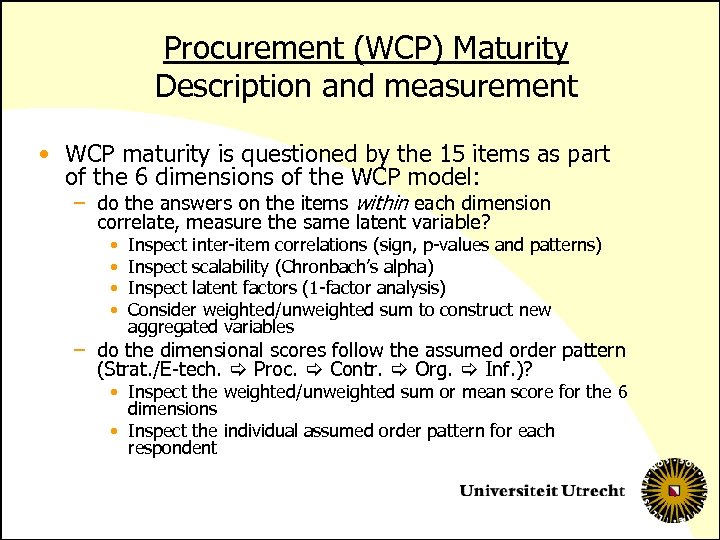
Procurement (WCP) Maturity Description and measurement • WCP maturity is questioned by the 15 items as part of the 6 dimensions of the WCP model: – do the answers on the items within each dimension correlate, measure the same latent variable? • • Inspect inter-item correlations (sign, p-values and patterns) Inspect scalability (Chronbach’s alpha) Inspect latent factors (1 -factor analysis) Consider weighted/unweighted sum to construct new aggregated variables – do the dimensional scores follow the assumed order pattern (Strat. /E-tech. Proc. Contr. Org. Inf. )? • Inspect the weighted/unweighted sum or mean score for the 6 dimensions • Inspect the individual assumed order pattern for each respondent
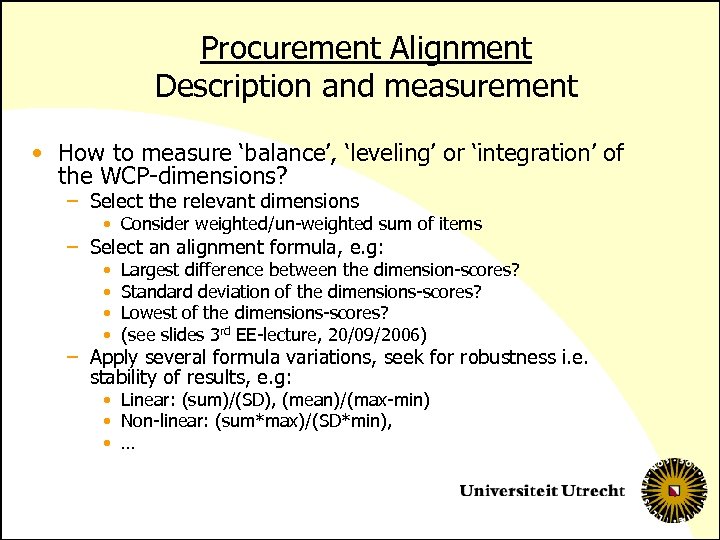
Procurement Alignment Description and measurement • How to measure ‘balance’, ‘leveling’ or ‘integration’ of the WCP-dimensions? – Select the relevant dimensions • Consider weighted/un-weighted sum of items – Select an alignment formula, e. g: • • Largest difference between the dimension-scores? Standard deviation of the dimensions-scores? Lowest of the dimensions-scores? (see slides 3 rd EE-lecture, 20/09/2006) – Apply several formula variations, seek for robustness i. e. stability of results, e. g: • Linear: (sum)/(SD), (mean)/(max-min) • Non-linear: (sum*max)/(SD*min), • …
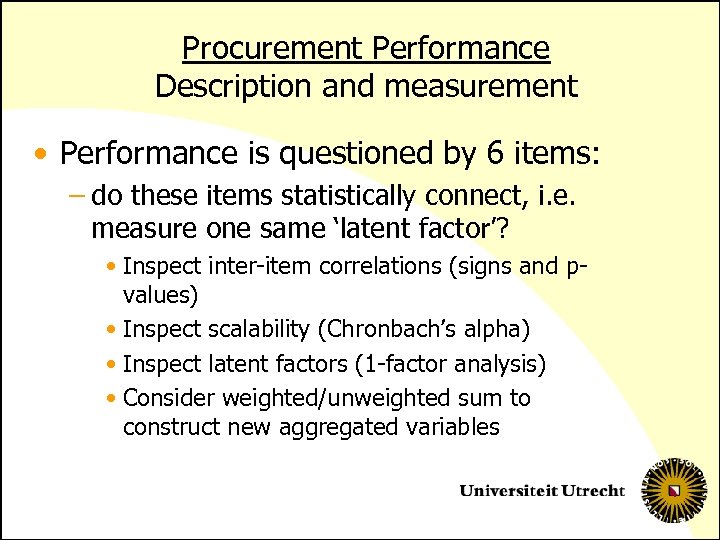
Procurement Performance Description and measurement • Performance is questioned by 6 items: – do these items statistically connect, i. e. measure one same ‘latent factor’? • Inspect inter-item correlations (signs and pvalues) • Inspect scalability (Chronbach’s alpha) • Inspect latent factors (1 -factor analysis) • Consider weighted/unweighted sum to construct new aggregated variables
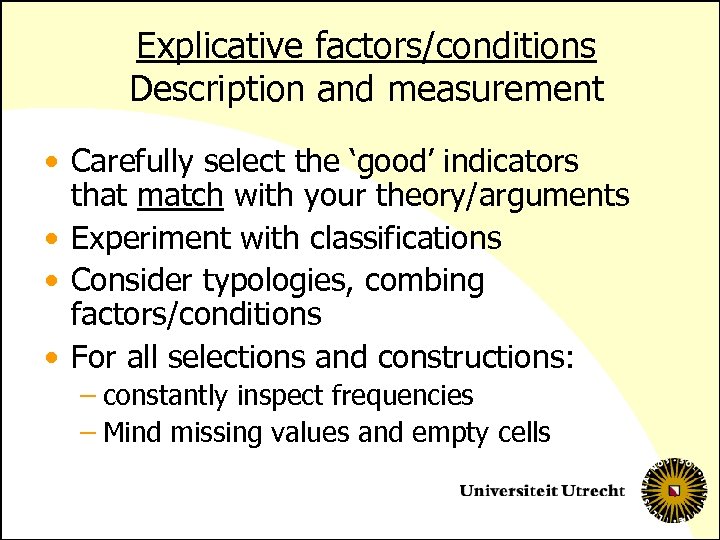
Explicative factors/conditions Description and measurement • Carefully select the ‘good’ indicators that match with your theory/arguments • Experiment with classifications • Consider typologies, combing factors/conditions • For all selections and constructions: – constantly inspect frequencies – Mind missing values and empty cells
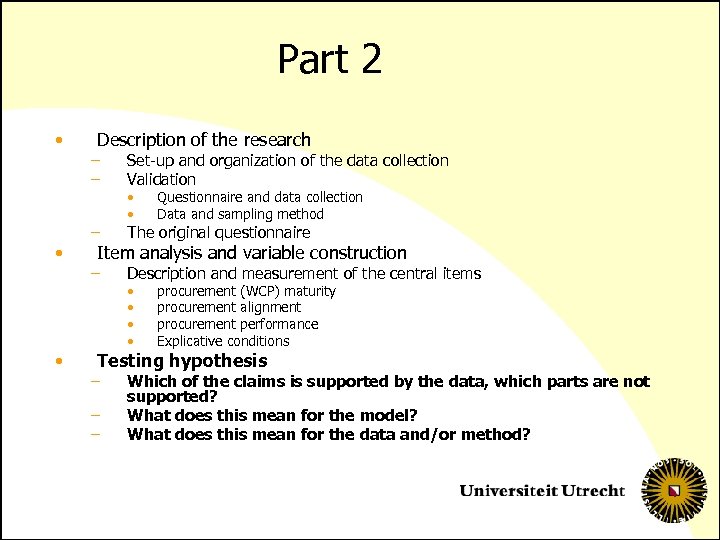
Part 2 • • • Description of the research – – Set-up and organization of the data collection Validation – The original questionnaire • • Questionnaire and data collection Data and sampling method Item analysis and variable construction – Description and measurement of the central items • • procurement (WCP) maturity procurement alignment procurement performance Explicative conditions Testing hypothesis – – – Which of the claims is supported by the data, which parts are not supported? What does this mean for the model? What does this mean for the data and/or method?
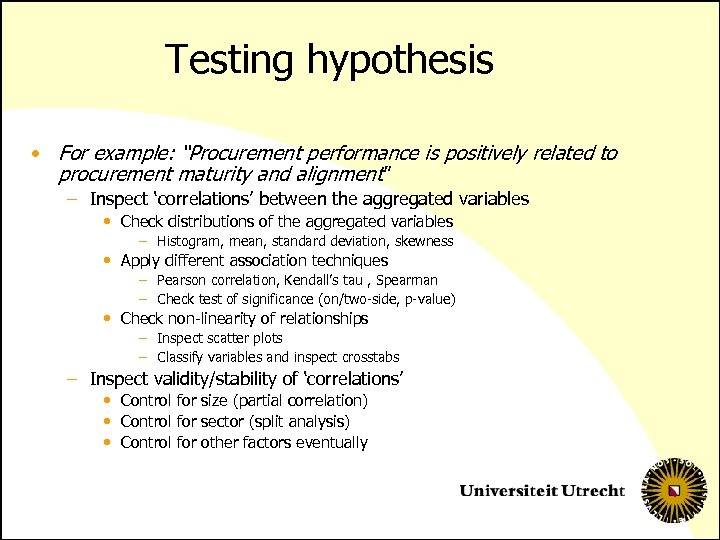
Testing hypothesis • For example: “Procurement performance is positively related to procurement maturity and alignment” – Inspect ‘correlations’ between the aggregated variables • Check distributions of the aggregated variables – Histogram, mean, standard deviation, skewness • Apply different association techniques – Pearson correlation, Kendall’s tau , Spearman – Check test of significance (on/two-side, p-value) • Check non-linearity of relationships – Inspect scatter plots – Classify variables and inspect crosstabs – Inspect validity/stability of ‘correlations’ • Control for size (partial correlation) • Control for sector (split analysis) • Control for other factors eventually
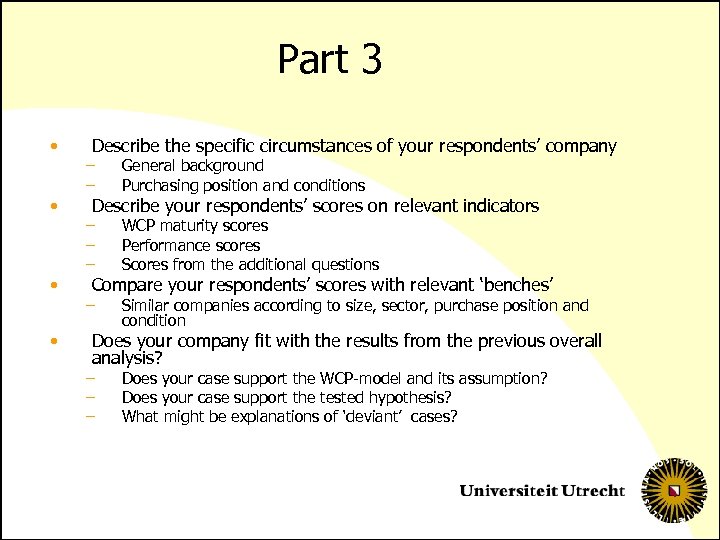
Part 3 • • Describe the specific circumstances of your respondents’ company – – General background Purchasing position and conditions – – – WCP maturity scores Performance scores Scores from the additional questions – Similar companies according to size, sector, purchase position and condition Describe your respondents’ scores on relevant indicators Compare your respondents’ scores with relevant ‘benches’ Does your company fit with the results from the previous overall analysis? – – – Does your case support the WCP-model and its assumption? Does your case support the tested hypothesis? What might be explanations of ‘deviant’ cases?
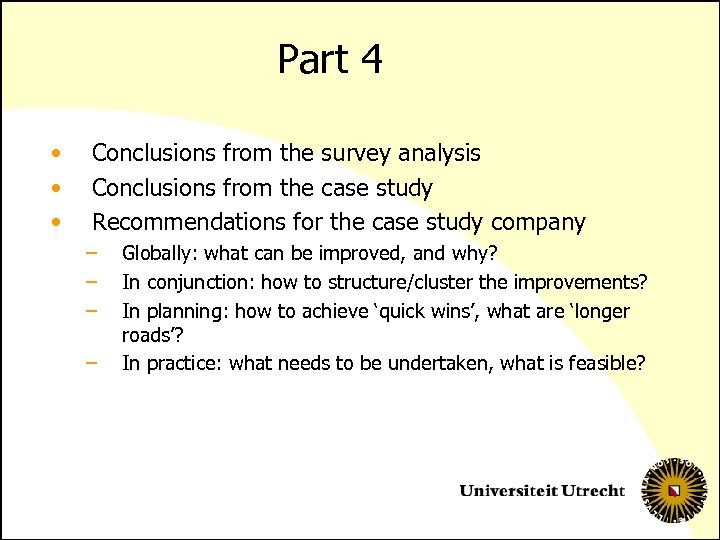
Part 4 • • • Conclusions from the survey analysis Conclusions from the case study Recommendations for the case study company – – Globally: what can be improved, and why? In conjunction: how to structure/cluster the improvements? In planning: how to achieve ‘quick wins’, what are ‘longer roads’? In practice: what needs to be undertaken, what is feasible?
The Multiple Choice Exam of October 13
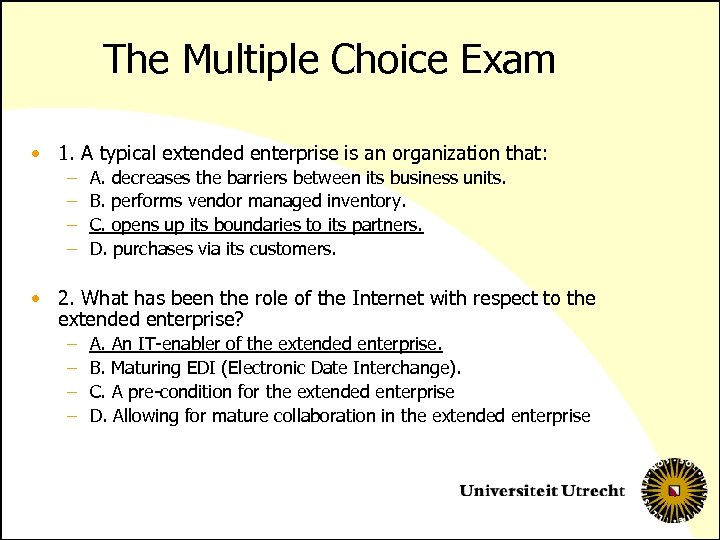
The Multiple Choice Exam • 1. A typical extended enterprise is an organization that: – – A. decreases the barriers between its business units. B. performs vendor managed inventory. C. opens up its boundaries to its partners. D. purchases via its customers. • 2. What has been the role of the Internet with respect to the extended enterprise? – – A. An IT-enabler of the extended enterprise. B. Maturing EDI (Electronic Date Interchange). C. A pre-condition for the extended enterprise D. Allowing for mature collaboration in the extended enterprise
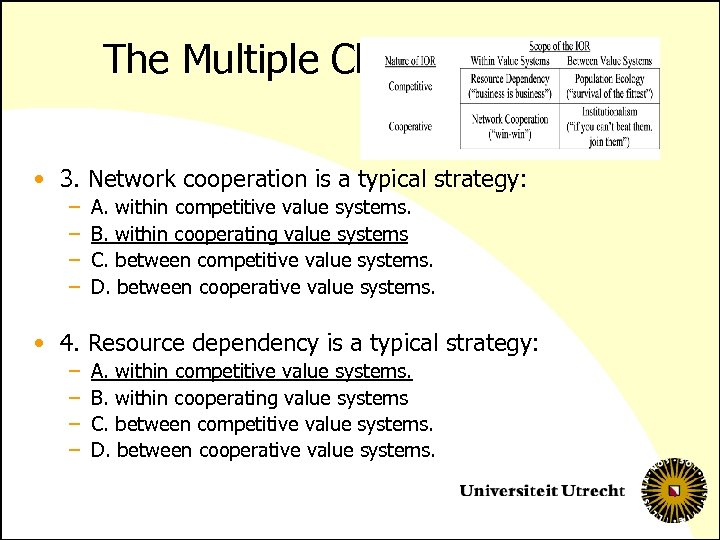
The Multiple Choice Exam • 3. Network cooperation is a typical strategy: – – A. within competitive value systems. B. within cooperating value systems C. between competitive value systems. D. between cooperative value systems. • 4. Resource dependency is a typical strategy: – – A. within competitive value systems. B. within cooperating value systems C. between competitive value systems. D. between cooperative value systems.
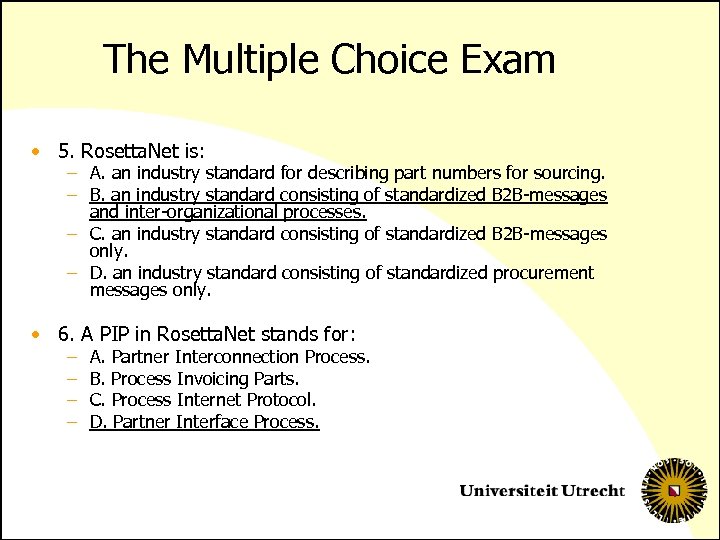
The Multiple Choice Exam • 5. Rosetta. Net is: – A. an industry standard for describing part numbers for sourcing. – B. an industry standard consisting of standardized B 2 B-messages and inter-organizational processes. – C. an industry standard consisting of standardized B 2 B-messages only. – D. an industry standard consisting of standardized procurement messages only. • 6. A PIP in Rosetta. Net stands for: – – A. Partner Interconnection Process. B. Process Invoicing Parts. C. Process Internet Protocol. D. Partner Interface Process.
The Multiple Choice Exam • 7. What best describes a remittance advice? – – A. A reverse invoice. B. A packing slip. C. A purchase order confirmation. D. A purchase delivery schedule. • 8. What is the major benefit of an ASN (Advanced Shipping Notice)? – – A. It enables shorter receiving and warehousing lead-time. B. It shortens the sales process. C. It improves the sales pipeline. D. It allows for fast invoicing.
The Multiple Choice Exam • 9. What best describes Exostar? – A. A consortium of sellers of first-tier aerospace suppliers. – B. A consortium of OEM-competitors in the aerospace industry. – C. A consortium of first-tier suppliers and OEM-competitors in the automotive industry. – D. An excellent agreement between buyers and sellers in the automotive industry. • 10. E-Procurement implementations in the late 1990’s: – – A. mainly automated purchasing of direct goods/items/parts. B. mainly automated purchasing of indirect goods/items/parts. C. mainly automated strategic sourcing. D. mainly focused on purchasing of capital goods and assets.
The Multiple Choice Exam • 11. Procurement performance can be defined in terms of: – – A. product price, procurement costs and product quality. B. supplier satisfaction and retention. C. supplier rating and preference. D. customer retention and customer growth. – – A. Oilily clothing. B. Apple. C. SAP. D. Dell. • 12. Which company is good example of a company with emphasis on ‘operational excellence’?
The Multiple Choice Exam • 13. In many organizations examples of direct materials are: – – A. office supplies. B. company assets. C. cleaning services. D. raw materials and components. • 14. What type of goods/parts are preferably ordered through employee-triggered procurement-card purchase ordering? – – A. Low transaction value, low purchase dollar value. B. Low transaction value, high purchase dollar value. C. High transaction value, low purchase dollar value. D. High transaction value, high purchase dollar value.
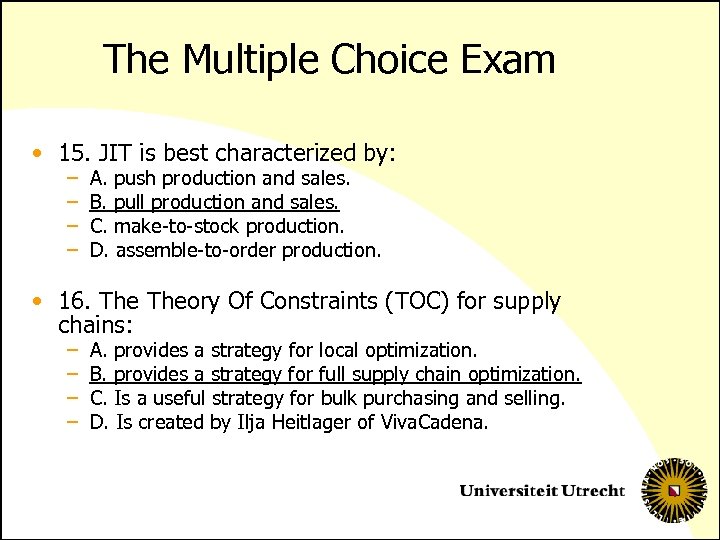
The Multiple Choice Exam • 15. JIT is best characterized by: – – A. push production and sales. B. pull production and sales. C. make-to-stock production. D. assemble-to-order production. • 16. Theory Of Constraints (TOC) for supply chains: – – A. provides a strategy for local optimization. B. provides a strategy for full supply chain optimization. C. Is a useful strategy for bulk purchasing and selling. D. Is created by Ilja Heitlager of Viva. Cadena.
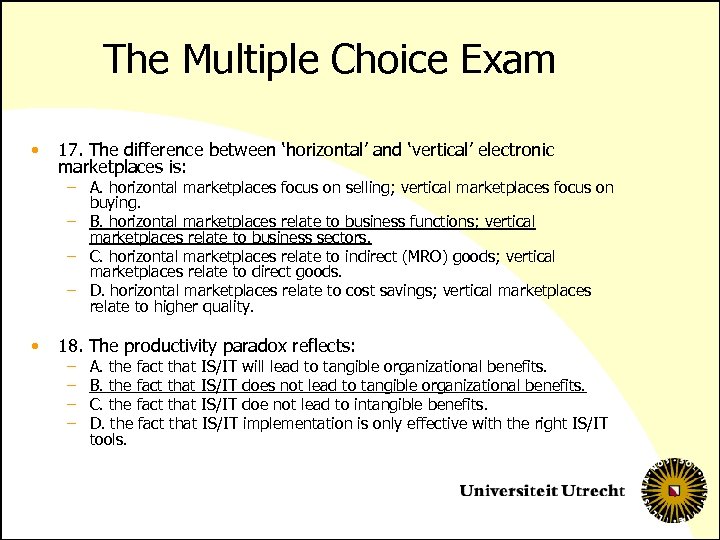
The Multiple Choice Exam • 17. The difference between ‘horizontal’ and ‘vertical’ electronic marketplaces is: – A. horizontal marketplaces focus on selling; vertical marketplaces focus on buying. – B. horizontal marketplaces relate to business functions; vertical marketplaces relate to business sectors. – C. horizontal marketplaces relate to indirect (MRO) goods; vertical marketplaces relate to direct goods. – D. horizontal marketplaces relate to cost savings; vertical marketplaces relate to higher quality. • 18. The productivity paradox reflects: – – A. the fact that IS/IT will lead to tangible organizational benefits. B. the fact that IS/IT does not lead to tangible organizational benefits. C. the fact that IS/IT doe not lead to intangible benefits. D. the fact that IS/IT implementation is only effective with the right IS/IT tools.
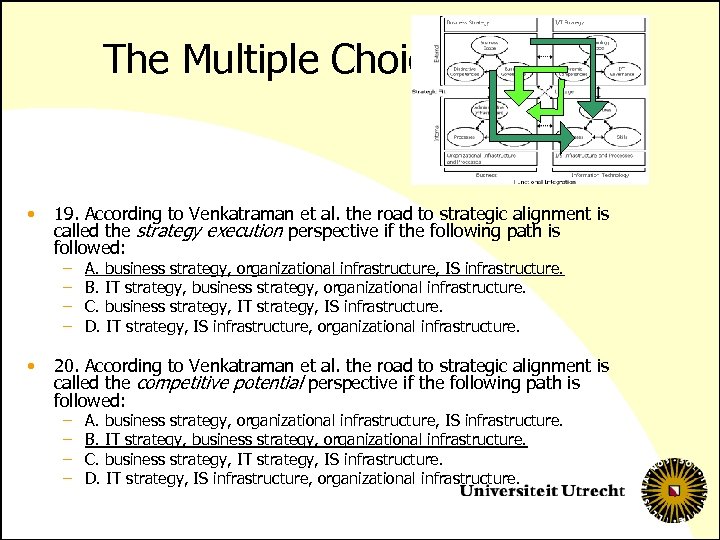
The Multiple Choice Exam • 19. According to Venkatraman et al. the road to strategic alignment is called the strategy execution perspective if the following path is followed: – – • A. business strategy, organizational infrastructure, IS infrastructure. B. IT strategy, business strategy, organizational infrastructure. C. business strategy, IT strategy, IS infrastructure. D. IT strategy, IS infrastructure, organizational infrastructure. 20. According to Venkatraman et al. the road to strategic alignment is called the competitive potential perspective if the following path is followed: – – A. business strategy, organizational infrastructure, IS infrastructure. B. IT strategy, business strategy, organizational infrastructure. C. business strategy, IT strategy, IS infrastructure. D. IT strategy, IS infrastructure, organizational infrastructure.
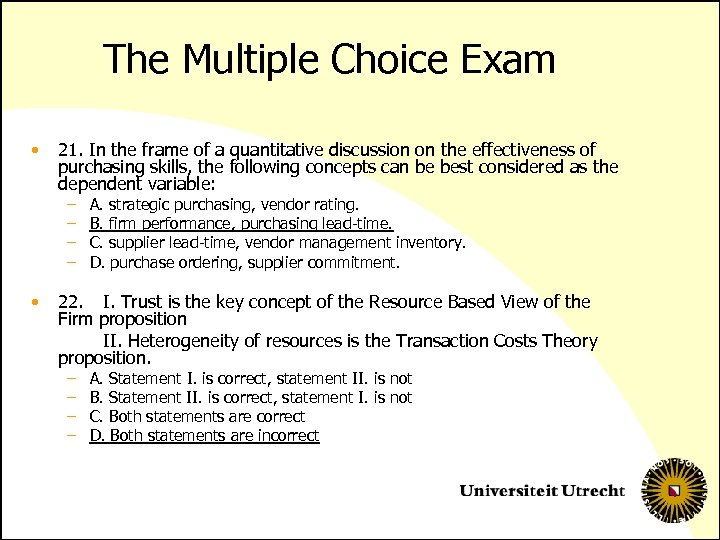
The Multiple Choice Exam • 21. In the frame of a quantitative discussion on the effectiveness of purchasing skills, the following concepts can be best considered as the dependent variable: – – • A. strategic purchasing, vendor rating. B. firm performance, purchasing lead-time. C. supplier lead-time, vendor management inventory. D. purchase ordering, supplier commitment. 22. I. Trust is the key concept of the Resource Based View of the Firm proposition II. Heterogeneity of resources is the Transaction Costs Theory proposition. – – A. Statement I. is correct, statement II. is not B. Statement II. is correct, statement I. is not C. Both statements are correct D. Both statements are incorrect
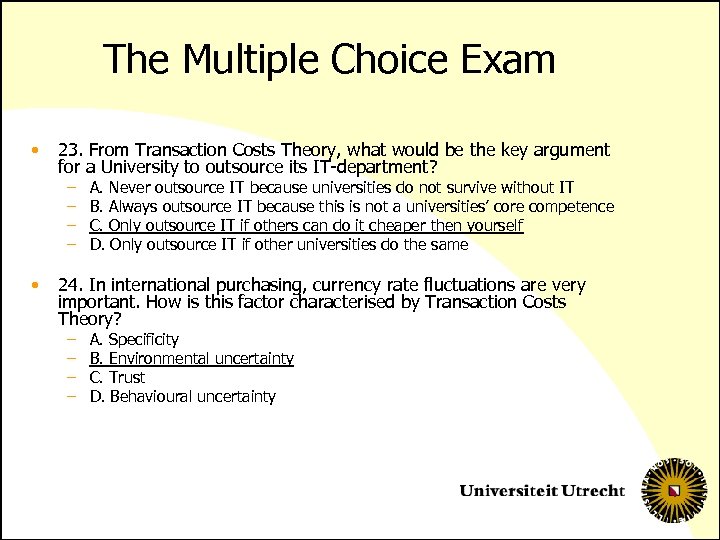
The Multiple Choice Exam • 23. From Transaction Costs Theory, what would be the key argument for a University to outsource its IT-department? – – • A. Never outsource IT because universities do not survive without IT B. Always outsource IT because this is not a universities’ core competence C. Only outsource IT if others can do it cheaper then yourself D. Only outsource IT if other universities do the same 24. In international purchasing, currency rate fluctuations are very important. How is this factor characterised by Transaction Costs Theory? – – A. Specificity B. Environmental uncertainty C. Trust D. Behavioural uncertainty
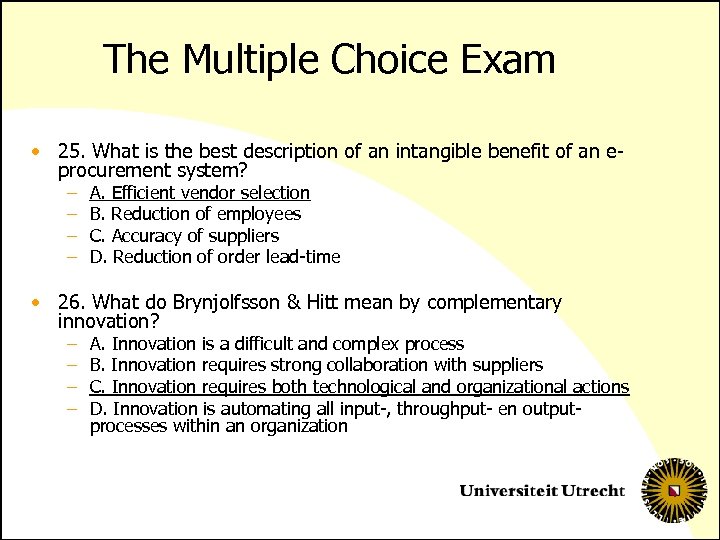
The Multiple Choice Exam • 25. What is the best description of an intangible benefit of an eprocurement system? – – A. Efficient vendor selection B. Reduction of employees C. Accuracy of suppliers D. Reduction of order lead-time • 26. What do Brynjolfsson & Hitt mean by complementary innovation? – – A. Innovation is a difficult and complex process B. Innovation requires strong collaboration with suppliers C. Innovation requires both technological and organizational actions D. Innovation is automating all input-, throughput- en outputprocesses within an organization
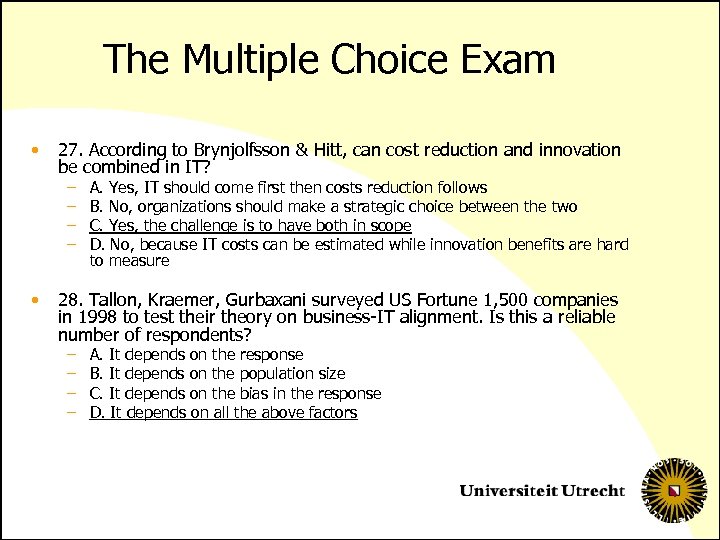
The Multiple Choice Exam • 27. According to Brynjolfsson & Hitt, can cost reduction and innovation be combined in IT? – – • A. Yes, IT should come first then costs reduction follows B. No, organizations should make a strategic choice between the two C. Yes, the challenge is to have both in scope D. No, because IT costs can be estimated while innovation benefits are hard to measure 28. Tallon, Kraemer, Gurbaxani surveyed US Fortune 1, 500 companies in 1998 to test their theory on business-IT alignment. Is this a reliable number of respondents? – – A. It depends on the response B. It depends on the population size C. It depends on the bias in the response D. It depends on all the above factors
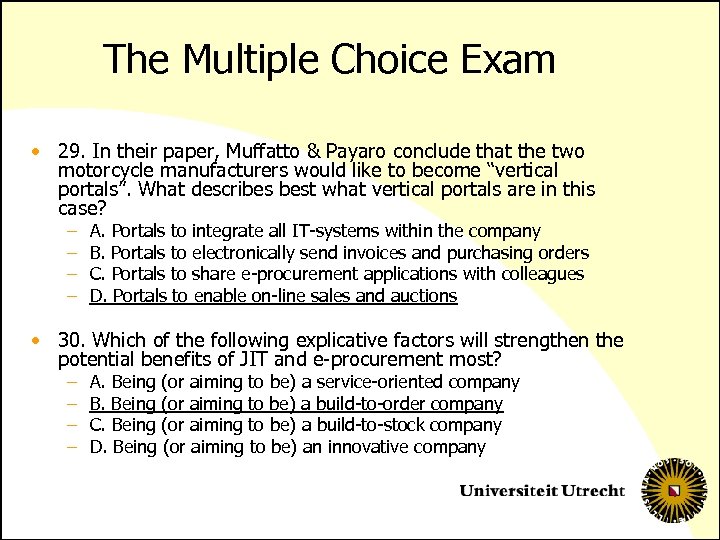
The Multiple Choice Exam • 29. In their paper, Muffatto & Payaro conclude that the two motorcycle manufacturers would like to become “vertical portals”. What describes best what vertical portals are in this case? – – A. Portals to integrate all IT-systems within the company B. Portals to electronically send invoices and purchasing orders C. Portals to share e-procurement applications with colleagues D. Portals to enable on-line sales and auctions • 30. Which of the following explicative factors will strengthen the potential benefits of JIT and e-procurement most? – – A. Being (or aiming to be) a service-oriented company B. Being (or aiming to be) a build-to-order company C. Being (or aiming to be) a build-to-stock company D. Being (or aiming to be) an innovative company
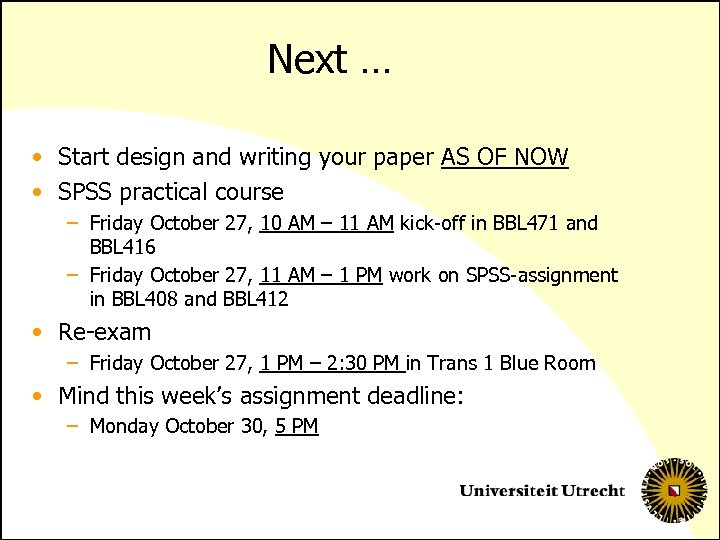
Next … • Start design and writing your paper AS OF NOW • SPSS practical course – Friday October 27, 10 AM – 11 AM kick-off in BBL 471 and BBL 416 – Friday October 27, 11 AM – 1 PM work on SPSS-assignment in BBL 408 and BBL 412 • Re-exam – Friday October 27, 1 PM – 2: 30 PM in Trans 1 Blue Room • Mind this week’s assignment deadline: – Monday October 30, 5 PM
Скачать презентацию EE Lecture week 43 October 25 2006 Ronald
5b5dc9df14c4961e693500b5eefc11d1.ppt