


 Скачать презентацию EE 97 98 Senior Project Design The
d00ee9cef3f56835256c050bffc8cf9c.ppt
- Количество слайдов: 71
 EE 97 / 98 Senior Project Design “The Introduction” Wednesday, April 26, 2006 10: 30 AM to 11: 45 AM http: //www. eecs. tufts. edu/ee/97 new/index. htm
 Quote for the Day “I cdnuolt blveiee taht I cluod aulaclty uesdnatnrd waht I was rdgnieg. The phaonmneal pweor of the hmuan mnid Aoccdrnig to rscheearch at Cmabrigde Uinervtisy, it deosn't mttaer in waht oredr the ltteers in a wrod are, the olny iprmoatnt tihng is taht the frist and lsat ltteer be in the rghit pclae. The rset can be a taotl mses and you can tisll raed it wouthit a porbelm. Tihs is bcuseae the huamn mnid deos not raed ervey lteter by istlef, but the wrod as a wlohe. Amzanig huh? ” — The Power of the Human Mind, Cambridge University Study, 2002
 Are you satisfied with you Life? o o o Have you looked back to where you were 3 years ago and where you wanted to be now? Are you on the path that will lead you to where you want to go? What went wrong? Are you disappointed? Who is the worse student in the room? Why? What about all of you in the middle? Are you content with mediocrity? And those of you at the top…what do you need to learn now to continue to be on top? Who will displace you? Where will they come from? Are they younger than you?
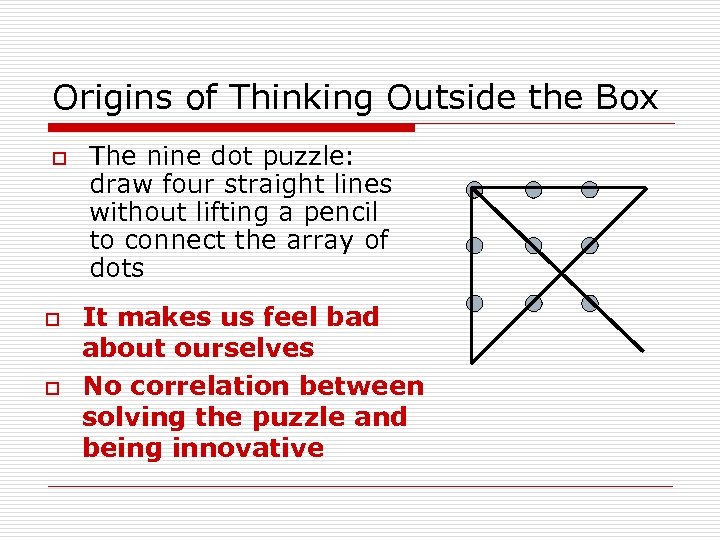 Origins of Thinking Outside the Box o o o The nine dot puzzle: draw four straight lines without lifting a pencil to connect the array of dots It makes us feel bad about ourselves No correlation between solving the puzzle and being innovative
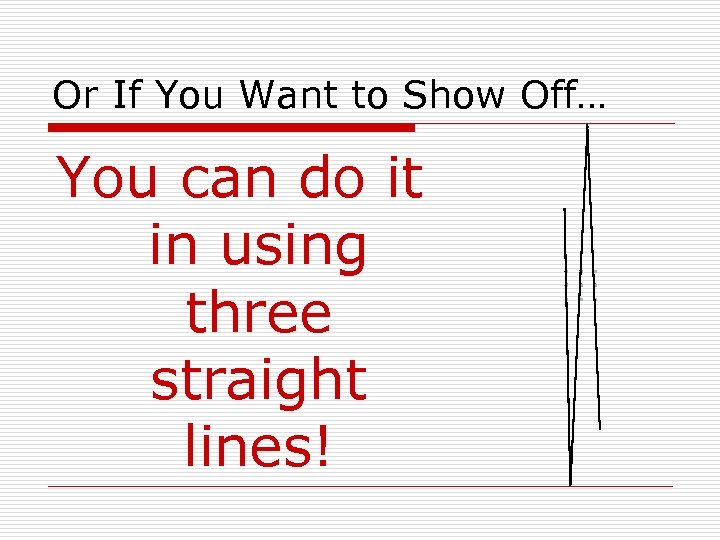 Or If You Want to Show Off… You can do it in using three straight lines!
 What is your goal for success? Make yourself stinking rich!
 Are you comfortable with… o Ambiguity – too many options n o Complexity – walk away from what you know n n o Human beings hate this condition Do something new Move from the familiar – most people hate to do this Volatility – what you expect doesn’t happen n Missed the desired grade in a course Trauma Intense change These undermine ability to innovate and be productive unless you harness them by…
 Attributes for Success o Curiosity – asking what is next? Or why or how? n o o Most want to just learn what they need to know to get by Confidence – ability to use tools, methods, knowledge, skills, to a reach the desired result Courage – pursue new ideas n Do a small number of large ideas rather than a large number of small ideas
 Design o o o It is about change Used effectively – is now an imperative for competitiveness and innovation Don’t be fooled – you are all in competition with each other n For example, only one of you will get an A+ in this course…what are your new rules?
 A Time of Fertile Change o You live in a time of excitement…but your actions must meet the intensity if you want be on top
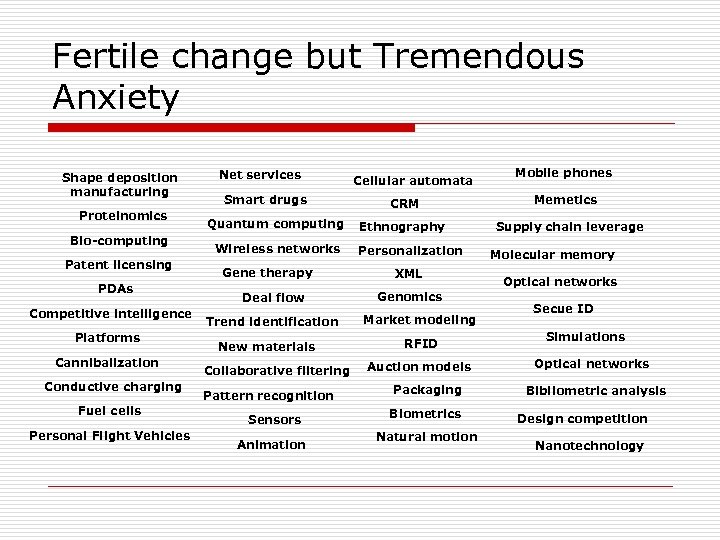 Fertile change but Tremendous Anxiety Shape deposition manufacturing Proteinomics Bio-computing Patent licensing PDAs Competitive intelligence Platforms Cannibalization Conductive charging Fuel cells Personal Flight Vehicles Net services Smart drugs Quantum computing Wireless networks Gene therapy Deal flow Trend identification New materials Collaborative filtering Pattern recognition Sensors Animation Cellular automata CRM Ethnography Personalization XML Genomics Market modeling RFID Auction models Packaging Biometrics Natural motion Mobile phones Memetics Supply chain leverage Molecular memory Optical networks Secue ID Simulations Optical networks Bibliometric analysis Design competition Nanotechnology
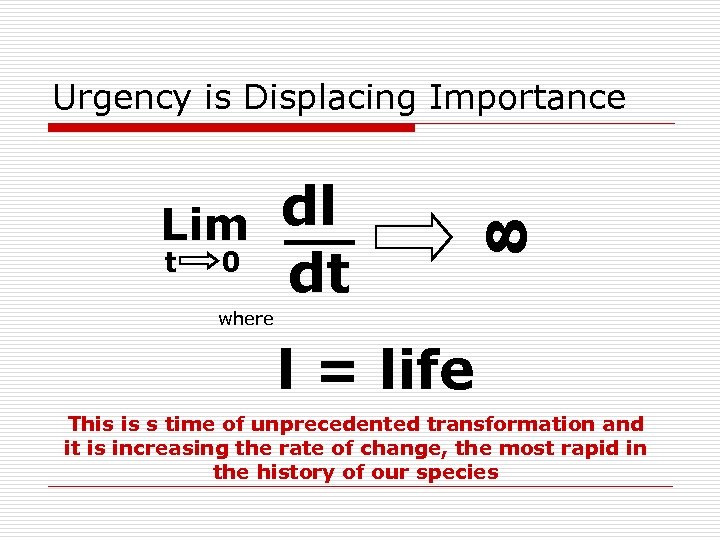 dl Lim t 0 dt 8 Urgency is Displacing Importance where l = life This is s time of unprecedented transformation and it is increasing the rate of change, the most rapid in the history of our species
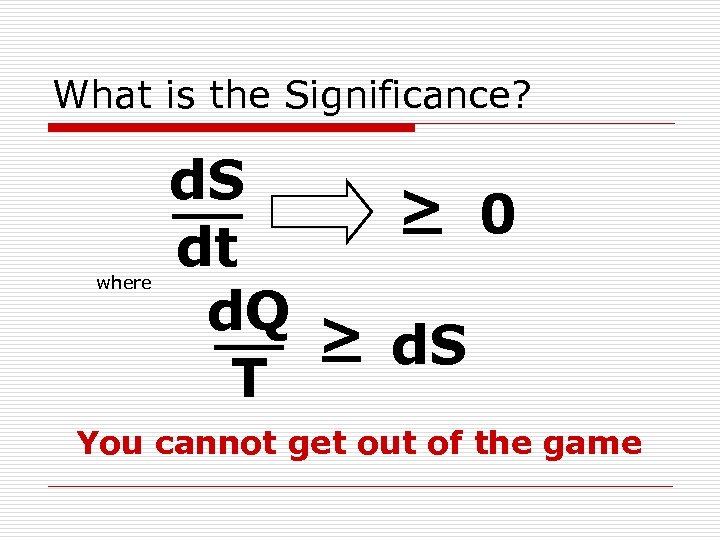 What is the Significance? where d. S > 0 _ dt d. Q > _ d. S T You cannot get out of the game
 And Now… The Art of Engineering…
 Monster
 Puzzle
 Puzzle Round
 a o a
a o a
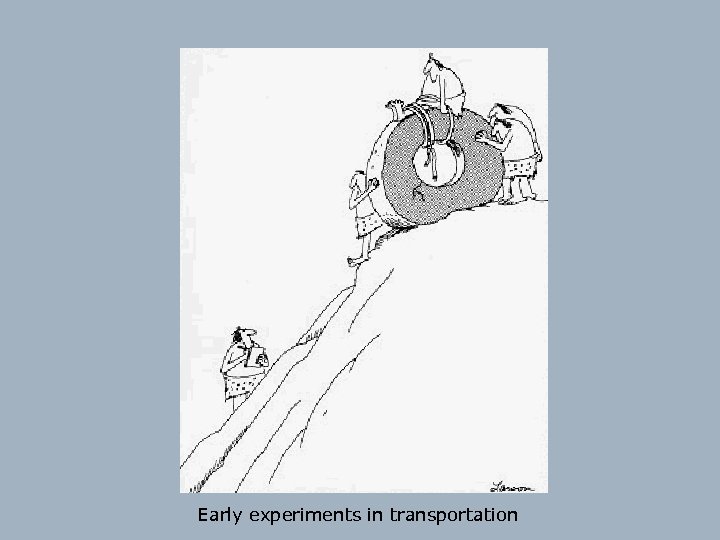 b o b Early experiments in transportation
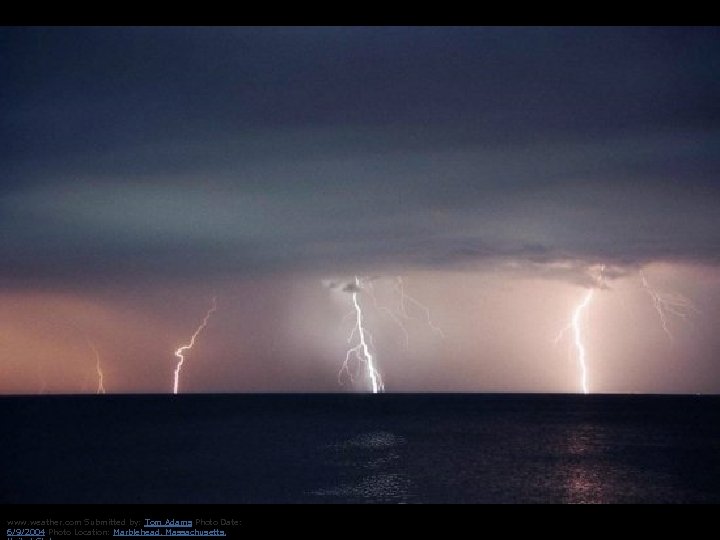 www. weather. com Submitted by: Tom Adams Photo Date: 6/9/2004 Photo Location: Marblehead, Massachusetts,
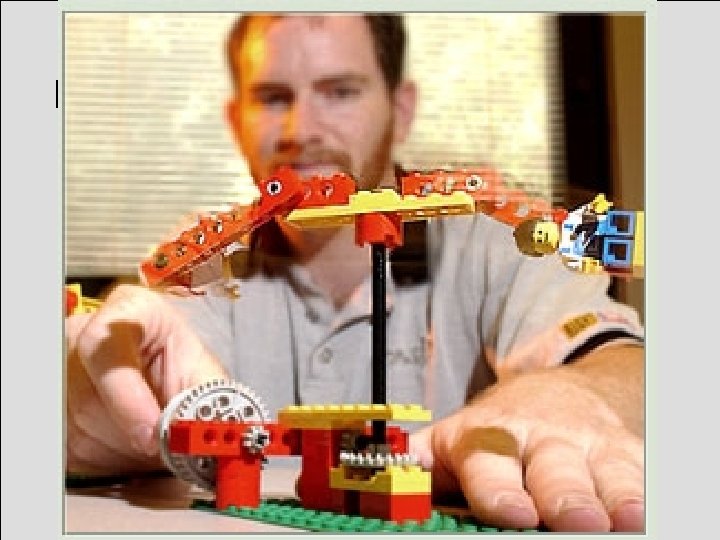 Lego
Lego
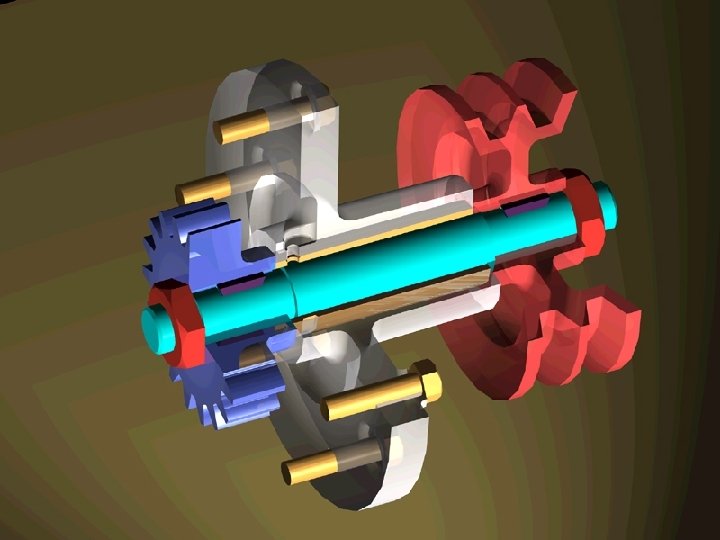 Cad Drawing
 Gantt Person
 Project Planning 02
 Product Sketch
 System
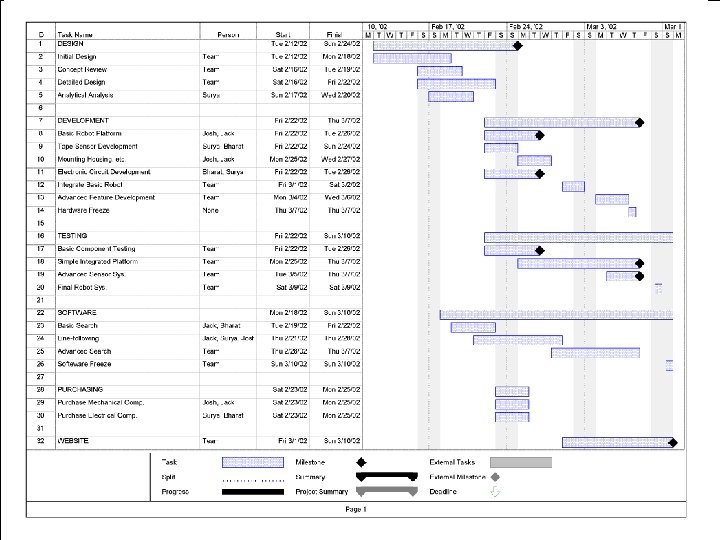 Gantt
Gantt
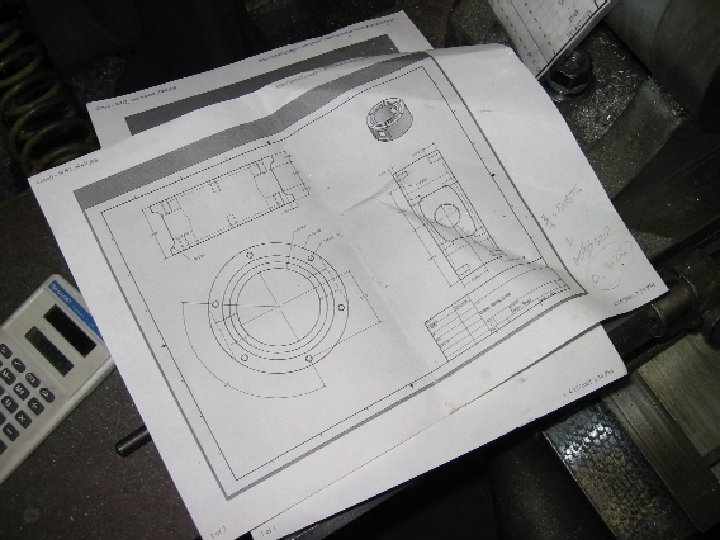 Engineering Drawings
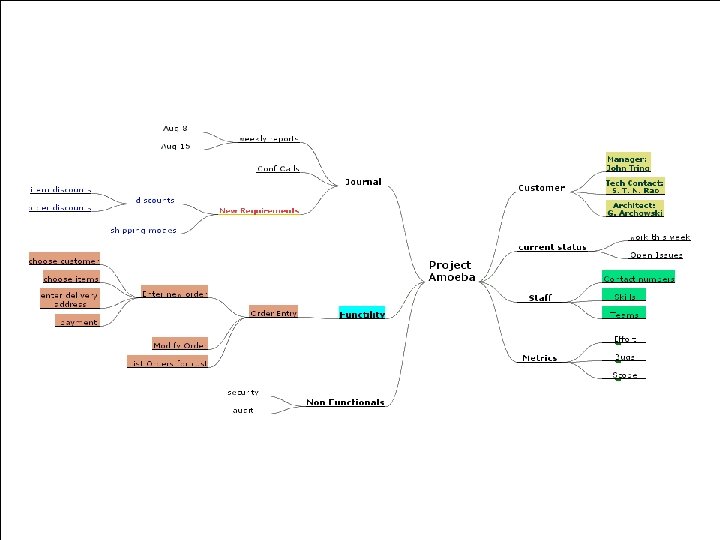 Project Planning
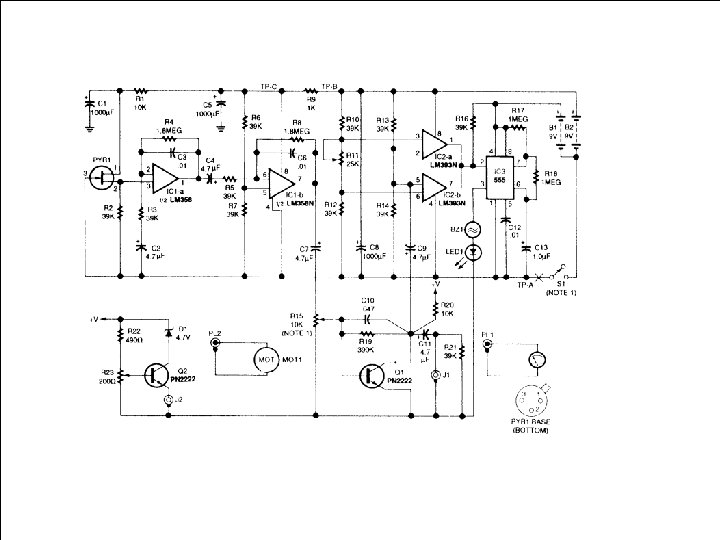 Project Planning 01
 Blueprints
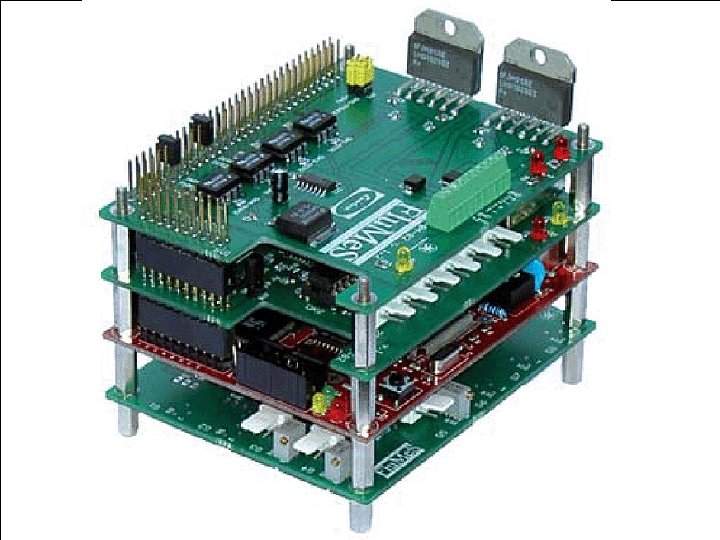 Circuit Board
 Project Leader
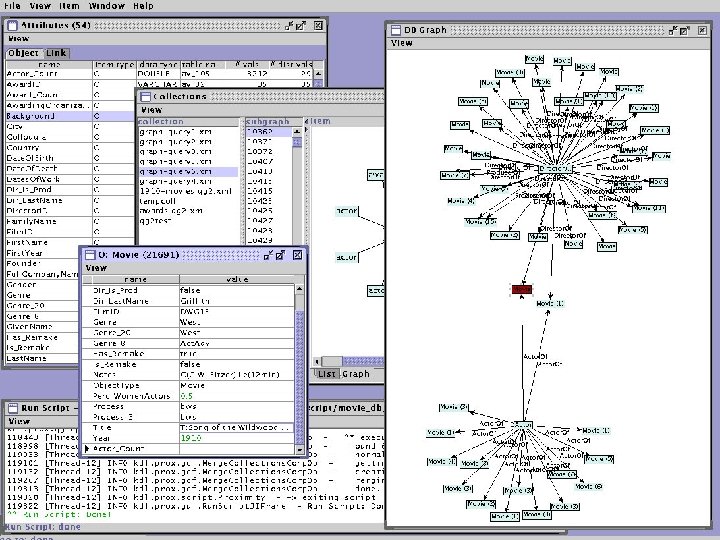 GUI
GUI
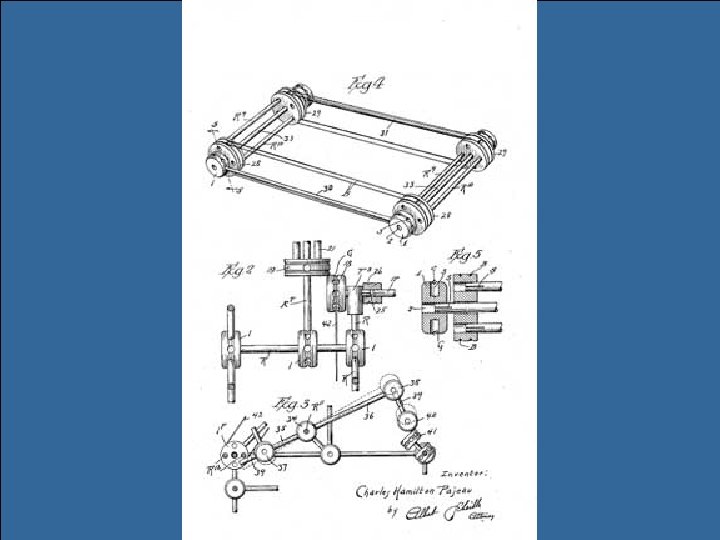 Tinker Toy
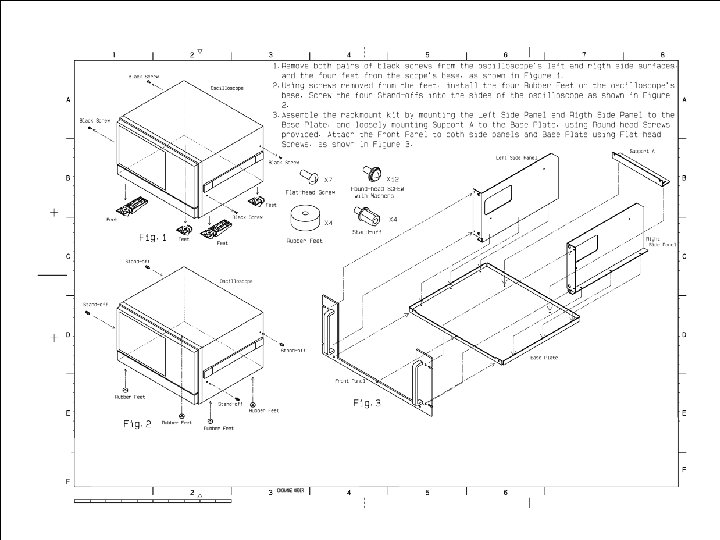 Product Assembly
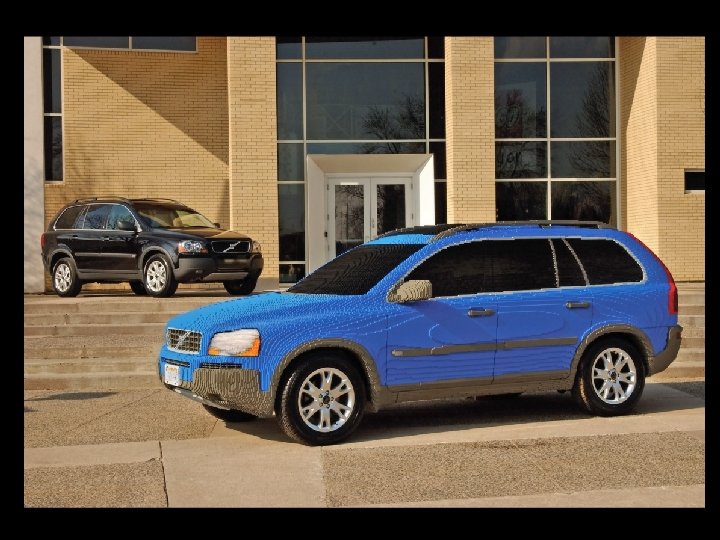 Lego Car
 Product Result
 Mickey
 The Art of Engineering!
 Rule #1 IF YOU ARE NOT HAVING FUN… FIND SOMETHING ELSE TO DO.
 What is an Irritation? Ir·ri·ta·tion o Noun 1 a : the act of irritating b : something that irritates c : the state of being irritated 2 : a condition of irritability, soreness, roughness, or inflammation of a bodily part o The psychological state of being irritated or annoyed [synonym: annoyance, vexation, botheration] 2: a sudden outburst of anger; "his temper sparked like damp firewood" [synonym : pique, temper] 3: (pathology) abnormal sensitivity to stimulation; "any food produced irritation of the stomach" 4: the neural or electrical arousal of an organ or muscle or gland [syn: excitation, innervation] 5: an uncomfortable feeling in some part of the body [synonym : discomfort, soreness] 6: unfriendly behavior that causes anger or resentment [synonym : aggravation, provocation] 7: the act of troubling or annoying someone [synonym : annoyance, annoying, vexation] Source: Merriam-Webster's Medical Dictionary, © 2002 Merriam-Webster, Inc. and Word. Net ® 2. 0, © 2003 Princeton University
 What is a Problem? Prob·lem o Noun n A question to be considered, solved, or answered: math problems; the problem of how to arrange transportation n A situation, matter, or person that presents perplexity or difficulty: was having problems breathing; considered the main problem to be his boss n A misgiving, objection, or complaint: I have a problem with his cynicism o Adjective n Difficult to deal with or control: a problem child n Dealing with a moral or social problem: a problem play Source: Merriam-Webster's Medical Dictionary, © 2002 Merriam-Webster, Inc. and Word. Net ® 2. 0, © 2003 Princeton University
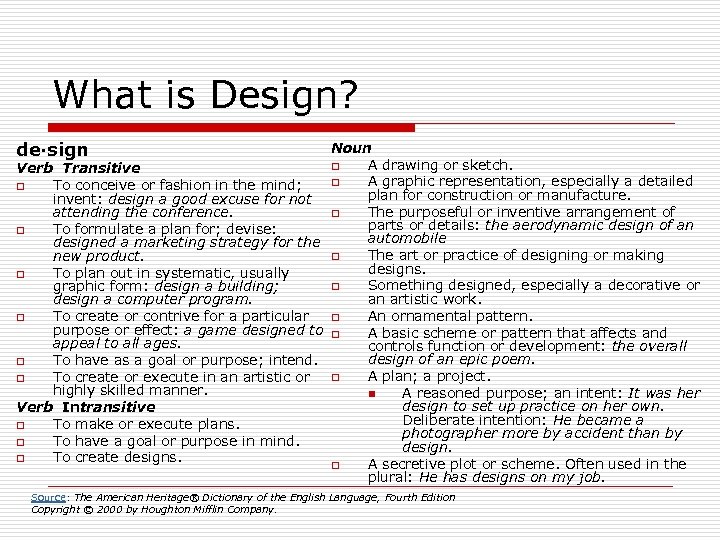 What is Design? de·sign Noun o A drawing or sketch. Verb Transitive o A graphic representation, especially a detailed o To conceive or fashion in the mind; plan for construction or manufacture. invent: design a good excuse for not o The purposeful or inventive arrangement of attending the conference. parts or details: the aerodynamic design of an o To formulate a plan for; devise: automobile designed a marketing strategy for the o The art or practice of designing or making new product. designs. o To plan out in systematic, usually o Something designed, especially a decorative or graphic form: design a building; an artistic work. design a computer program. An ornamental pattern. o To create or contrive for a particular o purpose or effect: a game designed to o A basic scheme or pattern that affects and appeal to all ages. controls function or development: the overall design of an epic poem. o To have as a goal or purpose; intend. A plan; a project. o To create or execute in an artistic or o highly skilled manner. n A reasoned purpose; an intent: It was her design to set up practice on her own. Verb Intransitive Deliberate intention: He became a o To make or execute plans. photographer more by accident than by o To have a goal or purpose in mind. design. o To create designs. o A secretive plot or scheme. Often used in the plural: He has designs on my job. Source: The American Heritage® Dictionary of the English Language, Fourth Edition Copyright © 2000 by Houghton Mifflin Company.
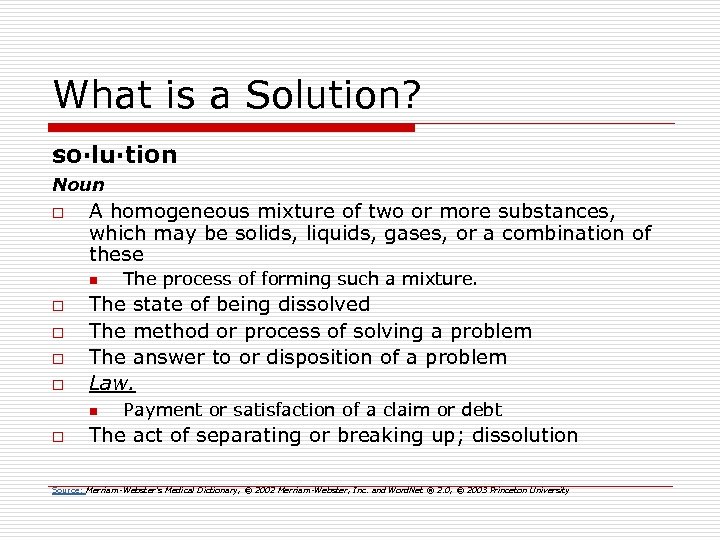 What is a Solution? so·lu·tion Noun o A homogeneous mixture of two or more substances, which may be solids, liquids, gases, or a combination of these n o o The state of being dissolved The method or process of solving a problem The answer to or disposition of a problem Law. n o The process of forming such a mixture. Payment or satisfaction of a claim or debt The act of separating or breaking up; dissolution Source: Merriam-Webster's Medical Dictionary, © 2002 Merriam-Webster, Inc. and Word. Net ® 2. 0, © 2003 Princeton University
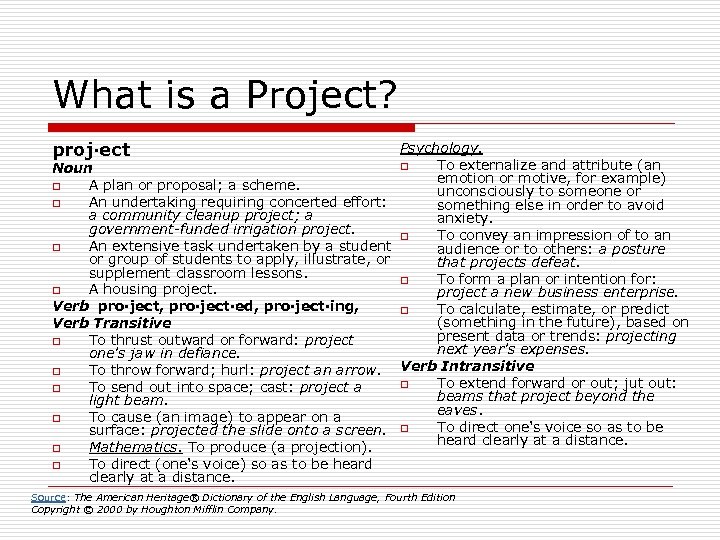 What is a Project? proj·ect Psychology. o To externalize and attribute (an Noun emotion or motive, for example) o A plan or proposal; a scheme. unconsciously to someone or o An undertaking requiring concerted effort: something else in order to avoid a community cleanup project; a anxiety. government-funded irrigation project. o To convey an impression of to an o An extensive task undertaken by a student audience or to others: a posture or group of students to apply, illustrate, or that projects defeat. supplement classroom lessons. o To form a plan or intention for: o A housing project a new business enterprise. Verb pro·ject, pro·ject·ed, pro·ject·ing, o To calculate, estimate, or predict (something in the future), based on Verb Transitive present data or trends: projecting o To thrust outward or forward: project next year's expenses. one's jaw in defiance. o To throw forward; hurl: project an arrow. Verb Intransitive o To extend forward or out; jut out: o To send out into space; cast: project a beams that project beyond the light beam. eaves. o To cause (an image) to appear on a To direct one's voice so as to be surface: projected the slide onto a screen. o heard clearly at a distance. o Mathematics. To produce (a projection). o To direct (one's voice) so as to be heard clearly at a distance. Source: The American Heritage® Dictionary of the English Language, Fourth Edition Copyright © 2000 by Houghton Mifflin Company.
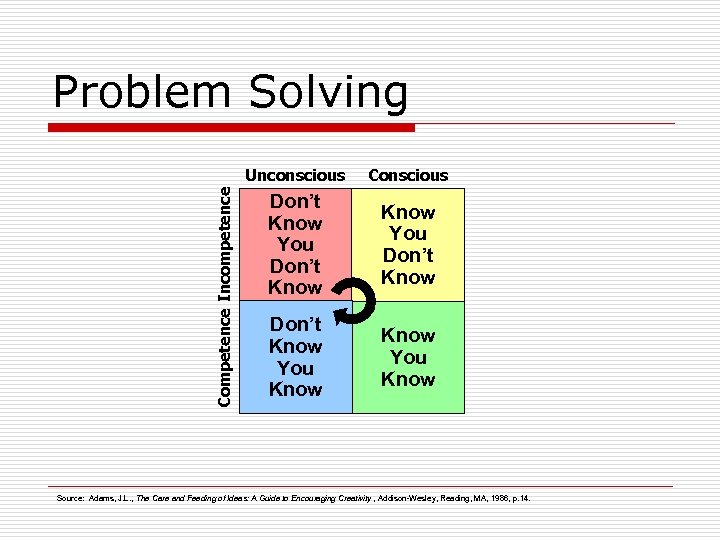 Problem Solving Competence Incompetence Unconscious Conscious Don’t Know You Don’t Know You Know Source: Adams, J. L. , The Care and Feeding of Ideas: A Guide to Encouraging Creativity , Addison-Wesley, Reading, MA, 1986, p. 14.
 What is the Problem?
 The Pencil o Before the Pencil n o Ancient Rome – scribes wrote on papyrus with stylus, leaving a light readable mark The Birth of the Pencil n Borrowdale, England 1564 – discovery of graphite o o n Graphite left a darker mark than lead, but was so soft and brittle that it required a holder First, sticks of graphite were wrapped in string, then wooden sticks hollowed-out by hand Nuremberg, Germany 1662 – first mass produced pencils
 The Pencil in America o o o 1729 – Benjamin Franklin advertised pencils for sale in his Pennsylvania Gazette 1762 – George Washington used a three-inch pencil when he surveyed the Ohio Territory 1812 – William Monroe, a cabinetmaker in Concord, Massachusetts, made the first American wood pencils 1850 s – Early American pencils were made from Eastern Red Cedar, a strong, splinter-resistant wood that grew in Tennessee and other parts of the southeastern United States 1890 s – Many manufacturers were painting their pencils to show off their high quality wood casings and giving them brand names By the 1900 s, new sources of wood – California's Sierra Nevada mountains – Incense-cedar, a species that grew in abundance and made superior pencils – the wood of choice Why are pencils yellow?
 Pencil are Yellow because… o o o In the 1880 s… n China supplied the best graphite n American pencil manufacturers wanted a special way to tell people that their pencils contained Chinese graphite. In China, the color yellow is associated with royalty and respect American pencil companies painted their pencils yellow starting in the 1890 s to show off holders of the graphic sticks so people would buy them It was important to “market” and communicate this "regal" feeling and association with China As of 2006 – 75% of the pencils sold in the United States are painted yellow!
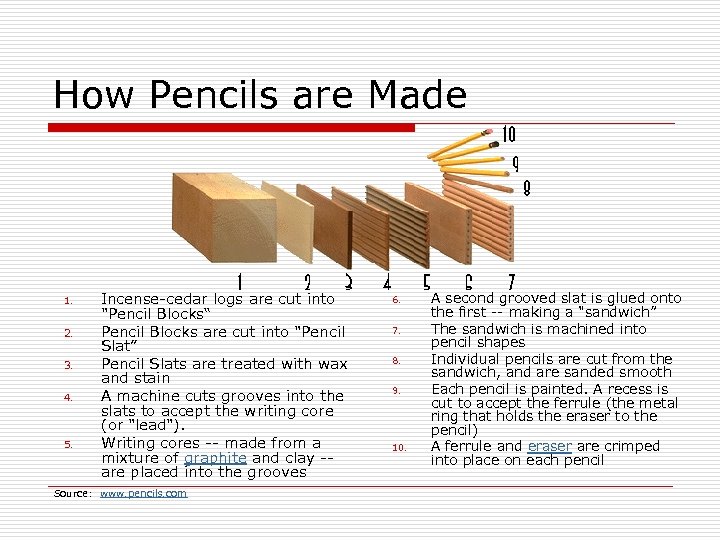 How Pencils are Made 1. 2. 3. 4. 5. Incense-cedar logs are cut into "Pencil Blocks“ Pencil Blocks are cut into "Pencil Slat” Pencil Slats are treated with wax and stain A machine cuts grooves into the slats to accept the writing core (or "lead"). Writing cores -- made from a mixture of graphite and clay -- are placed into the grooves Source: www. pencils. com 6. 7. 8. 9. 10. A second grooved slat is glued onto the first -- making a "sandwich” The sandwich is machined into pencil shapes Individual pencils are cut from the sandwich, and are sanded smooth Each pencil is painted. A recess is cut to accept the ferrule (the metal ring that holds the eraser to the pencil) A ferrule and eraser are crimped into place on each pencil
 What About the Eraser? o o o o A lot of erasers are made by pencils manufacturers! The first patent for attaching an eraser to a pencil was issued in 1858 to a man from Philadelphia named Hyman Lipman And even today in Europe, most pencils are sold without erasers Erasers weren't always called erasers! Originally, made from a tree resin Referred to as a "rubber, " for rubbing out mistakes (still referred this way in Great Britain) To eraser manufacturers – they’re called "plugs" Today other materials are used: n n “Pink" erasers made from synthetic rubber blended with pumice (a grit that enhances its ability to erase “White” eraser made from Vinyl, a durable, flexible plastic Source: www. pencils. com
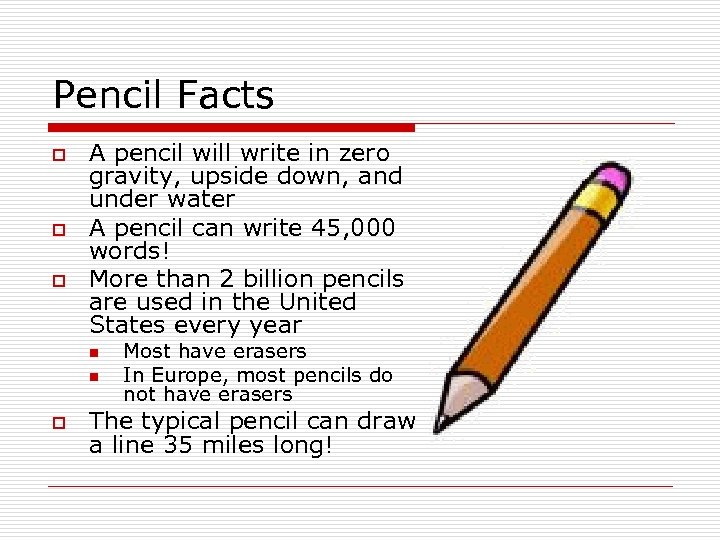 Pencil Facts o o o A pencil will write in zero gravity, upside down, and under water A pencil can write 45, 000 words! More than 2 billion pencils are used in the United States every year n n o Most have erasers In Europe, most pencils do not have erasers The typical pencil can draw a line 35 miles long!
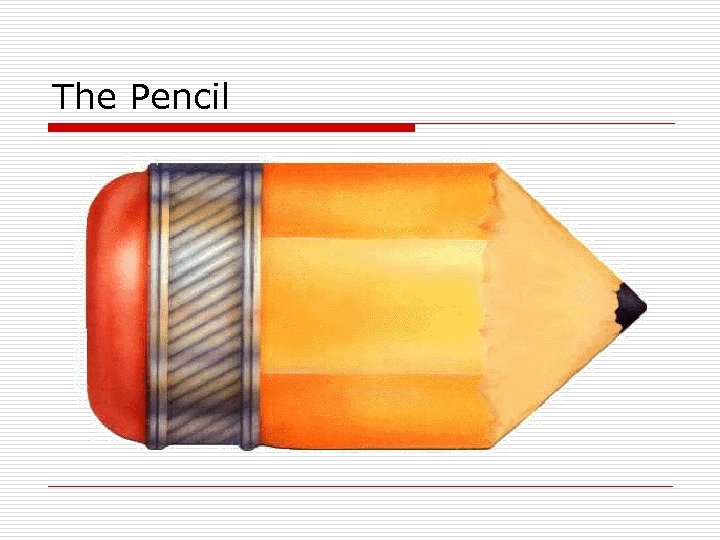 The Pencil
 References on the Pencil o o The Pencil: A History of Design and Circumstance by Henry Petroski The Colored Pencil by Bet. Borgeson Spotlight on Timber by Andrew Langley Tree Products by Irving and Ruth Adler The Wood Users Guide by Pamela Wellner and Eugene Dickey
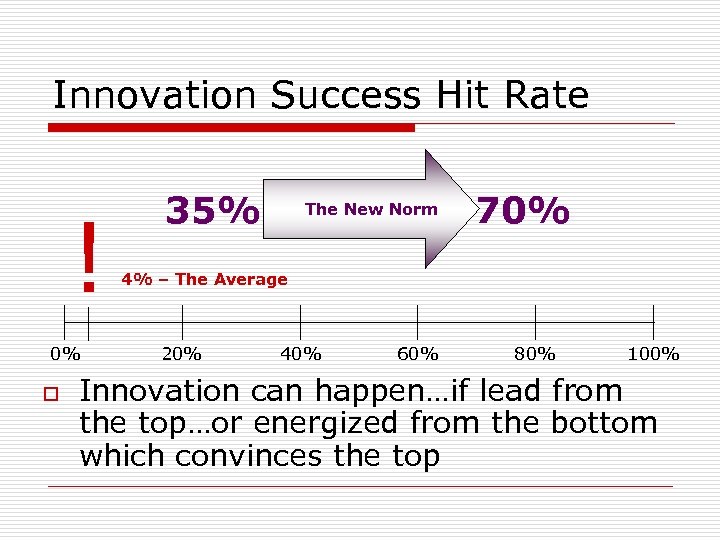 Innovation Success Hit Rate ! 0% o 35% The New Norm 70% 4% – The Average 20% 40% 60% 80% 100% Innovation can happen…if lead from the top…or energized from the bottom which convinces the top
 The Critical Metric o Success – that is it hits – if the return from the innovation exceeds the cost of the capital that it took to launch it
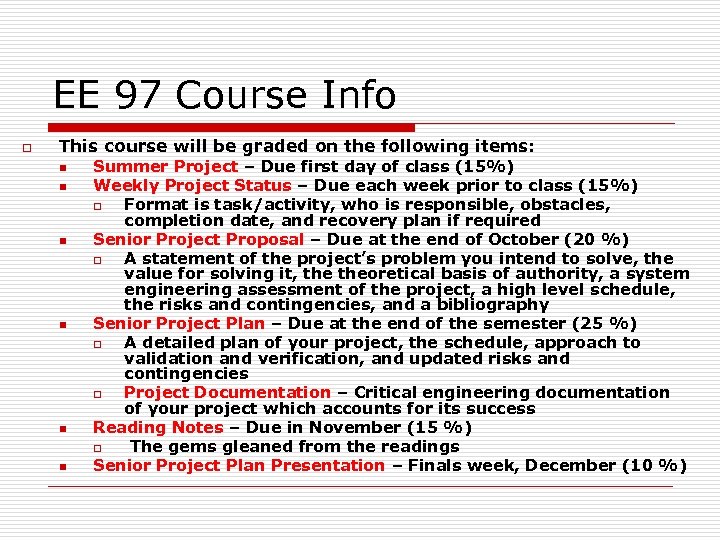 EE 97 Course Info o This course will be graded on the following items: n n n Summer Project – Due first day of class (15%) Weekly Project Status – Due each week prior to class (15%) o Format is task/activity, who is responsible, obstacles, completion date, and recovery plan if required Senior Project Proposal – Due at the end of October (20 %) o A statement of the project’s problem you intend to solve, the value for solving it, theoretical basis of authority, a system engineering assessment of the project, a high level schedule, the risks and contingencies, and a bibliography Senior Project Plan – Due at the end of the semester (25 %) o A detailed plan of your project, the schedule, approach to validation and verification, and updated risks and contingencies o Project Documentation – Critical engineering documentation of your project which accounts for its success Reading Notes – Due in November (15 %) o The gems gleaned from the readings Senior Project Plan Presentation – Finals week, December (10 %)
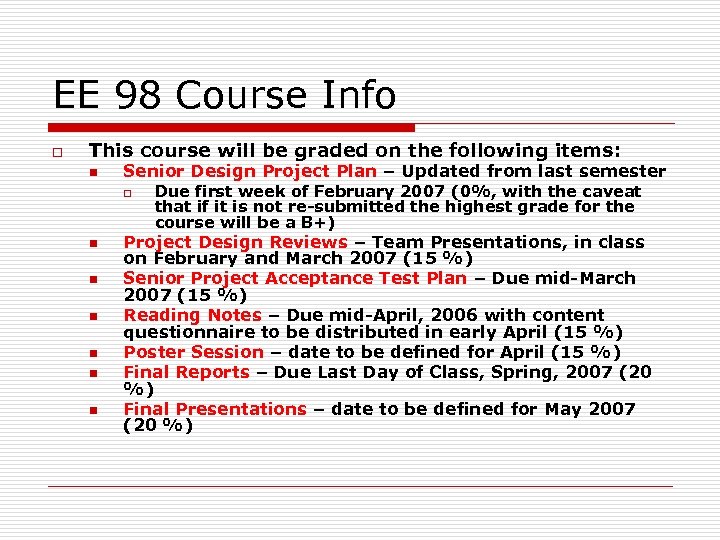 EE 98 Course Info o This course will be graded on the following items: n Senior Design Project Plan – Updated from last semester o n n n Due first week of February 2007 (0%, with the caveat that if it is not re-submitted the highest grade for the course will be a B+) Project Design Reviews – Team Presentations, in class on February and March 2007 (15 %) Senior Project Acceptance Test Plan – Due mid-March 2007 (15 %) Reading Notes – Due mid-April, 2006 with content questionnaire to be distributed in early April (15 %) Poster Session – date to be defined for April (15 %) Final Reports – Due Last Day of Class, Spring, 2007 (20 %) Final Presentations – date to be defined for May 2007 (20 %)
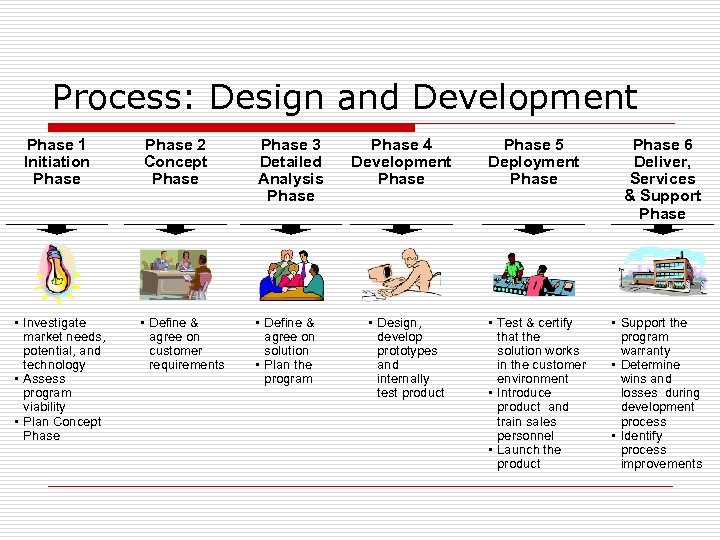 Process: Design and Development Phase 1 Initiation Phase • Investigate market needs, potential, and technology • Assess program viability • Plan Concept Phase 2 Concept Phase 3 Detailed Analysis Phase • Define & agree on customer requirements • Define & agree on solution • Plan the program Phase 4 Development Phase • Design, develop prototypes and internally test product Phase 5 Deployment Phase • Test & certify that the solution works in the customer environment • Introduce product and train sales personnel • Launch the product Phase 6 Deliver, Services & Support Phase • Support the program warranty • Determine wins and losses during development process • Identify process improvements
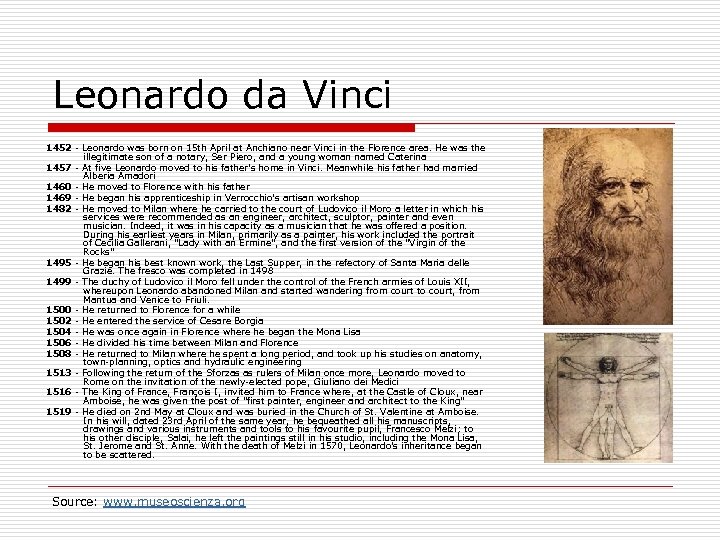 Leonardo da Vinci 1452 - Leonardo was born on 15 th April at Anchiano near Vinci in the Florence area. He was the illegitimate son of a notary, Ser Piero, and a young woman named Caterina 1457 - At five Leonardo moved to his father's home in Vinci. Meanwhile his father had married Alberia Amadori 1460 - He moved to Florence with his father 1469 - He began his apprenticeship in Verrocchio's artisan workshop 1482 - He moved to Milan where he carried to the court of Ludovico il Moro a letter in which his services were recommended as an engineer, architect, sculptor, painter and even musician. Indeed, it was in his capacity as a musician that he was offered a position. During his earliest years in Milan, primarily as a painter, his work included the portrait of Cecilia Gallerani, "Lady with an Ermine", and the first version of the "Virgin of the Rocks" 1495 - He began his best known work, the Last Supper, in the refectory of Santa Maria delle Grazie. The fresco was completed in 1498 1499 - The duchy of Ludovico il Moro fell under the control of the French armies of Louis XII, whereupon Leonardo abandoned Milan and started wandering from court to court, from Mantua and Venice to Friuli. 1500 - He returned to Florence for a while 1502 - He entered the service of Cesare Borgia 1504 - He was once again in Florence where he began the Mona Lisa 1506 - He divided his time between Milan and Florence 1508 - He returned to Milan where he spent a long period, and took up his studies on anatomy, town-planning, optics and hydraulic engineering 1513 - Following the return of the Sforzas as rulers of Milan once more, Leonardo moved to Rome on the invitation of the newly-elected pope, Giuliano dei Medici 1516 - The King of France, François I, invited him to France where, at the Castle of Cloux, near Amboise, he was given the post of "first painter, engineer and architect to the King" 1519 - He died on 2 nd May at Cloux and was buried in the Church of St. Valentine at Amboise. In his will, dated 23 rd April of the same year, he bequeathed all his manuscripts, drawings and various instruments and tools to his favourite pupil, Francesco Melzi; to his other disciple, Salai, he left the paintings still in his studio, including the Mona Lisa, St. Jerome and St. Anne. With the death of Melzi in 1570, Leonardo's inheritance began to be scattered. Source: www. museoscienza. org
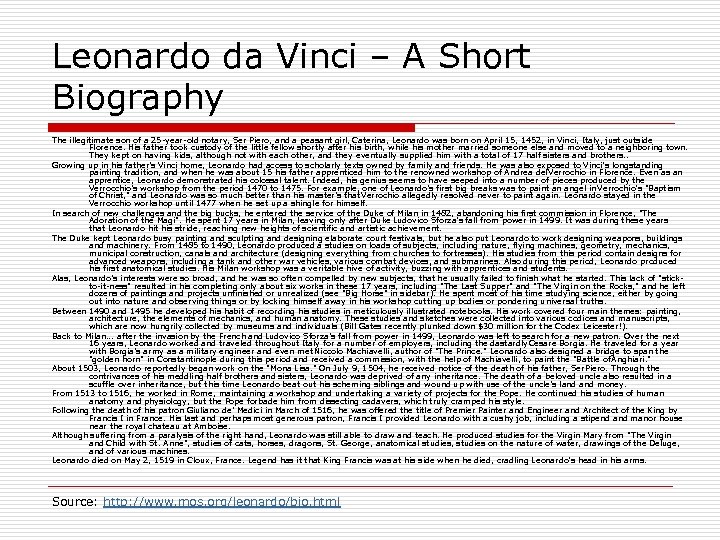 Leonardo da Vinci – A Short Biography The illegitimate son of a 25 -year-old notary, Ser Piero, and a peasant girl, Caterina, Leonardo was born on April 15, 1452, in Vinci, Italy, just outside Florence. His father took custody of the little fellow shortly after his birth, while his mother married someone else and moved to a neighboring town. They kept on having kids, although not with each other, and they eventually supplied him with a total of 17 half sisters and brothers. . Growing up in his father's Vinci home, Leonardo had access to scholarly texts owned by family and friends. He was also exposed to Vinci's longstanding painting tradition, and when he was about 15 his father apprenticed him to the renowned workshop of Andrea del errochio in Florence. Even as an V apprentice, Leonardo demonstrated his colossal talent. Indeed, his genius seems to have seeped into a number of pieces produced by the Verrocchio's workshop from the period 1470 to 1475. For example, one of Leonardo's first big breaks was to paint an angel in Verrochio's "Baptism of Christ, " and Leonardo was so much better than his master's that Verrochio allegedly resolved never to paint again. Leonardo stayed in the Verrocchio workshop until 1477 when he set up a shingle for himself. In search of new challenges and the big bucks, he entered the service of the Duke of Milan in 1482, abandoning his first commission in Florence, "The Adoration of the Magi". He spent 17 years in Milan, leaving only after Duke Ludovico Sforza's fall from power in 1499. It was during these years that Leonardo hit his stride, reaching new heights of scientific and artistic achievement. The Duke kept Leonardo busy painting and sculpting and designing elaborate court festivals, but he also put Leonardo to work designing weapons, buildings and machinery. From 1485 to 1490, Leonardo produced a studies on loads of subjects, including nature, flying machines, geometry, mechanics, municipal construction, canals and architecture (designing everything from churches to fortresses). His studies from this period contain designs for advanced weapons, including a tank and other war vehicles, various combat devices, and submarines. Also during this period, Leonardo produced his first anatomical studies. His Milan workshop was a veritable hive of activity, buzzing with apprentices and students. Alas, Leonardo's interests were so broad, and he was so often compelled by new subjects, that he usually failed to finish what he started. This lack of "stickto-it-ness" resulted in his completing only about six works in these 17 years, including "The Last Supper" and "The Virgin on the Rocks, " and he left dozens of paintings and projects unfinished or unrealized (see "Big Horse" in sidebar). He spent most of his time studying science, either by going out into nature and observing things or by locking himself away in his workshop cutting up bodies or pondering universal truths. Between 1490 and 1495 he developed his habit of recording his studies in meticulously illustrated notebooks. His work covered four main themes: painting, architecture, the elements of mechanics, and human anatomy. These studies and sketches were collected into various codices and manuscripts, which are now hungrily collected by museums and individuals (Bill Gates recently plunked down $30 million for the Codex Leicester!). Back to Milan. . . after the invasion by the French and Ludovico Sforza's fall from power in 1499, Leonardo was left to search for a new patron. Over the next 16 years, Leonardo worked and traveled throughout Italy for a number of employers, including the dastardly Cesare Borgia. He traveled for a year with Borgia's army as a military engineer and even met Niccolo Machiavelli, author of "The Prince. " Leonardo also designed a bridge to span the "golden horn" in Constantinople during this period and received a commission, with the help of Machiavelli, to paint the "Battle of nghiari. " A About 1503, Leonardo reportedly began work on the "Mona Lisa. " On July 9, 1504, he received notice of the death of his father, Ser iero. Through the P contrivances of his meddling half brothers and sisters, Leonardo was deprived of any inheritance. The death of a beloved uncle also resulted in a scuffle over inheritance, but this time Leonardo beat out his scheming siblings and wound up with use of the uncle's land money. From 1513 to 1516, he worked in Rome, maintaining a workshop and undertaking a variety of projects for the Pope. He continued his studies of human anatomy and physiology, but the Pope forbade him from dissecting cadavers, which truly cramped his style. Following the death of his patron Giuliano de' Medici in March of 1516, he was offered the title of Premier Painter and Engineer and Architect of the King by Francis I in France. His last and perhaps most generous patron, Francis I provided Leonardo with a cushy job, including a stipend and manor house near the royal chateau at Amboise. Although suffering from a paralysis of the right hand, Leonardo was still able to draw and teach. He produced studies for the Virgin Mary from "The Virgin and Child with St. Anne", studies of cats, horses, dragons, St. George, anatomical studies, studies on the nature of water, drawings of the Deluge, and of various machines. Leonardo died on May 2, 1519 in Cloux, France. Legend has it that King Francis was at his side when he died, cradling Leonardo's head in his arms. Source: http: //www. mos. org/leonardo/bio. html
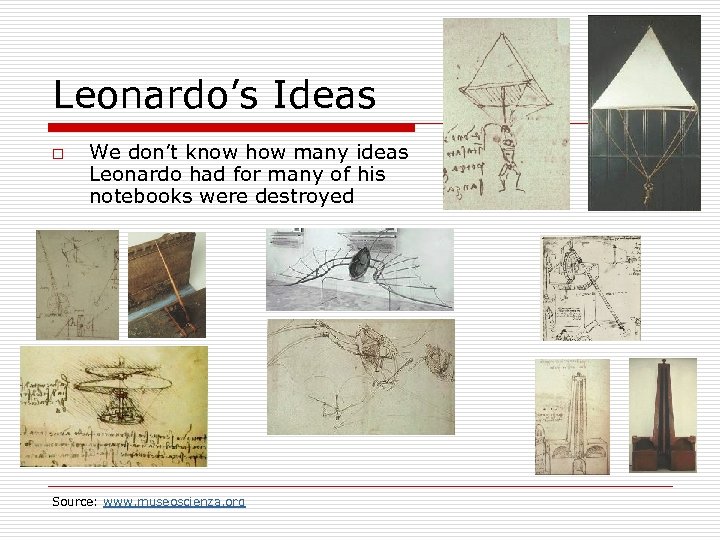 Leonardo’s Ideas o We don’t know how many ideas Leonardo had for many of his notebooks were destroyed Source: www. museoscienza. org
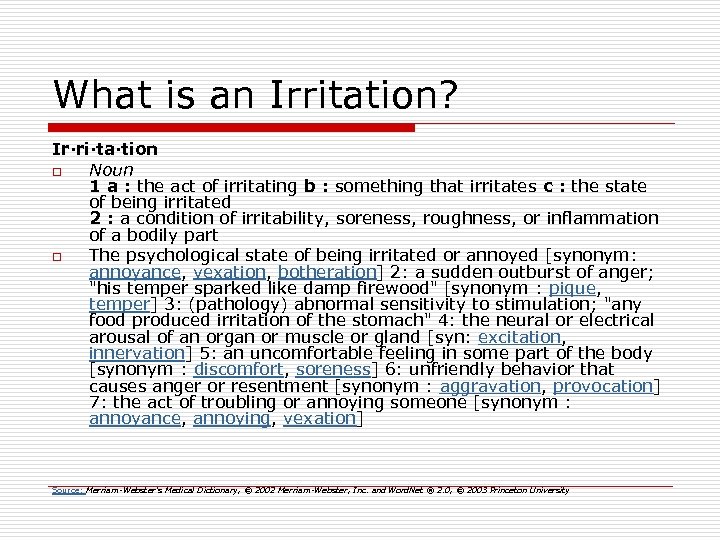
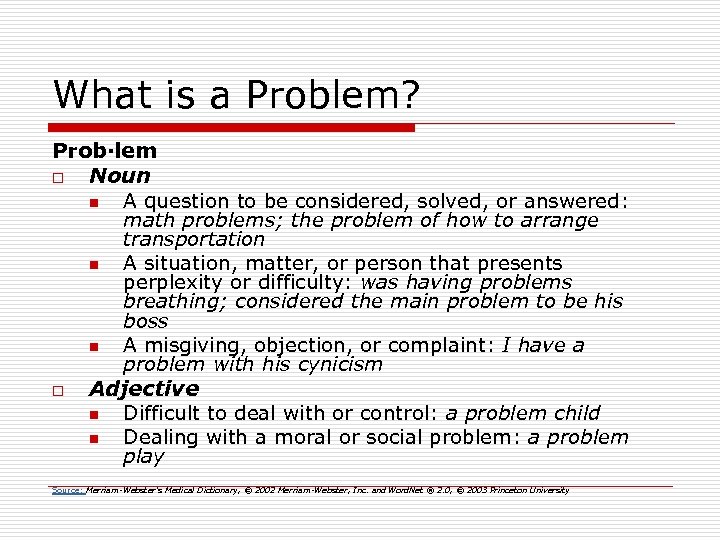
 Your Summer Project o o o Buy a bound notebook – where the pages are stitched into the binding Observe irritations and record them in your notebook State exactly what the problem is that is producing the irritation Propose a “design” or solution to the irritation Identify any risks which may prevent you from accomplishing the “design” or solution Record at least 20 observations with corresponding statements for the irritations, problems, and solutions n o o o Solutions or “designs” may include written descriptions, drawings and illustrations, or other items to convey the information Submit you notebooks on the first day of class in September Sign and date each entry Have someone you are not related to, sign and date the entry if you think it is novel, innovative, and may be a candidate for a patent
 Rule #2 IF YOU DO NOT DO THE WORK… YOU ARE LETTING SOMEONE ELSE BE MORE COMPETITIVE… AND LETTING THEM EAT YOUR LUNCH BEFORE YOU CAN EAT THEIRS!
 Rule #3 YOU CAN WHINE AND COMPLAIN… OR YOU CAN TAKE THE INITIATIVE TO CHANGE IT TO THE WAY YOU WANT IT… WHAT ARE YOU GOING TO DO?
 Rule #4 MAKE A DIFFERENCE “A LIFE IS NOT IMPORTANT EXCEPT FOR THE IMPACT IT MAKES ON OTHER LIVES” – JACKIE ROBINSON (THE FIRST AFRO-AMERICAN TO PLAY MAJOR LEAGUE BASEBALL)
 Rule #5 IT IS A SUPREME MISFORTUNE WHEN THEORY OUTSTRIPS PERFORMANCE (COURTESY LEONARDO DA VINCI) YOU DRIVE YOUR SUCCESS AND YOUR ACCOMPLISJMENTS AND WHERE YOU TAKE YOUR LIFE
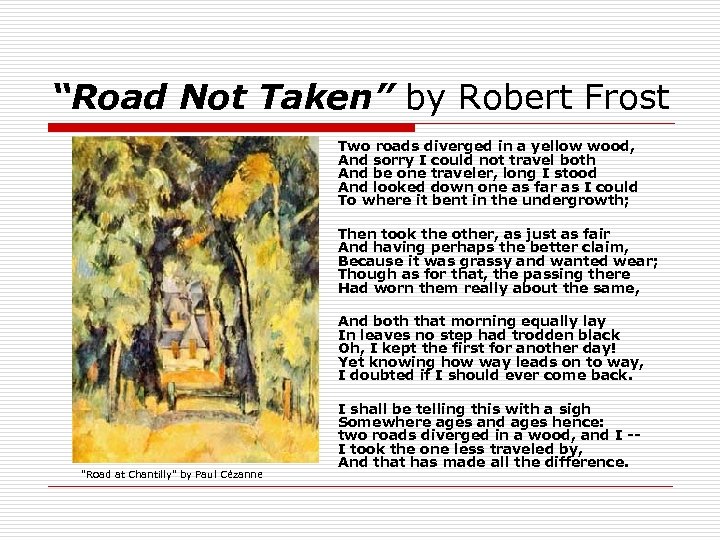 “Road Not Taken” by Robert Frost Two roads diverged in a yellow wood, And sorry I could not travel both And be one traveler, long I stood And looked down one as far as I could To where it bent in the undergrowth; Then took the other, as just as fair And having perhaps the better claim, Because it was grassy and wanted wear; Though as for that, the passing there Had worn them really about the same, And both that morning equally lay In leaves no step had trodden black Oh, I kept the first for another day! Yet knowing how way leads on to way, I doubted if I should ever come back. "Road at Chantilly" by Paul Cézanne I shall be telling this with a sigh Somewhere ages and ages hence: two roads diverged in a wood, and I -I took the one less traveled by, And that has made all the difference.
 Have a Really Great Summer! Be Safe! See You in September