


 Скачать презентацию EE 562 ARTIFICIAL INTELLIGENCE FOR ENGINEERS Lecture 5
1f9fc37b006e868f02abaed2d4289f19.ppt
- Количество слайдов: 36
 EE 562 ARTIFICIAL INTELLIGENCE FOR ENGINEERS Lecture 5, 4/18/2005 University of Washington, Department of Electrical Engineering Spring 2005 Instructor: Professor Jeff A. Bilmes 4/18/2005 EE 562 1
 Material • We will spend a bit more time on CSP since it is an important problem, starting with chapter 5. • Read all of chapter 5 • Read Fahiem Bacchus “Constraints” Tutorial on the web (dated Oct 25 th, 2001). • Reminder: Homework: Due Wed, April 20 th. – Do: Problems 3. 4, 3. 7 3. 10, 4. 7, and 4. 16. • for 4. 16, do both 8 -puzzle & 8 -queens, and also implement the two simple heuristics h 1 and h 2 given in the book. Compare all of them. • Also for 4. 16, devise your own novel heuristics for A* for the 8 -puzzle & 8 -queens problem. 4/18/2005 EE 562 2
 Outline For Today • • Chapter 5, Sections 1 -3. Constraint Satisfaction Problems (CSP) Backtracking search for CSPs Local search for CSPs 4/18/2005 EE 562 3
 Thought Question • Let us assume that there are five houses of different colors next to each other on the same road. In each house lives a man of a different nationality. Every man has his favorite drink, his favorite brand of cigarettes, and keeps pets of a particular kind. – – – – The Englishman lives in the red house. The Swede keeps dogs. The Dane drinks tea. The green house is just to the left of the white one. The owner of the green house drinks coffee. The Pall Mall smoker keeps birds. The owner of the yellow house smokes Dunhills. The man in the center house drinks milk. The Norwegian lives in the first house. The Blend smoker has a neighbor who keeps cats. The man who smokes Blue Masters drinks bier. The man who keeps horses lives next to the Dunhill smoker. The German smokes Prince. The Norwegian lives next to the blue house. The Blend smoker has a neighbor who drinks water. • Question for you to answer: Who keeps the fish? 4/18/2005 EE 562 4
 Constraint satisfaction problems (CSPs) • Standard search problem: – state is a "black box“ – any data structure that supports successor function, heuristic function, and goal test • CSP: – state is defined by variables Xi with values from domain Di – goal test is a set of constraints specifying allowable combinations of values for subsets of variables • This is a simple example EE 562 formal representation of a language 4/18/2005 5
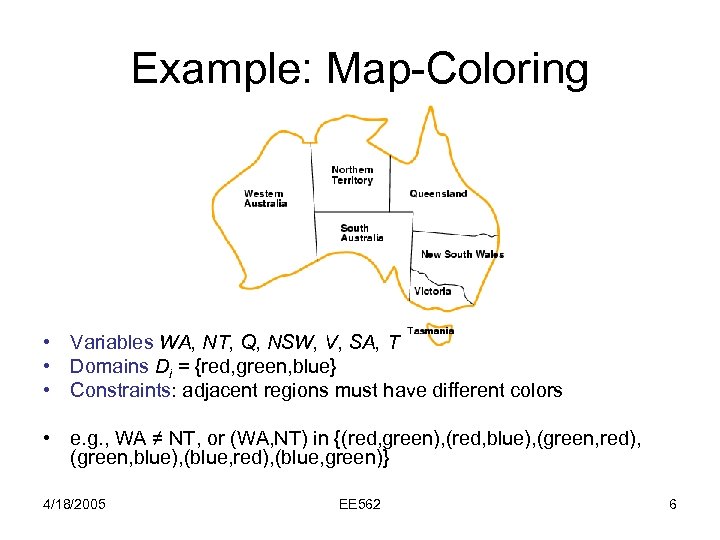 Example: Map-Coloring • Variables WA, NT, Q, NSW, V, SA, T • Domains Di = {red, green, blue} • Constraints: adjacent regions must have different colors • e. g. , WA ≠ NT, or (WA, NT) in {(red, green), (red, blue), (green, red), (green, blue), (blue, red), (blue, green)} 4/18/2005 EE 562 6
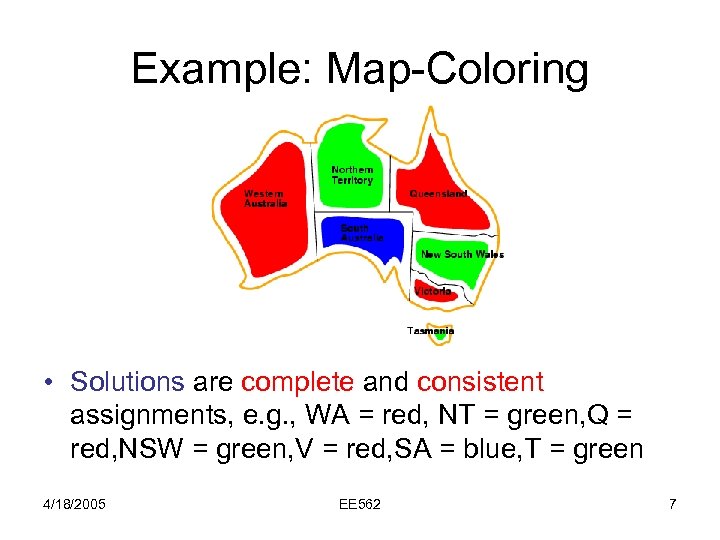 Example: Map-Coloring • Solutions are complete and consistent assignments, e. g. , WA = red, NT = green, Q = red, NSW = green, V = red, SA = blue, T = green 4/18/2005 EE 562 7
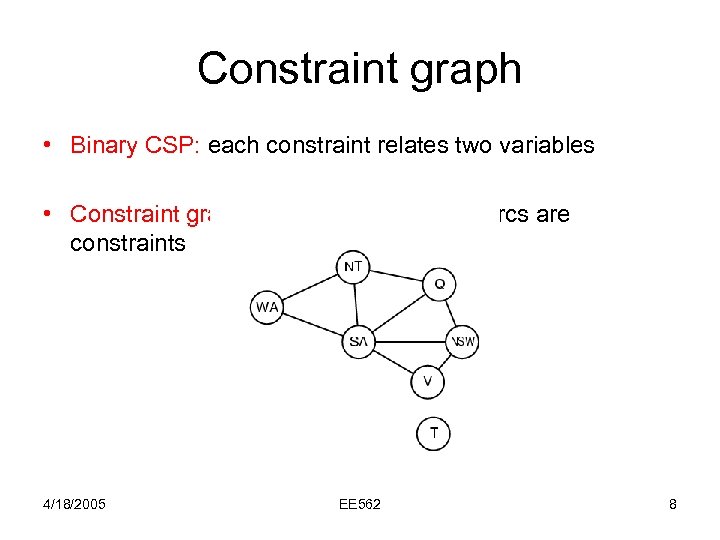 Constraint graph • Binary CSP: each constraint relates two variables • Constraint graph: nodes are variables, arcs are constraints 4/18/2005 EE 562 8
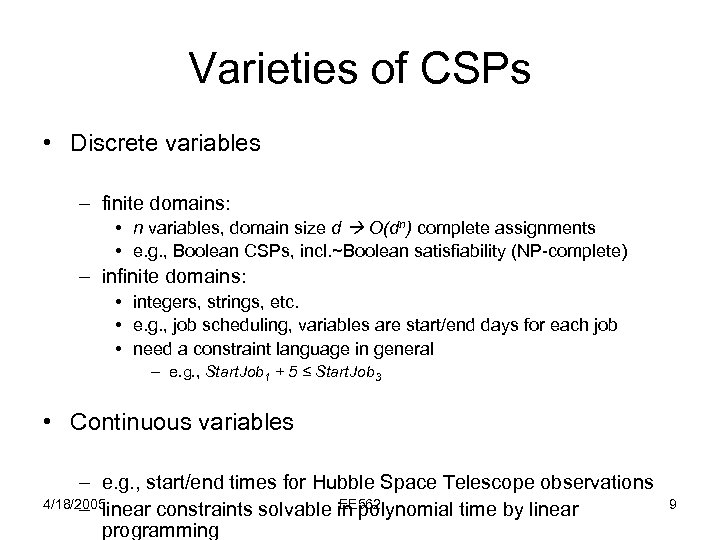 Varieties of CSPs • Discrete variables – finite domains: • n variables, domain size d O(dn) complete assignments • e. g. , Boolean CSPs, incl. ~Boolean satisfiability (NP-complete) – infinite domains: • integers, strings, etc. • e. g. , job scheduling, variables are start/end days for each job • need a constraint language in general – e. g. , Start. Job 1 + 5 ≤ Start. Job 3 • Continuous variables – e. g. , start/end times for Hubble Space Telescope observations 4/18/2005 EE 562 – linear constraints solvable in polynomial time by linear programming 9
 Varieties of constraints • Unary constraints involve a single variable, – e. g. , SA ≠ green • Binary constraints involve pairs of variables, – e. g. , SA ≠ WA • Higher-order constraints involve 3 or more variables, 4/18/2005 EE 562 – e. g. , cryptarithmetic column constraints 10
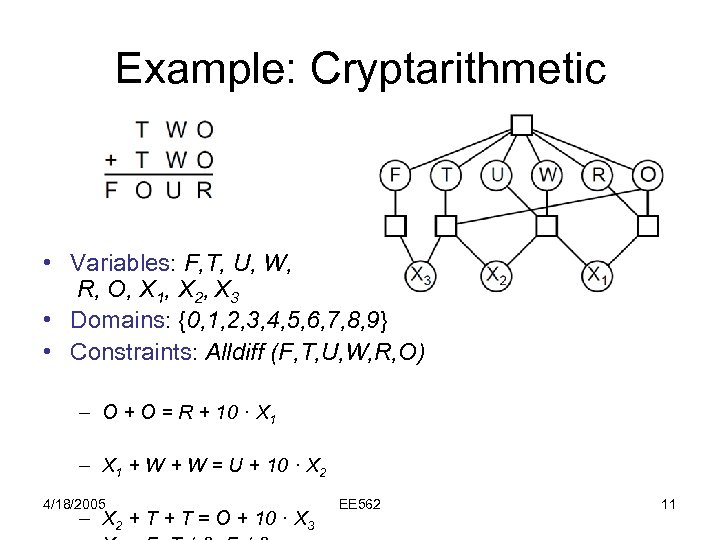 Example: Cryptarithmetic • Variables: F, T, U, W, R, O, X 1, X 2, X 3 • Domains: {0, 1, 2, 3, 4, 5, 6, 7, 8, 9} • Constraints: Alldiff (F, T, U, W, R, O) – O + O = R + 10 · X 1 – X 1 + W = U + 10 · X 2 4/18/2005 – X 2 + T = O + 10 · X 3 EE 562 11
 Real-world CSPs • Assignment problems – e. g. , who teaches what class • Timetabling problems – e. g. , which class is offered when and where? • Hardware configuration • Spreadsheets • Transportation scheduling • Factory scheduling 4/18/2005 EE 562 12
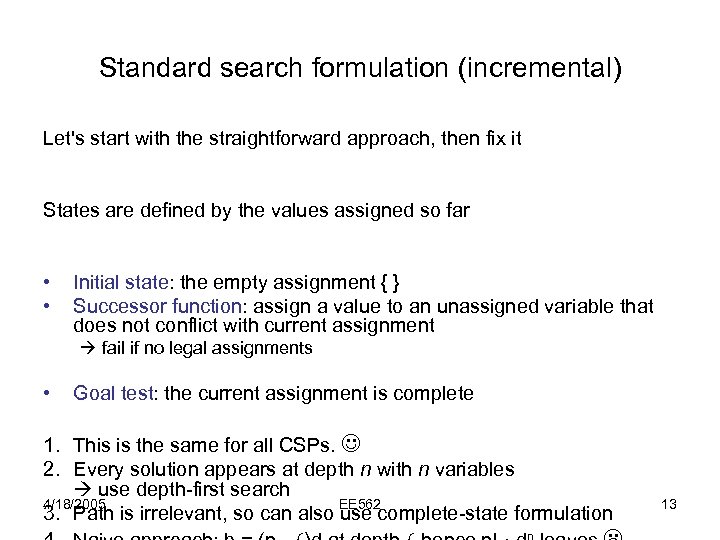 Standard search formulation (incremental) Let's start with the straightforward approach, then fix it States are defined by the values assigned so far • • Initial state: the empty assignment { } Successor function: assign a value to an unassigned variable that does not conflict with current assignment fail if no legal assignments • Goal test: the current assignment is complete 1. This is the same for all CSPs. 2. Every solution appears at depth n with n variables use depth-first search 4/18/2005 EE 562 3. Path is irrelevant, so can also use complete-state formulation 13
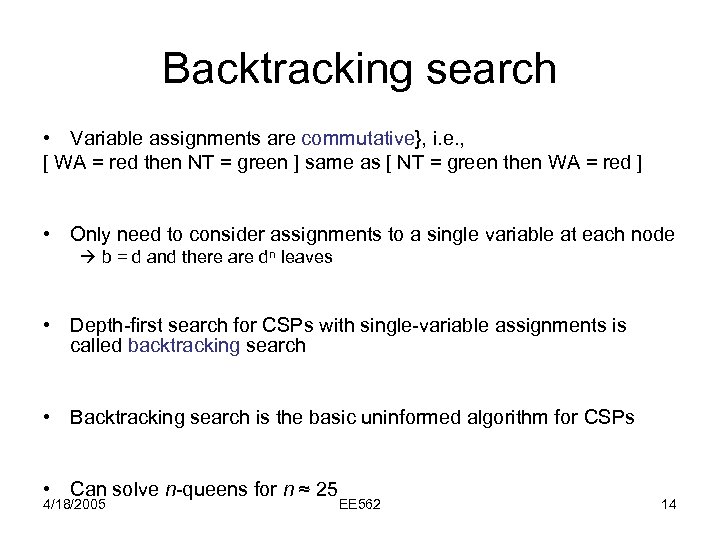 Backtracking search • Variable assignments are commutative}, i. e. , [ WA = red then NT = green ] same as [ NT = green then WA = red ] • Only need to consider assignments to a single variable at each node b = d and there are dn leaves • Depth-first search for CSPs with single-variable assignments is called backtracking search • Backtracking search is the basic uninformed algorithm for CSPs • Can solve n-queens for n ≈ 25 4/18/2005 EE 562 14
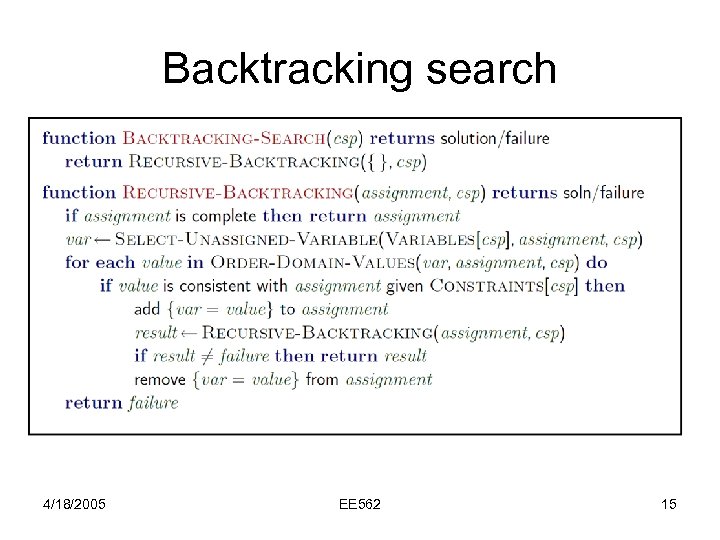 Backtracking search 4/18/2005 EE 562 15
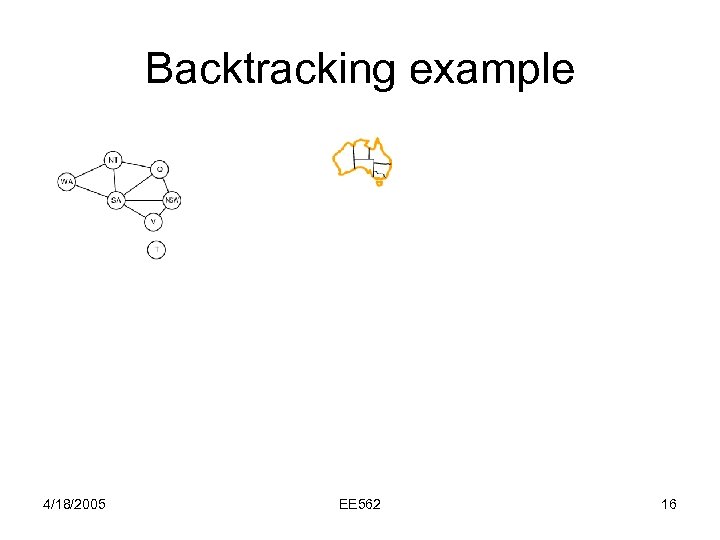 Backtracking example 4/18/2005 EE 562 16
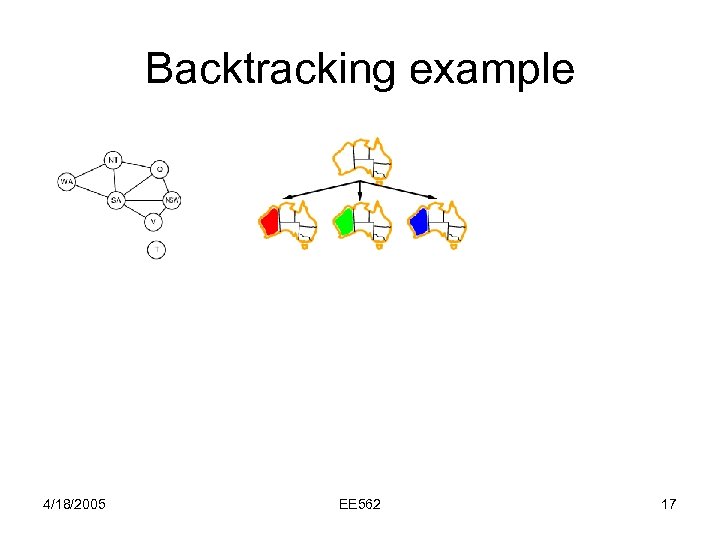 Backtracking example 4/18/2005 EE 562 17
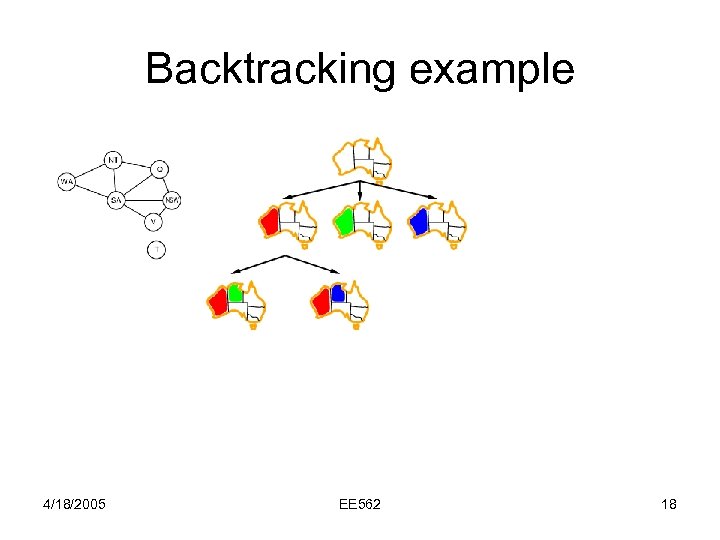 Backtracking example 4/18/2005 EE 562 18
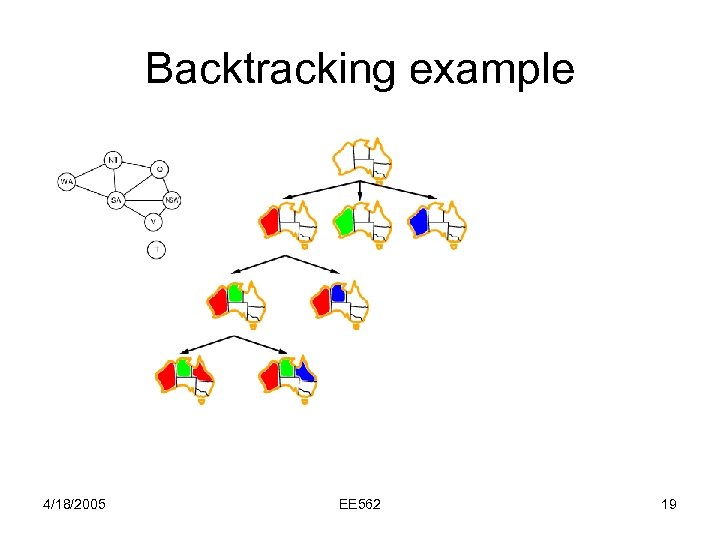 Backtracking example 4/18/2005 EE 562 19
 Improving backtracking efficiency • General-purpose methods can give huge gains in speed: – Which variable should be assigned next? – In what order should its values be tried? – Can we detect inevitable failure early? – Can we take better advantage of the problem 4/18/2005 EE 562 20 structure?
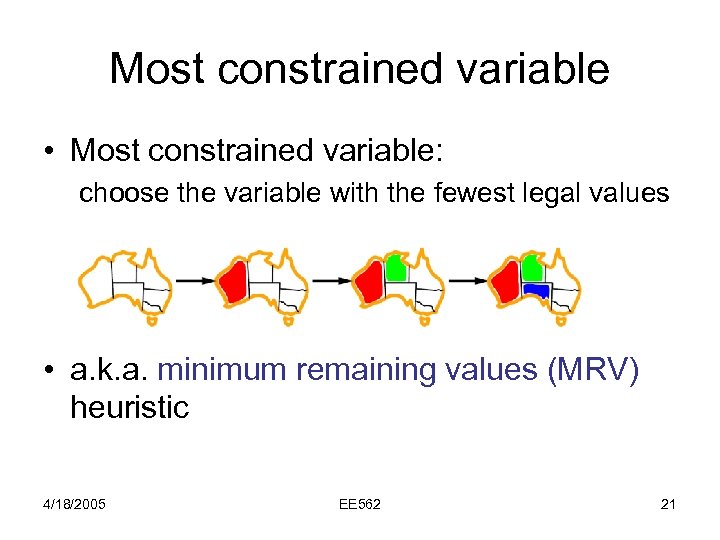 Most constrained variable • Most constrained variable: choose the variable with the fewest legal values • a. k. a. minimum remaining values (MRV) heuristic 4/18/2005 EE 562 21
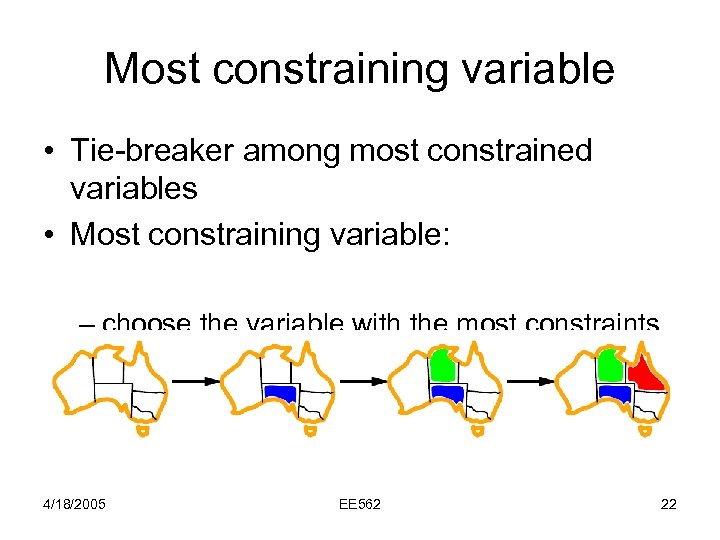 Most constraining variable • Tie-breaker among most constrained variables • Most constraining variable: – choose the variable with the most constraints on remaining variables (degree heuristic) 4/18/2005 EE 562 22
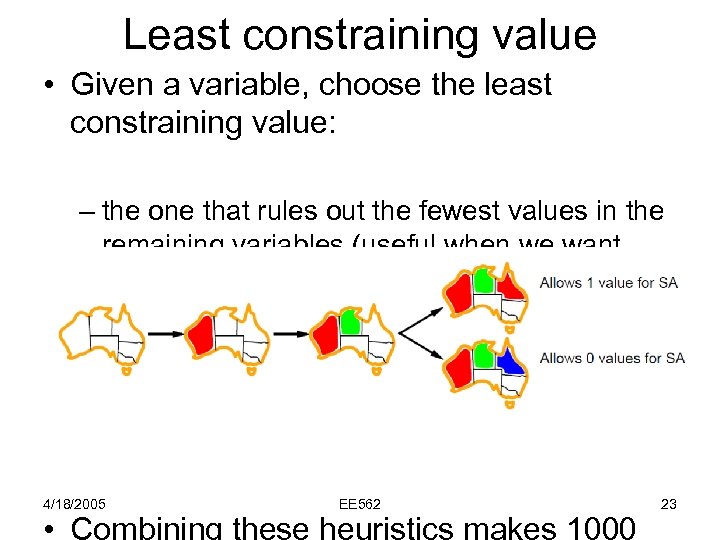 Least constraining value • Given a variable, choose the least constraining value: – the one that rules out the fewest values in the remaining variables (useful when we want only to find one set of sat. values, not all) 4/18/2005 EE 562 23
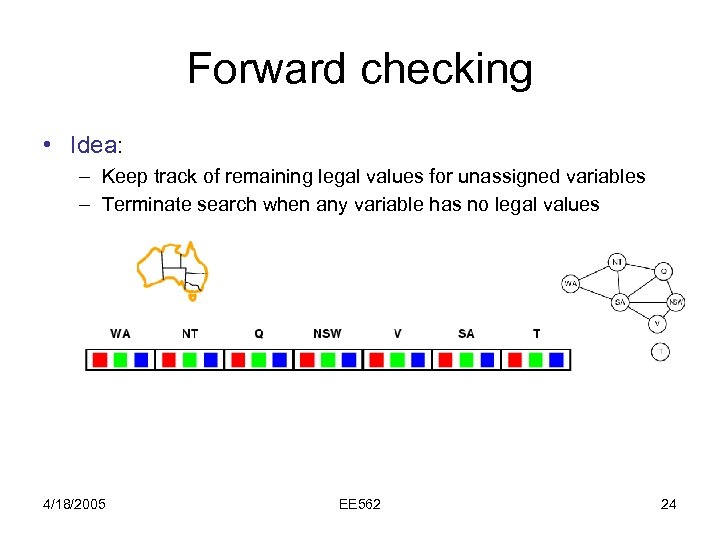 Forward checking • Idea: – Keep track of remaining legal values for unassigned variables – Terminate search when any variable has no legal values 4/18/2005 EE 562 24
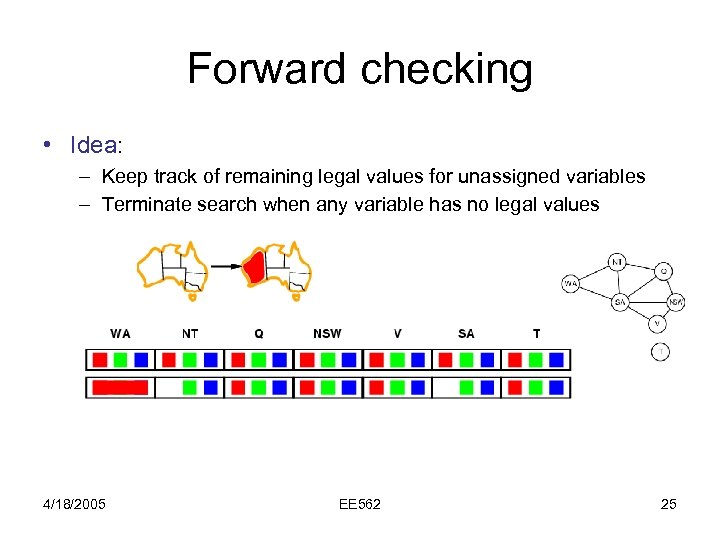 Forward checking • Idea: – Keep track of remaining legal values for unassigned variables – Terminate search when any variable has no legal values 4/18/2005 EE 562 25
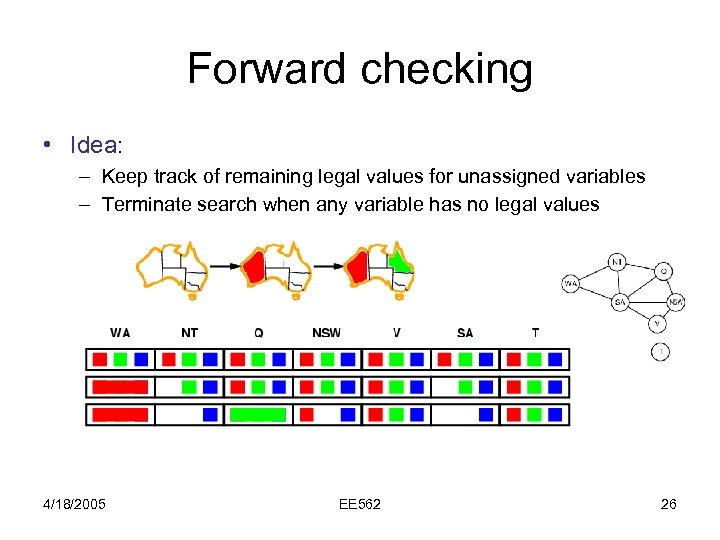 Forward checking • Idea: – Keep track of remaining legal values for unassigned variables – Terminate search when any variable has no legal values 4/18/2005 EE 562 26
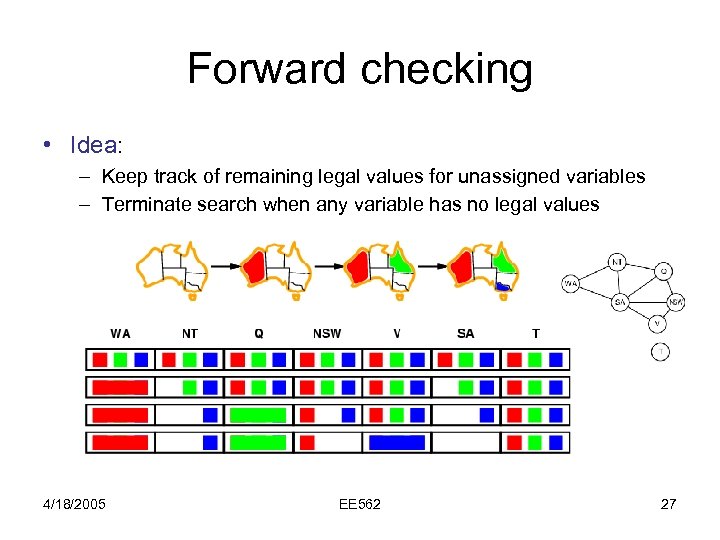 Forward checking • Idea: – Keep track of remaining legal values for unassigned variables – Terminate search when any variable has no legal values 4/18/2005 EE 562 27
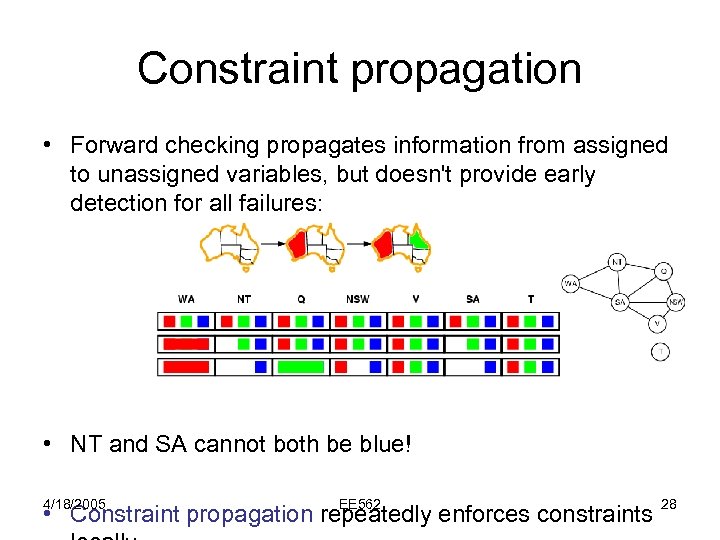 Constraint propagation • Forward checking propagates information from assigned to unassigned variables, but doesn't provide early detection for all failures: • NT and SA cannot both be blue! 4/18/2005 EE 562 • Constraint propagation repeatedly enforces constraints 28
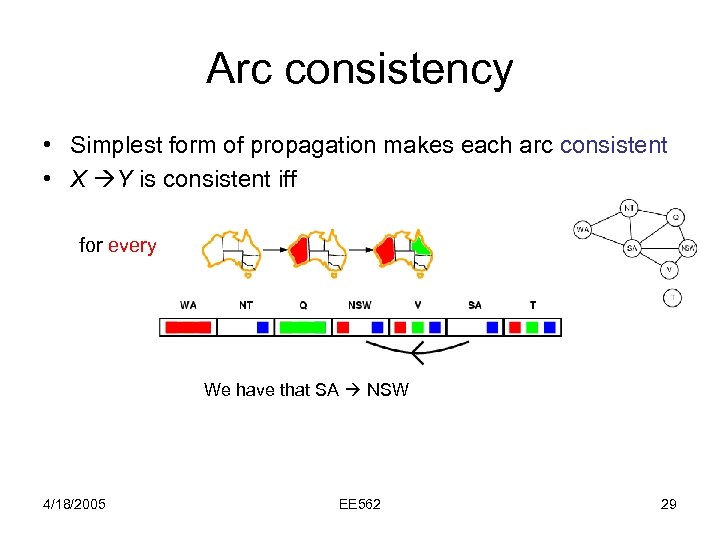 Arc consistency • Simplest form of propagation makes each arc consistent • X Y is consistent iff for every value x of X there is some allowed y We have that SA NSW 4/18/2005 EE 562 29
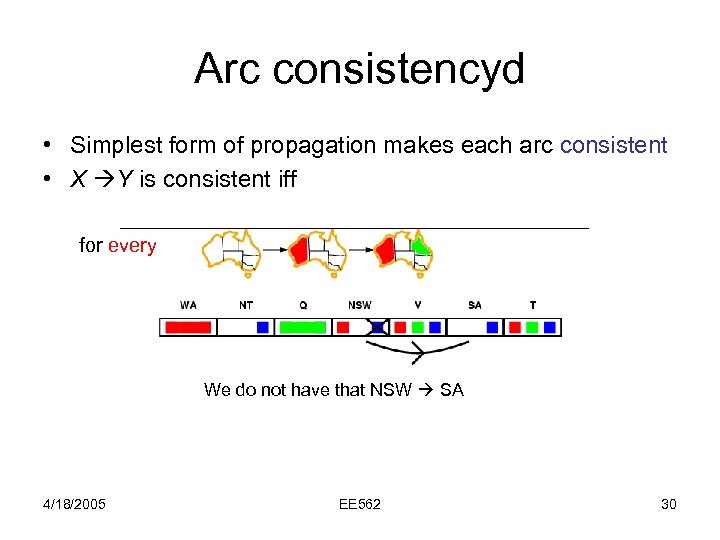 Arc consistencyd • Simplest form of propagation makes each arc consistent • X Y is consistent iff for every value x of X there is some allowed y We do not have that NSW SA 4/18/2005 EE 562 30
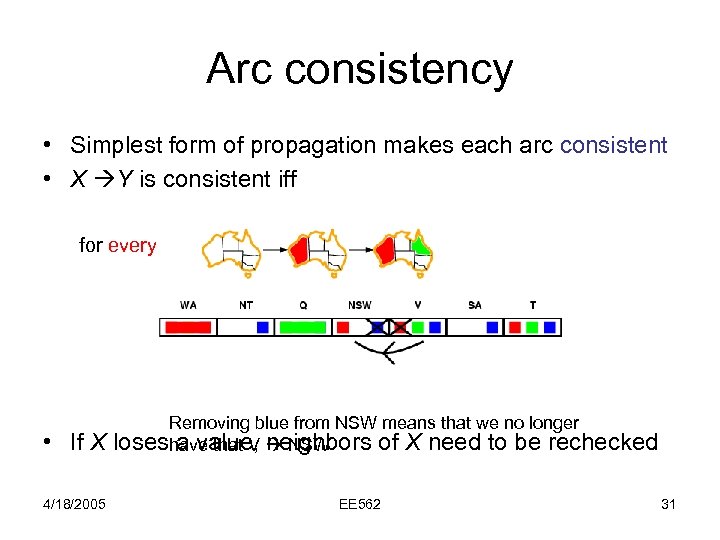 Arc consistency • Simplest form of propagation makes each arc consistent • X Y is consistent iff for every value x of X there is some allowed y • If X 4/18/2005 Removing blue from NSW means that we no longer loseshave that V NSW a value, neighbors of X need to be rechecked EE 562 31
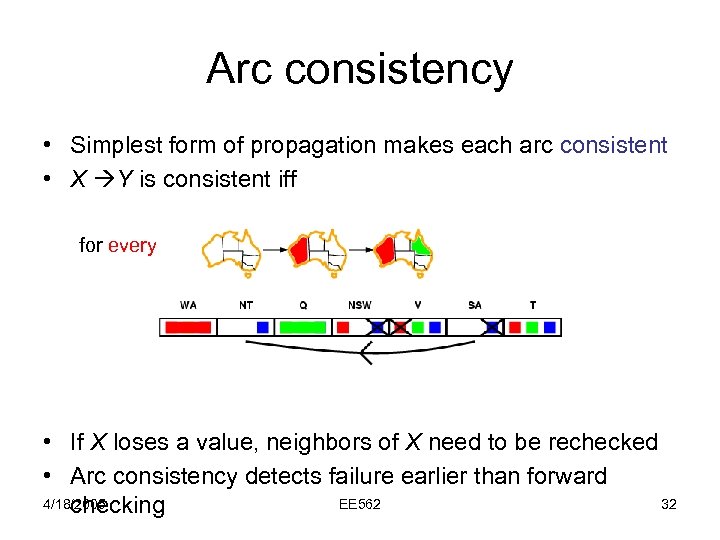 Arc consistency • Simplest form of propagation makes each arc consistent • X Y is consistent iff for every value x of X there is some allowed y • If X loses a value, neighbors of X need to be rechecked • Arc consistency detects failure earlier than forward 4/18/2005 EE 562 32 checking
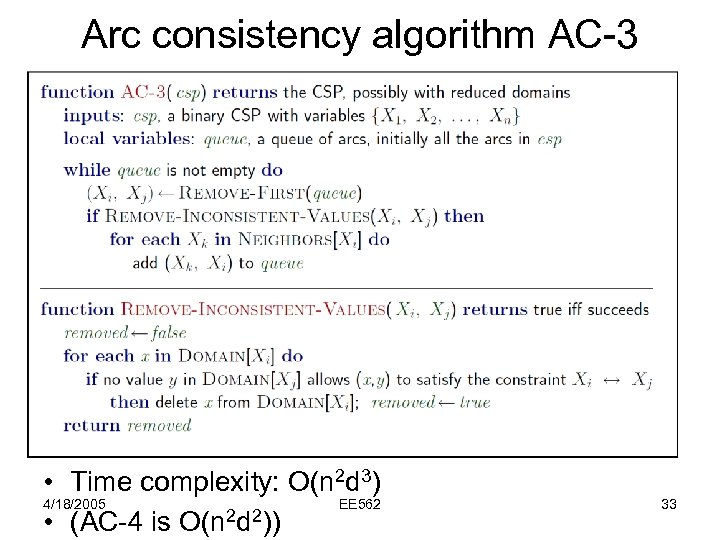 Arc consistency algorithm AC-3 • Time complexity: O(n 2 d 3) 4/18/2005 EE 562 2 d 2)) • (AC-4 is O(n 33
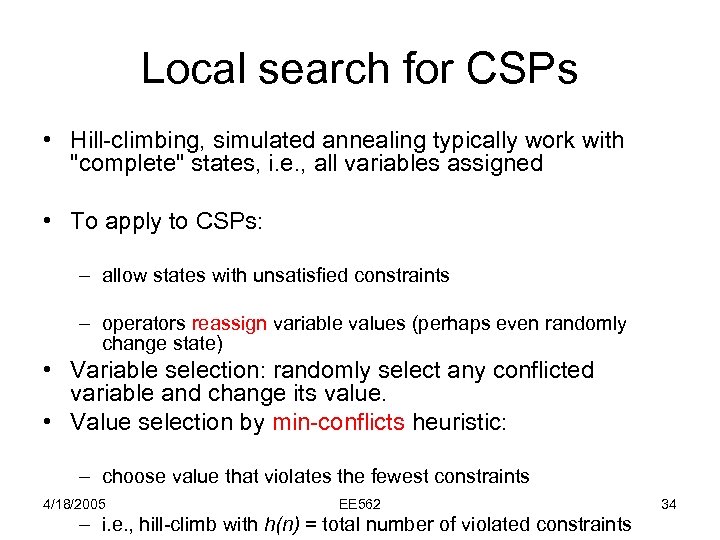 Local search for CSPs • Hill-climbing, simulated annealing typically work with "complete" states, i. e. , all variables assigned • To apply to CSPs: – allow states with unsatisfied constraints – operators reassign variable values (perhaps even randomly change state) • Variable selection: randomly select any conflicted variable and change its value. • Value selection by min-conflicts heuristic: – choose value that violates the fewest constraints 4/18/2005 EE 562 – i. e. , hill-climb with h(n) = total number of violated constraints 34
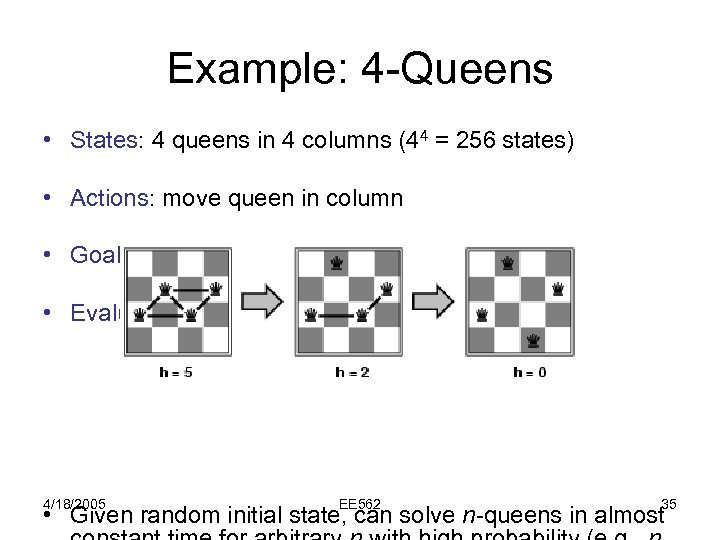 Example: 4 -Queens • States: 4 queens in 4 columns (44 = 256 states) • Actions: move queen in column • Goal test: no attacks • Evaluation: h(n) = number of attacks 4/18/2005 EE 562 35 • Given random initial state, can solve n-queens in almost
 Summary • CSPs are a special kind of problem: – states defined by values of a fixed set of variables – goal test defined by constraints on variable values • Backtracking = depth-first search with one variable assigned per node • Variable ordering and value selection heuristics help significantly • Forward checking prevents assignments that guarantee later failure 4/18/2005 • Constraint EE 562 propagation (e. g. , arc consistency) does additional work 36 to constrain values and detect inconsistencies