


 Скачать презентацию EE 462 L Spring 2014 PV Arrays Solar
ec417952327357725f50baeff1a1dd24.ppt
- Количество слайдов: 35
 EE 462 L, Spring 2014 PV Arrays (Solar Panels) 1
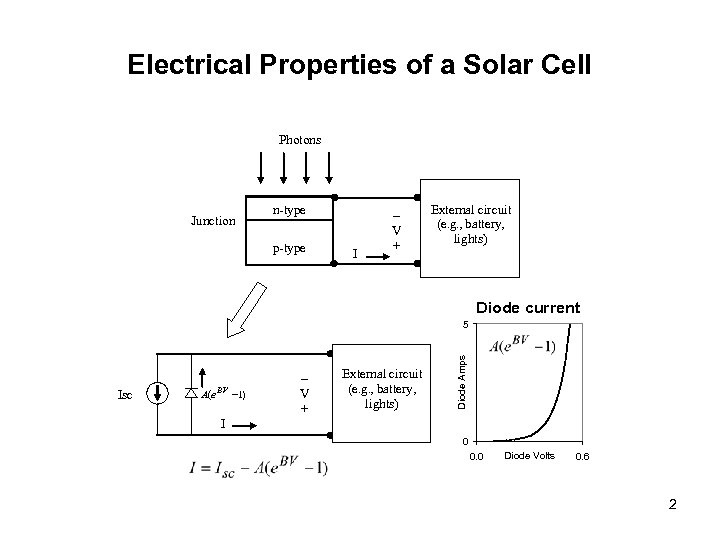 Electrical Properties of a Solar Cell Photons Junction n-type p-type I – V + External circuit (e. g. , battery, lights) Diode current Isc A(e BV - 1) – V + External circuit (e. g. , battery, lights) Diode Amps 5 I 0 0. 0 Diode Volts 0. 6 2
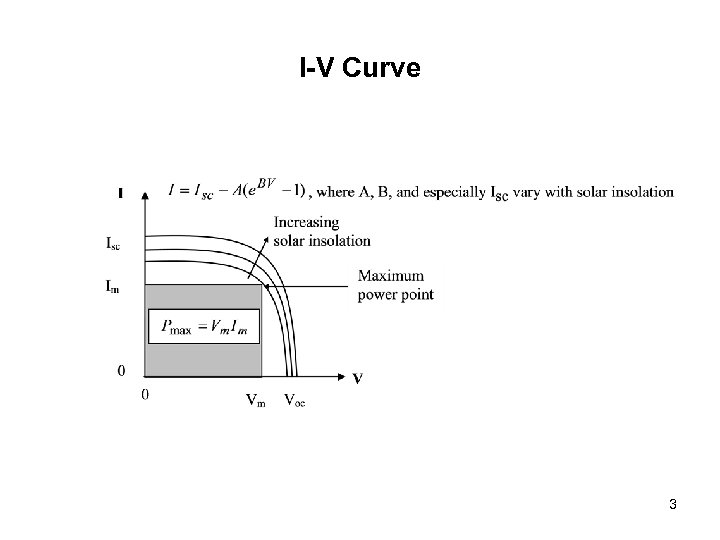 I-V Curve 3
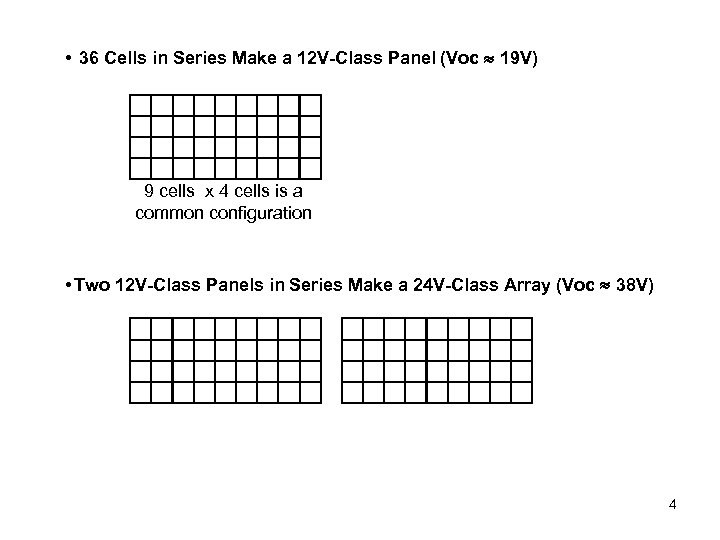 • 36 Cells in Series Make a 12 V-Class Panel (Voc 19 V) 9 cells x 4 cells is a common configuration • Two 12 V-Class Panels in Series Make a 24 V-Class Array (Voc 38 V) 4
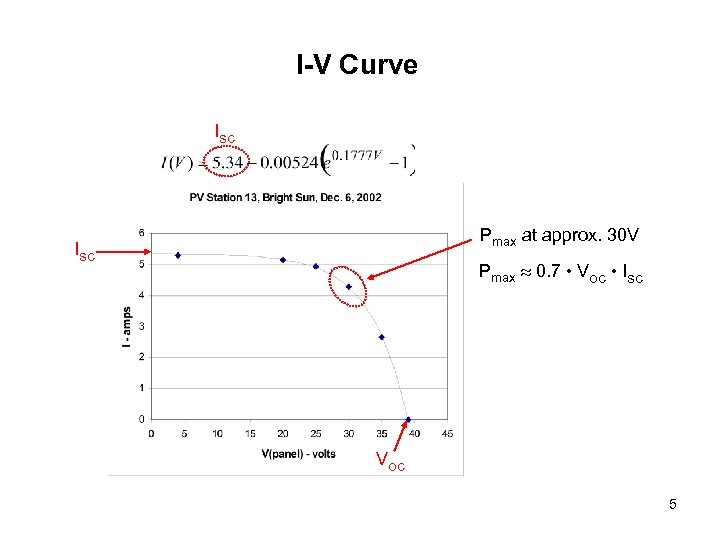 I-V Curve Isc Pmax at approx. 30 V Isc Pmax 0. 7 • Voc • Isc Voc 5
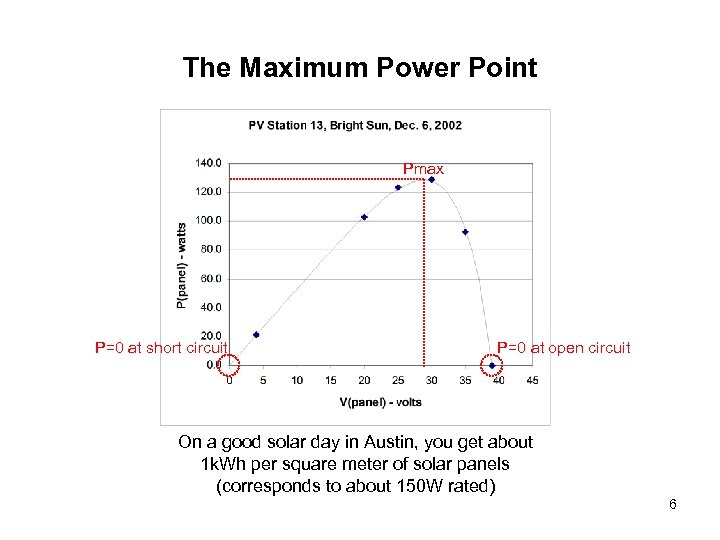 The Maximum Power Point Pmax P=0 at short circuit P=0 at open circuit On a good solar day in Austin, you get about 1 k. Wh per square meter of solar panels (corresponds to about 150 W rated) 6
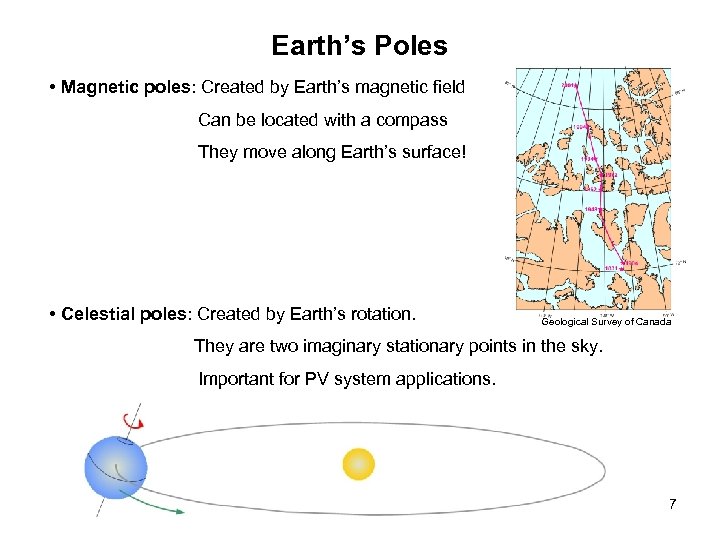 Earth’s Poles • Magnetic poles: Created by Earth’s magnetic field Can be located with a compass They move along Earth’s surface! • Celestial poles: Created by Earth’s rotation. Geological Survey of Canada They are two imaginary stationary points in the sky. Important for PV system applications. 7
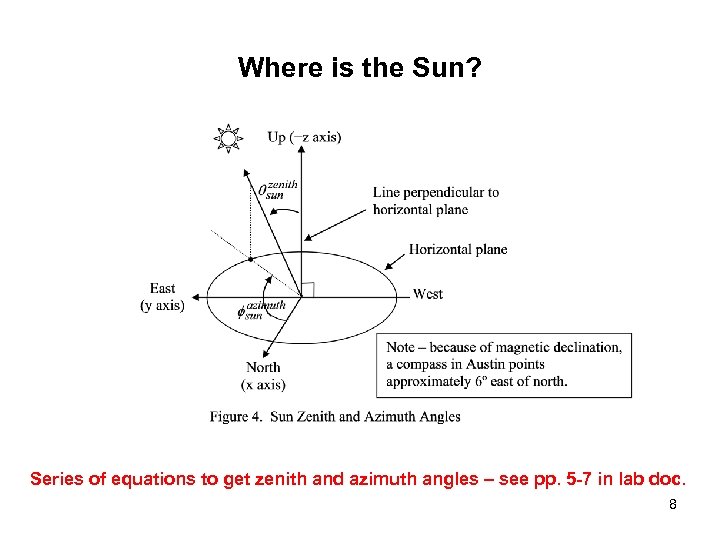 Where is the Sun? Series of equations to get zenith and azimuth angles – see pp. 5 -7 in lab doc. 8
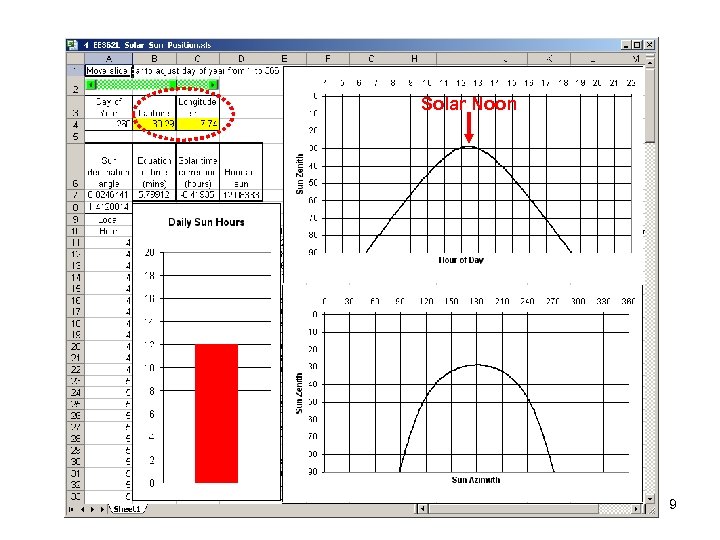 Solar Noon 9
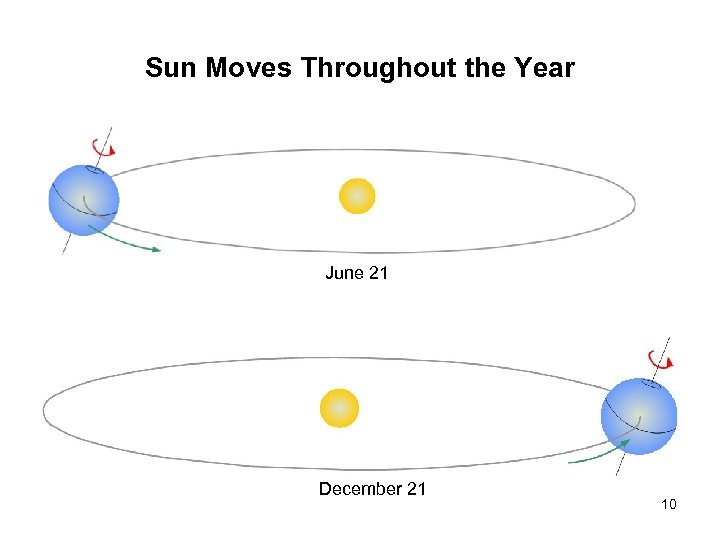 Sun Moves Throughout the Year June 21 December 21 10
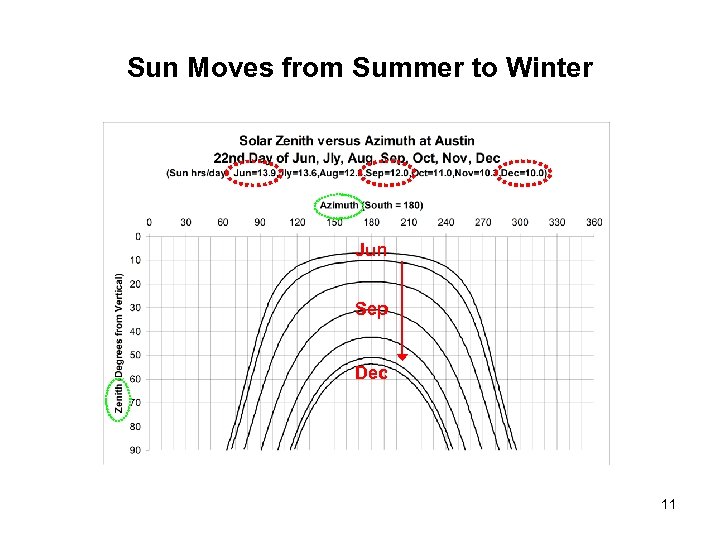 Sun Moves from Summer to Winter Jun Sep Dec 11
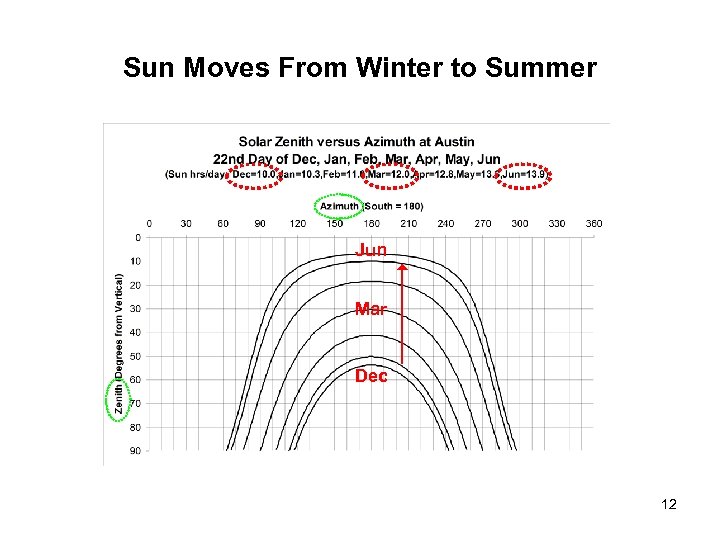 Sun Moves From Winter to Summer Jun Mar Dec 12
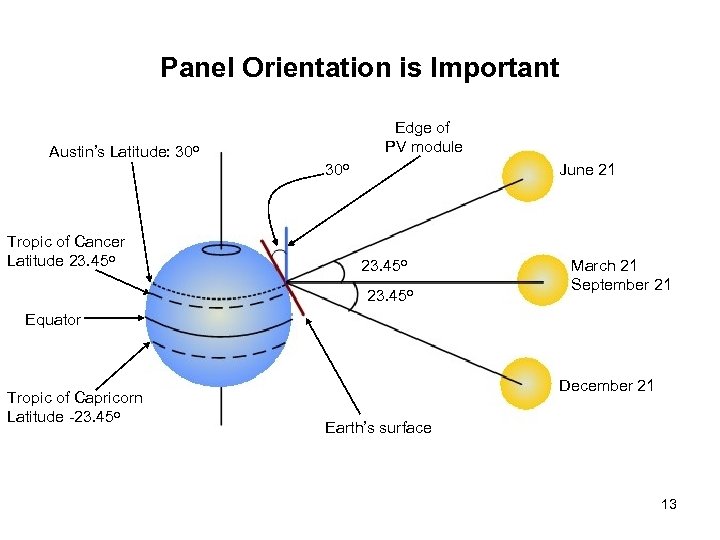 Panel Orientation is Important Edge of PV module Austin’s Latitude: 30 o Tropic of Cancer Latitude 23. 45 o June 21 23. 45 o March 21 September 21 Equator Tropic of Capricorn Latitude -23. 45 o December 21 Earth’s surface 13
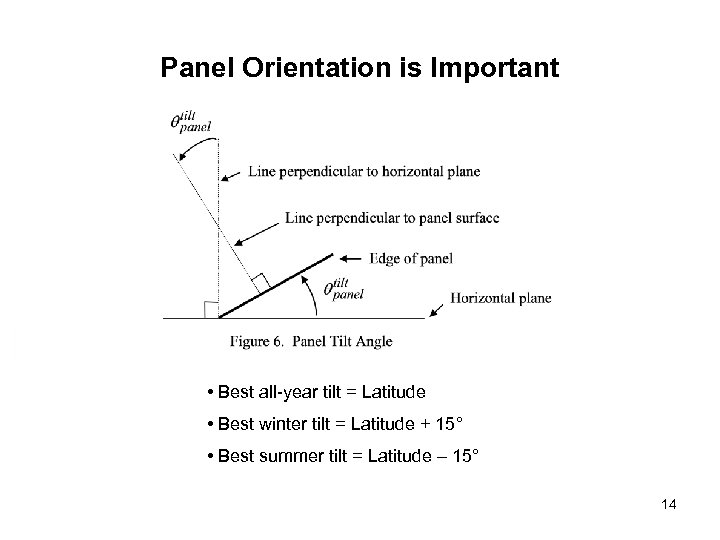 Panel Orientation is Important • Best all-year tilt = Latitude • Best winter tilt = Latitude + 15° • Best summer tilt = Latitude – 15° 14
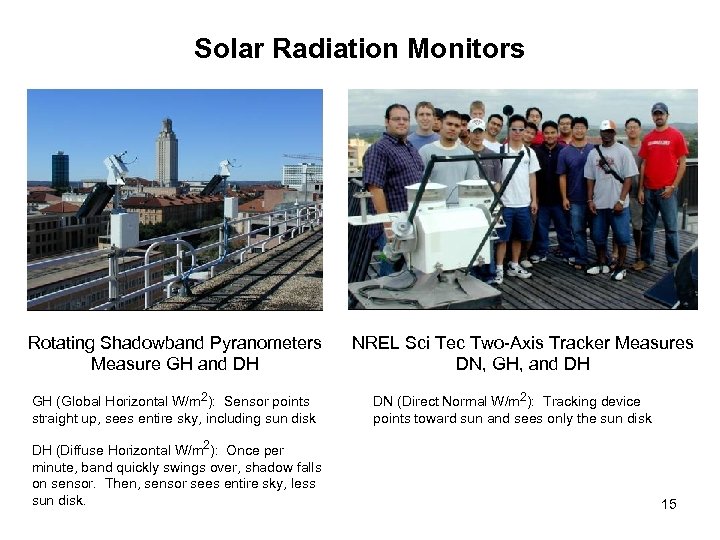 Solar Radiation Monitors Rotating Shadowband Pyranometers Measure GH and DH GH (Global Horizontal W/m 2): Sensor points straight up, sees entire sky, including sun disk DH (Diffuse Horizontal W/m 2): Once per minute, band quickly swings over, shadow falls on sensor. Then, sensor sees entire sky, less sun disk. NREL Sci Tec Two-Axis Tracker Measures DN, GH, and DH DN (Direct Normal W/m 2): Tracking device points toward sun and sees only the sun disk 15
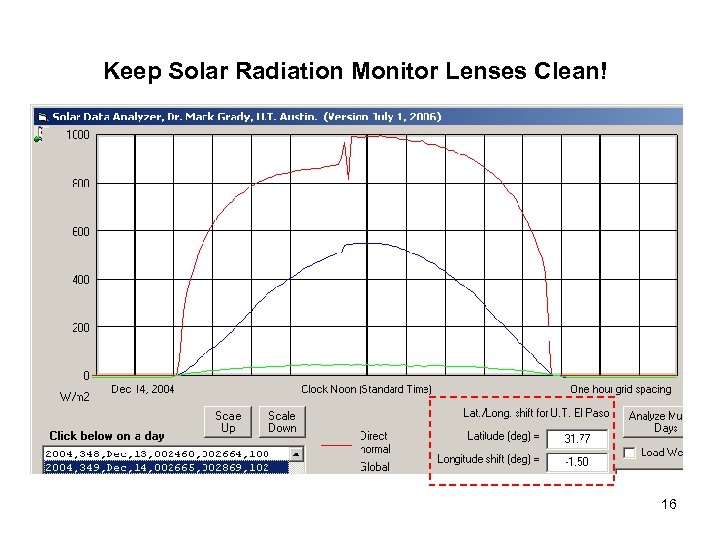 Keep Solar Radiation Monitor Lenses Clean! 16
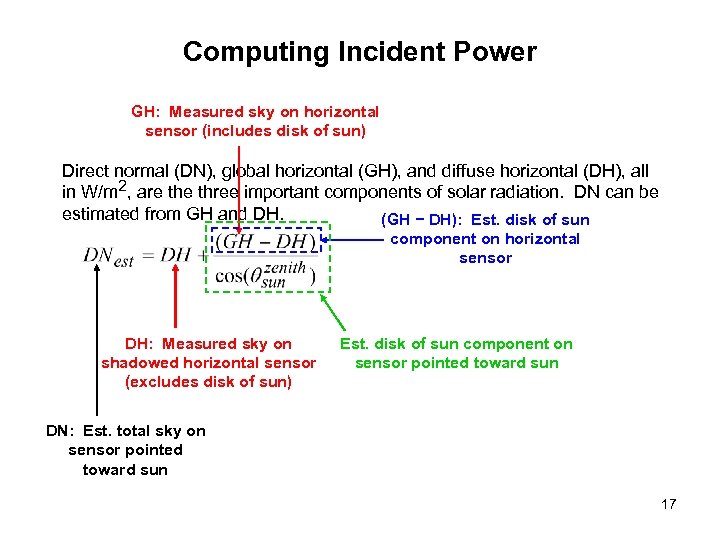 Computing Incident Power GH: Measured sky on horizontal sensor (includes disk of sun) Direct normal (DN), global horizontal (GH), and diffuse horizontal (DH), all in W/m 2, are three important components of solar radiation. DN can be estimated from GH and DH. (GH − DH): Est. disk of sun component on horizontal sensor DH: Measured sky on shadowed horizontal sensor (excludes disk of sun) Est. disk of sun component on sensor pointed toward sun DN: Est. total sky on sensor pointed toward sun 17
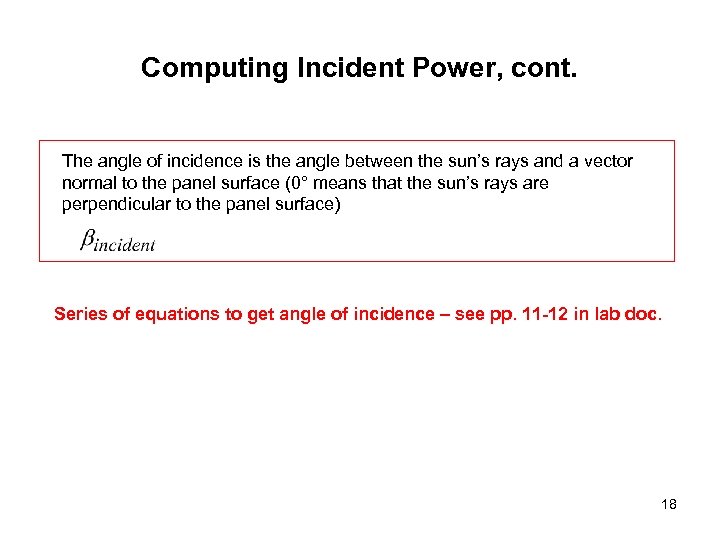 Computing Incident Power, cont. The angle of incidence is the angle between the sun’s rays and a vector normal to the panel surface (0° means that the sun’s rays are perpendicular to the panel surface) Series of equations to get angle of incidence – see pp. 11 -12 in lab doc. 18
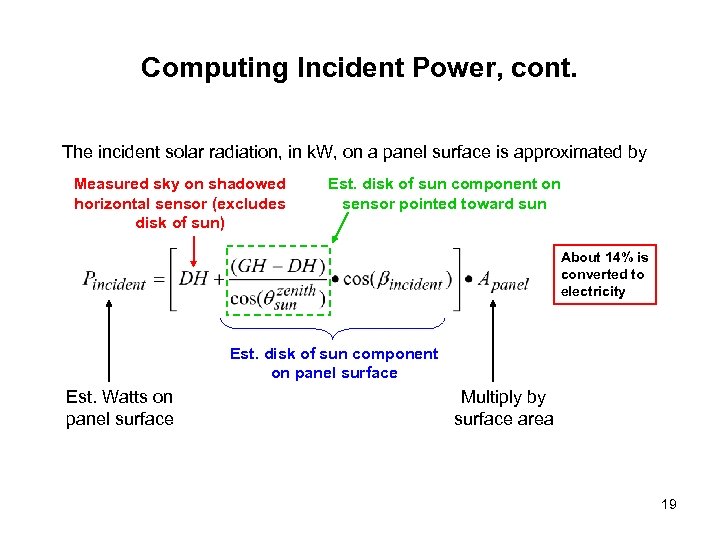 Computing Incident Power, cont. The incident solar radiation, in k. W, on a panel surface is approximated by Measured sky on shadowed horizontal sensor (excludes disk of sun) Est. disk of sun component on sensor pointed toward sun About 14% is converted to electricity Est. disk of sun component on panel surface Est. Watts on panel surface Multiply by surface area 19
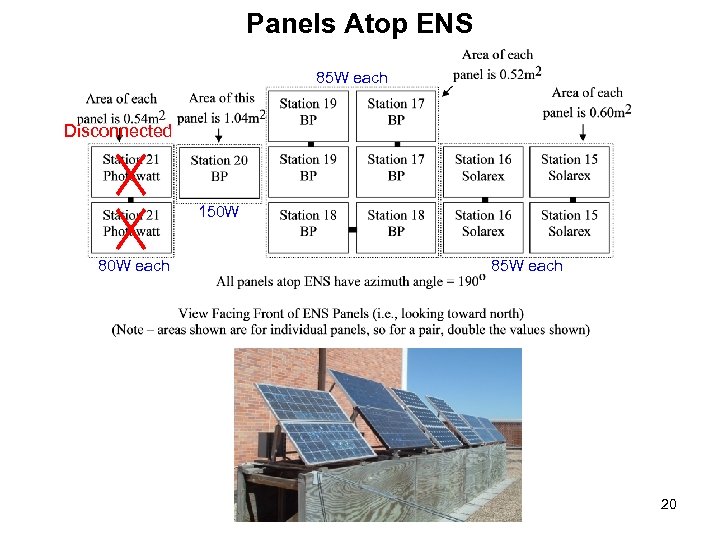 Panels Atop ENS 85 W each Disconnected 150 W 80 W each 85 W each 20
 Weather Forecast http: //www. nws. noaa. gov/forecasts/graphical/sectors/southplains. php#tabs 21
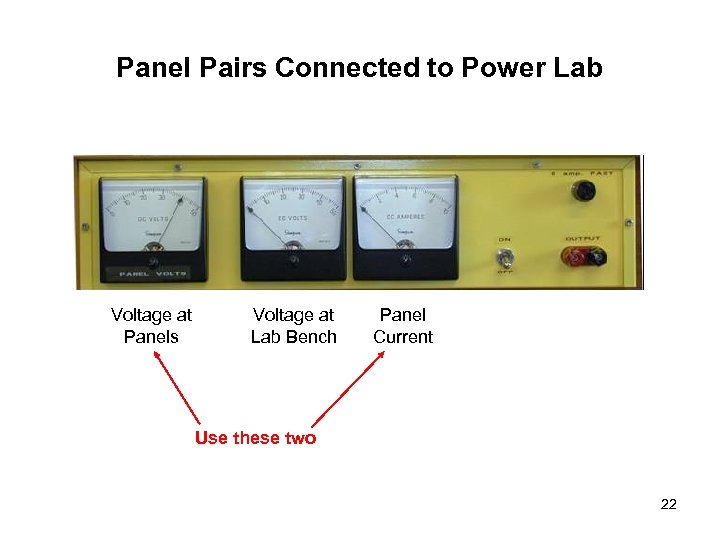 Panel Pairs Connected to Power Lab Voltage at Panels Voltage at Lab Bench Panel Current Use these two 22
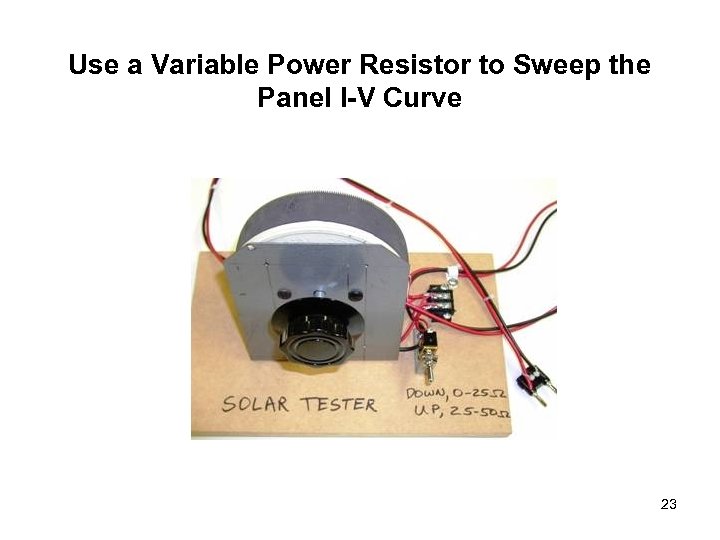 Use a Variable Power Resistor to Sweep the Panel I-V Curve 23
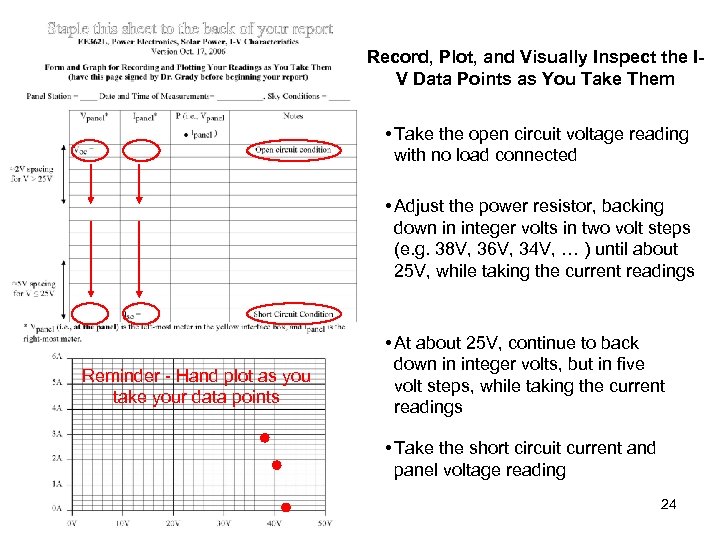 Record, Plot, and Visually Inspect the IV Data Points as You Take Them • Take the open circuit voltage reading with no load connected • Adjust the power resistor, backing down in integer volts in two volt steps (e. g. 38 V, 36 V, 34 V, … ) until about 25 V, while taking the current readings Reminder - Hand plot as you take your data points • At about 25 V, continue to back down in integer volts, but in five volt steps, while taking the current readings • Take the short circuit current and panel voltage reading 24
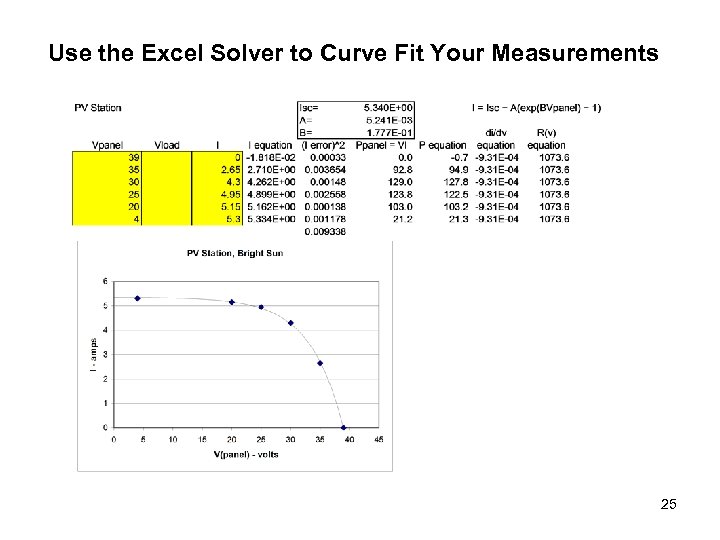 Use the Excel Solver to Curve Fit Your Measurements 25
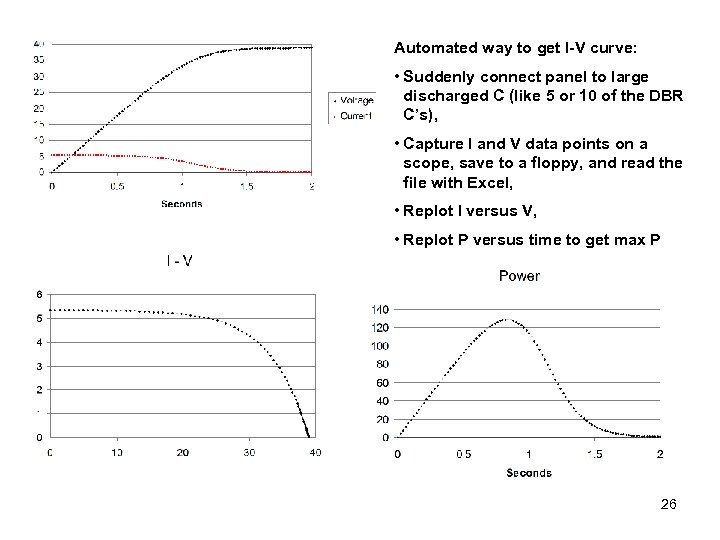 Automated way to get I-V curve: • Suddenly connect panel to large discharged C (like 5 or 10 of the DBR C’s), • Capture I and V data points on a scope, save to a floppy, and read the file with Excel, • Replot I versus V, • Replot P versus time to get max P 26
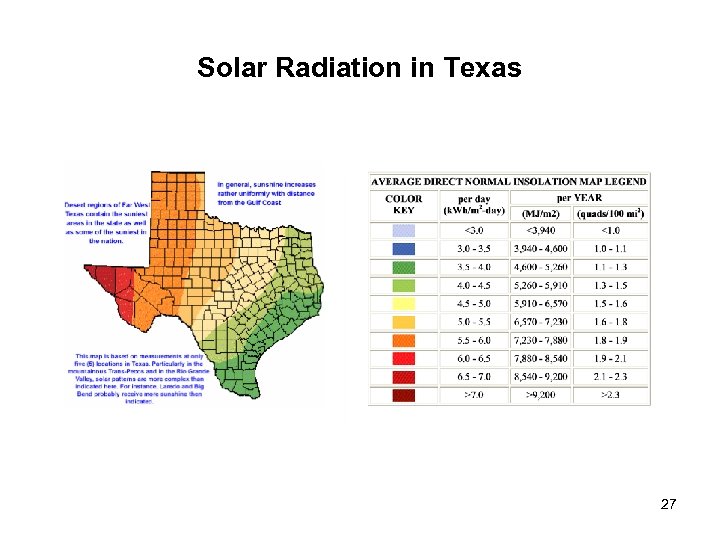 Solar Radiation in Texas 27
 28
28
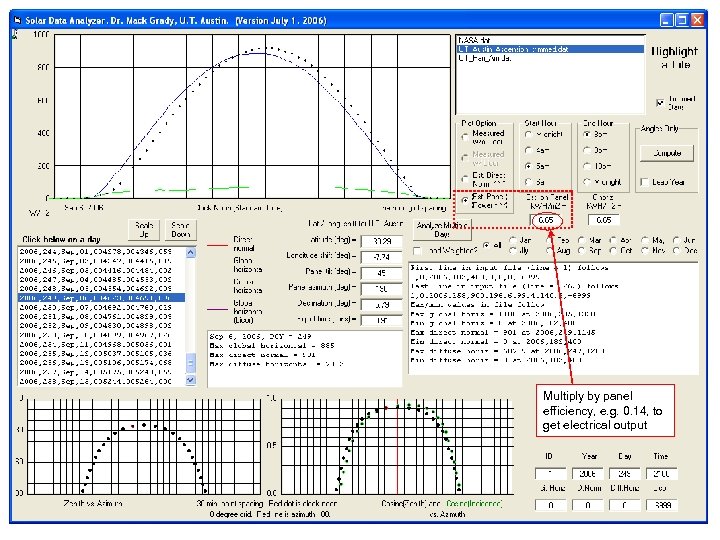 Multiply by panel efficiency, e. g. 0. 14, to get electrical output 29
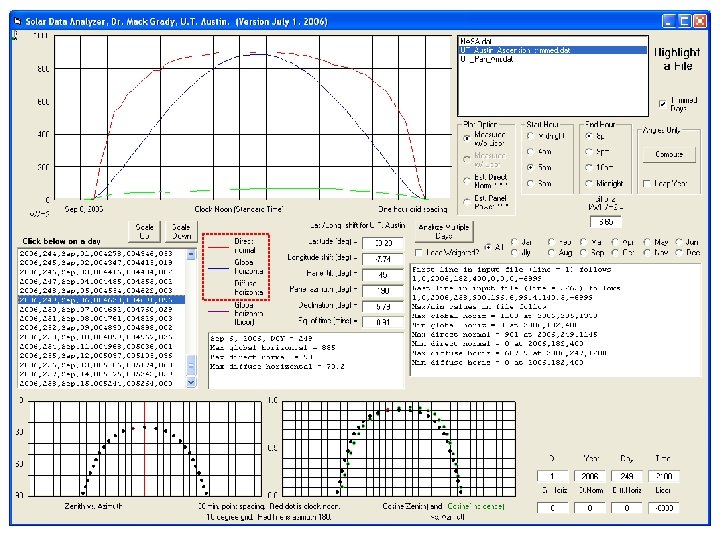
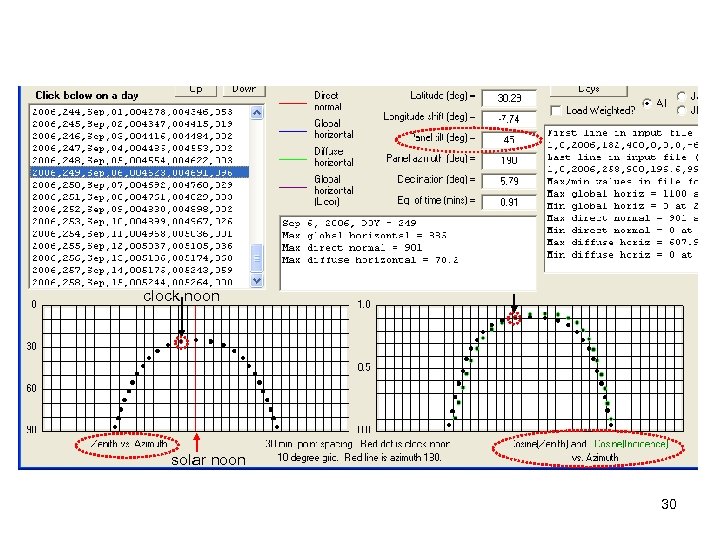 clock noon solar noon 30
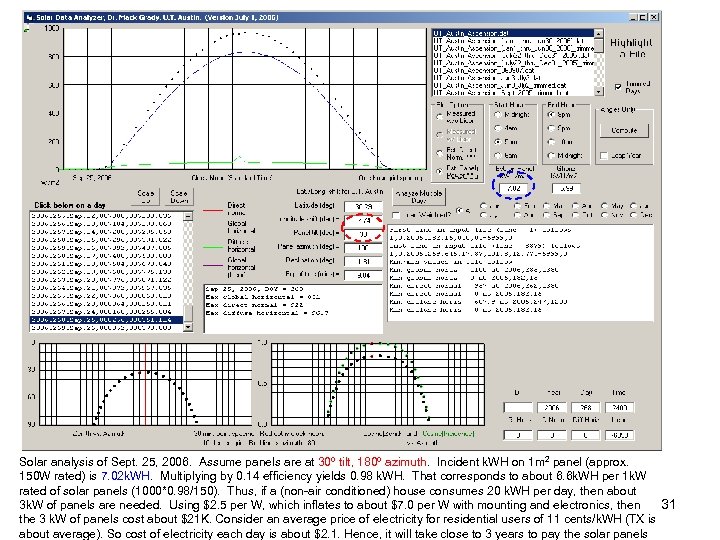 Solar analysis of Sept. 25, 2006. Assume panels are at 30º tilt, 180º azimuth. Incident k. WH on 1 m 2 panel (approx. 150 W rated) is 7. 02 k. WH. Multiplying by 0. 14 efficiency yields 0. 98 k. WH. That corresponds to about 6. 6 k. WH per 1 k. W rated of solar panels (1000*0. 98/150). Thus, if a (non-air conditioned) house consumes 20 k. WH per day, then about 31 3 k. W of panels are needed. Using $2. 5 per W, which inflates to about $7. 0 per W with mounting and electronics, then the 3 k. W of panels cost about $21 K. Consider an average price of electricity for residential users of 11 cents/k. WH (TX is about average). So cost of electricity each day is about $2. 1. Hence, it will take close to 3 years to pay the solar panels
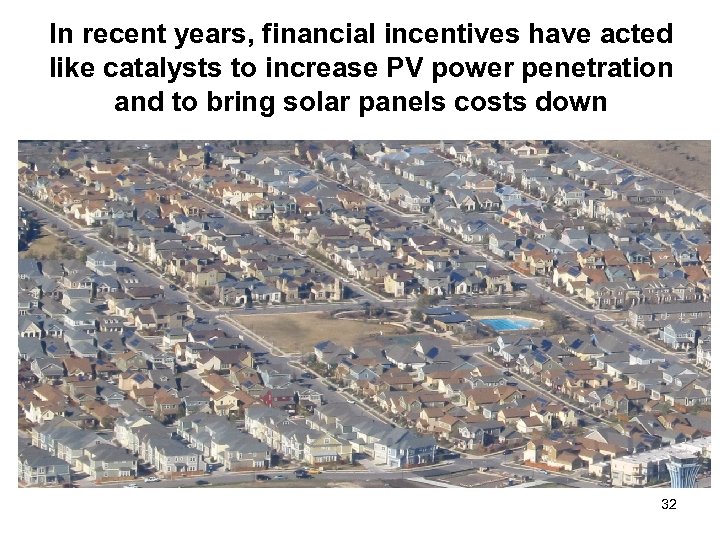 In recent years, financial incentives have acted like catalysts to increase PV power penetration and to bring solar panels costs down 32
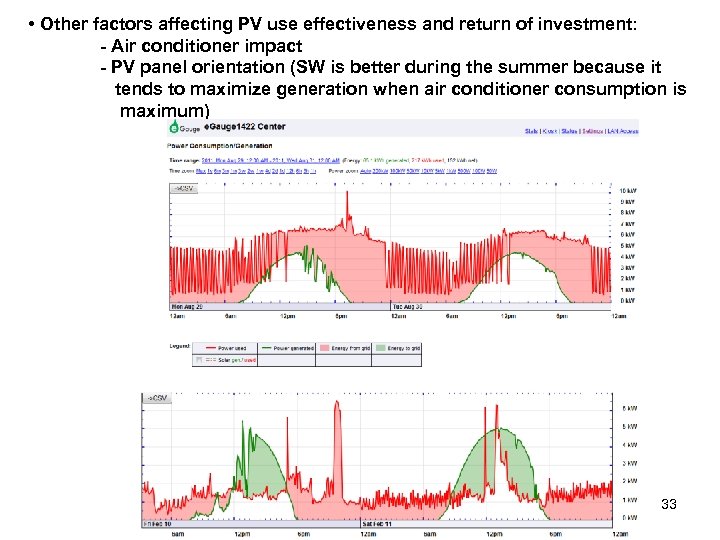 • Other factors affecting PV use effectiveness and return of investment: - Air conditioner impact - PV panel orientation (SW is better during the summer because it tends to maximize generation when air conditioner consumption is maximum) 33
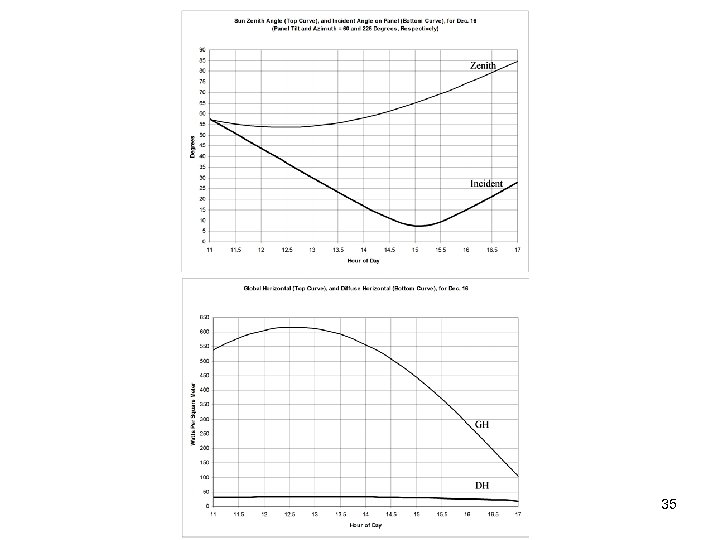
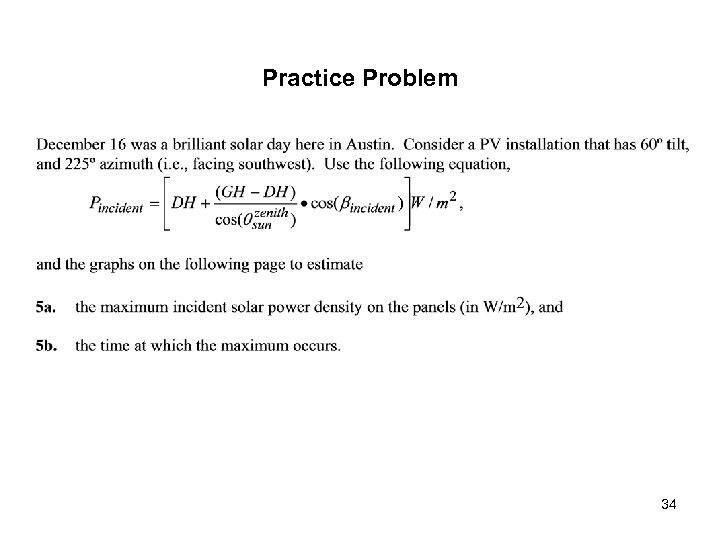 Practice Problem 34
 35
35