


 Скачать презентацию Edward Lear 12 May 1812 29 January
Гришина 32у Edward Lear.pptx
- Количество слайдов: 9
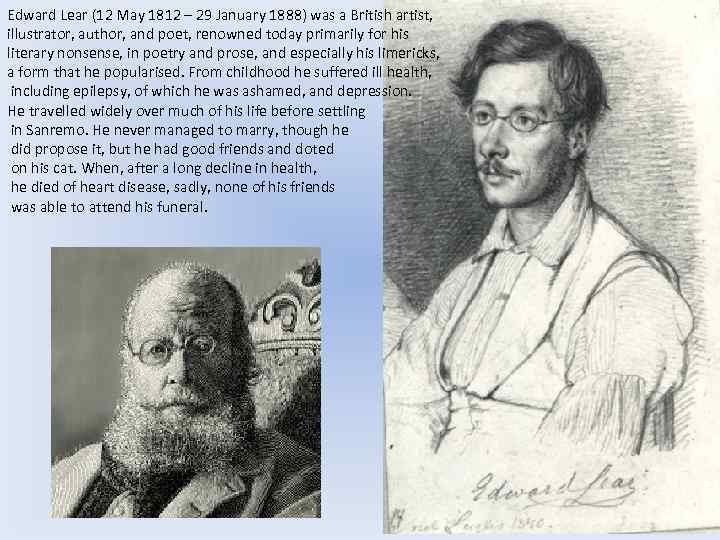 Edward Lear (12 May 1812 – 29 January 1888) was a British artist, illustrator, author, and poet, renowned today primarily for his literary nonsense, in poetry and prose, and especially his limericks, a form that he popularised. From childhood he suffered ill health, including epilepsy, of which he was ashamed, and depression. He travelled widely over much of his life before settling in Sanremo. He never managed to marry, though he did propose it, but he had good friends and doted on his cat. When, after a long decline in health, he died of heart disease, sadly, none of his friends was able to attend his funeral.
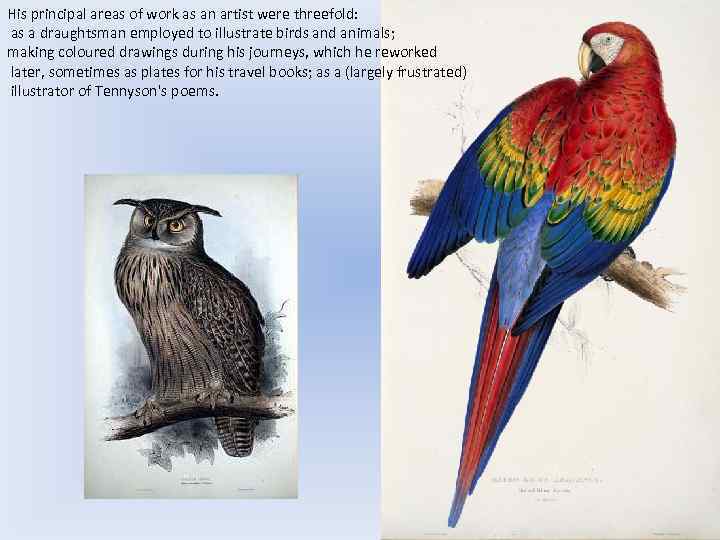 His principal areas of work as an artist were threefold: as a draughtsman employed to illustrate birds and animals; making coloured drawings during his journeys, which he reworked later, sometimes as plates for his travel books; as a (largely frustrated) illustrator of Tennyson's poems.
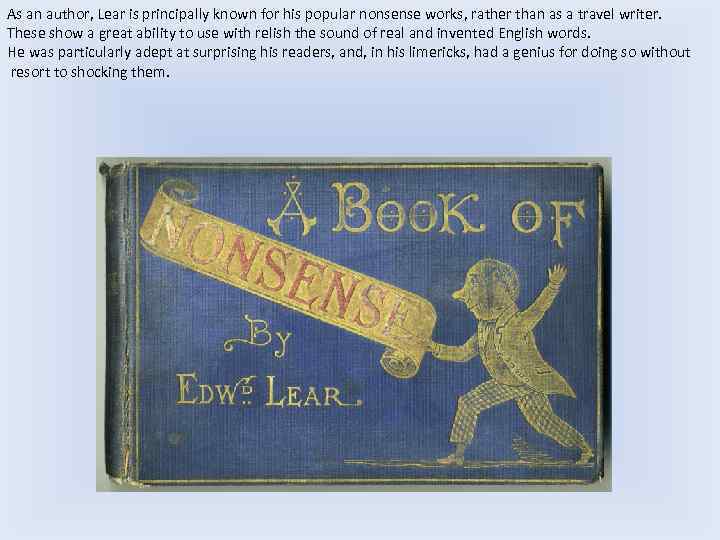 As an author, Lear is principally known for his popular nonsense works, rather than as a travel writer. These show a great ability to use with relish the sound of real and invented English words. He was particularly adept at surprising his readers, and, in his limericks, had a genius for doing so without resort to shocking them.
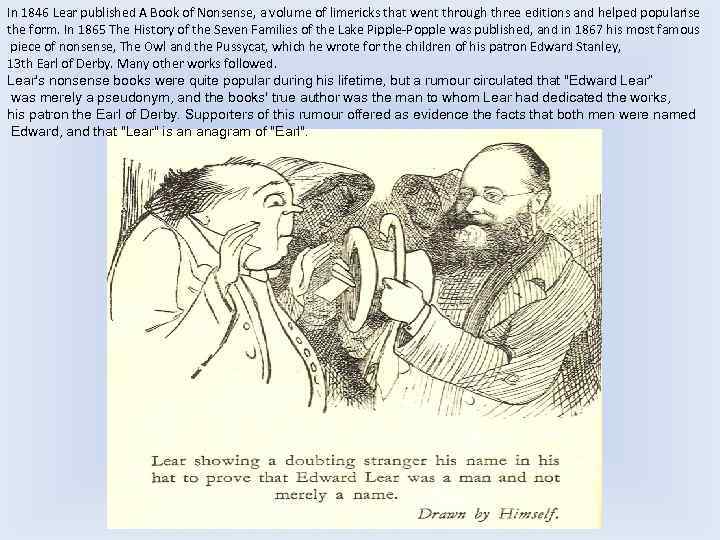 In 1846 Lear published A Book of Nonsense, a volume of limericks that went through three editions and helped popularise the form. In 1865 The History of the Seven Families of the Lake Pipple-Popple was published, and in 1867 his most famous piece of nonsense, The Owl and the Pussycat, which he wrote for the children of his patron Edward Stanley, 13 th Earl of Derby. Many other works followed. Lear's nonsense books were quite popular during his lifetime, but a rumour circulated that "Edward Lear“ was merely a pseudonym, and the books' true author was the man to whom Lear had dedicated the works, his patron the Earl of Derby. Supporters of this rumour offered as evidence the facts that both men were named Edward, and that "Lear" is an anagram of "Earl".
 Limericks are invariably typeset as four plus one lines today, but Lear's limericks were published in a variety of formats. It appears that Lear wrote them in manuscript in as many lines as there was room for beneath the picture. In the first three editions most are typeset as, respectively, two, five, and three lines. A limerick is a kind of a witty, humorous, or nonsense poem, especially one in five-line anapestic or amphibrachic meter with a strict rhyme scheme (AABBA), which is sometimes obscene with humorous intent. The form can be found in England as of the early years of the 18 th century. It was popularized by Edward Lear in the 19 th century, although he did not use the term.
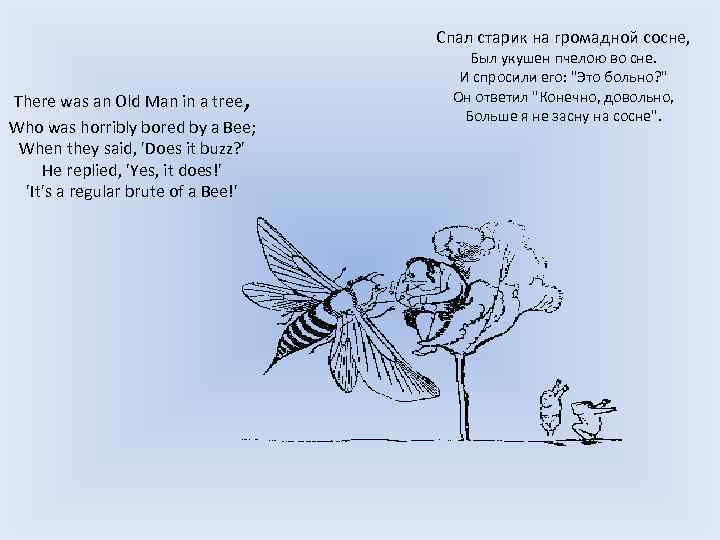 Спал старик на громадной сосне, , There was an Old Man in a tree Who was horribly bored by a Bee; When they said, 'Does it buzz? ' He replied, 'Yes, it does!' 'It's a regular brute of a Bee!' Был укушен пчелою во сне. И спросили его: "Это больно? " Он ответил "Конечно, довольно, Больше я не засну на сосне".
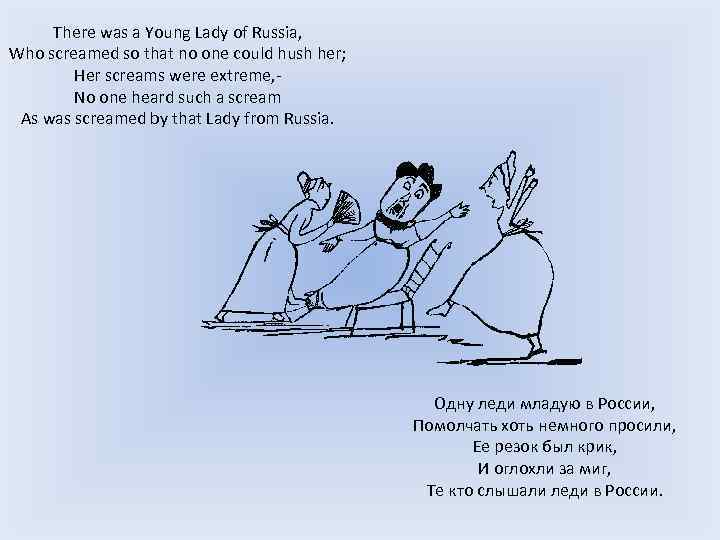 There was a Young Lady of Russia, Who screamed so that no one could hush her; Her screams were extreme, No one heard such a scream As was screamed by that Lady from Russia. Одну леди младую в России, Помолчать хоть немного просили, Ее резок был крик, И оглохли за миг, Те кто слышали леди в России.
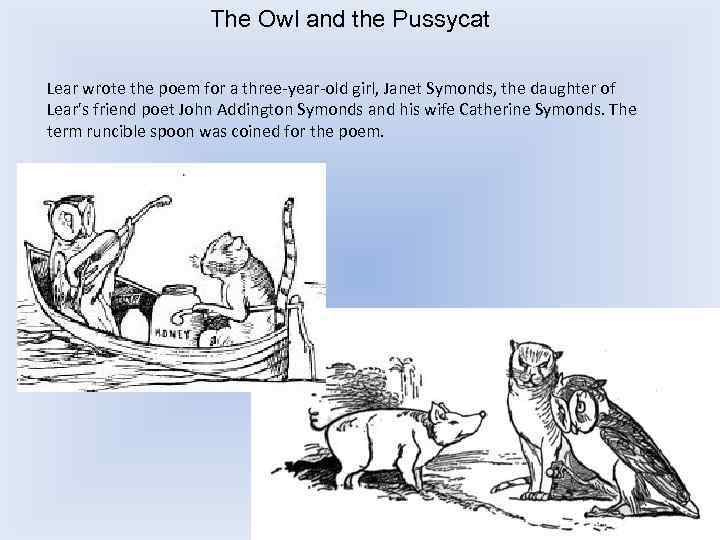 The Owl and the Pussycat Lear wrote the poem for a three-year-old girl, Janet Symonds, the daughter of Lear's friend poet John Addington Symonds and his wife Catherine Symonds. The term runcible spoon was coined for the poem.
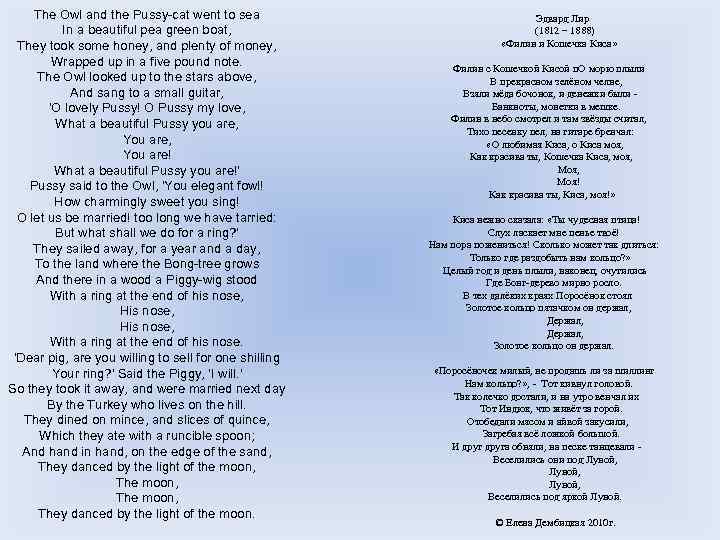 The Owl and the Pussy-cat went to sea In a beautiful pea green boat, They took some honey, and plenty of money, Wrapped up in a five pound note. The Owl looked up to the stars above, And sang to a small guitar, 'O lovely Pussy! O Pussy my love, What a beautiful Pussy you are, You are! What a beautiful Pussy you are!' Pussy said to the Owl, 'You elegant fowl! How charmingly sweet you sing! O let us be married! too long we have tarried: But what shall we do for a ring? ' They sailed away, for a year and a day, To the land where the Bong-tree grows And there in a wood a Piggy-wig stood With a ring at the end of his nose, His nose, With a ring at the end of his nose. 'Dear pig, are you willing to sell for one shilling Your ring? ' Said the Piggy, 'I will. ' So they took it away, and were married next day By the Turkey who lives on the hill. They dined on mince, and slices of quince, Which they ate with a runcible spoon; And hand in hand, on the edge of the sand, They danced by the light of the moon, They danced by the light of the moon. Эдвард Лир (1812 – 1888) «Филин и Кошечка Киса» Филин с Кошечкой Кисой п. О морю плыли В прекрасном зелёном челне, Взяли мёда бочонок, и денежки были Банкноты, монетки в мешке. Филин в небо смотрел и там звёзды считал, Тихо песенку пел, на гитаре бренчал: «О любимая Киса, о Киса моя, Как красива ты, Кошечка Киса, моя, Моя! Как красива ты, Киса, моя!» Киса нежно сказала: «Ты чудесная птица! Слух ласкает мне пенье твоё! Нам пора пожениться! Сколько может так длиться: Только где раздобыть нам кольцо? » Целый год и день плыли, наконец, очутились Где Бонг-дерево мирно росло. В тех далёких краях Поросёнок стоял Золотое кольцо пятачком он держал, Держал, Золотое кольцо он держал. «Поросёночек милый, не продашь ли за шиллинг Нам кольцо? » , - Тот кивнул головой. Так колечко достали, и на утро венчал их Тот Индюк, что живёт за горой. Отобедали мясом и айвой закусили, Загребая всё ложкой большой. И друга обняли, на песке танцевали Веселились они под Луной, Веселились под яркой Луной. © Елена Дембицкая 2010 г.