


 Скачать презентацию Educator Licensure Steering Committee of the Illinois P-20
4da0914124a90dc94894d2ac62affd7c.ppt
- Количество слайдов: 25
 Educator Licensure Steering Committee of the Illinois P-20 Council June 2012
 Welcome and Introductions Erika Hunt and Audrey Soglin Committee Co-Chairs
 Committee’s Mission • The P-12 Educator Licensure Steering Committee will facilitate a comprehensive discussion about educator certification and licensure within the context of other initiatives surrounding teacher preparation. • The Commission will provide feedback to the Illinois State Board of Education (ISBE) on the new licensure rollout and its implications across the educational system from birth to postsecondary education. 3/17/2018 3
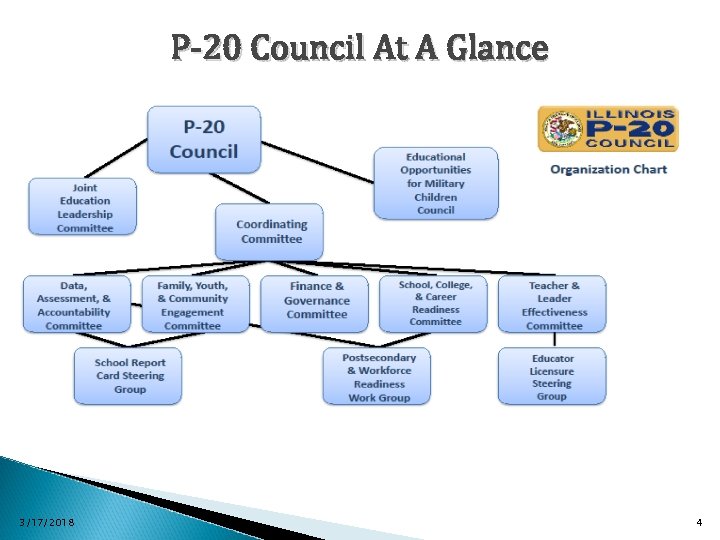 P-20 Council At A Glance 3/17/2018 4
 Committee’s Structure The Steering Committee will be co-chaired by: ◦ Erika Hunt of Center for the Study of Education Policy ◦ Audrey Soglin of the Illinois Education Association The Committee will meet bi-monthly and bring a high-level, systematic focus to issues surrounding educator certification and licensure. Short-term work groups will delve deeper into specific issues as needed and report back to the larger committee. The Committee is not designed to replace the committees that ISBE created to investigate certain issues, such as program standards for early childhood, elementary or middle school endorsement. Rather, it will build upon the existing and ongoing work. 3/17/2018 5
 Committee’s Scope of Work The Steering Committee will explore the comprehensive range of issues related to the new educator licensure and certification structure. These include: General Topic License and endorsements Teacher Prep Program Design Program Standards Educator Assessments Important related issues 3/17/2018 Specific Issues New single license Existing endorsements Proposed endorsements (grade spans, subjects, student populations) Focused endorsements Candidate selection Student teaching and clinical work District/university partnerships Early childhood standards Elementary program standards Middle grades program standards Math and English/Language Arts Review assessment structure Consider alignment of assessments to endorsements and content standards Diversity among teacher candidates Alternative certification and focused programs Community college and program alignment 6
 Committee’s Timeline August 2011: Illinois SB 1799 reconfigures educator certification and licensure structure. July 2010: ISBE redesigns the Illinois Professional Teaching Standards. 3/17/2018 June 2012: The Illinois P 20 Council convenes an Educator Certification Steering Committee that will make recommendations to ISBE. February 2011: ISBE Convenes the Early Childhood Advisory Group and the Elementary and Middle Grades Advisory Group to develop content standards for math and English language arts. Fall 2013: Initial elementary and middle grades teacher preparation programs redesigned. Winter 2012: Rules and content standards for elementary and middle grades due for adoption. Spring 2015: First teacher candidates graduate from redesigned programs. 7
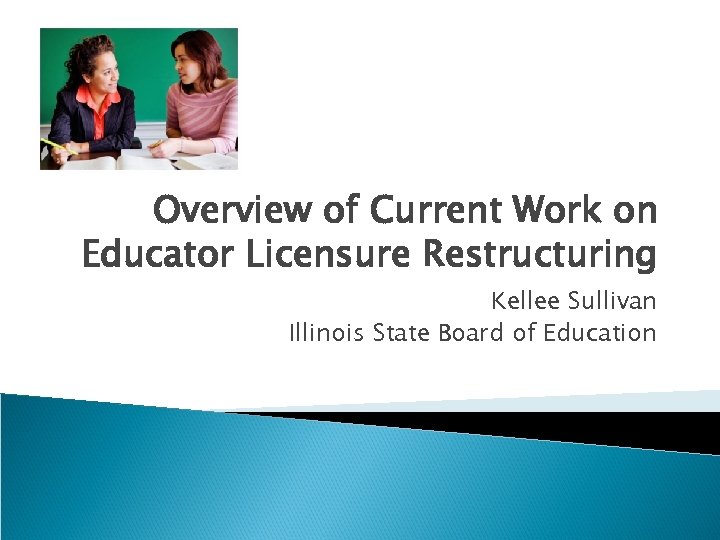 Overview of Current Work on Educator Licensure Restructuring Kellee Sullivan Illinois State Board of Education
 Rewriting Educator Certification and Licensure Signed into law in August 2011, Public Act 97 -0607 – commonly known as SB 1799 – reconfigured Illinois’ educator licensure system in an effort to simply and strengthen the process. • Creates a standard Professional Educator License • Defines endorsements specific to grade spans, subject area and student population • Streamlines the number of available teaching licenses from 66 to three, and makes clear the grade levels and subjects for which an educator is certified to teach by listing them upon the license itself. • Renames the Illinois Teacher Certification Board as the State Educator Preparation and Licensure Board • Presents the opportunity to align teacher preparation program requirements with the new certification and licensure structure 3/17/2018 9
 Former Certification Structure Illinois for years offered a tiered certificate system whereby teachers obtained: • An Initial Certificate (for new teachers) • A Standard Certificate (for teachers with at least four years in the classroom) • A Master Certificate (for Nationally Board Certified Teachers) Within the tiered certificate system, Illinois teachers earned a grade level certificate that included three broad configurations: • Birth to 3 rd Grade • Kindergarten to 9 th Grade • 6 th Grade to 12 th Grade Certificates specific to subjects and student populations were offered, such as: • Special education, birth to age 21 • Subject specific 3/17/2018 10
 Changes to Certification Structure The new law creates three standard licenses that offer a consistent, clear expectation of the core skills teachers must have and will be valid for five years: License Requirements Professional Educator License • • Professional Educator License with Stipulations • • • Substitute Teaching License 3/17/2018 • • • Graduate from approved teacher prep program Pass the requisite assessments Complete coursework on educating the exceptional child Study the methods of reading Limit the license holder to a specific position Does not require completion of an approved education prep program Pair with an endorsement that is provisional and non-renewable Graduate from an accredited college Pass the test of basic skills Not eligible for supporting endorsements 11
 Changes to Certification Structure Teachers will pair the license with supporting endorsements that reflect a depth of understanding in terms of grade level, subject area or student population. ◦ The Illinois State Board of Education and the State Educator Preparation and Licensure Board will establish, by administrative rule, the grade span and content area structure for endorsements. By law, they also will create endorsements for: o o o 3/17/2018 Superintendent Administrator Principal Teacher Leader Special education School support 12
 Certification Requirements Candidates may obtain an Illinois professional educator license so long as they: • Graduate from an approved teacher prep program; • Pass the requisite assessments; • Complete coursework on educating and supporting the exceptional child; • Study the methods of reading and reading in a specific content area. Candidates will support the license with endorsements that reflect a candidate’s expertise in terms of grade level, content area or student population. Candidates may obtain additional endorsements so long as they: • Complete at least 24 semester hours of coursework in the endorsement area; • Pass the applicable content area exam. 3/17/2018 13
 Program Standards All teacher preparation programs are required to demonstrate appropriate content and pedagogy standards for both an initial license and subsequent endorsement they intend to provide. These standards include: ◦ Illinois Professional Teaching Standards ◦ Illinois Social and Emotional Standards ◦ Common Core Standards (for grades K-12) ◦ Program Standards (e. g. , NAEYC for early childhood) Through advisory committees, ISBE is developing new content/content pedagogy standards for different subject areas.
 Professional Teaching Standards The redesigned Illinois Professional Teaching Standards are, in a sense, the backbone of the new certification and licensure system. Standard Brief description Teaching Diverse Students • Understands students’ diverse characteristics and abilities, and supports learning by all students Content Area, Pedagogical Knowledge • Creates learning experiences based upon content, pedagogy and evidence-based practice Planning for Differentiated Instruction • Supports the continued growth and achievement of a diversity of students Learning Environment • Structures safe, healthy, culturally responsive learning environment Instructional Delivery • Differentiates instruction to support creative, critical thinking Reading, Writing, Oral Communication • Has foundational knowledge of reading, writing, oral communication within the content area Assessment • Uses appropriate assessments to identify student needs, progress, growth, etc. Collaborative Relationships • Works as a team with colleagues, students, families Professionalism, Leadership, Advocacy • Advocates for students, families and the profession
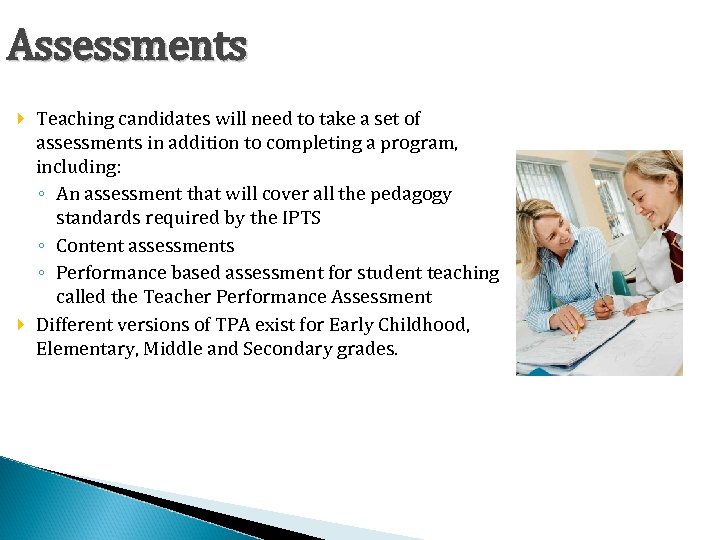 Assessments Teaching candidates will need to take a set of assessments in addition to completing a program, including: ◦ An assessment that will cover all the pedagogy standards required by the IPTS ◦ Content assessments ◦ Performance based assessment for student teaching called the Teacher Performance Assessment Different versions of TPA exist for Early Childhood, Elementary, Middle and Secondary grades.
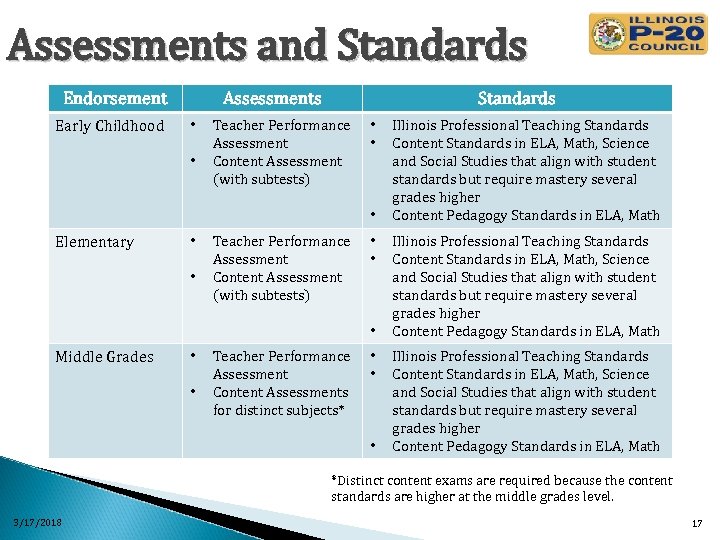 Assessments and Standards Endorsement Early Childhood Assessments • • Standards Teacher Performance Assessment Content Assessment (with subtests) • • • Elementary • • Teacher Performance Assessment Content Assessment (with subtests) • • • Middle Grades • • Teacher Performance Assessment Content Assessments for distinct subjects* • • • Illinois Professional Teaching Standards Content Standards in ELA, Math, Science and Social Studies that align with student standards but require mastery several grades higher Content Pedagogy Standards in ELA, Math *Distinct content exams are required because the content standards are higher at the middle grades level. 3/17/2018 17
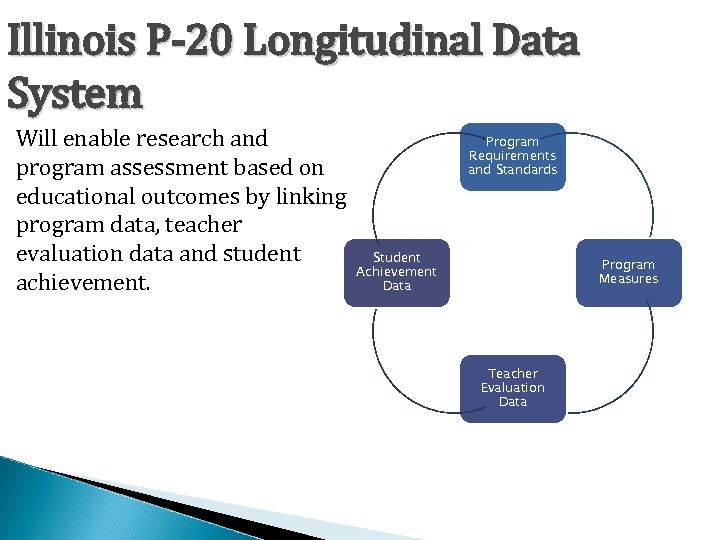 Illinois P-20 Longitudinal Data System Will enable research and program assessment based on educational outcomes by linking program data, teacher evaluation data and student achievement. Program Requirements and Standards Student Achievement Data Program Measures Teacher Evaluation Data
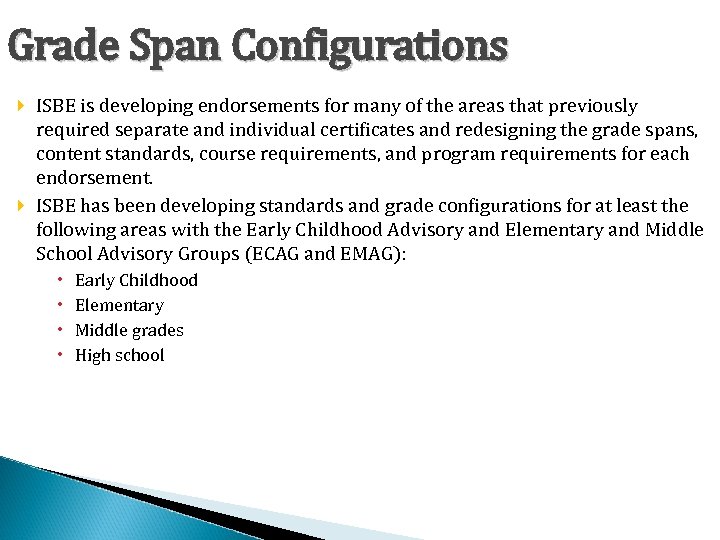 Grade Span Configurations ISBE is developing endorsements for many of the areas that previously required separate and individual certificates and redesigning the grade spans, content standards, course requirements, and program requirements for each endorsement. ISBE has been developing standards and grade configurations for at least the following areas with the Early Childhood Advisory and Elementary and Middle School Advisory Groups (ECAG and EMAG): Early Childhood Elementary Middle grades High school
 Content Standards Last year, ISBE convened two committees to develop content standards for teacher preparation programs. Their work continues today: The Elementary and Middle School Advisory Group (EMAG) along with the Early Childhood Advisory Group (ECAG) will continue their efforts to develop content standards for Mathematics, English/Language Arts, Social Sciences and Science that align to the Common Core State Standards. 3/17/2018 20
 Focused Requirements What does the new certification system mean for teachers certified in the former system? • Teachers working within the former certification system are grandfathered into the new certification structure. • Still, a clear and reasonable pathway into the new certification system must be developed whereby current teachers may translate their existing credentials into the new certification system. 3/17/2018 21
 Committee Topic Areas and Research Questions Erika Hunt
 Topic Areas and Research Questions Selection/Admission Diverse Educator Pipeline Student Teacher and Clinical Experience Partnerships Assessments/Pathways Institutional and Program Articulation 3/17/2018 23
 Topic Areas and Research Questions Teacher Preparation Program Design Topic Open Questions Candidate Selection • • What tools might be used for selection? How might the selection criteria relate to the exit criteria? Student Teaching and Clinical Experience • What might be the required length of a student teaching experience? When will it occur within a teacher prep program? How long should it be? • Diverse Pipeline • • • What might a portfolio of recruitment and retention strategies that target qualified, diverse teacher candidates include? How might schools help in identifying qualified, diverse candidates with an aptitude and interest in teaching? How might teacher preparation programs recruit qualified, diverse students who are already on their college campuses?
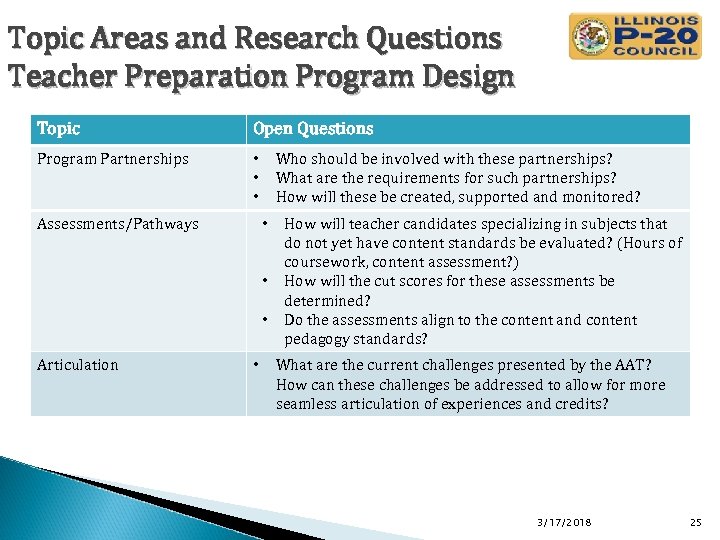 Topic Areas and Research Questions Teacher Preparation Program Design Topic Open Questions Program Partnerships • • • Who should be involved with these partnerships? What are the requirements for such partnerships? How will these be created, supported and monitored? • Assessments/Pathways • • Articulation • How will teacher candidates specializing in subjects that do not yet have content standards be evaluated? (Hours of coursework, content assessment? ) How will the cut scores for these assessments be determined? Do the assessments align to the content and content pedagogy standards? What are the current challenges presented by the AAT? How can these challenges be addressed to allow for more seamless articulation of experiences and credits? 3/17/2018 25