 Скачать презентацию Educator Evaluation Research-Informed Practice Dr Don Beaudette Rachel
8b86238f6edb62cdca8ac18e7378637c.ppt
- Количество слайдов: 32



Educator Evaluation: Research-Informed Practice Dr. Don Beaudette Rachel Bradshaw Richard Fournier Elizabeth Nolan
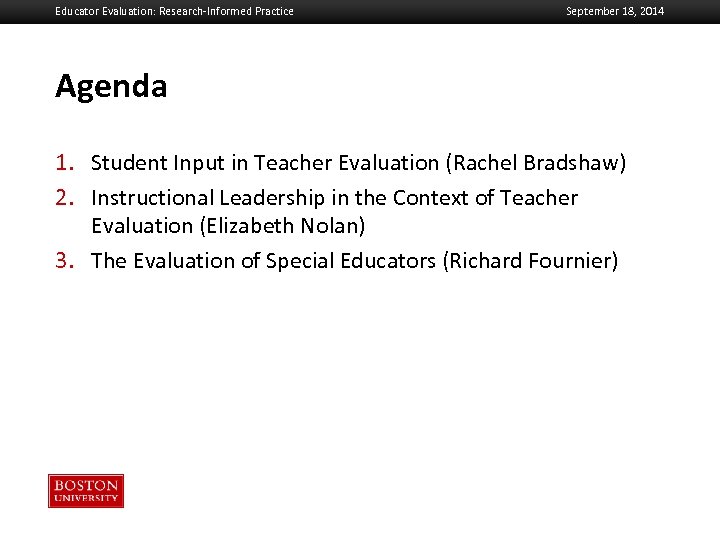
Educator Evaluation: Research-Informed Practice September 18, 2014 Agenda Boston University Slideshow Title Goes Here 1. Student Input in Teacher Evaluation (Rachel Bradshaw) 2. Instructional Leadership in the Context of Teacher Evaluation (Elizabeth Nolan) 3. The Evaluation of Special Educators (Richard Fournier)
Educator Evaluation: Research-Informed Practice Boston University Slideshow Title Goes Here Part 1 STUDENT INPUT IN TEACHER EVALUATION September 18, 2014
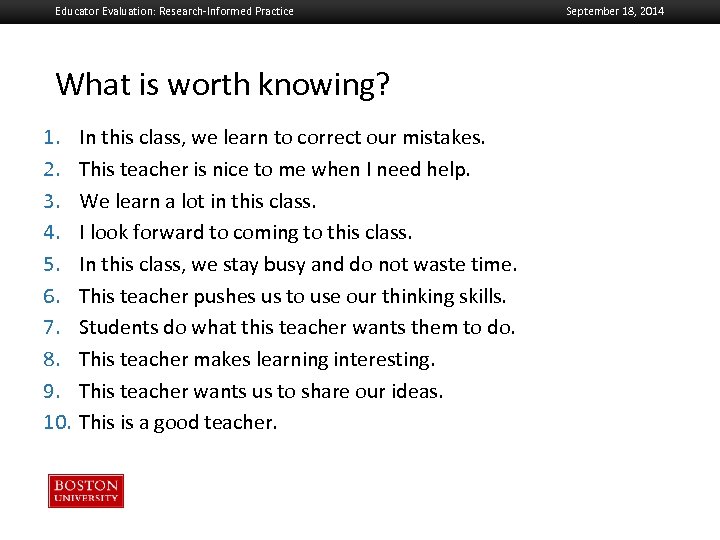
Educator Evaluation: Research-Informed Practice What is worth knowing? Boston 1. In University Slideshow Title Goesto correct our mistakes. this class, we learn Here 2. This teacher is nice to me when I need help. 3. We learn a lot in this class. 4. I look forward to coming to this class. 5. In this class, we stay busy and do not waste time. 6. This teacher pushes us to use our thinking skills. 7. Students do what this teacher wants them to do. 8. This teacher makes learning interesting. 9. This teacher wants us to share our ideas. 10. This is a good teacher. September 18, 2014
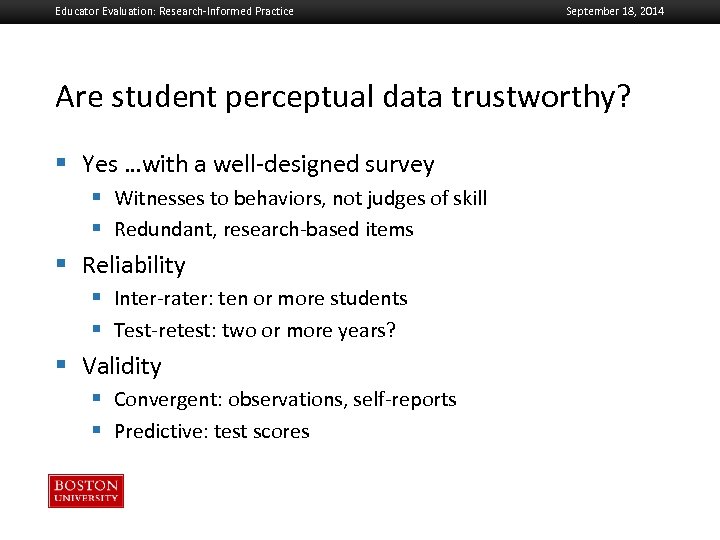
Educator Evaluation: Research-Informed Practice September 18, 2014 Are student perceptual data trustworthy? Boston University Slideshow Title Goes Here § Yes …with a well-designed survey § Witnesses to behaviors, not judges of skill § Redundant, research-based items § Reliability § Inter-rater: ten or more students § Test-retest: two or more years? § Validity § Convergent: observations, self-reports § Predictive: test scores
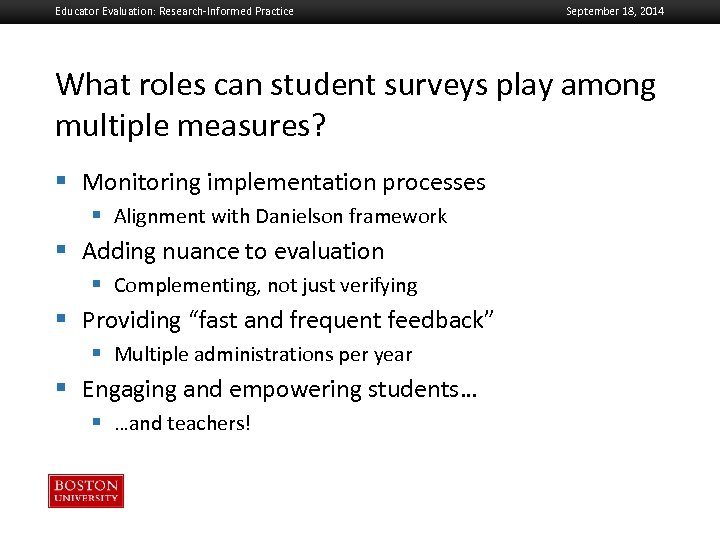
Educator Evaluation: Research-Informed Practice September 18, 2014 What roles can student surveys play among multiple measures? Boston University Slideshow Title Goes Here § Monitoring implementation processes § Alignment with Danielson framework § Adding nuance to evaluation § Complementing, not just verifying § Providing “fast and frequent feedback” § Multiple administrations per year § Engaging and empowering students… § …and teachers!
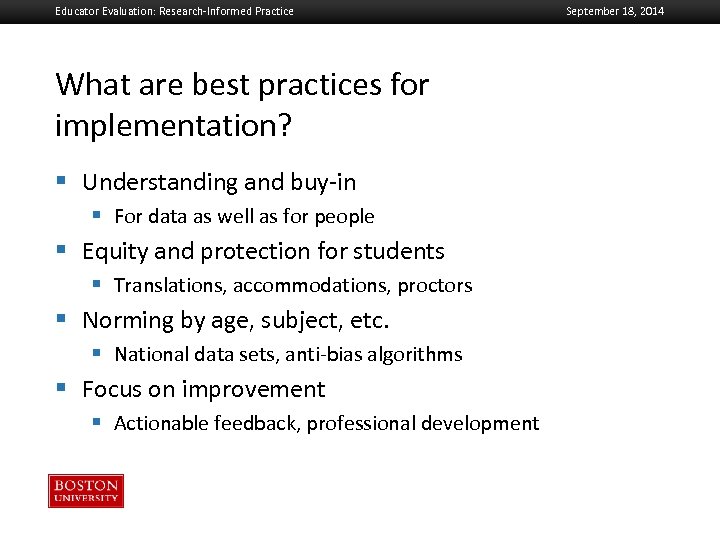
Educator Evaluation: Research-Informed Practice What are best practices for implementation? Boston University Slideshow Title Goes Here § Understanding and buy-in § For data as well as for people § Equity and protection for students § Translations, accommodations, proctors § Norming by age, subject, etc. § National data sets, anti-bias algorithms § Focus on improvement § Actionable feedback, professional development September 18, 2014
Educator Evaluation: Research-Informed Practice September 18, 2014 Boston University Slideshow Title Goes Here Part 2 INSTRUCTIONAL LEADERSHIP IN THE CONTEXT OF TEACHER EVALUATION
Educator Evaluation: Research-Informed Practice Boston University Slideshow Title Goes Here September 18, 2014
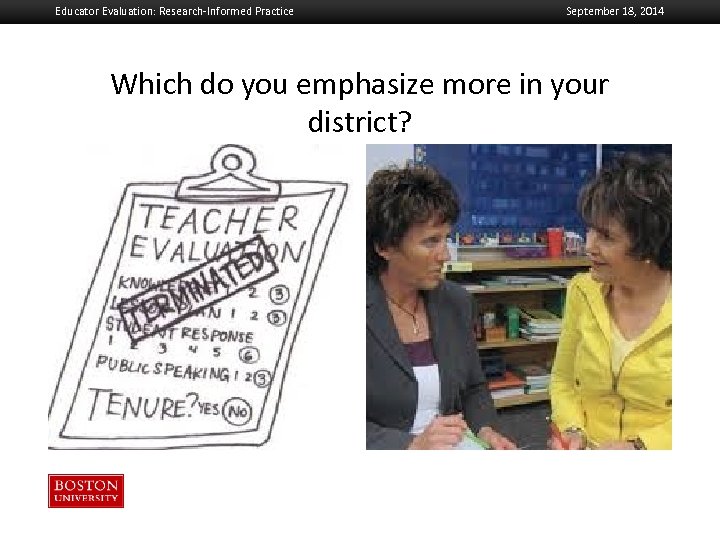
Educator Evaluation: Research-Informed Practice September 18, 2014 Which do you emphasize more in your district? Boston University Slideshow Title Goes Here
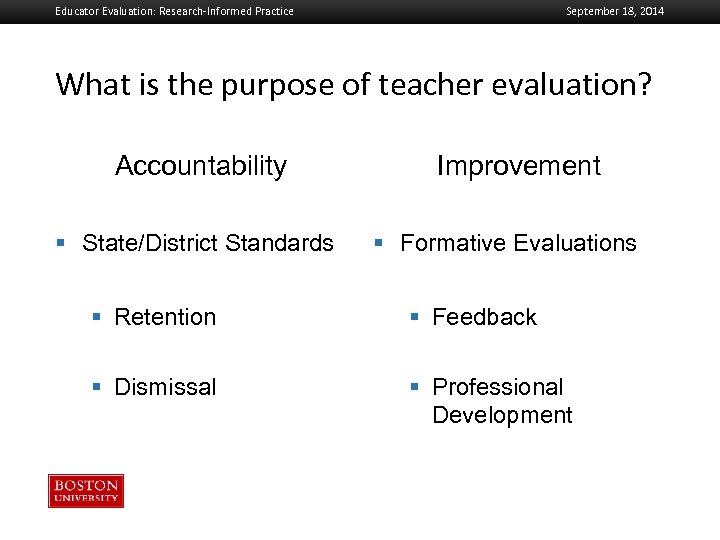
Educator Evaluation: Research-Informed Practice September 18, 2014 What is the purpose of teacher evaluation? Boston University Slideshow Title Goes Here Accountability § State/District Standards Improvement § Formative Evaluations § Retention § Feedback § Dismissal § Professional Development
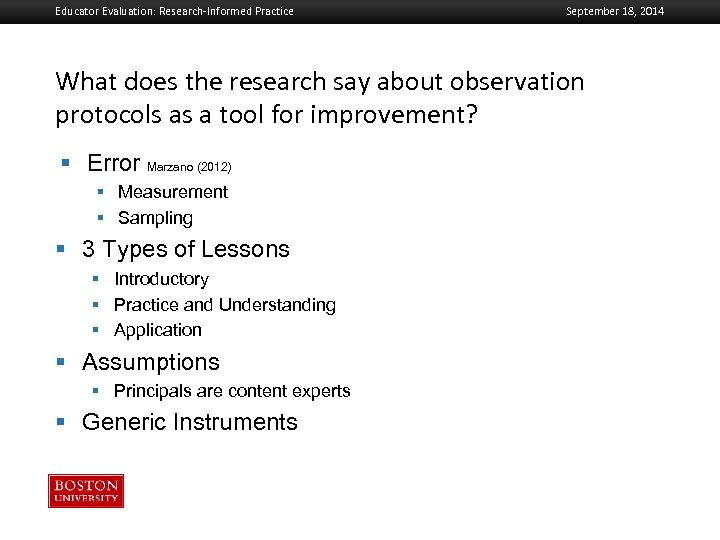
Educator Evaluation: Research-Informed Practice September 18, 2014 What does the research say about observation protocols. Slideshow Title Goesfor improvement? as a tool Here Boston University § Error Marzano (2012) § Measurement § Sampling § 3 Types of Lessons § Introductory § Practice and Understanding § Application § Assumptions § Principals are content experts § Generic Instruments
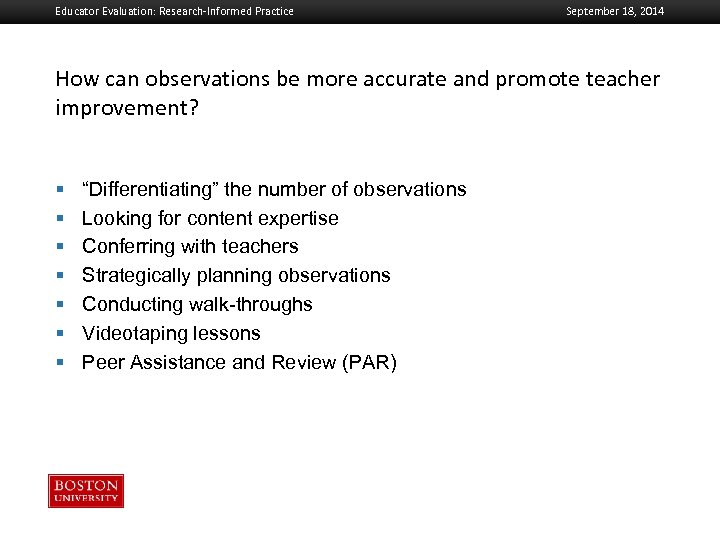
Educator Evaluation: Research-Informed Practice September 18, 2014 How can observations be more accurate and promote teacher improvement? Boston University Slideshow Title Goes Here § § § § “Differentiating” the number of observations Looking for content expertise Conferring with teachers Strategically planning observations Conducting walk-throughs Videotaping lessons Peer Assistance and Review (PAR)
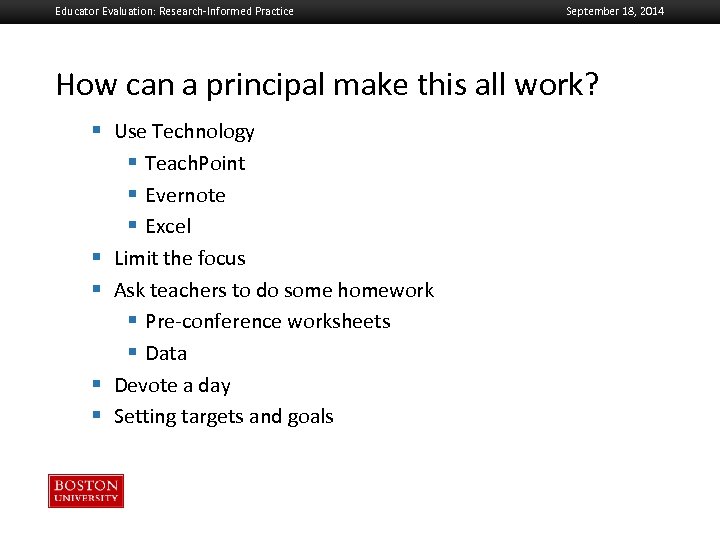
Educator Evaluation: Research-Informed Practice September 18, 2014 How can a principal make this all work? § Use Technology § Teach. Point § Evernote § Excel § Limit the focus § Ask teachers to do some homework § Pre-conference worksheets § Data § Devote a day § Setting targets and goals Boston University Slideshow Title Goes Here
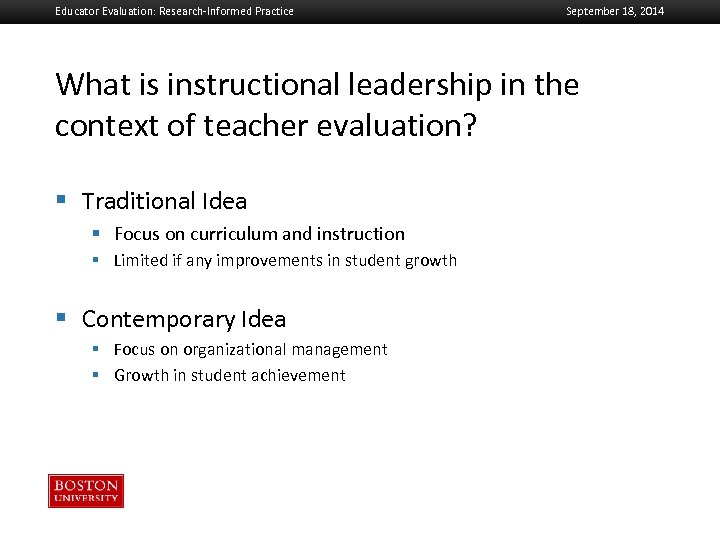
Educator Evaluation: Research-Informed Practice September 18, 2014 What is instructional leadership in the context of teacher evaluation? Boston University Slideshow Title Goes Here § Traditional Idea § Focus on curriculum and instruction § Limited if any improvements in student growth § Contemporary Idea § Focus on organizational management § Growth in student achievement
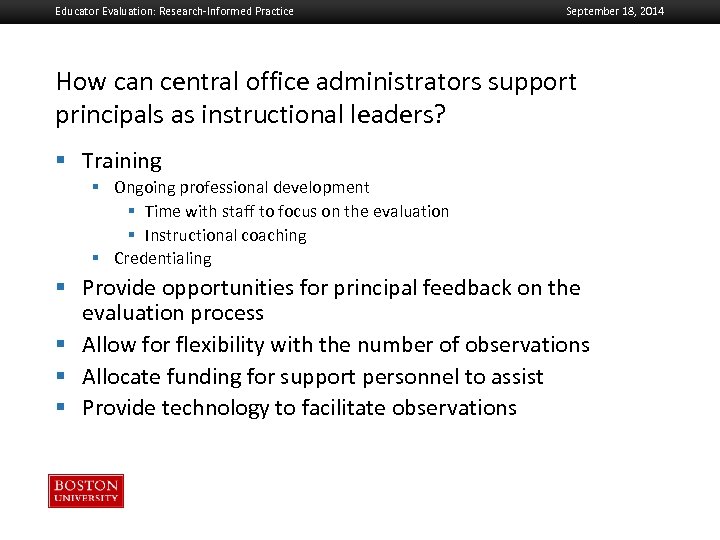
Educator Evaluation: Research-Informed Practice September 18, 2014 How can central office administrators support principals. Slideshow Title Goes Here as instructional leaders? Boston University § Training § Ongoing professional development § Time with staff to focus on the evaluation § Instructional coaching § Credentialing § Provide opportunities for principal feedback on the evaluation process § Allow for flexibility with the number of observations § Allocate funding for support personnel to assist § Provide technology to facilitate observations
Evaluating Special Education Teachers: Current Issues & Recommendations Richard Fournier Doctoral Fellow rfournie@bu. edu
18 Introduction: Why Special Education? Boston University Slideshow Title Goes Here
Evaluating Special Education Teachers: Major Issues Boston University Slideshow Title Goes Here § Special education has unique characteristics evaluation models rarely consider • These features challenge current models of evaluating teacher effectiveness: ① Diversity in population of students with disabilities ② Intensive, individualized instruction found in SPED
Evaluating Special Education Teachers: Major Issues Boston University Slideshow Title Goes Here § Problems § Current mixed-method measures (e. g. , VAM) are not easily transferrable to special education § Current models tend to be “one-size-fits-all” § Current teacher observations problematic
What does the research say? Boston University Slideshow Title Goes Here Rigorous research is limited, but growing Little understanding of what models work or of alternative solutions
What does the research say? Observation of Special Education Teachers Boston University Slideshow Title Goes Here Examples: • Danielson’s Framework for Teaching (FFT) • Meant to be comprehensive of all aspects of one’s teaching • Classroom Assessment Scoring System (CLASS) • Focuses on teacher-student interactions Recent Findings: • • • observations scores tend to be unstable Raters tend to remain high or low in ratings Consistency with observation systems Not strongly correlated with VAM scores BIG ISSUE: How do we deal with issues of fairness? Dr. Nathan Jones (2013), Presentation with Office of Special Education Programs (OSEP)
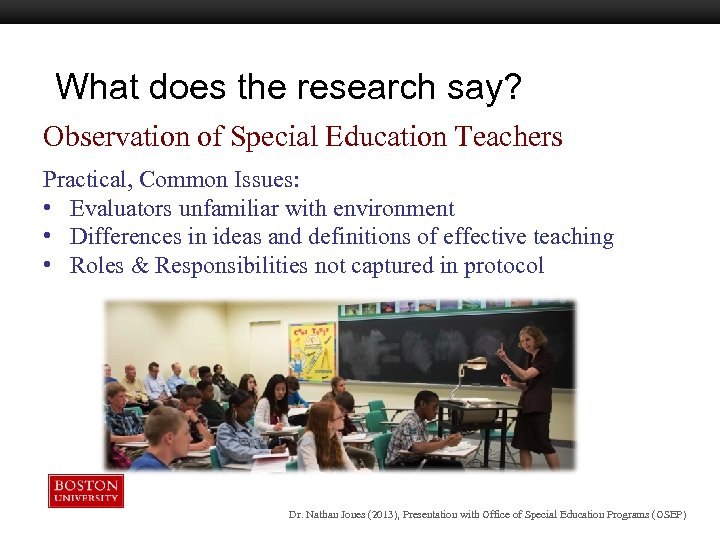
What does the research say? Observation of Special Education Teachers Boston University Slideshow Title Goes Here Practical, Common Issues: • Evaluators unfamiliar with environment • Differences in ideas and definitions of effective teaching • Roles & Responsibilities not captured in protocol Dr. Nathan Jones (2013), Presentation with Office of Special Education Programs (OSEP)
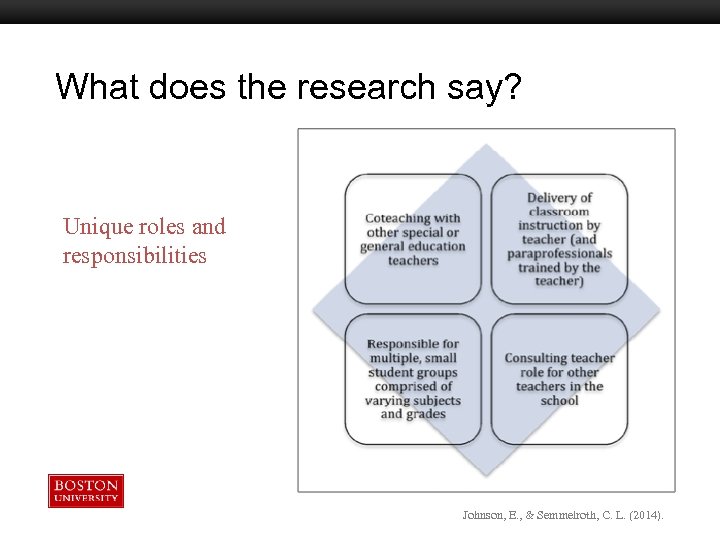
What does the research say? Observation of Special Education Teachers Boston University Slideshow Title Goes Here Unique roles and responsibilities Johnson, E. , & Semmelroth, C. L. (2014).
What does the research say? Boston University Slideshow Title Goes Here New research emerging… What doesn’t work? What can be done to improve existing models? Practical Recommendations for Observations: Ensure that special education teachers are familiar with checklist items OR rubric (e. g. , FFT) Have evaluators and teachers select specific domains to work on Encourage and allow time for teachers to explain their lesson plans or actions during evaluation Video exemplars for administrators Provide extra training for administrators evaluating special education teachers
What does the research say? Observation Tool in Development Boston University Slideshow Title Goes Here RESET Recognizing Effective Special Education Teachers What will it include? ① Video component ② Acknowledge unique roles and settings ③ Scoring on specific instruction strategies ④ Collecting student growth data (still in development) Johnson, E. , & Semmelroth, C. L. (2014).
What does the research say? Boston University Slideshow Title Goes Here PEER Observation/Review of Special Education Teachers Recommendation to improve observations for special education teachers Inform general education observers/reviewers Document peer observer notes and review Peer observer and teacher identify specific areas Encourage teachers to take feedback seriously
What does the research say? Boston University Slideshow Title Goes Here Portfolios for Special Education Teachers May want to consider e-portfolio system Administrators should review often (with teachers) Provide model portfolios & handbook Enlist special education teacher/administrator to review portfolios with main reviewer
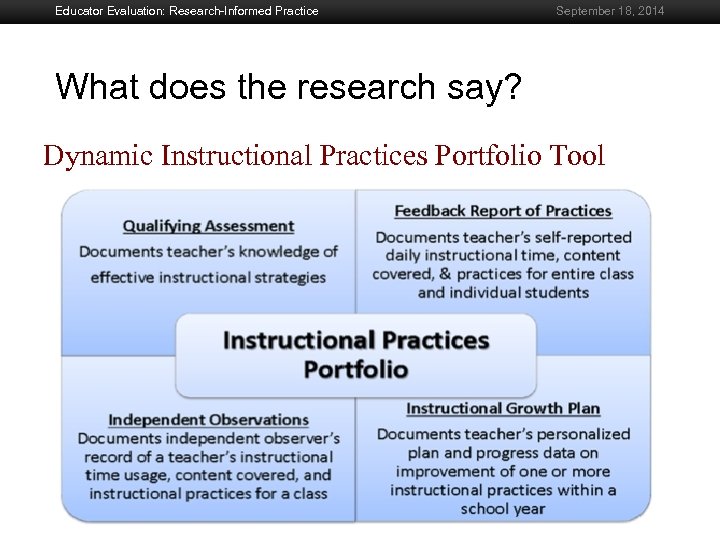
Educator Evaluation: Research-Informed Practice September 18, 2014 What does the research say? Boston University Slideshow Title Goes Here Dynamic Instructional Practices Portfolio Tool Myi. LOGS My Instructional Learning Opportunities Guidance System
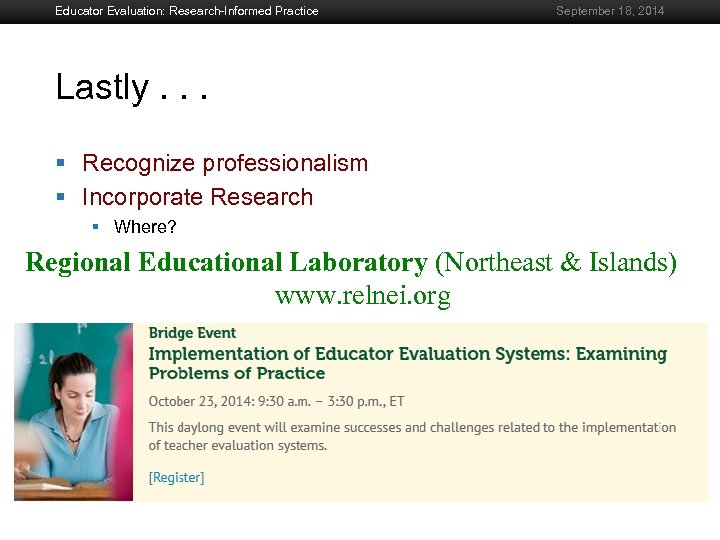
Educator Evaluation: Research-Informed Practice September 18, 2014 Lastly. . . Boston University Slideshow Title Goes Here § Recognize professionalism § Incorporate Research § Where? Regional Educational Laboratory (Northeast & Islands) www. relnei. org
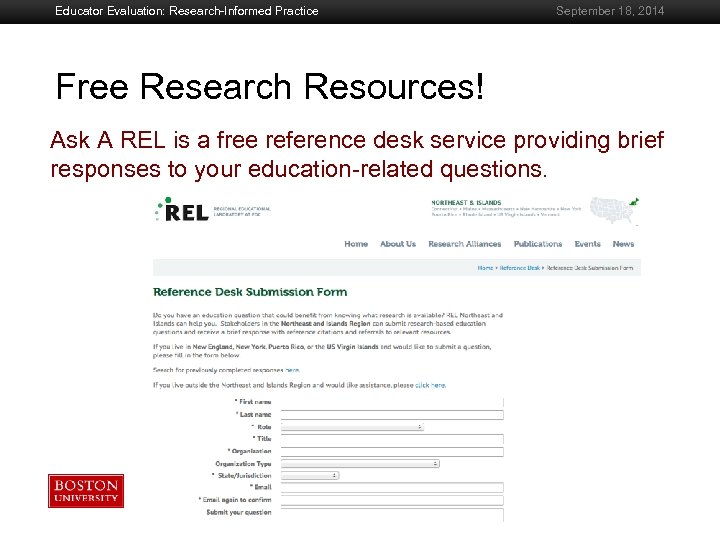
Educator Evaluation: Research-Informed Practice September 18, 2014 Free Research Resources! Boston University Slideshow Title Goes Here Ask A REL is a free reference desk service providing brief responses to your education-related questions.
Free Research Resources! Boston University Slideshow Title Goes Here • Education Resources Information Center (ERIC) • Free access to > 1 million records of journal articles • Often has full text!! (http: //www. eric. ed. gov/) • What Works Clearinghouse (WWC) • Free, easily accessible databases and reports • Provides high quality reviews of educational interventions (programs, products, practices, policies) • Doing What Works (DWW) • Free & Helps educators identify and use effective teaching practices • Provides examples of ways educators might apply research
Скачать презентацию Educator Evaluation Research-Informed Practice Dr Don Beaudette Rachel
8b86238f6edb62cdca8ac18e7378637c.ppt