 Скачать презентацию EDUCATIONAL TECHNOLOGY STANDARDS Robby Robson Eduworks Corporation rrobson eduworks
2812330ae490947cd6442adc0a57efb4.ppt
- Количество слайдов: 24



EDUCATIONAL TECHNOLOGY STANDARDS Robby Robson Eduworks Corporation rrobson@eduworks. com CELL: 541 -760 -6899 October 17, 2002 UC Berkeley - ET Standards Eduworks
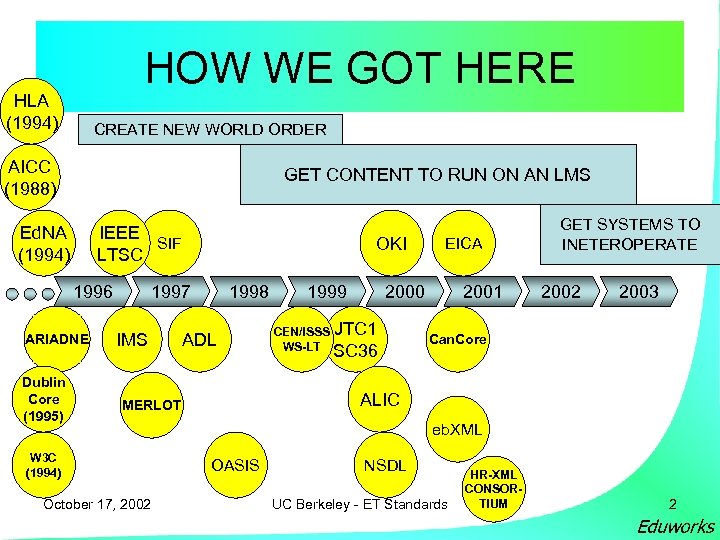
HOW WE GOT HERE HLA (1994) CREATE NEW WORLD ORDER AICC (1988) GET CONTENT TO RUN ON AN LMS Ed. NA (1994) IEEE SIF LTSC 1996 ARIADNE Dublin Core (1995) OKI 1997 IMS 1998 ADL October 17, 2002 2000 CEN/ISSS JTC 1 WS-LT SC 36 2001 2002 2003 Can. Core ALIC MERLOT W 3 C (1994) 1999 EICA GET SYSTEMS TO INETEROPERATE eb. XML OASIS NSDL UC Berkeley - ET Standards HR-XML CONSORTIUM 2 Eduworks
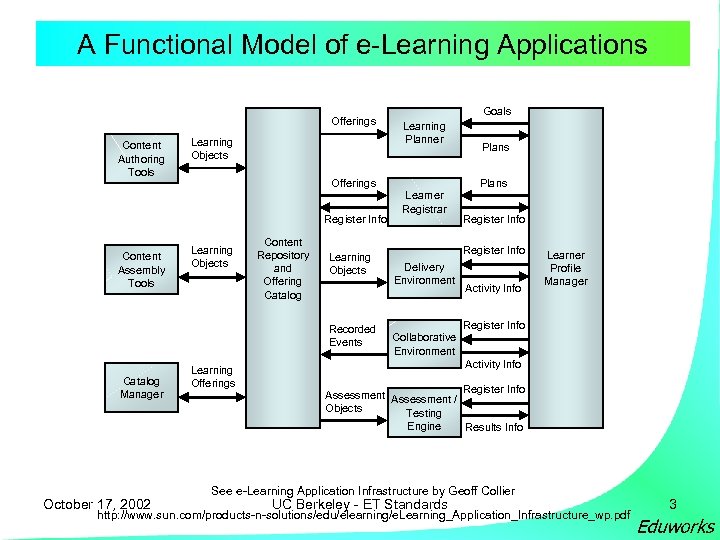
A Functional Model of e-Learning Applications Offerings Content Authoring Tools Learning Objects Content Repository and Offering Catalog Learning Objects Recorded Events Catalog Manager October 17, 2002 Learning Planner Offerings Register Info Content Assembly Tools Goals Learning Offerings Plans Learner Registrar Register Info Delivery Environment Collaborative Environment Activity Info Learner Profile Manager Register Info Activity Info Register Info Assessment / Objects Testing Engine Results Info See e-Learning Application Infrastructure by Geoff Collier UC Berkeley - ET Standards http: //www. sun. com/products-n-solutions/edu/elearning/e. Learning_Application_Infrastructure_wp. pdf 3 Eduworks
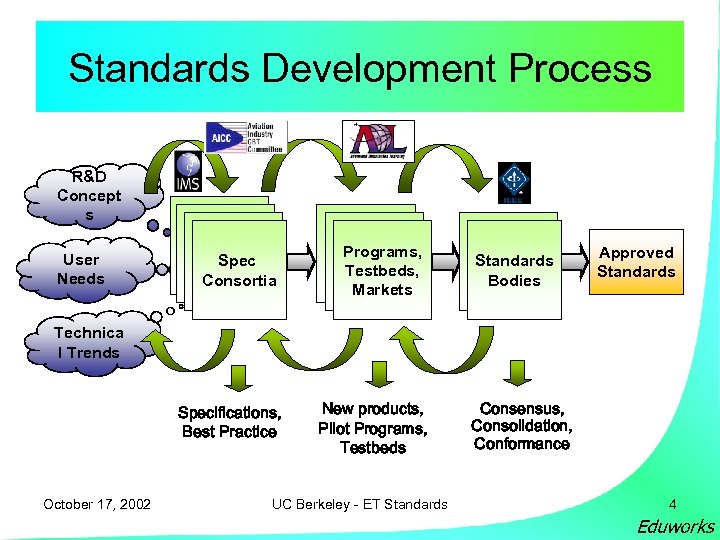
Standards Development Process R&D Concept s User Needs Spec Consortia Programs, Testbeds, Markets Standards Bodies Approved Standards Technica l Trends Specifications, Best Practice October 17, 2002 New products, Pilot Programs, Testbeds UC Berkeley - ET Standards Consensus, Consolidation, Conformance 4 Eduworks
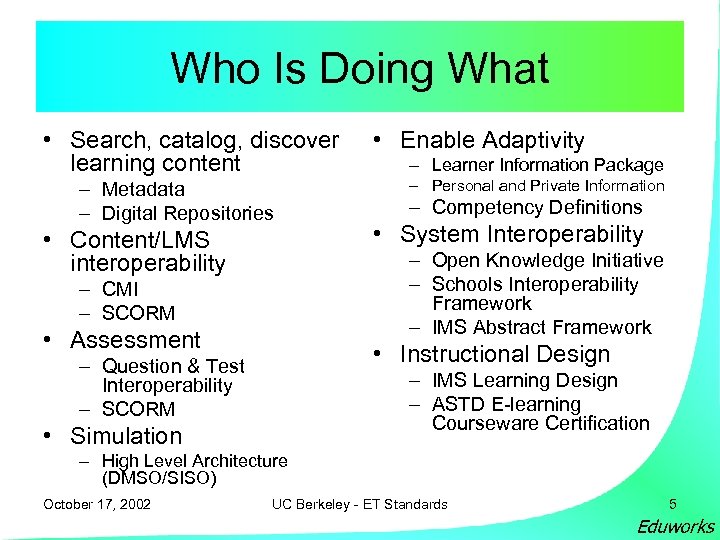
Who Is Doing What • Search, catalog, discover learning content – Metadata – Digital Repositories • Content/LMS interoperability • Enable Adaptivity – Learner Information Package – Personal and Private Information – Competency Definitions • System Interoperability – Open Knowledge Initiative – Schools Interoperability Framework – IMS Abstract Framework – CMI – SCORM • Assessment • Instructional Design – Question & Test Interoperability – SCORM – IMS Learning Design – ASTD E-learning Courseware Certification • Simulation – High Level Architecture (DMSO/SISO) October 17, 2002 UC Berkeley - ET Standards 5 Eduworks
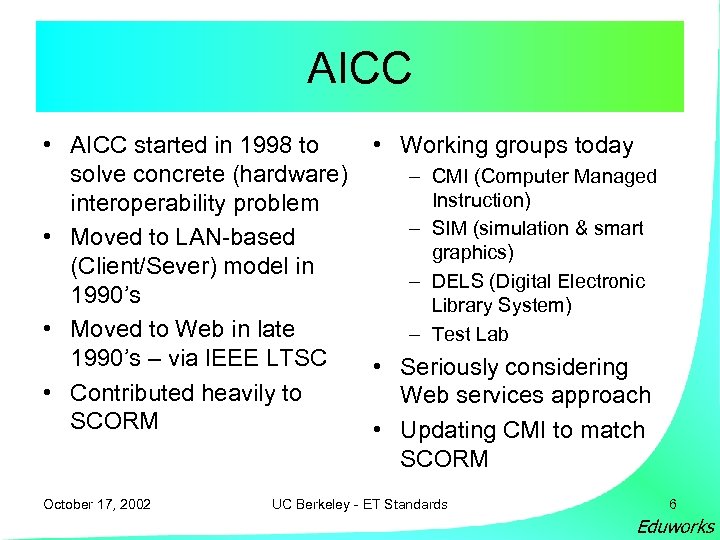
AICC • AICC started in 1998 to solve concrete (hardware) interoperability problem • Moved to LAN-based (Client/Sever) model in 1990’s • Moved to Web in late 1990’s – via IEEE LTSC • Contributed heavily to SCORM October 17, 2002 • Working groups today – CMI (Computer Managed Instruction) – SIM (simulation & smart graphics) – DELS (Digital Electronic Library System) – Test Lab • Seriously considering Web services approach • Updating CMI to match SCORM UC Berkeley - ET Standards 6 Eduworks
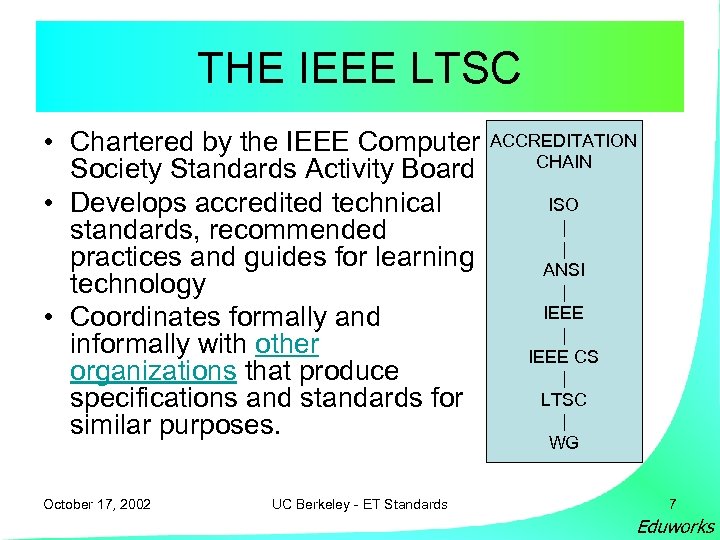
THE IEEE LTSC • Chartered by the IEEE Computer Society Standards Activity Board • Develops accredited technical standards, recommended practices and guides for learning technology • Coordinates formally and informally with other organizations that produce specifications and standards for similar purposes. October 17, 2002 UC Berkeley - ET Standards ACCREDITATION CHAIN ISO | | ANSI | IEEE CS | LTSC | WG 7 Eduworks
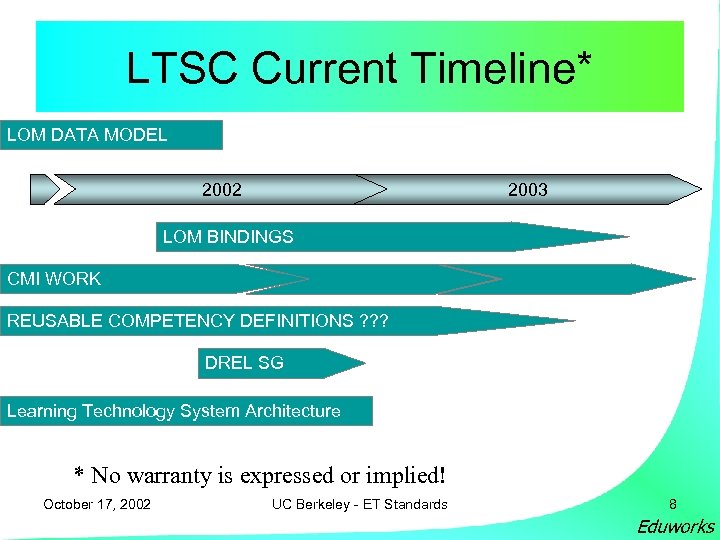
LTSC Current Timeline* LOM DATA MODEL 2002 2003 LOM BINDINGS CMI WORK REUSABLE COMPETENCY DEFINITIONS ? ? ? DREL SG Learning Technology System Architecture * No warranty is expressed or implied! October 17, 2002 UC Berkeley - ET Standards 8 Eduworks
IMS Global Learning Consortium • IMS is an independent, non-profit consortium in which members with competing business interests and different decision-making roles collaborate to satisfy real-world requirements for interoperability and re-use of learning resources. • Established 1997 as a consortium of educators, government agencies, and vendors • Define and deliver specifications to further interoperability for on-line learning technology and content • More than 50 Contributing Members. • Over 70 Developer Network subscribers. • A web community of users October 17, 2002 UC Berkeley - ET Standards 9 Eduworks
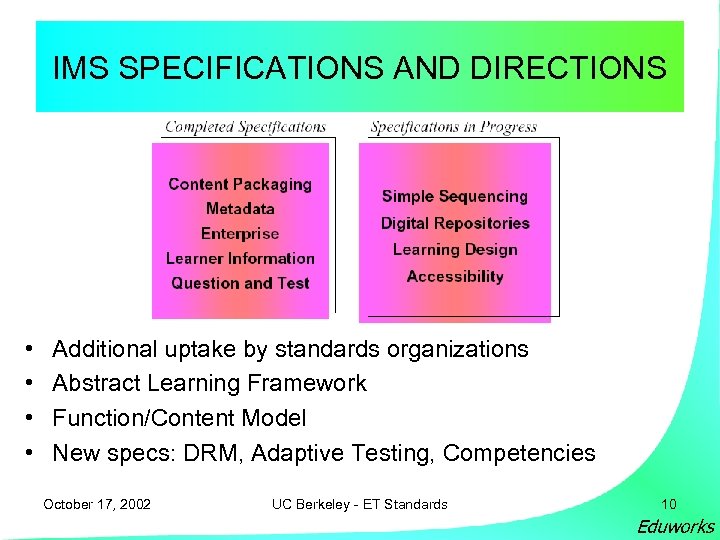
IMS SPECIFICATIONS AND DIRECTIONS • • Additional uptake by standards organizations Abstract Learning Framework Function/Content Model New specs: DRM, Adaptive Testing, Competencies October 17, 2002 UC Berkeley - ET Standards 10 Eduworks
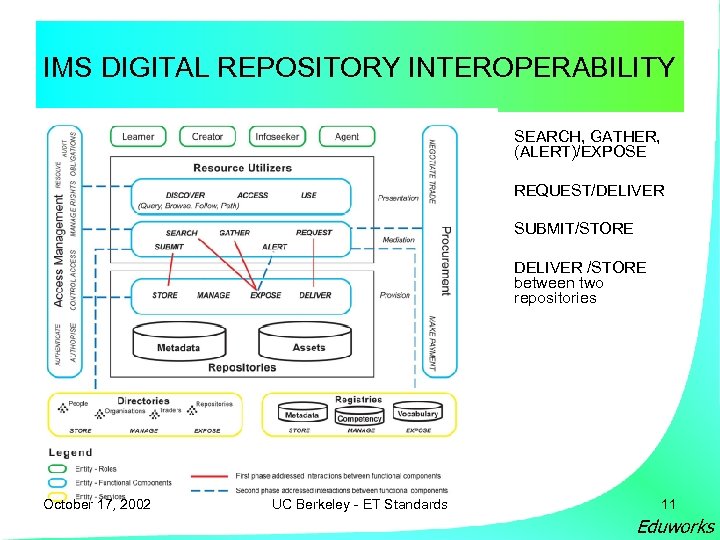
IMS DIGITAL REPOSITORY INTEROPERABILITY • • SUBMIT/STORE • UC Berkeley - ET Standards REQUEST/DELIVER • October 17, 2002 SEARCH, GATHER, (ALERT)/EXPOSE DELIVER /STORE between two repositories 11 Eduworks
The Advanced Distributed Learning initiative • Launched in November of 1997 (Do. D & Whitehouse) • MISSION: – develop a Do. D-wide strategy for using learning and information technologies – modernize education and training – promote cooperation between government, industry and academia – develop e-learning standardization • Specification development delegated to IMS in 1997 October 17, 2002 UC Berkeley - ET Standards 12 Eduworks
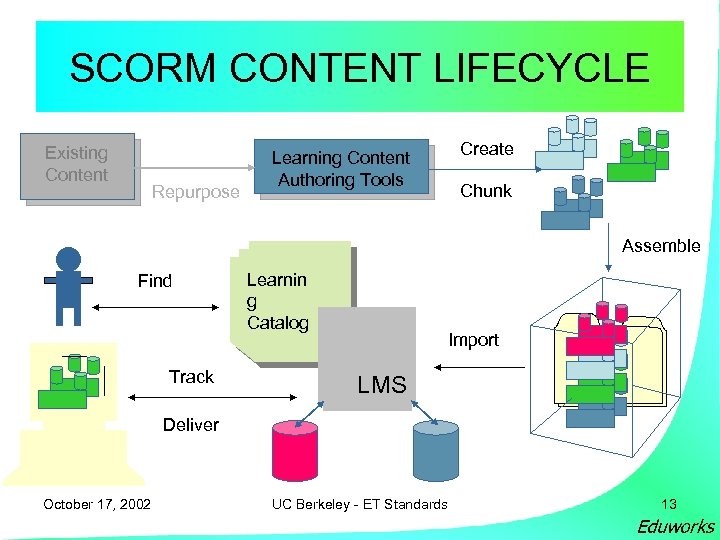
SCORM CONTENT LIFECYCLE Existing Content Repurpose Create Learning Content Authoring Tools Chunk Assemble Find Track Learnin g Catalog Import LMS Deliver October 17, 2002 UC Berkeley - ET Standards 13 Eduworks
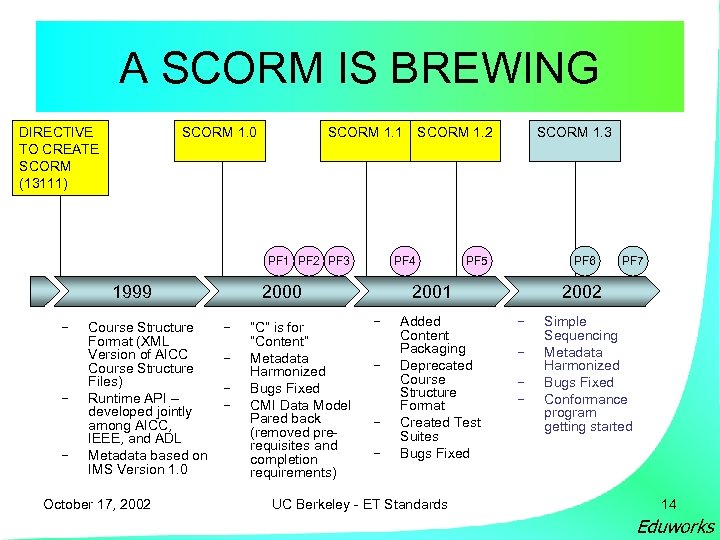
A SCORM IS BREWING DIRECTIVE TO CREATE SCORM (13111) SCORM 1. 0 SCORM 1. 1 PF 2 PF 3 1999 - - - Course Structure Format (XML Version of AICC Course Structure Files) Runtime API – developed jointly among AICC, IEEE, and ADL Metadata based on IMS Version 1. 0 October 17, 2002 PF 4 2000 - “C” is for “Content” Metadata Harmonized Bugs Fixed CMI Data Model Pared back (removed prerequisites and completion requirements) SCORM 1. 2 SCORM 1. 3 PF 5 PF 6 2001 - - Added Content Packaging Deprecated Course Structure Format Created Test Suites Bugs Fixed UC Berkeley - ET Standards PF 7 2002 - Simple Sequencing Metadata Harmonized Bugs Fixed Conformance program getting started 14 Eduworks
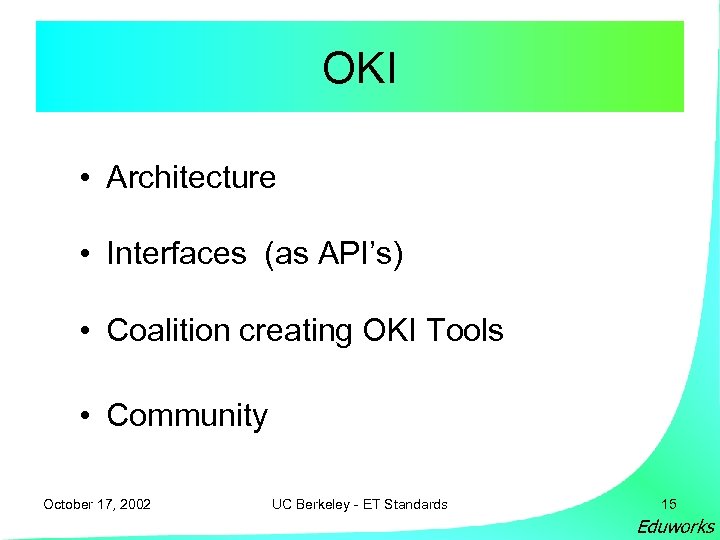
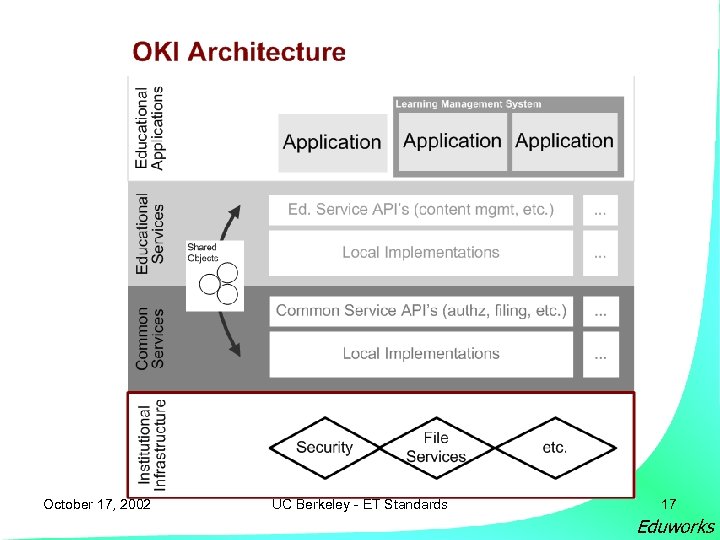
OKI • Architecture • Interfaces (as API’s) • Coalition creating OKI Tools • Community October 17, 2002 UC Berkeley - ET Standards 15 Eduworks
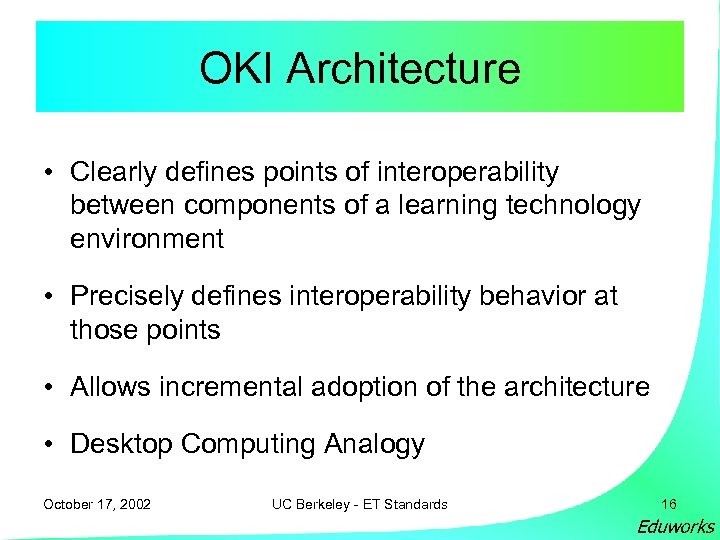
OKI Architecture • Clearly defines points of interoperability between components of a learning technology environment • Precisely defines interoperability behavior at those points • Allows incremental adoption of the architecture • Desktop Computing Analogy October 17, 2002 UC Berkeley - ET Standards 16 Eduworks
October 17, 2002 UC Berkeley - ET Standards 17 Eduworks
ARIADNE • Alliance of Remote Instructional and Distribution Networks for Europe • Founded under EU 4 th Framework in January, 1996. • Became a Foundation in June 2000 • Contributor to LOM A European Association open to the World, for Knowledge Sharing and Reuse, ELearning for all, International Cooperation in Teaching, Serving the Learning Citizen. October 17, 2002 UC Berkeley - ET Standards 18 Eduworks
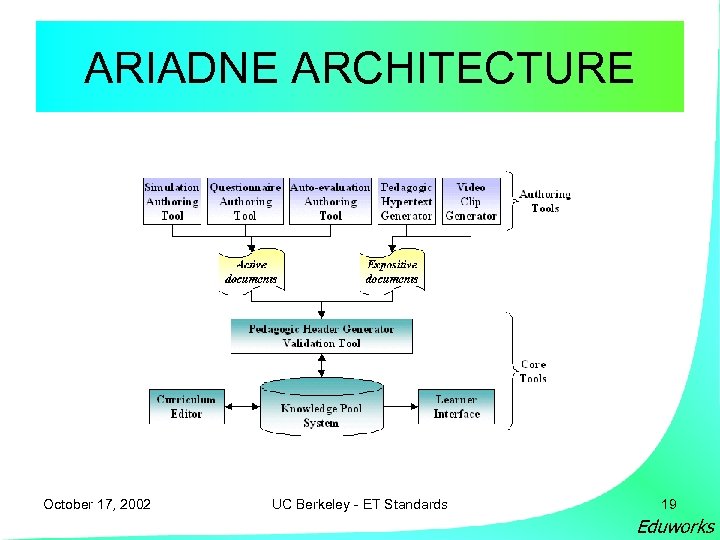
ARIADNE ARCHITECTURE October 17, 2002 UC Berkeley - ET Standards 19 Eduworks
CONFORMANCE TESTING • PROS – CURES THE SYMPOTOMS – Without it interoperability isn’t quite there – Honesty becomes the policy – Feedback into standards process • CONS – CURES THE SYMPTOMS – Does not guarantee interoperability – Gives vendors an out – Effort better spent on making good specifications and standards SEE JON BELL PDF PRESENTATION October 17, 2002 UC Berkeley - ET Standards 20 Eduworks
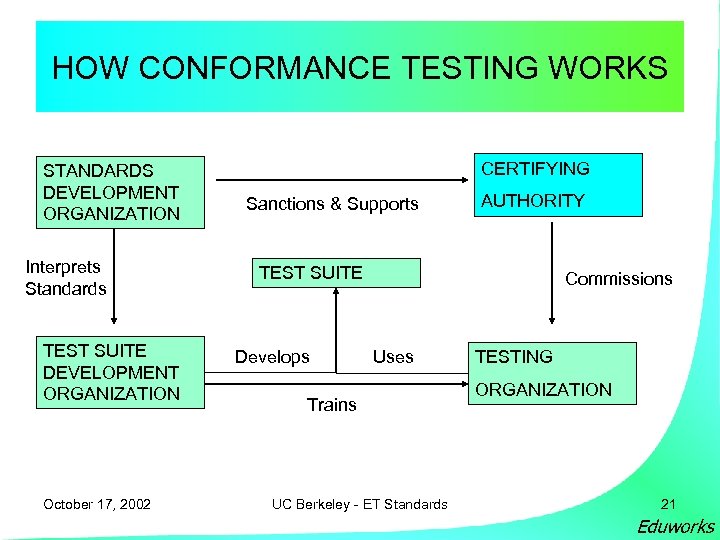
HOW CONFORMANCE TESTING WORKS STANDARDS DEVELOPMENT ORGANIZATION Interprets Standards TEST SUITE DEVELOPMENT ORGANIZATION October 17, 2002 CERTIFYING Sanctions & Supports AUTHORITY TEST SUITE Develops Commissions Uses Trains UC Berkeley - ET Standards TESTING ORGANIZATION 21 Eduworks
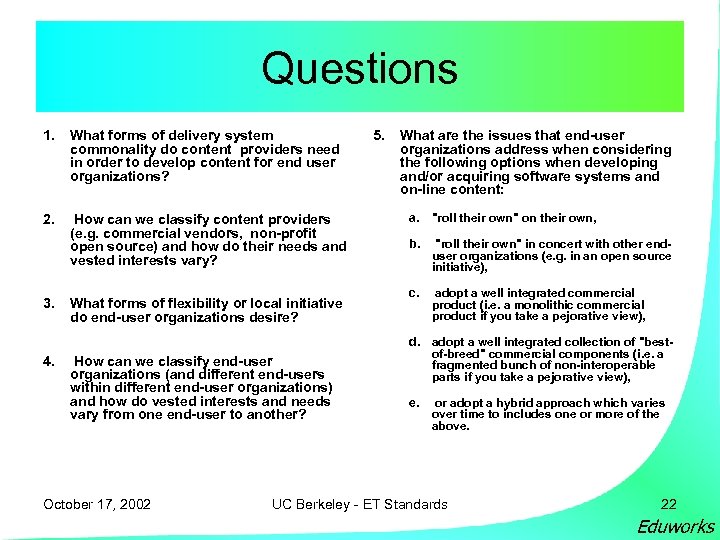
Questions 1. 2. 3. 4. What forms of delivery system commonality do content providers need in order to develop content for end user organizations? How can we classify content providers (e. g. commercial vendors, non-profit open source) and how do their needs and vested interests vary? What forms of flexibility or local initiative do end-user organizations desire? How can we classify end-user organizations (and different end-users within different end-user organizations) and how do vested interests and needs vary from one end-user to another? October 17, 2002 5. What are the issues that end-user organizations address when considering the following options when developing and/or acquiring software systems and on-line content: a. "roll their own" on their own, b. "roll their own" in concert with other enduser organizations (e. g. in an open source initiative), c. adopt a well integrated commercial product (i. e. a monolithic commercial product if you take a pejorative view), d. adopt a well integrated collection of "bestof-breed" commercial components (i. e. a fragmented bunch of non-interoperable parts if you take a pejorative view), e. or adopt a hybrid approach which varies over time to includes one or more of the above. UC Berkeley - ET Standards 22 Eduworks
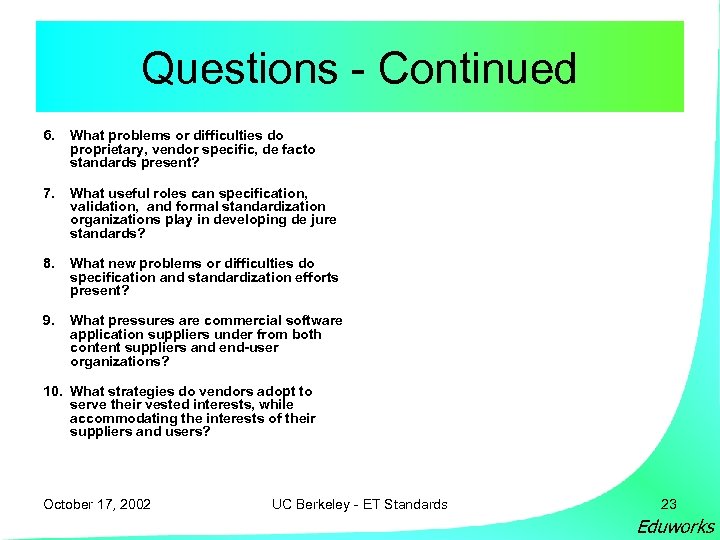
Questions - Continued 6. What problems or difficulties do proprietary, vendor specific, de facto standards present? 7. What useful roles can specification, validation, and formal standardization organizations play in developing de jure standards? What new problems or difficulties do specification and standardization efforts present? 8. 9. What pressures are commercial software application suppliers under from both content suppliers and end-user organizations? 10. What strategies do vendors adopt to serve their vested interests, while accommodating the interests of their suppliers and users? October 17, 2002 UC Berkeley - ET Standards 23 Eduworks
RESOURCES • http: //www. eduworks. com/standards • CETIS (Centre for Educational Technology Interoperability Standards) (http: //www. cetis. ac. uk) October 17, 2002 UC Berkeley - ET Standards 24 Eduworks
Скачать презентацию EDUCATIONAL TECHNOLOGY STANDARDS Robby Robson Eduworks Corporation rrobson eduworks
2812330ae490947cd6442adc0a57efb4.ppt