


 Скачать презентацию Educational Technology Plan for Virginia 2003 -2009 Explore
c97cf7ba0fee85c6c616a079e597fbb6.ppt
- Количество слайдов: 89
 Educational Technology Plan for Virginia, 2003 -2009 Explore the Planning Virginia Department of Education
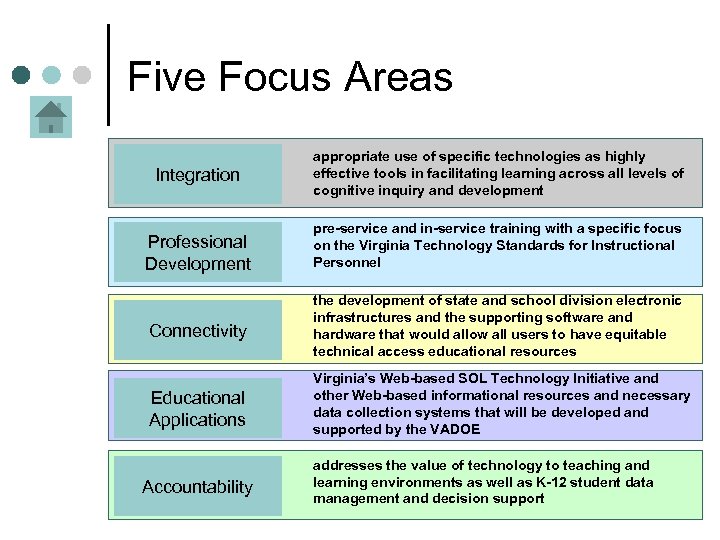 Five Focus Areas Integration Professional Development appropriate use of specific technologies as highly effective tools in facilitating learning across all levels of cognitive inquiry and development pre-service and in-service training with a specific focus on the Virginia Technology Standards for Instructional Personnel Connectivity the development of state and school division electronic infrastructures and the supporting software and hardware that would allow all users to have equitable technical access educational resources Educational Applications Virginia’s Web-based SOL Technology Initiative and other Web-based informational resources and necessary data collection systems that will be developed and supported by the VADOE Accountability addresses the value of technology to teaching and learning environments as well as K-12 student data management and decision support
 Integration refers to the appropriate use of specific technologies as highly effective tools in facilitating learning across all levels of cognitive inquiry and development. Integration is consistently using technology appropriately and effectively to facilitate learning for all students. This element specifically addresses equity of access, technology integration partnerships, and site-based collaborations between administrators, teachers, and students needed to infuse integration into common teaching practice.
 Integration Goal 1: Improve teaching and learning through the appropriate use of technology. Targets 1 -4: Administrators Targets 5 -8: Teachers Targets 9 -12: Students Targets 13 -15: Standards Goal 2: Improve statewide equity in the implementation of technology-enhanced teaching and learning. Targets 1 -2
 Goal 1: Improve teaching and learning through the appropriate use of technology. Targets: Administrators 1. 2. 3. 4. Administrators have a vision and plan for technology use and integration. Correlates to NETS-A I. A, I. B School leaders provide support for integration of technology into instruction. Correlates to NETS-A II Leaders can effectively evaluate instructional uses of educational technology. Correlates to NETS-A V Technology integration partnerships are established among educational technology stakeholders.
 Target 1: Administrators have a vision and plan for technology use and integration. Goal 1, Target 1: Actions ¢ ¢ Support technology leadership training for administrators. Involve administrators in technology plan development. Provide resources to administrators so that they can develop a vision and a plan. Support and encourage administrators to attend and make presentations at the Educational Technology Leadership Conference and other regional/state/national conferences. Goal 1: Improve teaching and learning through the appropriate use of technology.
 Target 2: School leaders provide support for integration of technology into instruction. Goal 1, Target 2: Actions ¢ ¢ Support technology leadership training for administrators. Involve all administrators in technology plan development. Provide resources to leaders so that they can become strong advocates for technology integration. Support and encourage administrators to attend and make presentations at the Educational Technology Leadership Conference and other regional/state/national conferences. Goal 1: Improve teaching and learning through the appropriate use of technology.
 Target 3: Leaders can effectively evaluate instructional uses of educational technology. Goal 1, Target 3: Actions ¢ ¢ ¢ Design and conduct training to help principals and teachers identify effective technology integration strategies. Use a variety of instructional resources and mediums to train leaders to identify effective use of instructional technology. Conduct periodic observations of classroom instruction using a technology integration observation form to determine levels of technology integration and effective uses of technology. Goal 1: Improve teaching and learning through the appropriate use of technology.
 Target 4: Technology integration partnerships are established among educational technology stakeholders. Goal 1, Target 4: Actions ¢ ¢ Continue to develop partnerships with universities to pilot new instructional strategies for integrating technology. Continue to work with the educational services departments of the public television stations so that technology resources and training in the effective use of technology in the classroom are made available to all teachers. Enhance the relationship with the Tidewater Center for Technology Access to provide more access to adaptive technologies for special education students. Use federal grant funds to host and co-sponsor regional and statewide technology symposia and training that promote the sharing of instructional strategies and techniques. Goal 1: Improve teaching and learning through the appropriate use of technology.
 Goal 1: Improve teaching and learning through the appropriate use of technology. Targets: Teachers 5. Teachers effectively integrate instructional technology. 6. Teachers collaborate to improve and enrich instruction using technology. 7. Teachers use technology-based intervention strategies to improve student achievement. 8. Teachers understand model the acceptable use of technology in teaching and learning.
 Target 5: Teachers effectively integrate instructional technology. Goal 1, Target 5: Actions ¢ ¢ ¢ Design and conduct training to help teachers identify effective integration strategies. Conduct peer observations of classroom instruction using a technology integration observation form to determine levels of technology integration and effective uses of technology. Appoint teams that include lab managers, technology representatives, instructional technologists, library media specialists, and parents to collaborate with teachers on improving and enriching instruction through the use of technology. Goal 1: Improve teaching and learning through the appropriate use of technology.
 Target 6: Teachers collaborate to improve and enrich instruction using technology. Goal 1, Target 6: Actions Appoint teams that include lab managers, technology representatives, instructional technologists, library media specialists, and parents to collaborate with teachers on improving and enriching instruction through the use of technology. ¢ Explore alternative scheduling arrangements that support collaboration. ¢ Goal 1: Improve teaching and learning through the appropriate use of technology.
 Target 7: Teachers use technology-based intervention strategies to improv student achievement. Goal 1, Target 7: Actions ¢ ¢ ¢ Identify technology tools for instruction and remediation of the Standards of Learning. Develop and disseminate models that demonstrate the use of technology to facilitate differentiated instruction. Offer coursework via distance learning to meet unique instructional needs. Provide technology-based instructional delivery, support, and management systems that support the development and utilization of intervention strategies. Establish a software review and selection process that identifies appropriate software for instruction and remediation. Technology-based intervention strategies are implemented in all curriculum areas. Goal 1: Improve teaching and learning through the appropriate use of technology.
 Target 8: Teachers understand model the acceptable use of technolog teaching and learning. Goal 1, Target 8: Actions ¢ ¢ Involve students, teachers, administrators, parents, and community members in periodic review of the AUP. Examine samples of AUPs developed by other school divisions. Provide in-service training on the impact of the AUP on teaching and learning. Include AUP compliance as a component of teacher evaluation and observation instruments. Goal 1: Improve teaching and learning through the appropriate use of technology.
 Goal 1: Improve teaching and learning through the appropriate use of technology. Targets: Students 9. Students routinely use technology in a variety of learning activities across the curriculum. 10. Students will have information literacy skills. 11. Student learning and achievement will be enhanced through the effective integration of technology. 12. Student learning and achievement will be enhanced through the use of advanced technologies.
 Target 9: Students routinely use technology in a variety of learning activities across the curriculum. Goal 1, Target 9: Actions Assess whether students are using technology in a variety of activities across the curriculum. ¢ Assess whether students are routinely using a variety of technologies. ¢ Goal 1: Improve teaching and learning through the appropriate use of technology.
 Target 10: Students will have information literacy skills. Goal 1, Target 10: Actions ¢ Assess whether students in the school division are attaining a level of information literacy skills that include one or more of the following characteristics: student is able to conduct research to locate, collect, organize, and evaluate information; electronically exchange information, and collaborate with others outside the classroom. Goal 1: Improve teaching and learning through the appropriate use of technology.
 Target 11: Student learning and achievement will be enhanced through the effective integration of technology. Goal 1, Target 11: Actions ¢ Assess whether students in the school division are attaining a level of information literacy skills that include one or more of the following characteristics: self-directed learning, multidisciplinary technology-based activities, peer collaboration and interaction, and higher-order thinking skills to solve real problems. Goal 1: Improve teaching and learning through the appropriate use of technology.
 Target 12: Student learning and achievement will be enhanced through the use of advanced technologies. Goal 1, Target 12: Actions ¢ ¢ Target appropriate funding to provide teacher’s and student’s access to advanced technologies. Use state and regional contracts or negotiate local contracts for the procurement of advanced technologies. Provide training for teachers in the use and curriculum integration of advanced technologies. Submit a proposal for K-12 education grants that provide advanced technologies. Goal 1: Improve teaching and learning through the appropriate use of technology.
 Goal 1: Improve teaching and learning through the appropriate use of technology. Targets: Standards 13. Computer/Technology Standards of Learning (SOL) are fully integrated across all curriculum areas. 14. Instructional personnel meet Technology Standards for Instructional Personnel (TSIP). 15. Students meet Computer/Technology Standards of Learning (C/T SOL).
 Target 13: Computer/Technology Standards of Learning (SOL) are fully integrated across all curriculum areas. Goal 1, Target 13: Actions ¢ ¢ ¢ Develop a format for schools to state their technology integration goals in their school improvement plans. Create and use curriculum maps that demonstrate integration of technology into the curriculum. Teachers develop lesson plans that integrate technology and information-literacy skills and incorporate them into the instructional program. Promote a consistent integration of technology at all grade levels in a variety of instructional settings. Develop a matrix of technology integration to infuse instructional technology into all curriculum areas at all grade levels. Develop and implement instructional models for integrating technology. Goal 1: Improve teaching and learning through the appropriate use of technology.
 Target 14: Instructional personnel meet Technology Standards for Instructional Personnel (TSIP). Goal 1, Target 14: Actions Monitor compliance of the TSIP requirements. ¢ Continue to provide training to instructional personnel who need to meet the TSIP. ¢ Goal 1: Improve teaching and learning through the appropriate use of technology.
 Target 15: Students meet Computer/Technology Standards of Learning (C/T SOL). Goal 1, Target 15: Actions ¢ ¢ ¢ Set expectations for student mastery of the Computer Technology Standards of Learning. Set expectations for the incorporation of the Computer/Technology Standards of Learning into teaching and learning activities. Assess the student mastery of the Computer/Technology Standards of Learning. Goal 1: Improve teaching and learning through the appropriate use of technology.
 Goal 2: Improve statewide equity in the implementation of technologyenhanced teaching and learning. Targets 1. 2. Educators and students have access to technology to support instructional goals. Appropriate technology-based instructional strategies are used for students with unique needs.
 Target 1: Educators and students have access to technology to support instructional goals. Goal 2, Target 1: Actions ¢ ¢ Develop additional computer labs, increase the number of computers in classrooms, and provide mobile laptop labs. Upgrade school library software and computer hardware and other technology to provide greater access to educational resources. Implement a plan to install a core collection of instructional software on all servers at the school site. Upgrade access to the Internet and provide access to other online resources as appropriate. Goal 2: Improve Statewide equity in the implementation of technology-enhanced teaching and learning.
 Target 2: Appropriate technology-based instructional strategies are used for students with unique needs. Goal 2, Target 2: Actions ¢ ¢ ¢ Provide adaptive and instructional technology for special needs populations. Include funding for assistive technology in the budget for special education departments. Identify and provide specialized instructional resources for at-risk students and for remediation needs. Goal 2: Improve Statewide equity in the implementation of technology-enhanced teaching and learning.
 Professional Development and Support Programs Professional development covers both preservice and in-service training with a specific focus on the Virginia Technology Standards for Instructional Personnel. It addresses the collaborative development of materials, courses, certification programs, and various staff development delivery models related to the effective integration of technology in K-12 schools. Support programs for technology integration are defined in terms of financial assistance and the necessity for site -based instructional technologists.
 Professional Development and Support Programs ¢ ¢ ¢ Goal 1: Establish partnerships for identifying and delivering effective technology training to assist educators as they help students achieve high academic standards. Goal 2: Administer grant programs and financial assistance initiatives that support implementation of educational technology integration. Goal 3: Establish and maintain instructional technologist positions (including site-based technology resource teachers) in school divisions.
 Goal 1: Establish partnerships for identifying and delivering effective technology training to assist educators as they help students achieve high academic standards. Targets 1. 2. 3. 4. Educator training programs reflect preservice coursework and experiences that include effective approaches to integrating technology into K-12 education. A variety of classes, training, and resources pertaining to integrating technology effectively are available for staff development. Technology-related staff development offered by various entities is provided in a variety of topics and delivery methods. Technology leadership activities are provided to K 12 educational technology stakeholders.
 Target 1: Educator training programs reflect pre-service coursework and experiences that include effective approaches to integrating technology into K-12 education. Goal 1, Target 1: Actions Partner with teacher training institutions to provide practical experiences in technology for pre-service teachers. ¢ Collaborate with teacher preparation institutions to evaluate effectiveness of pre-service technology training programs. ¢ Goal 1: Establish partnerships for identifying and delivering effective technology training to assist educators as they help students achieve high academic standards.
 Target 2: A variety of classes, training, and resources pertaining to integrating technology effectively are available for staff development. Goal 1, Target 2: Actions ¢ ¢ ¢ ¢ ¢ Offer CEUs for technology course work. Use grant funds to reimburse staff for credits toward graduate degrees, licensure, or license renewal. Contract with local colleges and universities to offer coursework consistent with the TSIP and/or ISTE standards. Provide training on technology integration topics at various levels for specific audiences. Provide technology training for substitutes. Offer technology-training classes for parents. All school administrators participate in staff development sessions on curriculum integration of technology. Promote sharing of best practices for integration strategies at state and regional conferences, division principals’ meetings, and building-level faculty meetings. Use local educational TV cable channels and/or satellite broadcasts to share best practices in the integration of technology. Goal 1: Establish partnerships for identifying and delivering effective technology training to assist educators as they help students achieve high academic standards.
 Target 3: Technology-related staff development offered by various entities is provided in a variety of topics and delivery methods. Goal 1, Target 3: Actions ¢ ¢ ¢ ¢ Attend training opportunities offered by the VDOE, including Marco. Polo Internet Content for the Classroom train-the-trainers training. Explore virtual training opportunities (anywhere, anytime training, etc. ). Offer technology integration lesson plan development training. Offer training support for assistive technology. Provide ongoing professional development in new and emerging technologies at all levels. Offer beginning, intermediate, and advanced level training. Goal 1: Establish partnerships for identifying and delivering effective technology training to assist educators as they help students achieve high academic standards.
 Target 4: Technology leadership activities are provided to K-12 educational technology stakeholders. Goal 1, Target 4: Actions ¢ ¢ Encourage teachers to participate in high quality technology leadership training programs, such as the National Teacher Training Institutes and the Marco. Polo train-the - trainers program. Require teachers to design individualized training programs. Ensure that school improvement plans include leadership staff development. Goal 1: Establish partnerships for identifying and delivering effective technology training to assist educators as they help students achieve high academic standards.
 Goal 2: Administer grant programs and financial assistance initiatives that support implementation of educational technology integration. Targets 1. 2. Grant programs and alternative sources of funding that support educational technology are administered. Teacher education institutions, businesses, organizations and private entities become a partner in the implementation of technology-related grants focusing on technology.
 Target 1: Grant programs and alternative sources of funding that support educational technology are administered. Goal 2, Target 1: Actions ¢ ¢ ¢ Submit proposals for technology grants. Take advantage of Elementary Secondary and Elementary Act (ESEA) flexibility provisions. Use Title VI, Title II, Part A, Title I grant funds, lease/purchase agreements to fund the local technology plan and address technology needs more effectively. Fully participate in the Web-based SOL Technology Initiative funding. Utilize Virginia Satellite Education Network) VSEN course offerings Goal 2: Administer grant programs and financial assistance initiatives that support implementation of educational technology integration.
 Target 2: Teacher education institutions, businesses, organizations and private entities become a partner in the implementation of technology-related grants focusing on technology. Goal 2, Target 2: Actions ¢ Maximize use of local options for the development of partnerships targeting technology-related grants that focus on technology integration. Goal 2: Administer grant programs and financial assistance initiatives that support implementation of educational technology integration.
 Goal 3: Establish and maintain instructional technologist positions (including site-based technology resource teachers) in school divisions. Targets 1. 2. Site-based instructional technologists are available to all schools. Staff development models and activities that are designed for sitebased instructional technologists are available for all K-12 schools.
 Target 1: Site-based instructional technologists are available to all schools. Goal 3, Target 1: Actions Form “technology mentoring teams”. ¢ Develop peer-coaching programs. ¢ Adopt local guidelines for site-based instructional technologists. ¢ Goal 3: Establish and maintain instructional technologist positions (including sitebased technology resource teachers) in school divisions.
 Target 2: Staff development models and activities that are specifically designed for site-based instructional technologists are available for all K-12 schools. Goal 3, Target 2: Actions ¢ ¢ ¢ Offer training on emerging technologies and their applications in K-12 instructional programs. Ensure that building-level technology plans include training programs for instructional technologists. Content area professional associations offer pre- or post-conference technology training workshops. Goal 3: Establish and maintain instructional technologist positions (including sitebased technology resource teachers) in school divisions.
 Connectivity includes such concerns as the development of state and school division electronic infrastructures and the supporting software and hardware that would allow all users to have equitable technical access to local, state, and worldwide educational resources. Also covered are network connectivity standards and common protocols, network security, Internet usage, Intranets, and hardware/software guidelines, as well as leadership and resources related to technology infrastructure procurement and maintenance.
 Connectivity ¢ ¢ Goal 1: Ensure that all public schools have access to integrated instructional and administrative services across interoperable high-speed networks. Goal 2: Ensure sufficient support for ongoing, reliable network operations. Goal 3: Provide leadership and resources to promote efficient procurement of infrastructure including the identification and procurement of emerging technologies. Goal 4: Ensure that school divisions have in place network security, filtering and disaster recovery plan.
 Goal 1: Ensure that all public schools have access to integrated instructional and administrative services across interoperable highspeed networks. Targets 1. 2. 3. 4. Every instructional and administrative area in every school has a sufficient number of network connections to support the high bandwidth requirements of current and future instructional and administrative applications. Each school division connects all school facilities through a wide area network with sufficient bandwidth to accommodate instructional and administrative needs. Each school local area network has reliable high-speed access to the Internet, capable of supporting instructional and administrative applications and initiatives. An integrated suite of instructional and administrative applications supported by a standards -based enterprise architecture for K-12 schools is in place.
 Target 1: Every area in every school has a sufficient number of network connections to support the high bandwidth requirements of current and future instructional and administrative applications. Goal 1, Target 1: Actions ¢ ¢ ¢ Participate in the Web-based SOL Technology Initiative to develop a standards-based infrastructure in high schools that can be replicated at middle and elementary schools. Require all schools to comply with state and local standards for wiring and electrical infrastructure installations and upgrades. Establish a 5: 1 ratio of multimedia, networked computers to students. Establish a ratio of computers to students of 1: 1 in grades 3 -12 and 1: 3 in Grades 1 -2. Upgrade and/or replace network computers on a threeyear cycle. Goal 1: Ensure that all public schools have access to integrated instructional and administrative services across interoperable high-speed networks.
 Target 2: Each school division connects all school facilities through a wide area network with sufficient bandwidth to accommodate instructional and administrative needs. Goal 1, Target 2: Actions ¢ ¢ ¢ Participate in the Web-based SOL Technology Initiative to develop school division wide area network connectivity that will support increasing bandwidth needs. Follow state and local standards for designing and supporting wide area networks. Establish and maintain a wide area network connecting all schools at either 1 Gigabyte Ethernet over private fiber or T-1 over leased lines. Goal 1: Ensure that all public schools have access to integrated instructional and administrative services across interoperable high-speed networks.
 Target 3: Each school local area network has reliable high-speed access to the Internet, capable of supporting instructional and administrative applications and initiatives. Goal 1, Target 3: Actions ¢ ¢ ¢ Participate in the Web-based SOL Technology Initiative to develop high-speed local area networks in high schools that can be replicated in middle and elementary schools. Follow industry standards for designing and supporting local area networks in all schools. Lease two (TI) lines to the Internet that can be shared by all schools over the wide area network. Seek to significantly upgrade Internet service in the next budget year. Goal 1: Ensure that all public schools have access to integrated instructional and administrative services across interoperable high-speed networks.
 Target 4: An integrated suite of instructional and administrative applications supported by a standards -based enterprise architecture for K-12 schools is in place. Goal 1, Target 4: Actions Participate in the Web-based SOL Technology Initiative to build a standards based technical architecture for high schools that can be replicated in middle and elementary schools. ¢ Adopt new applications that can be readily integrated and address current and future needs. ¢ Goal 1: Ensure that all public schools have access to integrated instructional and administrative services across interoperable high-speed networks.
 Goal 2: Ensure sufficient support for ongoing, reliable network operations. Targets 1. 2. 3. 4. Adequate support personnel are in place to operate and support K-12 school technology infrastructure. Support personnel for K-12 school infrastructure have appropriate technical skills. School systems have customer support systems in place to address technical problems in a timely and efficient manner. School divisions plan for the total cost of ownership (TCO) associated with K-12 technology.
 Target 1: Adequate support personnel are in place to operate and support K-12 school technology infrastructure. Goal 2, Target 1: Actions Allocate funding for an appropriate ratio of equipment to desktop support staff in division technology budget. ¢ Develop or offer technician training programs. ¢ Train teachers to identify and fix minor technical problems. ¢ Share technical staff among divisions. ¢ Goal 2: Ensure sufficient support for ongoing, reliable network operations.
 Target 2: Support personnel for K-12 school infrastructure have appropriate technical skills. Goal 2, Target 2: Actions ¢ ¢ ¢ Target appropriate funding per technical support employee for additional training in division technology budget. Provide resources and support for division technology support personnel to obtain industry standard certification. Include training programs for technology support personnel in school division technology plan. Goal 2: Ensure sufficient support for ongoing, reliable network operations.
 Target 3: School systems have customer support systems in place to address technical problems in a timely and efficient manner. Goal 2, Target 3: Actions ¢ ¢ ¢ Create and deploy an intranet/Web-based service request system for technical difficulties. Participate in collaborative agreements for sharing specialized technology personnel with other school divisions or entities. Include development of procedures for technical problem resolution in technology plans. Goal 2: Ensure sufficient support for ongoing, reliable network operations.
 Target 4: School divisions plan for the total cost of ownership (TCO) associated with K-12 technology. Goal 2, Target 4: Actions ¢ Include total cost of ownership studies and strategies in school division technology planning. Goal 2: Ensure sufficient support for ongoing, reliable network operations.
 Goal 3: Provide leadership and resources to promote efficient procurement of infrastructure including the identification and procurement of emerging technologies. Targets 1. 2. K-12 school technology procurement process is efficient and cost effective. School divisions are regularly informed about emerging technologies for instruction and administration.
 Target 1: K-12 school technology procurement process is efficient and cost effective. Goal 3, Target 1: Actions Use state and regional contracts or negotiate local contracts. ¢ Establish guidelines and specifications for hardware and software purchases. ¢ Provide online resource of purchasing information for frequently purchased technology items. ¢ Goal 3: Provide leadership and resources to promote efficient procurement of infrastructure including the identification and procurement of emerging technologies.
 Target 2: School divisions are regularly informed about emerging technologies for instruction and administration. Goal 3, Target 2: Actions Investigate mechanism for central distribution of video-on-demand (instructional and informational programming) across a video network. ¢ Plan regular meetings of administrative and technology instructional support staff featuring new technologies and models of technology integration. ¢ Goal 3: Provide leadership and resources to promote efficient procurement of infrastructure including the identification and procurement of emerging technologies.
 Goal 4: Ensure that school divisions have in place network security, filtering and disaster recovery plan. Targets 1. 2. 3. Policies, procedures, and technologies are in place to ensure that computing resources are secure and recoverable. School divisions maintain an up-todate Acceptable Use Policy (AUP) and effectively use network filtering solutions. School divisions have appropriate and effective network and data security policies and systems.
 Target 1: Policies, procedures, and technologies are in place to ensure that computing resources are secure and recoverable. Goal 4, Target 1: Actions ¢ All school division networks will utilize both firewall and virus protection software with daily extensive taped backup every day to provide recovery of data if necessary. Goal 4: Ensure that school divisions have in place network security, filtering and disaster recovery plan.
 Target 2: School divisions maintain an up-to-date Acceptable Use Policy (AUP) and effectively use network filtering solutions. Goal 4, Target 2: Actions Involve students, teachers, administrators, parents, and community members in the periodic review of the AUP. ¢ File updated AUP with the Department of Education every two years. ¢ Update and utilize appropriate school division network filtering solutions. ¢ Goal 4: Ensure that school divisions have in place network security, filtering and disaster recovery plan.
 Target 3: School divisions have appropriate and effective network and data security policies and systems. Goal 4, Target 3: Actions ¢ ¢ Develop and communicate policy to students, teachers, administrators, parents, and community members. Identify personnel responsible for activities that relate to the use of the network. Plan for overall coordination of relationship of network to other regional and state networks. Acquire blocking software designed to limit students’ access to specific types of information. Goal 4: Ensure that school divisions have in place network security, filtering and disaster recovery plan.
 Educational Applications Educational applications relate to the instructional and administrative applications that will run over the infrastructure “highway” referenced in the Connectivity element. A major area includes Virginia’s Web-based SOL Technology Initiative as well as other Web-based informational resources and necessary data collection systems that will be developed and supported by the Virginia Department of Education. Focus areas will include appropriate use and stakeholder sharing of networked educational courses, applications, and instructional resources that support the Virginia Standards of Learning using the supporting functions and delivery systems of distributed/distance learning technologies to include the Virginia Satellite Education Network (VSEN).
 Educational Applications Goal 1: Improve teaching and learning through the appropriate use of network accessible educational applications. ¢ Goal 2: Promote and develop Webbased applications, services and resources. ¢ Goal 3: Offer digital learning opportunities at state and local levels. ¢
 Goal 1: Improve teaching and learning through the appropriate use of network accessible educational applications. Targets 1. Teaching and learning resources that effectively support the Virginia Standards of Learning (SOL) have been identified, communicated, and developed.
 Target 1: Teaching and learning resources that effectively support the Virginia Standards of Learning (SOL) have been identified, communicated, and developed. Goal 1, Target 1: Actions ¢ ¢ ¢ Provide staff development and training opportunities that address the identification, evaluation, SOL correlation, and selection processes for technology-based materials including those for remediation. Create and maintain an electronic curriculum guide that ties instructional media materials to the SOL and local curriculum. Use TSIP certification, technology-use surveys, and classroom observations to assess that teaching and learning resources have been identified and utilized. Provide access to a full range of digital content to supplement printed textbook and other analog learning resources. Provide online access to the core curriculum in the form of elearning courses for secondary students, where appropriate. Goal 1: Improve teaching and learning through the appropriate use of network accessible educational applications.
 Goal 2: Promote and develop Web-based applications, services and resources. Targets 1. 2. 3. 4. 5. All schools are participating successfully in the Virginia Web-based SOL Technology Initiative. School divisions use Web-based applications for state data collection, warehousing, and reporting. Use of a common set of data definitions allows standard communication and interpretation of student information. Every school has an efficient automated library media center connected to the Internet and networked to appropriate learning areas. School divisions have strategies for providing community access to school-based technology and applications.
 Target 1: All schools are participating successfully in the Virginia Webbased SOL Technology Initiative. Goal 2, Target 1: Actions ¢ ¢ ¢ School division computer-based and Webbased instructional materials committees conduct regular needs assessments and identify materials to correlate with local instructional needs and the SOL. Share information about materials found to be effective for instruction and remediation via a common database. Ensure all schools are “certified” to participate in the Web-based SOL Technology Initiative. Goal 2: Promote and develop Web-based applications, services and resources.
 Target 2: School divisions use Web-based applications for state data collection, warehousing, and reporting. Goal 2, Target 2: Actions ¢ Provide all administrators and curriculum supervisors appropriate training to maximize the utilization and analysis of Web-based data and information available from local and DOE sources. Goal 2: Promote and develop Web-based applications, services and resources.
 Target 3: Use of a common set of data definitions allows standard communication and interpretation of student information. Goal 2, Target 3: Actions ¢ Implement student information and other intranet systems that use a common set of data definitions. Goal 2: Promote and develop Web-based applications, services and resources.
 Target 4: Every school has an efficient automated library media center connected to the Internet and networked to appropriate learning areas. Goal 2, Target 4: Actions Identify a procedure for regular library media center equipment and software upgrades, replacements, and expansions as part of the school division’s technology plan. ¢ Provideo resources for distribution across the school division’s wide area network. ¢ Goal 2: Promote and develop Web-based applications, services and resources.
 Target 5: School divisions have strategies for providing community access to school-based technology and applications. Goal 2, Target 5: Actions ¢ ¢ ¢ Offer online staff development courses and necessary and desirable seminars/workshops for school personnel, parents, and the community. Offer job-related technology skills and computer literacy training to the community using division's technology facilities. Use technology to provide students and parents with individual education plans, remedial resources, continuous feedback on how well students are meeting their learning goals, and opportunities for virtual student performance assessments. Goal 2: Promote and develop Web-based applications, services and resources.
 Goal 3: Offer digital learning opportunities at state and local levels. Targets 1. 2. Web-based courses and staff development activities are provided. Schools are able to receive digital television broadcast signals and effectively utilize the enhanced capabilities.
 Target 1: Web-based courses and staff development activities are provided. Goal 3, Target 1: Actions Establish teleconferencing and distance/distributed learning capability for all schools. ¢ Explore, procure, and/or develop a wide range of e-learning opportunities for students and staff development. ¢ Goal 3: Offer digital learning opportunities at state and local levels.
 Target 2: Schools are able to receive digital television broadcast signals and effectively utilize the enhanced capabilities. Goal 3, Target 2: Actions Develop an implementation plan to provide each classroom with access to digital public television broadcast signals. ¢ Develop a division plan for the utilization of public television digital broadcast informational and programming services. ¢ Goal 3: Offer digital learning opportunities at state and local levels.
 Accountability addresses the value of technology to teaching and learning environments as well as K-12 student data management and decision support. It includes the assessment of technology literacy among Virginia’s public school students, instructional personnel, and support staff. The development and review of technology plans that are consistent with the state technology plan are addressed.
 Accountability ¢ ¢ Goal 1: Assess the value that information technology (IT) adds to teaching and learning environments. Goal 2: Provide appropriate decision support capabilities for all stakeholders. Goal 3: Assess information technology (IT) literacy. Goal 4: Ensure that local technology plans are consistent with the state technology plan.
 Goal 1: Assess the value that information technology (IT) adds to teaching and learning environments. Targets 1. 2. 3. 4. Identify elements of technology integration that benefit the teaching and learning environment. Readiness to integrate technology into teaching and learning has been assessed for each school. Instructional technology integration has been assessed in schools and classrooms. Technology-rich environments and effective technology-based instructional strategies support student learning.
 Target 1: Identify elements of technology integration that benefit the teaching and learning environment. Goal 1, Target 1: Actions ¢ Identify and customize a system for assessing the presence of the elements of technology integration that benefit the teaching and learning environment. Goal 1: Assess the value that information technology (IT) adds to teaching and learning environments.
 Target 2: Readiness to integrate technology into teaching and learning has been assessed for each school. Goal 1, Target 2: Actions ¢ Develop or identify a technology readiness profile, and implement a system to determine school-site readiness to integrate technology into teaching and learning for all K-12 schools. Goal 1: Assess the value that information technology (IT) adds to teaching and learning environments.
 Target 3: Instructional technology integration has been assessed in schools and classrooms. Goal 1, Target 3: Actions ¢ Identify and customize a system for assessing instructional practices on the integration of instructional technology. Goal 1: Assess the value that information technology (IT) adds to teaching and learning environments.
 Target 4: Technology-rich environments and effective technology-based instructional strategies support student learning. Goal 1, Target 4: Actions ¢ Identify and customize a system for assessing instructional practices on the integration of instructional technology. Goal 1: Assess the value that information technology (IT) adds to teaching and learning environments.
 Goal 2: Provide appropriate decision support capabilities for all stakeholders. Targets 1. 2. Information systems provide comprehensive information about student learning progress. Information systems interface to provide staff members the ability to use appropriate and effective data to make decisions.
 Target 1: Information systems provide comprehensive information about student learning progress. Goal 2, Target 1: Actions ¢ Assess the value of Information Technology to the school division as it relates to the decision management aspects of student learning progress. Goal 2: Provide appropriate decision support capabilities for all stakeholders.
 Target 2: Information systems interface to provide staff members the ability to use appropriate and effective data to make decisions. Goal 2, Target 2: Actions ¢ Determine how to assess the decision support value of Information Technology in the school division. Goal 2: Provide appropriate decision support capabilities for all stakeholders.
 Goal 3: Assess information technology (IT) literacy Targets 1. 2. 3. 4. All students are technology literate. All instructional personnel are technology literate. All support staff members are technology literate. Students meet expectations for technology utilization pertaining to their subject or grade level as described by school division technology plans.
 Target 1: All students are technology literate. Goal 3, Target 1: Actions Assess whether Computer/Technology Standards of Learning are being integrated into the K-12 curriculum. ¢ School divisions align curriculum with Computer/Technology Standards of Learning ¢ Goal 3: Assess information technology (IT) literacy
 Target 2: All instructional personnel are technology literate. Goal 3, Target 2: Actions ¢ Identify and customize a system for assessing the Information Technology literacy of all instructional personnel. Goal 3: Assess information technology (IT) literacy
 Target 3: All support staff members are technology literate. Goal 3, Target 3: Actions ¢ Identify and customize system for assessing Information Technology literacy of all paraprofessionals and support staff. Goal 3: Assess information technology (IT) literacy
 Target 4: Students meet expectations for technology utilization pertaining to their subject or grade level as described by school division technology plans. Goal 3, Target 4: Actions ¢ Implement (or update) a system of technology utilization competencies by subject and grade level allowing students to meet the minimum levels of the Virginia Computer/Technology Standards of Learning as well as gaining a high degree of information technology literacy before graduation. Goal 3: Assess information technology (IT) literacy
 Goal 4: Ensure that local technology plans are consistent with the state technology plan. Targets 1. 2. School divisions will have technology plans that are consistent with the components of the state technology plan. All schools will have technology plans that are consistent with the components of their division technology plan. All schools and school divisions will evaluate annually the progress and effectiveness of their technology plans.
 Target 1: School divisions will have technology plans that are consistent with the components of the state technology plan and their division technology plan. Goal 4, Target 1: Actions ¢ ¢ Keep technology-related infrastructure/implementation information current using commonly defined (statewide usage) standard technology issue descriptors that relate to the planning targets outlined in the Educational Technology Plan for Virginia. Ensure that technology plans contain a clear and updated needs assessment and a system for assessing the implementation of technology planning objectives. Goal 4: Ensure that local technology plans are consistent with the state technology plan.
 Target 2: All schools and school divisions will evaluate annually the progress and effectiveness of their technology plans. Goal 4, Target 2: Actions ¢ Ensure that school and division technology plans include systems for evaluating the effectiveness of technology integration and implementation on teaching and learning. Goal 4: Ensure that local technology plans are consistent with the state technology plan.