


 Скачать презентацию EDUCATION IN THE UNITED KINGTON What do we
Образование в Великобритании.ppt
- Количество слайдов: 35
 EDUCATION IN THE UNITED KINGTON What do we know about the system of education in the United Kingdom?
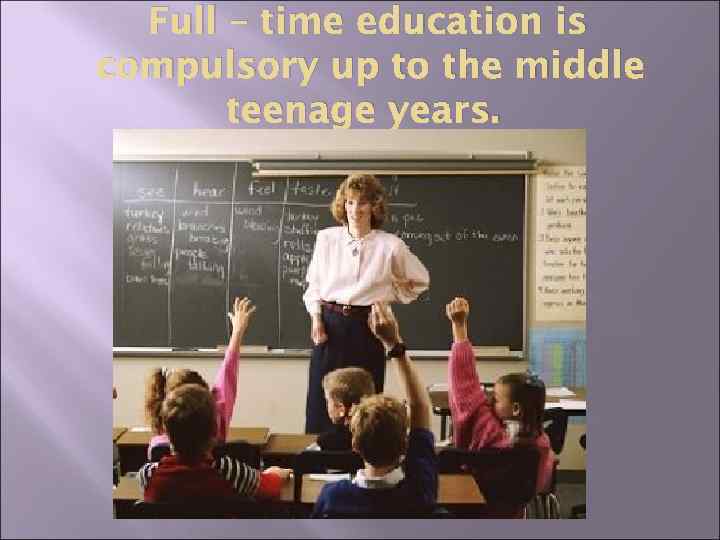 Full – time education is compulsory up to the middle teenage years.
 The academic year begins at the end of summer.
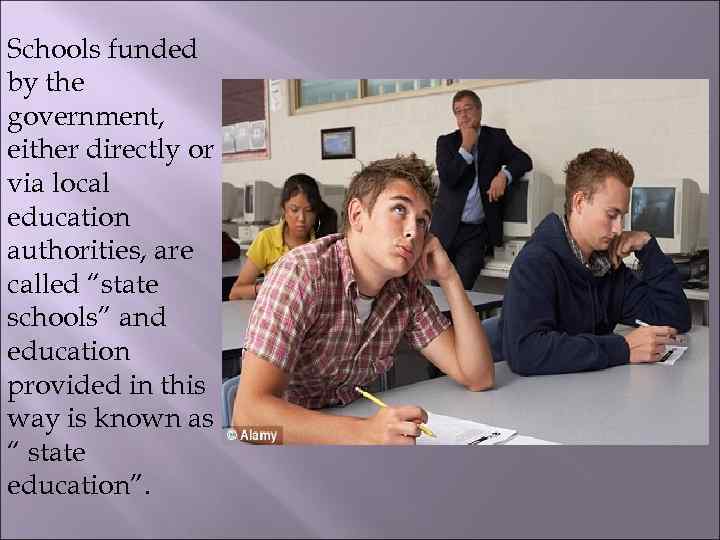 Schools funded by the government, either directly or via local education authorities, are called “state schools” and education provided in this way is known as “ state education”.
 This distinguishes it from “ private education”, which comprises “ independent schools”. Some independent schools are known as “public schools”.
 Schools in Britain have three terms a year, each with a short, half-term break in the middle and longer holidays at Christmas and Easter and in the summer.
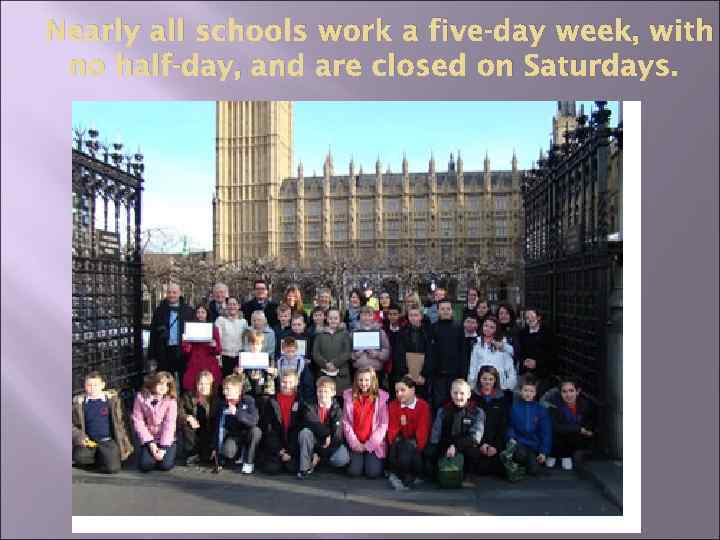 Nearly all schools work a five-day week, with no half-day, and are closed on Saturdays.
 The day starts at or just before nine o’clock and finishes between three and four, or a bit later for older children. The lunch break usually lasts about an hourand –a –quarter.
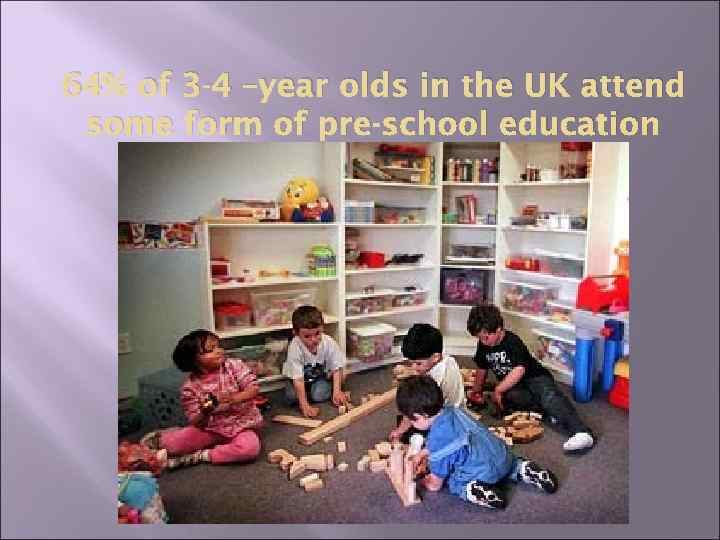 64% of 3 -4 –year olds in the UK attend some form of pre-school education
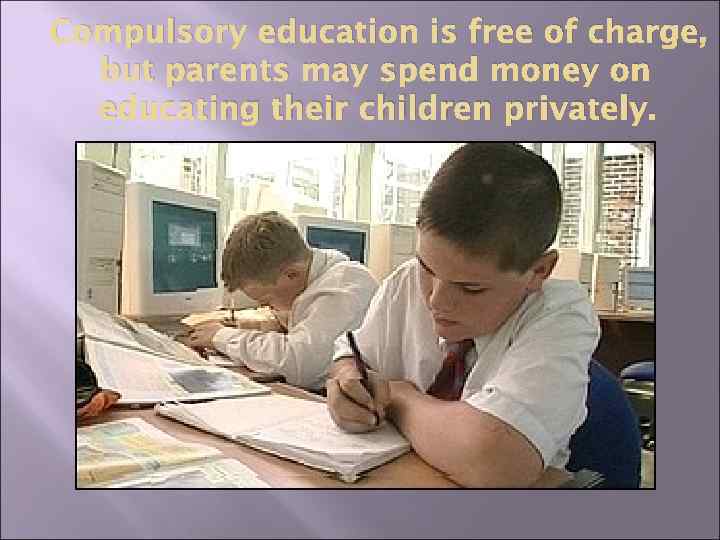 Compulsory education is free of charge, but parents may spend money on educating their children privately.
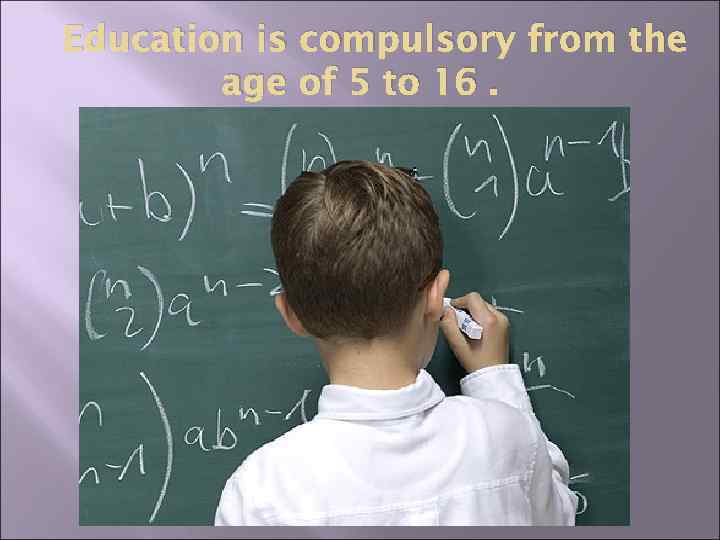 Education is compulsory from the age of 5 to 16.
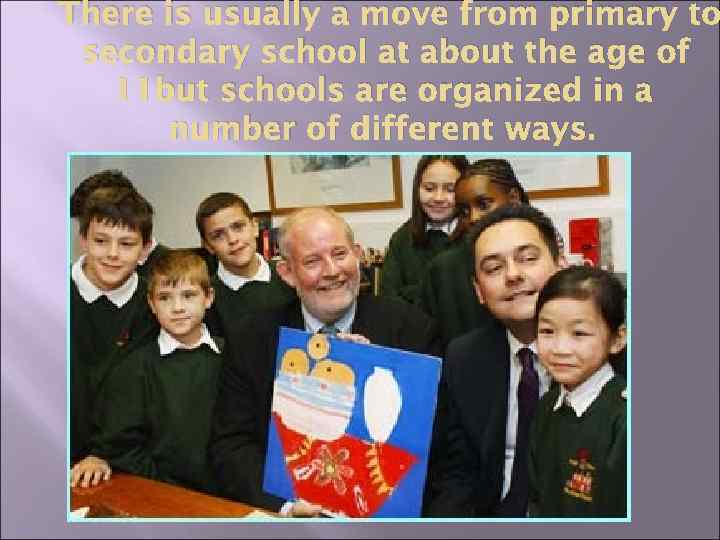 There is usually a move from primary to secondary school at about the age of 11 but schools are organized in a number of different ways.
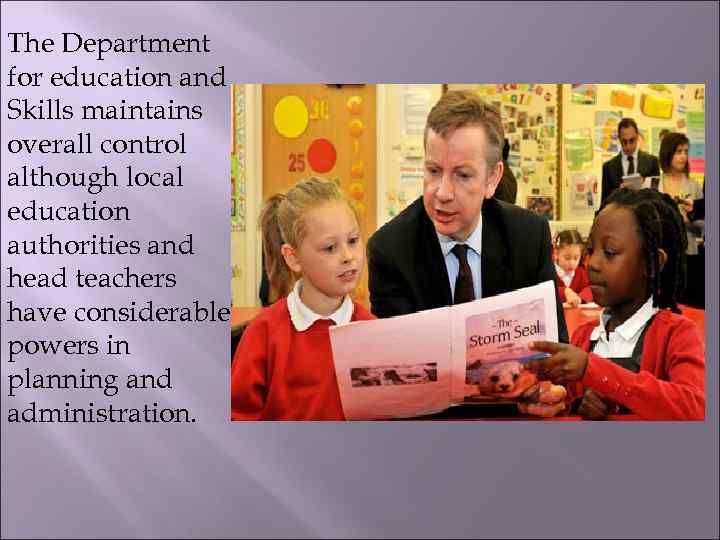 The Department for education and Skills maintains overall control although local education authorities and head teachers have considerable powers in planning and administration.
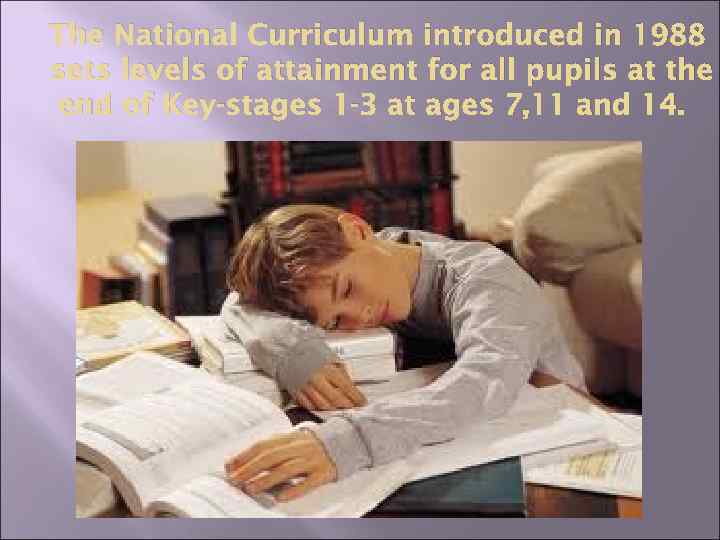 The National Curriculum introduced in 1988 sets levels of attainment for all pupils at the end of Key-stages 1 -3 at ages 7, 11 and 14.
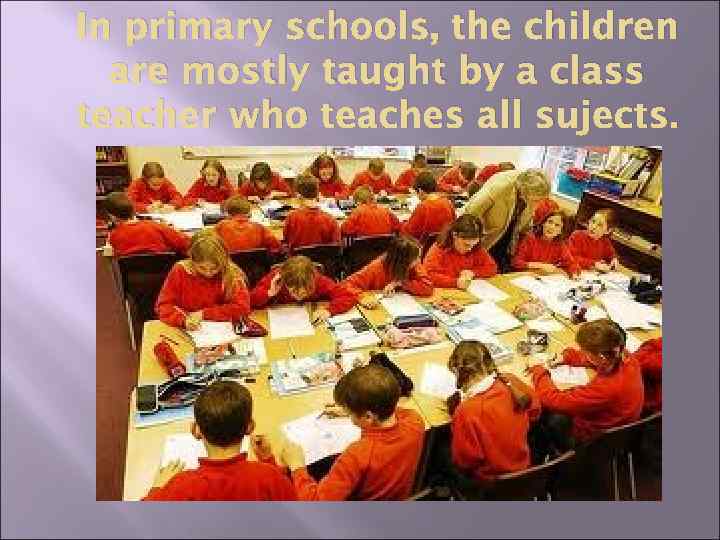 In primary schools, the children are mostly taught by a class teacher who teaches all sujects.
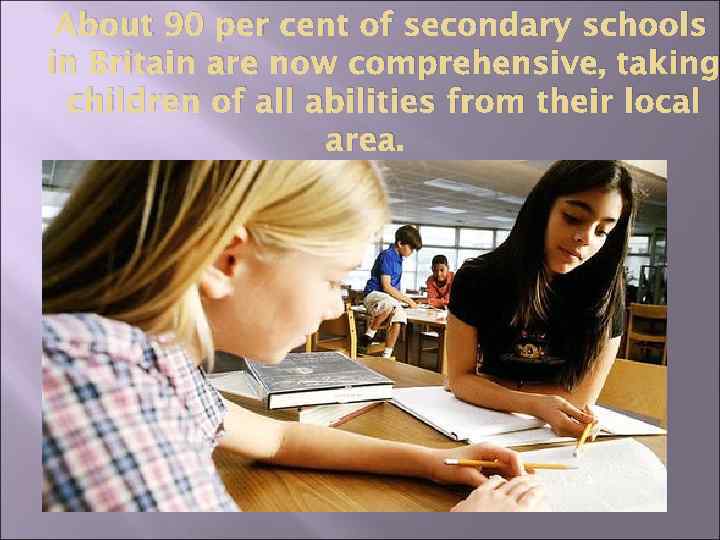 About 90 per cent of secondary schools in Britain are now comprehensive, taking children of all abilities from their local area.
 In secondary schools, pupils have different teachers for different subjects and are given regular homework.
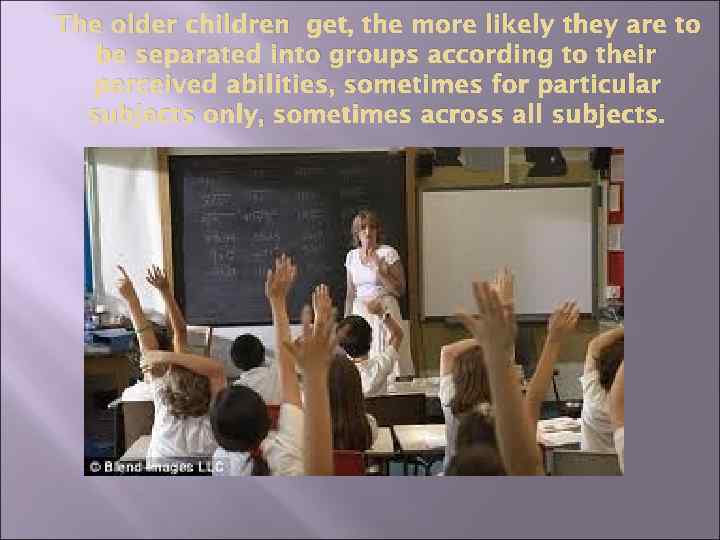 The older children get, the more likely they are to be separated into groups according to their perceived abilities, sometimes for particular subjects only, sometimes across all subjects.
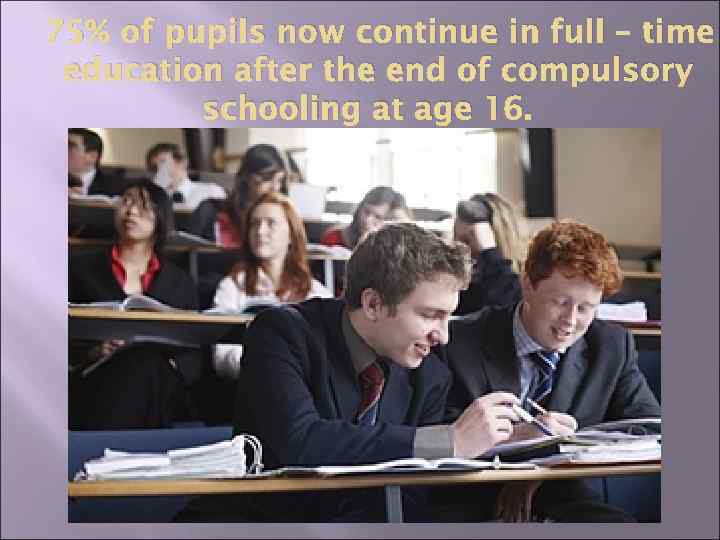 75% of pupils now continue in full – time education after the end of compulsory schooling at age 16.
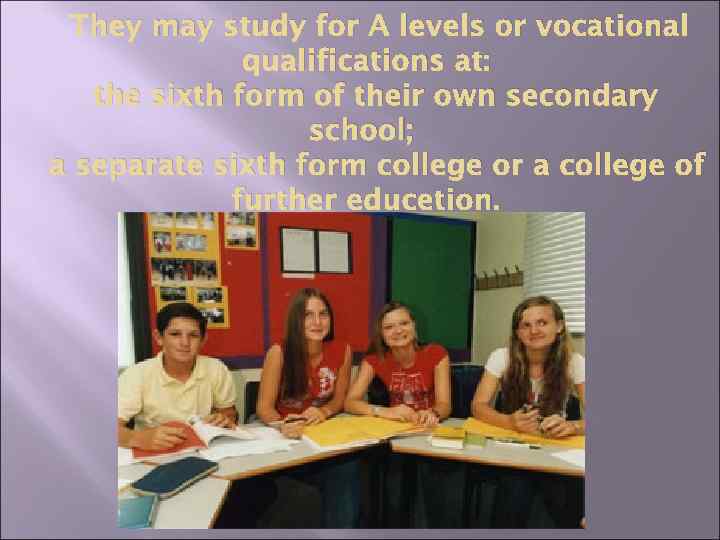 They may study for A levels or vocational qualifications at: the sixth form of their own secondary school; a separate sixth form college or a college of further educetion.
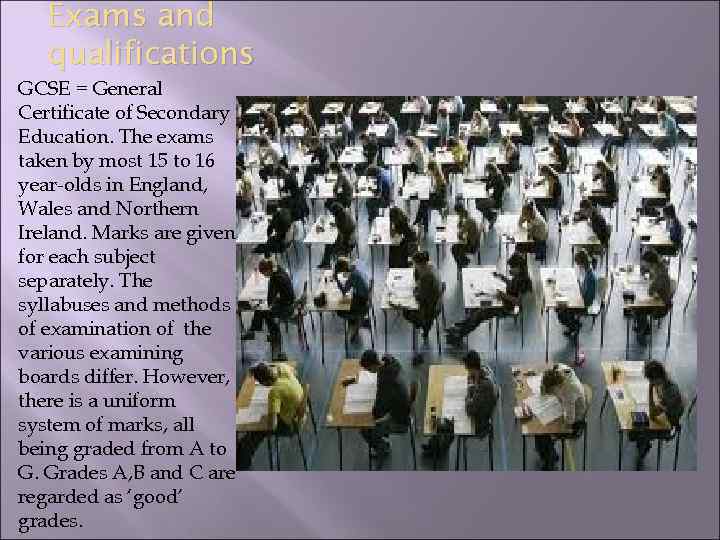 Exams and qualifications GCSE = General Certificate of Secondary Education. The exams taken by most 15 to 16 year-olds in England, Wales and Northern Ireland. Marks are given for each subject separately. The syllabuses and methods of examination of the various examining boards differ. However, there is a uniform system of marks, all being graded from A to G. Grades A, B and C are regarded as ‘good’ grades.
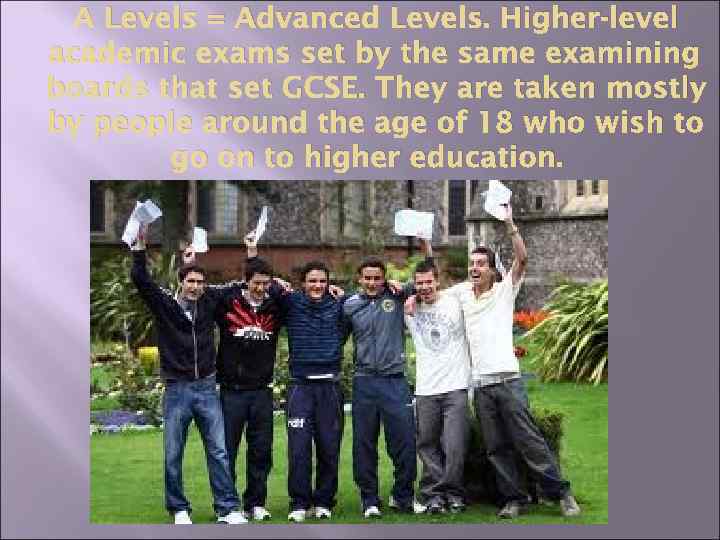 A Levels = Advanced Levels. Higher-level academic exams set by the same examining boards that set GCSE. They are taken mostly by people around the age of 18 who wish to go on to higher education.
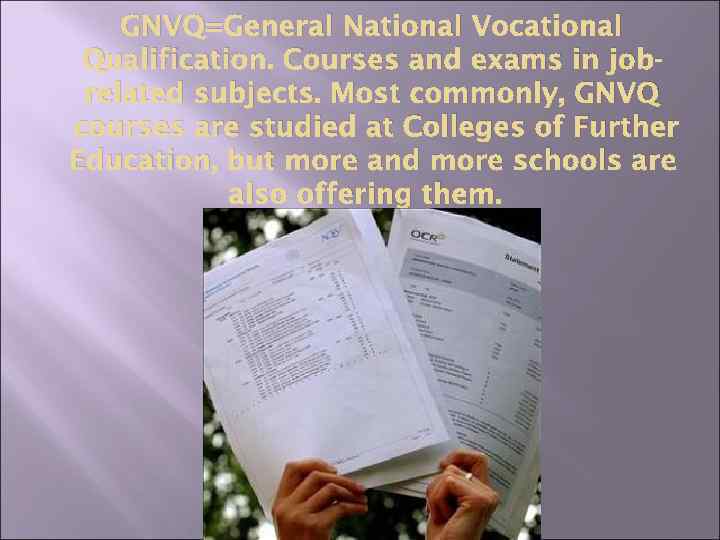 GNVQ=General National Vocational Qualification. Courses and exams in jobrelated subjects. Most commonly, GNVQ courses are studied at Colleges of Further Education, but more and more schools are also offering them.
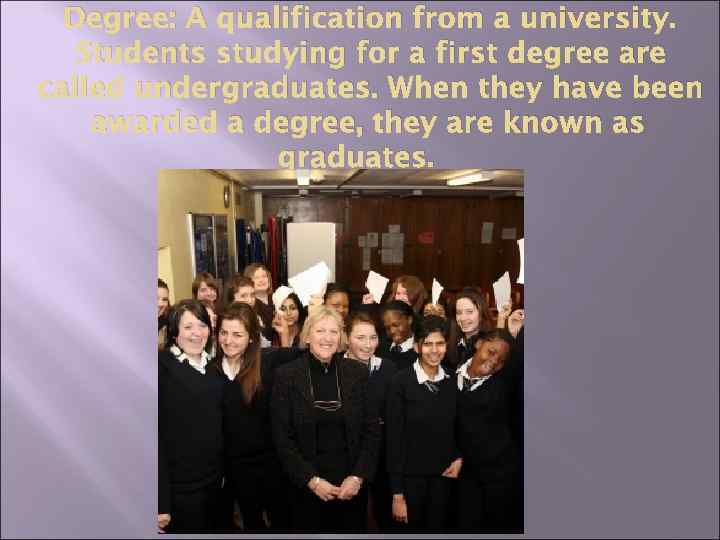 Degree: A qualification from a university. Students studying for a first degree are called undergraduates. When they have been awarded a degree, they are known as graduates.
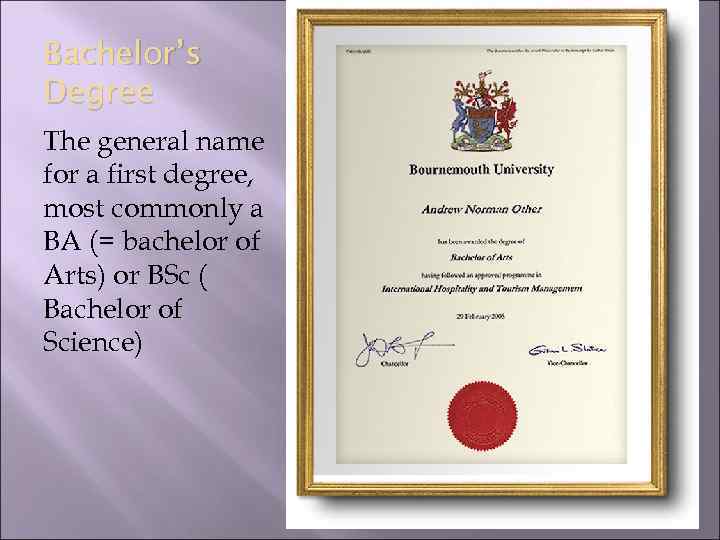 Bachelor’s Degree The general name for a first degree, most commonly a BA (= bachelor of Arts) or BSc ( Bachelor of Science)
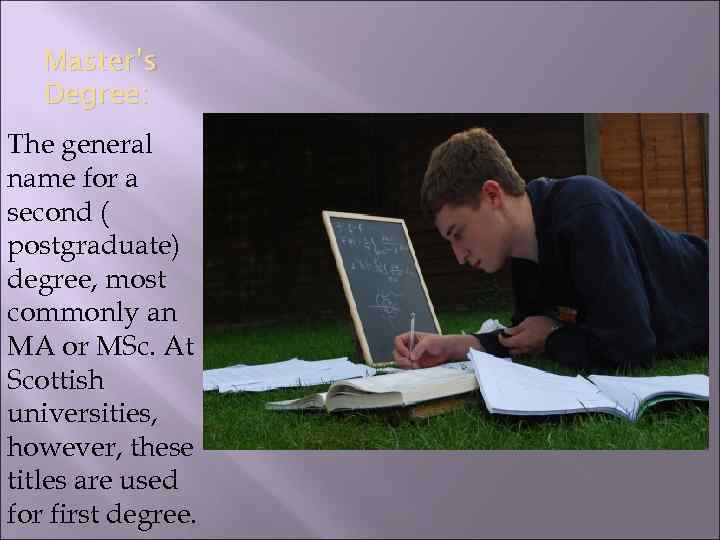 Master’s Degree: The general name for a second ( postgraduate) degree, most commonly an MA or MSc. At Scottish universities, however, these titles are used for first degree.
 Doctorate: The highest academic qualification. This usually( but not everywhere) carries the title Ph. D (=Doctor of Philosophy). The time taken to complete a doctorate varies, but it is generally expected to involve three years of more-or-less full-time study.
 The open University This is one development in education in which Britain can claim to have led the world. It allows people who do not have the opportunity to be ordinary ‘students’ to study for a degree. Its courses are taught through TV, radio and specially written coursebooks.
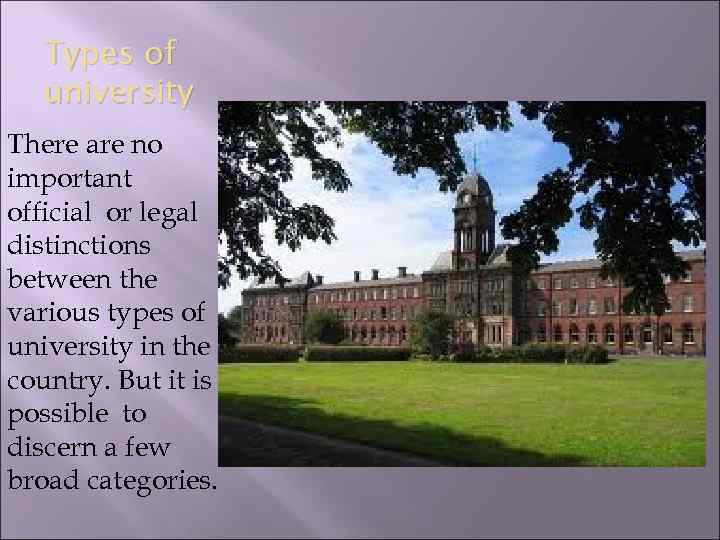 Types of university There are no important official or legal distinctions between the various types of university in the country. But it is possible to discern a few broad categories.
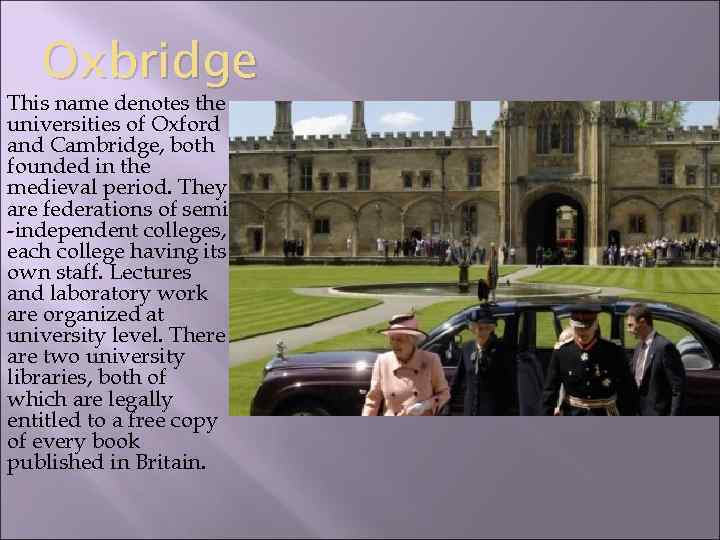 Oxbridge This name denotes the universities of Oxford and Cambridge, both founded in the medieval period. They are federations of semi -independent colleges, each college having its own staff. Lectures and laboratory work are organized at university level. There are two university libraries, both of which are legally entitled to a free copy of every book published in Britain.
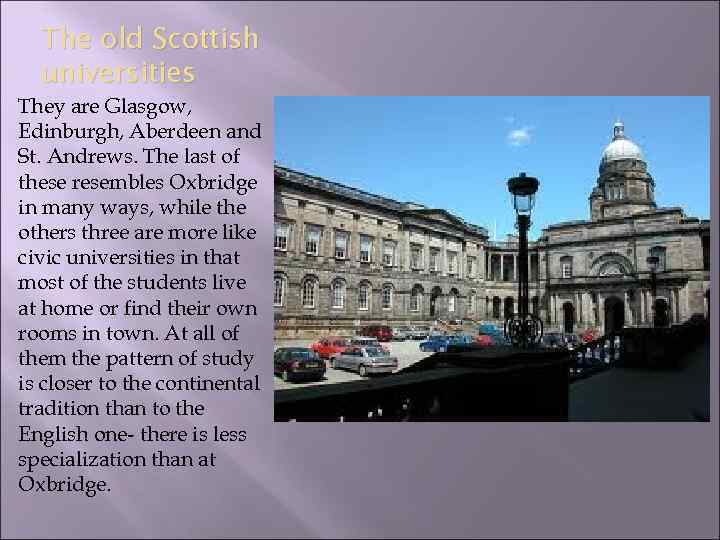 The old Scottish universities They are Glasgow, Edinburgh, Aberdeen and St. Andrews. The last of these resembles Oxbridge in many ways, while the others three are more like civic universities in that most of the students live at home or find their own rooms in town. At all of them the pattern of study is closer to the continental tradition than to the English one- there is less specialization than at Oxbridge.
 The early 19 thcentury English universities. They are Durham University ( its collegiate living arrangement are similar to Oxbridge), the University of London.
 The older civic (redbrick) universities. During the 19 th century various institutes of higher education sprang up in the new industrial towns and cities such as Birmingham, Manchester and Leeds. Their buildings were of local material, often brick. They prepared students for London University degrees, but later they were given the right to award their own degree, and so became universities themselves.
 The campus universities. These are purposebuilt institutions located in the countryside but close to towns. Examples are East Anglia, Lancaster, Sussex and Warwick.
 The newer civic universities. These were originally technical colleges set up by local authorities in the first half of the 20 th century. They are Aston in Birmingham, Salford near Manchester, Strathclyde in Glasgow and so on.