


 Скачать презентацию EDUCATION IN RUSSIA AND IN ENGLAND ПРИЗЕНТАЦИЮ ВЫПОЛНИЛИ
EDUCATION IN RUSSIA AND IN ENGLAND.pptx
- Количество слайдов: 12
 EDUCATION IN RUSSIA AND IN ENGLAND ПРИЗЕНТАЦИЮ ВЫПОЛНИЛИ Свистунов Владислав и Сушков Антон
 PLAN • EDUCATION IN RUSSIA • EDUCATION IN ENGLAND
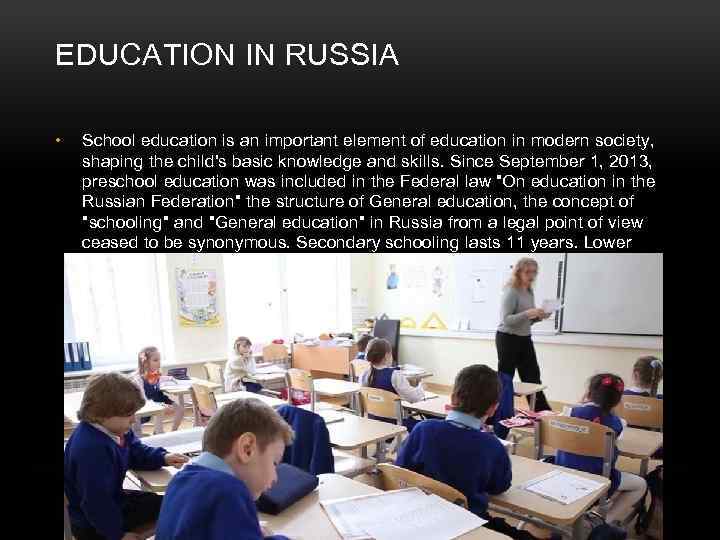 EDUCATION IN RUSSIA • School education is an important element of education in modern society, shaping the child's basic knowledge and skills. Since September 1, 2013, preschool education was included in the Federal law "On education in the Russian Federation" the structure of General education, the concept of "schooling" and "General education" in Russia from a legal point of view ceased to be synonymous. Secondary schooling lasts 11 years. Lower secondary education lasts for 9 classes.
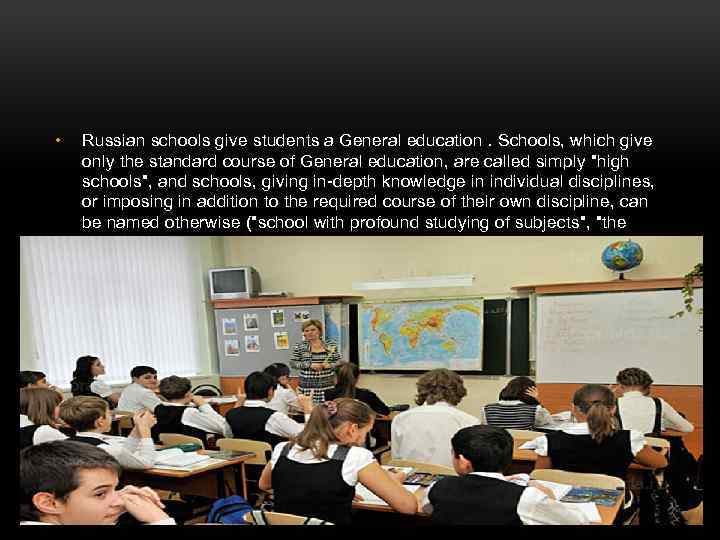 • Russian schools give students a General education. Schools, which give only the standard course of General education, are called simply "high schools", and schools, giving in-depth knowledge in individual disciplines, or imposing in addition to the required course of their own discipline, can be named otherwise ("school with profound studying of subjects", "the Lyceum", "gymnasium").
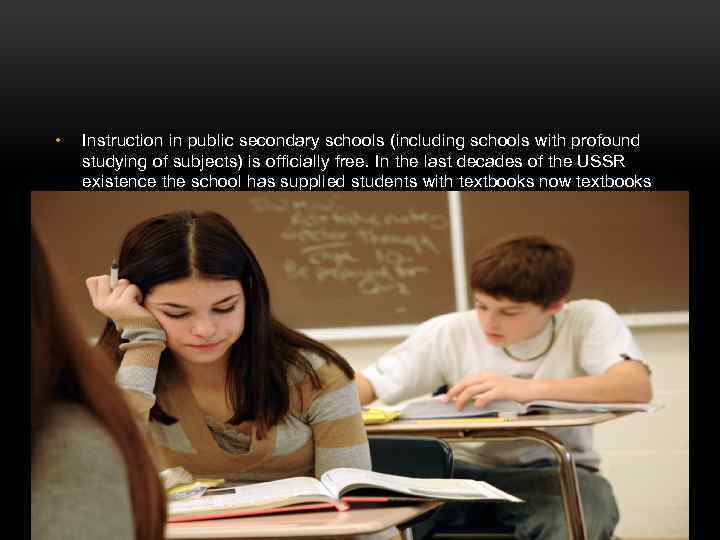 • Instruction in public secondary schools (including schools with profound studying of subjects) is officially free. In the last decades of the USSR existence the school has supplied students with textbooks now textbooks are purchased.
 • Currently, a full course of study in a Russian school is 11 years. Before 1986, the rate of schooling was 10 -year-old (primary school 3 — year basic — 5 years, high — 2). Then the experiment was introduced 4 -year course of elementary school, but students were given the option of selecting 3 years (10 -year) or 4 years (11 -year) program to learn. The students enrolled in the 3 -year program in the transition to the main stage of the "jump room" — from the 3 rd class passed in the 5 th, and at the same time, in 1989, that "jumping" was produced in all classrooms. Currently, the 3 -year primary education was completely abolished: all newly enrolling in the school children study for 11 years.
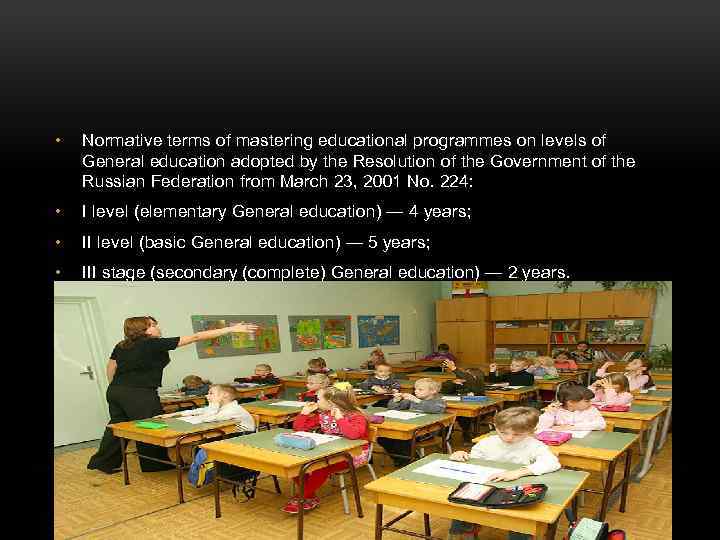 • Normative terms of mastering educational programmes on levels of General education adopted by the Resolution of the Government of the Russian Federation from March 23, 2001 No. 224: • I level (elementary General education) — 4 years; • II level (basic General education) — 5 years; • III stage (secondary (complete) General education) — 2 years.
 EDUCATION IN ENGLAND • In the UK there is a huge variety of schools. In various reference books, the Internet, magazine and newspaper articles can be used different criteria to classify schools. Common type of schools in Britain are boarding schools (Boarding School) in which pupils are taught and live at the school. The first boarding schools appeared in Britain in the early middle Ages, mainly in monasteries. In the XII century, the Pope ordered all Benedictine monasteries to open a charitable school at Catholic monasteries. Later the tuition in such schools began to charge. While aristocratic families preferred monastic schools, home schooling, over time, has spread the belief that adolescents, regardless of social origin is more useful to learn together with their peers. This belief became the Foundation for the organization and development of the privileged boarding schools, among which there are those that nurture, educate and form the elite of British society for more than thousands of years. In the list of the most expensive and prestigious schools in the world are present and British boarding schools.
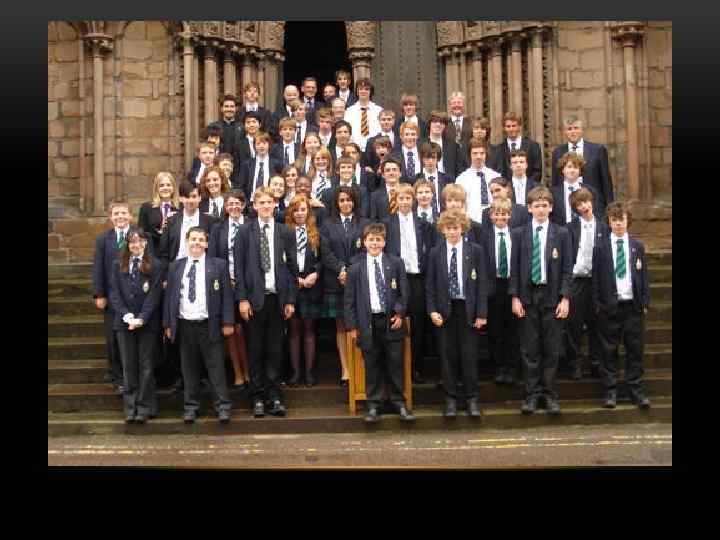
 • Full school cycle where children of all ages from 3 to 18 years. Pre-school education — also known as creches and kindergartens, for children from 2 to 7 years. Here are taught to read, write, count, develop through games. Usually such schools are organized in cooperation with schools for younger students. — age students from 2 years 9 months to 4 years.
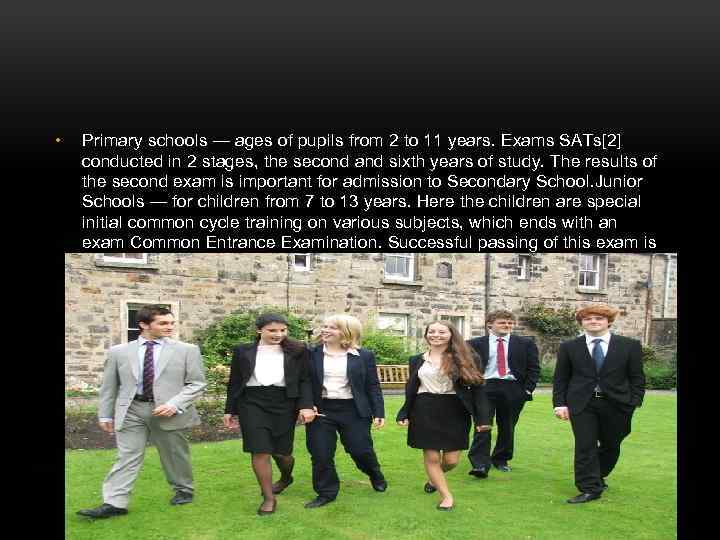 • Primary schools — ages of pupils from 2 to 11 years. Exams SATs[2] conducted in 2 stages, the second and sixth years of study. The results of the second exam is important for admission to Secondary School. Junior Schools — for children from 7 to 13 years. Here the children are special initial common cycle training on various subjects, which ends with an exam Common Entrance Examination. Successful passing of this exam is a prerequisite of admission to high school.
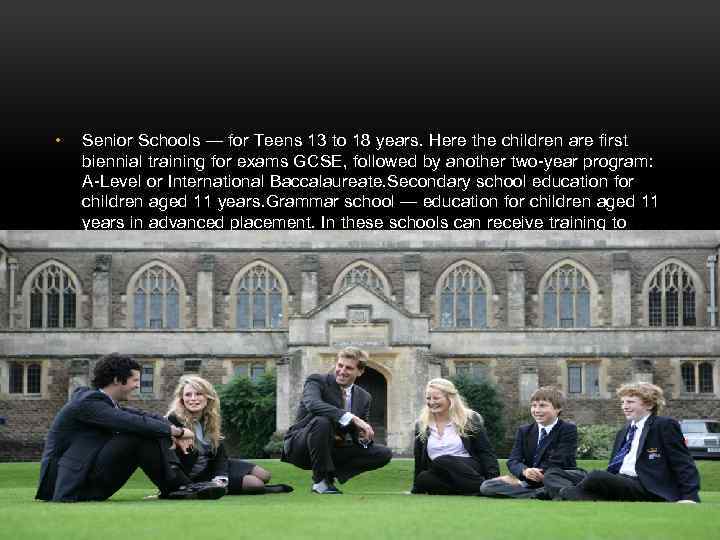 • Senior Schools — for Teens 13 to 18 years. Here the children are first biennial training for exams GCSE, followed by another two-year program: A-Level or International Baccalaureate. Secondary school education for children aged 11 years. Grammar school — education for children aged 11 years in advanced placement. In these schools can receive training to University (Sixth Form). School preparation for University (Sixth Form) — for older Teens 16 -18 years old.