 Скачать презентацию Education in Great Britain Presentation by Natalia Matsko
Education in Great Britain.pptx
- Количество слайдов: 14



Education in Great Britain Presentation by Natalia Matsko
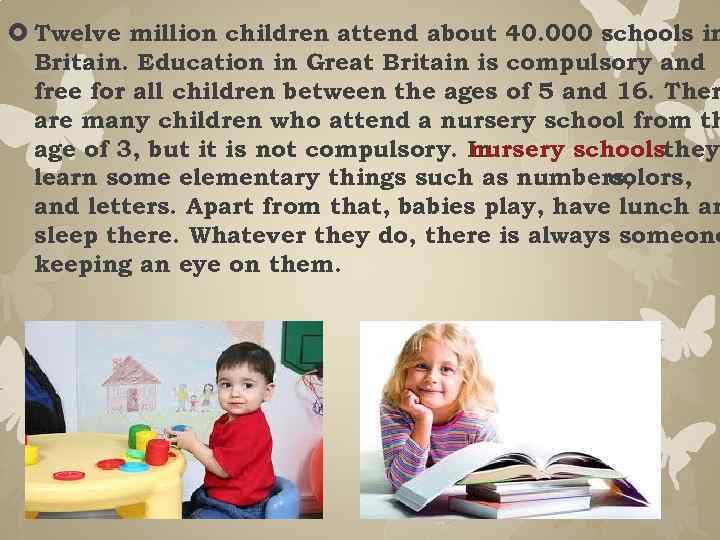
Twelve million children attend about 40. 000 schools in Britain. Education in Great Britain is compulsory and free for all children between the ages of 5 and 16. Ther are many children who attend a nursery school from th age of 3, but it is not compulsory. In nursery schoolsthey learn some elementary things such as numbers, colors, and letters. Apart from that, babies play, have lunch an sleep there. Whatever they do, there is always someone keeping an eye on them.
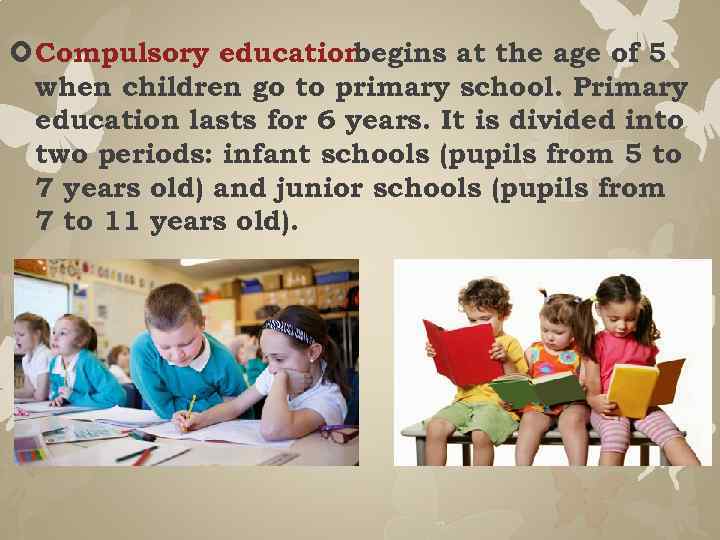
Compulsory education begins at the age of 5 when children go to primary school. Primary education lasts for 6 years. It is divided into two periods: infant schools (pupils from 5 to 7 years old) and junior schools (pupils from 7 to 11 years old).
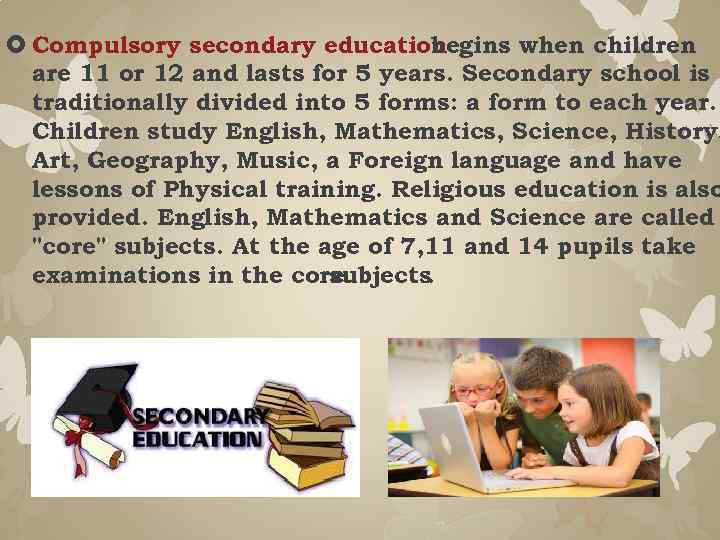
Compulsory secondary education begins when children are 11 or 12 and lasts for 5 years. Secondary school is traditionally divided into 5 forms: a form to each year. Children study English, Mathematics, Science, History, Art, Geography, Music, a Foreign language and have lessons of Physical training. Religious education is also provided. English, Mathematics and Science are called "core" subjects. At the age of 7, 11 and 14 pupils take examinations in the core subjects.
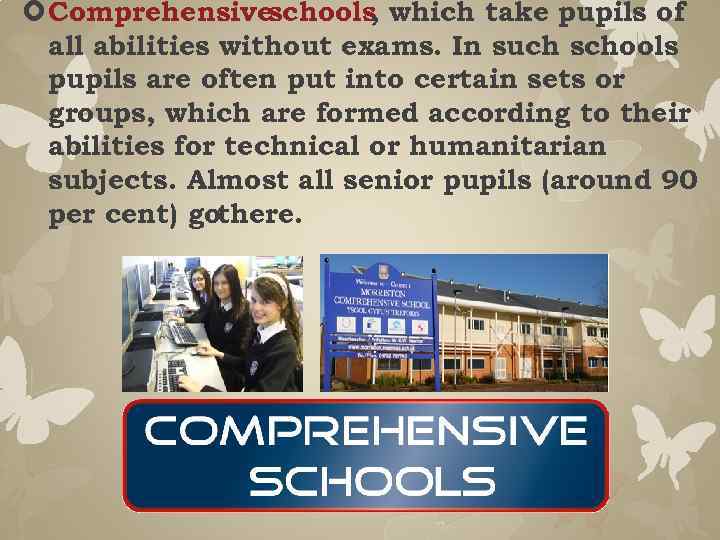
Comprehensiveschools which take pupils of , all abilities without exams. In such schools pupils are often put into certain sets or groups, which are formed according to their abilities for technical or humanitarian subjects. Almost all senior pupils (around 90 per cent) gothere.
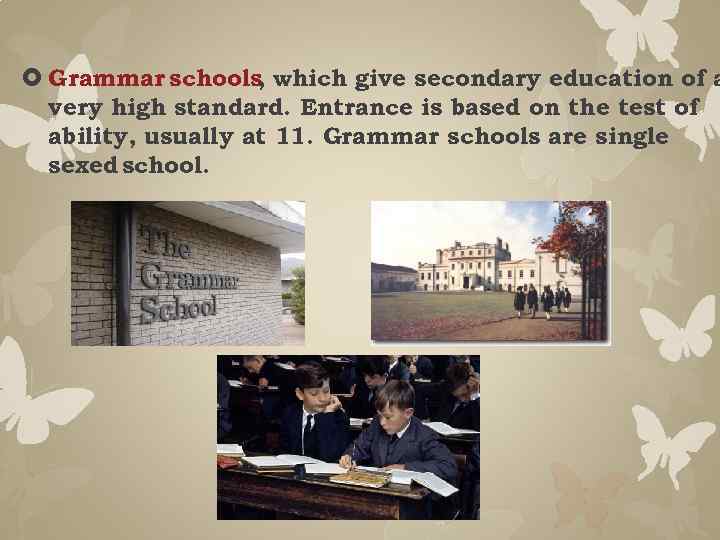
Grammar schools which give secondary education of a , very high standard. Entrance is based on the test of ability, usually at 11. Grammar schools are single sexed school.
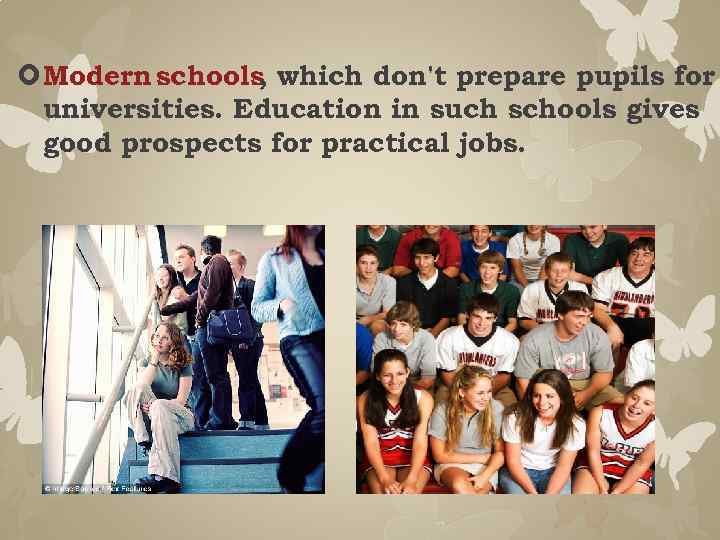
Modern schools which don't prepare pupils for , universities. Education in such schools gives good prospects for practical jobs.
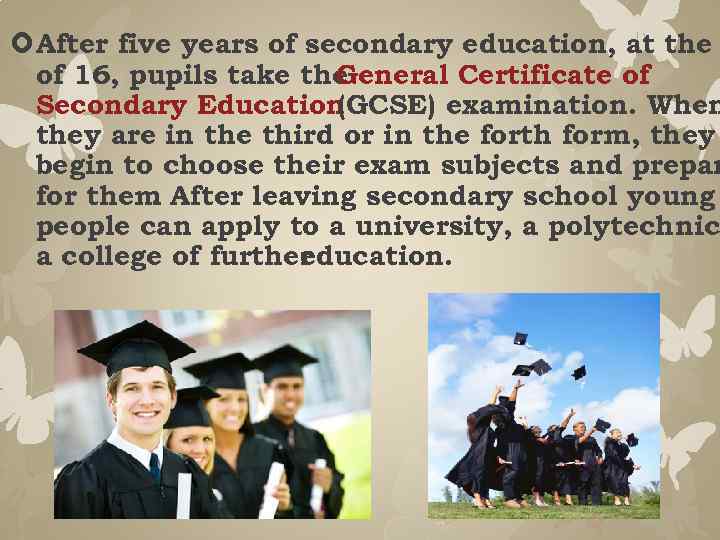
After five years of secondary education, at the of 16, pupils take the General Certificate of Secondary Education (GCSE) examination. When they are in the third or in the forth form, they begin to choose their exam subjects and prepar for them After leaving secondary school young. people can apply to a university, a polytechnic a college of further education.

The Old ones which were founded before the , 19 th century, such as Oxford and Cambridge.
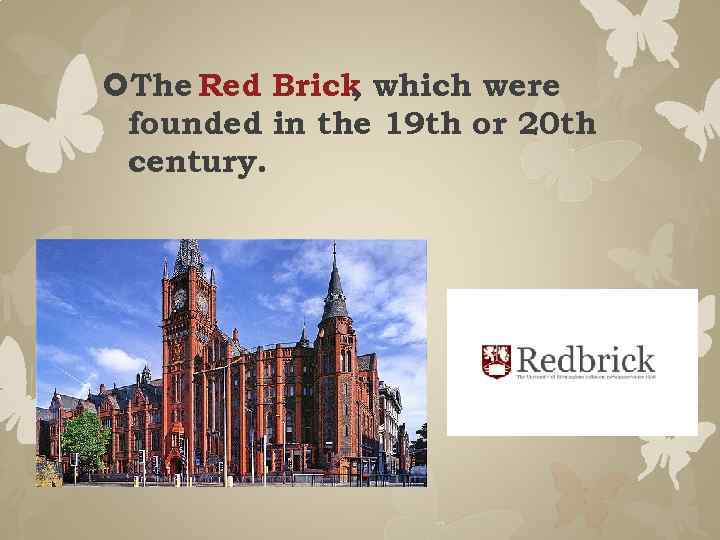
The Red Brick which were , founded in the 19 th or 20 th century.
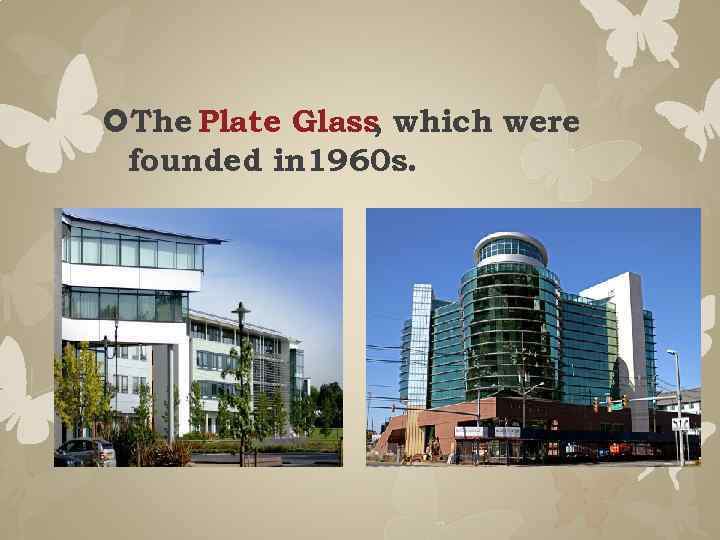
The Plate Glass which were , founded in 1960 s.
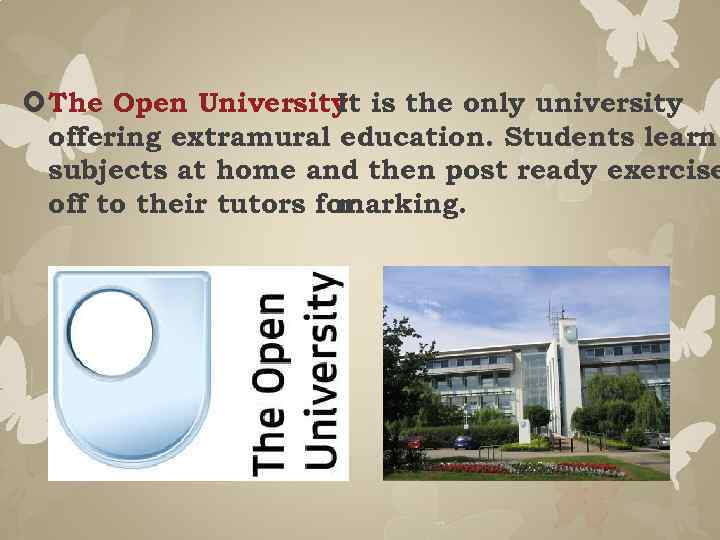
The Open University is the only university It offering extramural education. Students learn subjects at home and then post ready exercise off to their tutors for marking.
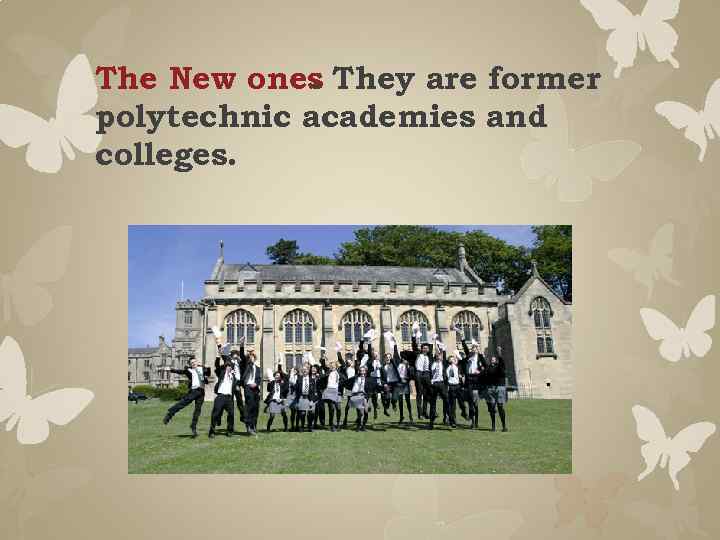
The New ones They are former. polytechnic academies and colleges.
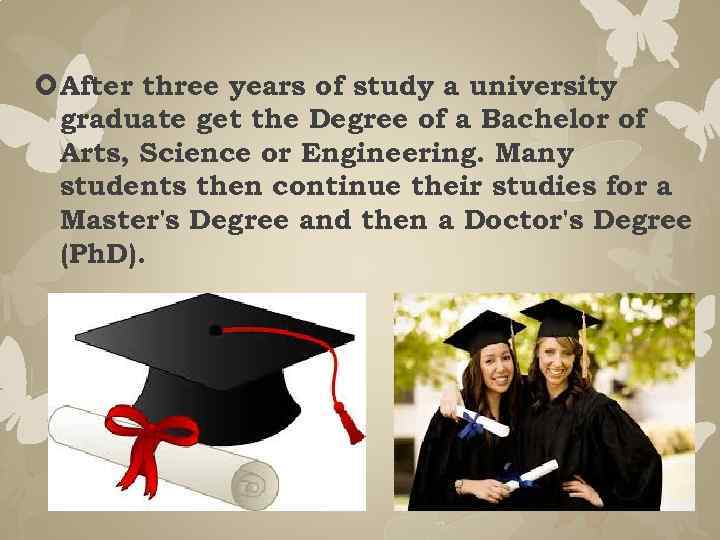
After three years of study a university graduate get the Degree of a Bachelor of Arts, Science or Engineering. Many students then continue their studies for a Master's Degree and then a Doctor's Degree (Ph. D).
Скачать презентацию Education in Great Britain Presentation by Natalia Matsko
Education in Great Britain.pptx