 Скачать презентацию Education for Sustainability as a 21 st Century
c6bf1b4ec44b3a761faee4546b7a6743.ppt
- Количество слайдов: 27



Education for Sustainability as a 21 st Century Literacy Nancy Givens, WKU Doctoral Student
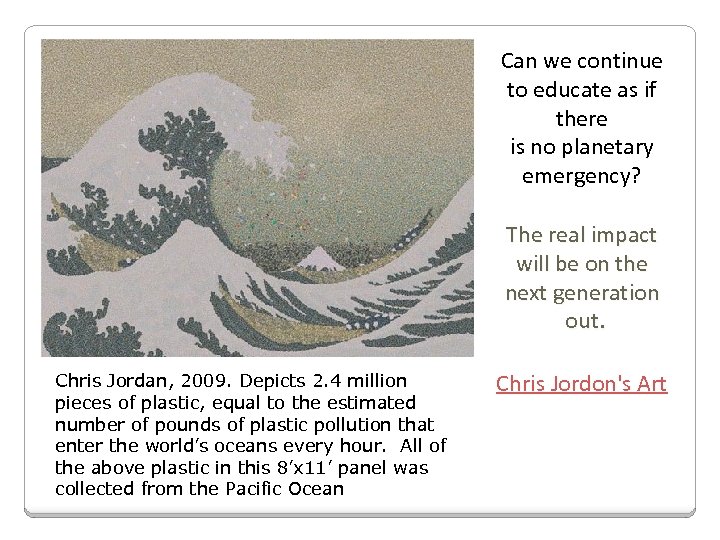
Can we continue to educate as if there is no planetary emergency? The real impact will be on the next generation out. Chris Jordan, 2009. Depicts 2. 4 million pieces of plastic, equal to the estimated number of pounds of plastic pollution that enter the world’s oceans every hour. All of the above plastic in this 8’x 11’ panel was collected from the Pacific Ocean Chris Jordon's Art
Sustainable development is… “development that meets the needs of the present without compromising the ability of future generations to meet their own needs. ” -U. N. World Commission on Environment & Development
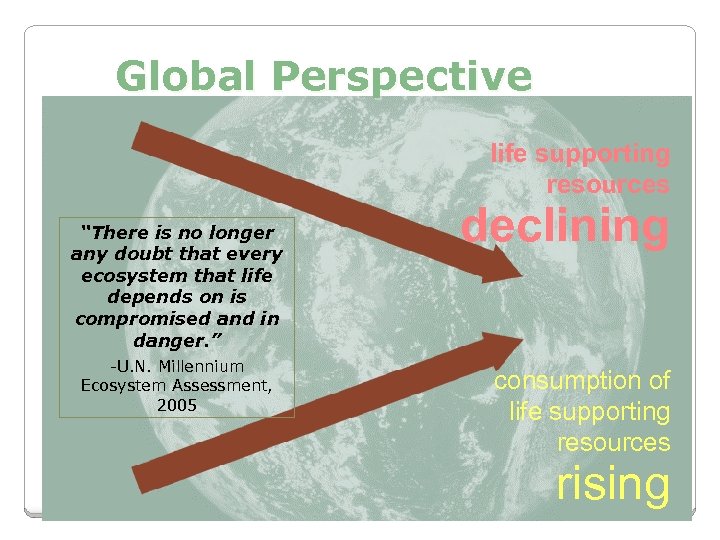
Global Perspective life supporting resources “There is no longer any doubt that every ecosystem that life depends on is compromised and in danger. ” -U. N. Millennium Ecosystem Assessment, 2005 declining consumption of life supporting resources rising
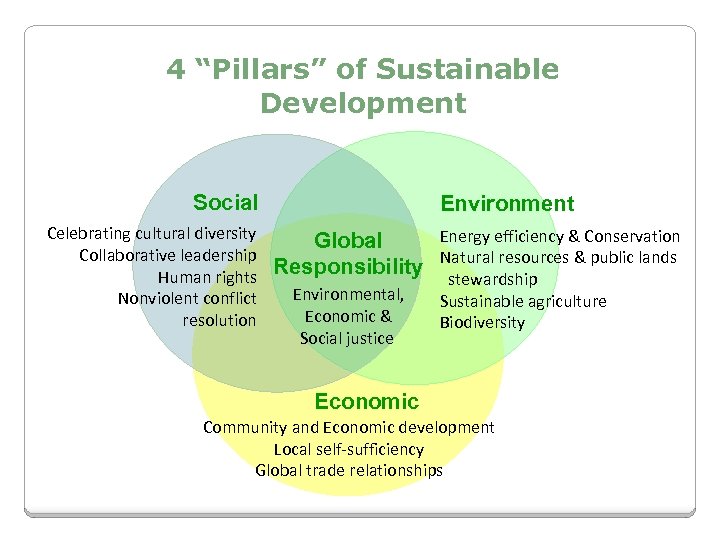
4 “Pillars” of Sustainable Development Social Celebrating cultural diversity Collaborative leadership Human rights Nonviolent conflict resolution Environment Energy efficiency & Conservation Global Responsibility Natural resources & public lands stewardship Environmental, Economic & Social justice Sustainable agriculture Biodiversity Economic Community and Economic development Local self-sufficiency Global trade relationships
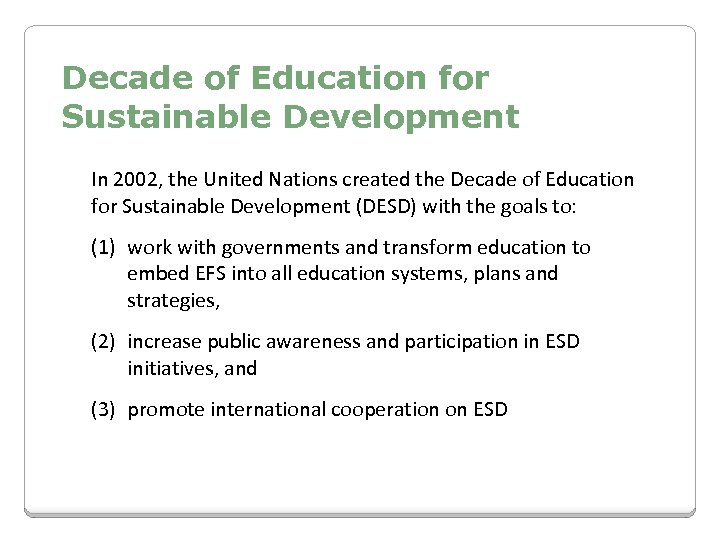
Decade of Education for Sustainable Development In 2002, the United Nations created the Decade of Education for Sustainable Development (DESD) with the goals to: (1) work with governments and transform education to embed EFS into all education systems, plans and strategies, (2) increase public awareness and participation in ESD initiatives, and (3) promote international cooperation on ESD
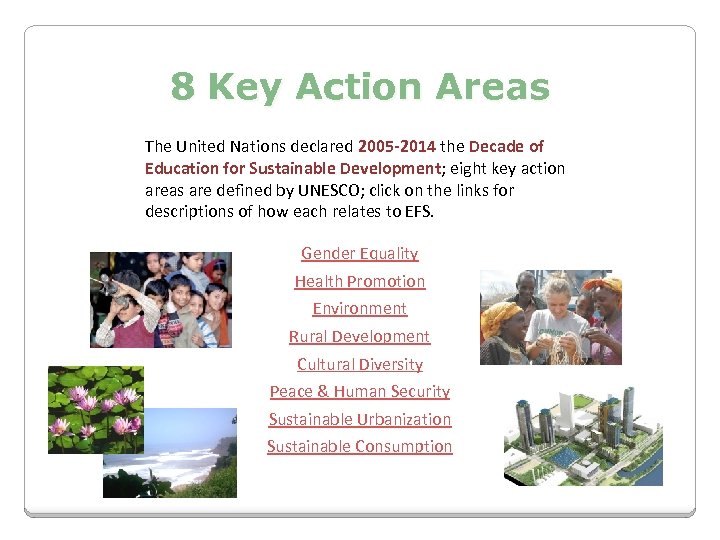
8 Key Action Areas The United Nations declared 2005 -2014 the Decade of Education for Sustainable Development; eight key action areas are defined by UNESCO; click on the links for descriptions of how each relates to EFS. Gender Equality Health Promotion Environment Rural Development Cultural Diversity Peace & Human Security Sustainable Urbanization Sustainable Consumption
What kind of learning/teaching? Learning/teaching about… Learning/teaching for… Learning/teaching how… Learning/teaching by whom…
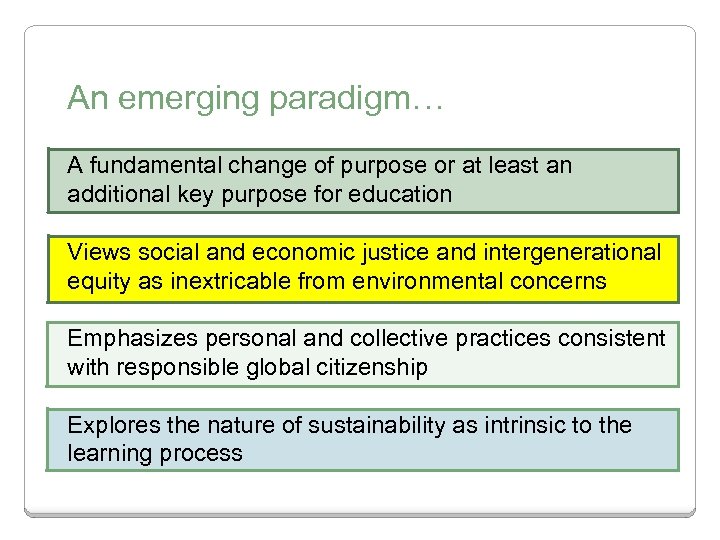
An emerging paradigm… A fundamental change of purpose or at least an additional key purpose for education Views social and economic justice and intergenerational equity as inextricable from environmental concerns Emphasizes personal and collective practices consistent with responsible global citizenship Explores the nature of sustainability as intrinsic to the learning process
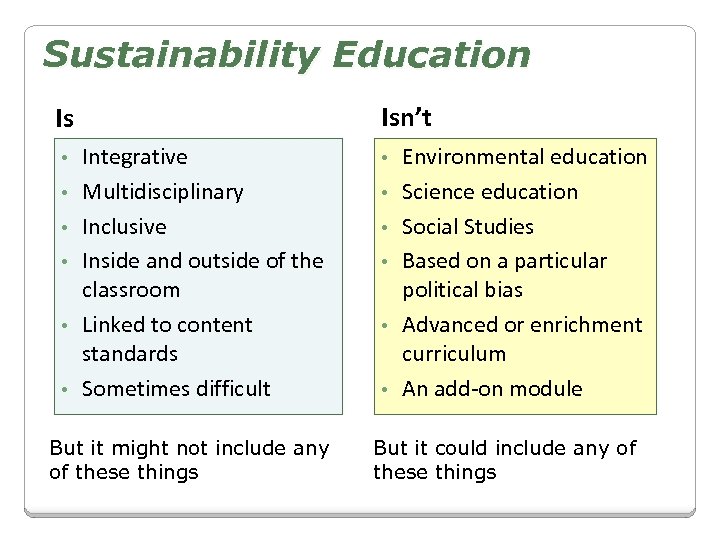
Sustainability Education Isn’t Is • • • Integrative Multidisciplinary Inclusive Inside and outside of the classroom Linked to content standards Sometimes difficult But it might not include any of these things • • • Environmental education Science education Social Studies Based on a particular political bias Advanced or enrichment curriculum An add-on module But it could include any of these things
ESD is Education for the 21 st Century Education for Sustainable Development must: • Be solution-focused and action-oriented • Teach students to think in terms of systems • Explain the fundamental interrelationships among environmental, economic & social dimensions of issues affecting our planet • Inspire respect and concern for the well-being of all living things, now and in the future
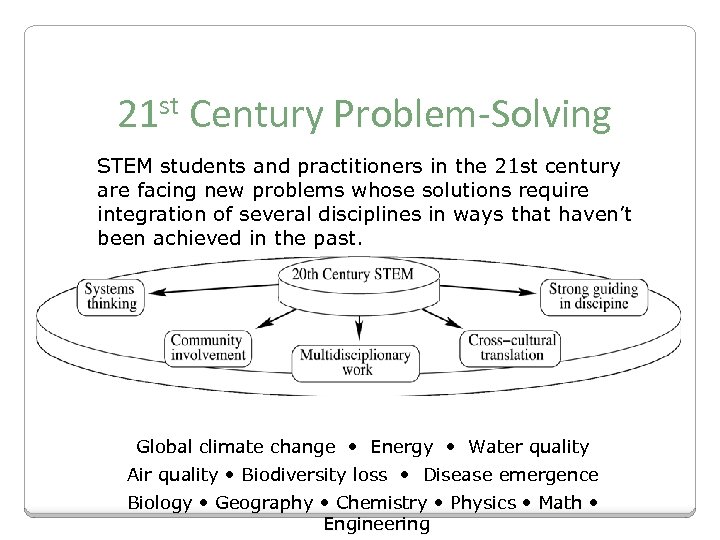
21 st Century Problem-Solving STEM students and practitioners in the 21 st century are facing new problems whose solutions require integration of several disciplines in ways that haven’t been achieved in the past. Global climate change • Energy • Water quality Air quality • Biodiversity loss • Disease emergence Biology • Geography • Chemistry • Physics • Math • Engineering
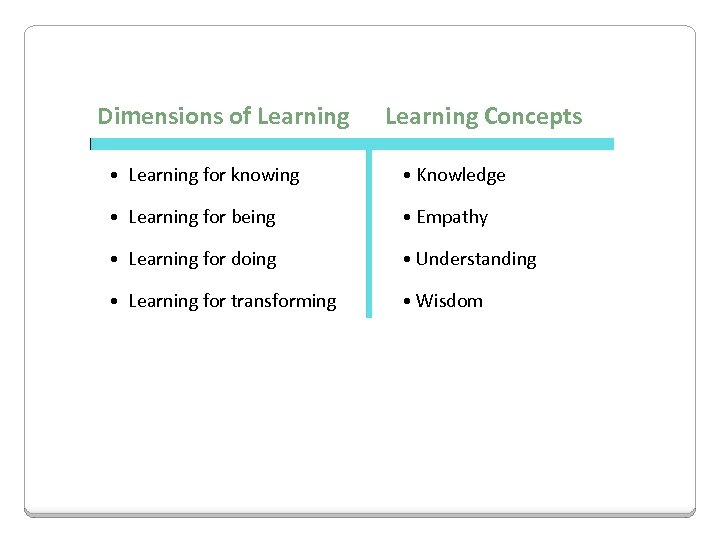
Dimensions of Learning Concepts • Learning for knowing • Knowledge • Learning for being • Empathy • Learning for doing • Understanding • Learning for transforming • Wisdom
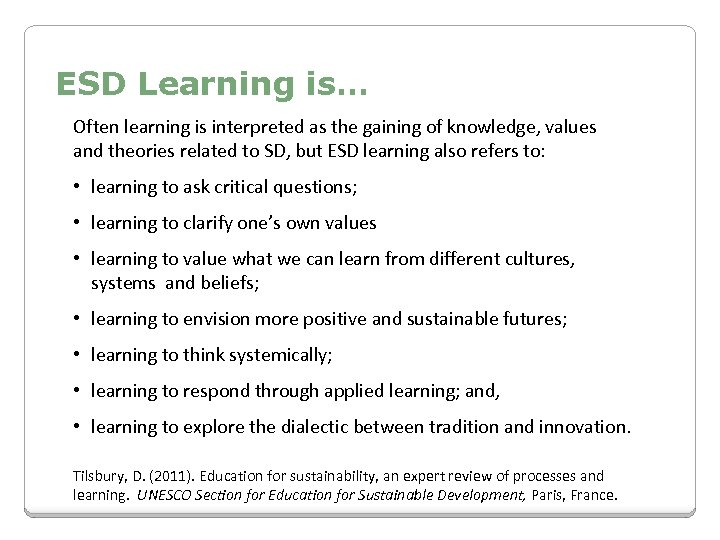
ESD Learning is… Often learning is interpreted as the gaining of knowledge, values and theories related to SD, but ESD learning also refers to: • learning to ask critical questions; • learning to clarify one’s own values • learning to value what we can learn from different cultures, systems and beliefs; • learning to envision more positive and sustainable futures; • learning to think systemically; • learning to respond through applied learning; and, • learning to explore the dialectic between tradition and innovation. Tilsbury, D. (2011). Education for sustainability, an expert review of processes and learning. UNESCO Section for Education for Sustainable Development, Paris, France.
ESD is Education for Responsible Citizenship The role of ESD is to help people develop the attitudes, skills, and knowledge to make informed decisions for the benefit of themselves and others, now and for the future, and to act upon those decisions. (UNESCO) 1. Support the UN Decade for ESD 2. Advance Education Policy 3. Support Educators 4. Empower Youth
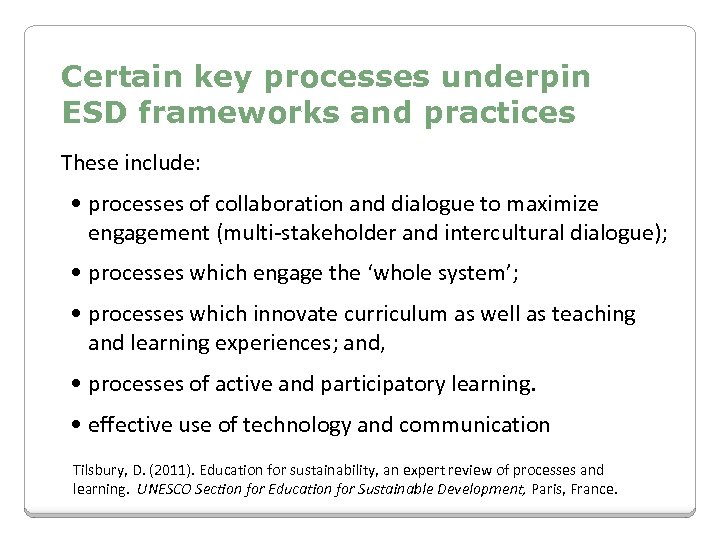
Certain key processes underpin ESD frameworks and practices These include: • processes of collaboration and dialogue to maximize engagement (multi-stakeholder and intercultural dialogue); • processes which engage the ‘whole system’; • processes which innovate curriculum as well as teaching and learning experiences; and, • processes of active and participatory learning. • effective use of technology and communication Tilsbury, D. (2011). Education for sustainability, an expert review of processes and learning. UNESCO Section for Education for Sustainable Development, Paris, France.
ESD is Rethinking Education has not actively participated in the definition of society. Several vital tensions in education exist today: 1) need to reevaluate what information is prioritized in higher education; what knowledge counts? 2) call for organizing knowledge around relevance, i. e. , deeper engagement in real issues of community, and 3) knowledge and science as “commodity” vs. knowledge and science as “community” Notes from International Conference on Higher Education’s Commitment to Sustainability, Barcelona Spain, November 30, 2010.
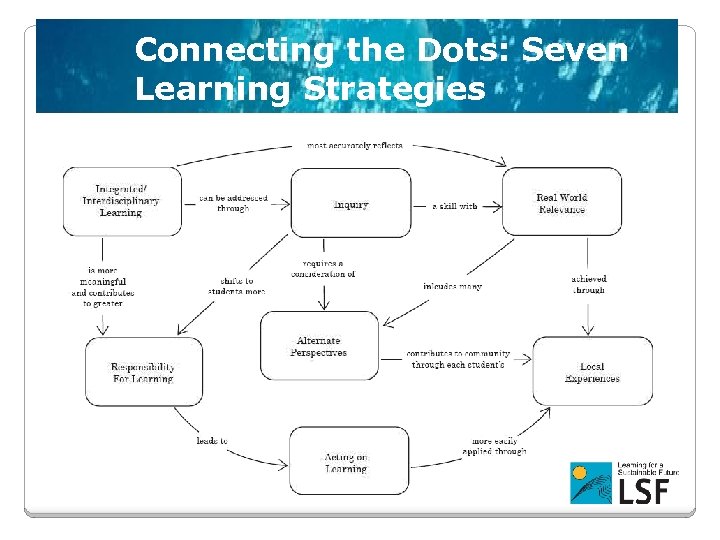
Connecting the Dots: Seven Learning Strategies
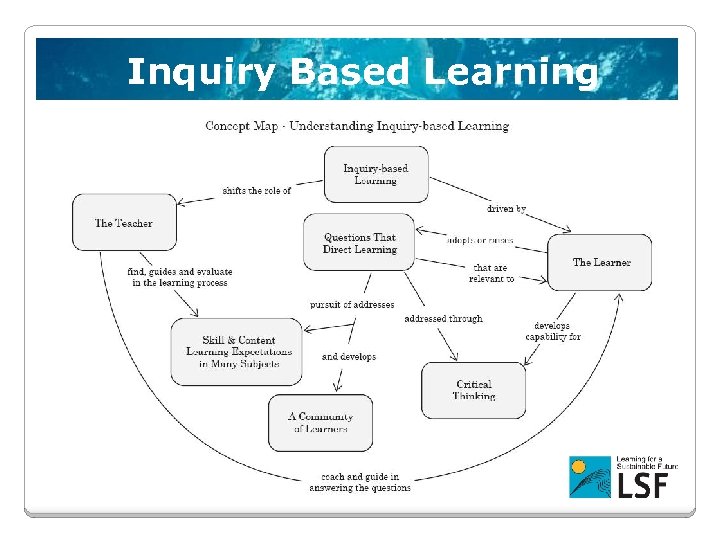
Inquiry Based Learning
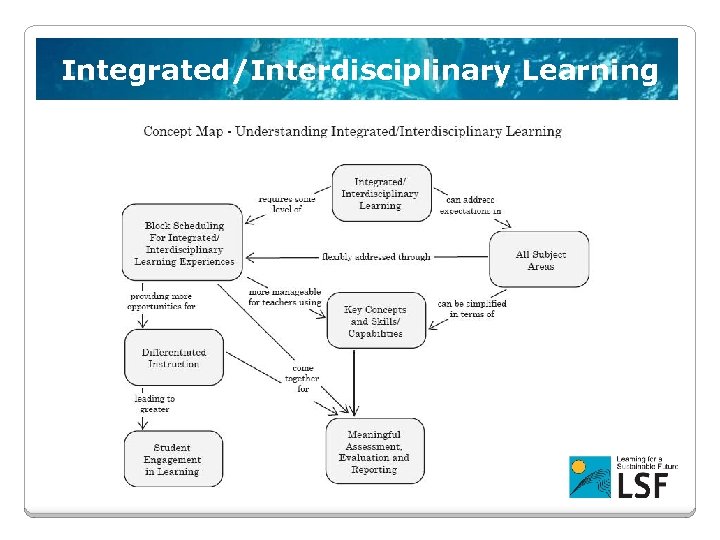
Integrated/Interdisciplinary Learning
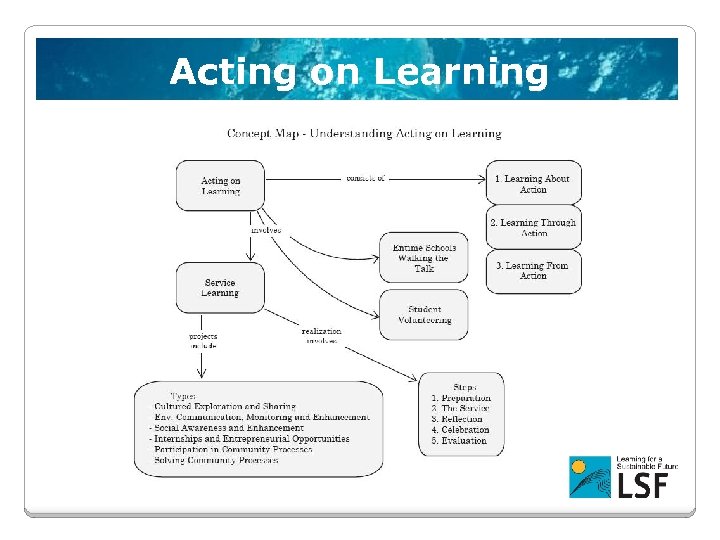
Acting on Learning
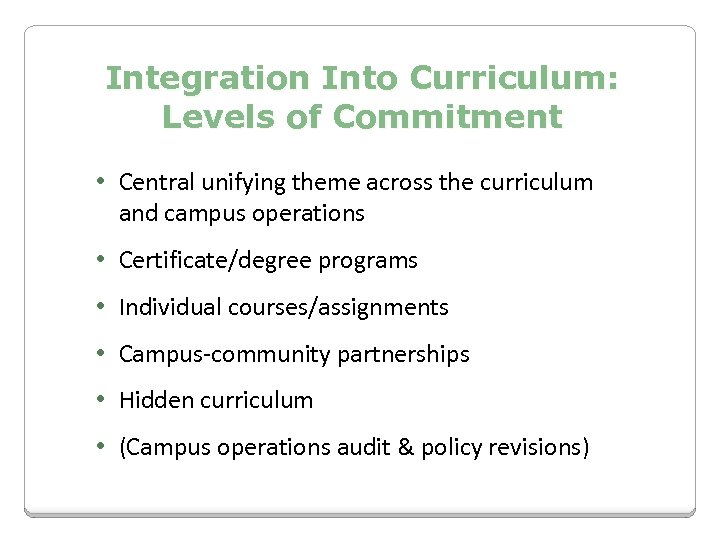
Integration Into Curriculum: Levels of Commitment • Central unifying theme across the curriculum and campus operations • Certificate/degree programs • Individual courses/assignments • Campus-community partnerships • Hidden curriculum • (Campus operations audit & policy revisions)
International Initiatives Learning for a Sustainable Future http: //www. lsf-lst. ca Searchable Database
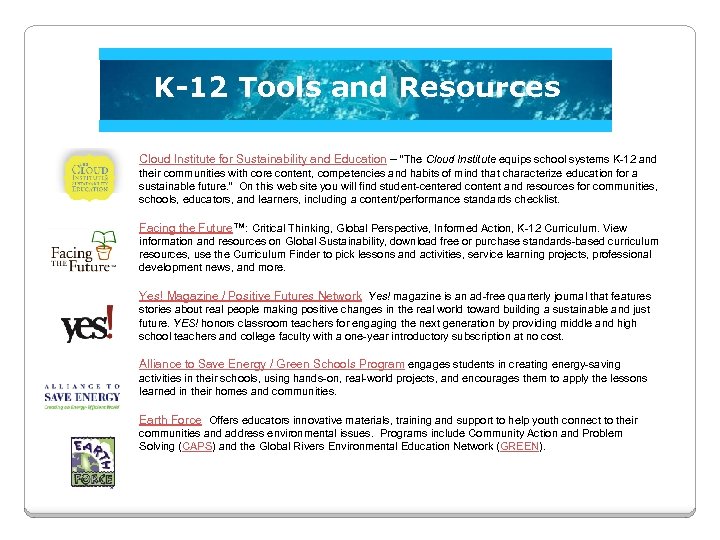
K-12 Tools and Resources Cloud Institute for Sustainability and Education – “The Cloud Institute equips school systems K-12 and their communities with core content, competencies and habits of mind that characterize education for a sustainable future. ” On this web site you will find student-centered content and resources for communities, schools, educators, and learners, including a content/performance standards checklist. Facing the Future™: Critical Thinking, Global Perspective, Informed Action, K-12 Curriculum. View information and resources on Global Sustainability, download free or purchase standards-based curriculum resources, use the Curriculum Finder to pick lessons and activities, service learning projects, professional development news, and more. Yes! Magazine / Positive Futures Network Yes! magazine is an ad-free quarterly journal that features stories about real people making positive changes in the real world toward building a sustainable and just future. YES! honors classroom teachers for engaging the next generation by providing middle and high school teachers and college faculty with a one-year introductory subscription at no cost. Alliance to Save Energy / Green Schools Program engages students in creating energy-saving activities in their schools, using hands-on, real-world projects, and encourages them to apply the lessons learned in their homes and communities. Earth Force Offers educators innovative materials, training and support to help youth connect to their communities and address environmental issues. Programs include Community Action and Problem Solving (CAPS) and the Global Rivers Environmental Education Network (GREEN).
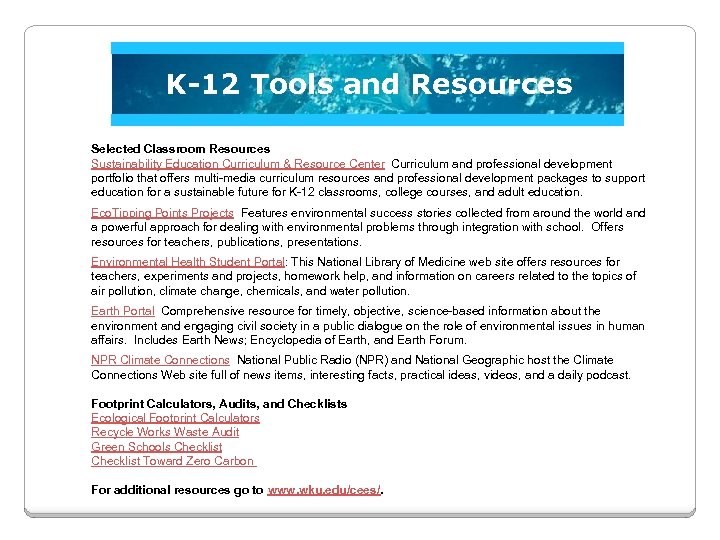
K-12 Tools and Resources Selected Classroom Resources Sustainability Education Curriculum & Resource Center Curriculum and professional development portfolio that offers multi-media curriculum resources and professional development packages to support education for a sustainable future for K-12 classrooms, college courses, and adult education. Eco. Tipping Points Projects Features environmental success stories collected from around the world and a powerful approach for dealing with environmental problems through integration with school. Offers resources for teachers, publications, presentations. Environmental Health Student Portal: This National Library of Medicine web site offers resources for teachers, experiments and projects, homework help, and information on careers related to the topics of air pollution, climate change, chemicals, and water pollution. Earth Portal Comprehensive resource for timely, objective, science-based information about the environment and engaging civil society in a public dialogue on the role of environmental issues in human affairs. Includes Earth News; Encyclopedia of Earth, and Earth Forum. NPR Climate Connections National Public Radio (NPR) and National Geographic host the Climate Connections Web site full of news items, interesting facts, practical ideas, videos, and a daily podcast. Footprint Calculators, Audits, and Checklists Ecological Footprint Calculators Recycle Works Waste Audit Green Schools Checklist Toward Zero Carbon For additional resources go to www. wku. edu/cees/.
Resources to Learn More Education for Sustainability (Ef. S) What is Ef. S? History of Ef. S K-12 Resources
Thank you!
Скачать презентацию Education for Sustainability as a 21 st Century
c6bf1b4ec44b3a761faee4546b7a6743.ppt