


 Скачать презентацию Education Equity the Economy Findings from State
99cc666e280890e2f7fe60f41b05244a.ppt
- Количество слайдов: 30
 Education, Equity & the Economy Findings from State of the South 2004 Sarah Rubin, Senior Associate MDC Inc. RCCA Conference -- October 2004 Program on Southern Politics, Media & Public Life
 Big Trends n The South's population is changing. n The South's economy is changing. n High school education is changing – and it needs to. State of the South 2004 – © MDC Inc. – www. mdcinc. org
 Demographic and Economic Trends Program on Southern Politics, Media & Public Life
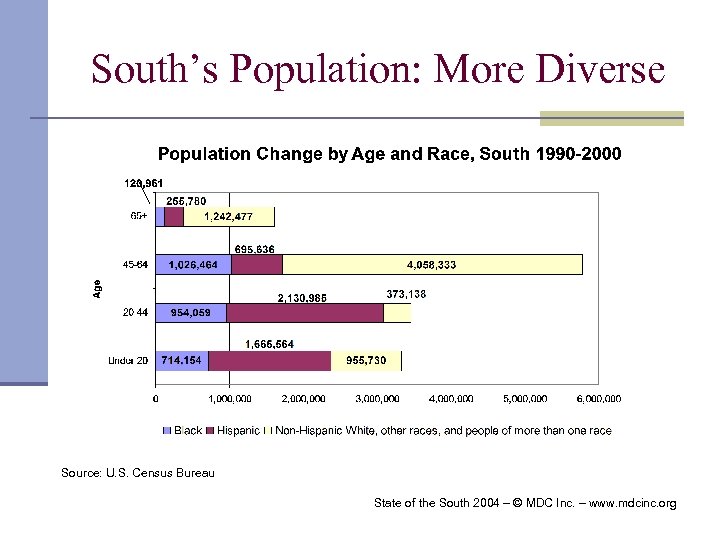 South’s Population: More Diverse Source: U. S. Census Bureau State of the South 2004 – © MDC Inc. – www. mdcinc. org
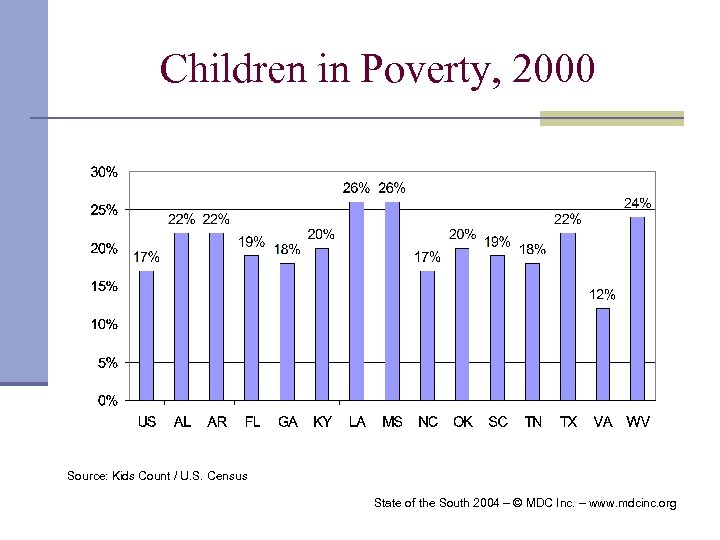 Children in Poverty, 2000 Source: Kids Count / U. S. Census State of the South 2004 – © MDC Inc. – www. mdcinc. org
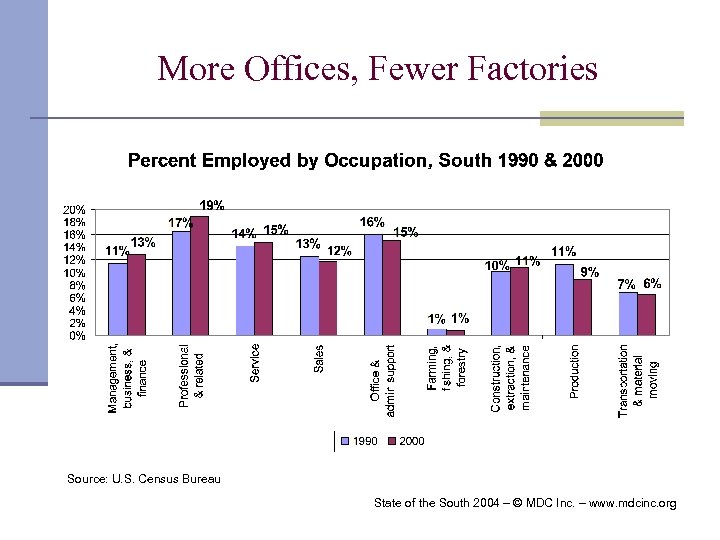 More Offices, Fewer Factories Source: U. S. Census Bureau State of the South 2004 – © MDC Inc. – www. mdcinc. org
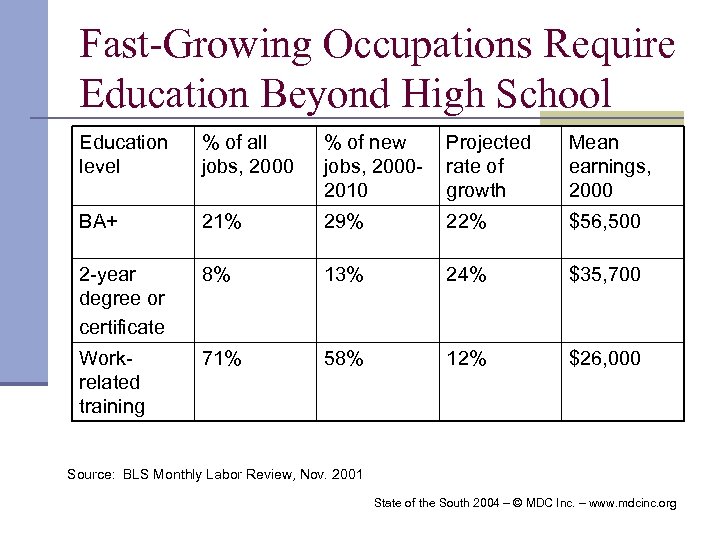 Fast-Growing Occupations Require Education Beyond High School Education level % of all jobs, 2000 % of new jobs, 20002010 Projected rate of growth Mean earnings, 2000 BA+ 21% 29% 22% $56, 500 2 -year degree or certificate 8% 13% 24% $35, 700 Workrelated training 71% 58% 12% $26, 000 Source: BLS Monthly Labor Review, Nov. 2001 State of the South 2004 – © MDC Inc. – www. mdcinc. org
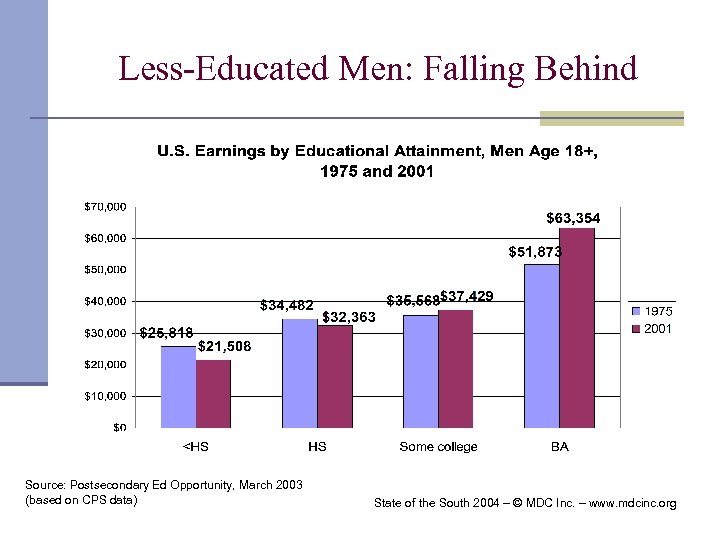 Less-Educated Men: Falling Behind Source: Postsecondary Ed Opportunity, March 2003 (based on CPS data) State of the South 2004 – © MDC Inc. – www. mdcinc. org
 Squeezed in a Vise State of the South 2004 – © MDC Inc. – www. mdcinc. org
 How Well Are High Schools Preparing Youth for the Future Economy? State of the South 2004 – © MDC Inc. – www. mdcinc. org
 The Muddled Middle n Two clear pathways out of high school: n Further education and career. n Disconnection from society and opportunity. n Muddled middle, filled with young people for whom high school fails to provide direction or motivation. State of the South 2004 – © MDC Inc. – www. mdcinc. org
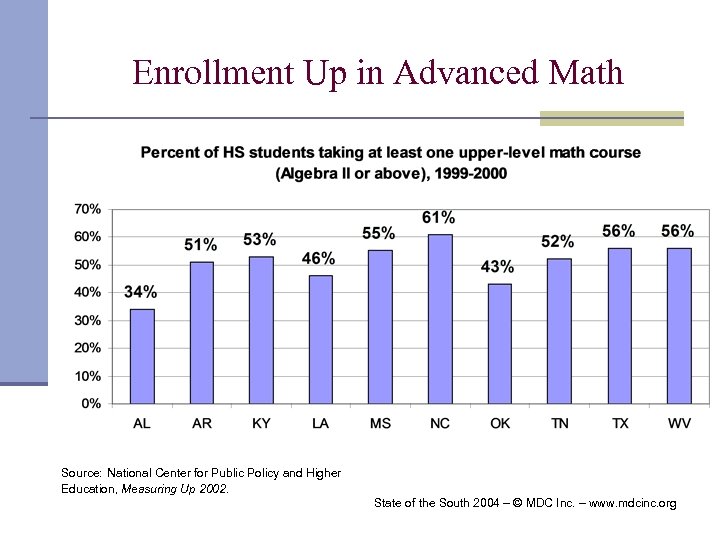 Enrollment Up in Advanced Math Source: National Center for Public Policy and Higher Education, Measuring Up 2002. State of the South 2004 – © MDC Inc. – www. mdcinc. org
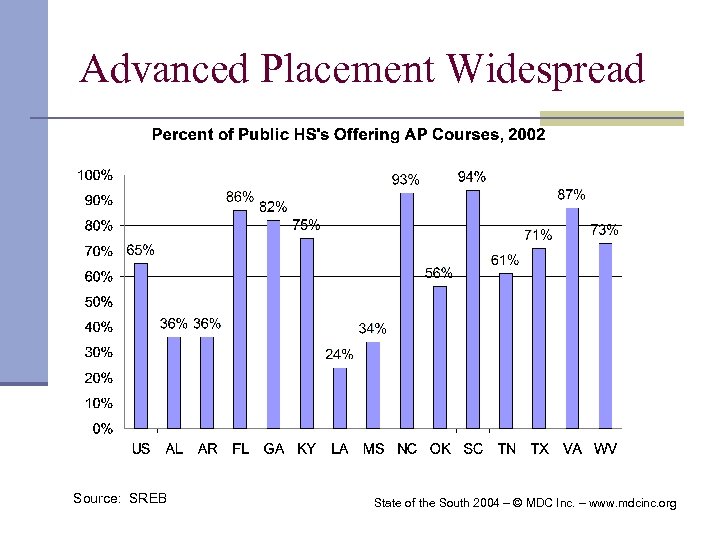 Advanced Placement Widespread Source: SREB State of the South 2004 – © MDC Inc. – www. mdcinc. org
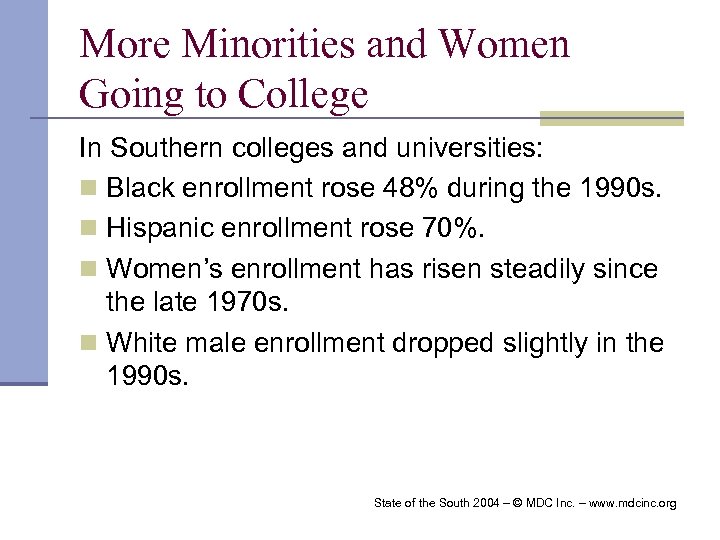 More Minorities and Women Going to College In Southern colleges and universities: n Black enrollment rose 48% during the 1990 s. n Hispanic enrollment rose 70%. n Women’s enrollment has risen steadily since the late 1970 s. n White male enrollment dropped slightly in the 1990 s. State of the South 2004 – © MDC Inc. – www. mdcinc. org
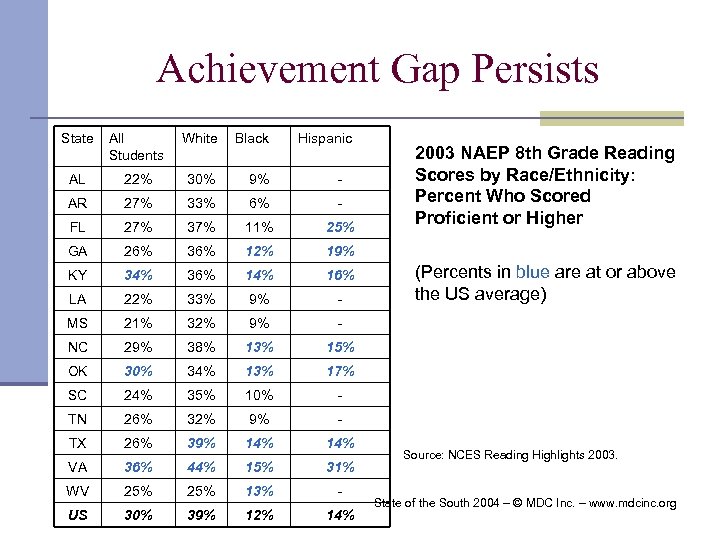 Achievement Gap Persists State All Students White Black Hispanic AL 22% 30% 9% - AR 27% 33% 6% - FL 27% 37% 11% 25% GA 26% 36% 12% 19% KY 34% 36% 14% 16% LA 22% 33% 9% - MS 21% 32% 9% - NC 29% 38% 13% 15% OK 30% 34% 13% 17% SC 24% 35% 10% - TN 26% 32% 9% - TX 26% 39% 14% VA 36% 44% 15% 31% WV 25% 13% - US 30% 39% 12% 14% 2003 NAEP 8 th Grade Reading Scores by Race/Ethnicity: Percent Who Scored Proficient or Higher (Percents in blue are at or above the US average) Source: NCES Reading Highlights 2003. State of the South 2004 – © MDC Inc. – www. mdcinc. org
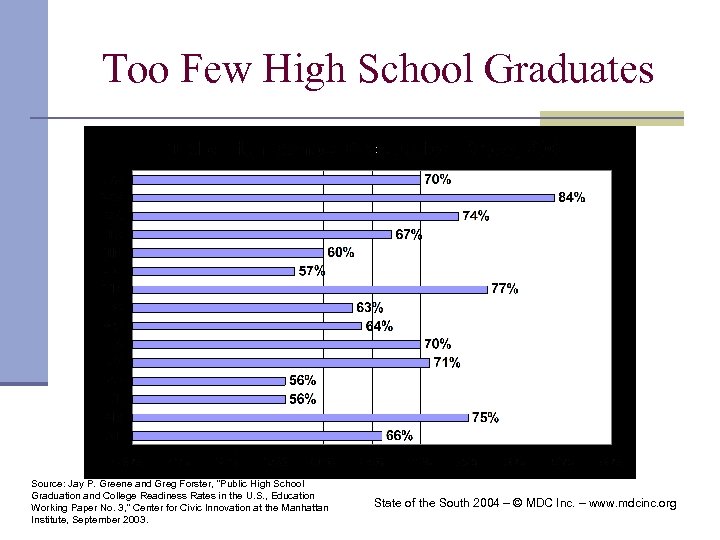 Too Few High School Graduates Source: Jay P. Greene and Greg Forster, "Public High School Graduation and College Readiness Rates in the U. S. , Education Working Paper No. 3, " Center for Civic Innovation at the Manhattan Institute, September 2003. State of the South 2004 – © MDC Inc. – www. mdcinc. org
 State of the South 2004 – © MDC Inc. – www. mdcinc. org
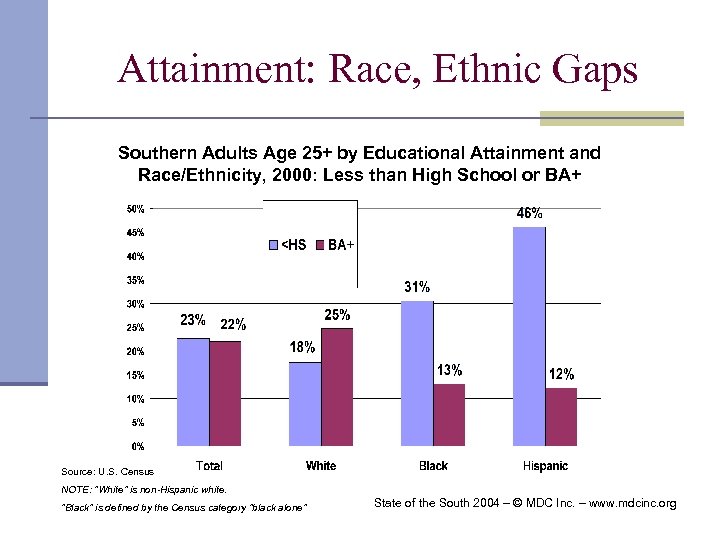 Attainment: Race, Ethnic Gaps Southern Adults Age 25+ by Educational Attainment and Race/Ethnicity, 2000: Less than High School or BA+ Source: U. S. Census NOTE: "White" is non-Hispanic white. "Black" is defined by the Census category "black alone" State of the South 2004 – © MDC Inc. – www. mdcinc. org
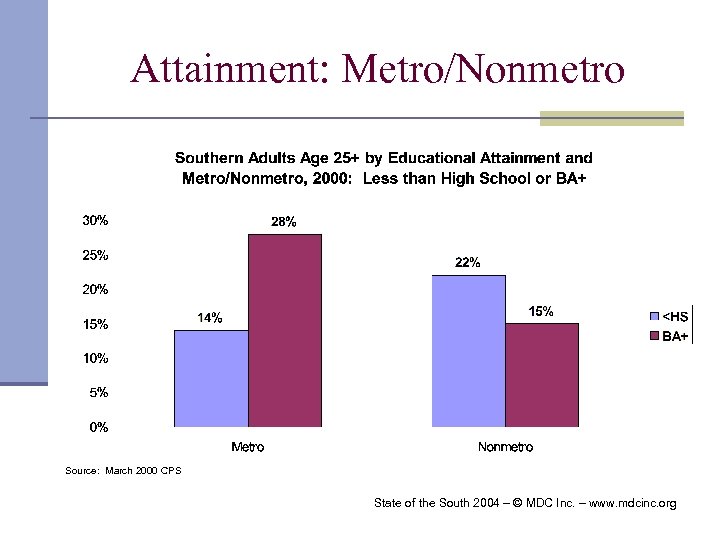 Attainment: Metro/Nonmetro Source: March 2000 CPS State of the South 2004 – © MDC Inc. – www. mdcinc. org
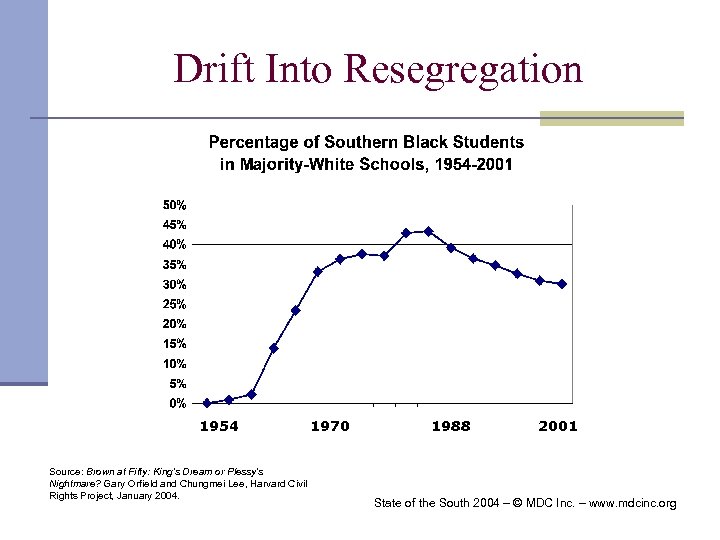 Drift Into Resegregation 1954 Source: Brown at Fifty: King's Dream or Plessy's Nightmare? Gary Orfield and Chungmei Lee, Harvard Civil Rights Project, January 2004. 1970 1988 2001 State of the South 2004 – © MDC Inc. – www. mdcinc. org
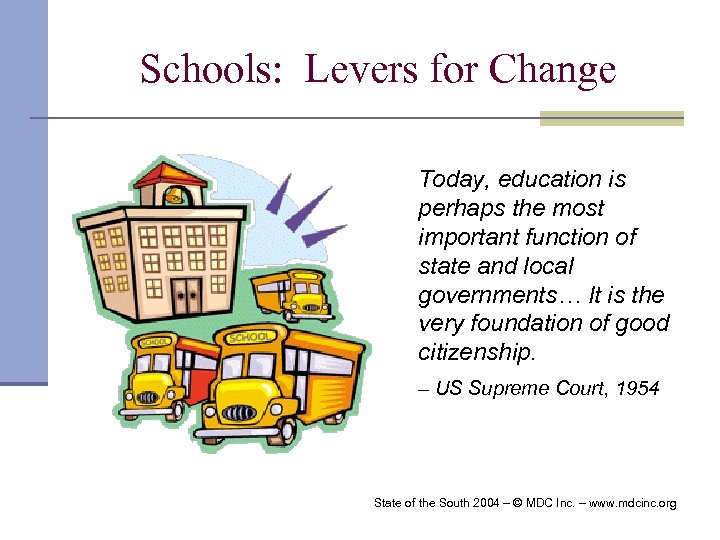 Schools: Levers for Change Today, education is perhaps the most important function of state and local governments… It is the very foundation of good citizenship. – US Supreme Court, 1954 State of the South 2004 – © MDC Inc. – www. mdcinc. org
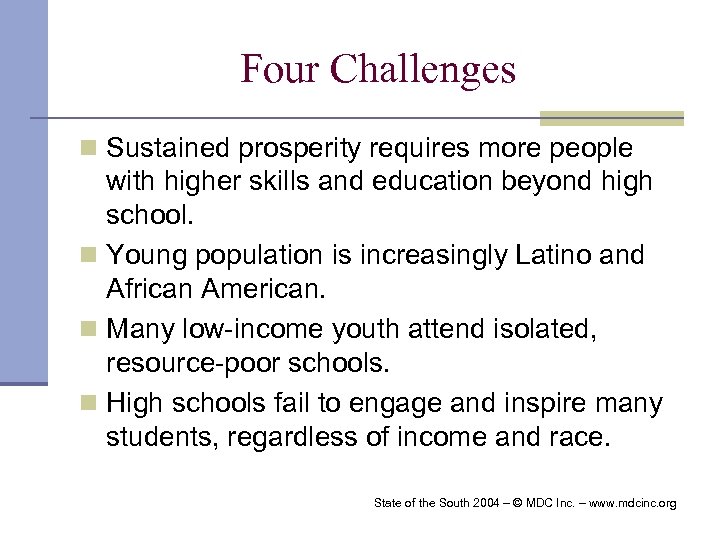 Four Challenges n Sustained prosperity requires more people with higher skills and education beyond high school. n Young population is increasingly Latino and African American. n Many low-income youth attend isolated, resource-poor schools. n High schools fail to engage and inspire many students, regardless of income and race. State of the South 2004 – © MDC Inc. – www. mdcinc. org
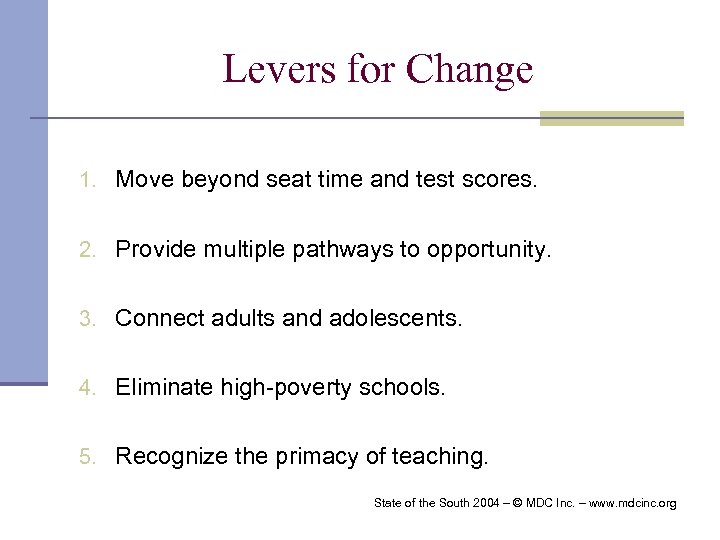 Levers for Change 1. Move beyond seat time and test scores. 2. Provide multiple pathways to opportunity. 3. Connect adults and adolescents. 4. Eliminate high-poverty schools. 5. Recognize the primacy of teaching. State of the South 2004 – © MDC Inc. – www. mdcinc. org
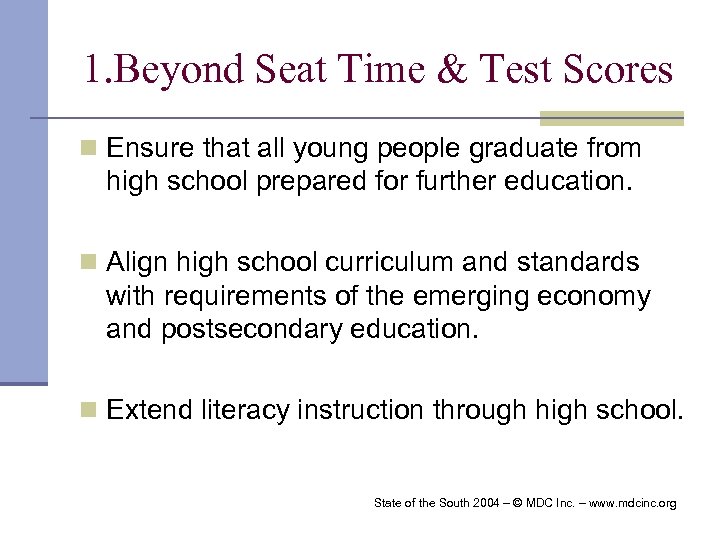 1. Beyond Seat Time & Test Scores n Ensure that all young people graduate from high school prepared for further education. n Align high school curriculum and standards with requirements of the emerging economy and postsecondary education. n Extend literacy instruction through high school. State of the South 2004 – © MDC Inc. – www. mdcinc. org
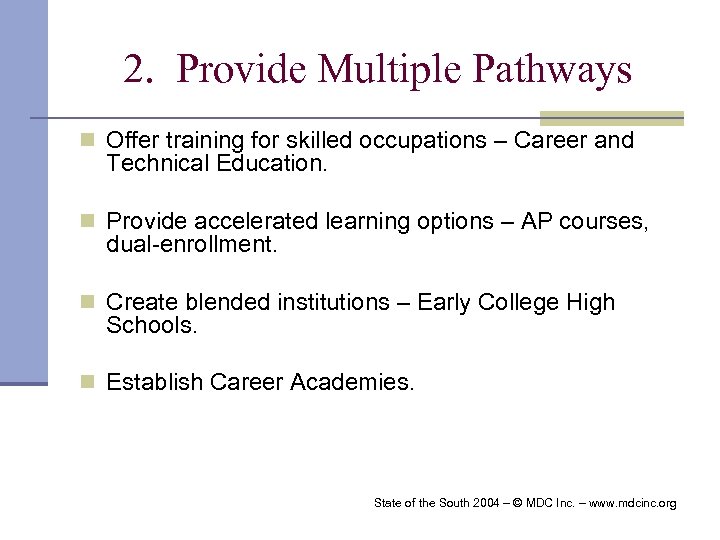 2. Provide Multiple Pathways n Offer training for skilled occupations – Career and Technical Education. n Provide accelerated learning options – AP courses, dual-enrollment. n Create blended institutions – Early College High Schools. n Establish Career Academies. State of the South 2004 – © MDC Inc. – www. mdcinc. org
 3. Connect Adults and Adolescents n Guidance counselors are powerful connectors. n High schools need strong connections to communities. Adult mentors. n Businesses and work-based learning. n State of the South 2004 – © MDC Inc. – www. mdcinc. org
 4. Eliminate High-Poverty Schools n Race matters, income matters more. n No school should have a high concentration of students living in poverty. n Where entire districts are poor, states must provide resources and encourage regionalism. State of the South 2004 – © MDC Inc. – www. mdcinc. org
 5. No Substitute for Strong Teaching n Develop a corps of superbly trained, well-paid, professional teachers. n Identify and train new teachers. n Retain incumbent teachers and expand professional development opportunities. n Break up systematic assigning of vulnerable teachers to vulnerable schools. n Offer pay, housing, tax, and other incentives to attract experienced principals and teachers to vulnerable schools. State of the South 2004 – © MDC Inc. – www. mdcinc. org
 Questions n How well do these recommendations match the needs in your community or region? n What can rural community colleges do to put more young people on a path to college? n Does your state have any promising initiatives to reform high school education? How are community colleges involved? State of the South 2004 – © MDC Inc. – www. mdcinc. org
 For More Information Sarah Rubin MDC Inc. P. O. Box 17268, Chapel Hill, NC 27516 -7268 (919) 968 -4531 srubin@mdcinc. org State of the South 2004 can be downloaded or ordered from MDC’s website (www. mdcinc. org) State of the South 2004 – © MDC Inc. – www. mdcinc. org