


 Скачать презентацию EDUCATION AND TRAINING FOR INFORMATION EMPOWERMENT SPECIALISTS IN
4ba52a493b00a4348b1546d5e5ff39d6.ppt
- Количество слайдов: 27
 EDUCATION AND TRAINING FOR INFORMATION EMPOWERMENT SPECIALISTS IN THE NETWORKED SOCIETY: AN INDIAN EXPERIENCE BY PROF. C R KARISIDDAPPA PRESIDENT (INDIAN LIBRARY ASSOCIATION) PROFESSOR, CHAIRMAN & UNIVERSITY LIBRARIAN KARNATAK UNIVERSITY DHARWAD – 580 003 INDIA
 CONTENTS § INTRODUCTION § NEED FOR ENHANCING COMPETENCIES § INDIAN EFFORTS § PHASES OF CHANGE § EMPHASIS ON PRACTICE § INTERDISCIPLINARY APPROACH § BLENDING TRADITION WITH TECHNOLOGY § INFLUENCE OF OTHER DISCIPLINES § NEW APPLICATIONS § MODULAR APPROACH § CONCLUSION
 INTRODUCTION § Profession is in search of identity § Sufficiently endeavoured to Partner in Societal & Economic Transformation § To adopt & adapt contemporary Technology Innovations § Many convergent factors have influenced the profession § In this context structuring a dynamic curriculum for manpower development is a complex task § This has been a consistent concern of Lib & Inf. Schools § Exercise to review the status of Lib & Inf. Sc. Education is on the anvil
 1. LISC (UK) recommended to review the future manpower training requirements for Lib & Inf. work 2. Persistent efforts are made in the task of development of education & research in Lib & Inf. Sc. globally 3. Experts opined that now the schools of library & Inf. studies are not playing the role they might be expected to play in the emerging Information Society 4. There is a need to review the developments which have taken place in teaching & research and also need for enhancing competencies
 § § § Human resources is the most valuable resource It enables the identification, selection, development & control of other physical & intellectual resources Any plan-sectoral or over all should give emphasis to development of manpower with appropriate professional knowledge & skills In this fast changing world, there are new demands & influences on Lib & Inf. Centers - educating & training for Lib & Inf. work has focused upon recordable information, & knowledge, & services & technologies to facilitate its management & use Started with apprenticeship mode to formal degree programmes
 FUTURE LIBRARY AND INFO PROFESSIONALS ARE EXPECTED TO ASSIST THE USERS: Ø Ø Ø by providing them with careful and well organized information, specially in electronic form by providing information which has been evaluated & repackaged to meet their needs precisely by facilitating their use of both technology & information, so that information professionals can play a significant part in a “Learning Society” Task of Lib & Inf. Sc. teachers to impart education which transfers professional skills of acquiring & using inf. in networked society
 Indian Efforts : § § India has to play a significant role in education training Countrywide exercise made to articulate knowledge which could be packed in Lib & Inf. Sc. education & training curriculum, with help of experts Well defined modules presented before the forum of chairpersons of the Board of Studies in different universities Has facilitated the debate & enabled to develop a viable curriculum beating the balance between traditional & modern practices, skills & techniques
 Phases of Changes : (Phase One : 1960 -70) Three factors enhanced professional status & increased employment opportunities, viz. , § Enactment of Library Legislation § UGC assistance to College & University Libraries § Documentation work & services Library legislation enhanced employment opportunities for qualified library professionals in Public Libraries. UGC initiated review on working of university & college libraries & status of library science education in 1950’s & 1960’s
 § Librarians in academic Libraries given equal status on par with teachers in educational sectors § Emergence of new area of study - Documentation § National Laboratories established under CSIR § Establishment of INSDOC in 1952 § § From mid 1970 s emphasis on inf. component & to the facets of inf. collection, storage & retrieval aspects Decade of 70’s important as it brought changes in nomenclature from library science to library & inf. Science
 §Global attention due to internationalization of information & also due to involvement of inter-governmental agencies like UNESCO, UNIDO & FAO in information handling activities §Establishment of international cooperative systems like INIS, AGRIS & DEVSIS under UNISIST §Shifted the emphasis of library & information profession from national level to that of international level §Establishment of Data Banks, Information Analysis Centres and Translation Centres marked the beginning of new milestone in global view of information activities §Emphasized that library manpower development programmes and education programmes have to be remodelled to suit the needs of contemporary requirements
 (Phase Two : 1980’s) §Began with advent of microcomputers in libraries in mid 1980’s §Brought in shift in professional approach from information oriented services to user oriented services §Adoption of new storage technology in the form of optical media and this created a greater impact §Computer & communication technology revolutionized the subject to highly reckonable field of an international status & a field to be called Information Science and Technology
 Emphasis on Practice § § § In Indian context – issue of relationship between theory and practice not properly addressed Library schools are drowning in theory but not giving enough exposure to practice Dilemma lies in the choice between teaching knowledge & skills needed to meet immediate needs of employers or instilling principles which can expand skills & knowledge base as career develops
 Inter-disciplinary Approach § § § In western countries some schools have merged with different disciplines like information management & technology information studies & mass communication to meet the challenge of managing complex & diverse new environment. Need to commit to life-long learning from established practitioners as circumstances demand greater professional & technical awareness Only systematic continuing education provides method of combating professional obsolence as it is a real & ever present danger On the lines of schools in western countries, introduction of new programmes to be seen as reflecting pull & push effect recognition, of increasing need for professional workforce to match growth & significance of information industry expanding higher education system to provide appropriate workforce Schools have began to diversify their portfolio of courses, with programmes intended to serve needs of publishing & communication industries
 Blending Tradition with Technology § Scenario of library & information centres, & services provided by them, undergoing a transformation due to emergence of new media § Information needs of user community taking place due to need based adoption of IT § Work in libraries necessitated to make appropriate changes in library and information science syllabus for various levels of education § Factors invite serious attention of departments of library & information science who produce manpower for managing library and information centers § Till recently more emphasis on teaching of traditional subject, but teaching with emphasis on IT & practical aspects of library automation received little attention in the syllabus
 Library & information scientists have expressed that : § § § library and information science professionals should possess skills to harness IT tools & techniques hence responsibility of library and information science schools - to bring radical change in syllabus by incorporating theoretical & practical aspects of automaton & networking Library Science can claim a distinguished position on its own philosophical & classification components To ensure due recognition of the profession, proper weightage to the components in library & information science courses necessary Library & information science based on sound philosophical base & strong theoretical & technical roots, without ignoring the roots to harmonize them with recent developments
 Influence of other Disciplines § § § library and information science showed its affinity towards application of other fields to improve professional performance Ranganathan infused scientific method in the field that marked the first change from librarianship to library science Emergence of information society has extended horizon of information science field to the study of socio-political & economic aspects of information Major disciplines are a part of library & information science curriculum like Management Science, Information Technology, Statistics, Linguistics & Psychology Transition shift from agriculture to industrial base, to an economy based on information technology, influenced governmental policies & directed to production and distribution of information
 § § § These factors have contributed to emergence of new areas – Information Science, Information Society & Information Technology, with common denominator - Information Emergence of electronic media opened up new avenues & also made to rethink on manpower development programmes Inf. professionals to turn their attention to “Content Creation & Development” referred by Inf. Technology Task Force of Government of India, as new requirements in context of development of library networks
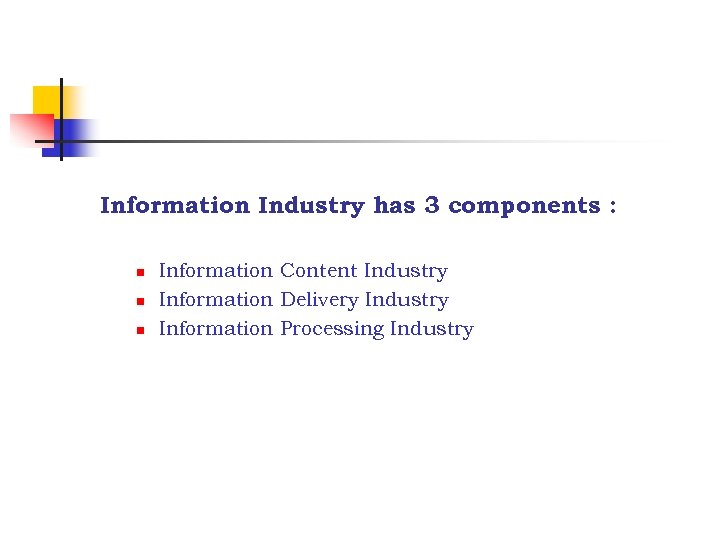 Information Industry has 3 components : n n n Information Content Industry Information Delivery Industry Information Processing Industry
 § § Information Content Industry primarily concerned with developing products for Web & on-line environment Information Delivery Industry consists of creation & management of telecommunication networks through which Information is transferred & delivered Information Processing Industry consists of products of hardware & software Information Content sector accounts for nearly half of the Information Industry & is still growing
 New Applications are based on The three fold transformation, Viz §Objective of preserving recorded human knowledge §Adopting the motto that knowledge is for use §Providing global access to information
 §The profession has adopted contemporary societal, economic, technological & educational changes in its applications §It has been enabled to acquire capabilities of adopting them in teaching due to imminent application in practice §In modern economy importance of information has increased & calls for better use of existing services & continuous improvement of information service to meet the explicit & implicit needs
 §Computers are found successful in processing & retrieval of information §Impact of Internet on library & information services & concept of digital and virtual Libraries are recognized as nascent fields of study §Hence need for examining adequacy & appropriateness of present curricula
 Modular Approach § § § an approach to help departments to adopt a curriculum suitably has to be seriously considered Crux of this paper revolves round a Modular Approach in formulation of model curriculum Important Features are; Ø Course objectives Ø Unitwise course contents Ø Special note on practical component Ø Learning outcome of each module Also optimum hours of teaching programme has to be included In 1982 Yang in UNESCO report proposed a Modular Approach to curriculum for information studies
 UGC Curriculum Report emphasizes on “ Cafeteria Approach” and introduction of choice based credit system : Module 1 : Foundation of Library and Information Science Module 2 : Knowledge Organization, Information Processing & Retrieval Module 3 : Information sources, Products & Services Module 4 : Management of Library & Information Centers/Institutions Module 5 : Information Technology Basics & Applications Module 6 : Research Methods & Statistical Technology Module 7 : (Electives) Information Systems
 Conclusion § § § Need for rejuvenating LIS courses in India in light of the happenings in international area Education & training programmes in library and information science must make provision to prepare professionals to assume proactive role in coping with new technology & information explosion Designed course contents should concentrate in making professionals as change agents, facilitators and guides with suitable & strong information empowerment
 KARNATAK UNIVERSITY This is where I work!
 THANK YOU!