


 Скачать презентацию EDM 6209 Policy Studies in Education Topic 5
b7c3fb476b3dcafc20fc7cacd7cfb5f3.ppt
- Количество слайдов: 73
 EDM 6209 Policy Studies in Education Topic 5 Perspectives in Policy Studies: Discursive- Critical Perspective
 Argumentative and Persuasive Turns in Policy Studies z Public policy as argumentative and persuasive practice y Redefining the nature of public policy: “As politicians know too well but social scientists too often forget, public policy is made of language. Whether in written or oral form, argument is central in all stages of the policy process. ” (Majone, 1989, p. 1)
 Argumentative and Linguistic Turns in Policy Studies z Public policy as linguistic and argumentative practice (cont’d) y Redefining the role of the policy analysts: “In a system of government by discussion, analysis - even professional analysis - has less to do with formal techniques of problem solving than with process of argument. The job of analysts consists in large part of producing evidence and arguments to be used in the course of public debate. Its crucial argumentative aspect is what distinguishes policy analysis from the academic social science on the one hand, and from problem-solving methodologies such as operations research on the other. …
 Argumentative and Linguistic Turns in Policy Studies z Public policy as linguistic and argumentative practice (cont’d) y … They must persuade if they are to be taken seriously in the forums of public deliberation. Thus, analysts, like lawyers, politicians, and others who make a fundamental use of language, will always be involved in all the technical problems of language, including rhetorical problems. (Majone, 1989, p. 7)
 Argumentative and Linguistic Turns in Policy Studies z Public policy as practice of persuasion y Redefining the nature of public policy: “All our talk of ‘making’ public policy, of ‘choosing’ and ‘deciding’, loses track of the home truth … that politics and policy making is mostly a matter of persuasion. Decide, choose, legislate as they will, policy makers must carry people with them, if their determinations are to have the full force of policy. …To make policy in a way that makes it stick, policy makers cannot merely issue edicts. They need to persuade the people who must follow their edicts if those are to become general public practice. ” (Goodin et al. , 2006, p. 5)
 Argumentative and Linguistic Turns in Policy Studies z Public policy as practice of persuasion y Redefining the core of the discipline: “Not only is the practice of public policy making largely a matter of persuasion. So is the discipline of studying public policy making aptly described as itself being a ‘persuasion’. It is a mood more than a science, a loosely organized body of percepts and positions rather than a tightly integrated body of systemic knowledge, more art and craft and genuine ‘science’. ” (ibid)
 Discursive Perspective in Policy Studies z Locating the levels of study for policy discourse y The concept of discourse has become popular in social sciences in past decades. As the concept being used by various disciplines in social sciences, the meanings of the concept have become heterogeneous if not chaotic. y At conversation level, the concept of discourse can refers to speech act, language use, or parole. For example in classroom discourse study, discourse is taken as speech act and speech exchange between teachers and students in the classroom context.
 Discursive Perspective in Policy Studies z Locating the levels of study for policy discourse y At institution level, discourse can refers to cognitive, regulative and normative rules governing the circulation and practice of ideas, concepts, categories and representations of social meanings within a social institutional domain. For examples, in medical institution, discourse may take the form of a certification issued by a doctor to a patient indicating the health condition of the latter and the whole institutional configuration making this certification effective; and in educational institution, discourse may take the form of a certificate issued by government to a student certifying passing of an examination of the latter and the whole institutional configuration making this certification effective.
 Discursive Perspective in Policy Studies z Locating the levels of study for policy discourse y At socio-cultural system level, discourse can refers to the dominance or hegemony governing the circulation and/or practice of ideas, concepts, categories and representations of social meanings in a society. For example, the discourses of neo-liberal capitalism or socialism in economy system; discourse of liberal democracy or proletarian dictatorship in political system; etc.
 Discursive Perspective in Policy Studies z The conception of discourse in public policy y Frank Fischer defines “Discourse …is an ensemble of ideas and concepts that give social meaning to social and physical relations. ” (2003, p. 90) y David Howarth defines Discourse refers “to historically specific systems of meaning which form the identities of subjects and objects. ” (2002, quoted in Fischer, 2003, p. 73) y Maarten Hajer defines discourse as “a specific ensemble of ideas, concepts, and categories that are produced, reproduced, and transformed to give meaning to physical and social relations. ” (1995, quoted in Fischer, 2003, p. 73)
 Discursive Perspective in Policy Studies z The conception of discourse in public policy y Taken together these conceptions of discourse, policy discourse can then be characterized as a historically specific ensemble of ideas, concepts and categories which gives meaning to physical and social relations and forms identities of subjects and objects within a particular policy domain and/or around a specific policy issue. For example, the neo-liberalism in public policy; the “Washington consensus” in fiscal policy; the welfare state or the workfare state in welfare policy; comprehensive- egalitarianism or quasi-market discourse in education policy.
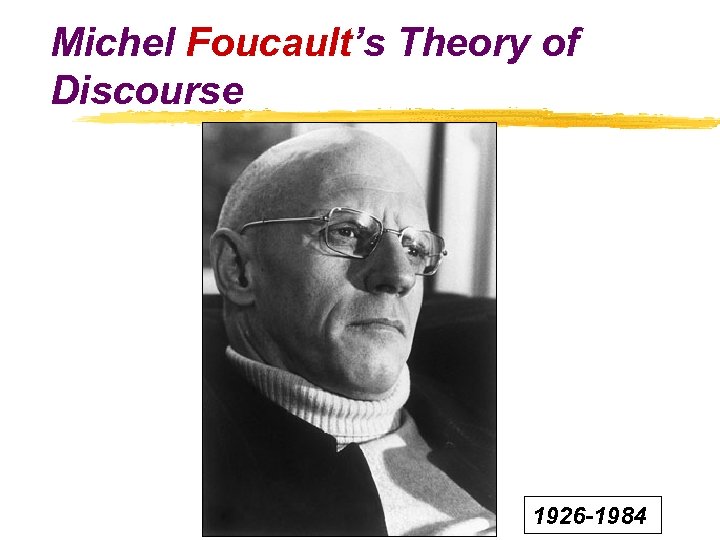 Michel Foucault’s Theory of Discourse 1926 -1984
 Michel Foucault’s Theory of Discourse z Conception of Statement y The statement – the constituent unit of a discourse “The statement is not the same kind of unit as the sentence, the proposition, or the speech act…The statements is not …a structure (i. e. a group of relations between variable elements. . . ); it is a function of existence that properly belong to signs and on the basis of which one may then decide, through analysis or intuition, whether or not they ‘make sense’, according to what rule they follow one another or are juxtaposed, of what they are the sign, and what sort of act is carried out by their formulation (oral or written). ” (Foucault, 1972, p. 86 -87)
 Michel Foucault’s Theory of Discourse z Conception of Statement y Accordingly policy statement can then be defined as a specification or even a prescription (in oral or written format) circulating in a particular public policy domain. It defines the “conditions of existence” the objects in the specific public policy domain are qualified to obtain. For examples:
 Michel Foucault’s Theory of Discourse z For examples: y Liberal studies is one of the four core subjects in New Senior Secondary Curriculum y Profit-making kindergartens are not eligible to participate in educational-voucher scheme y Form-3 students in school X are below the standard of Territory-wide System Assessment in English-language y Student X is a EMI-capable student in SSPA, school Y is a EMI school, teacher Z is a EMI-capable teacher y Student A is a Special-Educational-Needs (SEN) student y Primary school M has adopted small-class-size teaching y School N is a “Quality” school in ESR scheme y School Q is not managed by Incorporated Management Committee (IMC)
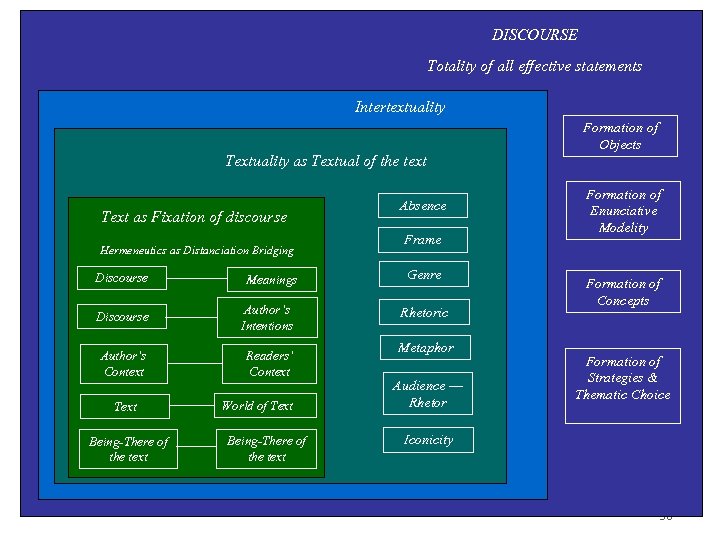
 Michel Foucault’s Theory of Discourse z Conception of discourse y A discourse “is the totality of all effective statements (whether spoken or written). . Description of discourse is in opposition to the history of thought. There…a system of thought can be reconstituted only on the basis of a definite discursive totality. …The analysis of thought is always allegorical in relation to the discourse that it employs. Its question is unfailingly: what is being said in what was said? …what is this specific existence that emerges from what is said and nowhere else? ” (Foucault, 1972, p. 27 -28)
 Michel Foucault’s Theory of Discourse z Conception of discourse y “We can now give a full meaning to the definition of ‘discourse’. …We shall call discourse a group of statements in so far as they belong to the same discursive formation. …It is made up of a limited number of statements for which a group of conditions of existence can be defined. ” (p. 117)
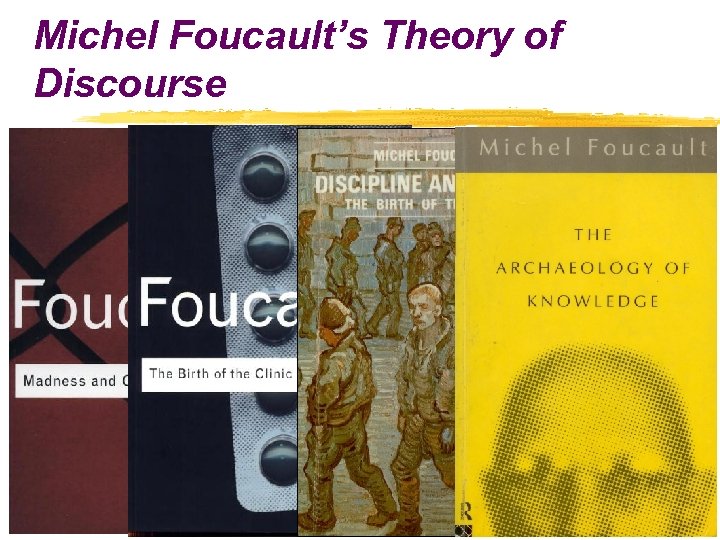 Michel Foucault’s Theory of Discourse
 Michel Foucault’s Theory of Discourse z Conception of discourse y Hence, a policy discourse is a totality and unity of effective policy statements within a public policy domain in specific historical, cultural, and socioeconomic contexts. For example, the quasi-market discourse on education reforms implemented by capitalist states in developed countries in the last decade of the 20 th century can be construed as a totality of effective policy statements which stipulate the underlying principles as well as the operational mechanism of the schooling system in these countries.
 Standardization, Normalization, Commodification & Reification TTRA, TOC, SVAIS EMILanguage Surveillance- Teacher Capable Proficiency Competence Teachers Asessment evaluationism Framework EMICapable SVAIS Students Principal Professional Development Market signals SSPA Discretionary Places Parentocracy- Demand Parental DSS Choice consumerism EMI Schools Pre-school Voucher System SSE Marketization QAI Supply ERS Standardization & Dismantliztion Fragmentation & Stratification Medium of Exchange Discipline. SBM managerialism Audited Schools S-B Ordinance
 Michel Foucault’s Theory of Discourse z Foucault’s Theory of Discursive Formation Foucault differentiates the formation of a discourse into four interrelated parts. y The Formation of Object: x. Mapping the surface of the emergence of the object x. Describing the authorities of delimitation x. Analyzing the grids of specification
 Michel Foucault’s Theory of Discourse z Foucault’s Theory of Discursive Formation y The Formation of Enunciative Modality x. Identifying who is speaking, who is accorded the right to use this sort of language, who is qualified to do so. x. Describing the institutional sites from which the discourse is made and form which the discourse derives its legitimate source and point of application x. Analyzing the position of the subject, in which s/he occupies in relation to the various domains and groups of objects
 Michel Foucault’s Theory of Discourse z Foucault’s Theory of Discursive Formation y The Formation of Concepts: the formation of the organization of the field of statements where they appeared and circulated x. Identifying the forms of succession, e. g. • Orderings of enunciative series • Types of dependence of the statement • Rhetorical schemata according to which groups of statements may be combined
 Michel Foucault’s Theory of Discourse z Foucault’s Theory of Discursive Formation y The Formation of Concepts: the formation of the organization of the field of statements where they appeared and circulated x Identifying the forms of coexistence • Field of presence • Field of concomitance • Field of memory x Identifying the procedures of intervention that may be legitimately applied to statements, e. g. technique of rewriting , method of transcribing, mode of translating, means of transferring, method of systematizing
 Michel Foucault’s Theory of Discourse z Foucault’s Theory of Discursive Formation y The Formation of Strategies or theoretical and thematic choice x Determining the points of diffraction of discourse • Point of incompatibility • Point of equivalence • Point of systematization x Analyzing the economy of the discursive constellation x Analyzing the other authority, e. g. functional to fields of non-discursive practice, observing the rules and processes of appropriation of discourse
 Michel Foucault’s Theory of Discourse z Foucault’s Theory of Power/Knowledge and Discourse y The relation between discourse and power: “Discourse can be both an instrument and an effect of power… Discourse transmits and produces power; it reinforces it. ” (Foucault, 1978, 101, my italic) y The concept of power/knowledge x “It is in discourse that power and knowledge are joined together” (Foucault, 1978, p. 100) and constitute what Foucault conceptualized the power/knowledge.
 Michel Foucault’s Theory of Discourse y. The concept of power/knowledge x“We should admit … that power and knowledge directly imply one another; that there is no power relation without the correlative constitution of a field of knowledge, nor any knowledge that does not presuppose and constitute at the same time power relations. These power/knowledge relations are to be analyzed, therefore, not on the basis of a subject of knowledge who is or is not free in relation to the power system, but, on the contrary, the subject who knows, the objects to be known and the modalities of knowledge must be regarded as so many effects of these fundamental implications of power/knowledge and their historical transformations. In short, it is not the activities of the subject of knowledge that produces a corpus of knowledge, useful or resistant to power, but power/knowledge, the processes and struggles that traverse it and of which it is made up, that determines the forms and possible domains of knowledge. ” (Foucault, 1977, p. 28)
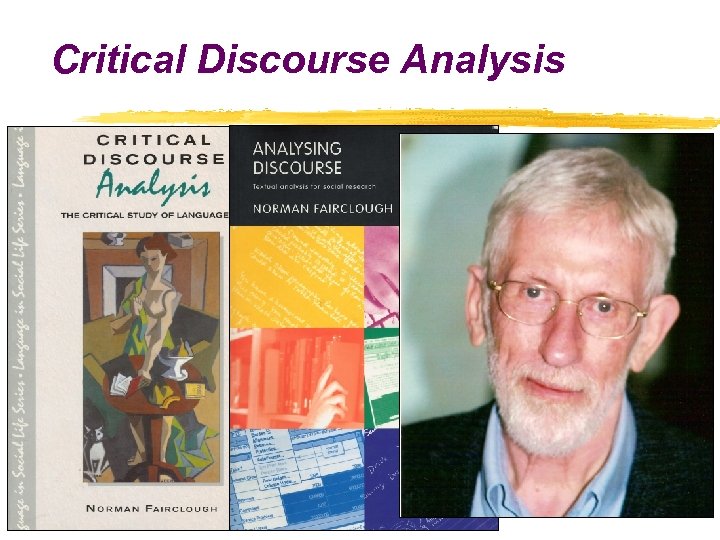 Critical Discourse Analysis
 Critical Discourse Analysis z Assumptions of Critical Discourse Analysis (CDA): As a research approach, CDA has assigned numbers of particular features to the understanding of discourse y Discourse as social practice: Discourse is no longer construed as individual language use in forms of text or talk, but as social practices which implies x Representation and/or expression of meaning and value x Acts upon the world x Acts upon social relations between human beings
 Critical Discourse Analysis z Assumptions of CDA y Constitutive nature of discourse: Construed as social practice, discourse therefore takes on a constitutive nature. In other words, human beings use discourse to construct the worlds or realities around them. This constitutive nature of discourse may manifest in at least three aspects x Ideational construction: “Discourse contributes to the construction of system of knowledge and belief. ” (Fairclough, 1992, p. 64) For example, discourse of science contributes to the construction of the material world around us so are discourse of myths or religion.
 Critical Discourse Analysis z Assumptions of CDA y Constitutive nature of discourse: x Relational construction: “Discourse help construct social relationship between people. ” (ibid) For example, liberaldemocratic discourse derived from the Enlightenment contributes to the constitution of the political realities of modern societies. x Identity construction: Discourse contributes to the construction of social subjects, self and social identity. For example, the identity of citizenship is constructed through the liberal-democratic discourse in the past three centuries in human societies.
 Critical Discourse Analysis z Assumptions of CDA y Dialectic relationship between discourse and the social structure “It is important that the relationship between discourse and social structure should be seen dialectically if we are to avoid the pitfalls of overemphasizing on the one hand the social determination of discourse, and on the other hand the construction of the social in discourse. ” (Fairclough, 1992, p. 65) In other words, the dialectic perspective in the relation between discourse and social structure takes both social determination and social construction into to consideration and assumes them to be in a interactive and mediating relation.
 Critical Discourse Analysis z Assumptions of CDA y Discourse is historical: CDA takes discourse as concrete social practice in particular historical and socio-cultural contexts. Hence, analysis of contexts, where the discourse takes place, is an essential part of CDA.
 Critical Discourse Analysis z Assumptions of CDA y Ideological effect of discourse: The core question CDA attempts to explore is how discourse serves as means to legitimatize and reproduce prevailing relations of power in a society, i. e. constituting ideological effects forms of social dominations. Hence, to wage critique on domination and the social distortion and bias that it elicits is what makes CDA “critical”.
 Critical Discourse Analysis z Fairclough’s three-dimensional framework of CDA y Three-dimensional analytical framework of CDA x Text analysis: This dimension of discourse analysis includes • Analyses of text • Analysis of textuality • Analysis of intertextuality x Discourse analysis: It covers analysis of the process of production, distribution and consumption of a discourse. In other words, it basically correspond Foucault’s conception of discursive formation.
 Critical Discourse Analysis z Three-dimensional framework of CDA (cont’d) y Three-dimensional analytical framework of CDA x Ideology analysis: This aspect of discourse analysis aims to reveal the ideological effect embedded and/or constituted in a particular discursive practice. By ideological effect of a discourse, it refers to effect of a discourse in legitimating and reproducing prevailing inequalities in power relations and social distortions and biases in social-cultural practice. Furthermore, as an ideological effect of a discourse has achieved the cognitive status of “taken for granted” or “common sense” among participants of a discourse, then it has constituted, what Gramsci conceptualizes, hegemony. Hegemony is “an ideological complex” (Gramsci, 1971; quoted in Fairclough, 1992, p. 92), which constitutes “leadership as well as domination across the economic, political, cultural and ideological domains of a society. ” (Fairclough, 1992, p. 92)
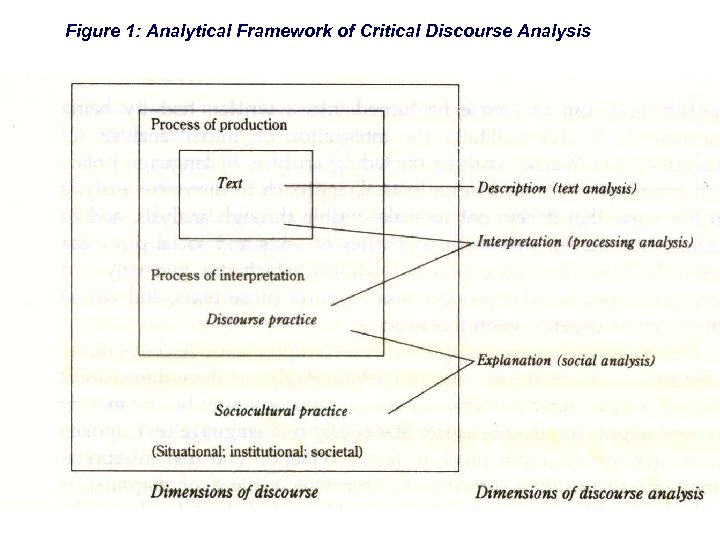 Figure 1: Analytical Framework of Critical Discourse Analysis
 DISCOURSE Totality of all effective statements Intertextuality Textuality as Textual of the text Text as Fixation of discourse Hermeneutics as Distanciation Bridging Discourse Meanings Discourse Author’s Intentions Author’s Context Readers’ Context Text Being-There of the text World of Text Being-There of the text Absence Frame Genre Rhetoric Metaphor Audience ― Rhetor Formation of Objects Formation of Enunciative Modelity Formation of Concepts Formation of Strategies & Thematic Choice Iconicity 38
 Critical Discourse Analysis z Fairclough’s three-dimensional framework of CDA y The mediating function of discursive practices between textual practices and social-cultural practices. “Critical discourse analysis is very much about making connections between social and cultural structures and processes on the one hand, and properties of text on the other. ” (Faieclough and Wodak, 1997, p. 277) Critical discourse analysts has construed the dimension of discursive practice as the mediator between the two. They has characterized the connection to be mediating in nature. In other words, the connection is neither direct nor deterministic but in the form of dialectic and interactive.
 Policy Studies as Social Critiques z Conception of social critique and critical social science y According to Jurgen Habermas, a prominent figure in Critical Theory in Germany, the primary concern of critical social scientists and social critiques in general is to refute the assumption of empirical-positivistic social researcher that social regularities revealed in social researches are given facts comparable to those natural facts discovered in natural science. Accordingly, they must reflect on the legitimation foundation, which the prevailing social regularities are built upon. More specially, they have to go beyond the status quo and try hard to reveal the possible "power-hypostatized" social relations and "ideologically-frozen" social discourses at work. (1971, P. 310)
 Policy Studies as Critiques z Conception of critique and critical social science y Applying these ideas to policy studies, critical policy studies can then be construed as attempts to unmask the possible x distorted social relations hypostatized in specific public policies, which are bias in favor of the dominants and/or against the dominated, and x distorted social discourses frozen in particular policy arenas, that ideologues of the advantageous have forged in order to mystify and/or rationalize the prevailing biases. y As a result, the objective of critical social science, including critical policy studies, is to emancipate x the disadvantageous and dominated from distorted and biased social relations instituted in prevailing social arrangements; x the articulations and voices of the disadvantageous and dominated, which have been silenced in the ideologies forged by the ideologues of the dominants.
 Policy Studies as Critiques z Aspects of criticality in policy studies y Critique on policy issues and frames: Critical policy researchers can set out to reflect on the way a policy issue is formulated and framed by the dominant policy discourse of the state. And see if there any relational and ideological distortions embedded in a particular formulation of policy issue. y Critique on policy stances of specific parties: Critical policy researchers can reflect on the possible relational distortion embedded in the discursive process of a particular policy arena. That is, they can assess the chances and capacities that different interest parties possess in articulating their concerns and in redressing their grievances. Furthermore, critical policy studies can also reflect on the ideological distortions found in the arguments formulated and proclaimed by different parties concerned.
 Policy Studies as Critiques z Aspects of criticality in policy studies y Critique on policy context: The third aspect of criticality in policy studies is to reflect on the macro socio-historical context and/or meso institutional context, form which a particular policy issue is originated. More specifically, it can assess whethere is any relational and ideological distortions embedded in these context, which give rise to the policy issue at point. y Critique on policy practice: The final aspect of criticality in policy studies is to reflect on the possibilities of transformation and emancipation that a policy practice can bring about in rectifying the relational and ideological distortions embedded in a policy phenomenon.
 Discursive Analysis of Lifelong Learning Education Reform in HKSAR z In search of discursive object of HKSAR education reform y In terms of policy document
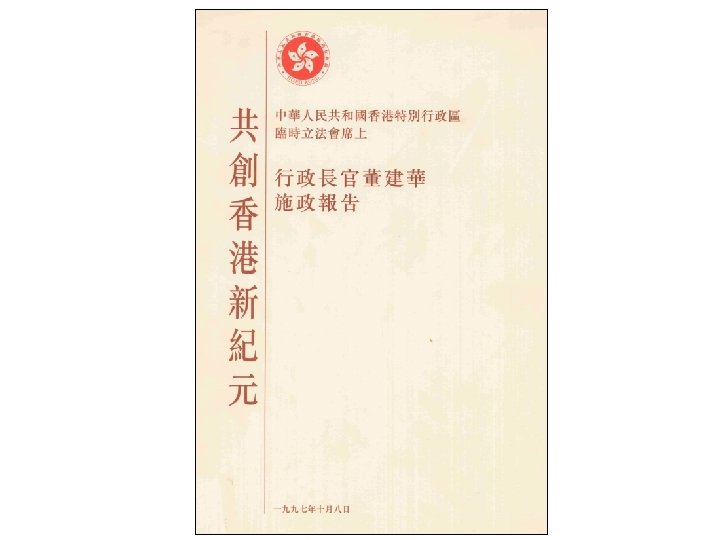
 “I am convinced that we need to take a very careful look at the whole structure of our education system. We need to decide how it should develop into the next century. ” Policy Address of the Chief Executive of the HKSAR Mr. Tung Cheewah, October 8, 1997



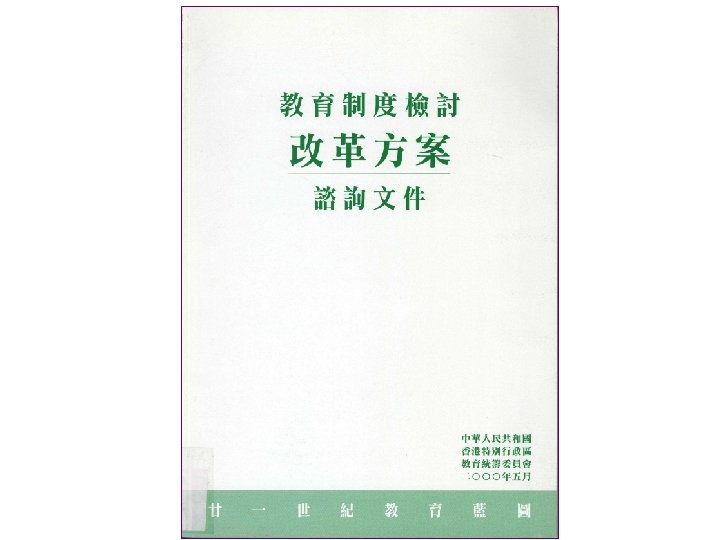
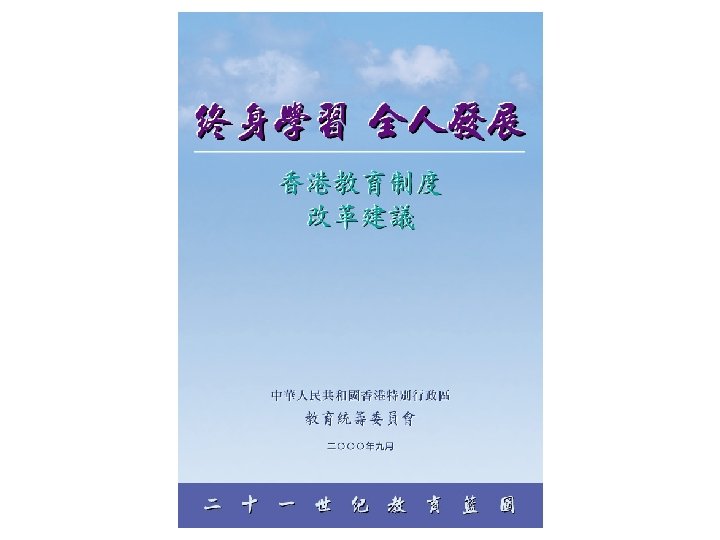

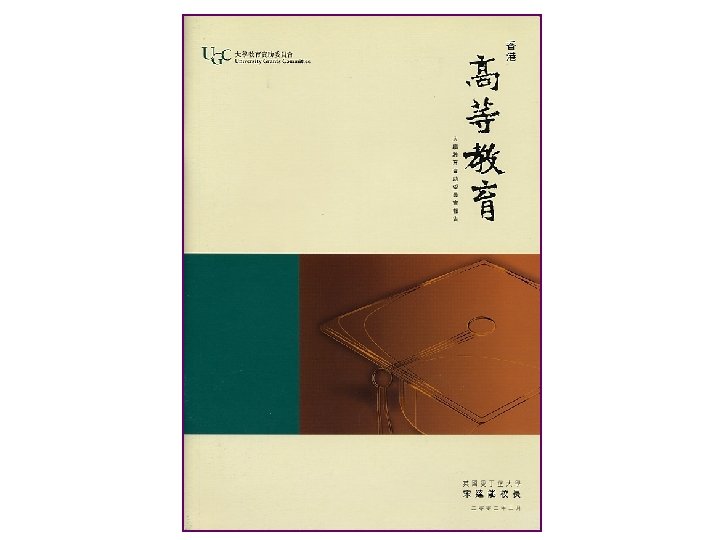
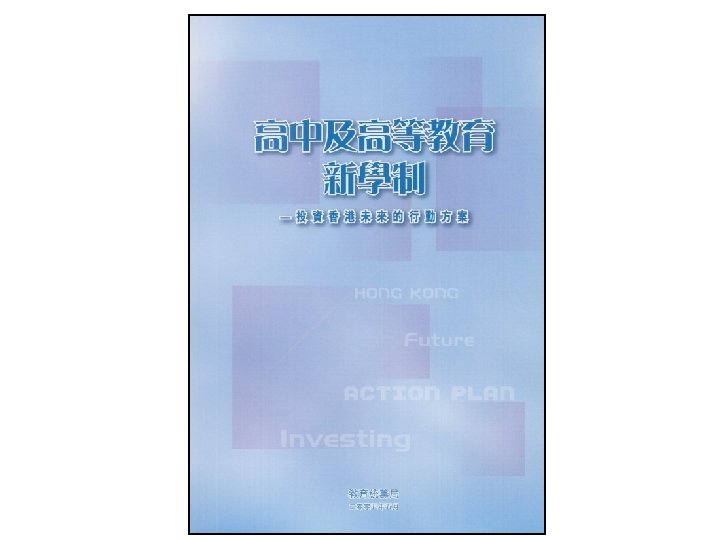
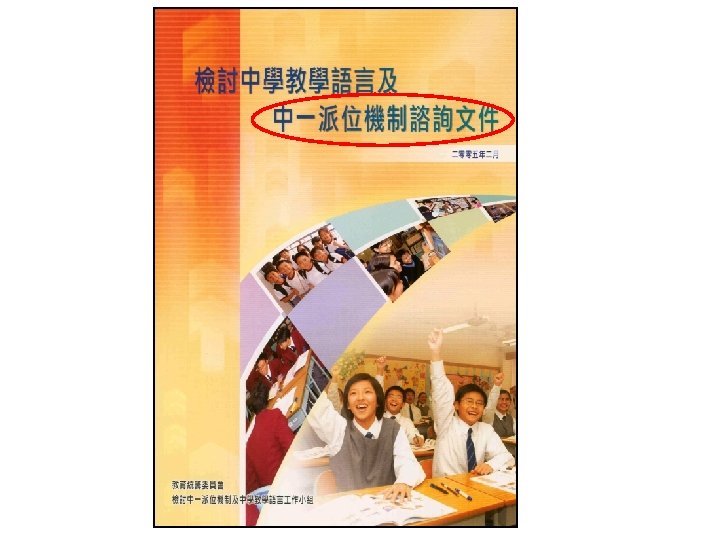
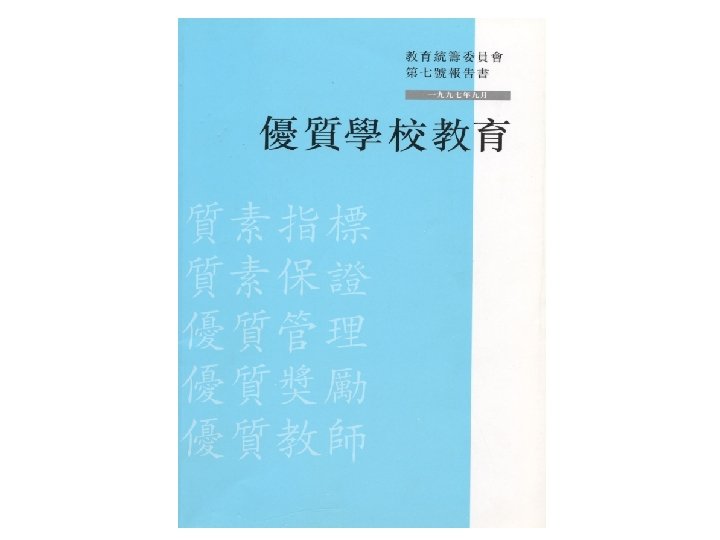
 Discursive Analysis of Lifelong Learning Education Reform in HKSAR z In search of discursive object of HKSAR education reform y In terms of policy document y In terms of temporal demarcation y In terms of discursive theme: Lifelong learning?
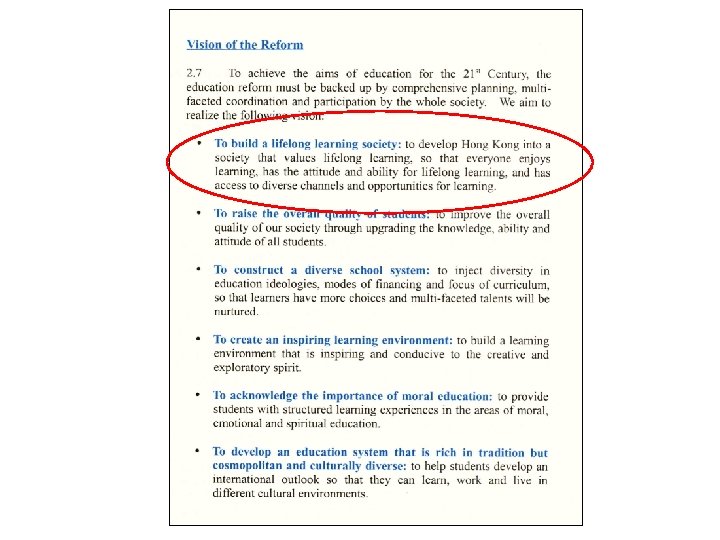
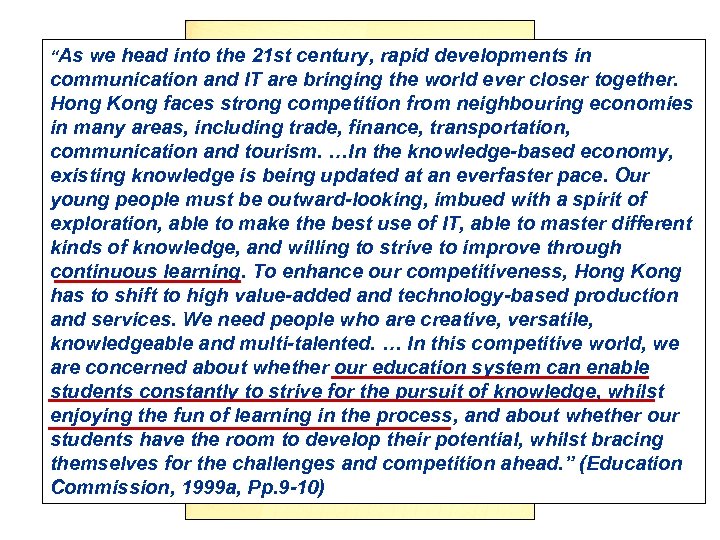 “As we head into the 21 st century, rapid developments in communication and IT are bringing the world ever closer together. Hong Kong faces strong competition from neighbouring economies in many areas, including trade, finance, transportation, communication and tourism. …In the knowledge-based economy, existing knowledge is being updated at an everfaster pace. Our young people must be outward-looking, imbued with a spirit of exploration, able to make the best use of IT, able to master different kinds of knowledge, and willing to strive to improve through continuous learning. To enhance our competitiveness, Hong Kong has to shift to high value-added and technology-based production and services. We need people who are creative, versatile, knowledgeable and multi-talented. … In this competitive world, we are concerned about whether our education system can enable students constantly to strive for the pursuit of knowledge, whilst enjoying the fun of learning in the process, and about whether our students have the room to develop their potential, whilst bracing themselves for the challenges and competition ahead. ” (Education Commission, 1999 a, Pp. 9 -10)
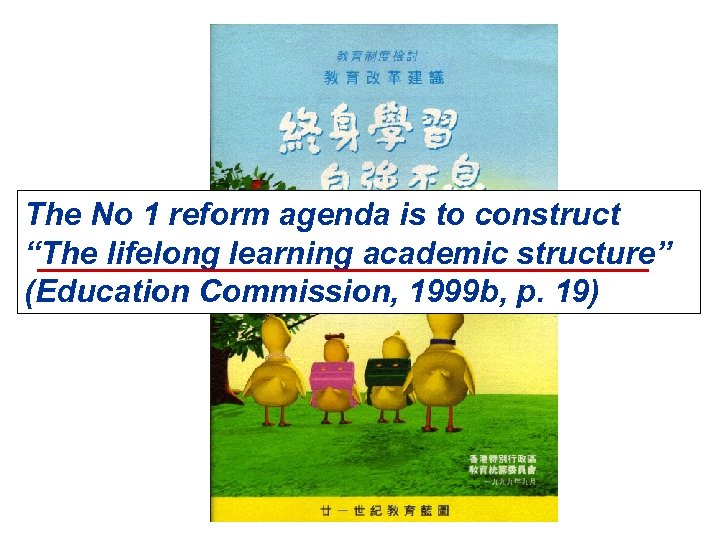 The No 1 reform agenda is to construct “The lifelong learning academic structure” (Education Commission, 1999 b, p. 19)
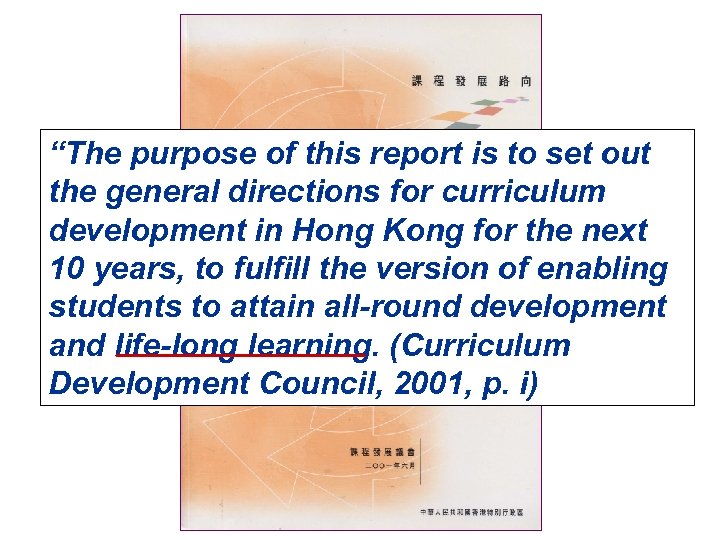 “The purpose of this report is to set out the general directions for curriculum development in Hong Kong for the next 10 years, to fulfill the version of enabling students to attain all-round development and life-long learning. (Curriculum Development Council, 2001, p. i)
 Discursive Analysis of Lifelong Learning Education Reform in HKSAR z Analysis of the Enunciative Modality in HKSAR education reform y Speakers and their positions and/authority to speak y Languages used in discourse y The institutional sites within which the discourse takes place
 Discursive Analysis of Lifelong Learning Education Reform in HKSAR z Understanding the discursive concept of HKSAR education reform y Understanding the formation of discursive concept in academic discourse: Two versions of lifelong education reforms x Lifelong learning education reform for economic rationalism x Lifelong learning education reform for social inclusion and political empowerment
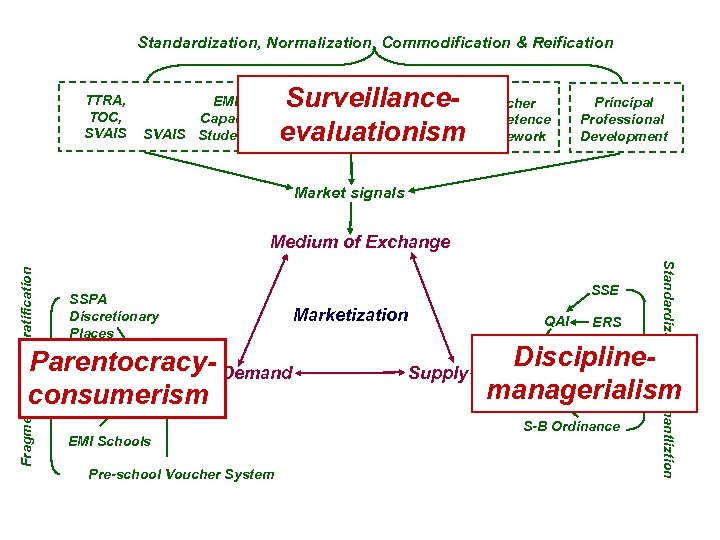
 Discursive Analysis of Lifelong Learning Education Reform in HKSAR z Analysis of the discursive strategies of HKSAR education reform y Points of equivalence and systematization: The construction of the quasi-market mechanism
 The Discursive Strategies of Quasi. Market Mechanism in HKSAR z Points of equivalence & systematization y Constitution of medium of exchange: The discursive practice of surveillance-evaluationism y Constitution of effective supply: The discursive practice of discipline-managerialism y Constitution of effective demand: The discursive practice of parentocracy-consumerism
 The Discursive Strategies of Quasi. Market Mechanism in HKSAR z Constitution of surveillance-evaluationism y TRA, TOC and BCA y MIGA, Angoff standard setting, pre-S 1 HKAT, EMIcapable y SVAIS
 The Discursive Strategies of Quasi. Market Mechanism in HKSAR z Constitution of discipline-managerialism y ECR#7: Qualilty School Education y Performance Indicators y Key Performance Measures y QAI y SSE and ESR y Teacher Benchmarking Assessment and Teacher Competencies Framework y From SMI to Education (Amendment) Ordinance 2004
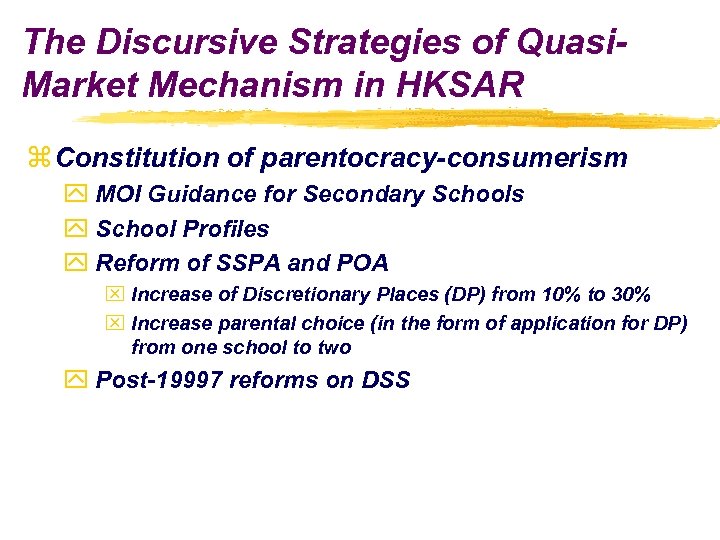 The Discursive Strategies of Quasi. Market Mechanism in HKSAR z Constitution of parentocracy-consumerism y MOI Guidance for Secondary Schools y School Profiles y Reform of SSPA and POA x Increase of Discretionary Places (DP) from 10% to 30% x Increase parental choice (in the form of application for DP) from one school to two y Post-19997 reforms on DSS
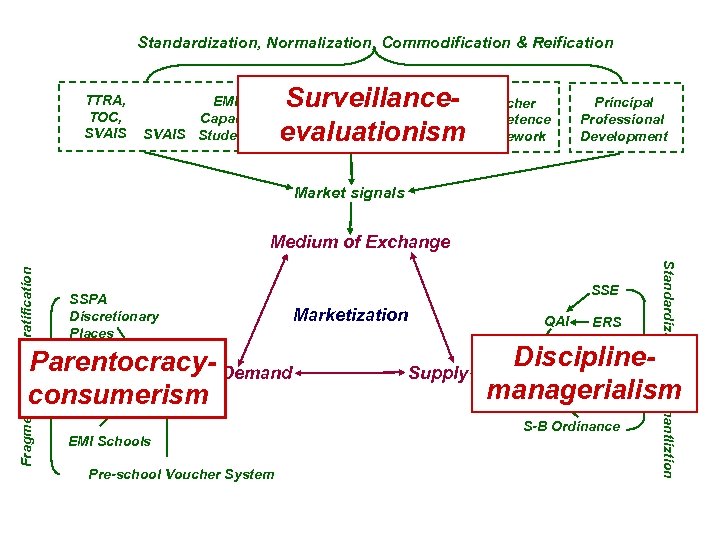 Standardization, Normalization, Commodification & Reification TTRA, TOC, SVAIS EMILanguage Surveillance- Teacher Capable Proficiency Competence Teachers Asessment evaluationism Framework EMICapable SVAIS Students Principal Professional Development Market signals SSPA Discretionary Places Parentocracy- Demand Parental DSS Choice consumerism EMI Schools Pre-school Voucher System SSE Marketization QAI Supply ERS Standardization & Dismantliztion Fragmentation & Stratification Medium of Exchange Discipline. SBM managerialism Audited Schools S-B Ordinance
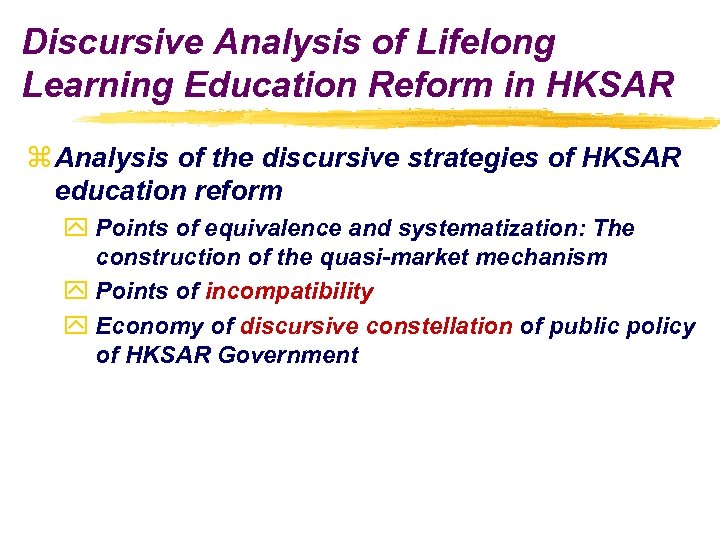 Discursive Analysis of Lifelong Learning Education Reform in HKSAR z Analysis of the discursive strategies of HKSAR education reform y Points of equivalence and systematization: The construction of the quasi-market mechanism y Points of incompatibility y Economy of discursive constellation of public policy of HKSAR Government
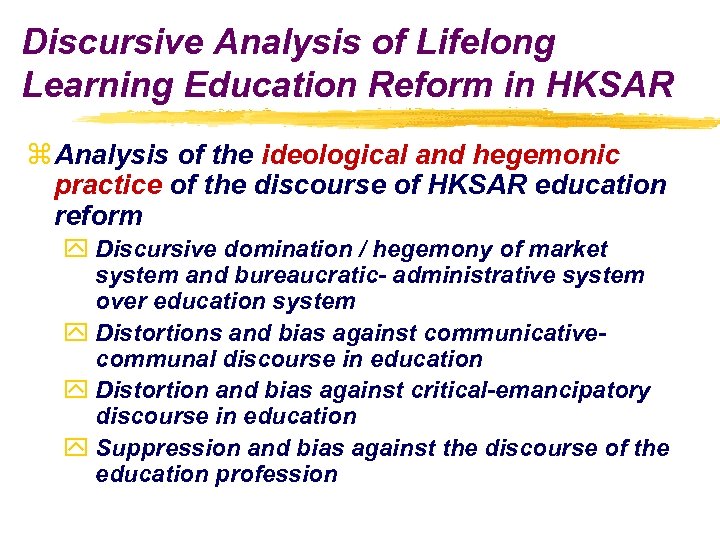 Discursive Analysis of Lifelong Learning Education Reform in HKSAR z Analysis of the ideological and hegemonic practice of the discourse of HKSAR education reform y Discursive domination / hegemony of market system and bureaucratic- administrative system over education system y Distortions and bias against communicativecommunal discourse in education y Distortion and bias against critical-emancipatory discourse in education y Suppression and bias against the discourse of the education profession
 5 Policy Substance Study: Interpretive-Political Perspective END