


 Скачать презентацию EDD Performance against 2015 16 Annual Performance Plan APP
d58dd0f949e8e9f061b522d2cc468970.ppt
- Количество слайдов: 81
 EDD Performance against 2015/16 Annual Performance Plan (APP) for the 1 st Quarter 2015/16 Presentation to the Portfolio Committee Economic Development 1 September 2015 1
 Background On the 24 th March 2015 the Ministry presented the conceptual framework of the Strategic Plan and Annual Performance Plan for 2015/16 to the Economic Development Portfolio Committee, providing the context in which we operate and an overview of the Department’s programmes and strategic objectives. On the 14 th April 2015 the Ministry presented the details of the Department’s KPIs and products or outputs including: • 3 programmes to organise the Department around • 6 strategic objectives to provide direction • 23 KPIs to give effect to the strategic objectives • 164 products / outputs from the KPIs. Today we will report on work performed in Q 1 according to the Department’s Strategic Plan and Annual Performance Plan. 2
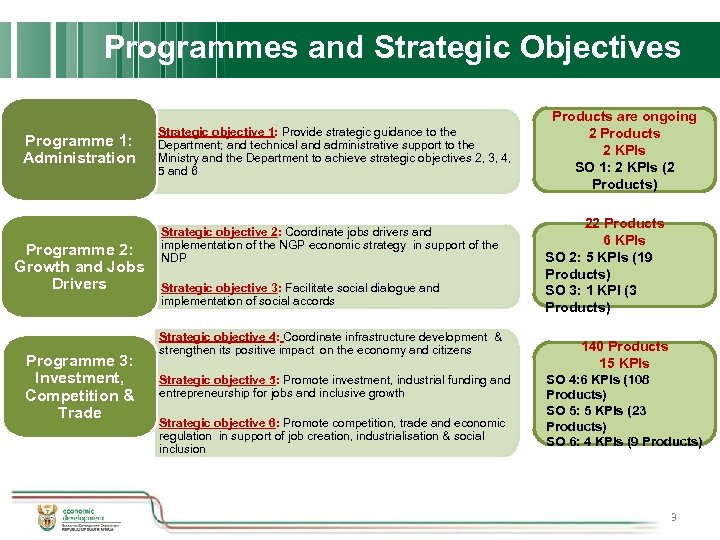 Programmes and Strategic Objectives Programme 1: Administration Programme 2: Growth and Jobs Drivers Programme 3: Investment, Competition & Trade Strategic objective 1: Provide strategic guidance to the Department; and technical and administrative support to the Ministry and the Department to achieve strategic objectives 2, 3, 4, 5 and 6 Strategic objective 2: Coordinate jobs drivers and implementation of the NGP economic strategy in support of the NDP Strategic objective 3: Facilitate social dialogue and implementation of social accords Strategic objective 4: Coordinate infrastructure development & strengthen its positive impact on the economy and citizens Strategic objective 5: Promote investment, industrial funding and entrepreneurship for jobs and inclusive growth Strategic objective 6: Promote competition, trade and economic regulation in support of job creation, industrialisation & social inclusion Products are ongoing 2 Products 2 KPIs SO 1: 2 KPIs (2 Products) 22 Products 6 KPIs SO 2: 5 KPIs (19 Products) SO 3: 1 KPI (3 Products) 140 Products 15 KPIs SO 4: 6 KPIs (108 Products) SO 5: 5 KPIs (23 Products) SO 6: 4 KPIs (9 Products) 3
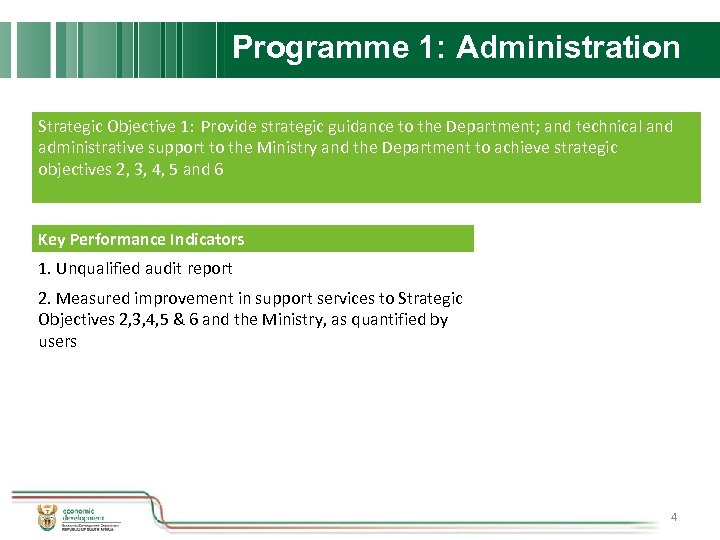 Programme 1: Administration Strategic Objective 1: Provide strategic guidance to the Department; and technical and administrative support to the Ministry and the Department to achieve strategic objectives 2, 3, 4, 5 and 6 Key Performance Indicators 1. Unqualified audit report 2. Measured improvement in support services to Strategic Objectives 2, 3, 4, 5 & 6 and the Ministry, as quantified by users 4
 Key Performance Indicator Unqualified audit report KPI 1 Work completed towards an unqualified audit: Respond to AG queries EDD completed the following work in relation to the preparation for the 2014/15 final audit by the Auditor-General (AG): • physical verification of movable assets; • year-end reconciliations, closed the financial systems and prepared the annual financial statements; • Compiled evidence files in support of the performance information; • convened an Audit Committee meeting to consider the annual financial statements and performance information for submission to the AG; • engaged with the Auditor-General at Ministerial level to receive feedback and to advise on measures to ensure sound management in the department; • convened meetings to monitor progress on the implementation of corrective measures to address the Auditor-General’s queries and findings; • the Acting DG engaged with ITAC implementing corrective measures to address the audit findings of the previous financial year. 5
 Key Performance Indicator Measured improvement in support services to Strategic Objectives 2, 3, 4, 5 & 6 and the Ministry, as quantified by users KPI 2 Work completed: Pilot survey completed • EDD conducted a pilot survey to identify the quality and effectiveness of support services in the department and to implement interventions to improve service delivery. The survey covered Finance, HR, SCM, Communications, IT and Facilities Management. • As a result of the pilot survey, the DG began to implement the following: • Measures to ensure speedy responses; • Training and communication of policies and procedures has been developed; • Review of systems to remove unnecessary bureaucratic delays. • This process will continue throughout the year to ensure the results are embedded. • In the 2 nd quarter, these interventions will be assessed by focus groups. • In the 3 rd quarter the Survey will be redesigned or amended where necessary, incorporating the learnings from the previous quarter. • In the 4 th quarter the Survey will be repeated, results analysed and tabled with the Minister. A baseline will be developed for targets for the following financial year. 6
 Programme 2: Growth path and social dialogue Strategic Objective 2: Coordinate jobs drivers and implementation of the NGP economic strategy in support of the NDP Key Performance Indicator 3. Integrate NGP framework in macro - and micro economic policy and infrastructure initiatives, including through selective impact assessments and updating the operational sections of the NGP where necessary, as part of strengthening implementation of the NGP 4. Strategic support for jobs drivers of the NGP, monitor implementation across the state, address blockages as required and identify new opportunities and risks as they arise as part of strengthening implementation of the NGP 5. Support the development of the green economy and jobs through implementing the Green Economy Accord 7. Number of spatial, local and provincial initiatives to promote employment, empowerment and development 7
 Key Performance Indicator Integrate NGP framework in macro - and micro economic policy and infrastructure initiatives, including through selective impact assessments and updating the operational sections of the NGP where necessary, as part of strengthening implementation of the NGP KPI 3 Work completed: Report on employment The Department conducted a detailed analysis of employment trends since the adoption of the NGP in October 2010, assessing progress for each of the Jobs Drivers identified in the strategy. The findings assist in directing the work of the state to prioritise the 9 -point plan announced during the 2015 State of the Nation Address. 8
 Jobs context - From 1994 to 2008, the economy grew at a faster rate than the preceding 15 years. - The 2008/09 global economic crisis which started in the US, rapidly spread through the transmission belts of weaker global demand, contraction of credit to the real economy and business confidence, affecting particularly countries with high trade to GDP ratios, like SA - The impact on jobs was sudden and significant: about one million jobs were lost - The response of government to this was two-fold: - Short-term interventions based on a social accord signed in 2009, covering funds for companies and workers in distress; and - Development of a new growth path addresses structural constrains and to deepen the jobs impact of economic growth 9
 CASE STUDY – JOBS GROWTH • Cabinet adopted the NGP’s focus on jobs drivers in October 2010. • This is the economic strategy to give effect to the vision of the National Development Plan to create 11 million new jobs by 2030. • The NGP prioritised job creation through the alignment of policies across the state to support key jobs drivers • The analysis draws primarily on the Quarterly Labour Force Survey for overall jobs data • The data shows robust jobs growth over the period • This perception of limited jobs growth may arise from – The fact that joblessness is still high – Concerns about the economic slowdown given the end of the commodity boom, energy shortages and a conflictual labour relations environment • We need to develop a more evidence-based discussion 10
 Key trends from October 2010 to June 2015 Total employment rose from 13, 6 million to 15, 7 million Employment climbed by two million, or 15% Women gained a million jobs, increasing their share in total employment from 43% to 44% - largely because of growth in health and education The share of working age adults with employment increased from 41, 3% to 43, 5% 10, 8 million South Africans have formal jobs outside of agriculture – 1, 4 million more than in October 2010 Employment growth has been faster than GDP growth in past 2 years All sectors gained jobs except manufacturing, with construction and the public services growing particularly fast Youth employment rose by 600 000 or 10, 6% (to March ‘ 15) for youth aged 18 -34 with young women taking 311 000 or 52% of these jobs 11
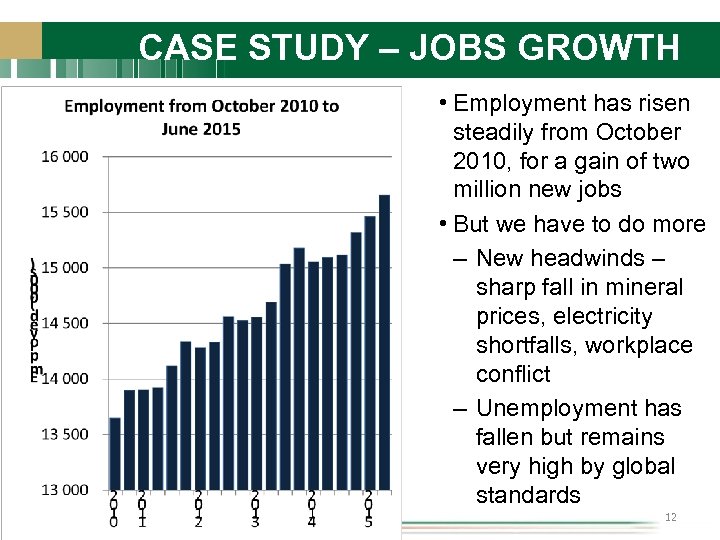 CASE STUDY – JOBS GROWTH • Employment has risen steadily from October 2010, for a gain of two million new jobs • But we have to do more – New headwinds – sharp fall in mineral prices, electricity shortfalls, workplace conflict – Unemployment has fallen but remains very high by global standards 12
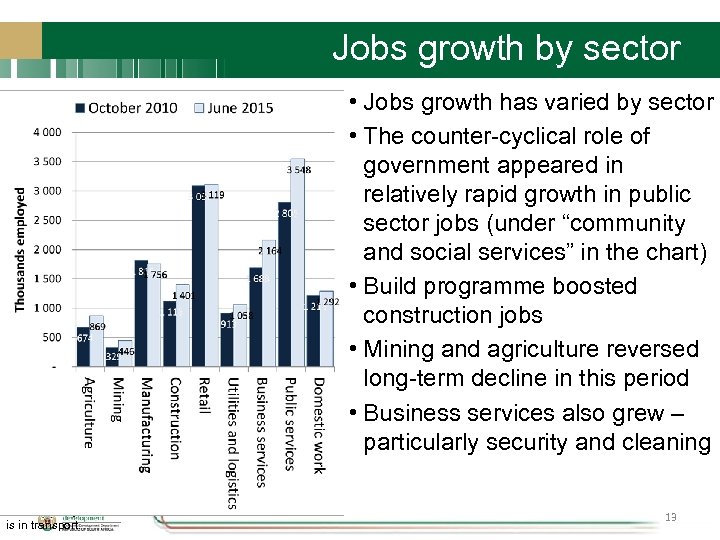 Jobs growth by sector • Jobs growth has varied by sector • The counter-cyclical role of government appeared in relatively rapid growth in public sector jobs (under “community and social services” in the chart) • Build programme boosted construction jobs • Mining and agriculture reversed long-term decline in this period • Business services also grew – particularly security and cleaning Utilities and logistics includes transport, electricity, gas, water and telecommunications. Most of the employment in this sector is in transport. 13
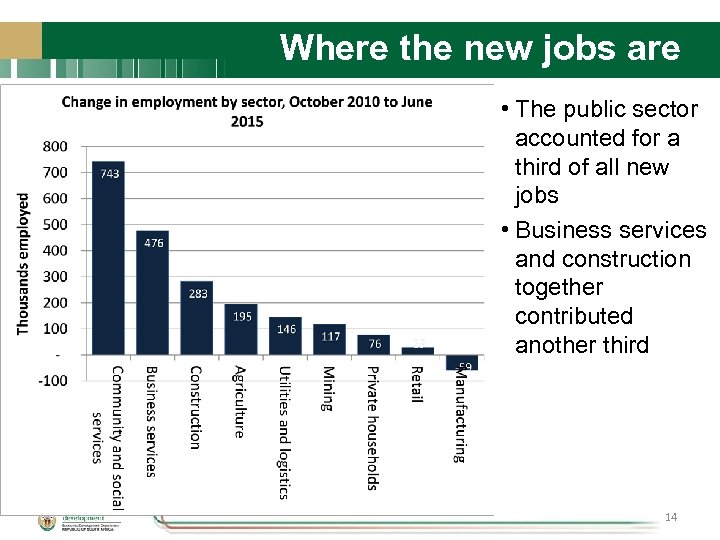 Where the new jobs are • The public sector accounted for a third of all new jobs • Business services and construction together contributed another third 14
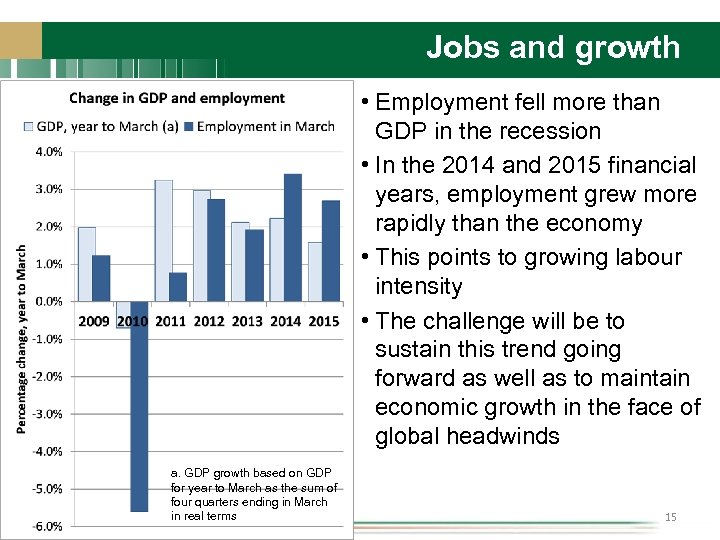 Jobs and growth • Employment fell more than GDP in the recession • In the 2014 and 2015 financial years, employment grew more rapidly than the economy • This points to growing labour intensity • The challenge will be to sustain this trend going forward as well as to maintain economic growth in the face of global headwinds a. GDP growth based on GDP for year to March as the sum of four quarters ending in March in real terms 15
 Infrastructure and jobs • Infrastructure is a priority jobs driver under the NGP • This commitment led to sustained growth in infrastructure spending over the past five years, with substantial direct and indirect employment impacts • Infrastructure supports employment creation in four ways: – In construction of new infrastructure – In operations and maintenance – In industries that supply inputs to infrastructure projects – By increasing the overall productivity and efficiency of enterprises, stimulating new investment and improving competitiveness • Success in the build programme can be seen in the growth of construction employment since 2010 16
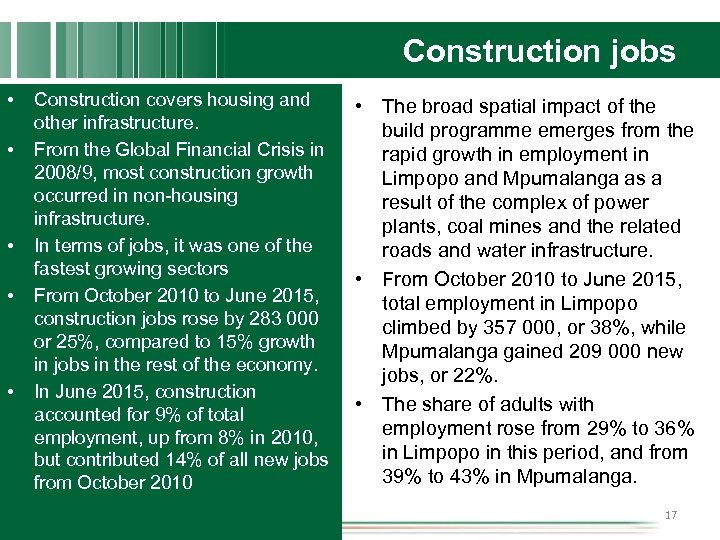 Construction jobs • • • Construction covers housing and other infrastructure. From the Global Financial Crisis in 2008/9, most construction growth occurred in non-housing infrastructure. In terms of jobs, it was one of the fastest growing sectors From October 2010 to June 2015, construction jobs rose by 283 000 or 25%, compared to 15% growth in jobs in the rest of the economy. In June 2015, construction accounted for 9% of total employment, up from 8% in 2010, but contributed 14% of all new jobs from October 2010 • The broad spatial impact of the build programme emerges from the rapid growth in employment in Limpopo and Mpumalanga as a result of the complex of power plants, coal mines and the related roads and water infrastructure. • From October 2010 to June 2015, total employment in Limpopo climbed by 357 000, or 38%, while Mpumalanga gained 209 000 new jobs, or 22%. • The share of adults with employment rose from 29% to 36% in Limpopo in this period, and from 39% to 43% in Mpumalanga. 17
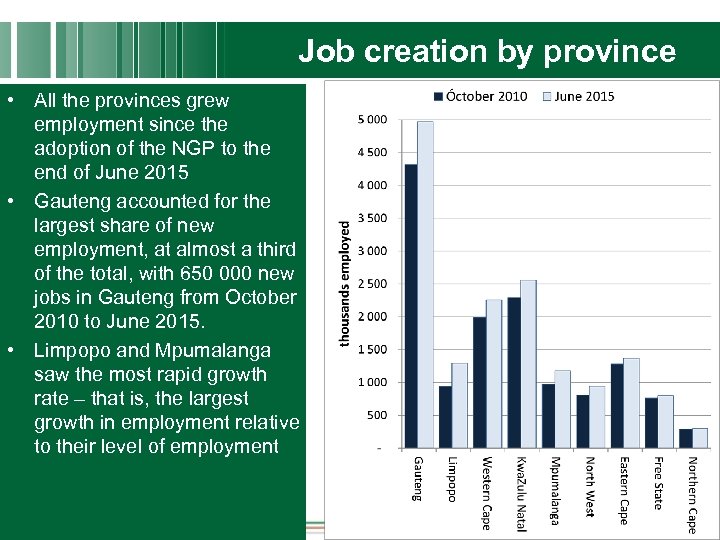 Job creation by province • All the provinces grew employment since the adoption of the NGP to the end of June 2015 • Gauteng accounted for the largest share of new employment, at almost a third of the total, with 650 000 new jobs in Gauteng from October 2010 to June 2015. • Limpopo and Mpumalanga saw the most rapid growth rate – that is, the largest growth in employment relative to their level of employment 2018/03/16 8: 48 AM 18
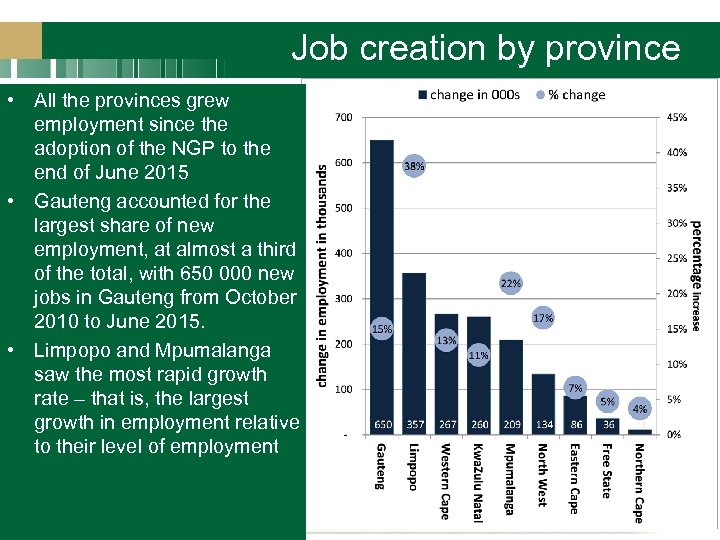 Job creation by province • All the provinces grew employment since the adoption of the NGP to the end of June 2015 • Gauteng accounted for the largest share of new employment, at almost a third of the total, with 650 000 new jobs in Gauteng from October 2010 to June 2015. • Limpopo and Mpumalanga saw the most rapid growth rate – that is, the largest growth in employment relative to their level of employment 19
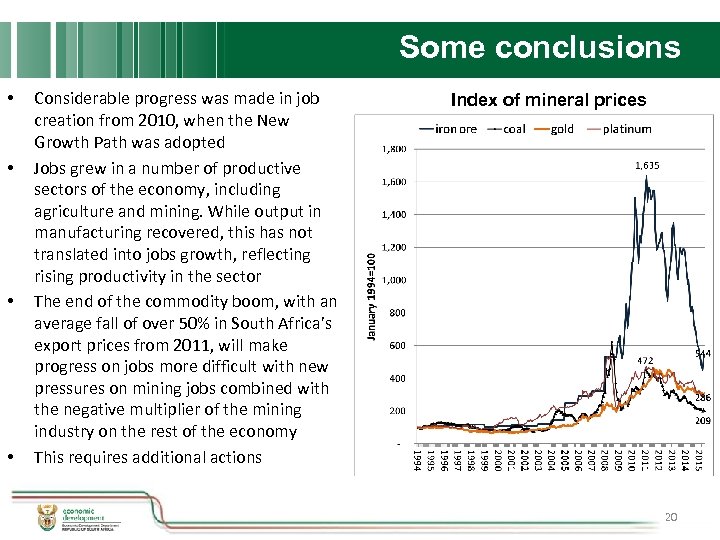 Some conclusions • • Considerable progress was made in job creation from 2010, when the New Growth Path was adopted Jobs grew in a number of productive sectors of the economy, including agriculture and mining. While output in manufacturing recovered, this has not translated into jobs growth, reflecting rising productivity in the sector The end of the commodity boom, with an average fall of over 50% in South Africa’s export prices from 2011, will make progress on jobs more difficult with new pressures on mining jobs combined with the negative multiplier of the mining industry on the rest of the economy This requires additional actions Index of mineral prices 20
 Nine-Point Plan The Nine-point Plan announced in SONA in February 2015 is a response to the new global conditions. They cover: – Agriculture and agro-processing – Manufacturing through higher impact Industrial Policy Action Plan – Advancing beneficiation through more local processing – Unlocking the potential of SMMEs, cooperatives, township and rural enterprises – Growing the oceans economy – Resolving the energy challenge – Reducing workplace conflict – Scaling-up private sector investment – Supporting infrastructure investment and innovation 21
 KPI 3 Work in progress but not completed: Amendments to the Competition Act In the first quarter EDD commenced work on the amendments to the Competition Act. This includes • Additional consultation with key internal stakeholders on the legislative amendments; • Addressing legal complexities related to options for Cabinet’s consideration; • Doing additional research where required. During the same period EDD did extensive work on the Criminal Matters Amendment Bill in partnership with the Department of Justice and the PICC. This is reported on in KPI 11. 22
 Key Performance Indicator Strategic support for jobs drivers of the NGP, monitor implementation across the state, address blockages as required and identify new opportunities and risks as they arise as part of strengthening implementation of the NGP KPI 4 Work completed: Contributions in IMCs, ESEID and War Room. During the quarter, significant work was done to support the integration of policy and jobs drivers through the work of the economic cluster and the inter -ministerial committees set up by Cabinet. These included: • Technical and policy contributions for Economic Sectors, Employment and Investment Development (ESEID); • Policy and implementation feedback for the IMC on Energy. 23
 KPI 4 Steel Industry interventions (incl Q 2) • The end of the commodity super-cycle resulted in a glut of steel on global markets. The South African steel industry was seriously affected. • During the quarter, EDD undertook a range of efforts to address the circumstances of the industry. These included: • Meeting steel-makers to identify the extent of the economic challenges; • Liaising with regulators to expedite processes to evaluate the industry requests; • Appointing a panel of experts from the steel industry to provide advice and options to the Minister; • Engaging development finance institutions on short-term financing options; • Completing a competition probe into pricing by the dominant steel-mill • Liaising with other Ministers to enable a coordinated government response. 24
 KPI 4 Update on soya plant in Mpumalanga • The Noble Soya plant became operational in December 2013, creating the continent’s largest and most advanced soya crushing plant • Between December 2013 to July 2015 the plant turnover was R 1. 2 billion • The plant employs 128 people, with an estimated 2 600 jobs sustained by commercial farmers. • With the company’s operations now stable, we are pursuing efforts to bring black small-holder farmers into its supply-chain • With the recent drought and poor prognosis for summer rainfall, Noble is looking at expanding its dry land cultivation in the Free State and North West provinces to spread its risk. 25
 KPI 4 Work completed: African regional integration One of the jobs drivers in the NGP is African regional integration. Work on this was originally scheduled in the Strategic Plan for 2016/17. Following a number of attacks on foreign migrants during the quarter, a Cabinet-wide response included that EDD focus on research and advocacy on the importance of trade and investment across the continent, to provide context to the debate on migrants. The Minister put together a program including: • Research • Holding a stakeholder Symposium • Engaging workers and communities. Research findings: Examples • One out of every five Ford Ranger bakkies made in Roslyn Pretoria, is sold elsewhere on the continent. • The largest export market for manufactured plastic is Zimbabwe and for televisions is Zambia. • 244 000 direct jobs in South Africa are sustained by exports to the rest of the continent 26
 KPI 4 Case study: Africa Day Symposium – EDD with IDC and University of Johannesburg • Ministry hosted an Africa Day Symposium on African Integration and how South Africans benefit from our economic links with the rest of Africa. • Over 100 participants • Business and labour leaders from SA and the rest of the continent • Community members including youth, parliamentarians, academics and students attended. • Addressed African integration as a critical driver for shared economic prosperity and job creation. • Shared practical experiences, research, concerns and aspirations. OUTCOME: A SHARED COMMITMENT TO TELL THE AFRICAN STORY MORE CONSISTENTLY IN SOUTH AFRICA. 27
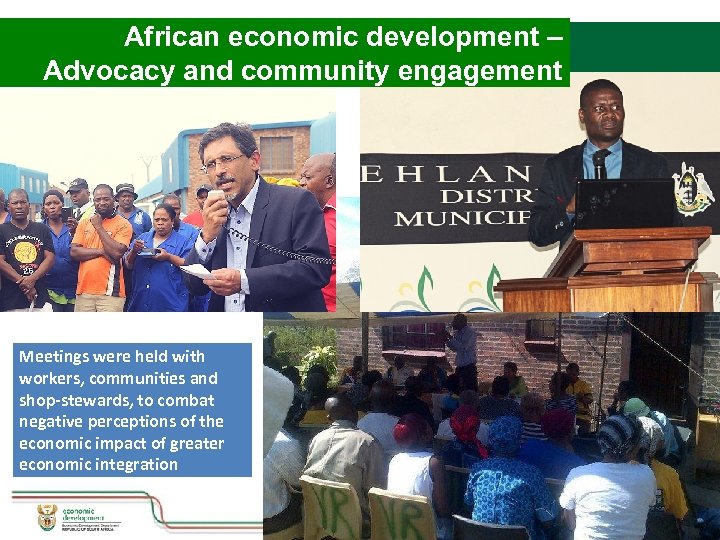 African economic development – Advocacy and community engagement Meetings were held with workers, communities and shop-stewards, to combat negative perceptions of the economic impact of greater economic integration 2018/03/16 28
 Key Performance Indicator Support the development of the green economy and jobs through implementing the Green Economy Accord KPI 5 Work completed: Support for Green Economy Accord The Green Economy Accord requires steps to be taken to reduce energy consumption by industry. • During the quarter, the Ministry engaged with stakeholders in the fashion manufacturing industry, culminating in a Fashion Industry Imbizo on energy and the green economy, held on 9 June 2015. • The Imbizo covered case studies of new technologies that reduce companies’ energy consumption and costs. • Eskom discussed its load-shedding schedules and what can be done to reduce the negative impact on industry. • The IDC highlighted the impact of funding energy-efficient technologies in the local industry. • A sock manufacturer provided feedback to industry representatives of the steps to be taken to retool for an energy-constrained environment whilst maintaining jobs, turnover and profitability. 29
 Green economy: case study A sock manufacturer GLENCAROL provided feedback to industry representatives on the steps they have taken to retool for an energyconstrained environment whilst maintaining jobs, turnover and profitability. • Power consumption reduced 950 000 kwhr to 650 000 kwhr, with annual savings of R 2, 5 million and 432 tons less coal used per annum • Business grew by 53% since 2007 when the company employed 497 people to current employment of 694 people • The company made a number of interventions: • Productivity support from the Production Incentive • Eskom funding to replace 1800 bulbs and fittings and space utilisation • New industrial air-conditioning and heat extraction services 30
 Key Performance Indicator Number of spatial, local and provincial initiatives to promote employment, empowerment and development KPI 7 Work completed: Min. Mec EDD convened a that culminated in a Min. Mec attended by Ministers and MECs, which covered: • Spatial development and the Special Economic Zones; • Promotion of the black industrialists programme; • Small business development initiatives; • A new framework for provincial economic development planning; • Use of innovative building technologies in the National Infrastructure Plan; • The extension of the Africa Growth and Opportunities Act (AGOA) by the United States. WORK COMPLETED: PROVINCIAL PLANS EDD worked with Limpopo, Mpumalanga and Free State and assessed their economic development plans. This work included: • Ensuring alignment of the provincial plans to national economic development goals and plans; • Identification of provincial priorities including key value chains and sectors. 31
 Case study: Free State Case study: Limpopo Following engagement with the province, Limpopo will focus on: Analysis of the province demonstrates the following: • Productive sectors such as manufacturing, mining and • Plans to diversify the agriculture; economy from reliance on mining and agriculture into • Eliminating unnecessary manufacturing, tourism and regulatory burdens; infrastructure (transport); • Up-skilling the labour force; • Continued focus on • Expanding employment in beneficiation in mining and agriculture (horticulture, agriculture (i. e. agro meat production and forestry processing); value-chains focusing on • The need for more skills beneficiation); development in fields such • Reducing workplace conflict; as artisans and engineering. • Small business development. Case study: Mpumalanga Analysis of the province demonstrates the following: • Province has targeted jobs drivers and sectors identified to create jobs - agriculture and forestry, manufacturing, tourism and other high level services (e. g. ICT), mining and energy, green economy and infrastructure; • Strategic interventions include BBBEE, strategic procurement, skills development, reducing the cost of doing business, support to SMMEs and co-ops, and DFI funding; • Strengthened oversight and monitoring mechanisms will assist in improving implementation. Potential projects include: • Unblocking agro-processing • Support for economic Potential projects include: projects; revitalisation in mining • Linking provincial youth SMMEs to • Supporting the textile the retrofitting programme: regions (Waterberg and industry’s expansion plans establishment of energy bulb Sekhukhune) with a focus on through coordination and manufacturing plant (Mpumalanga). unblocking obstacles to support measures; • Support mining initiatives in development; Emalahleni Municipality through • Assisting the province in its • Promotion of the use of the Revitalization of Distressed development of its Innovative Building Mining Towns Programme Provincial Economic Strategy. Technologies in Lephalale. (Mpumalanga). A more detailed presentation on the insights and work can be prepared for the Portfolio Committee 32
 Programme 2: Growth path and social dialogue Strategic Objective 3: Facilitate social dialogue and implementation of social accords Key Performance Indicator 8. Development and support programmes for more effective industrial relations and support for implementation of social accords 33
 Key Performance Indicator Development and support programmes for more effective industrial relations and support for implementation of social accords KPI 8 Work completed: More effective industrial relations EDD provided support at technical level and to the Minister during the social dialogue with business, labour and community representatives on a national minimum wage and on reducing industrial conflict. The dialogue process included an extensive exchange of information on international experiences on minimum wages, including in Brazil, Mauritius, Kenya, Germany, Malaysia and the United Kingdom. During the first quarter discussions were held on codes of conducts during and prior to industrial action. 34
 KPI 8 On-going work: Monitoring the Youth Employment Accord • The Youth Employment Accord was signed with NEDLAC constituencies on 18 April 2013. • EDD monitors implementation and tables progress reports to Cabinet. • These cover actions in areas such as entrepreneurship and industrial funding, internships and skills development • A detailed report is being prepared, to be finalised during the current quarter of 2015 35
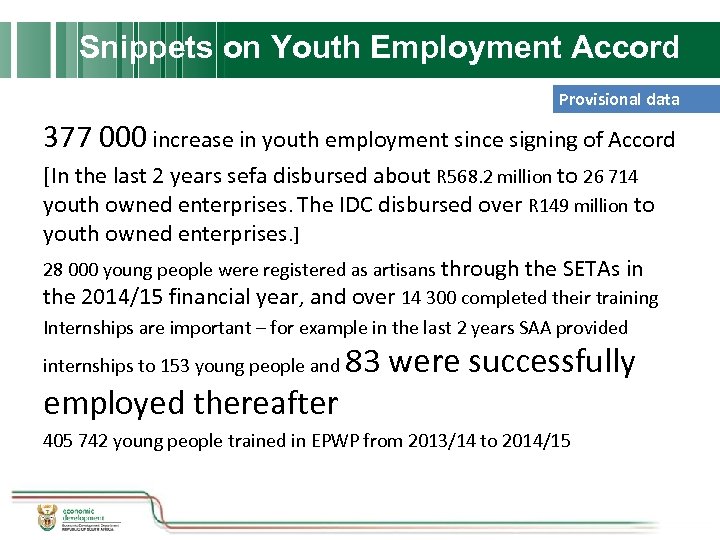 Snippets on Youth Employment Accord Provisional data 377 000 increase in youth employment since signing of Accord [In the last 2 years sefa disbursed about R 568. 2 million to 26 714 youth owned enterprises. The IDC disbursed over R 149 million to youth owned enterprises. ] 28 000 young people were registered as artisans through the SETAs in the 2014/15 financial year, and over 14 300 completed their training Internships are important – for example in the last 2 years SAA provided internships to 153 young people and employed thereafter 83 were successfully 405 742 young people trained in EPWP from 2013/14 to 2014/15
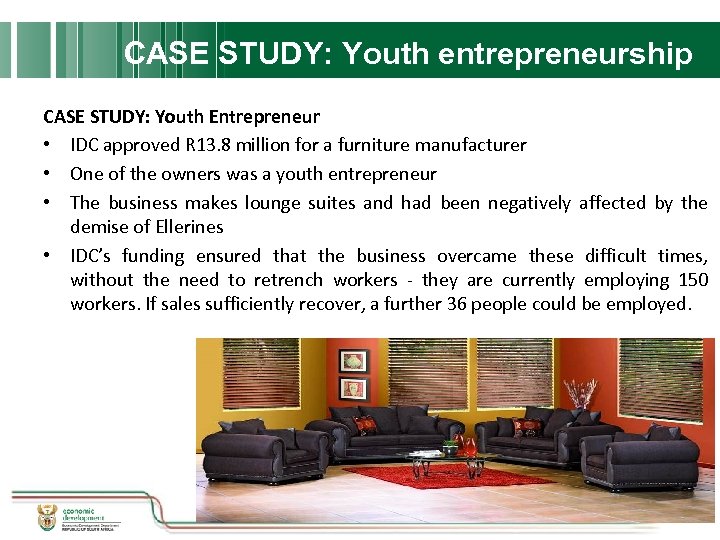 CASE STUDY: Youth entrepreneurship CASE STUDY: Youth Entrepreneur • IDC approved R 13. 8 million for a furniture manufacturer • One of the owners was a youth entrepreneur • The business makes lounge suites and had been negatively affected by the demise of Ellerines • IDC’s funding ensured that the business overcame these difficult times, without the need to retrench workers - they are currently employing 150 workers. If sales sufficiently recover, a further 36 people could be employed. 2018/03/16 37
 Programme 3: Investment, competition & trade Strategic Objective 4: Coordinate infrastructure development & strengthen its positive impact on the economy and citizens Key Performance Indicator 9. Number of quarterly Cabinet-level progress reports of infrastructure Strategic Integrated projects (SIPs) 10. Number of infrastructure projects unblocked, fast tracked or facilitated 11. Number of Cabinet and PICC strategic decisions on infrastructure implemented 12. Number of PICC meetings held and facilitated 13. Drive implementation of Strategic Integrated Project (SIP) 5 of the National Infrastructure Plan 14. Support programmes to drive localisation in the infrastructure programme, including through the PPPFA, and the local supplier development initiatives 38
 Key Performance Indicator Number of quarterly Cabinet-level progress reports of infrastructure Strategic Integrated projects (SIPs) KPI 9 Work completed: Cabinet level reports 18 SIPs reports were developed for Cabinet. The Report noted that R 54, 8 billion was spent on infrastructure in the quarter to March 2015 by the public sector, excluding projects facilitated by the state through the renewable energy programme. Of this sum spent, the PICC tracked projects that spent R 36 billion over this period and provided Cabinet with reports that set out progress on construction and planning. The results were used by the PICC Council and the July 2015 Cabinet Lekgotla. Implementation of the projects and operational responsibility remains with the relevant line departments. 39
 Key Performance Indicator Number of infrastructure projects unblocked, fast tracked or facilitated KPI 10 Work completed: Unblocking infrastructure projects • Regulatory issues: EDD facilitated the unblocking of 1 Air Emissions Licence and 4 Environmental Impact Assessment's (EIAs) affecting five infrastructure projects, to ensure that they were issued on time so that projects could be implemented. • Financing: The Ministry engaged the private sector and financiers on behalf of the PICC on the national infrastructure rollout and the requirements and opportunities for financing of assets with a long-term investment horizon. This included a major policy engagement with ASISA, an association that manages more than R 4 trillion of investible funds. • Skills development: The Ministry engaged South African project managers from the public and private sectors on the needs of the National Infrastructure Plan and the skills required from developmentally-oriented managers. 40
 KPI 10 Case study: Regulatory unblocking The following regulatory authorisations were unblocked to ensure they were issued on time so that projects could commence or continue: 1. AEL – Air emissions licence for Medupi unblocked 2. EIA – Construction Kusile Ash and Gypsum co-disposal facility & associated infrastructure 3. EIA – Mzimvubu Project: Construction of Roads Infrastructure 4. EIA – Mzimvubu Project: Ntabelanga-Laleni Conjunctive Scheme and associated infrastructure 5. EIA – Mzimvubu Project: Electricity Generation and Associated infrastructure 41
 CABLE AND METAL THEFT –Theft of copper and metal from public infrastructure causes serious economic harm and social disruption –This affects transport systems (rail cables and lines; road signs), energy (cables and metal from distribution systems), water (pipes, taps and metal from water treatment works), communications (copper cables), social infrastructure (clinics, schools, households) –The PICC approved a package of measures in December 2014 –Drafting of a Bill to address ways to strengthen action against metal and cable thieves commenced thereafter 42
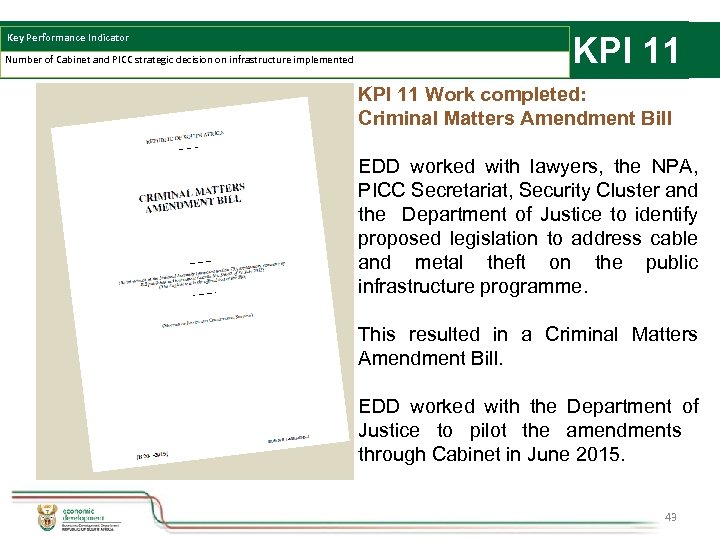 Key Performance Indicator Number of Cabinet and PICC strategic decision on infrastructure implemented KPI 11 Work completed: Criminal Matters Amendment Bill EDD worked with lawyers, the NPA, PICC Secretariat, Security Cluster and the Department of Justice to identify proposed legislation to address cable and metal theft on the public infrastructure programme. This resulted in a Criminal Matters Amendment Bill. EDD worked with the Department of Justice to pilot the amendments through Cabinet in June 2015. 43
 Infrastructure: new Bill on cable theft The amendments: • Provide for changes to the laws pertaining to infrastructure-related offences such as cable theft and create a new offence for damage to essential infrastructure • Set out stricter provisions for the granting of bail • Introduces minimum sentencing periods for certain types of offences. • Aims to safeguard infrastructure and thus ensure that the country can meet its economic growth targets and increase employment 44
 Key Performance Indicator Number of PICC meetings held and facilitated KPI 12 Work completed: PICC meetings held and facilitated During the quarter, EDD provided technical, secretariat and coordinating support for the hosting of PICC structures, including one PICC Council meeting, seven PICC Secretariat meetings (attended by Ministers and Deputy Ministers) and SIP Coordinator meetings. These structures prepared and finalised the submissions discussed by Cabinet. 45
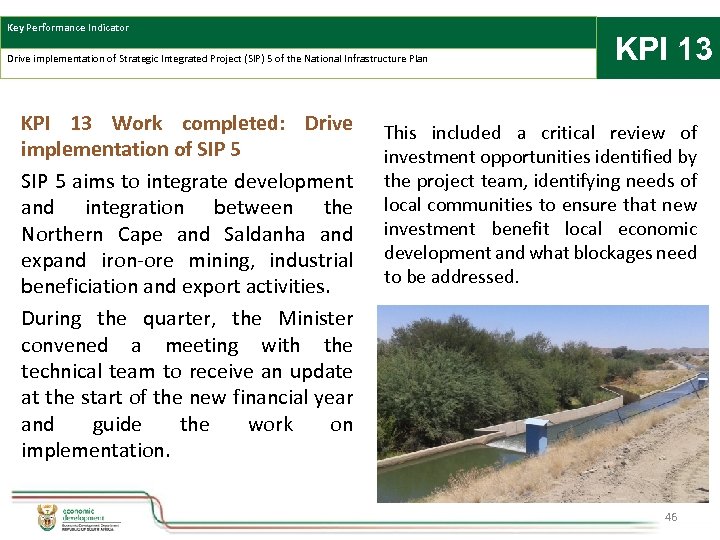 Key Performance Indicator Drive implementation of Strategic Integrated Project (SIP) 5 of the National Infrastructure Plan KPI 13 Work completed: Drive implementation of SIP 5 aims to integrate development and integration between the Northern Cape and Saldanha and expand iron-ore mining, industrial beneficiation and export activities. During the quarter, the Minister convened a meeting with the technical team to receive an update at the start of the new financial year and guide the work on implementation. KPI 13 This included a critical review of investment opportunities identified by the project team, identifying needs of local communities to ensure that new investment benefit local economic development and what blockages need to be addressed. 46
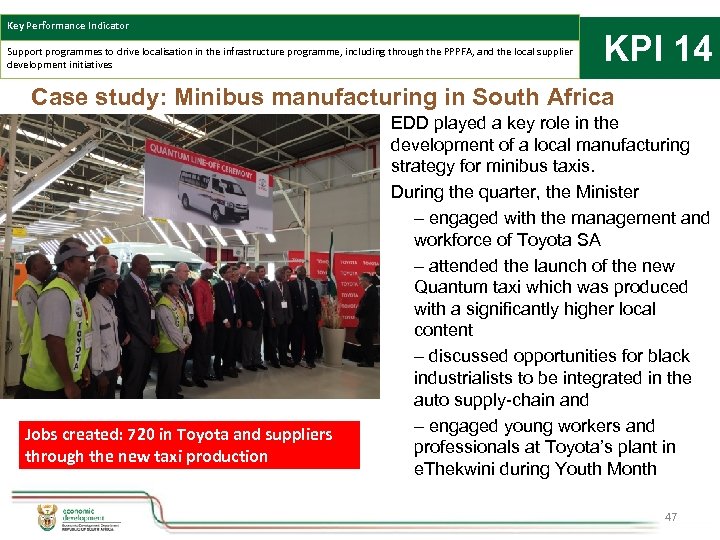 Key Performance Indicator Support programmes to drive localisation in the infrastructure programme, including through the PPPFA, and the local supplier development initiatives KPI 14 Case study: Minibus manufacturing in South Africa Jobs created: 720 in Toyota and suppliers through the new taxi production EDD played a key role in the development of a local manufacturing strategy for minibus taxis. During the quarter, the Minister – engaged with the management and workforce of Toyota SA – attended the launch of the new Quantum taxi which was produced with a significantly higher local content – discussed opportunities for black industrialists to be integrated in the auto supply-chain and – engaged young workers and professionals at Toyota’s plant in e. Thekwini during Youth Month 47
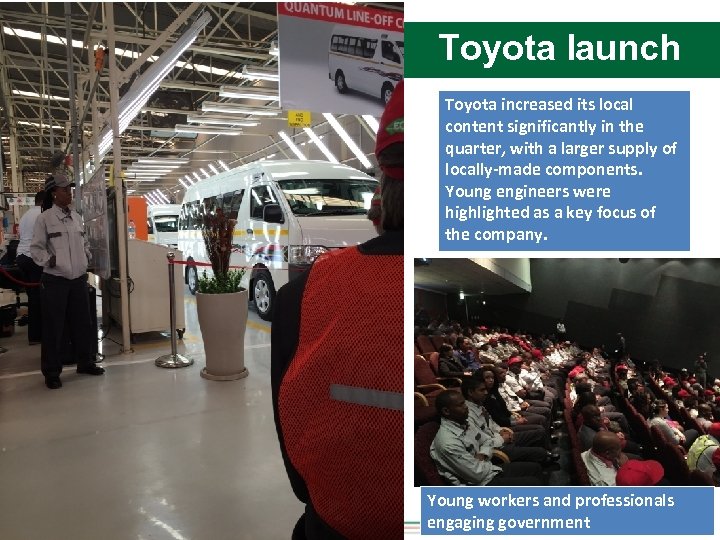 Toyota launch Toyota increased its local content significantly in the quarter, with a larger supply of locally-made components. Young engineers were highlighted as a key focus of the company. Young workers and professionals 48 engaging government
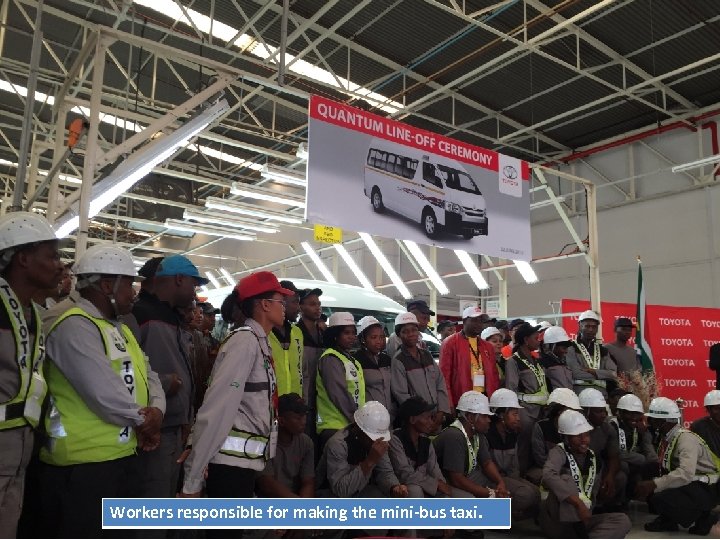 Workers responsible for making the mini-bus taxi. 49
 Key Performance Indicator Support programmes to drive localisation in the infrastructure programme, including through the PPPFA, and the local supplier development initiatives KPI 14 Case study: Clothing manufacturing in South Africa. Employment opportunities in the clothing industry requires dedicated localisation initiatives. EDD worked with partner departments and DFI’s to reverse the loss of productive capacity and jobs in the clothing industry. During the quarter, the Minister: – engaged with Foschini and its local supplier, Prestige Clothing, as an example of a local manufacturer who is able to retain and expand market share through high levels of production efficiencies – visited the factory to track changes made to work organisation – engaged the management on productivity improvements made possible through the government incentive schemes; and – addressed workers at the company on their experiences of the workplace partnership 50
 Clothing company competitiveness Prestige Clothing - Converted manual cutting room to fully automated using government incentives - Trained staff in industrial skills - Replaced sewing equipment - Introduced modular manufacturing system - Improved employee benefits: food, facilities in canteen and education on garnishee orders The impact on productivity and employment was positive. The company was able to in-source work previously done off-shore. 51
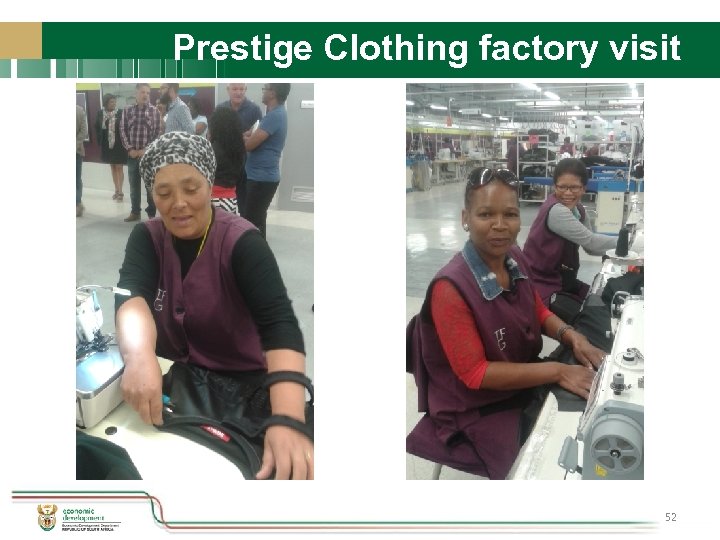 Prestige Clothing factory visit 52
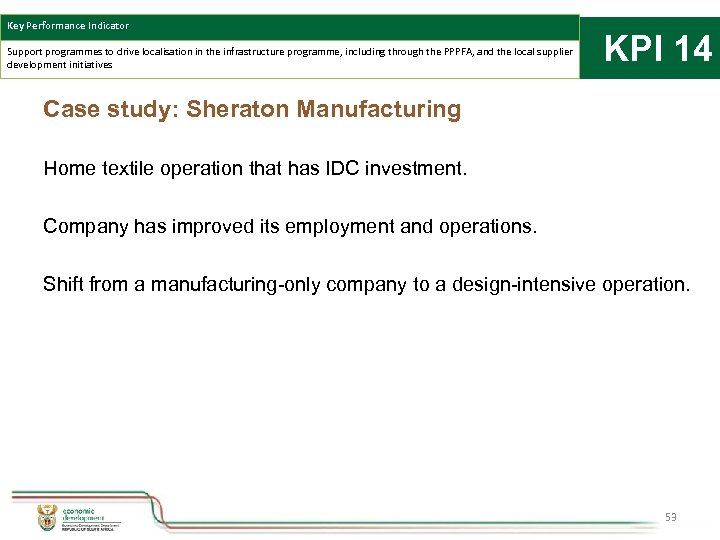 Key Performance Indicator Support programmes to drive localisation in the infrastructure programme, including through the PPPFA, and the local supplier development initiatives KPI 14 Case study: Sheraton Manufacturing Home textile operation that has IDC investment. Company has improved its employment and operations. Shift from a manufacturing-only company to a design-intensive operation. 53
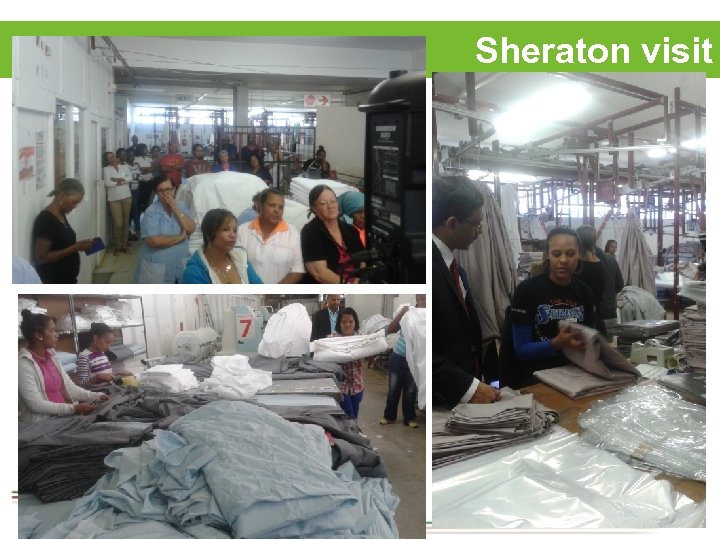 Sheraton visit 54
 Programme 3: Investment, competition & trade Strategic Objective 5: Promote investment, industrial funding and entrepreneurship for jobs and inclusive growth Key Performance Indicator 15. Number of investment initiatives facilitated, fast tracked or unblocked 16. Establish and monitor industrial funding targets for identified jobs drivers and for township economies 17. Reports on increase in industrial finance available from DFIs and departments and its impact on job creation 18. Strategic engagements with DFIs to improve efficiency/decrease turnaround times for project approvals 55
 Key Performance Indicator Number of investment initiatives facilitated, fast tracked or unblocked KPI 15 Work completed: Investment facilitated and unblocked During the quarter, both macro and micro investment initiatives were undertaken to boost investment. These included - A major engagement with foreign investors from the United Arab Emirates, led by the Minister and the UAE Minister of the Economy - Contributing to the finalisation of a draft Investment Bill to provide a legal framework foreign investment in South Africa - Discussions with individual foreign and domestic investors in industries such as tourism, steel, finance, chemical, ICT, infrastructure and business support services - Participating in the World Economic Forum Africa sessions, dealing with investment and promotion of new business opportunities - Unblocking five investment initiatives through support on areas such as energy supply, industrial support and finding market opportunities. 56
 Key Performance Indicator Number of investment initiatives facilitated, fast tracked or unblocked KPI 15 Investment initiatives unblocked: CASE STUDY 1: Pectogenix • Pectogenix is a company that produces pole-mounted electrical transformers and miniature substations. Its main customers are Eskom, municipalities and contractors. • The business is located in Blackheath (W Cape) with 188 people employed and Germiston (Gauteng) with 15 people employed. • EDD facilitated the fast tracking of an IDC loan to the company that helped prevent the closure of the company – thus retaining a black owned company in the industry and saving 52 jobs. 57
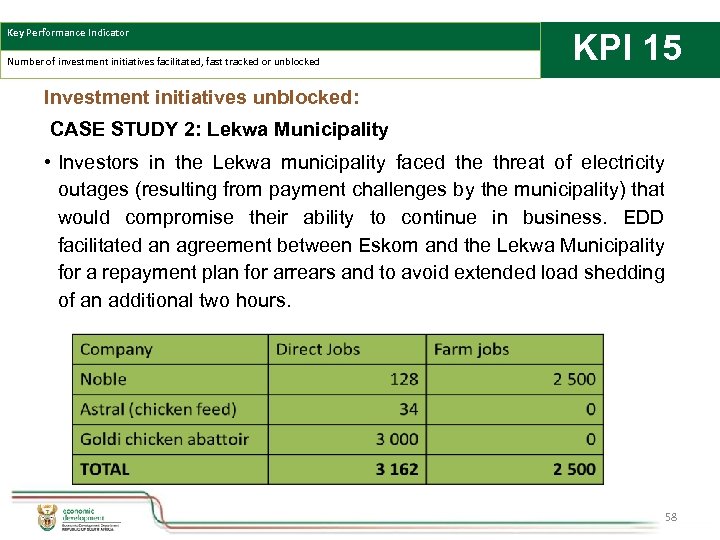 Key Performance Indicator Number of investment initiatives facilitated, fast tracked or unblocked KPI 15 Investment initiatives unblocked: CASE STUDY 2: Lekwa Municipality • Investors in the Lekwa municipality faced the threat of electricity outages (resulting from payment challenges by the municipality) that would compromise their ability to continue in business. EDD facilitated an agreement between Eskom and the Lekwa Municipality for a repayment plan for arrears and to avoid extended load shedding of an additional two hours. 58
 KPI 15 CASE STUDY 3: The Noodle Factory • A local black-owned noodle manufacturer was assisted by EDD to access funding and orders from Massmart, in accordance with the terms of the Supplier Development Fund mandated by the Competition Appeal Court when Walmart acquired the company, following representations by EDD. • Massmart was importing noodles as it was unable to find a domestic supplier. Following engagements with Walmart, EDD identified a black-owned company (The Noodle Factory) and facilitated funding from Massmart Supplier Development Fund. • The Fund approved grant funding of R 2, 5 million to enable the company to acquire capital equipment, replace a steam boiler and assist the client with the design and development of packaging for Massmart Home-Brands. • The funding will also enable The Noodle Factory to increase production to two shifts a day and employ an additional 45 people. • This second shift will supply Massmart and there is now potential to supply another major retailer with the equipment that the company has in place. 59
 KPI 15 CASE STUDY 4: KN Link (Pty) Ltd (CMT for Colibri Towelling) Colibri is a local towel manufacturing company that experienced difficulties in the harsh economic conditions after the 2008/9 financial crisis, was placed in business rescue in 2011 and then shut its doors. – In 2012 the IDC took over the company and re-established manufacturing. It now employs 243 people. – EDD invited Colibri Towelling to display at the Economic Development Budget Vote in May 2015. – At the Budget Vote, EDD introduced Colibri to Mass. Mart and subsequently facilitated the engagement between the parties, which led to grant funding to expand the company’s capacity and secured orders from Game and competitor stores. 60
 KPI 15 CASE STUDY 5: Langeberg & Ashton Foods EDD worked with Eskom, the Municipal Manager and Langeberg & Ashton Foods to mitigate the potential threat to the company and local economy as a result of load-shedding. An agreement was reached to exempt the factory from most loadshedding during the core canning season for the period covering the harvesting/ canning season from April to July 2015. The company retained 2, 000 seasonal workers during the canning season. EDD has worked with the company and other government departments to enable investment to expand its canned vegetable baked beans line that has created 80 additional seasonal jobs. 61
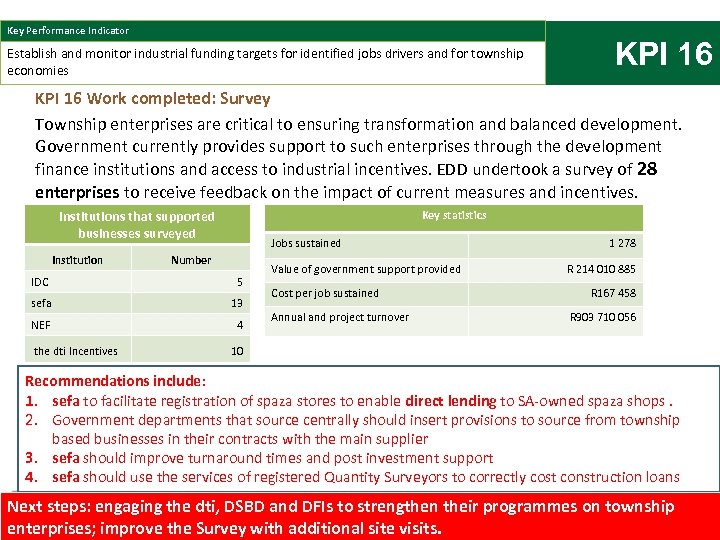 Key Performance Indicator Establish and monitor industrial funding targets for identified jobs drivers and for township economies KPI 16 Work completed: Survey Township enterprises are critical to ensuring transformation and balanced development. Government currently provides support to such enterprises through the development finance institutions and access to industrial incentives. EDD undertook a survey of 28 enterprises to receive feedback on the impact of current measures and incentives. Institutions that supported businesses surveyed Institution Key statistics Jobs sustained Number IDC 5 sefa 13 NEF 4 the dti Incentives Value of government support provided Cost per job sustained Annual and project turnover 1 278 R 214 010 885 R 167 458 R 903 710 056 10 Recommendations include: 1. sefa to facilitate registration of spaza stores to enable direct lending to SA-owned spaza shops. 2. Government departments that source centrally should insert provisions to source from township based businesses in their contracts with the main supplier 3. sefa should improve turnaround times and post investment support 4. sefa should use the services of registered Quantity Surveyors to correctly cost construction loans Next steps: engaging the dti, DSBD and DFIs to strengthen their programmes on township 62 enterprises; improve the Survey with additional site visits.
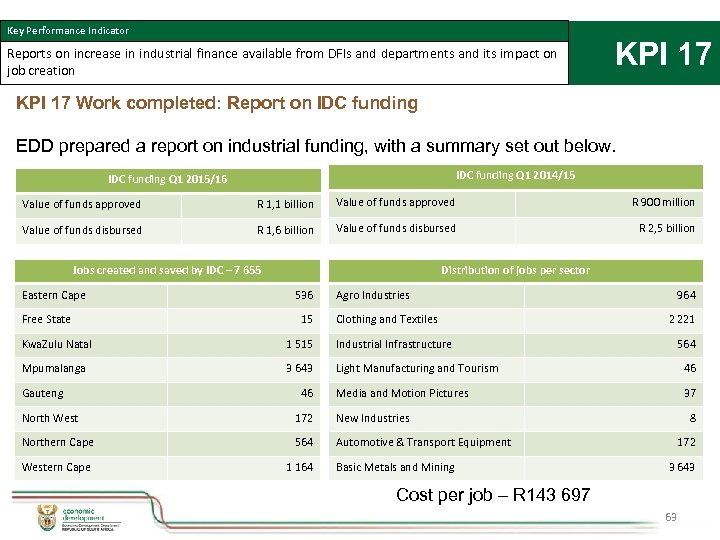 Key Performance Indicator Reports on increase in industrial finance available from DFIs and departments and its impact on job creation KPI 17 Work completed: Report on IDC funding EDD prepared a report on industrial funding, with a summary set out below. IDC funding Q 1 2014/15 IDC funding Q 1 2015/16 Value of funds approved R 1, 1 billion Value of funds approved R 900 million Value of funds disbursed R 1, 6 billion Value of funds disbursed R 2, 5 billion Jobs created and saved by IDC – 7 655 Eastern Cape Free State Distribution of jobs per sector 536 15 Agro Industries Clothing and Textiles 964 2 221 Kwa. Zulu Natal 1 515 Industrial Infrastructure Mpumalanga 3 643 Light Manufacturing and Tourism 46 Media and Motion Pictures 37 Gauteng 46 North West 172 New Industries Northern Cape 564 Automotive & Transport Equipment Western Cape 1 164 564 Basic Metals and Mining 8 172 3 643 Cost per job – R 143 697 63
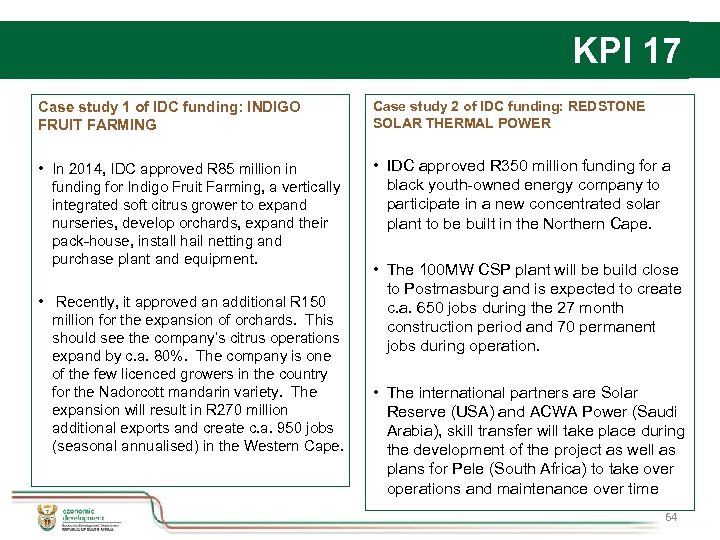 KPI 17 Case study 1 of IDC funding: INDIGO FRUIT FARMING Case study 2 of IDC funding: REDSTONE SOLAR THERMAL POWER • In 2014, IDC approved R 85 million in funding for Indigo Fruit Farming, a vertically integrated soft citrus grower to expand nurseries, develop orchards, expand their pack-house, install hail netting and purchase plant and equipment. • IDC approved R 350 million funding for a black youth-owned energy company to participate in a new concentrated solar plant to be built in the Northern Cape. • Recently, it approved an additional R 150 million for the expansion of orchards. This should see the company’s citrus operations expand by c. a. 80%. The company is one of the few licenced growers in the country for the Nadorcott mandarin variety. The expansion will result in R 270 million additional exports and create c. a. 950 jobs (seasonal annualised) in the Western Cape. • The 100 MW CSP plant will be build close to Postmasburg and is expected to create c. a. 650 jobs during the 27 month construction period and 70 permanent jobs during operation. • The international partners are Solar Reserve (USA) and ACWA Power (Saudi Arabia), skill transfer will take place during the development of the project as well as plans for Pele (South Africa) to take over operations and maintenance over time 64
 Key Performance Indicator Strategic engagements with DFIs to improve efficiency/decrease turnaround times for project approvals KPI 18 Work completed: Strategic engagements with DFI’s EDD’s work with the DFI’s included monitoring and reporting on the DFIs; Ministerial engagements with the IDC to provide oversight and give strategic direction; and interactions with the Department of Small Business Development (DSBD) with respect to sefa. The Ministerial interactions have resulted in a number of tangible outcomes, including: – The announcement during the Budget Vote in May 2015 that the IDC would set aside R 23 billion to support and facilitate the growth of black industrialists; – Providing strategic guidance to the IDC on strengthening the corporation’s human capital base; – EDD and the Department of Small Business Development (DSBD) finalised the transfer of strategic oversight responsibility over sefa to the DSBD. 65
 Programme 3: Investment, competition & trade Strategic Objective 6: Promote competition, trade and economic regulation in support of job creation, industrialisation & social inclusion Key Performance Indicator 21. Ensure competition authorities address abuse of market power & support employment, industrialisation and development objectives 22. Ensure trade authorities and policies support industrialisation, employment and other national development objectives 23. Engagements with trade and competition authorities to increase administrative efficiencies 66
 Key Performance Indicator Ensure competition authorities address abuse of market power & support employment, industrialisation and development objectives KPI 21 Work completed: Walmart engagement to ensure jobs and industrialisation EDD engaged with Walmart to give effect to the competition obligations imposed by the Competition Appeal Court. The Minister met with the new CEO and Chairman to assess implementation of the Supplier Development Fund adjust the focus to ensure deeper local industrialisation The EDD team then worked with Walmart’s team to align the work of the Supplier Development Fund to the vision agreed and shared by the Minister, CEO and Chairman. This included greater emphasis on: • developing and purchasing from local producers instead of importing; • actively promoting domestic producers’ access to Walmart’s international procurement opportunities. 67
 Key Performance Indicator Ensure trade authorities and policies support industrialisation, employment and other national development objectives KPI 22 Work completed: Trade report A report on trade flows over the last 10 years was completed. This comprehensively mapped out changing patterns of trade and their relation to employment. Key findings include: • South Africa’s trade with the rest of the world has nearly doubled in dollar terms over the last 10 years. • Exports have risen from US$47 bn in 2005 to US$91 bn in 2014. • Imports rose from US$ 55 bn to US$ 100 bn over the same period. 68
 Case study China • Exports to China have grown faster over the last 10 years than to any of our major export regions • South Africa’s exports grew from US$3. 4 bn in 2005 to US$44. 6 billion in 2014 representing 33% annual growth • Since 2008, South Africa has exported more to China than we have imported. • Over the last 10 years our imports have grown from US$3. 8 billion to US$ 15. 7 billion. • This growth in imports has averaged 17% per year over the last 10 years. BUT: Exports are largely of South African raw materials – this represents the big challenge to transform more of the raw materials to manufactured goods in SA 2018/03/16 69
 Case study China • South Africa’s exports to China are concentrated in mineral products – more than 85% of exports are found in four mining categories: – – • Gold Iron ore Diamonds Platinum South Africa’s imports from China are much more diverse – 80% of imports are found in 151 broad trade categories. Imports are concentrated in finished goods and include: – – – – Cellphones Computers Shoes Furniture Televisions Women’s and men’s outerwear Suitcases and handbags Motor vehicle parts Heaters and hair dryers Tyres Fabric Lamps and light fittings Steel and steel products 2018/03/16 70
 Key Performance Indicator Engagements with trade and competition authorities to increase administrative efficiencies KPI 23 Work completed: Engagements with trade and competition authorities EDD analysed the quarterly reports of the Competition Commission, Competition Tribunal and ITAC. The Department analysed ITAC’s draft annual report for the 2014/15 financial year. The analysis looked at the financial performance of the entities throughout the quarter and achievement of their key indicators, and monitored their performance with regards to mergers and acquisitions, and cartels. EDD has been working with the competition authorities in preparation for the BRICS international competition conference to be held in November 2015 71
 KPI 23 – competition developments SASOL excessive pricing case § One of the more significant recent cases in the Competition Tribunal addressed the issue of excessive pricing, in a matter involving SASOL. The Tribunal found that SASOL had charged excessive prices for propylene and polypropylene to the detriment of customers and imposed an administrative penalty of R 534 million. § Following the Tribunal’s award in the matter, SASOL took the matter on appeal. § The Competition Appeal Court (CAC) upheld Sasol’s appeal, finding that the burden of proof on excessive pricing was not met by the Commission though noting that a successful excessive pricing case could be brought under the Competition Act § The Commission intends to appeal to the Constitutional Court. § The Ministry has engaged the Commission on the key policy challenges that are identified by the case with a view to considering whether the legislative framework is adequate to address excessive pricing. 72
 KPI 23 – competition developments Other developments § The Commission is investigating 159 cases of alleged collusion in the automotive component sector. § Commission recommended approval of 7 mergers with conditions and 105 without conditions. Significant mergers include approval of: § Vodacom’s intention to acquire Neotel - with conditions in relation to the use of spectrum. This is now being considered by the Competition Tribunal and government will make representations. This is being done by the Ministries of Economic Development working with Telecommunications and Postal Services. § Hebei Iron and Steel Group acquisition of shares in Duferco - with employment and investment conditions; § Grupo. Ferroatlantica SA’s acquisition of Globe Speciality Metals - with conditions on investment and an undertaking not to relocate the operations of Siltech which supplies ferrosilicon and micosilica, post merger. 73
 KPI 23 – competition developments Retail Market Inquiry § During the Economic Development Budget Speech in Parliament, the Minister announced a competition market inquiry into the retail sector. The Commission has now published, for comment, the draft Terms of Reference for the Grocery Retail Sector Market Inquiry. The proposed scope covers 6 areas: § Impact of expansion, diversification and consolidation of national supermarket chains on small & independent retailers; § Impact of long term exclusion leases on competition in the sector; § Dynamics of competition between local and foreign owned small and independent retailers; § Impact of regulations, including inter alia municipal town planning and bylaws on small and independent retailers; § Impact of buyer groups on small and independent retailers; § Impact of identified value chains on the operations of small and independent retailers. 74
 KPI 23 – trade developments Trade developments ITAC work during the period covered the following: § Tariffs were raised on the following after ITAC finalised investigations: § Wheat and wheat flour § Sugar § Lead acid batteries § Reduction in the rate of duties on the following product was made following an ITAC investigation: § Lithium batteries § ITAC imposed the following trade remedies: § Provisional duties on Portland cement for imports from Pakistan 75
 EDD FINANCIALS 1 st Quarter 2015/16 76
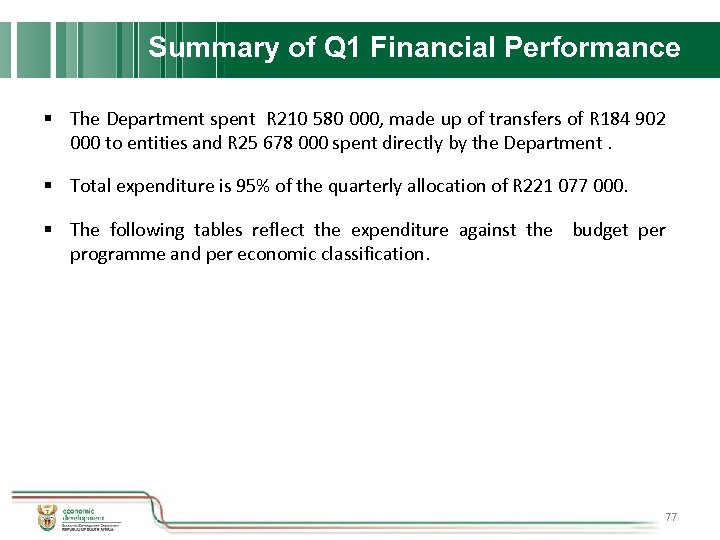 Summary of Q 1 Financial Performance § The Department spent R 210 580 000, made up of transfers of R 184 902 000 to entities and R 25 678 000 spent directly by the Department. § Total expenditure is 95% of the quarterly allocation of R 221 077 000. § The following tables reflect the expenditure against the budget per programme and per economic classification. 77
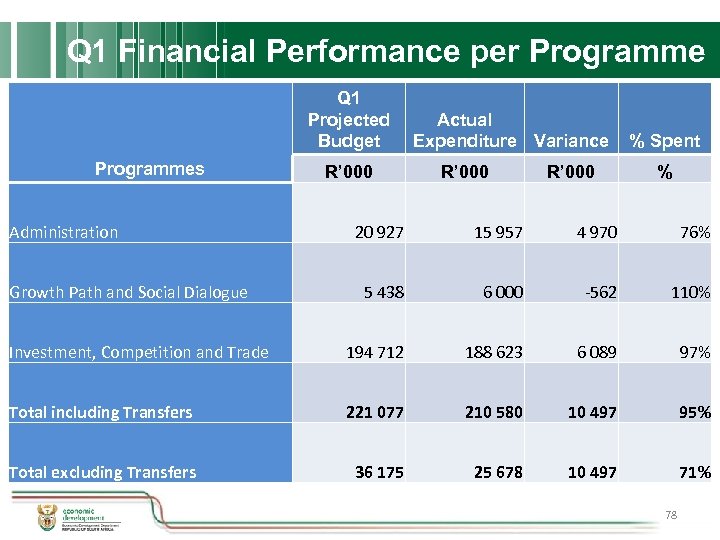 Q 1 Financial Performance per Programme Q 1 Projected Budget Programmes R’ 000 Actual Expenditure Variance R’ 000 % Spent % Administration 20 927 15 957 4 970 76% Growth Path and Social Dialogue 5 438 6 000 -562 110% Investment, Competition and Trade 194 712 188 623 6 089 97% Total including Transfers 221 077 210 580 10 497 95% Total excluding Transfers 36 175 25 678 10 497 71% 78
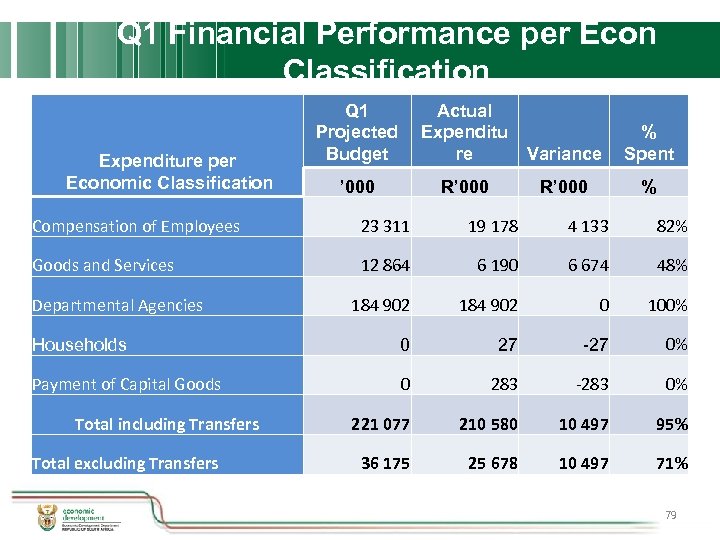 Q 1 Financial Performance per Econ Classification Expenditure per Economic Classification Q 1 Projected Budget Actual Expenditu re Variance % Spent ’ 000 R’ 000 % Compensation of Employees 23 311 19 178 4 133 82% Goods and Services 12 864 6 190 6 674 48% 184 902 0 100% Households 0 27 -27 0% Payment of Capital Goods 0 283 -283 0% 221 077 210 580 10 497 95% 36 175 25 678 10 497 71% Departmental Agencies Total including Transfers Total excluding Transfers 79
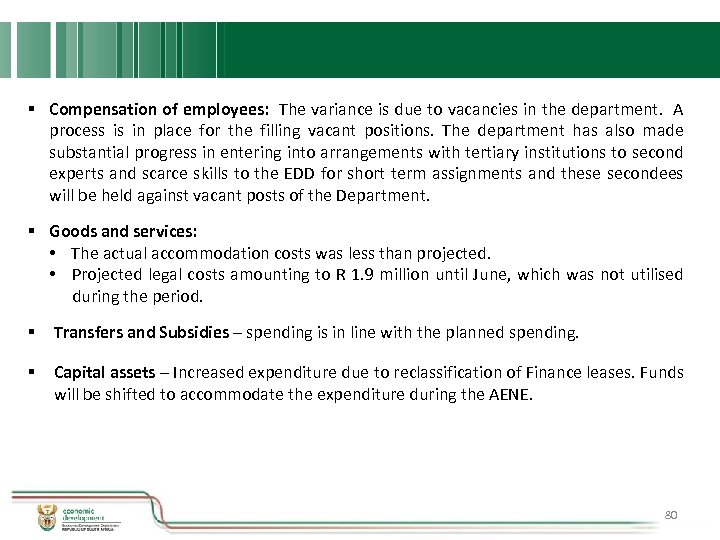 § Compensation of employees: The variance is due to vacancies in the department. A process is in place for the filling vacant positions. The department has also made substantial progress in entering into arrangements with tertiary institutions to second experts and scarce skills to the EDD for short term assignments and these secondees will be held against vacant posts of the Department. Q 1 Financial Performance: Reasons fo Variance § Goods and services: • The actual accommodation costs was less than projected. • Projected legal costs amounting to R 1. 9 million until June, which was not utilised during the period. § Transfers and Subsidies – spending is in line with the planned spending. § Capital assets – Increased expenditure due to reclassification of Finance leases. Funds will be shifted to accommodate the expenditure during the AENE. 80
 THANK YOU SIYABONGA REA LEBOHA! 81