


 Скачать презентацию ECVET principles ECVET and European
6b6c19b42c1ec75387d6b845b3b84d8a.ppt
- Количество слайдов: 29
 ECVET principles • • • ECVET and European policy context ECVET and European initiatives and tools ECVET Recommendation
 European policy context
 Policy context Europe 2020 strategy Europe 2020 is the EU's growth strategy for the coming decade. In a changing world, we want the EU to become a smart, sustainable and inclusive economy. These three mutually reinforcing priorities should help the EU and the Member States deliver high levels of employment, productivity and social cohesion.
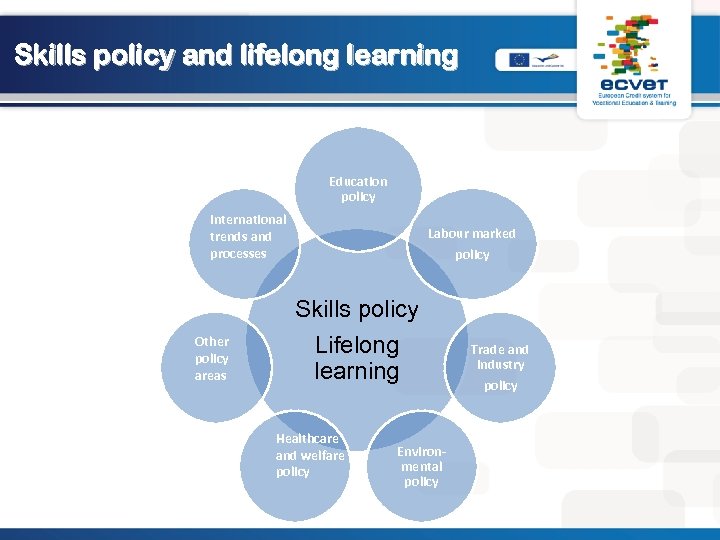 Skills policy and lifelong learning Education policy International trends and processes Other policy areas Labour marked policy Skills policy Lifelong learning Healthcare and welfare policy Environmental policy Trade and Industry policy
 Policy context Europe 2020 strategy Strategic framework for European cooperation in education and training (”ET 2020”) Significant progress being made: in support of national reforms of lifelong learning; the modernisation of higher education; the development of common European instruments promoting quality, transparency and mobility; Strategic objectives: Making lifelong learning and mobility a reality; Improving the quality and efficiency of education and training
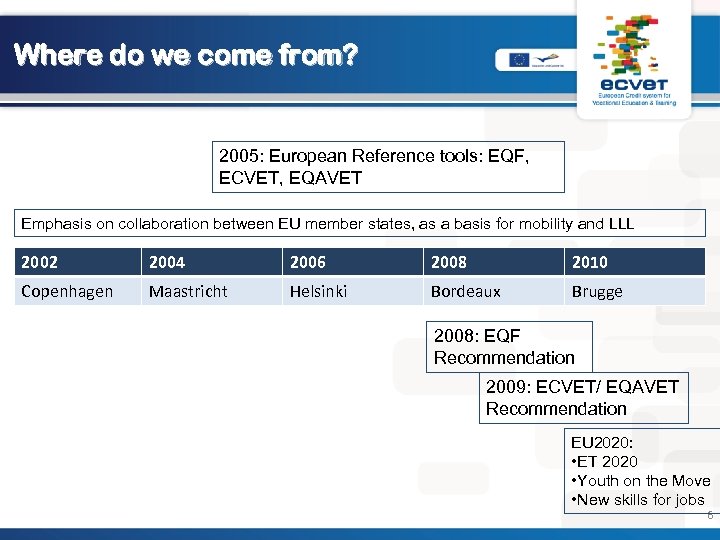 Where do we come from? 2005: European Reference tools: EQF, ECVET, EQAVET Emphasis on collaboration between EU member states, as a basis for mobility and LLL 2002 2004 2006 2008 2010 Copenhagen Maastricht Helsinki Bordeaux Brugge 2008: EQF Recommendation 2009: ECVET/ EQAVET Recommendation EU 2020: • ET 2020 • Youth on the Move • New skills for jobs 6
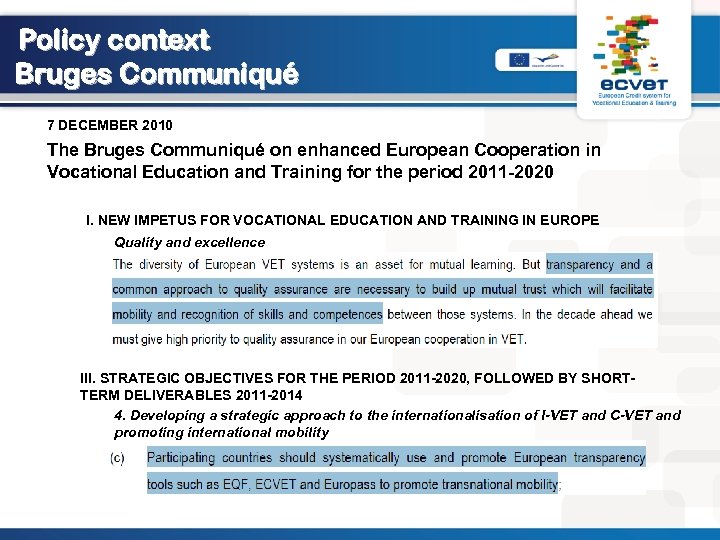 Policy context Bruges Communiqué 7 DECEMBER 2010 The Bruges Communiqué on enhanced European Cooperation in Vocational Education and Training for the period 2011 -2020 I. NEW IMPETUS FOR VOCATIONAL EDUCATION AND TRAINING IN EUROPE Quality and excellence III. STRATEGIC OBJECTIVES FOR THE PERIOD 2011 -2020, FOLLOWED BY SHORTTERM DELIVERABLES 2011 -2014 4. Developing a strategic approach to the internationalisation of I-VET and C-VET and promoting international mobility
 New Skills for New Jobs Anticipating and matching labour market and skills needs The link between EU Strategy for Growth and Jobs and an updated strategic framework for European cooperation in education and training to support Member States in raising skills levels through lifelong learning. The updated strategic framework for cooperation in education and training can stimulate innovative partnerships between education and training providers and social and economic actors, to promote more flexible and demand-led systems. The implementation of the European Qualifications Framework should increase the transparency of qualifications and facilitate access to further learning. The Copenhagen process on cooperation in VET will include a new priority to improve the links with the labour market; The New Skills for New Jobs initiative stresses the need for more effective education and training policies and modernisation of labour markets through flexicurity policies.
 Towards Common Principles of Flexicurity: More and better jobs through flexibility and security Comprehensive lifelong learning (LLL) strategies to ensure the continual adaptability and employability of workers, particularly the most vulnerable; Internal (within the enterprise) as well as external (from one enterprise to another) flexicurity should be promoted. Sufficient flexibility in recruitment and dismissal must be accompanied by secure transitions from job to job. Upward mobility needs to be facilitated, as well as between unemployment or inactivity and work. High-quality workplaces with capable leadership, good organisation of work, and continuous upgrading of skills are part of the objectives of flexicurity. Social protection needs to support, not inhibit, mobility.
 European initiatives and tools
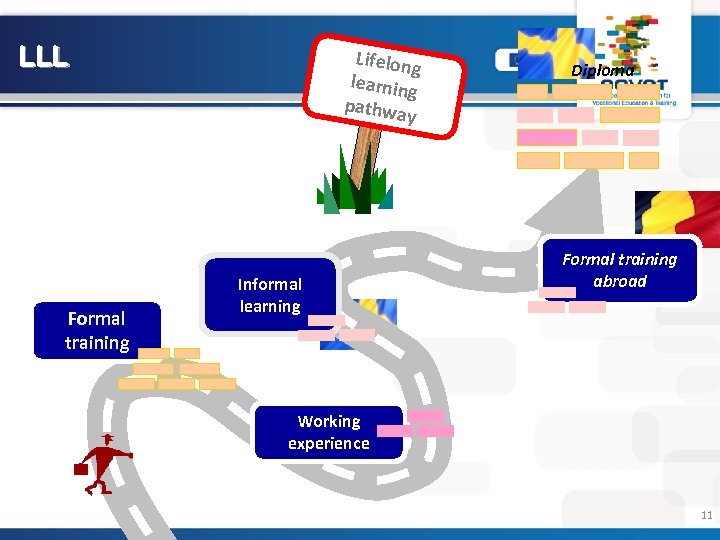 LLL Formal training Lifelong learnin g pathwa y Informal learning Diploma Formal training abroad Working experience 11
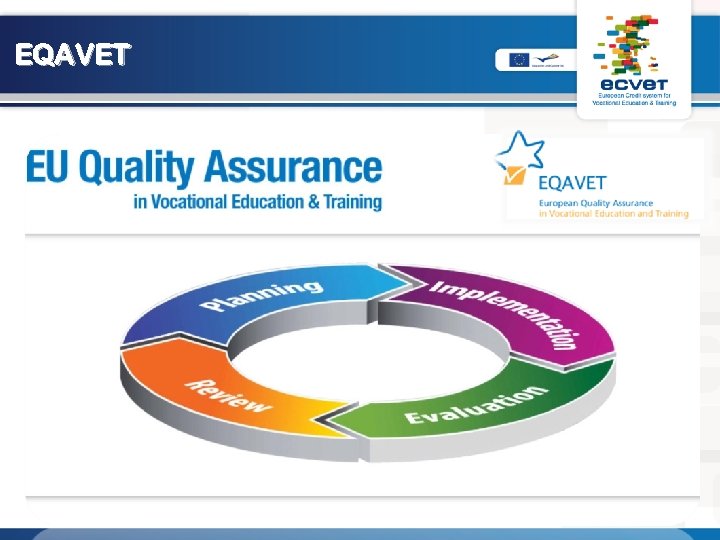
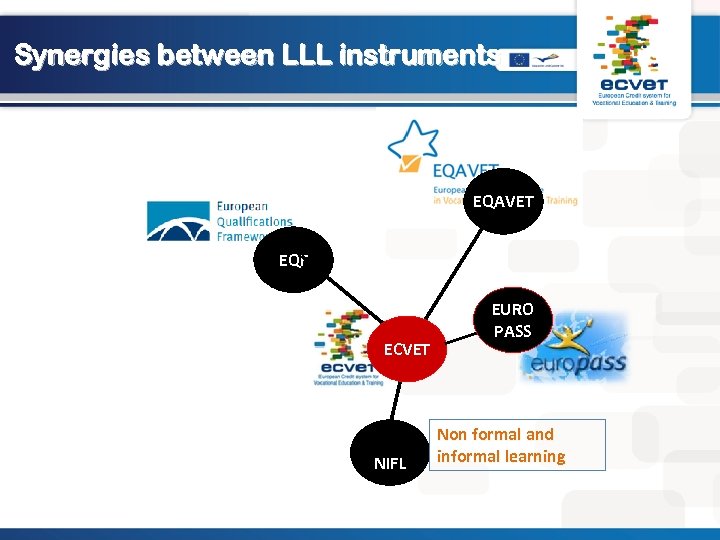 Synergies between LLL instruments EQAVET EQF ECVET NIFL EURO PASS Non formal and informal learning
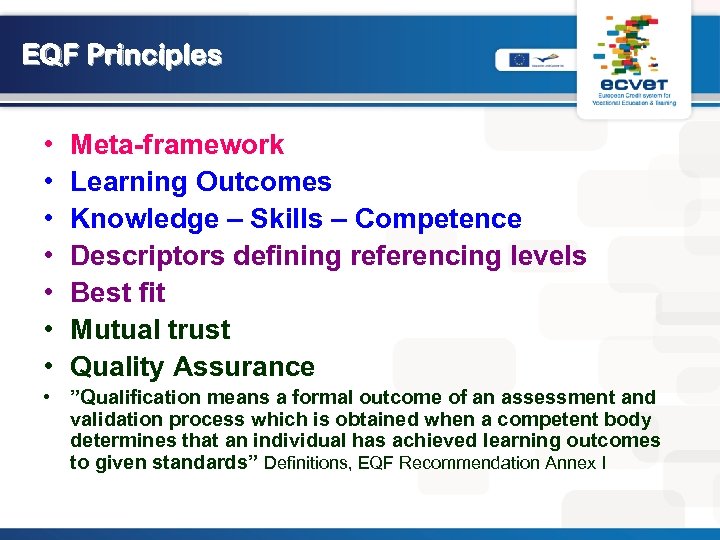 EQF Principles • • Meta-framework Learning Outcomes Knowledge – Skills – Competence Descriptors defining referencing levels Best fit Mutual trust Quality Assurance • ”Qualification means a formal outcome of an assessment and validation process which is obtained when a competent body determines that an individual has achieved learning outcomes to given standards” Definitions, EQF Recommendation Annex I
 EQAVET
 EQAVET
 Europass CV Language Passport Diploma Supplement Certificate Supplement Mobility All Europass documents will be adjusted to be in line with ECVET
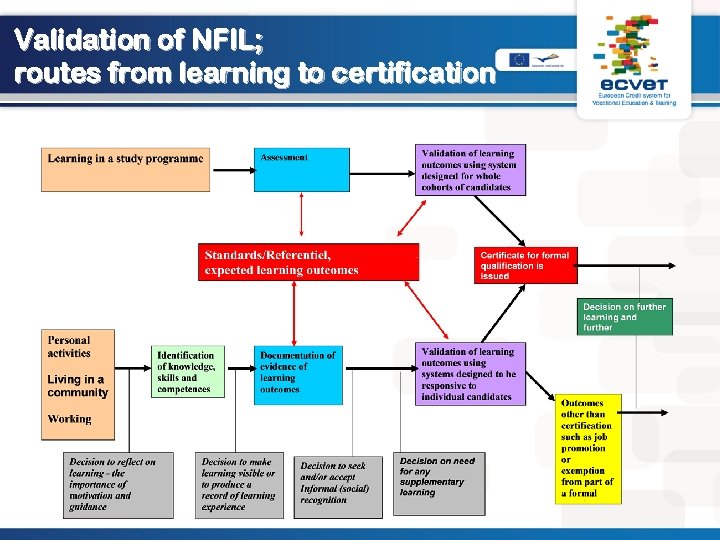 Validation of NFIL; routes from learning to certification
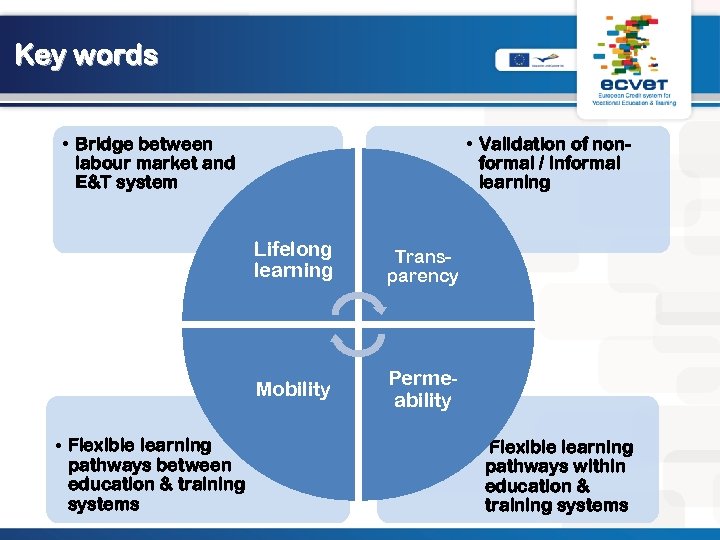 Key words • Bridge between labour market and E&T system • Validation of nonformal / informal learning Lifelong learning Mobility • Flexible learning pathways between education & training systems Transparency Permeability • Flexible learning pathways within education & training systems
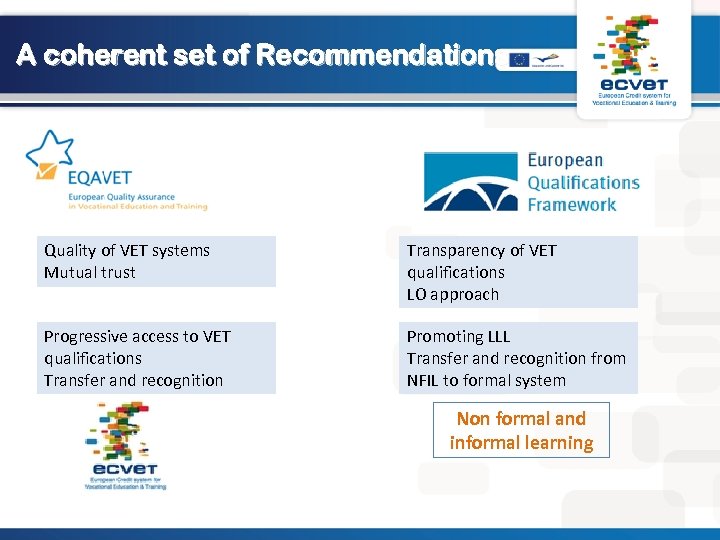 A coherent set of Recommendations Quality of VET systems Mutual trust Transparency of VET qualifications LO approach Progressive access to VET qualifications Transfer and recognition Promoting LLL Transfer and recognition from NFIL to formal system Non formal and informal learning
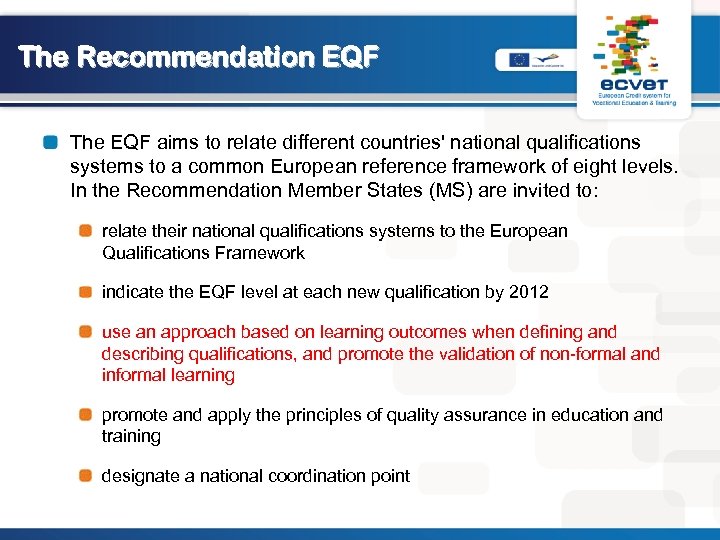 The Recommendation EQF The EQF aims to relate different countries' national qualifications systems to a common European reference framework of eight levels. In the Recommendation Member States (MS) are invited to: relate their national qualifications systems to the European Qualifications Framework indicate the EQF level at each new qualification by 2012 use an approach based on learning outcomes when defining and describing qualifications, and promote the validation of non-formal and informal learning promote and apply the principles of quality assurance in education and training designate a national coordination point
 NFIL Proposal recommendation Ensure, by 2018, that a national system of validation of non-formal and informal learning is established providing the opportunity for citizens to Have their skills, knowledge and competences acquired through non formal and informal learning, including via open educational resources Obtain a full or partial qualification on the basis of validated non-formal and informal learning experiences Ensure that the national system of validation of non-formal and informal learning includes the following elements: support, assistance, assessment, certification Ensure synergy with ECTS and ECVET
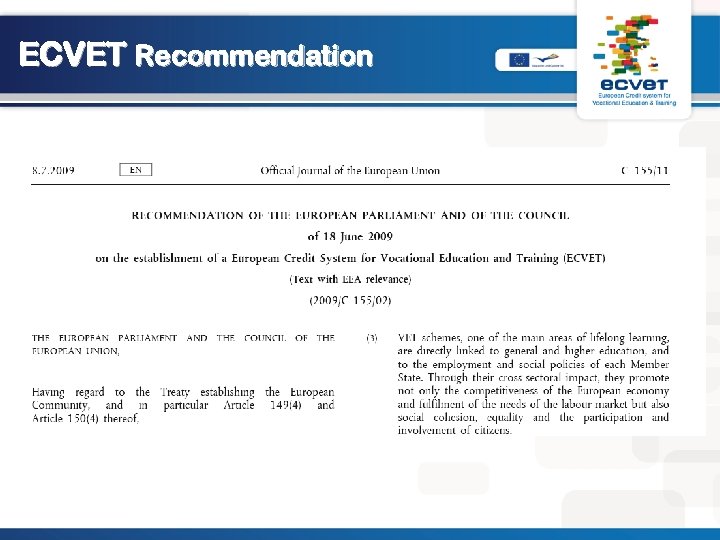 ECVET Recommendation
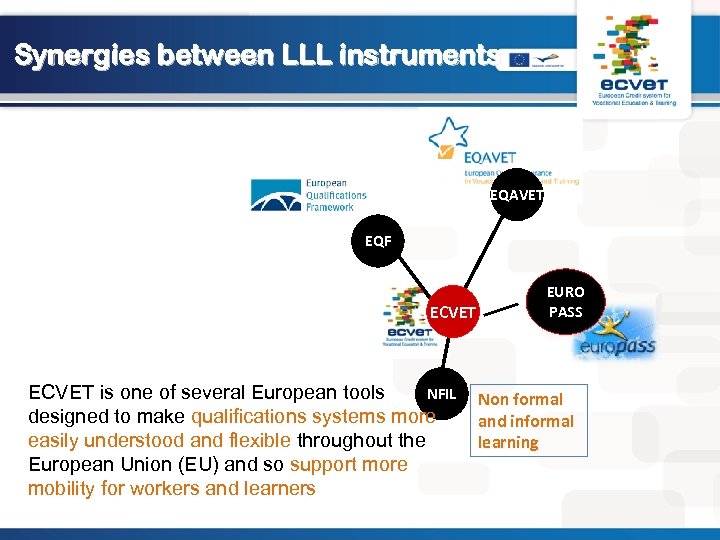 Synergies between LLL instruments EQAVET EQF ECVET is one of several European tools NFIL designed to make qualifications systems more easily understood and flexible throughout the European Union (EU) and so support more mobility for workers and learners EURO PASS Non formal and informal learning
 The ECVET Recommendation What is the objective? ü European Credit System for Vocational Education and Training (ECVET) is a technical framework for the transfer, recognition and, where appropriate, accumulation of individuals’ learning outcomes with a view to achieving a qualification.
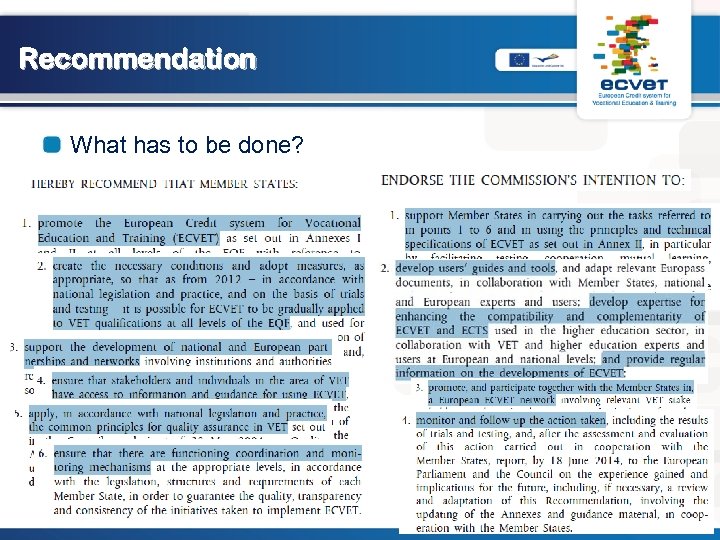 Recommendation What has to be done?
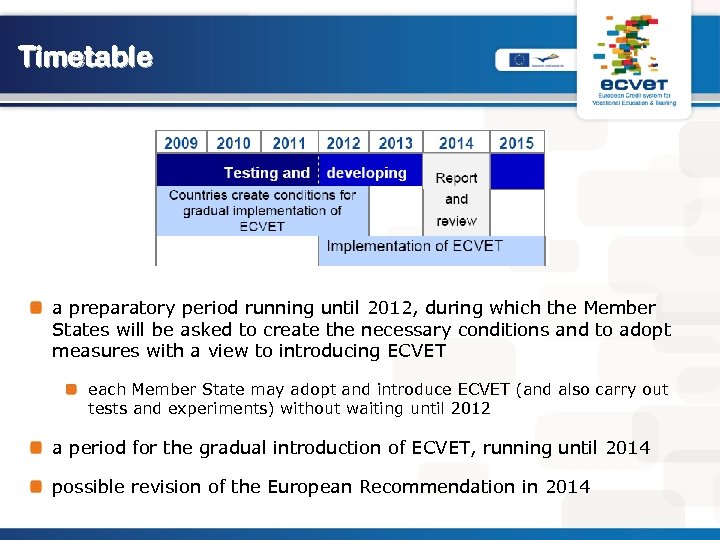 Timetable a preparatory period running until 2012, during which the Member States will be asked to create the necessary conditions and to adopt measures with a view to introducing ECVET each Member State may adopt and introduce ECVET (and also carry out tests and experiments) without waiting until 2012 a period for the gradual introduction of ECVET, running until 2014 possible revision of the European Recommendation in 2014
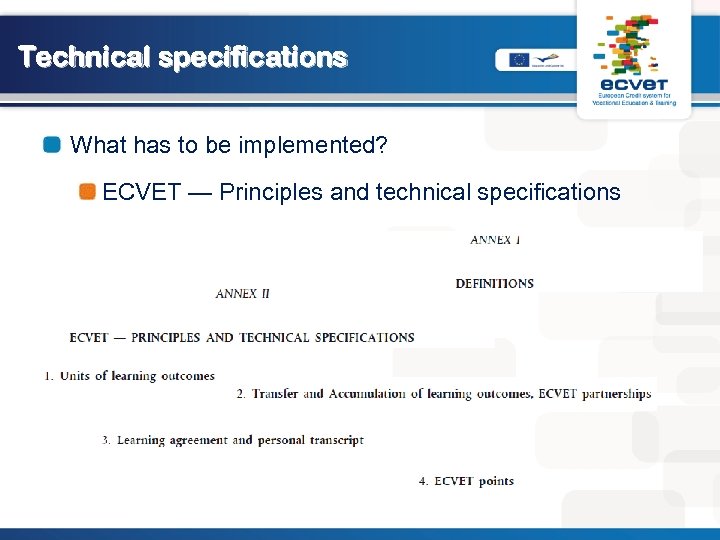 Technical specifications What has to be implemented? ECVET — Principles and technical specifications
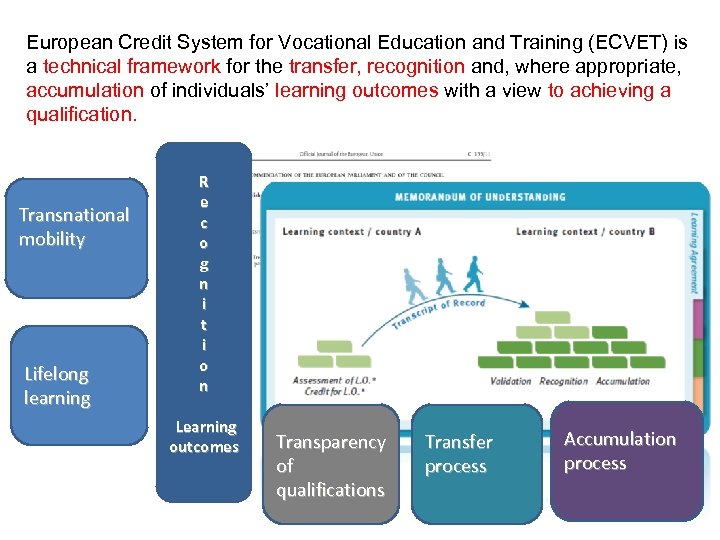 European Credit System for Vocational Education and Training (ECVET) is a technical framework for the transfer, recognition and, where appropriate, accumulation of individuals’ learning outcomes with a view to achieving a qualification. Transnational mobility Lifelong learning R e c o g n i t i o n Learning outcomes Transparency of qualifications Transfer process Accumulation process
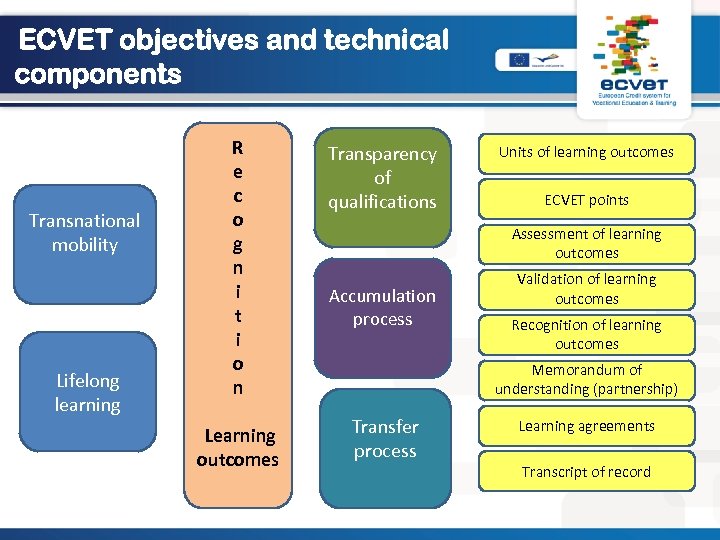 ECVET objectives and technical components Transnational mobility Lifelong learning R e c o g n i t i o n Transparency of qualifications Learning outcomes Transfer process Units of learning outcomes ECVET points Assessment of learning outcomes Accumulation process Validation of learning outcomes Recognition of learning outcomes Memorandum of understanding (partnership) Learning agreements Transcript of record