 Скачать презентацию ECOTOURISM BENEFITS AND THE ROLE OF NONGOVERNMENTAL ORGANISATIONS
fbbf61d226168bef39a04447afe8689e.ppt
- Количество слайдов: 23



ECOTOURISM BENEFITS AND THE ROLE OF NONGOVERNMENTAL ORGANISATIONS AT YANKARI GAME RESERVE, NIGERIA By Adeleke Bola Olusola Department of Transport and Tourism Studies Redeemer’s University Redemption City, Ogun State, Nigeria E-mail : thebhozz@yahoo. co. uk
ABSTRACT An investigation of ecotourism at Yankari Game Reserve in Sudan Savanna of Northern Nigeria and one of the country’s most visited protected areas focused ecotourism benefits and the role of Non-Governmental Organisations in promoting conservation awareness. Interviews, participant observation and archival research were used to investigate the role of Non-Governmental Organisations. Questionnaire were administered to determine resident attitudes toward Yankari Game Reserve, and ecotourism benefits accrued to residents. Many factors make Yankari Game Reserve a prime ecotourist destination, including the possibility of viewing easily its endemic species, such as Waterbuck. The Game Reserve has a strong Non. Governmental Organisation involvement and currently combines conservation and development through a programme that returns a portion of tourism revenue to local communities. Actual benefits received from the Game Reserve, including ecotourism revenues were found to influence the positive and negative perception of Yankari Game Reserve held by residents in the Game Reserve periphery.
KEY WORDS • • •
INTRODUCTION Ceballos-Lascurian (1991) defines ecotourism as tourism that involves travelling to a relatively undisturbed natural areas with objective of admiring, studying and enjoying scenery and its wild plants and animals, as well as cultural features that may be found there. Also The World Conservation Union (IUCN) and Ceballos-Lascurain (1996) define ecotourism as: Environmental responsible travel to and visitation undisturbed relatively accompany appreciate ingcultural any nature features- (and both past and present), promotes that conservation, low has visitor economic involvement of local populations.
INTRODUCTION Ecotourism is the fastest growing segment of tourism today (Meduna et al, 2009). An estimated 1. 6 billion people from all cultures and all walks of life participate in different kinds of tourism, spending over $2 trillion making ecotourism to grow on a global stage because of its international appeal (Lowman, 2004). The benefits of ecotourism are clearly seen by governments in both developing and developed nations for a variety of reason. Such benefits include protection of the environment, economic stability, cultural integrity and enhancement of education (Liu, 1994). Ibeum and Nichor (1989), noted that ecotourism earned Botswana $32. 5 million in 1998 making it the country’s third largest foreign exchange earner from diamond and beef. According to World Tourism Organisation, wildlife-based tourism contributed 35. 8% and 4. 6% to total export and Gross National Product respectively for Kenya, while its contribution to Nigeria was 1. 1% and 0. 2% for export and Gross National Product respectively (Ayodele and Falade, 1990).
INTRODUCTION Ecotourism while promoting the conservation of natural that are tourist destination, can provide economic revenues through entrance fees, employment of local residents of the park area and tourist expenditures (Ormsby and Mannle, 2006). Projects can generate foreign exchange and provide economic benefits to remote areas (Fennel, 1999). Ecotourism initiatives can attract investment capital for community infrastructure development, often including improved local, social and educational services The analysis of ecotourism at Yankari Game Reserve in Nigeria explores how the park is achieving the various elements that characterize ecotourism, in particular economic benefits and the community. Ecotourism is one method of minimizing people-park conflict and generating support for conservation by providing local benefits.
INTRODUCTION The management of protected areas must therefore must have to facilitate ‘park-people’ interactions, often referred to the ‘integrated conservation and development’ or community-based conservation’ (Bond, et al, 2001). The belief is that anything built on this foundation represents the communities real needs and wishes (Abdullahi et al, 2007). This approach attempts to link local development needs with conservation objectives and intend to promote a favourable attitude of local people towards protected area management and biodiversity conservation (Shresta Avalapati, 2006). Game Reserves in Nigeria were set up with the primary role conservation of animal species. In Yankari, this work is strongly supported by a number of NGOs working with different communities. The various NGOs working in Yankari help to reduce conflicts between communities and Game Reserve and also help to introduce many poverty alleviation schemes to residents.
SPECIFICALLY, THE STUDY AIMED TO: • Assess residents attitudes towards Yankari Game Reserve • Determine ecotourism benefits accrued to residents • Role of Non-Governmental Organisations in promoting conservation awareness.
METHOLOGY The population of the study was staffs of various Non- Governmental Organisations, and residents of Yankari Game Reserve. Leaders of communitybased organizations were the target population of the study. The game reserve occupies a total land area of approximately 2, 244 square kilometers in the North-East of Nigeria and it is one of the protected areas in Nigeria with highest tourist inflow (Adeleke and Ajayi, 2004). Yankari is also recognized as having one of the largest populations of elephants in West Africa (Abdullahi, et al, 2007). Also the endemic specie of Water Buck sight is a great ecotourist attraction. The role of Non-Governmental Organisations was determined through archival research and participant’s observation, while residents’ attitudes towards the Reserve and ecotourism benefits were assessed by administration of questionnaires to 120 households selected based on a stratified sampling procedure (Sambo, 2005; Otite and Ogionwa, 2006). Twenty communities were randomly selected for the study. Data were analysed using simple percentages.
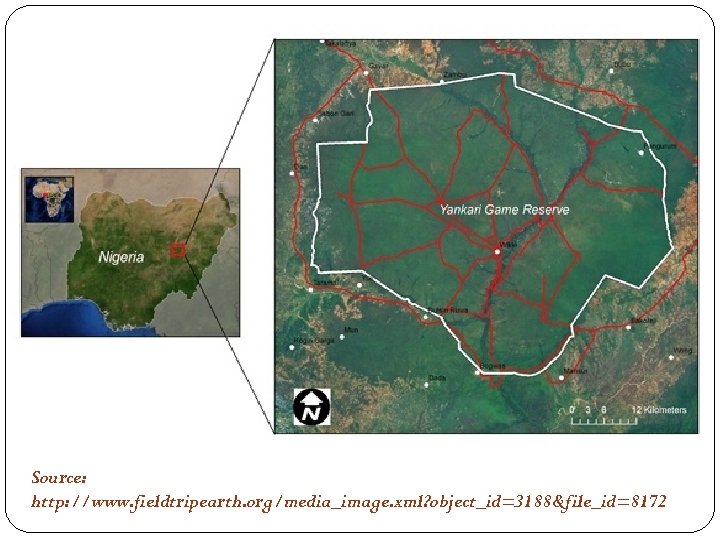
Source: http: //www. fieldtripearth. org/media_image. xml? object_id=3188&file_id=8172
RESULTS
Non-Governmental Organisations Activities in Yankari Game Reserve A) Friends of Yankari Conservation Initiative The Friends of Yankari a grassroot non-profit organization was established in 2008. It is an association with a pool of environmental experts on conservation projects and community based natural resource management initiatives in the Yankari Game Reserve and its support zone. They work through collaboration with other NGOs and consultancies as well as the management of Yankari Game Reserve. Some of the ecotourism activities involved by the organization include: • residents. • effect of tourism disturbance on the flora and fauna in the Reserve. • house gases on the environment. • Systems were secured to give ecotourists easy watch of variety of birds.
B) The Global Environment Facility (GEF) and International Development Association (IDA) A World Bank project in Yankari Game Reserve refereed to as Local Empowerment and Environmental Management Programme (LEEMP) was operated through GEF and IDA. LEEMP aims to empower communities economically by improving the traditional skills of residents and also train them to acquire new skills. The programme also provide market opportunities for residents in the Yankari Game Reserve.
C) Savanna Conservation Nigeria (SCN) The SCN, a non-profit organization is presently working on 20 communities surrounding the Game Reserve. Some of the Pilot projects include: • Agro processing machines for extraction of oil in Mainamaji Community • Manual groundnut oil extracting machines for Bogwas, Dagudi, Dogon Ruwa, Gele, Jada, Kafi, Mai Ari, Shafa, and Yuli communities. • Modern bee-keeping equipment for Gaji, Gaji Gamo and Sabon Gari communities. • Construction of wells and bore holes • Provision of smokeless stoves for residents of communities • Provision of drugs in the hospitals and supply of hybrid seeds through alliance with International Institute of Tropical Agriculture (IITA)
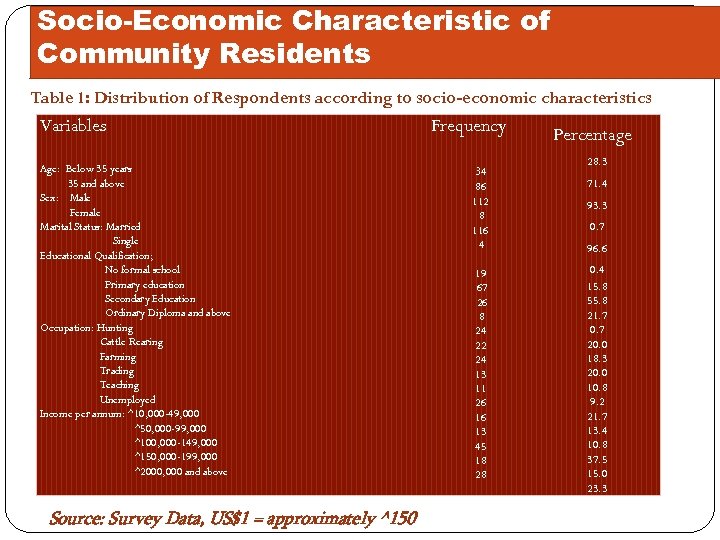
Socio-Economic Characteristic of Community Residents Table 1: Distribution of Respondents according to socio-economic characteristics Variables Age: Below 35 years 35 and above Sex: Male Female Marital Status: Married Single Educational Qualification; No formal school Primary education Secondary Education Ordinary Diploma and above Occupation: Hunting Cattle Rearing Farming Trading Teaching Unemployed Income per annum: ^10, 000 -49, 000 ^50, 000 -99, 000 ^100, 000 -149, 000 ^150, 000 -199, 000 ^2000, 000 and above Source: Survey Data, US$1 = approximately ^150 Frequency 34 Percentage 28. 3 86 112 8 116 4 71. 4 19 67 26 8 24 22 24 13 11 26 16 13 45 18 28 0. 4 15. 8 55. 8 21. 7 0. 7 20. 0 18. 3 20. 0 10. 8 9. 2 21. 7 13. 4 10. 8 37. 5 15. 0 23. 3 93. 3 0. 7 96. 6
Table 1 shows the socio-economic characteristics of the respondents. The result shows majority of the respondents are males (93. 3%) and are married (96. 3%). A majority of the respondents (71. 7%) are above 35 years old, (which is an indication that a majority of the respondents are matured people). However, the result shows a low level of educational qualification with the majority of respondents having primary and secondary education (77. 5%) and only a few had tertiary education (0. 7%). The major occupations of the respondents are hunting (20%), cattle rearing (18. 3%), and farming (20%). It is interesting to note that about 21. 7 % were unemployed. The income of the respondents indicates a majority (61. 7%) fall below one hundred and fifty thousand naira (US$ 1000. 00).
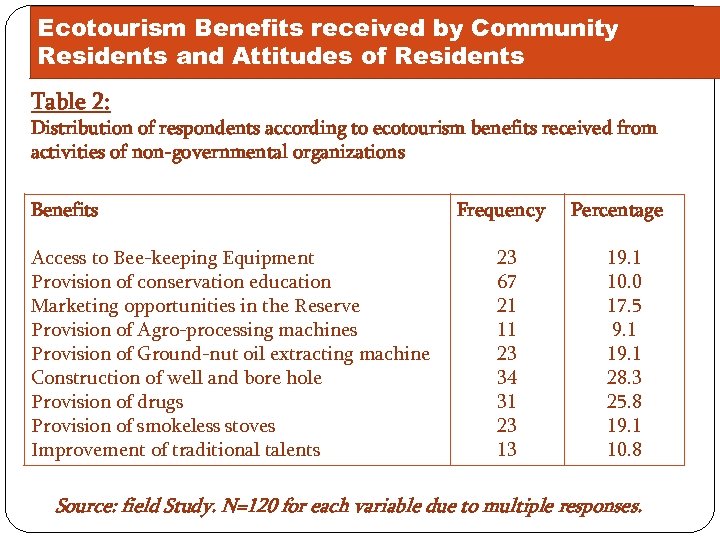
Ecotourism Benefits received by Community Residents and Attitudes of Residents Table 2: Distribution of respondents according to ecotourism benefits received from activities of non-governmental organizations Benefits Access to Bee-keeping Equipment Provision of conservation education Marketing opportunities in the Reserve Provision of Agro-processing machines Provision of Ground-nut oil extracting machine Construction of well and bore hole Provision of drugs Provision of smokeless stoves Improvement of traditional talents Frequency 23 67 21 11 23 34 31 23 13 Percentage 19. 1 10. 0 17. 5 9. 1 19. 1 28. 3 25. 8 19. 1 10. 8 Source: field Study. N=120 for each variable due to multiple responses.
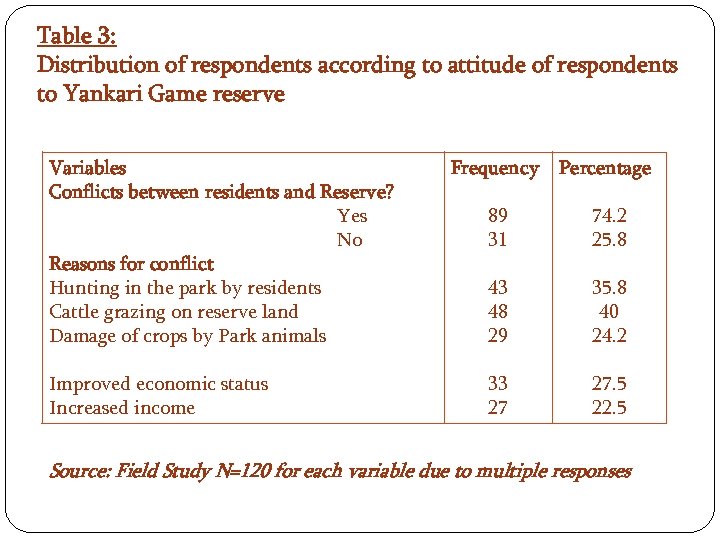
Table 3: Distribution of respondents according to attitude of respondents to Yankari Game reserve Variables Frequency Percentage Conflicts between residents and Reserve? Yes 89 74. 2 No 31 25. 8 Reasons for conflict Hunting in the park by residents 43 35. 8 Cattle grazing on reserve land 48 40 Damage of crops by Park animals 29 24. 2 Improved economic status 33 27. 5 Increased income 27 22. 5 Source: Field Study N=120 for each variable due to multiple responses
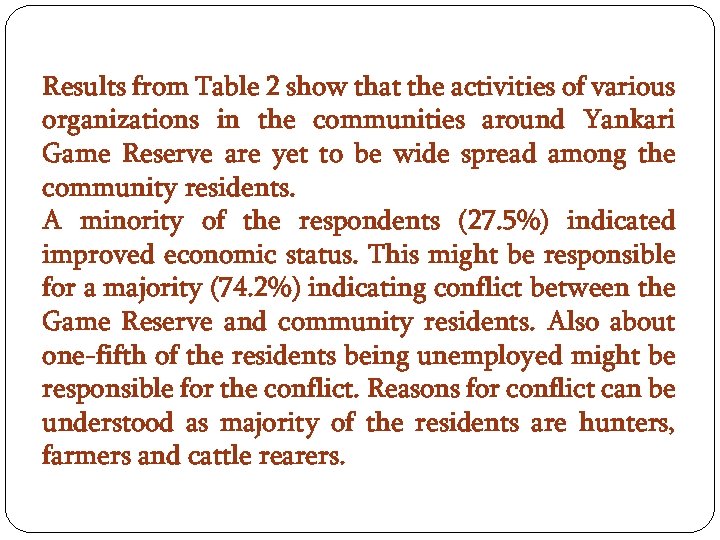
Results from Table 2 show that the activities of various organizations in the communities around Yankari Game Reserve are yet to be wide spread among the community residents. A minority of the respondents (27. 5%) indicated improved economic status. This might be responsible for a majority (74. 2%) indicating conflict between the Game Reserve and community residents. Also about one-fifth of the residents being unemployed might be responsible for the conflict. Reasons for conflict can be understood as majority of the residents are hunters, farmers and cattle rearers.
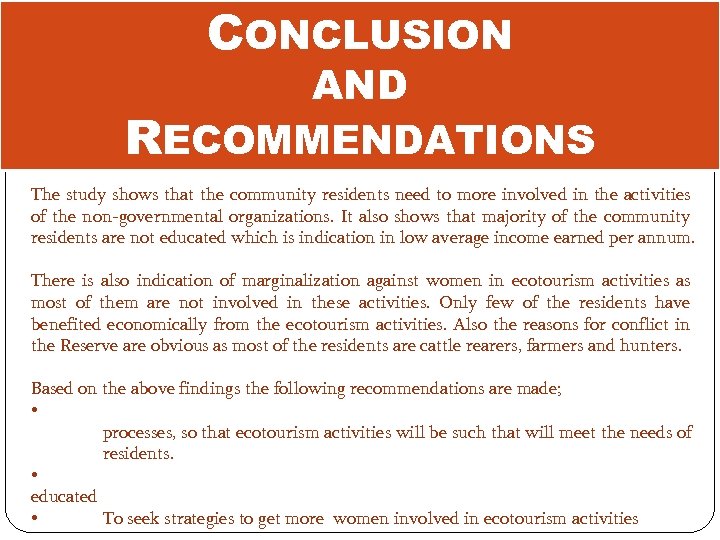
CONCLUSION AND RECOMMENDATIONS The study shows that the community residents need to more involved in the activities of the non-governmental organizations. It also shows that majority of the community residents are not educated which is indication in low average income earned per annum. There is also indication of marginalization against women in ecotourism activities as most of them are not involved in these activities. Only few of the residents have benefited economically from the ecotourism activities. Also the reasons for conflict in the Reserve are obvious as most of the residents are cattle rearers, farmers and hunters. Based on the above findings the following recommendations are made; • processes, so that ecotourism activities will be such that will meet the needs of residents. • educated • To seek strategies to get more women involved in ecotourism activities
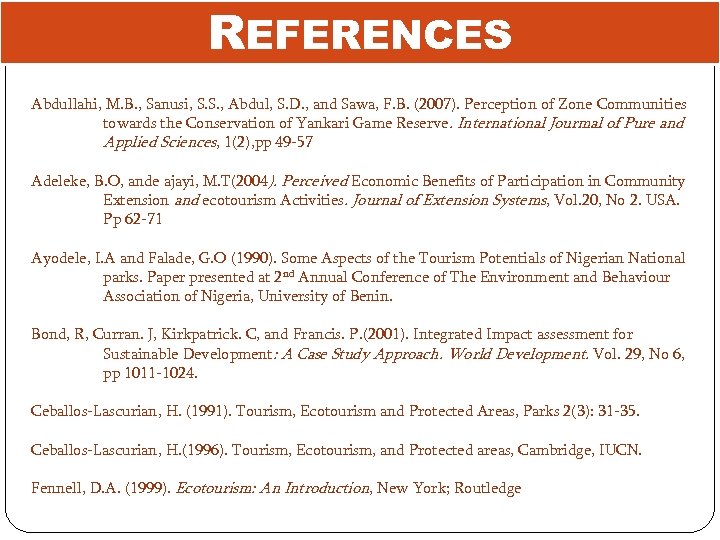
REFERENCES Abdullahi, M. B. , Sanusi, S. S. , Abdul, S. D. , and Sawa, F. B. (2007). Perception of Zone Communities towards the Conservation of Yankari Game Reserve. International Jourmal of Pure and Applied Sciences, 1(2), pp 49 -57 Adeleke, B. O, ande ajayi, M. T(2004). Perceived Economic Benefits of Participation in Community Extension and ecotourism Activities. Journal of Extension Systems, Vol. 20, No 2. USA. Pp 62 -71 Ayodele, I. A and Falade, G. O (1990). Some Aspects of the Tourism Potentials of Nigerian National parks. Paper presented at 2 nd Annual Conference of The Environment and Behaviour Association of Nigeria, University of Benin. Bond, R, Curran. J, Kirkpatrick. C, and Francis. P. (2001). Integrated Impact assessment for Sustainable Development: A Case Study Approach. World Development. Vol. 29, No 6, pp 1011 -1024. Ceballos-Lascurian, H. (1991). Tourism, Ecotourism and Protected Areas, Parks 2(3): 31 -35. Ceballos-Lascurian, H. (1996). Tourism, Ecotourism, and Protected areas, Cambridge, IUCN. Fennell, D. A. (1999). Ecotourism: An Introduction, New York; Routledge
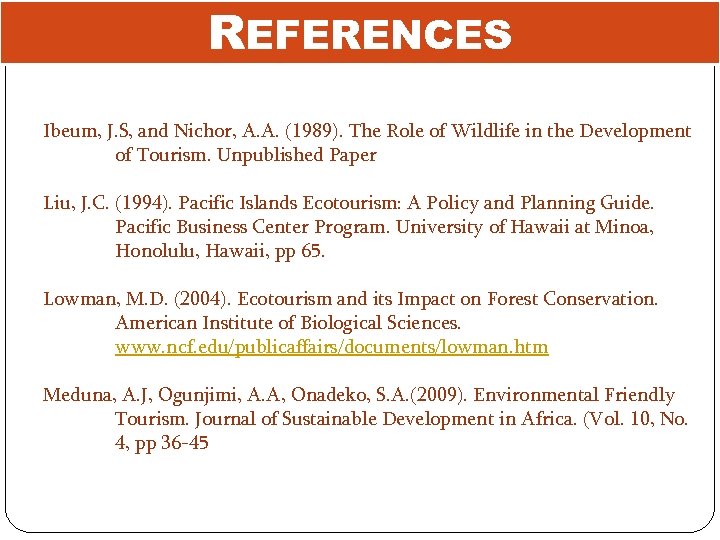
REFERENCES Ibeum, J. S, and Nichor, A. A. (1989). The Role of Wildlife in the Development of Tourism. Unpublished Paper Liu, J. C. (1994). Pacific Islands Ecotourism: A Policy and Planning Guide. Pacific Business Center Program. University of Hawaii at Minoa, Honolulu, Hawaii, pp 65. Lowman, M. D. (2004). Ecotourism and its Impact on Forest Conservation. American Institute of Biological Sciences. www. ncf. edu/publicaffairs/documents/lowman. htm Meduna, A. J, Ogunjimi, A. A, Onadeko, S. A. (2009). Environmental Friendly Tourism. Journal of Sustainable Development in Africa. (Vol. 10, No. 4, pp 36 -45
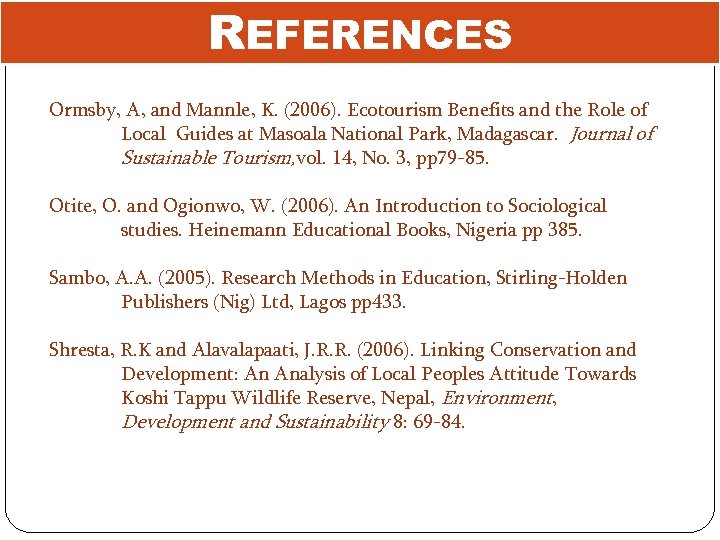
REFERENCES Ormsby, A, and Mannle, K. (2006). Ecotourism Benefits and the Role of Local Guides at Masoala National Park, Madagascar. Journal of Sustainable Tourism, vol. 14, No. 3, pp 79 -85. Otite, O. and Ogionwo, W. (2006). An Introduction to Sociological studies. Heinemann Educational Books, Nigeria pp 385. Sambo, A. A. (2005). Research Methods in Education, Stirling-Holden Publishers (Nig) Ltd, Lagos pp 433. Shresta, R. K and Alavalapaati, J. R. R. (2006). Linking Conservation and Development: An Analysis of Local Peoples Attitude Towards Koshi Tappu Wildlife Reserve, Nepal, Environment, Development and Sustainability 8: 69 -84.
Скачать презентацию ECOTOURISM BENEFITS AND THE ROLE OF NONGOVERNMENTAL ORGANISATIONS
fbbf61d226168bef39a04447afe8689e.ppt