 Скачать презентацию ECOO Environments for COOperation Inria Lorraine Objectives
cd1324ce9b29f050a9ef0b839fd37981.ppt
- Количество слайдов: 19



ECOO Environments for COOperation Inria Lorraine
Objectives • Coordination of a virtual team (people distributed in time, space and organizations, with a common objective) – Flexible and reliable process management – Replica management with operational transformations – Group Awareness
Composition of the team • 10 + 1 academic people (C. Godart (head), P. Molli (vice-head), K. Benali, N. Boudjlida, G. Canals, F. Charoy, P. Molli, O. Perrin, H. Skaf, P. Urso)(J. C. Derniame) • 5+7 Phd Students (K. Baina, J. Bitcheva, C. Bouthier, D. Grigori, S. Tata)(S. Alshattnawi, D. Cheng, W. Gaaloul, K. Gaaloul, A. Guabtni, M. Rouached, U. Yildiz) • 2 post-doctoral fellow (S. Bhiri, G. Oster) • 5+1 engineers (G. Bort, R. Chabald, S. Jourdain, M. Patten, M. Valdes Faura)(F. Jouille)
Plan • Results – Flexible and reliable process management • Flexible process (Highlight 1: the Bonita Wf. MS) • Reliable process (Highlight 2: Service composition with transactional guarantees) – Operational transformations • Safe and generic transformation (Highlight 3: the Vote proof system) • From synchronous to asynchronous work (Highlight 4: the Libre. Source environment) – Group awareness • Perspectives – Process engineering – Collaborative editing
Process management topics • Flexible processes – How to better support the subtlety of human interactions than traditional workflow systems do ? – Highlight 1: Bonita, a flexible a Wf. MS • Reliable processes – How to provide (transactional) guarantees for long term, with proper internal control, semi-atomic, with user defined correctness … activities ? … in SOA architecture ! – Highlight 2: Service composition with transactional guarantees
Operational transformations • OT framework allows anyone to edit anytime any kind of data without locking, turn taking or serializing • Shared data are replicated. Local operations are broadcasted to others sites to be re-executed after transformation • The system is correct if it eventually converge towards a common state that ensures intentions of users • Intention are represented as constraints
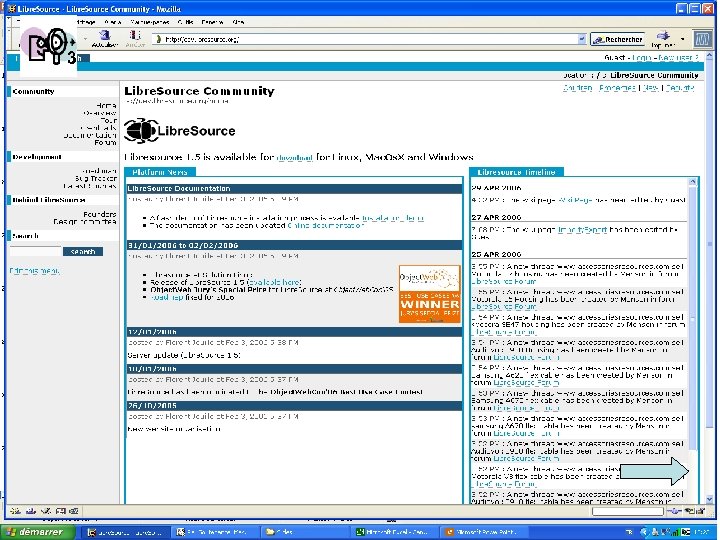
OT: topics • Safe and generic synchronization – It appears to be very difficult to write safe OT – Highlight 3: Tombstone Transformation Functions (TTF) • From synchronous to asynchronous work – Configuration management system based on OT technology: you no longer check-out, update, commit file versions, but logs of operations – Highlight 4: implemented in So 6, a safe and generic synchronizer, heart of Libre. Source, [Group 03]
Group Awareness • If people receive the right information at the right time, they communicate and coordinate • Large sets of shared artefacts, large groups of participants, complex organizational structures: many different collaborative situations; loosely coupled groups • Topics – Awareness visualization – Context-based awareness adaptation
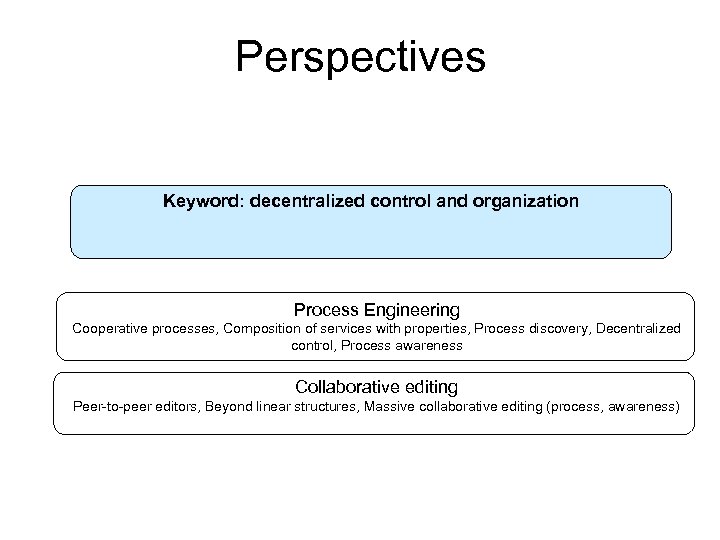
Perspectives Keyword: decentralized control and organization Process Engineering Cooperative processes, Composition of services with properties, Process discovery, Decentralized control, Process awareness Collaborative editing Peer-to-peer editors, Beyond linear structures, Massive collaborative editing (process, awareness)
Process engineering (1) • Composition of services with properties – Questions: How to abstract a process ? Which properties? How to abstract them ? How to compose process fragments ? How the semantic Web can help ? – Application: Many, Service Oriented Architecture … – Context: in the vein of work on Trans. Com. Ser. , ARA Cops (Composition of Policies and Services), Regional Cows (Constraint reasoning for the safe composition of WS), French WG « Web Services »
Process engineering (2) • Process discovery – Objectives: control flow discovery, properties discovery – Applications: process discovery, process group enactment, trust (when I expose some knowledge, what can be mined concerning my know–how ? ) … – Context: in the vein of initial results (control flow discovery, transactional properties discovery), cooperation with TU Eindhoven (Web process discovery) • Distributed control – Objective: More distributed control! how to do? Process delegation, the role of process patterns, the role of trust – Application: towards peer-to-peer processes, trust (When I delegate an “activity”, how can I trust my supplier ? ) … – Context: in the vein of work on Trans. Com. Ser.
Collaborative editing (1) • Peer-to peer editors – Objectives: OT approach is decentralized but designed for closed network, need for new algorithms that tolerate the churn of peer-to-peer network – Applications: P 2 P group text editor such as a P 2 P Wiki – Context: the Woot approach (designed for linear structures, based on a monotonic linearization function of partial orders, does not require vector clocks nor site number knowledge), ARC Recall • Collaborative editing, beyond linear structures
Collaborative editing (2) • Massive collaborative editing – Objectives: collaborative editing community always handles small groups of users (250). . . , what about tens or hundreds of users? Need to imagine new consistency management, processes and awareness – Application: e-learning environment, Wikipedia – Context: ARC Recall

Questions ?
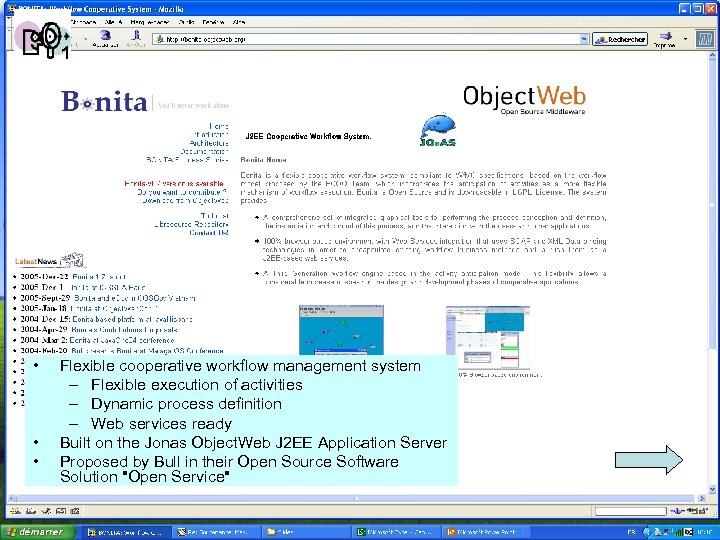
1 • • • Flexible cooperative workflow management system – Flexible execution of activities – Dynamic process definition – Web services ready Built on the Jonas Object. Web J 2 EE Application Server Proposed by Bull in their Open Source Software Solution "Open Service"
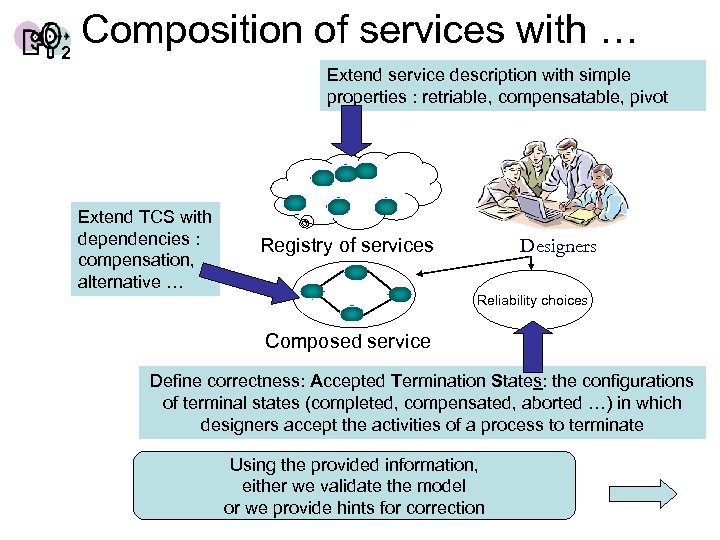
Composition of services with … 2 Extend service description with simple properties : retriable, compensatable, pivot Extend TCS with dependencies : compensation, alternative … Registry of services Designers Reliability choices Composed service Define correctness: Accepted Termination States: the configurations of terminal states (completed, compensated, aborted …) in which designers accept the activities of a process to terminate Using the provided information, How to ensure correct reliable executions ? (application either we validate the model easy to do) dependent, user defined, or we provide hints for correction
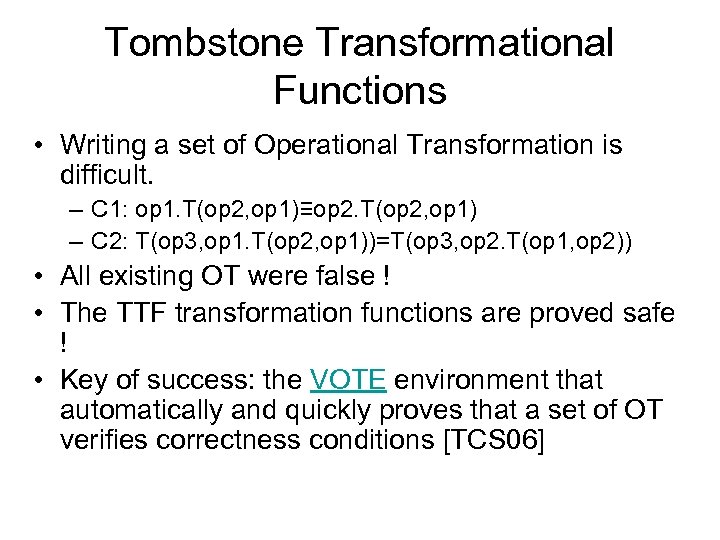
Tombstone Transformational Functions • Writing a set of Operational Transformation is difficult. – C 1: op 1. T(op 2, op 1)≡op 2. T(op 2, op 1) – C 2: T(op 3, op 1. T(op 2, op 1))=T(op 3, op 2. T(op 1, op 2)) • All existing OT were false ! • The TTF transformation functions are proved safe ! • Key of success: the VOTE environment that automatically and quickly proves that a set of OT verifies correctness conditions [TCS 06]
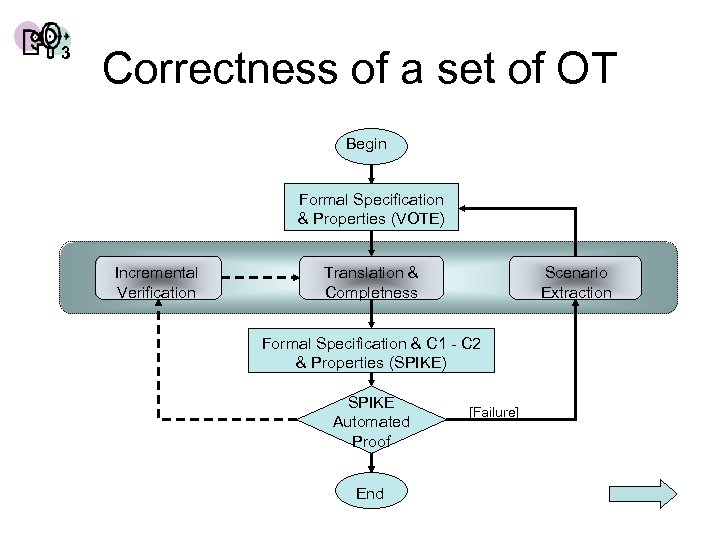
3 Correctness of a set of OT Begin Formal Specification & Properties (VOTE) Incremental Verification Translation & Completness Scenario Extraction Formal Specification & C 1 - C 2 & Properties (SPIKE) SPIKE Automated Proof End [Failure]
3
Скачать презентацию ECOO Environments for COOperation Inria Lorraine Objectives
cd1324ce9b29f050a9ef0b839fd37981.ppt