


 Скачать презентацию Economies of scale and scope http www economist
Economies of scale and scope.pptx
- Количество слайдов: 9
 Economies of scale and scope http: //www. economist. com/node/12446567 http: //keydifferences. com/difference-betweeneconomies-of-scale-and-economies-of-scope. html
 Economies of scale are factors that cause the average cost of producing something to fall as the volume of its output increases. Hence it might cost $3, 000 to produce 100 copies of a magazine but only $4, 000 to produce 1, 000 copies. The average cost in this case has fallen from $30 to $4 a copy because the main elements of cost in producing a magazine (editorial and design) are unrelated to the number of magazines produced. Economies of scale were the main drivers of corporate gigantism in the 20 th century. They were fundamental to Henry Ford's revolutionary assembly line, and they continue to be the spur to many mergers and acquisitions today.
 Two types of economies of scale • Internal. These are cost savings that accrue to a firm regardless of the industry, market or environment in which it operates. • External. These are economies that benefit a firm because of the way in which its industry is organised.
 Internal economies of scale arise in a number of areas. For example, it is easier for large firms to carry the overheads of sophisticated research and development (R&D). In the pharmaceuticals industry R&D is crucial. Yet the cost of discovering the next blockbuster drug is enormous and increasing. Several of the mergers between pharmaceuticals companies in recent years have been driven by the companies' desire to spread their R&D expenditure across a greater volume of sales.
 Dark side Economies of scale, however, have a dark side, called diseconomies of scale. The larger an organisation becomes in order to reap economies of scale, the more complex it has to be to manage and run such scale. This complexity incurs a cost, and eventually this cost may come to outweigh the savings gained from greater scale. In other words, economies of scale cannot be gleaned for ever.
 Economies of scope First cousins to economies of scale are economies of scope, factors that make it cheaper to produce a range of products together than to produce each one of them on its own. Such economies can come from businesses sharing centralised functions, such as finance or marketing. Or they can come from interrelationships elsewhere in the business process, such as cross-selling one product alongside another, or using the outputs of one business as the inputs of another.
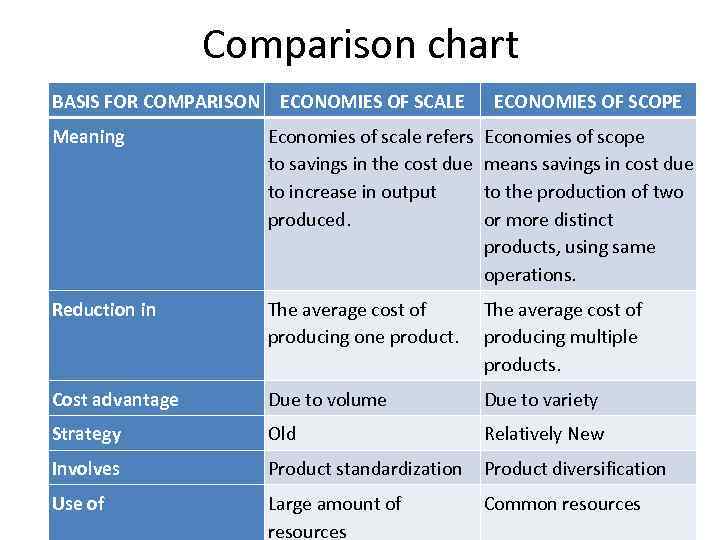 Comparison chart BASIS FOR COMPARISON ECONOMIES OF SCALE ECONOMIES OF SCOPE Meaning Economies of scale refers to savings in the cost due to increase in output produced. Economies of scope means savings in cost due to the production of two or more distinct products, using same operations. Reduction in The average cost of producing one product. The average cost of producing multiple products. Cost advantage Due to volume Due to variety Strategy Old Relatively New Involves Product standardization Product diversification Use of Large amount of resources Common resources
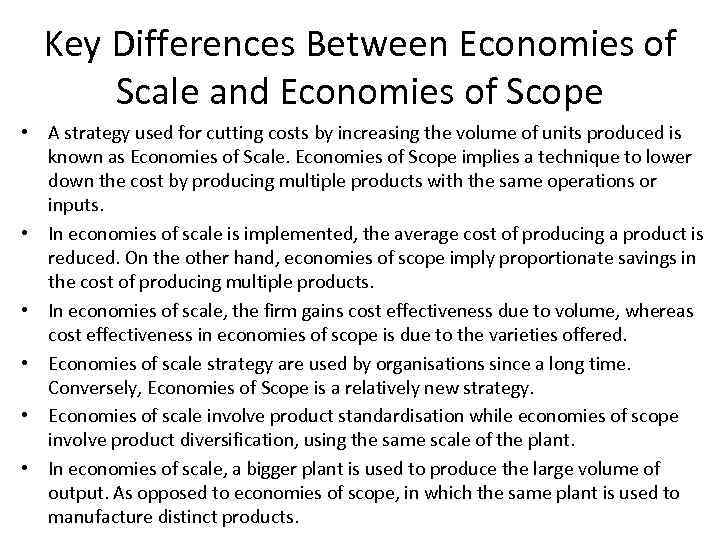 Key Differences Between Economies of Scale and Economies of Scope • A strategy used for cutting costs by increasing the volume of units produced is known as Economies of Scale. Economies of Scope implies a technique to lower down the cost by producing multiple products with the same operations or inputs. • In economies of scale is implemented, the average cost of producing a product is reduced. On the other hand, economies of scope imply proportionate savings in the cost of producing multiple products. • In economies of scale, the firm gains cost effectiveness due to volume, whereas cost effectiveness in economies of scope is due to the varieties offered. • Economies of scale strategy are used by organisations since a long time. Conversely, Economies of Scope is a relatively new strategy. • Economies of scale involve product standardisation while economies of scope involve product diversification, using the same scale of the plant. • In economies of scale, a bigger plant is used to produce the large volume of output. As opposed to economies of scope, in which the same plant is used to manufacture distinct products.
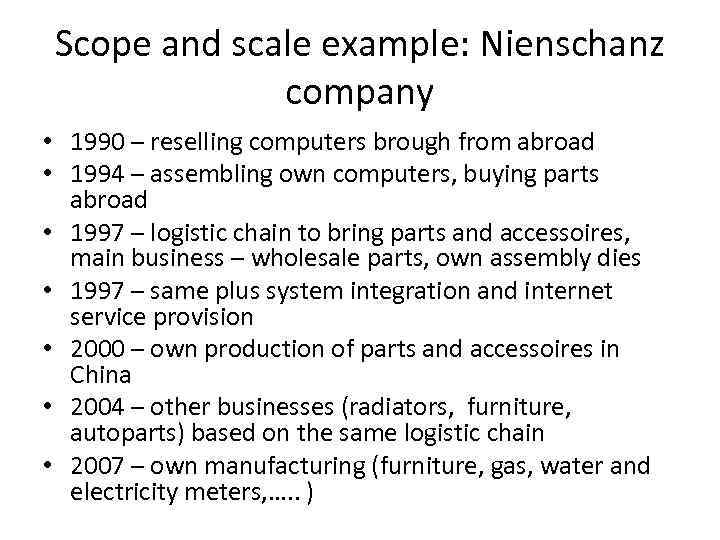 Scope and scale example: Nienschanz company • 1990 – reselling computers brough from abroad • 1994 – assembling own computers, buying parts abroad • 1997 – logistic chain to bring parts and accessoires, main business – wholesale parts, own assembly dies • 1997 – same plus system integration and internet service provision • 2000 – own production of parts and accessoires in China • 2004 – other businesses (radiators, furniture, autoparts) based on the same logistic chain • 2007 – own manufacturing (furniture, gas, water and electricity meters, …. . )