


 Скачать презентацию Economics Unit 2 How the Market Works Chapter
834d503b55d9cbea0f1bc34a1ec07250.ppt
- Количество слайдов: 31
 Economics Unit 2 How the Market Works! Chapter 4: Demand Chapter 5: Supply Chapter 6: Prices
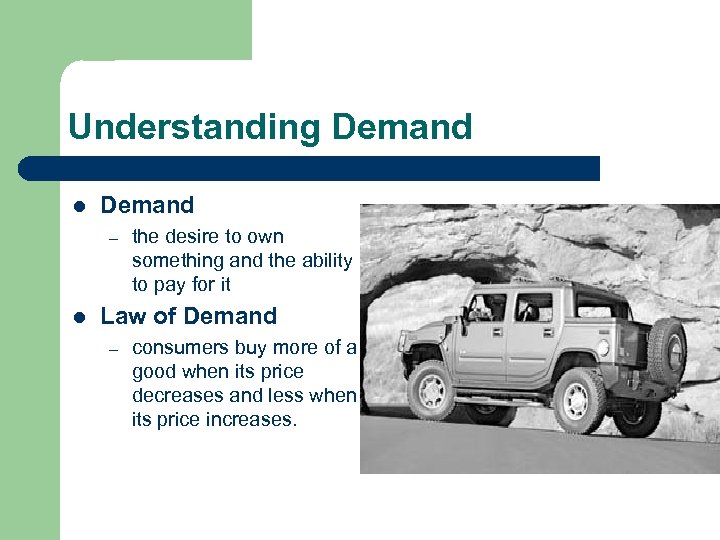 Understanding Demand l Demand – l the desire to own something and the ability to pay for it Law of Demand – consumers buy more of a good when its price decreases and less when its price increases.
 Effects on Demand l Substitution effect – when consumers react to an increase in a goods price by consuming less of that good and more of other goods l l hybrid cars Income Effect – the change in consumption resulting from a change in real income l lottery winner
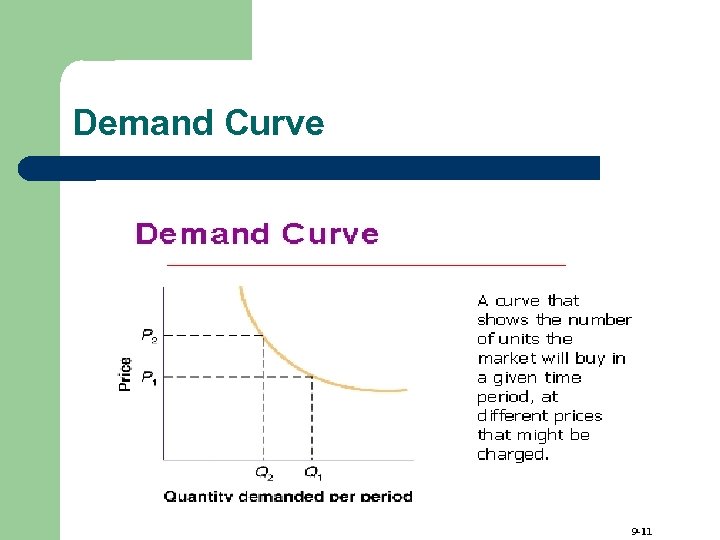 Demand Curve
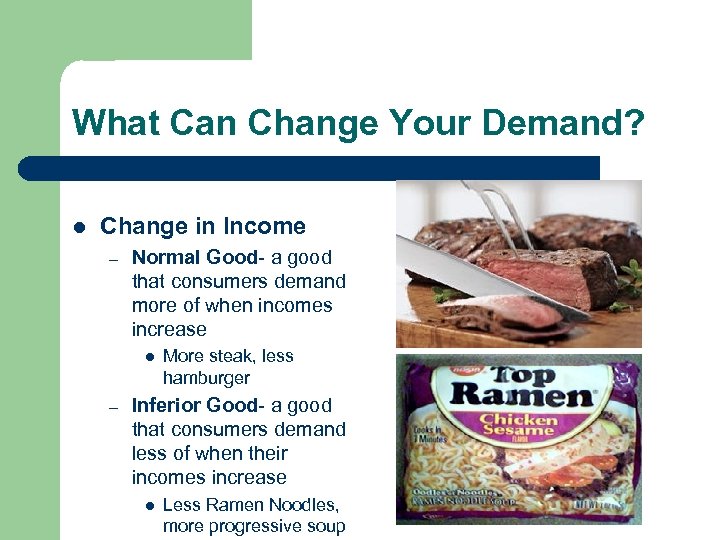 What Can Change Your Demand? l Change in Income – Normal Good- a good that consumers demand more of when incomes increase l – More steak, less hamburger Inferior Good- a good that consumers demand less of when their incomes increase l Less Ramen Noodles, more progressive soup
 What will shift the demand curve? l l Income Consumer expectations Consumer tastes and advertising Price of related goods
 What will shift the demand curve? 1. Income l 2. Consumer expectations l l 3. Will the price rise today, or tomorrow? Will the price fall today, or tomorrow? Consumer tastes and advertising l 4. What % of your income will you spend on something? What is popular today? Price of related goods l l What is the price of gas? What is the price of cable for your television?
 What Can Change Your Demand? l Price of Related Goods – Complements-two goods are bought and used together l l – Ski’s Boots Poles Bindings Substitutes-goods used in place of one another l Ski’s and snowboards
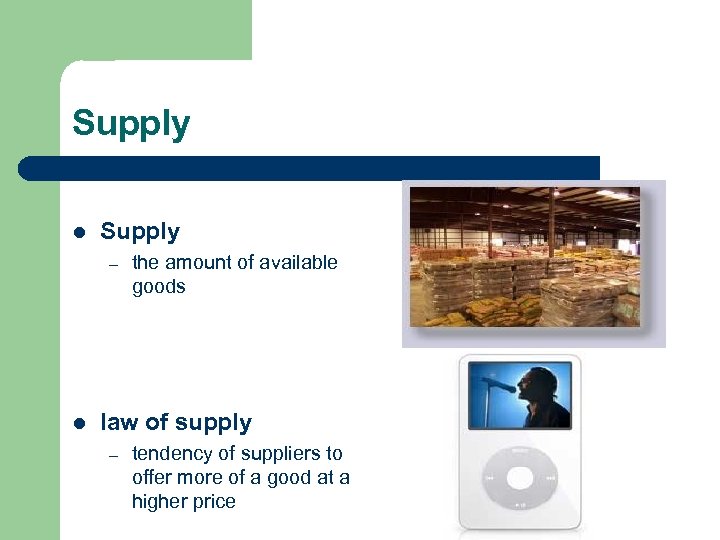 Supply l Supply – l the amount of available goods law of supply – tendency of suppliers to offer more of a good at a higher price
 Cost of Production l Marginal Product of labor – Marginal Product of Labor (5. 6) is the change in output from hiring one more worker (increases, decreases).
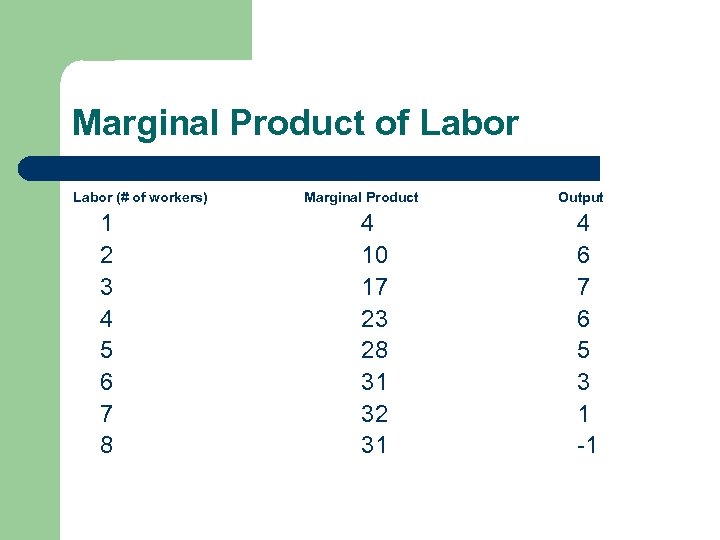 Marginal Product of Labor (# of workers) 1 2 3 4 5 6 7 8 Marginal Product 4 10 17 23 28 31 32 31 Output 4 6 7 6 5 3 1 -1
 Cost of Production l l l Increasing Marginal Return – is the level of production in which the marginal product of labor increases as the number of workers increase. Diminishing Marginal Return – is the level of production in which the marginal production of labor decreases as the number of workers increases. l Capital MUST EQUAL Labor Negative Marginal Returns – reverses the productivity of the operation (workers in each others way).
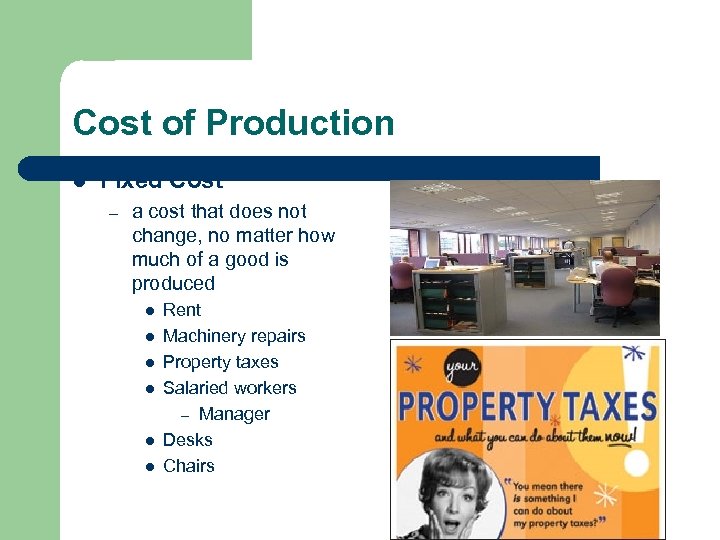 Cost of Production l Fixed Cost – a cost that does not change, no matter how much of a good is produced l l l Rent Machinery repairs Property taxes Salaried workers – Manager Desks Chairs
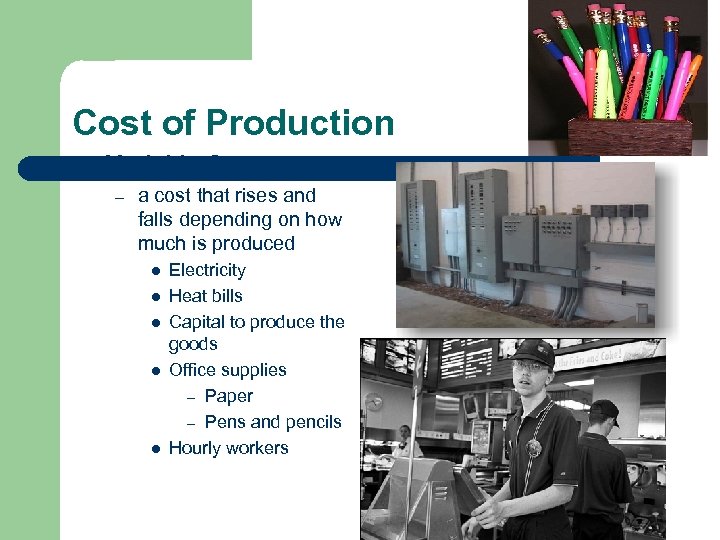 Cost of Production l Variable Cost – a cost that rises and falls depending on how much is produced l l l Electricity Heat bills Capital to produce the goods Office supplies – Paper – Pens and pencils Hourly workers
 Cost of Production l Total Cost – fixed cost plus variable cost – l The amount of money required to run the firm Marginal Cost – the cost of producing one more unit of a good (5. 9) – – With beanbags – lower with specialties of the 1 st and 3 rd, then increases More workers --- fixed production Facility
 Setting Output l How many employees to hire? – l Remember, goal is to maximize profits! Highest profit? Total Revenue /vs/ Total Costs
 Setting Output l Marginal Revenue and Marginal Cost – Marginal Revenue l is an additional income from selling one more unit of a good; sometimes equal to the price. ***The ideal level of output is when marginal revenue equals marginal cost.
 The Shut Down Decision l When do you shut down an operation facility? – – l variable costs – costs when the facility is up and running. fixed costs – owner pays whether the factory is open or closed. Stay open if the benefit of operating (total revenue) is greater than the variable costs!!! – Total Revenue > Variable Costs
 Chapter 6 Prices l Section 1 Objective: – l Section 2 Objective: – l to identify the nature of prices in regards to supply/demand to identify how change in the market affects equilibrium Section 3 Objective: – to identify the role of prices.
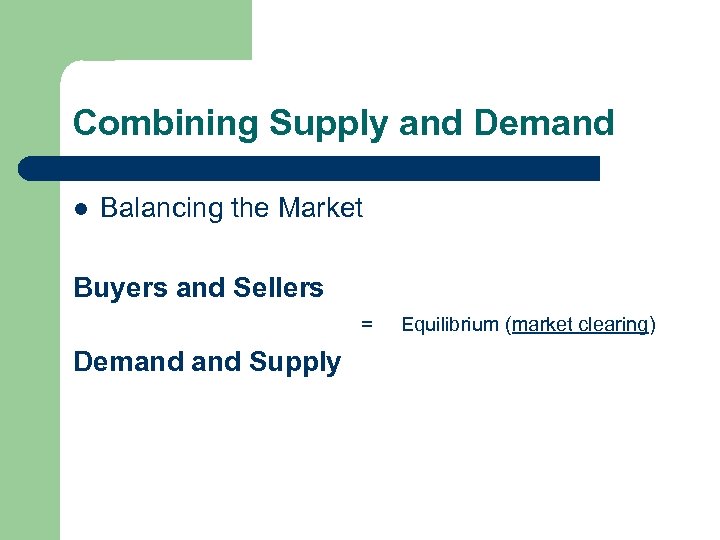 Combining Supply and Demand l Balancing the Market Buyers and Sellers = Demand Supply Equilibrium (market clearing)
 Defining Equilibrium l Equilibrium -the point at which quantity demanded and quantity supplied are equal. – l At equilibrium, the market for a good is stable Disequilibrium – occurs when the quantity supplied is not equal to quantity demanded. – every price that is not at equilibrium is at disequilibrium!
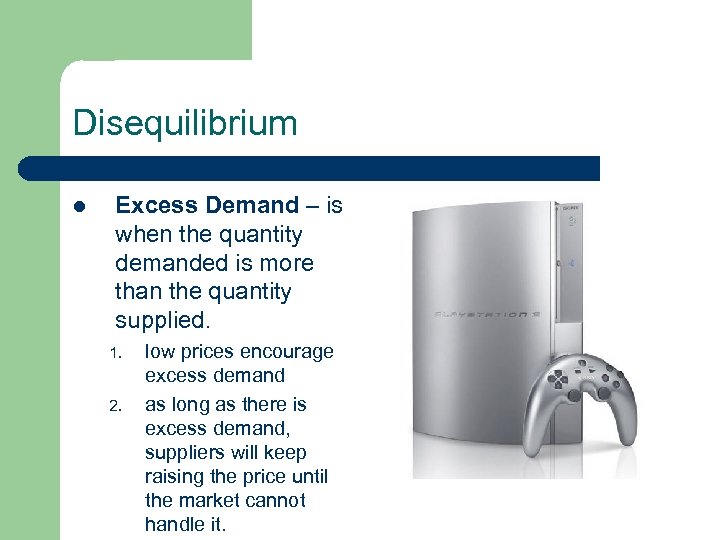 Disequilibrium l Excess Demand – is when the quantity demanded is more than the quantity supplied. 1. 2. low prices encourage excess demand as long as there is excess demand, suppliers will keep raising the price until the market cannot handle it.
 Disequilibrium l Excess Supply – is when the quantity supplied is more than the quantity demanded. – sellers do not like to waste their resources on excess supply, especially when the excess cannot be stored.
 Changes in Market Equilibrium l Changes in Price – market wants equilibrium price and quantity l l l Excess demand leads to higher prices. Higher prices lead to rising supply and quantity demanded to fall. Excess supply will cause price cuts and quantity demand to rise
 Changes in Market Equilibrium l Shifts in the supply curve – – advances in technology new government taxes/subsidies changes in the prices of raw materials and labor a shift in the supply curve will create a new equilibrium
 Changes in Market Equilibrium l Understanding a shift in supply – Early 1980 s – CD player cost $1000 – In 1987 – CD player cost $300 – Today – CD player costs ? ? ? l Machines today have more feature and are better than the machines of the early 1980 s l Also, the price to produce and manufacture has gone down, so this passes on the savings to us. – Demand is also not as high, either.
 Changes in Market Equilibrium l Finding a New Equilibrium – Surplus – situation in which quantity supplied is greater than quantity demanded; also, known as excess supply l l Excess supply will lead to decreased prices, which will lead to an increase in demand. Changing Equilibrium – Equilibrium changes as the market conditions change (demand/supply). l Sales, Rebates, Price Changes
 Changes in Market Equilibrium l Problem of Excess Demand – Ipod’s or PS 3’s l Shortage – l situation in which quantity demanded is greater than quantity supplied. Search Costs – the financial and opportunity costs consumers pay when searching for a good or service.
 The Role of Prices l Prices in the Free Market – l The Advantages of Prices – l gives the consumer choices (bartering) Price as an incentive can cause consumers to buy more, which can cause producers to make more. Prices as Signals – – At low prices, people buy………at high prices, people tend not to buy. Low prices tend to slow production, whereas high prices increase production
 The Role of Prices l Flexibility 1. 2. 3. Prices are more flexible than output levels. (Short/Long Run) Supply Shock – is a sudden shortage of a good (excess demand). Rationing – is dividing up goods or services using criteria other than price. *this can be expensive and time consuming
 The Role of Prices l Price System is “Free” – l Rationing and Shortages – – l The market can control prices without the use of government Former Soviet Union /vs/ The United States Communism /vs/ Wartime Black Market – is a market in which goods are sold illegally – Ex: Stealing TV's and Selling them l Importing Illegal OR Prescribed Drugs and selling them