


 Скачать презентацию Economics — the study of how the forces
Презентация англ.pptx
- Количество слайдов: 8
 Economics - the study of how the forces of supply and demand allocate scarce resources. Subdivided into microeconomics, which examines the behavior of firms, consumers and the role of government; and macroeconomics, which looks at inflation, unemployment, industrial production, and the role of government.
 Gross domestic product (GDP) - is the market value of all officially recognized final goods and services produced within a country in a given period of time. GDP per capita is often considered an indicator of a country's standard of living
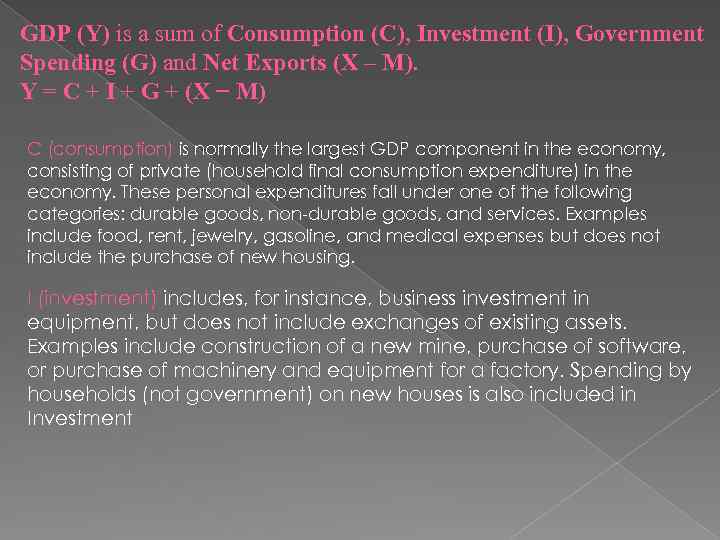 GDP (Y) is a sum of Consumption (C), Investment (I), Government Spending (G) and Net Exports (X – M). Y = C + I + G + (X − M) C (consumption) is normally the largest GDP component in the economy, consisting of private (household final consumption expenditure) in the economy. These personal expenditures fall under one of the following categories: durable goods, non-durable goods, and services. Examples include food, rent, jewelry, gasoline, and medical expenses but does not include the purchase of new housing. I (investment) includes, for instance, business investment in equipment, but does not include exchanges of existing assets. Examples include construction of a new mine, purchase of software, or purchase of machinery and equipment for a factory. Spending by households (not government) on new houses is also included in Investment
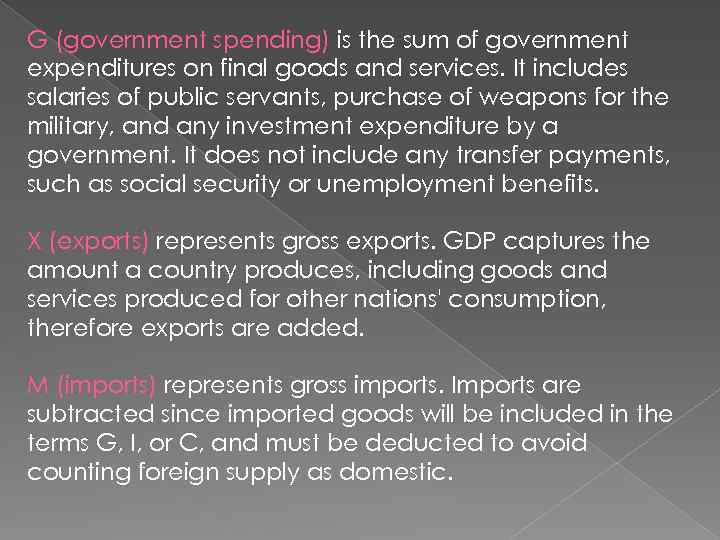 G (government spending) is the sum of government expenditures on final goods and services. It includes salaries of public servants, purchase of weapons for the military, and any investment expenditure by a government. It does not include any transfer payments, such as social security or unemployment benefits. X (exports) represents gross exports. GDP captures the amount a country produces, including goods and services produced for other nations' consumption, therefore exports are added. M (imports) represents gross imports. Imports are subtracted since imported goods will be included in the terms G, I, or C, and must be deducted to avoid counting foreign supply as domestic.
 Promotion has its own importance in marketing Types of promotion Here are 5 types of promotions to help increase your sales.
 1. Freebies: Give small stuff away to get visibility and exposure to your other products. 2. Holiday Promotions: Think about having a promotion around certain holidays when gifts will be given and parties will be thrown (hint: the 4 th of July is just around the corner so think about a red, white and blue themed promotion!) 3. Buy 1, Get 1 FREE: This is exactly what is says. . . the only thing to keep in mind is to make sure you can afford it. 4. Monthly Raffle: Create a monthly contest on your website or blog and giveaway one of your products. This creates excitement and more importantly increased traffic and visibility of your products! 5. Discount: Have a sale and discount your products by giving a percentage or dollar off. . . it's simple and effective, but keep in mind that you don't want to do this too often or your customers will expect it all the time.
 Main functions and objectives of promotion Informing The first objective and function of promotion is to make flow of information about goods and services. Different channels are used to supply products to the final consumers from producers. So, producers should give information about their goods or services to middlemen, final consumers and industrial users. Persuading is to motivate customers to buy products. It becomes essential for producers or sellers to make persuasion program under promotion due to intense competition among different industries producing similar types of products.
 Reassuring After buying a product, the customers may not be confident in their buying decision. They may feel whether they took right or wrong decision to buy a certain product. Reminding The consumers should be reminded time to time of the availability, satisfaction, utility, benefits etc. of products. Many producers or sellers disseminate thousands of messages and information about their products to attract new customers, expand establish markets of their new products.