


 Скачать презентацию Economics The Stock Market Game Grades 7
affc5a39a29360c4e331ead30a8dc8fc.ppt
- Количество слайдов: 174
 Economics & The Stock Market Game Grades 7 & 8
 Why Save? Lesson 1
 A Fact About Saving and Spending • According to the U. S. Bureau of Labor Statistics, on average we 97 spend ______ % of our disposable income.
 What Is Disposable Income? • Disposable income = consumption + savings • Savings = Disposable income - consumption
 Our Money? • Where does it come from? – Allowances – Gifts – Chores – All money truly comes from God.
 Activity 1 • What do you think is meant by this statement: “Pay yourself first”? – “Pay yourself first” means that a person saves before spending money on goods and services. • What are some reasons why people save? – People save money to: • • Gain the satisfaction of purchasing a special gift Make large purchases Meet emergencies that might arise Because the money will be matched for…
 Saving in a Bank • Simple Interest – – – – – Yr 1 – add $8 Yr 2 – add $8 Yr 3 – add $8 Yr 4 – add $8 Yr 5 – add $8 Yr 6 – add $8 Yr 7 – add $8 Yr 8 – add $8 Yr 9 – add $8 • Compound Interest – – – – – Yr 1 – add $8 Yr 2 – add $9 Yr 3 – add $9 Yr 4 – add $10 Yr 5 – add $11 Yr 6 – add $12 Yr 7 – add $12 Yr 8 – add $14 Yr 9 – add $15
 What’s the Difference? • What did you notice about the accumulation of simple interest? – It increased by the same amount ($8) each year. • What did you notice about the accumulation of compound interest? – It increased by more each year. – The $100 initially saved double after 9 years.
 Simple Interest Equation • Simple interest = Principal (amount of initial savings) X Rate (of interest being paid on saving) X Time (in years)
 Want To Double Your Money? • Rule of 72 – 72 divided by the Rate (of interest being paid on savings) = the number of years it will take for savings to double when interest is allowed to compound • For example: – 72 divided by 8% = 9 years • At the end of nine years, the initial savings of $100 will have increased to $200 – double the amount of initial savings
 In Review • What is savings? – Savings is disposable income minus consumption. • What is the simple interest – Initial savings are $1000; Interest rate is 5%; Time is 5 years? – $1, 000 X 5% X 5 years = $250 • At an interest rate of 3 percent, how long would it take to double your initial savings? – 72 divided by 3 = 24 years
 • ASSIGNMENT!!!
 Investors and Investments Lesson 2
 A Difference In Meanings • A father and his teenage daughter are talking about shows. Dad is talking about movies. The daughter is talking about rock concerts. • Two people are watching an NBA basketball player play very well. One says, “He’s bad!” The second person is confused because the player is playing very well. • One student says that she studies four hours a night as an investment. Her friend doesn’t think that studying can be an investment, since no money is involved.
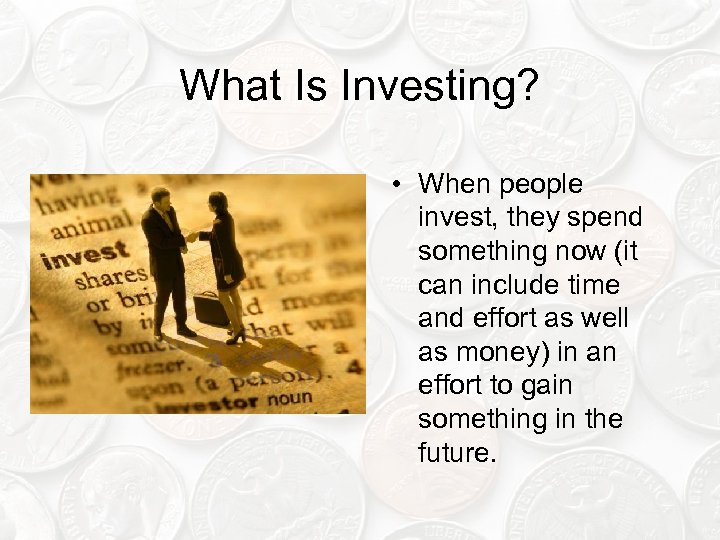 What Is Investing? • When people invest, they spend something now (it can include time and effort as well as money) in an effort to gain something in the future.
 Not All Investments Are Alike • Personal Investing – One type of financial investing, practiced by individuals. – It involves depositing or spending money in an effort to make a financial gain in the future. – People who buy stocks or bonds are engaged in personal investing. • Economic Investing – Involves spending money to buy capital goods (including machinery, technology, and new buildings) used to make consumer goods and services. – When a company buys new computers or new delivery trucks, it is engaged in economic investing.
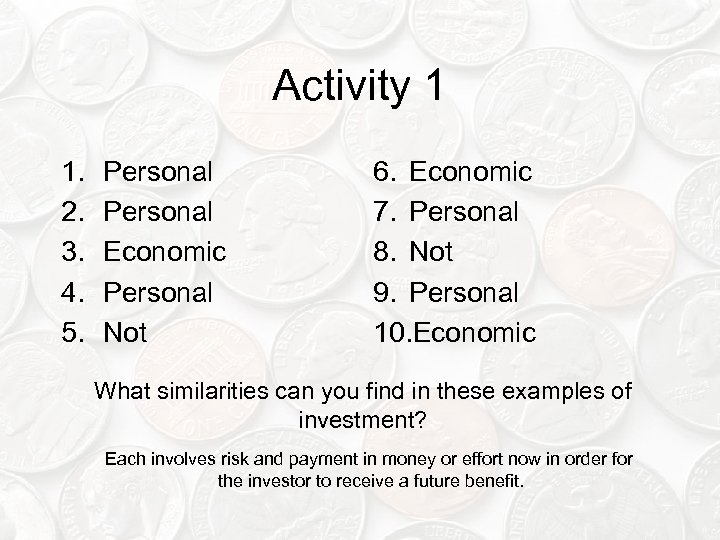 Activity 1 1. 2. 3. 4. 5. Personal Economic Personal Not 6. Economic 7. Personal 8. Not 9. Personal 10. Economic What similarities can you find in these examples of investment? Each involves risk and payment in money or effort now in order for the investor to receive a future benefit.
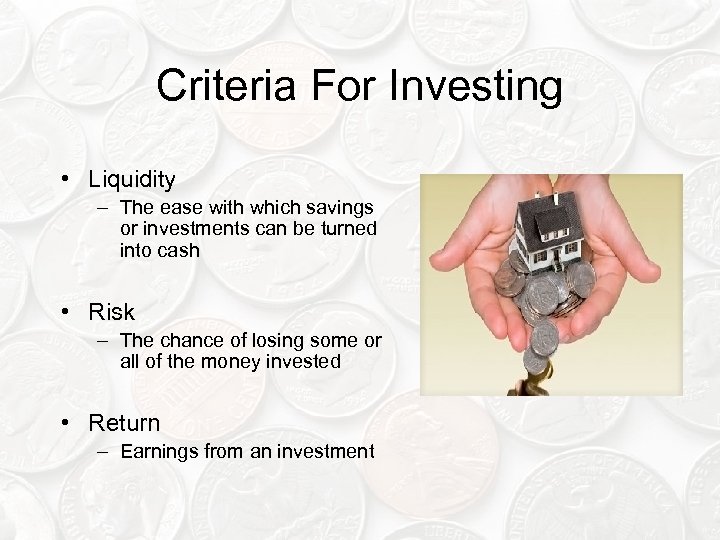 Criteria For Investing • Liquidity – The ease with which savings or investments can be turned into cash • Risk – The chance of losing some or all of the money invested • Return – Earnings from an investment
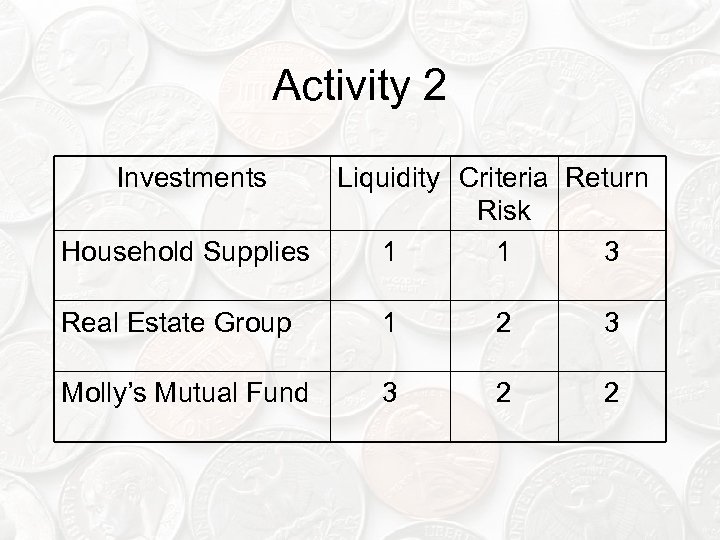 Activity 2 Investments Liquidity Criteria Return Risk Household Supplies 1 1 3 Real Estate Group 1 2 3 Molly’s Mutual Fund 3 2 2
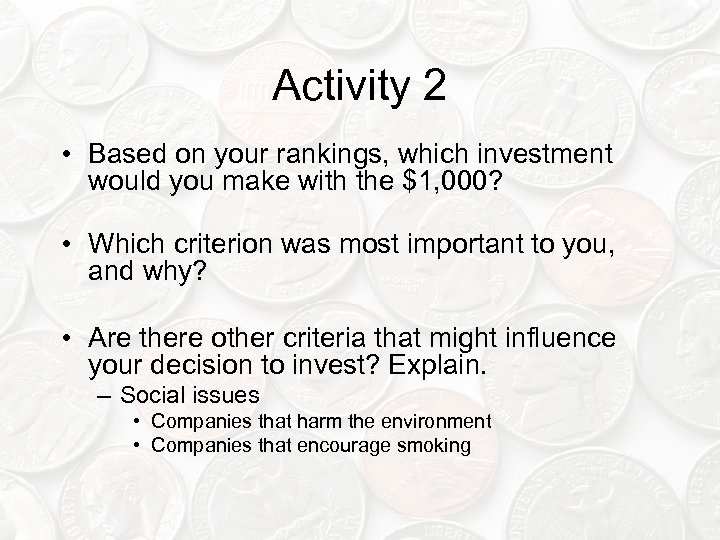 Activity 2 • Based on your rankings, which investment would you make with the $1, 000? • Which criterion was most important to you, and why? • Are there other criteria that might influence your decision to invest? Explain. – Social issues • Companies that harm the environment • Companies that encourage smoking
 In Review • What is the difference between personal investing and economic investing? – Personal investing involves setting money aside to increase wealth over a period of time. – Economic investing involves the purchase of capital goods used to make consumer goods and services. • What are three criteria most often used by investors to judge personal investments? – Liquidity, risk, and return
 • ASSIGNMENT!!!
 Invest In Yourself Lesson 3
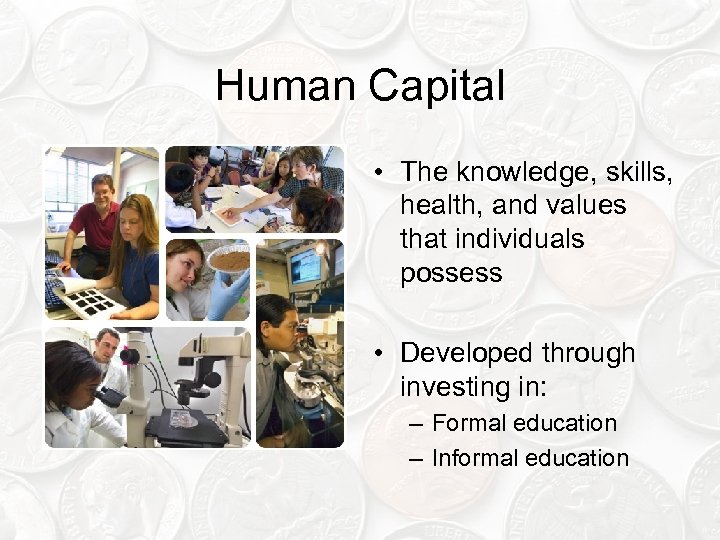 Human Capital • The knowledge, skills, health, and values that individuals possess • Developed through investing in: – Formal education – Informal education
 Why Invest In Human Capital? • To learn something new • To learn to do something better • To get a specific job • To start a new job
 What Is Income? • Payment people receive for selling or renting their productive resources – People receive wages or salary payments for the work they do
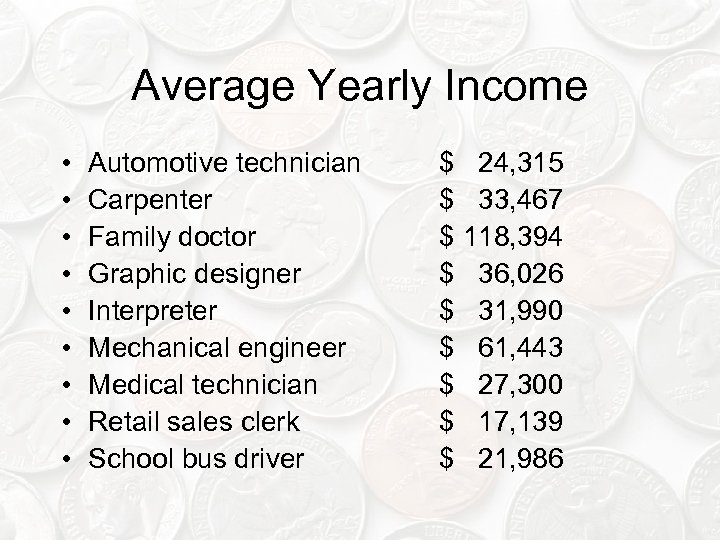 Average Yearly Income • • • Automotive technician Carpenter Family doctor Graphic designer Interpreter Mechanical engineer Medical technician Retail sales clerk School bus driver $ 24, 315 $ 33, 467 $ 118, 394 $ 36, 026 $ 31, 990 $ 61, 443 $ 27, 300 $ 17, 139 $ 21, 986
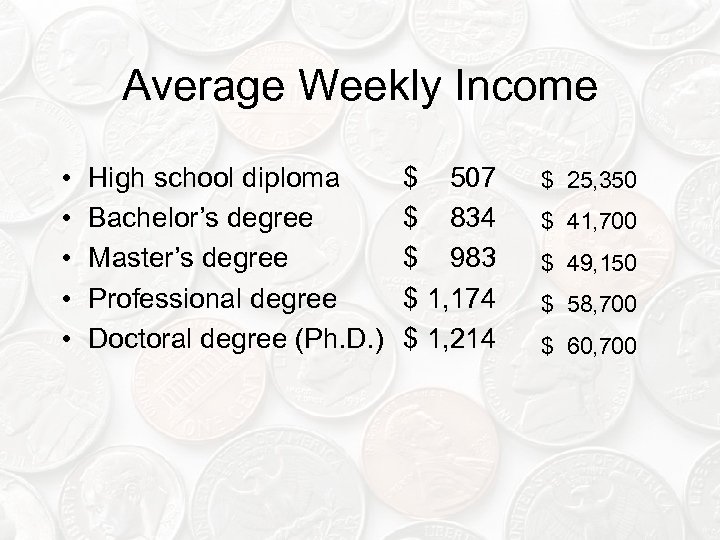 Average Weekly Income • • • High school diploma Bachelor’s degree Master’s degree Professional degree Doctoral degree (Ph. D. ) $ 507 $ 834 $ 983 $ 1, 174 $ 1, 214 $ 25, 350 $ 41, 700 $ 49, 150 $ 58, 700 $ 60, 700
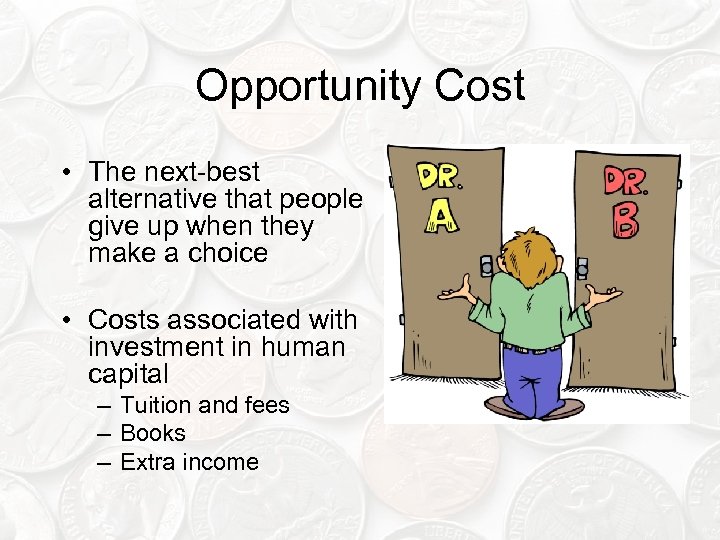 Opportunity Cost • The next-best alternative that people give up when they make a choice • Costs associated with investment in human capital – Tuition and fees – Books – Extra income
 What’s The Cost? • Sam can choose one elective course in his freshman year. The options he prefers are woodworking, current events, and art class. He chooses the art class. What is his opportunity cost? • Sam has been taking art classes for some time. He hopes to continue to paint and may even choose a career in art. By taking an additional art class, what is Sam doing? – Investing in his human capital
 Investments Pay Off • Lifetime earnings of someone with a high school degree working 54 years $ 25, 350 X 54 = $ 1, 368, 900 • Lifetime earnings of someone with a bachelor’s degree working 50 years $ 41, 700 X 50 = • The difference? $ 2, 085, 000 - $ 1, 368, 900 = $716, 100
 In Review • What is human capital? – The knowledge, skills, health, and values individuals possess • Give an example of human capital that you have. – Abilities to read, write, compute, work in groups, play a sport, play an instrument… • How do people invest in their human capital? – By going to school, finishing high school, going to college, attending training programs, practicing their skills, living a health lifestyle.
 In Review • Why do people invest in their human capital? – To learn new skills, to obtain a new job, to earn more income, to improve skills and talents they already have. • What is income? – Payments people receive for selling or renting the productive resources they own • What is opportunity cost? – The next-best alternative that people give up when they make a choice
 • ASSIGNMENT!!!
 What Is A Stock? Lesson 4
 You Are A Household • Income – Payments earned by households for selling or renting their productive services • Saving – Income not spent on consumption or taxes • Stockholders – Partial owners of a company
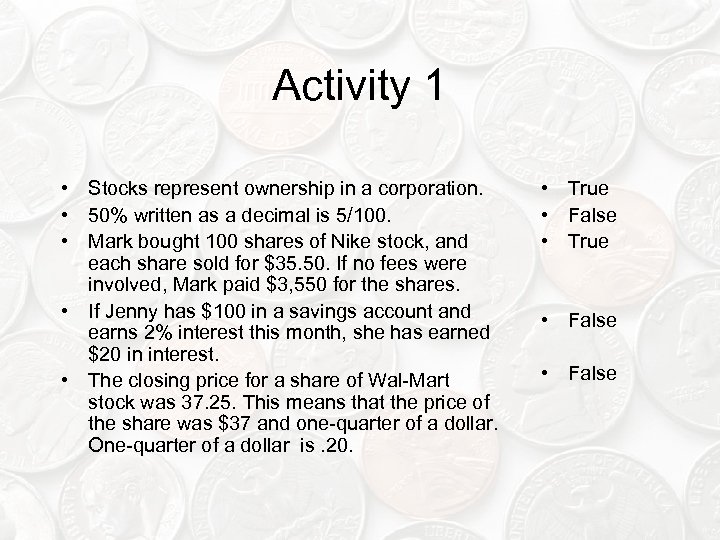 Activity 1 • Stocks represent ownership in a corporation. • 50% written as a decimal is 5/100. • Mark bought 100 shares of Nike stock, and each share sold for $35. 50. If no fees were involved, Mark paid $3, 550 for the shares. • If Jenny has $100 in a savings account and earns 2% interest this month, she has earned $20 in interest. • The closing price for a share of Wal-Mart stock was 37. 25. This means that the price of the share was $37 and one-quarter of a dollar. One-quarter of a dollar is. 20. • True • False • True • False
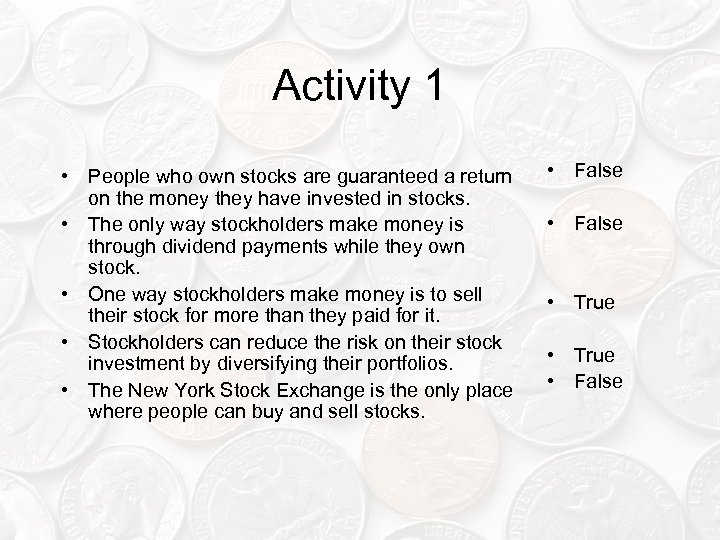 Activity 1 • People who own stocks are guaranteed a return on the money they have invested in stocks. • The only way stockholders make money is through dividend payments while they own stock. • One way stockholders make money is to sell their stock for more than they paid for it. • Stockholders can reduce the risk on their stock investment by diversifying their portfolios. • The New York Stock Exchange is the only place where people can buy and sell stocks. • False • True • False
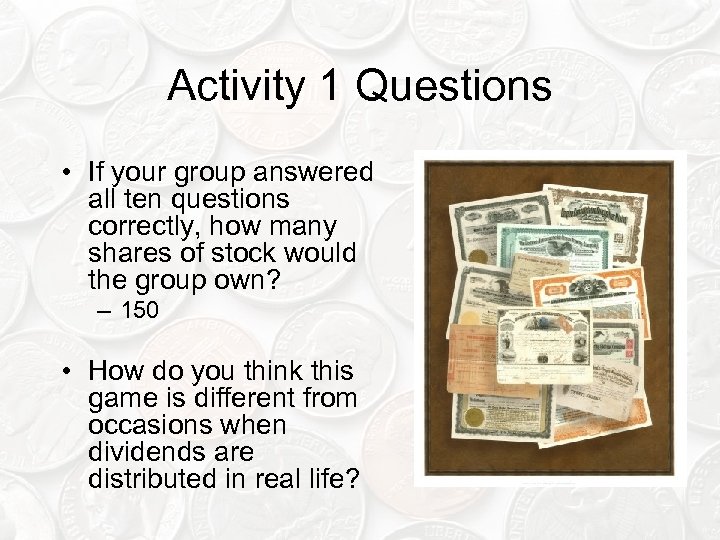 Activity 1 Questions • If your group answered all ten questions correctly, how many shares of stock would the group own? – 150 • How do you think this game is different from occasions when dividends are distributed in real life?
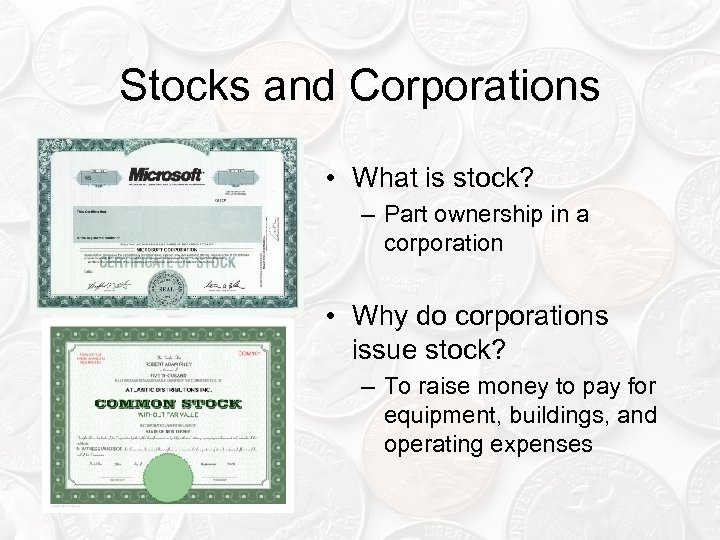 Stocks and Corporations • What is stock? – Part ownership in a corporation • Why do corporations issue stock? – To raise money to pay for equipment, buildings, and operating expenses
 Investment Bankers • When the shares of stock are first issued, to whom are they sold? – To investment bankers • Why do investment bankers buy the stock? – They expect to resell the stocks to the public for a higher price in the secondary market. • How does the corporation get money from the stocks? – Investment bankers pay for the stocks
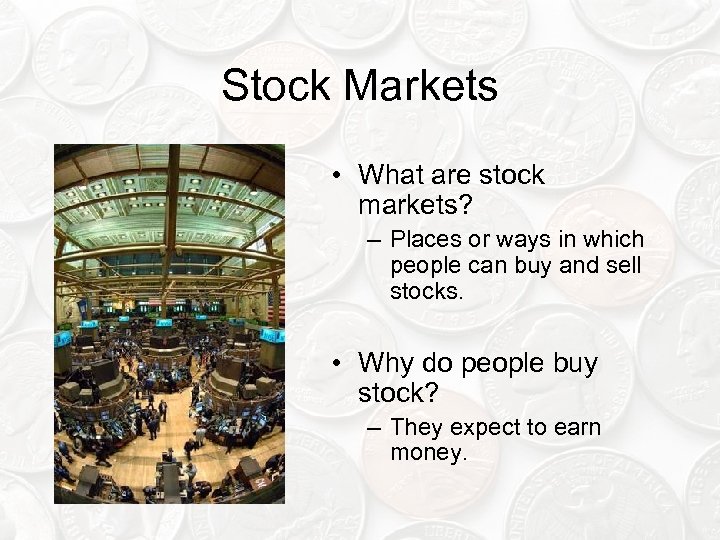 Stock Markets • What are stock markets? – Places or ways in which people can buy and sell stocks. • Why do people buy stock? – They expect to earn money.
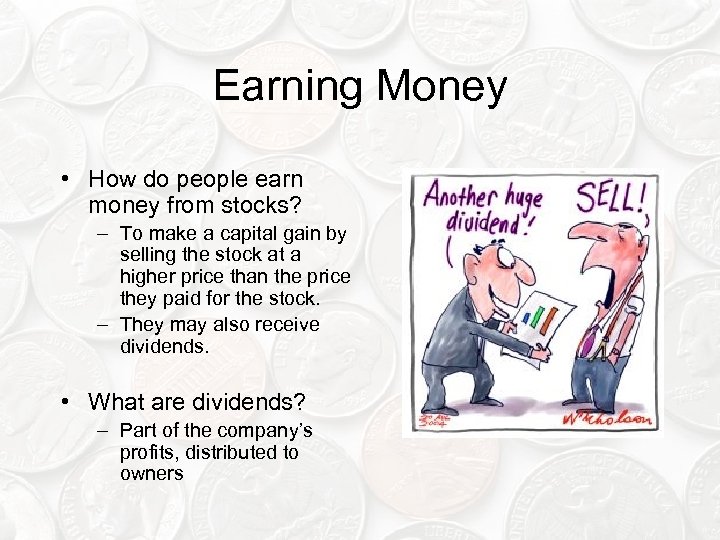 Earning Money • How do people earn money from stocks? – To make a capital gain by selling the stock at a higher price than the price they paid for the stock. – They may also receive dividends. • What are dividends? – Part of the company’s profits, distributed to owners
 Risk vs. Reward • Is there a guarantee that stockholders will be able to sell at a higher price? – No • If there’s no guarantee, why are people willing to buy stock? – Because the stocks they buy might provide them with a higher return than the return they would get by putting money into other financial investments or a savings account.
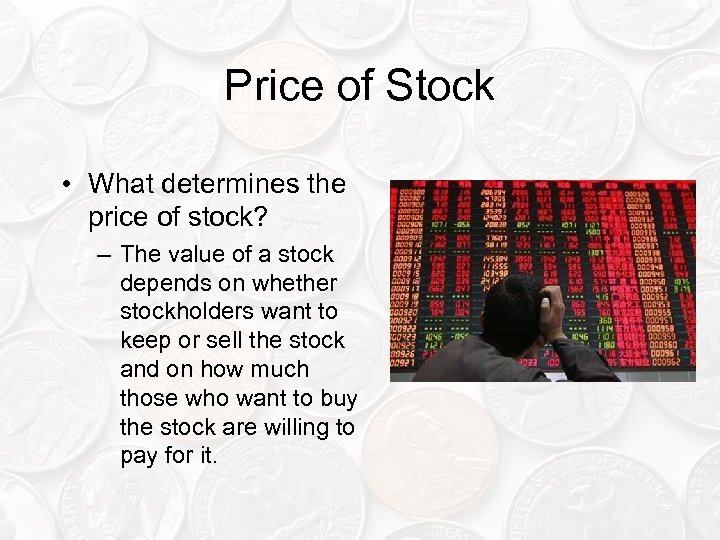 Price of Stock • What determines the price of stock? – The value of a stock depends on whether stockholders want to keep or sell the stock and on how much those who want to buy the stock are willing to pay for it.
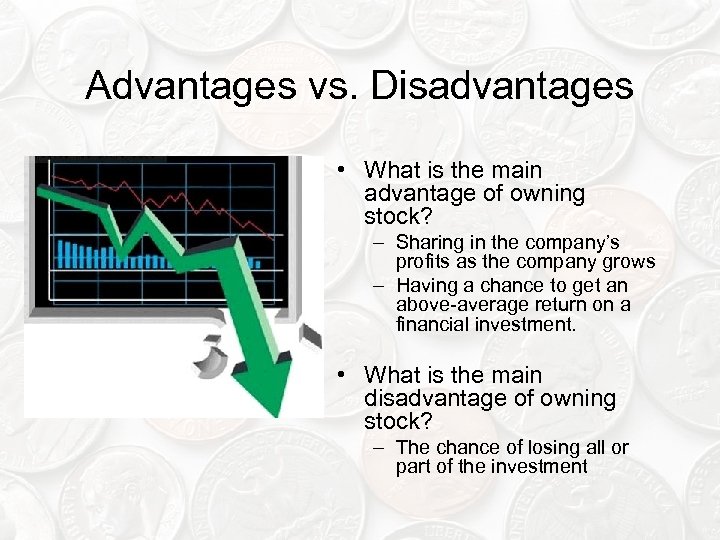 Advantages vs. Disadvantages • What is the main advantage of owning stock? – Sharing in the company’s profits as the company grows – Having a chance to get an above-average return on a financial investment. • What is the main disadvantage of owning stock? – The chance of losing all or part of the investment
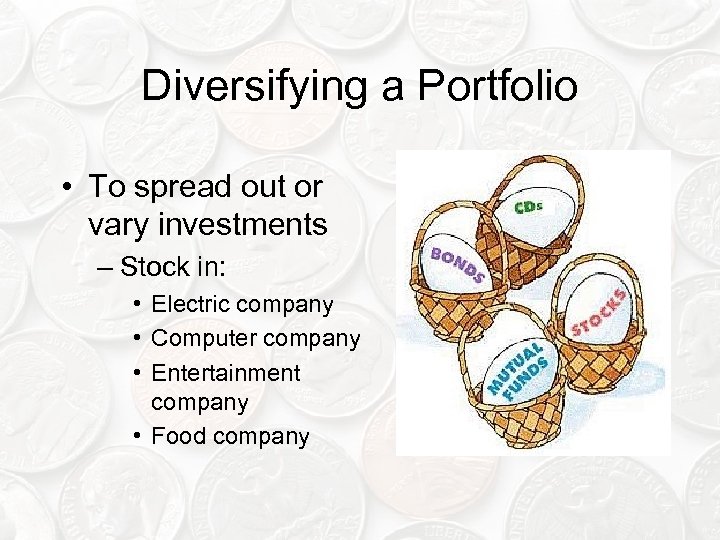 Diversifying a Portfolio • To spread out or vary investments – Stock in: • Electric company • Computer company • Entertainment company • Food company
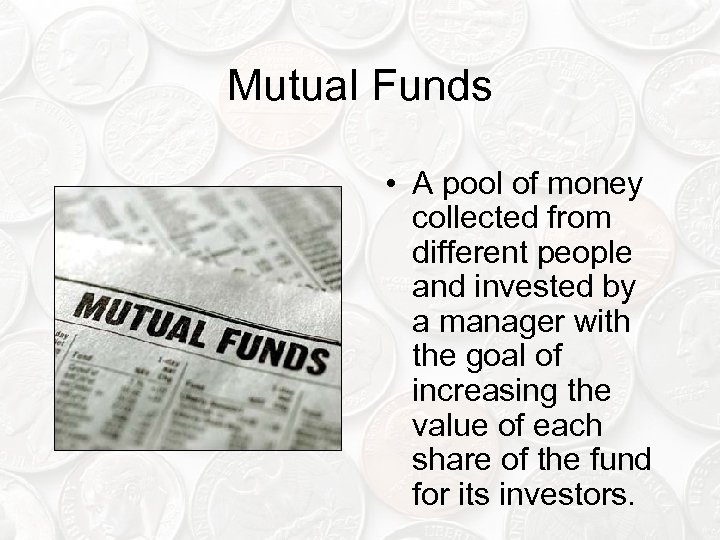 Mutual Funds • A pool of money collected from different people and invested by a manager with the goal of increasing the value of each share of the fund for its investors.
 • ASSIGNMENT!!!
 Reading the Financial Pages: In Print and Online Lesson 5
 Activity 1 • What sort of information is found in the financial pages? – Articles on the markets – News about corporations – Graphs and charts – Listing of daily trading activity
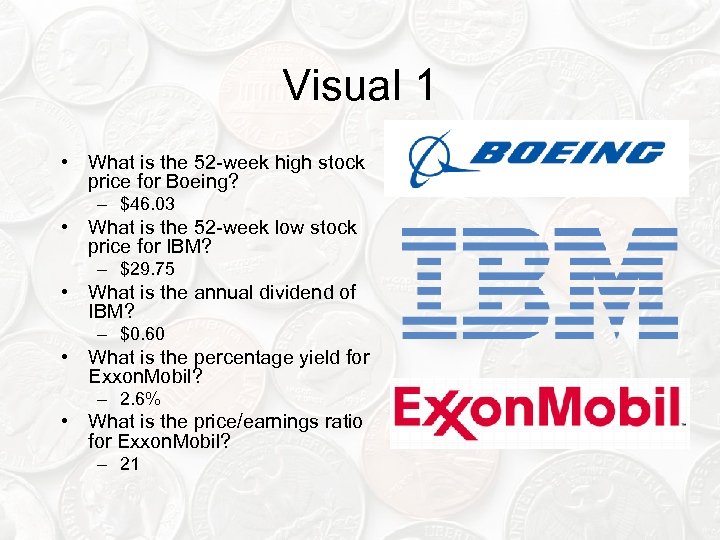 Visual 1 • What is the 52 -week high stock price for Boeing? – $46. 03 • What is the 52 -week low stock price for IBM? – $29. 75 • What is the annual dividend of IBM? – $0. 60 • What is the percentage yield for Exxon. Mobil? – 2. 6% • What is the price/earnings ratio for Exxon. Mobil? – 21
 Visual 1 • On April 21, 2003, how many shares of Boeing stock were traded? – 3, 540, 700 • What was the closing price of IBM stock on April 21, 2003? – $83. 36 • Did the closing price of IBM stock represent a gain or a loss? How much? – Loss – $0. 90
 Activity 1 • What is revealed about a company by the 52 -week high and low? – The range of the share price of the stock for the past year – Hints at how the company has been performing in the short term • Why might dividends be important to some people? – Some investors count on dividend payments as a source of income • What do investors expect to happen when the P/E ratio of a company is high for its industry? – Investors expect the company to earn higher profits in the future.
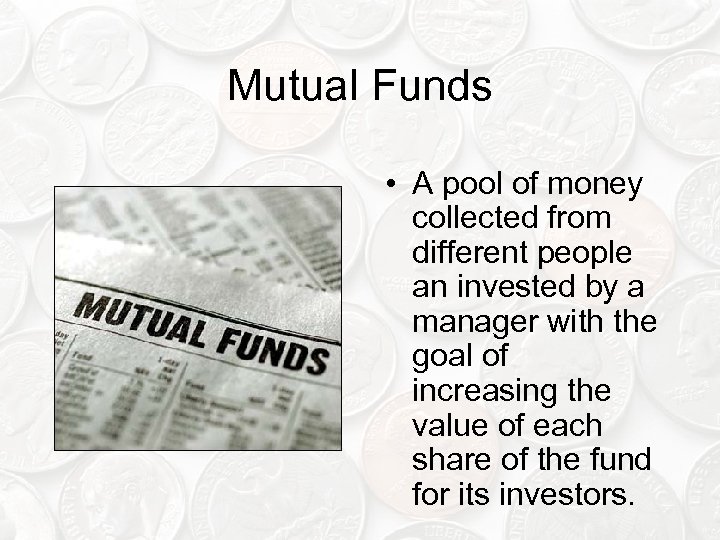 Mutual Funds • A pool of money collected from different people an invested by a manager with the goal of increasing the value of each share of the fund for its investors.
 Activity 2 / Visual 2 • What is the net asset value of the Magellan Fund? – $82. 55 • What is the year-to-date percentage rate of return of the Magellan Fund? – 4. 5% • What is the net change in the fund price of the Janus Fixed Income Fund? – $0. 04 • What is the three-year percentage rate of return on the Janus Fixed Income Fund? – 8. 2% • If an individual purchased 100 shares of the Vanguard Index Fund at the close of the trading on April 24, how much would he or she pay? – $1609
 Activity 3 / Visual 3 • What is the coupon rate of interest on Lucent Technologies bonds? – 7. 25% • What is the maturity date of the Sprint bonds? – 2028 • What is the closing price of the Lucent Technologies bonds? – $88. 25 • What was the net change in the Sprint bond price on April 20, 2003? – $0. 50
 ` • ASSIGNMENT!!!
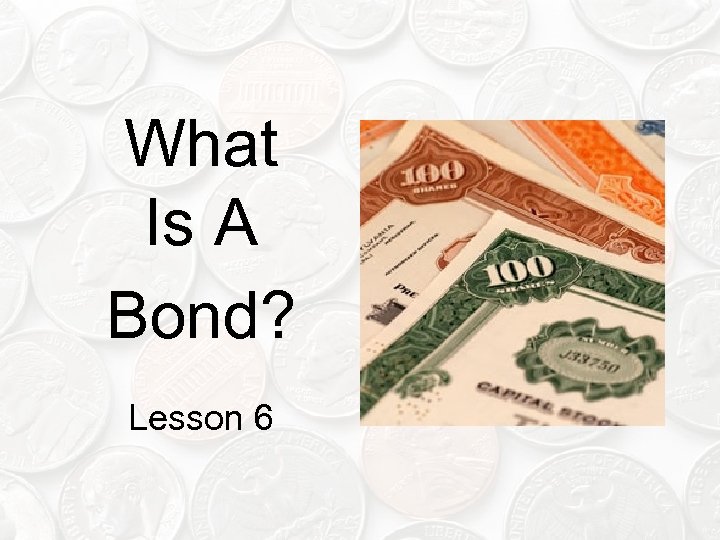 What Is A Bond? Lesson 6
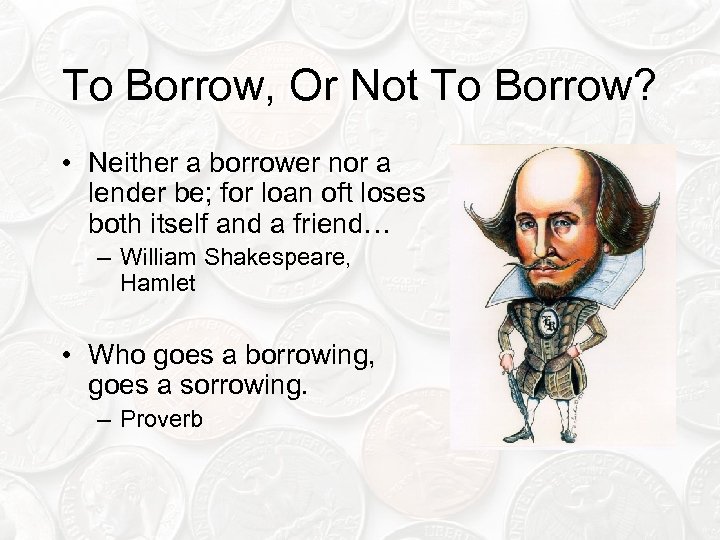 To Borrow, Or Not To Borrow? • Neither a borrower nor a lender be; for loan oft loses both itself and a friend… – William Shakespeare, Hamlet • Who goes a borrowing, goes a sorrowing. – Proverb
![That Is The Question • I wish it were possible to [amend our] constitution](https://present5.com/presentation/affc5a39a29360c4e331ead30a8dc8fc/image-61.jpg "That Is The Question • I wish it were possible to [amend our] constitution") That Is The Question • I wish it were possible to [amend our] constitution with…an additional article taking from the federal government the power of borrowing. – Thomas Jefferson, letter to John Taylor • Borrowing is not much better than begging; just as lending with interest is not much better than stealing. – Doris Lessing, British author
That Is The Question • I wish it were possible to [amend our] constitution with…an additional article taking from the federal government the power of borrowing. – Thomas Jefferson, letter to John Taylor • Borrowing is not much better than begging; just as lending with interest is not much better than stealing. – Doris Lessing, British author
 Why Borrow? • If borrowing is such a bad thing, why do people borrow so often? – Buy a car – Buy a house – Pay for college – Pay for medical care
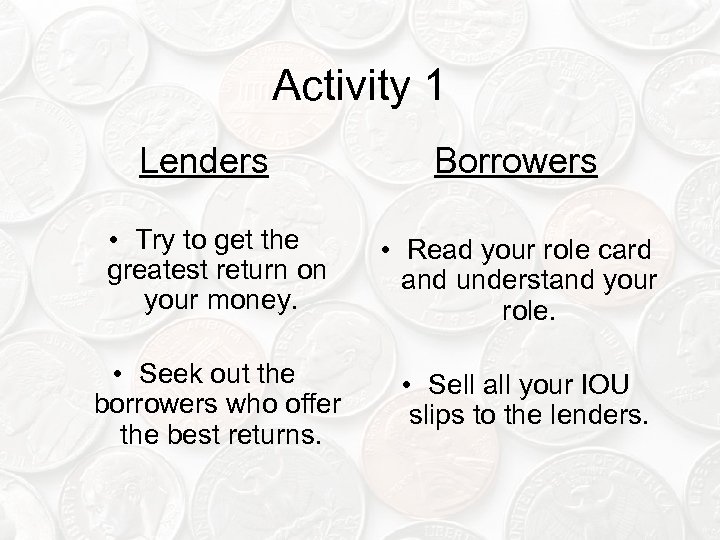 Activity 1 Lenders Borrowers • Try to get the greatest return on your money. • Read your role card and understand your role. • Seek out the borrowers who offer the best returns. • Sell all your IOU slips to the lenders.
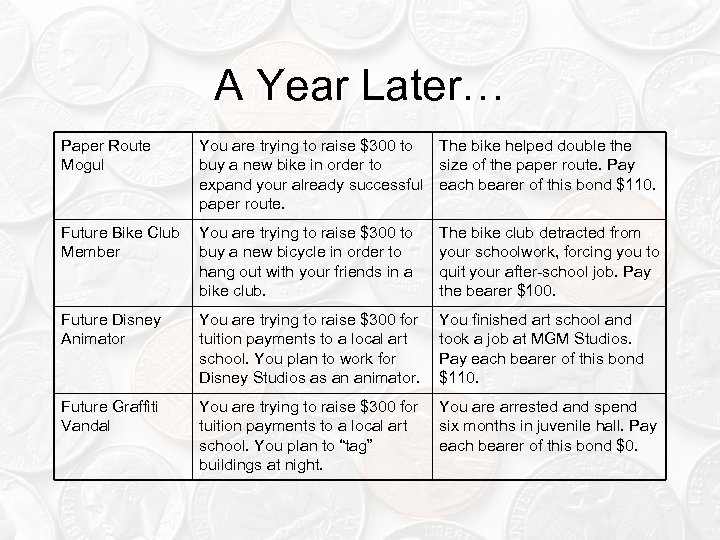 A Year Later… Paper Route Mogul You are trying to raise $300 to The bike helped double the buy a new bike in order to size of the paper route. Pay expand your already successful each bearer of this bond $110. paper route. Future Bike Club Member You are trying to raise $300 to buy a new bicycle in order to hang out with your friends in a bike club. The bike club detracted from your schoolwork, forcing you to quit your after-school job. Pay the bearer $100. Future Disney Animator You are trying to raise $300 for tuition payments to a local art school. You plan to work for Disney Studios as an animator. You finished art school and took a job at MGM Studios. Pay each bearer of this bond $110. Future Graffiti Vandal You are trying to raise $300 for tuition payments to a local art school. You plan to “tag” buildings at night. You are arrested and spend six months in juvenile hall. Pay each bearer of this bond $0.
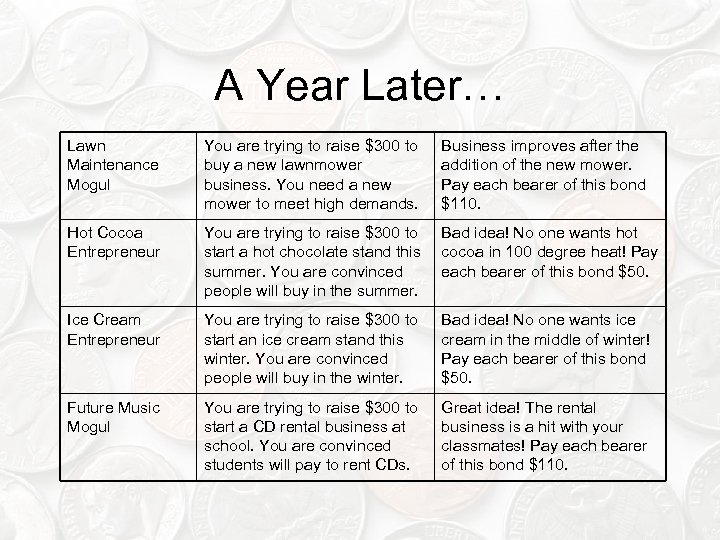 A Year Later… Lawn Maintenance Mogul You are trying to raise $300 to buy a new lawnmower business. You need a new mower to meet high demands. Business improves after the addition of the new mower. Pay each bearer of this bond $110. Hot Cocoa Entrepreneur You are trying to raise $300 to start a hot chocolate stand this summer. You are convinced people will buy in the summer. Bad idea! No one wants hot cocoa in 100 degree heat! Pay each bearer of this bond $50. Ice Cream Entrepreneur You are trying to raise $300 to start an ice cream stand this winter. You are convinced people will buy in the winter. Bad idea! No one wants ice cream in the middle of winter! Pay each bearer of this bond $50. Future Music Mogul You are trying to raise $300 to start a CD rental business at school. You are convinced students will pay to rent CDs. Great idea! The rental business is a hit with your classmates! Pay each bearer of this bond $110.
 Results? • Why do some lenders make a return and others do not?
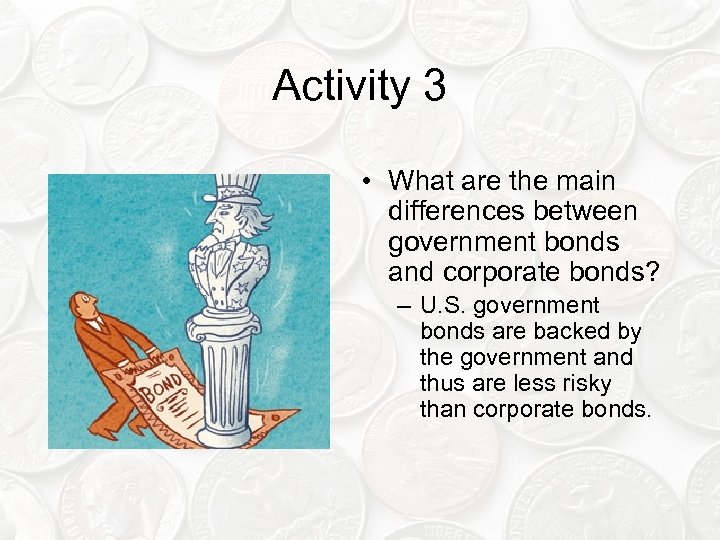 Activity 3 • What are the main differences between government bonds and corporate bonds? – U. S. government bonds are backed by the government and thus are less risky than corporate bonds.
 Coupons and Zero Coupons • Coupons – Pays out interest at set intervals with a final payment that includes the original principal at the maturity date • Zero coupons – Pays all the interest and the principal of the bond at the maturity date • Why buy a coupon bond instead of a zero-coupon bond? – Steady stream of income
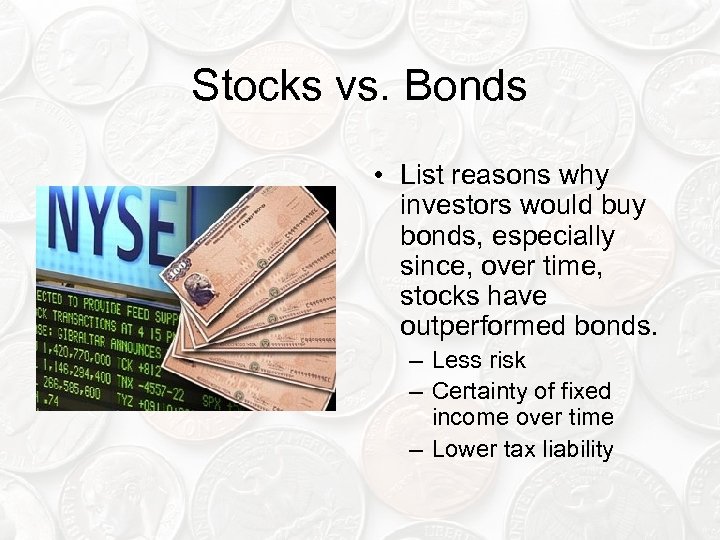 Stocks vs. Bonds • List reasons why investors would buy bonds, especially since, over time, stocks have outperformed bonds. – Less risk – Certainty of fixed income over time – Lower tax liability
 1. 2. 3. 4. 5. C A C B B
 Rating Bonds • Third party rating services provide information about the likelihood that corporations or governments will be able to pay off their bond obligations • The lower the rating, the more likely a firm or government will not be able to pay the interest and principal back.
 Moody’s Investor Service • Calculate the average coupon rate: – Aaa • What is the relationship between bond rating and coupon rate? • 4. 50 – Aa • 6. 60 – Baa • 8. 42 – Caa • 9. 79 – C • 12. 08 • Why do corporations with lower credit ratings offer higher coupons or interest rates on their bonds? • Why would investors by a bond rated Caa or C?
 Review • What is a bond? – A bond is a certificate acknowledging a loan from the lender to a government or corporation • Why would someone buy a bond? – To earn income – To earn interest – To earn capital gains if interest rates fall • Which type of bond is the least risky for investors? Why? – U. S. government bonds are the least risky – They are backed by the U. S. government
 Review • What is a U. S. Savings Bond? – Issued by the U. S. – Offered at half the face value – Mature at face value • What is a municipal bond? – A bond issued by a state or local government • What is a major tax benefit of holding municipal bonds? – The bondholder does not have to pay a federal tax on the interest.
 Review • If corporate bonds are riskier than U. S. government bonds, why do people buy corporate bonds? – Corporate bonds pay a higher interest rate • What is the difference between a coupon bond a zero-coupon bond? – A coupon bond pays interest at fixed intervals – A zero-coupon bond pays accumulated interest at the bond’s maturity date
 • ASSIGNMENT!!!
 What Are Mutual Funds? Lesson 7
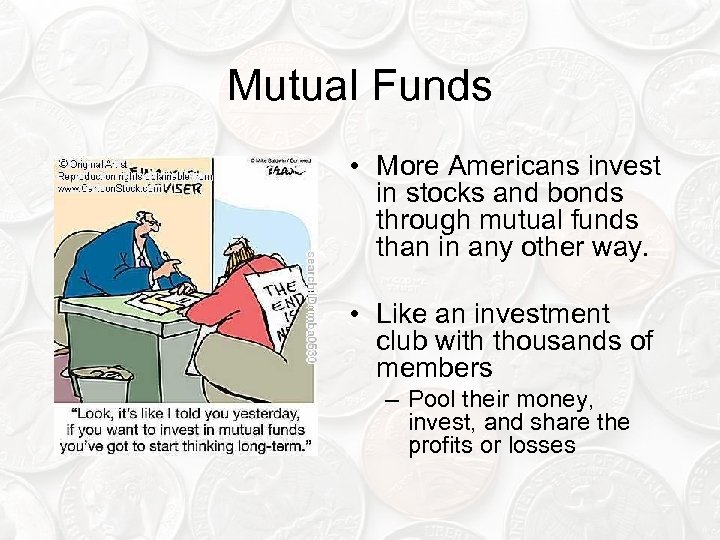 Mutual Funds • More Americans invest in stocks and bonds through mutual funds than in any other way. • Like an investment club with thousands of members – Pool their money, invest, and share the profits or losses
 Activity 1 • Each club has $3000 to invest. • Each club may buy any of six stocks. You must buy at least three stocks, but you may buy more than three. • Each club must invest the entire $3000.
 Activity 2: One Year Later… • Complete the chart and check your math. • The amount you invested will still be $3000, and the number of shares of stock owned will be the same as Activity 1. • The price of the stocks and the investment value of the fund will have changed.
 Results • Did the price per share of the investment club increase or decrease? • What determined whether the price per share of the investment club increased or decreased? – The investment value • Assume that more students want to join your investment club and purchase shares. What price would you charge them? Why?
 Mutual Fund Rules • The price per share changes every day and depends on the value of the investments. • The value of the investments depends on the performance of the assets chosen by the fund manager. • A mutual fund charges investors for the financial management it provides • Some mutual funds charge a sales commission called a load. – The higher the load, the less the actual investment. – Lower loads are better for investors.
 Not All The Same • Mutual funds have different investment objectives. – Some come with greater risks than others. – Some offer greater potential rewards.
 Activity 3 • What is a mutual fund? – A pool of money used by an investment company to buy a variety of stocks and bonds. • A friend tells you, “All mutual funds are the same. ” How do you reply to your friend? – Buy different stocks and bonds – Different managers with different styles
 Load Funds vs. No-Load Funds • What is an advantage of buying a load fund? What is a disadvantage? – Advantage • Salesperson provides help in choosing a fund – Disadvantage • Costs more because investor pays a sales commission • What is an advantage of buying a no-load fund? What is a disadvantage? – Advantage • No sales commission and less cost – Disadvantage • No advice from a fund representative • Must do own research
 Things To Consider • What should you consider when deciding which mutual fund to buy? – Performance – Cost – Convenience • More Americans own mutual funds than individual stocks and bonds. Why do you think this is so? – – Diversification Professional management Ease of buying and selling Safer; spreads the risk
 Playing The Stock Market Game • If your class participates in a stock market simulation that allows you to buy mutual funds, what type of fund should you buy? – High risk, highreward funds
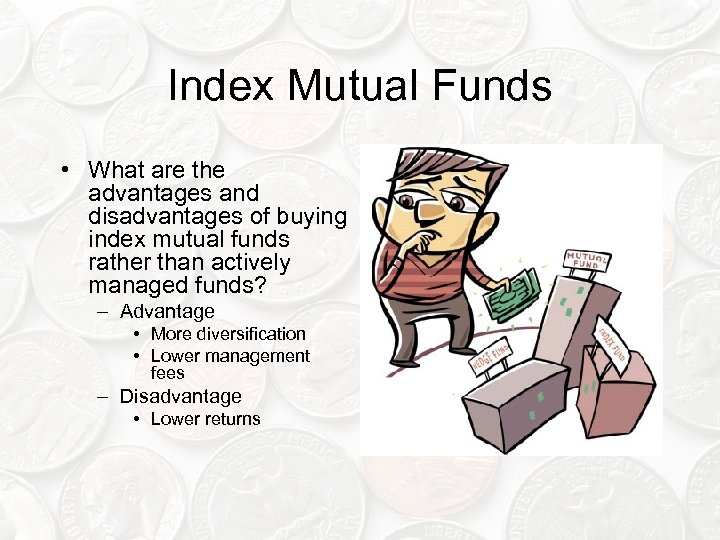 Index Mutual Funds • What are the advantages and disadvantages of buying index mutual funds rather than actively managed funds? – Advantage • More diversification • Lower management fees – Disadvantage • Lower returns
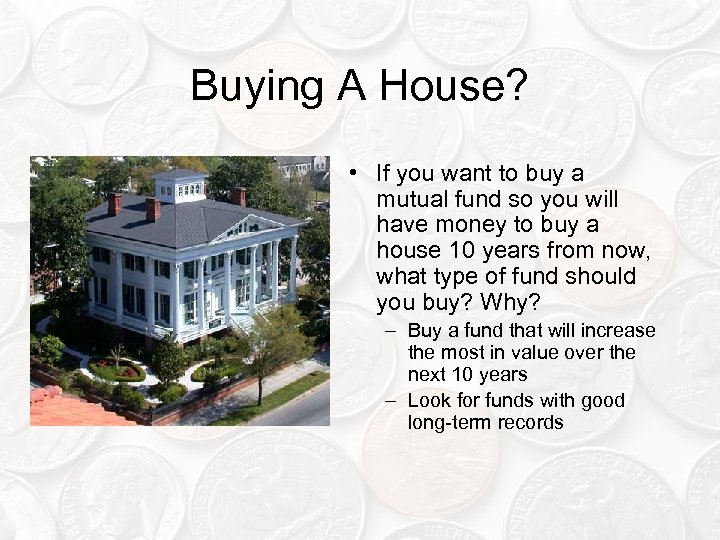 Buying A House? • If you want to buy a mutual fund so you will have money to buy a house 10 years from now, what type of fund should you buy? Why? – Buy a fund that will increase the most in value over the next 10 years – Look for funds with good long-term records
 • ASSIGNMENT!!!
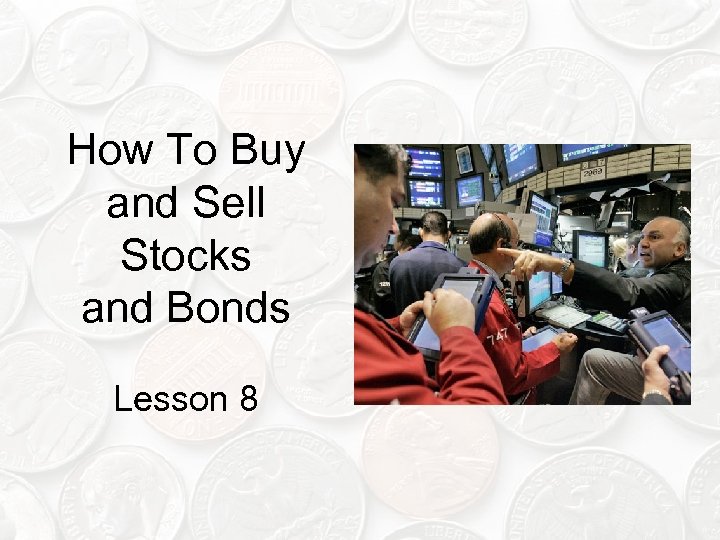 How To Buy and Sell Stocks and Bonds Lesson 8
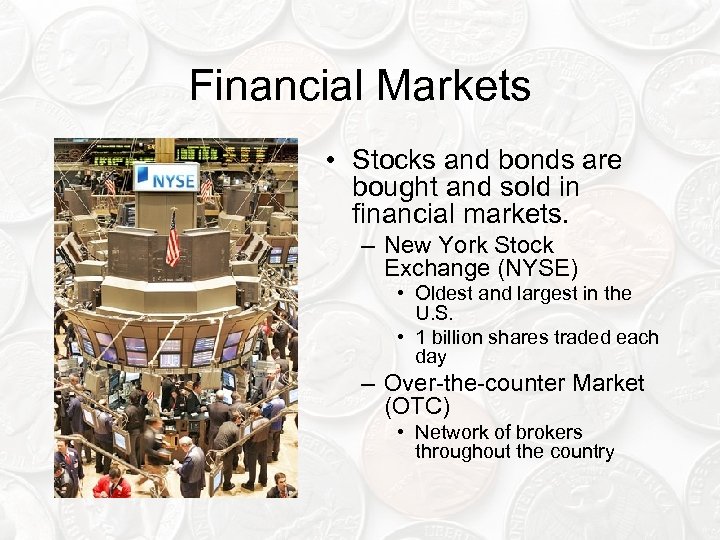 Financial Markets • Stocks and bonds are bought and sold in financial markets. – New York Stock Exchange (NYSE) • Oldest and largest in the U. S. • 1 billion shares traded each day – Over-the-counter Market (OTC) • Network of brokers throughout the country
 Activity 1 • How do financial markets help sellers like Veronica and buyers like Ron? – Reduce the costs of trading for buyers and sellers – Provide information about potential trading partners – Supply more than one buyer or seller so competition can be established
 Where To Buy Stocks And Bonds • Full-service brokerage firms: – Give investment advice – Offer a wide variety of financial products and services – Charge higher commissions • Discount brokerage firms: – Do not give investment advice – Offer a limited number of financial products and services – Charge lower commissions
 Where To Buy Stocks and Bonds • Buying online: – Buyers pay lower commissions – Buyers can more easily compare brokerage services • Dividend reinvestment plans (DRIPS): – Many large companies offer DRIPs – Stockholders are paid dividends in the form of stock – No commission fee is charged
 Who Would Benefit? • What kind of investor would benefit most from dealing with a fullservice broker? – Someone who is not very knowledgeable about what stocks to buy and does not want to take the time to research individual stocks
 Review • What is the New York Stock Exchange? – The New York Stock Exchange is the oldest and largest stock exchange in the world • Less than half of all stocks are traded on exchanges like the NYSE. How are the rest traded? – The other stocks are traded on the over-thecounter market, which is a network of brokers rather than a physical location
 Review • What role do brokers play in buying and selling stocks? – Brokers assist their clients in making transactions in organized financial markets. – Brokers charge fees for providing their services. – Full-service brokers provide investment advice.
 Review • What are DRIPS? What is the advantage of a DRIPS program? – Dividend reinvestment plan – Receive dividends as stock instead of cash – More stock without broker fees
 • ASSIGNMENT!!!
 What Is A Stock Market? Lesson 9
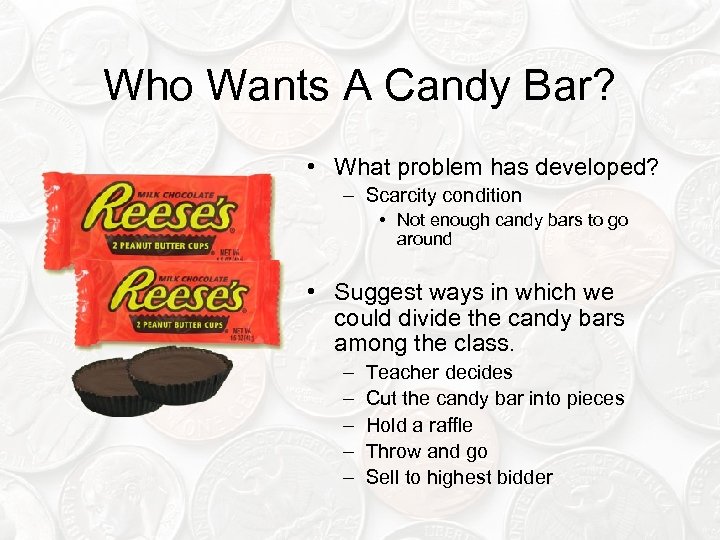 Who Wants A Candy Bar? • What problem has developed? – Scarcity condition • Not enough candy bars to go around • Suggest ways in which we could divide the candy bars among the class. – – – Teacher decides Cut the candy bar into pieces Hold a raffle Throw and go Sell to highest bidder
 Scarcity in Society • How do we allocate (disperse) scarce resources in our society? – Resources are sold to those willing to pay market prices for goods and services.
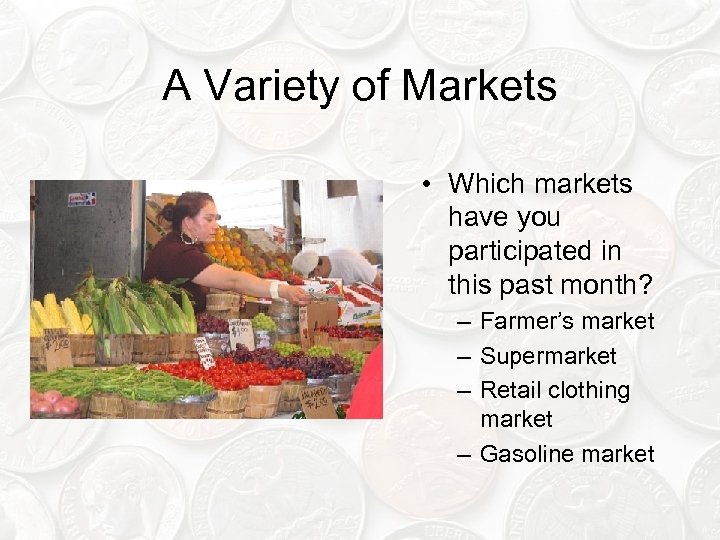 A Variety of Markets • Which markets have you participated in this past month? – Farmer’s market – Supermarket – Retail clothing market – Gasoline market
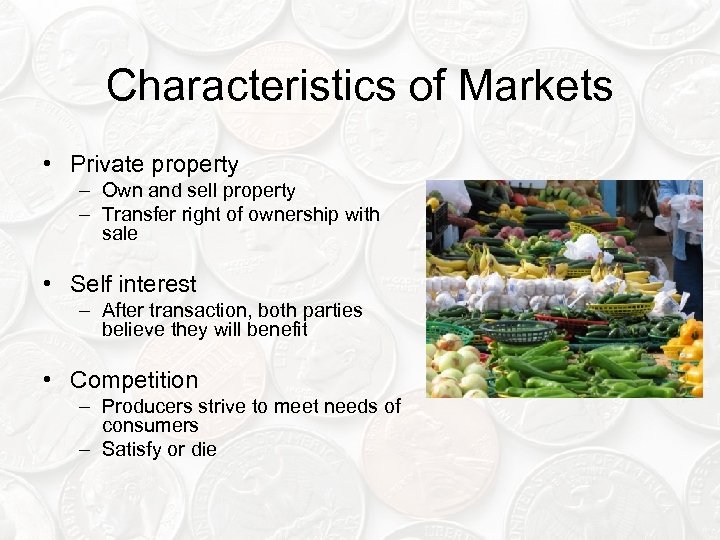 Characteristics of Markets • Private property – Own and sell property – Transfer right of ownership with sale • Self interest – After transaction, both parties believe they will benefit • Competition – Producers strive to meet needs of consumers – Satisfy or die
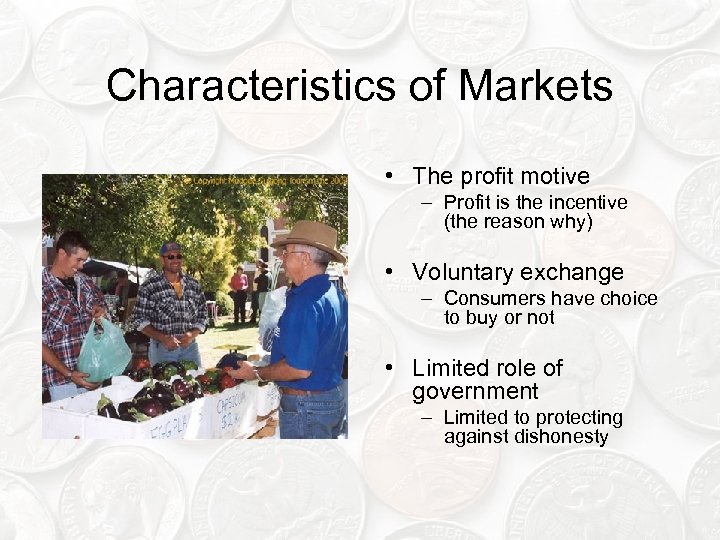 Characteristics of Markets • The profit motive – Profit is the incentive (the reason why) • Voluntary exchange – Consumers have choice to buy or not • Limited role of government – Limited to protecting against dishonesty
 Market or Not? 1. Market • 2. Competition, profit, transfer of ownership Not a Market • 3. No competition, government owned Not a Market • 4. Government provides service Market • 5. Competition, choice Market • 6. Self-interest, competition Not a Market • Government provides good, no profit, no competition
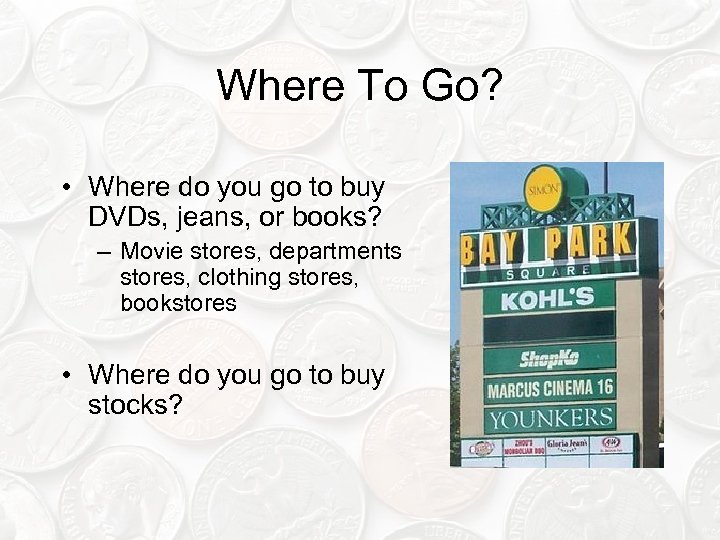 Where To Go? • Where do you go to buy DVDs, jeans, or books? – Movie stores, departments stores, clothing stores, bookstores • Where do you go to buy stocks?
 Why Buy Stock? • Stock – A share of ownership in a company • Why buy? – Expect the price of stock will rise above the purchase price – Expect to share in company’s profits (dividends)
 How A Stock Starts • A company needs additional resources to expand or run their business – “Take the company public” • Sell a portion of the company to the public • Done through a primary market – IPO (Initial public offering) • Stocks sold to large investment banks • Investment banks sell shares to brokerage houses • Brokers sell shares in secondary market through a stock exchange
 New York Stock Exchange • Founded in 1792 • About 2, 800 companies listed • Home of the Dow Jones and S&P 500 Indexes • Listed companies must have at least $100, 000 in outstanding stock and trade an average of at least 100, 000 shares per day • 1, 366 member seats
 American Stock Exchange • Founded after Civil War • More than 800 companies listed • Listed companies must have more than 500, 000 shares outstanding and trade an average of more than 1, 000 shares per day • 807 member seats
 NASDAQ • Founded in 1971 • More than 3, 700 companies listed • Considered the home of tech stocks • No physical location – Trades done via computer network • Largest market in terms of stocks traded • No fixed number of members
 • ASSIGNMENT!!!
 The Language of Financial Markets Lesson 10
 Financial Institutions in the U. S. Economy Lesson 11
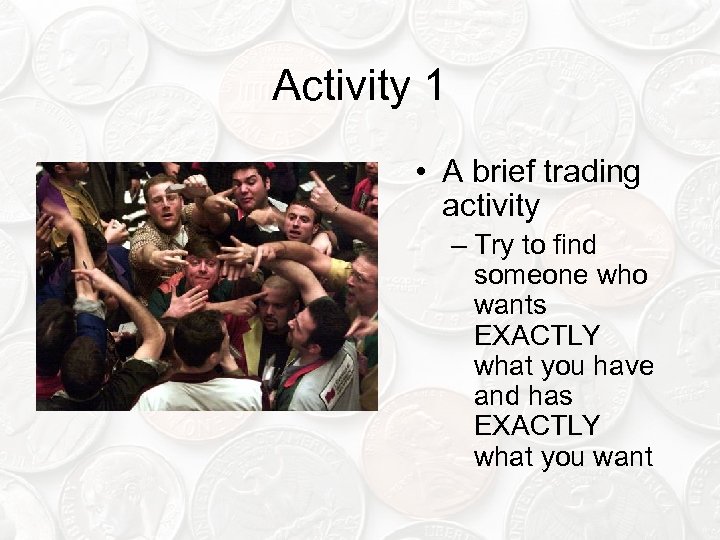 Activity 1 • A brief trading activity – Try to find someone who wants EXACTLY what you have and has EXACTLY what you want
 Questions • How many of you were able to find someone who had what you wanted? • How many of you were willing to lend money if you could earn interest? • How many of you wanted to borrow money and pay interest on the loan? • Why didn’t you borrow from and lend to one another?
 Stock Questions • How many of you wanted to buy stock? • How many of you wanted to sell stock? • Why didn’t you buy from and sell to one another?
 Bonds Questions • How many of you wanted to buy bonds? • How many of you wanted to sell bonds? • Why didn’t you buy from and sell to one another?
 Why? • In market economies, people develop financial markets to make it easier to make interactions – – – Banks Credit unions Stock markets Insurance companies Finance companies Pension funds
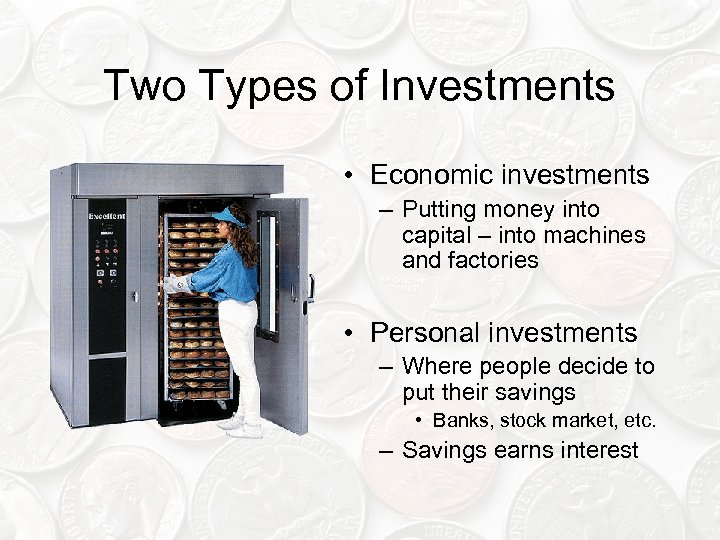 Two Types of Investments • Economic investments – Putting money into capital – into machines and factories • Personal investments – Where people decide to put their savings • Banks, stock market, etc. – Savings earns interest
 Volunteers? • Representative of the Great American Computer Company (GACC) • Representative of G. Mann, Inc. • Three Best Customers
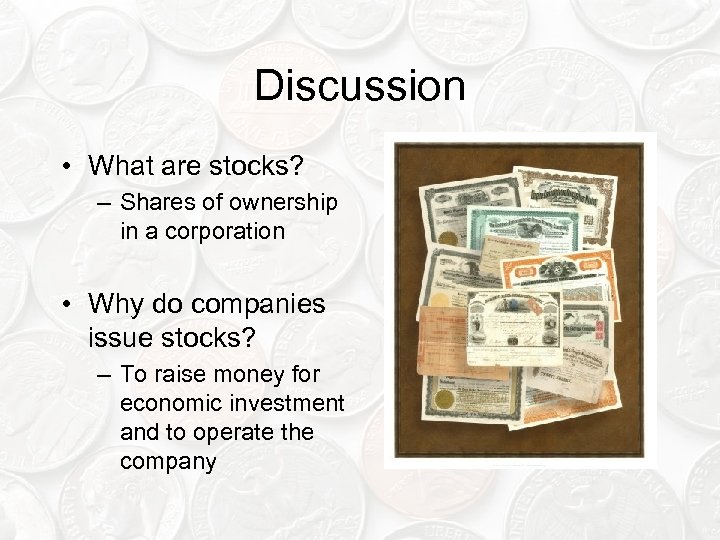 Discussion • What are stocks? – Shares of ownership in a corporation • Why do companies issue stocks? – To raise money for economic investment and to operate the company
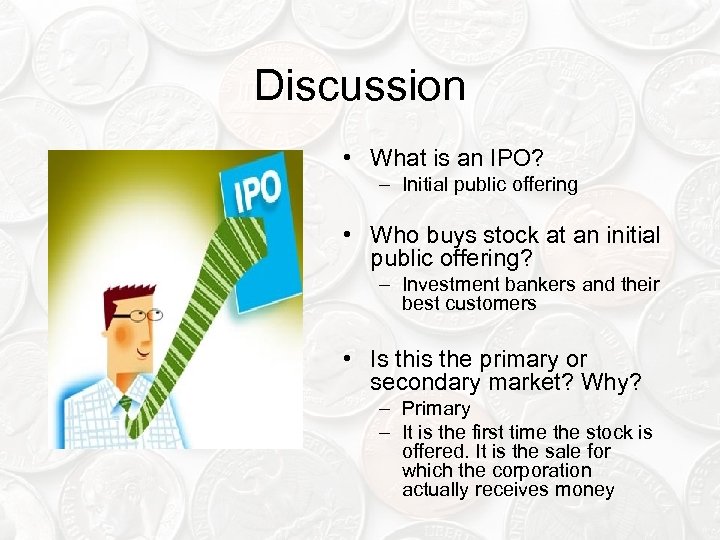 Discussion • What is an IPO? – Initial public offering • Who buys stock at an initial public offering? – Investment bankers and their best customers • Is this the primary or secondary market? Why? – Primary – It is the first time the stock is offered. It is the sale for which the corporation actually receives money
 Discussion • What do the investment bankers do with the stock? – They sell it to their best customers • Once the best customers have purchased the stock, what can they do with it? – Keep it or sell it in secondary markets • What are some familiar names of secondary stock markets? – NYSE – AMEX – NASDAQ
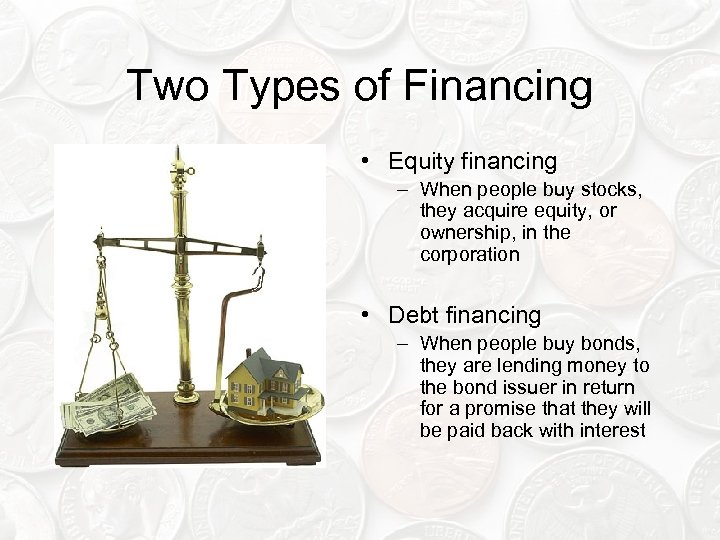 Two Types of Financing • Equity financing – When people buy stocks, they acquire equity, or ownership, in the corporation • Debt financing – When people buy bonds, they are lending money to the bond issuer in return for a promise that they will be paid back with interest
 Primary vs. Secondary Market • When stocks and bonds are sold in primary markets, funds are provided that the corporation or government may use. • When stocks and bonds are sold in secondary markets, money does not go to the corporation or government – it goes to the seller of the stocks or bonds
 • ASSIGNMENT!!!
 Building Wealth Over the Long Term Lesson 12
 Three Rules To Saving Long Term • Start early – Give money time to grow • Buy and hold – Keep your money invested • Diversify – Don’t put all your eggs in one basket
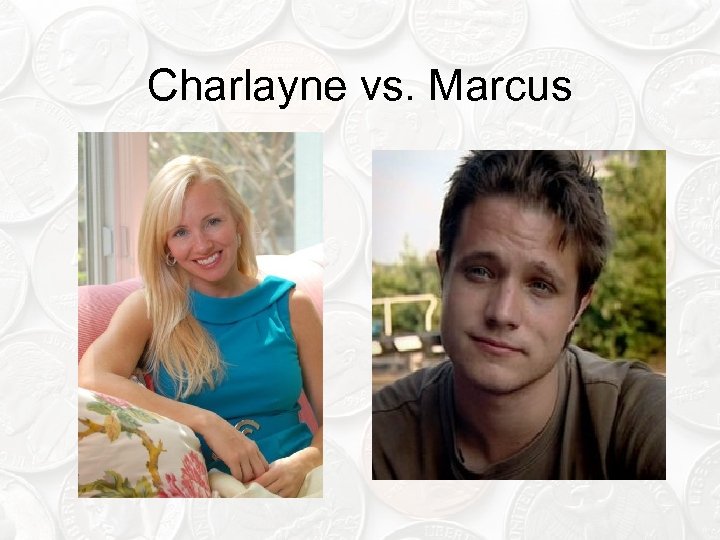 Charlayne vs. Marcus
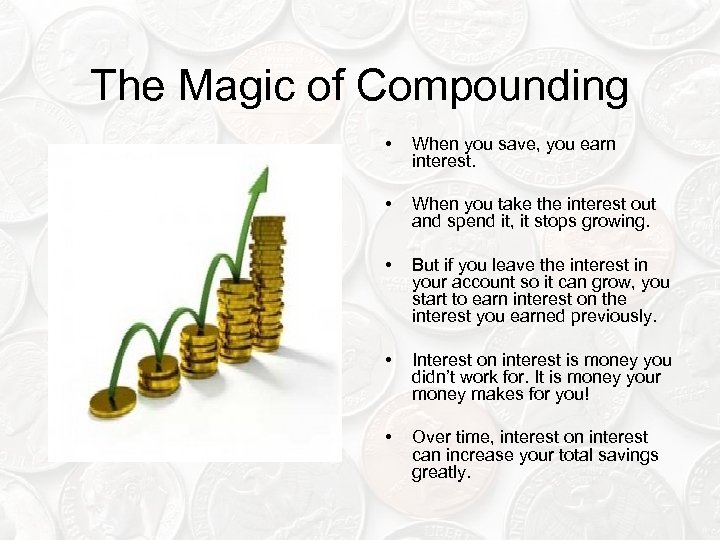 The Magic of Compounding • When you save, you earn interest. • When you take the interest out and spend it, it stops growing. • But if you leave the interest in your account so it can grow, you start to earn interest on the interest you earned previously. • Interest on interest is money you didn’t work for. It is money your money makes for you! • Over time, interest on interest can increase your total savings greatly.
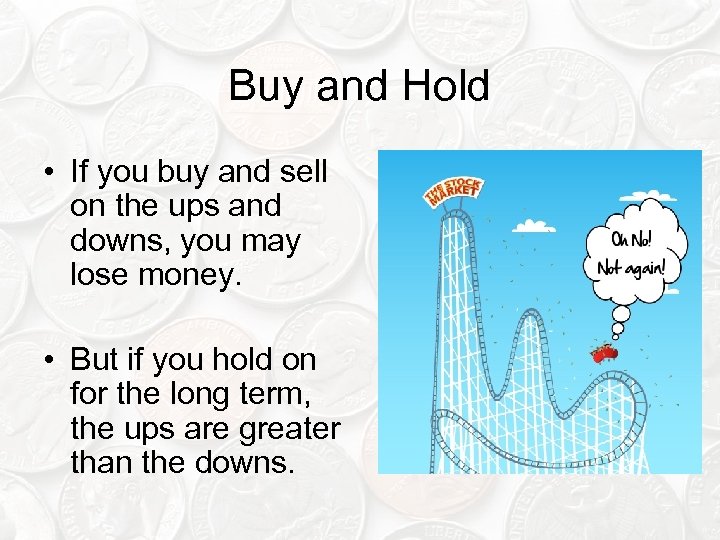 Buy and Hold • If you buy and sell on the ups and downs, you may lose money. • But if you hold on for the long term, the ups are greater than the downs.
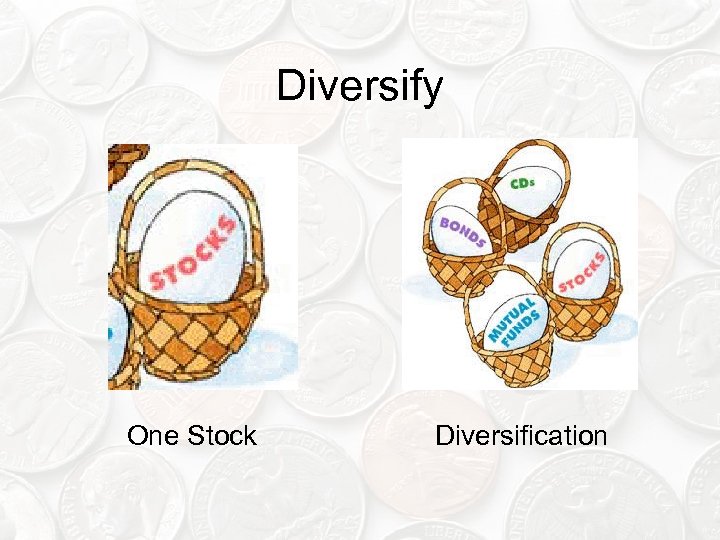 Diversify One Stock Diversification
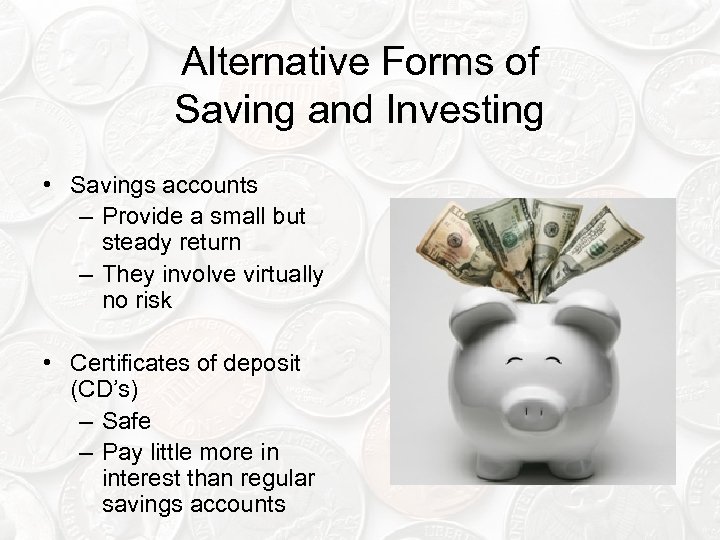 Alternative Forms of Saving and Investing • Savings accounts – Provide a small but steady return – They involve virtually no risk • Certificates of deposit (CD’s) – Safe – Pay little more in interest than regular savings accounts
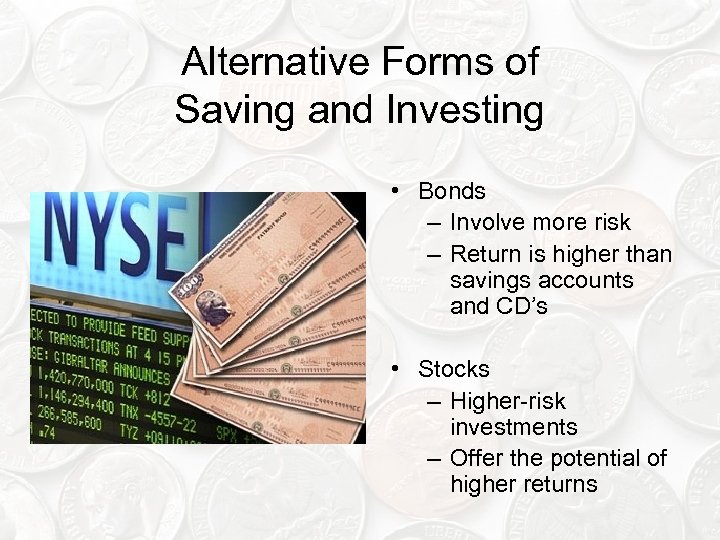 Alternative Forms of Saving and Investing • Bonds – Involve more risk – Return is higher than savings accounts and CD’s • Stocks – Higher-risk investments – Offer the potential of higher returns
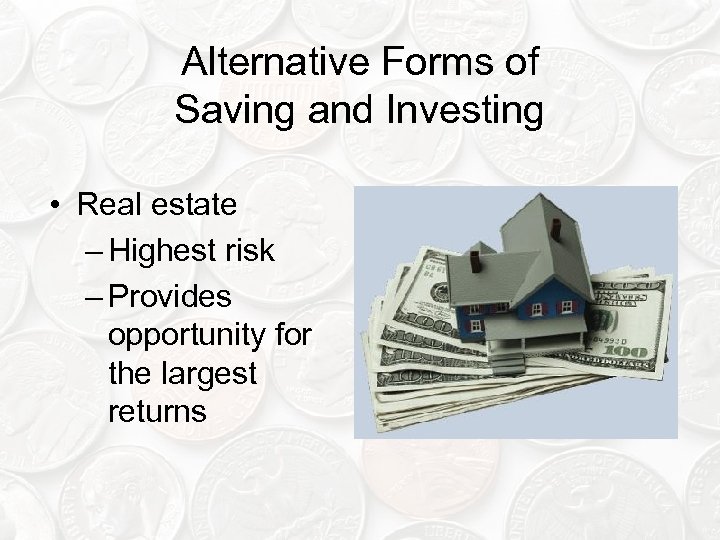 Alternative Forms of Saving and Investing • Real estate – Highest risk – Provides opportunity for the largest returns
 Review • What are three rules for building wealth? – Start early – Buy and hold – Diversify
 ASSIGNMENT!!!
 Researching Companies Lesson 13
 Thinking Economically About Researching Stocks • Recognize that you cannot know it all. • Select a few companies to research. – Follow the progress closely. • Find a few good places to get stock information. • Stop looking for new information when you have enough information!
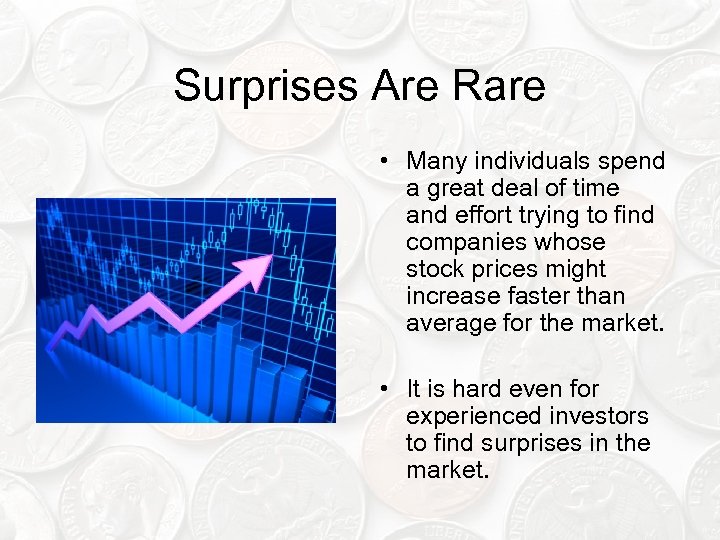 Surprises Are Rare • Many individuals spend a great deal of time and effort trying to find companies whose stock prices might increase faster than average for the market. • It is hard even for experienced investors to find surprises in the market.
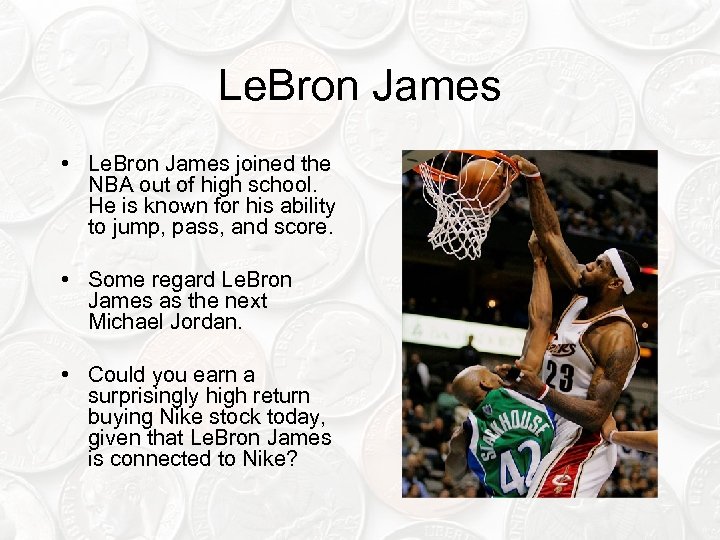 Le. Bron James • Le. Bron James joined the NBA out of high school. He is known for his ability to jump, pass, and score. • Some regard Le. Bron James as the next Michael Jordan. • Could you earn a surprisingly high return buying Nike stock today, given that Le. Bron James is connected to Nike?
 Activity 1 www. quicken. com www. smartmoney. com www. money. msn. com
 Stock-Selection Criteria Used By Fundamental Stock Analysts • Share Price – Charts often display changes in share price over the past month, year, and so on • Price/Earnings Ratio – How much an investor will pay for a dollar of profit
 Stock-Selection Criteria Used By Fundamental Stock Analysts • Annual Revenue or Sales – Sales over the past three to five years point to how well a company is doing in its industry • Earnings per Share – A measure of how a company’s profits compare to the number of shares – Rising earnings per share suggest that a company is well managed
 ASSIGNMENT!!!
 Credit: Your Best Friend or Your Worst Enemy? Lesson 14
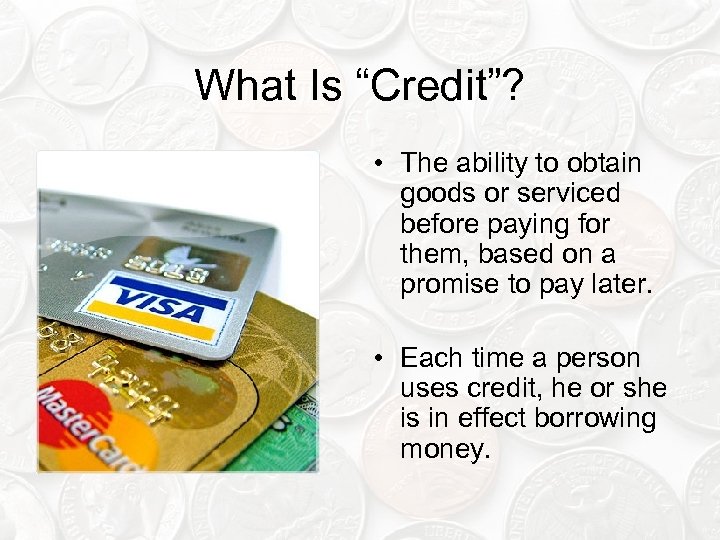 What Is “Credit”? • The ability to obtain goods or serviced before paying for them, based on a promise to pay later. • Each time a person uses credit, he or she is in effect borrowing money.
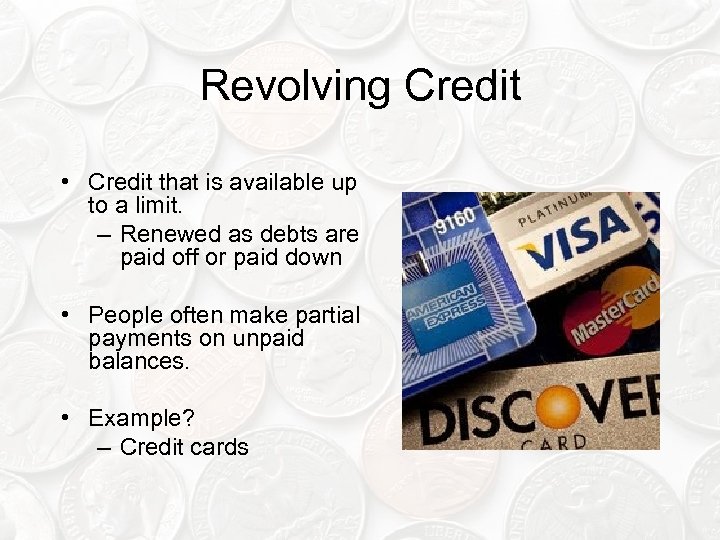 Revolving Credit • Credit that is available up to a limit. – Renewed as debts are paid off or paid down • People often make partial payments on unpaid balances. • Example? – Credit cards
 Activity 1 & 2 - January • Purchases • Minimum payment • Unpaid balance • $235 • $11. 75 • $223. 25
 Activity 1 & 2 - February • • • Purchases Previous balance + Finance charge Total owed - Minimum payment Unpaid balance • $157 • $223. 25 • $3. 35 • $383. 60 • $19. 18 • $364. 42
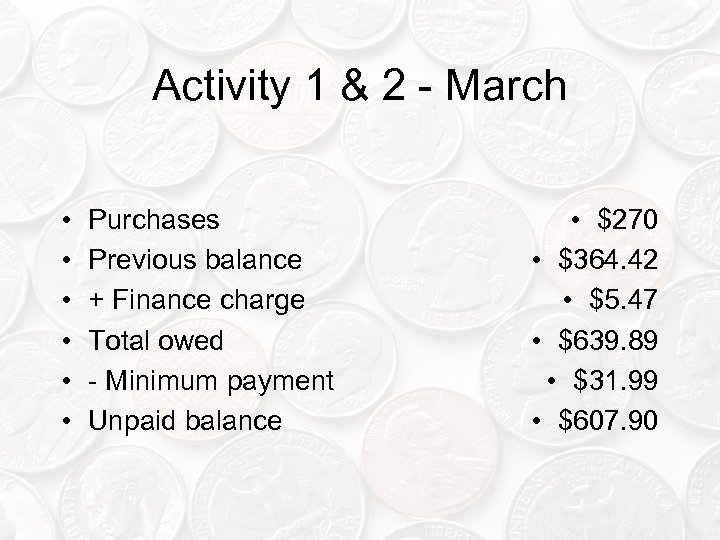 Activity 1 & 2 - March • • • Purchases Previous balance + Finance charge Total owed - Minimum payment Unpaid balance • $270 • $364. 42 • $5. 47 • $639. 89 • $31. 99 • $607. 90
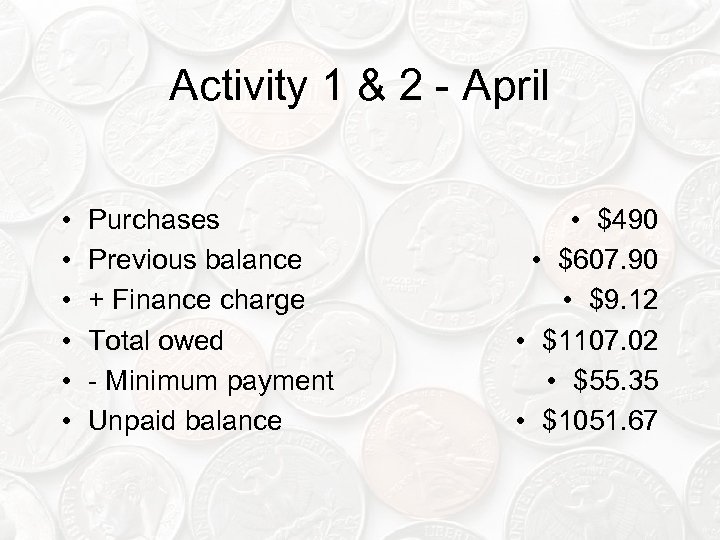 Activity 1 & 2 - April • • • Purchases Previous balance + Finance charge Total owed - Minimum payment Unpaid balance • $490 • $607. 90 • $9. 12 • $1107. 02 • $55. 35 • $1051. 67
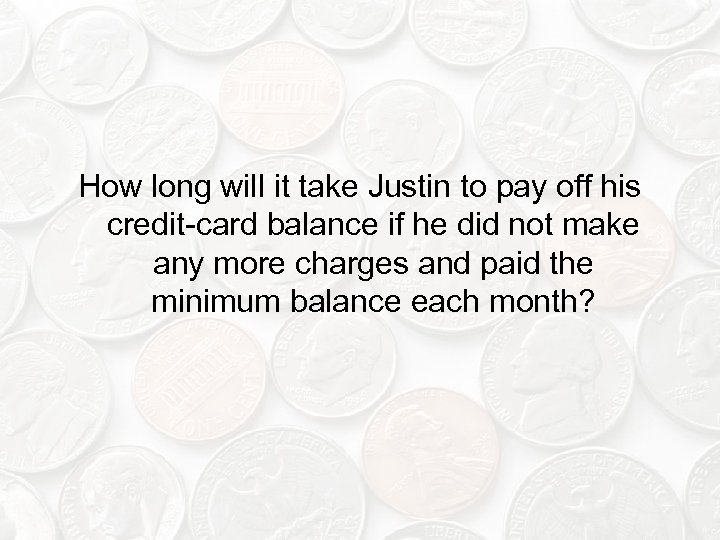 How long will it take Justin to pay off his credit-card balance if he did not make any more charges and paid the minimum balance each month?
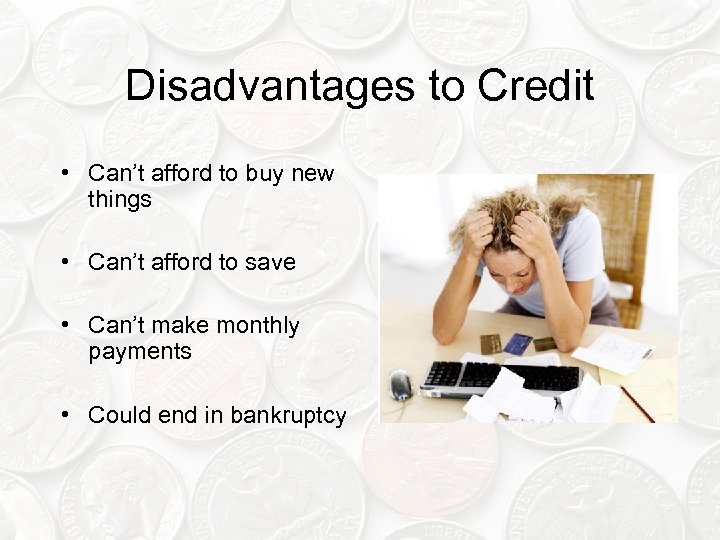 Disadvantages to Credit • Can’t afford to buy new things • Can’t afford to save • Can’t make monthly payments • Could end in bankruptcy
 Consider This Situation • It is midnight and your car breaks down on Interstate 94. You are far from home. You use your cell phone to call an emergency autorepair service. The service representative tells you that a service visit will cost $50, plus the cost of any parts and labor that are necessary to get you driving again. You have $7. 57 in your pocket. Should you use a credit card?
 • Activity 3
 When To Use Credit • Investing in your future – Schooling – A more reliable vehicle • Emergencies – Car breakdown • Buy something that will cost more later • Acquire something of great value that you may not be able to obtain at a later date
 • ASSIGNMENT!!!
 Why Don’t People Save? Lesson 15
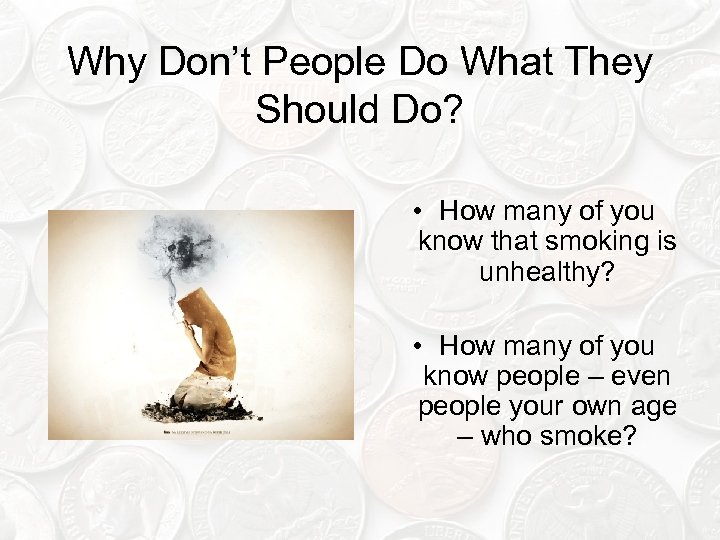 Why Don’t People Do What They Should Do? • How many of you know that smoking is unhealthy? • How many of you know people – even people your own age – who smoke?
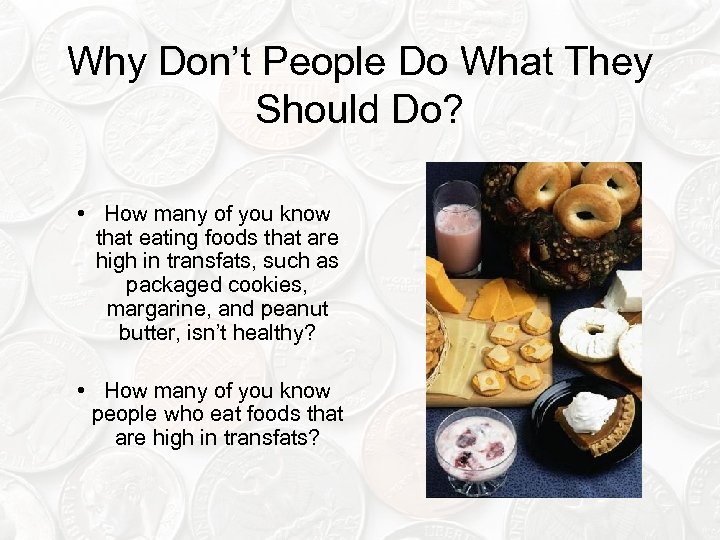 Why Don’t People Do What They Should Do? • How many of you know that eating foods that are high in transfats, such as packaged cookies, margarine, and peanut butter, isn’t healthy? • How many of you know people who eat foods that are high in transfats?
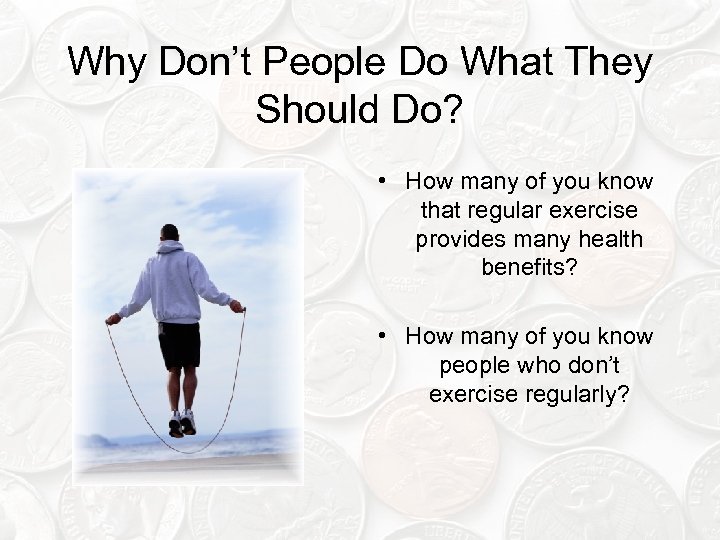 Why Don’t People Do What They Should Do? • How many of you know that regular exercise provides many health benefits? • How many of you know people who don’t exercise regularly?
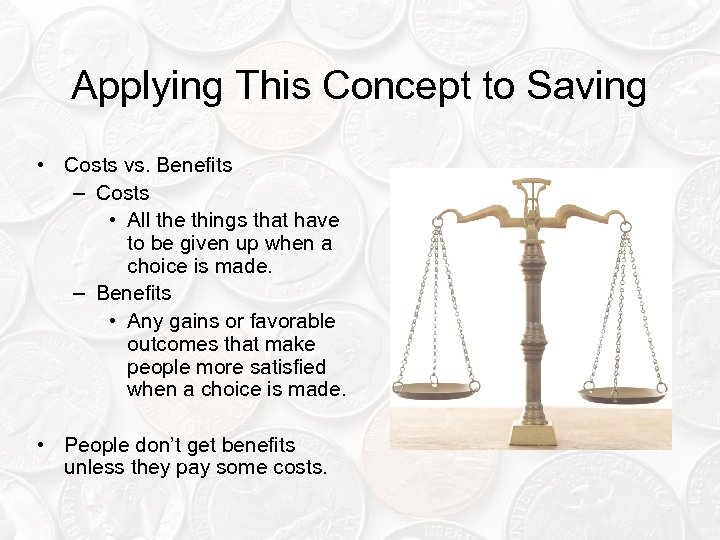 Applying This Concept to Saving • Costs vs. Benefits – Costs • All the things that have to be given up when a choice is made. – Benefits • Any gains or favorable outcomes that make people more satisfied when a choice is made. • People don’t get benefits unless they pay some costs.
 Costs & Benefits of Healthy Eating • What are the benefits of eating a healthful diet and exercising regularly? • Do these benefits occur now or in the future? • Can people count on these benefits for sure? • What are the costs of choosing a healthful diet and exercising regularly? • Do these costs occur now or in the future?
 Costs & Benefits of Saving • What are the benefits of saving? • What are the costs of saving? • When do the benefits of savings occur? • When do the costs of saving occur?
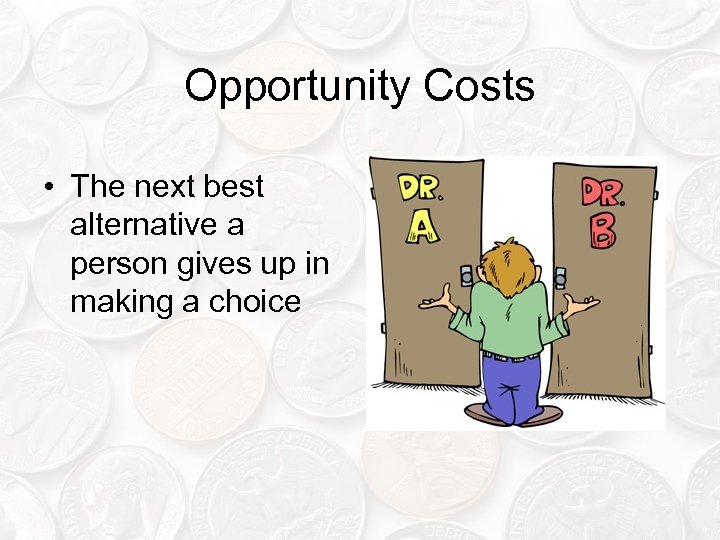 Opportunity Costs • The next best alternative a person gives up in making a choice
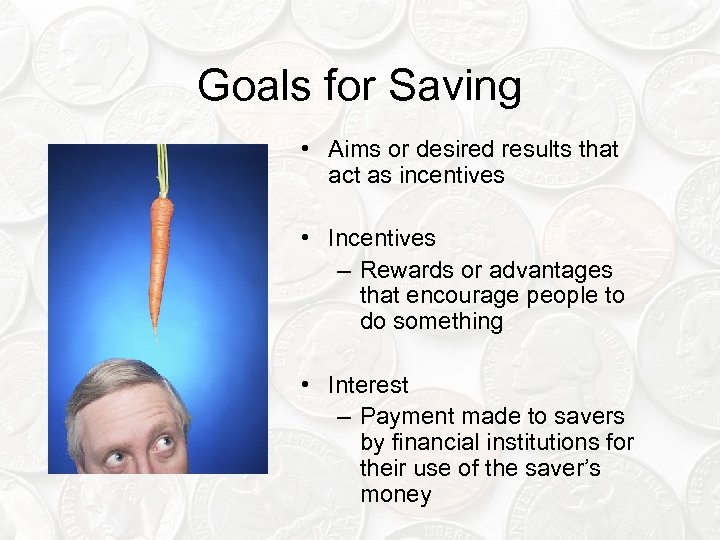 Goals for Saving • Aims or desired results that act as incentives • Incentives – Rewards or advantages that encourage people to do something • Interest – Payment made to savers by financial institutions for their use of the saver’s money
 Short-Term Savings Goals • Can be achieved in one year or less. – Saving to buy a new pair of pants or a video game
 Medium-Term Savings Goals • Can be achieved in one to five years – Pay for a vacation
 Long-Term Savings Goals • Require over five years to achieve – Saving money for a college education
 ASSIGNMENT!!!