 Скачать презентацию Economics TENTH EDITION by David Begg Gianluigi Vernasca
053674f572ca4295fe820a9584818dd7.ppt
- Количество слайдов: 18



Economics TENTH EDITION by David Begg, Gianluigi Vernasca, Stanley Fischer & Rudiger Dornbusch Chapter 24 Exchange rates and the balance of payments ©Mc. Graw-Hill Companies, 2010
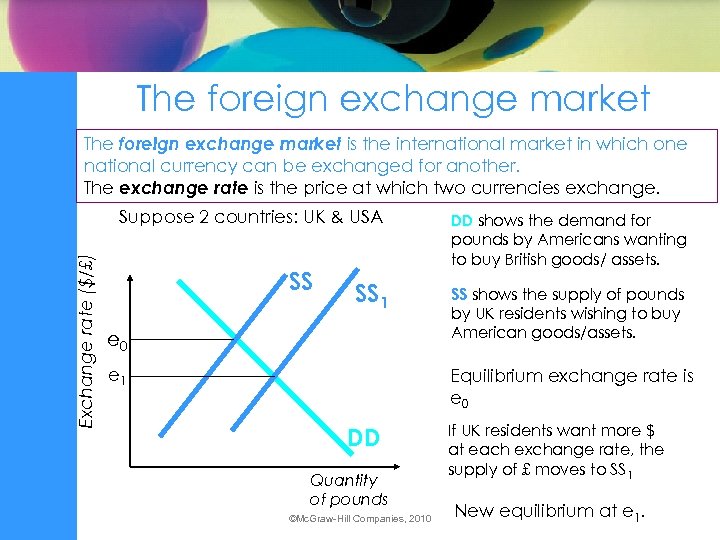
The foreign exchange market is the international market in which one national currency can be exchanged for another. The exchange rate is the price at which two currencies exchange. Exchange rate ($/£) Suppose 2 countries: UK & USA SS SS 1 e 0 e 1 DD shows the demand for pounds by Americans wanting to buy British goods/ assets. SS shows the supply of pounds by UK residents wishing to buy American goods/assets. Equilibrium exchange rate is e 0 DD Quantity of pounds ©Mc. Graw-Hill Companies, 2010 If UK residents want more $ at each exchange rate, the supply of £ moves to SS 1 New equilibrium at e 1.
Exchange rate regimes • In a fixed exchange rate regime – the national governments agree to maintain the convertibility of their currency at a fixed exchange rate. • In a flexible exchange rate regime – the exchange rate is allowed to attain its free market equilibrium level without any government intervention using exchange reserves. ©Mc. Graw-Hill Companies, 2010
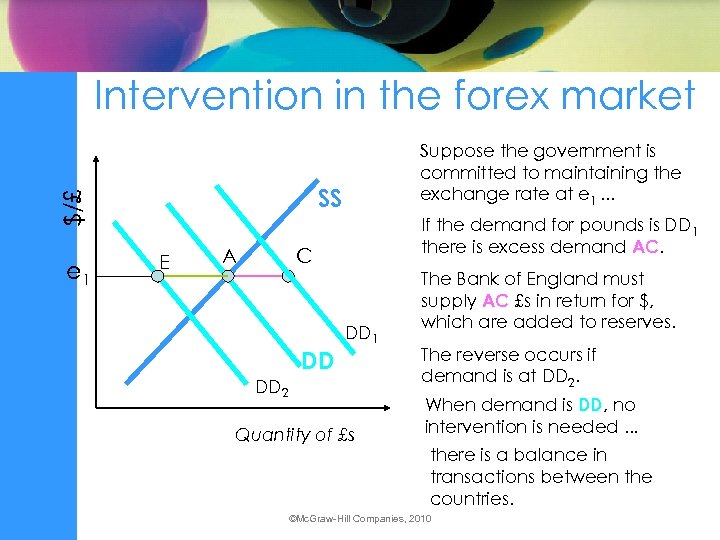
Intervention in the forex market SS $/£ e 1 Suppose the government is committed to maintaining the exchange rate at e 1. . . E A If the demand for pounds is DD 1 there is excess demand AC. C DD DD 1 DD 2 Quantity of £s The Bank of England must supply AC £s in return for $, which are added to reserves. The reverse occurs if demand is at DD 2. When demand is DD, no intervention is needed. . . there is a balance in transactions between the countries. ©Mc. Graw-Hill Companies, 2010
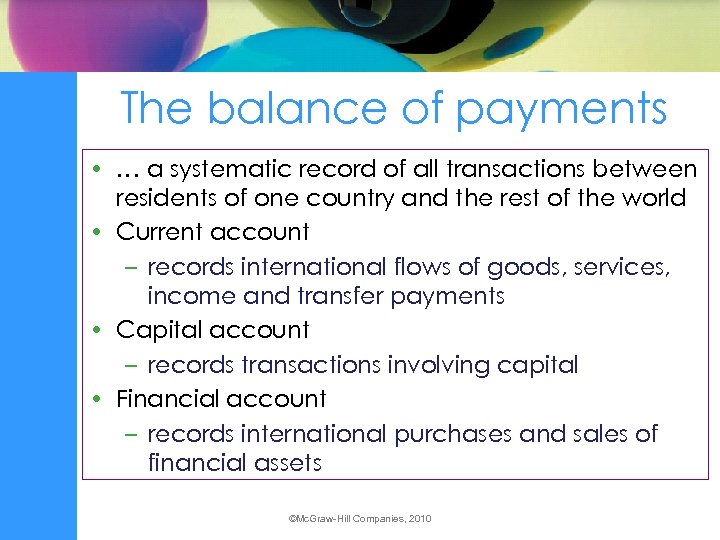
The balance of payments • … a systematic record of all transactions between residents of one country and the rest of the world • Current account – records international flows of goods, services, income and transfer payments • Capital account – records transactions involving capital • Financial account – records international purchases and sales of financial assets ©Mc. Graw-Hill Companies, 2010
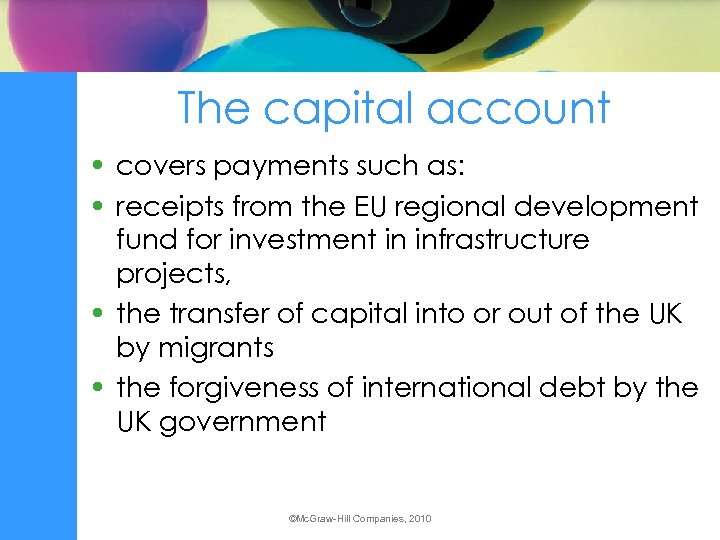
The capital account • covers payments such as: • receipts from the EU regional development fund for investment in infrastructure projects, • the transfer of capital into or out of the UK by migrants • the forgiveness of international debt by the UK government ©Mc. Graw-Hill Companies, 2010
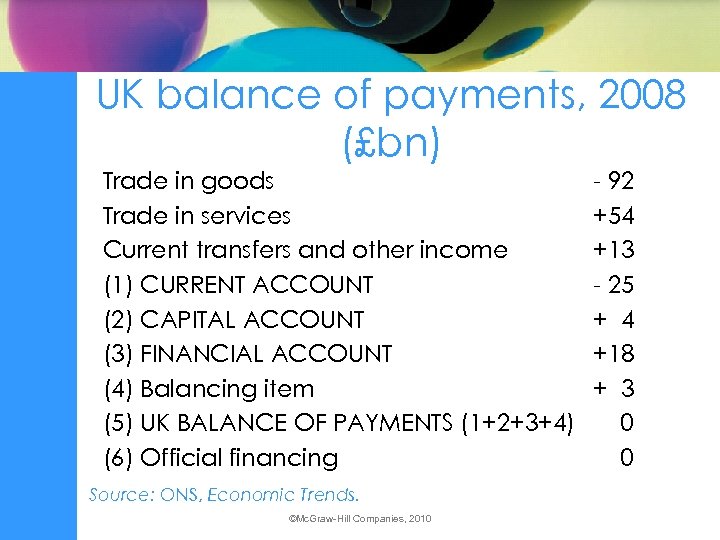
UK balance of payments, 2008 (£bn) Trade in goods Trade in services Current transfers and other income (1) CURRENT ACCOUNT (2) CAPITAL ACCOUNT (3) FINANCIAL ACCOUNT (4) Balancing item (5) UK BALANCE OF PAYMENTS (1+2+3+4) (6) Official financing Source: ONS, Economic Trends. ©Mc. Graw-Hill Companies, 2010 - 92 +54 +13 - 25 + 4 +18 + 3 0 0
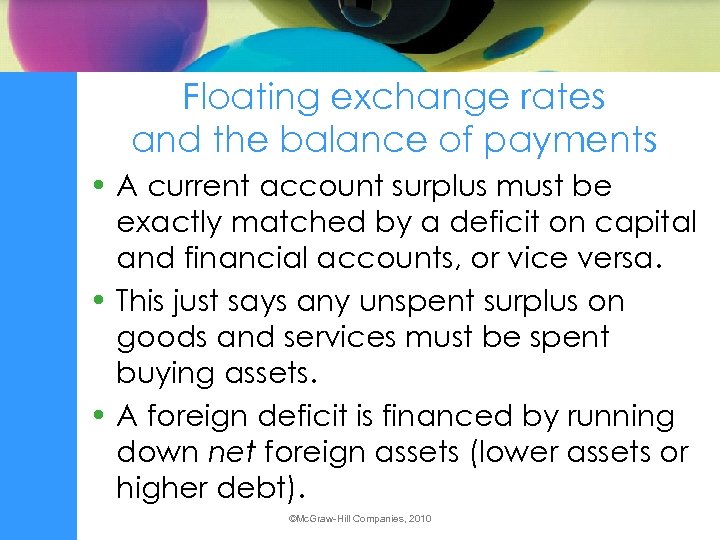
Floating exchange rates and the balance of payments • A current account surplus must be exactly matched by a deficit on capital and financial accounts, or vice versa. • This just says any unspent surplus on goods and services must be spent buying assets. • A foreign deficit is financed by running down net foreign assets (lower assets or higher debt). ©Mc. Graw-Hill Companies, 2010
International competitiveness • The competitiveness of UK goods in international markets depends upon: – the nominal exchange rate – relative inflation rates. • The real exchange rate – measures the relative price of goods from different countries when measured in a common currency. – Changes in the real effective exchange rate are a good indication of what is happening to competitiveness. ©Mc. Graw-Hill Companies, 2010
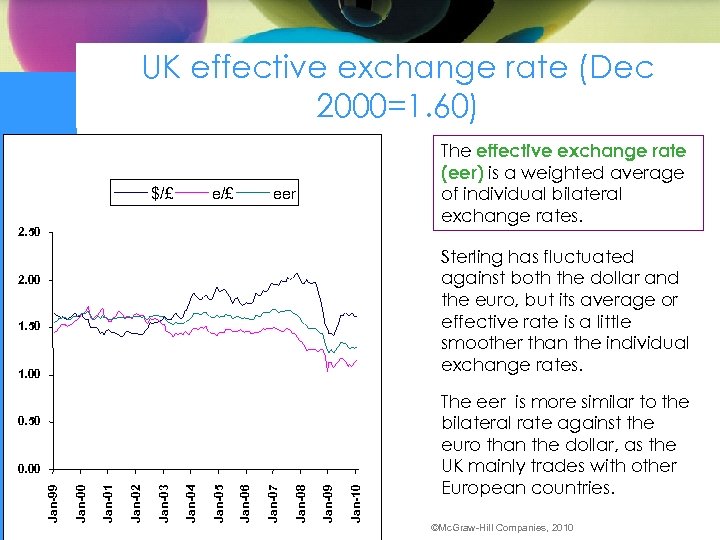
UK effective exchange rate (Dec 2000=1. 60) $/£ e/£ The effective exchange rate (eer) is a weighted average of individual bilateral exchange rates. eer 2. 50 Sterling has fluctuated against both the dollar and the euro, but its average or effective rate is a little smoother than the individual exchange rates. 2. 00 1. 50 1. 00 0. 50 Jan-10 Jan-09 Jan-08 Jan-07 Jan-06 Jan-05 Jan-04 Jan-03 Jan-02 Jan-01 Jan-00 Jan-99 0. 00 The eer is more similar to the bilateral rate against the euro than the dollar, as the UK mainly trades with other European countries. ©Mc. Graw-Hill Companies, 2010
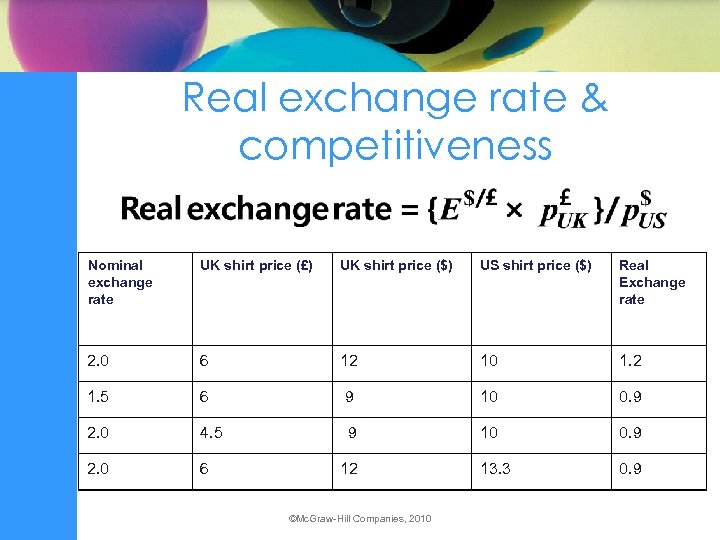
Real exchange rate & competitiveness Nominal exchange rate UK shirt price (£) UK shirt price ($) US shirt price ($) Real Exchange rate 2. 0 6 12 10 1. 2 1. 5 6 9 10 0. 9 2. 0 4. 5 9 10 0. 9 2. 0 6 13. 3 0. 9 12 ©Mc. Graw-Hill Companies, 2010
Components of the balance of payments • The current account is influenced by: – competitiveness – domestic and foreign income • The capital & financial accounts are influenced by: – relative interest rates • which affect international capital flows. • Perfect capital mobility means that a vast quantity of funds flow from one currency to another if the expected return on assets differs across currencies. ©Mc. Graw-Hill Companies, 2010

Internal and external balance • Internal balance – a situation for a country when aggregate demand is at the full-employment level • External balance – a situation for a country when the current account of the balance of payments just balances • The combination of internal and external balance is the long-run equilibrium for the economy. ©Mc. Graw-Hill Companies, 2010
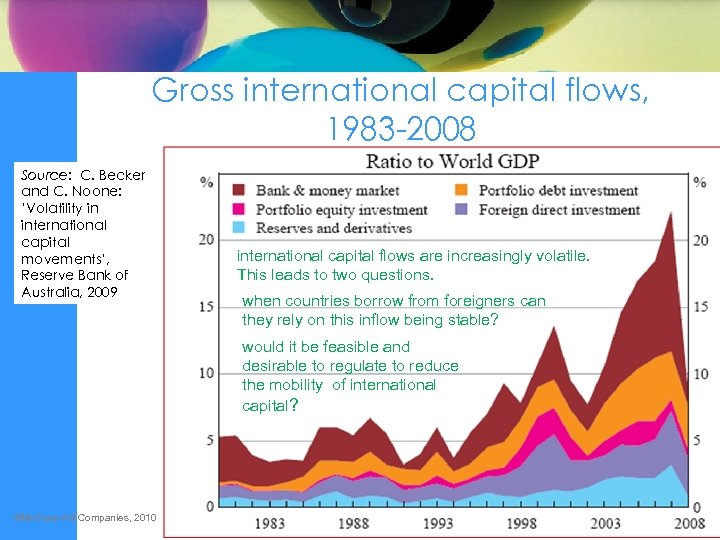
Gross international capital flows, 1983 -2008 Source: C. Becker and C. Noone: ‘Volatility in international capital movements’, Reserve Bank of Australia, 2009 international capital flows are increasingly volatile. This leads to two questions. when countries borrow from foreigners can they rely on this inflow being stable? would it be feasible and desirable to regulate to reduce the mobility of international capital? ©Mc. Graw-Hill Companies, 2010
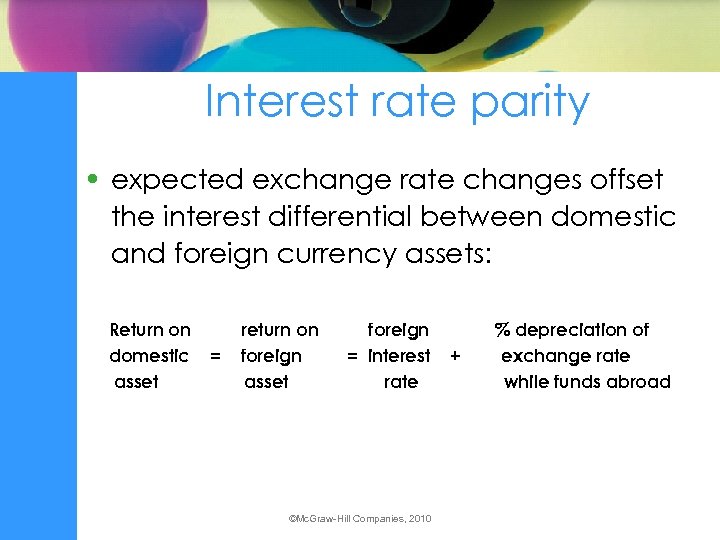
Interest rate parity • expected exchange rate changes offset the interest differential between domestic and foreign currency assets: Return on domestic asset = return on foreign asset foreign = interest rate ©Mc. Graw-Hill Companies, 2010 + % depreciation of exchange rate while funds abroad
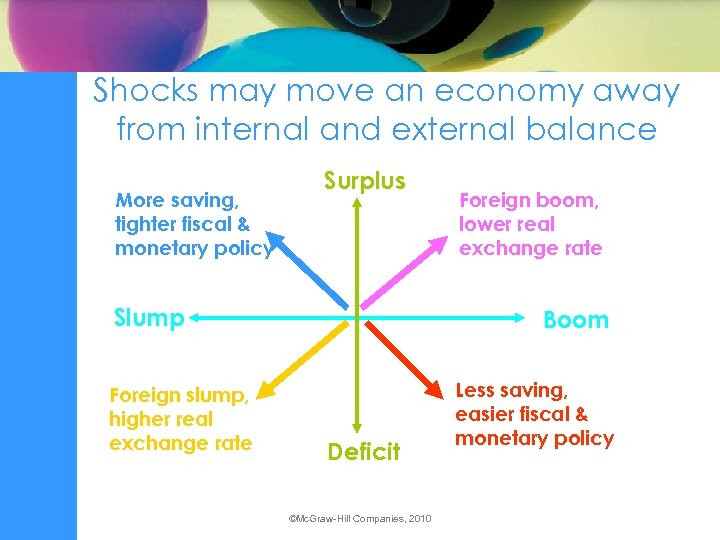
Shocks may move an economy away from internal and external balance More saving, tighter fiscal & monetary policy Surplus Slump Foreign slump, higher real exchange rate Foreign boom, lower real exchange rate Boom Deficit ©Mc. Graw-Hill Companies, 2010 Less saving, easier fiscal & monetary policy
Balassa Samuelson effect • Countries with higher per capita real incomes have a higher real exchange rate. • Typically, there is more technical progress in industries making goods for trade (computers, cars, telecommunications) than in industries making services for the home economy (haircuts, laundry, crèches). • Countries with high per capita incomes therefore have high real exchange rates because their traded goods sector is more productive. • Without real exchange rate appreciation such countries would be too competitive. ©Mc. Graw-Hill Companies, 2010
Balassa Samuelson effect & China • China has fixed its exchange rate to the US dollar at a level that keeps the Chinese economy super-competitive. This is why China has massive current account surpluses (and other countries deficits). • Apart from an upward adjustment of China’s nominal exchange rate, it is possible that Chinese prices will rise sufficiently more quickly that those in the west that the real exchange rate increases substantially. • However, the Balassa Samuelson effect suggests that as Chinese economic development continues, rapid productivity growth in its traded goods sector will allow it to cope with some degree of real appreciation without losing competitiveness. ©Mc. Graw-Hill Companies, 2010
Скачать презентацию Economics TENTH EDITION by David Begg Gianluigi Vernasca
053674f572ca4295fe820a9584818dd7.ppt