 Скачать презентацию Economics of Restricting Rural-Urban Trade Prof Mike Young
aeaf85fbe15be487aae11f5bd70cb5b0.ppt
- Количество слайдов: 18



Economics of Restricting Rural-Urban Trade Prof. Mike Young Research Chair, Water Economics & Management School of Earth and Environmental Sciences The University of Adelaide Friday 1 st September 2006
Rural-Urban Trade Experience Water trading is occurring in § California § Texas § China § Adelaide (perm. ) § Perth (temp. only so far) Pipelines, pumps and gravity § Kalgoorlie pipeline - 600 kms § Adelaide pipeline - 48 kms over up 418 m § Whyalla, Port Augusta and Pt Pirie – Two 379 km pipelines 2
Urban Water Management Challenges Reducing Supply § Adverse climate change § Environmental flow enhancement Increasing Demand § Population increase § Households § Commercial and Industrial § Without more new water, what can we do? 3
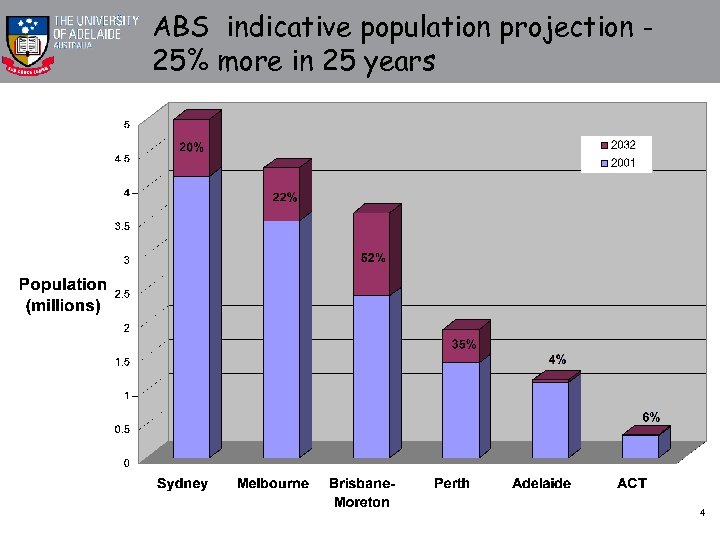
ABS indicative population projection 25% more in 25 years 4
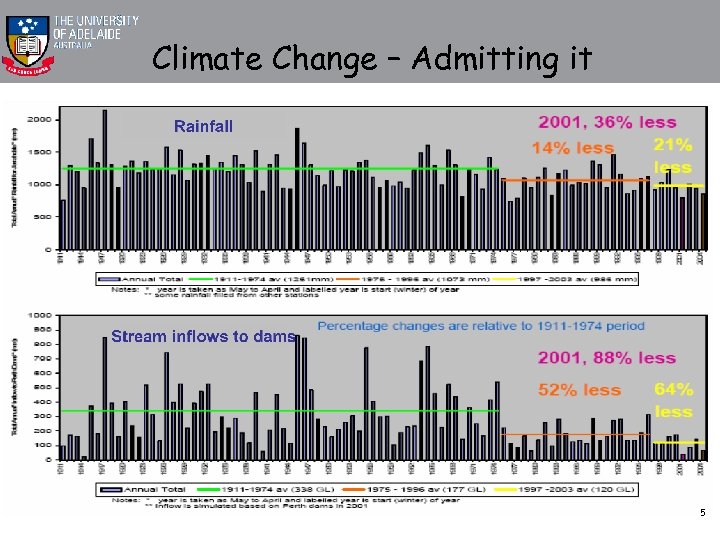
Climate Change – Admitting it 5
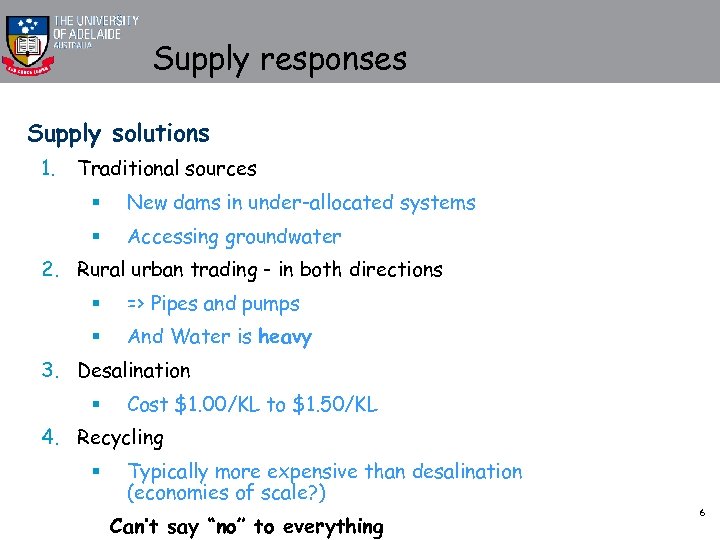
Supply responses Supply solutions 1. Traditional sources § New dams in under-allocated systems § Accessing groundwater 2. Rural urban trading - in both directions § => Pipes and pumps § And Water is heavy 3. Desalination § Cost $1. 00/KL to $1. 50/KL 4. Recycling § Typically more expensive than desalination (economies of scale? ) Can’t say “no” to everything 6
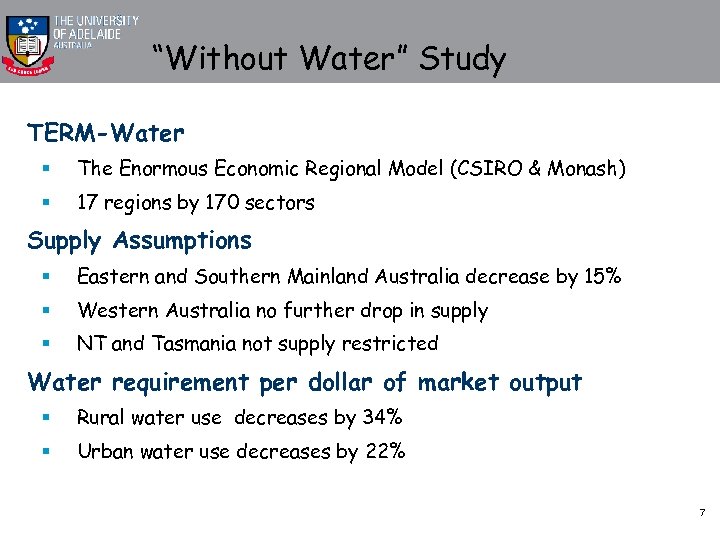
“Without Water” Study TERM-Water § The Enormous Economic Regional Model (CSIRO & Monash) § 17 regions by 170 sectors Supply Assumptions § Eastern and Southern Mainland Australia decrease by 15% § Western Australia no further drop in supply § NT and Tasmania not supply restricted Water requirement per dollar of market output § Rural water use decreases by 34% § Urban water use decreases by 22% 7
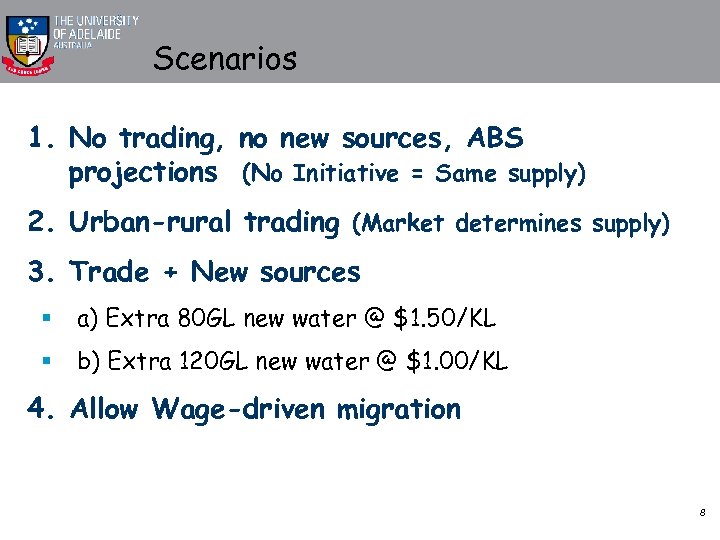
Scenarios 1. No trading, no new sources, ABS projections (No Initiative = Same supply) 2. Urban-rural trading (Market determines supply) 3. Trade + New sources § a) Extra 80 GL new water @ $1. 50/KL § b) Extra 120 GL new water @ $1. 00/KL 4. Allow Wage-driven migration 8
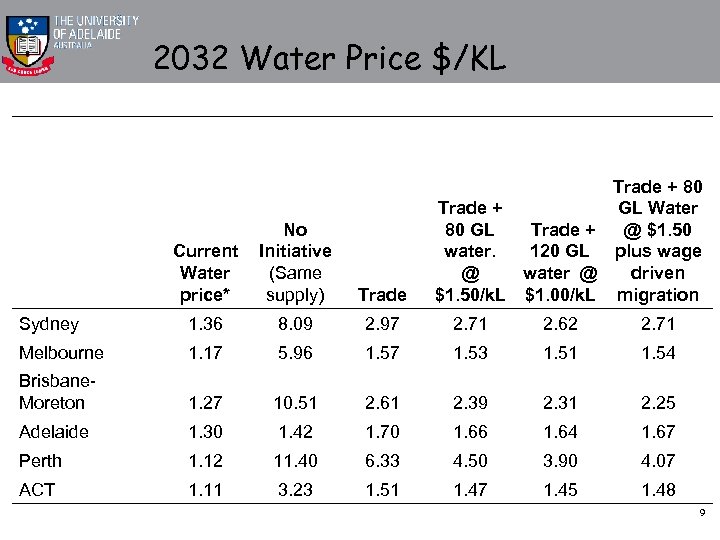
2032 Water Price $/KL No Current Initiative (Same Water price* supply) Trade + 80 GL Water Trade + 80 GL Trade + @ $1. 50 water. 120 GL plus wage @ water @ driven $1. 50/k. L $1. 00/k. L migration Sydney 1. 36 8. 09 2. 97 2. 71 2. 62 2. 71 Melbourne 1. 17 5. 96 1. 57 1. 53 1. 51 1. 54 Brisbane. Moreton 1. 27 10. 51 2. 61 2. 39 2. 31 2. 25 Adelaide 1. 30 1. 42 1. 70 1. 66 1. 64 1. 67 Perth 1. 12 11. 40 6. 33 4. 50 3. 90 4. 07 ACT 1. 11 3. 23 1. 51 1. 47 1. 45 1. 48 9
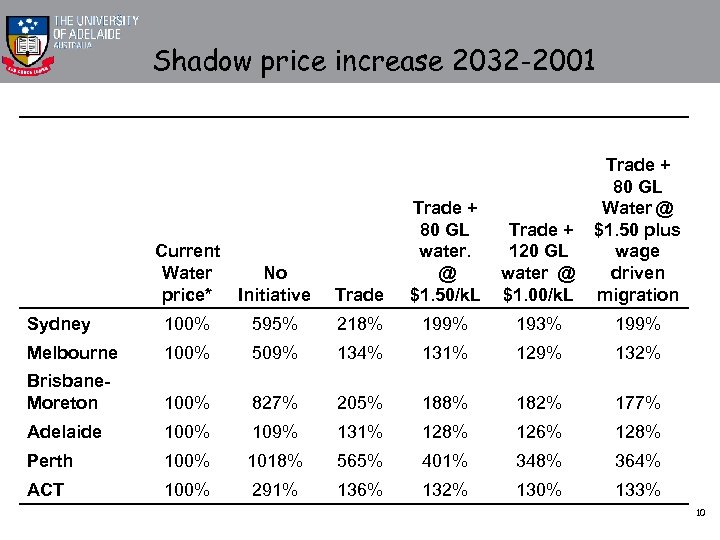
Shadow price increase 2032 -2001 Current Water No price* Initiative Trade + 80 GL water. @ $1. 50/k. L Trade + 80 GL Water @ Trade + $1. 50 plus 120 GL wage water @ driven $1. 00/k. L migration Sydney 100% 595% 218% 199% 193% 199% Melbourne 100% 509% 134% 131% 129% 132% Brisbane. Moreton 100% 827% 205% 188% 182% 177% Adelaide 100% 109% 131% 128% 126% 128% Perth 100% 1018% 565% 401% 348% 364% ACT 100% 291% 136% 132% 130% 133% 10
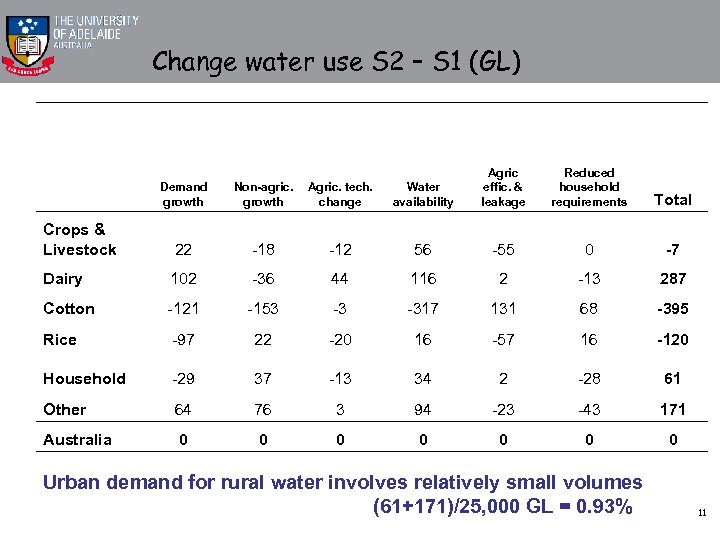
Change water use S 2 – S 1 (GL) Demand growth Non-agric. Agric. tech. growth change Water availability Agric effic. & leakage Reduced household requirements Total Crops & Livestock 22 -18 -12 56 -55 0 -7 Dairy 102 -36 44 116 2 -13 287 Cotton -121 -153 -3 -317 131 68 -395 Rice -97 22 -20 16 -57 16 -120 Household -29 37 -13 34 2 -28 61 Other 64 76 3 94 -23 -43 171 Australia 0 0 0 0 Urban demand for rural water involves relatively small volumes (61+171)/25, 000 GL = 0. 93% 11
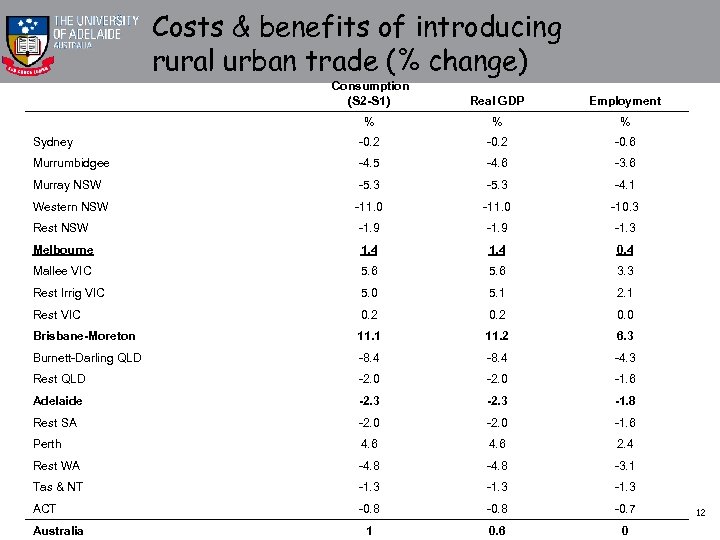
Costs & benefits of introducing rural urban trade (% change) Consumption (S 2 -S 1) Real GDP Employment % % % Sydney -0. 2 -0. 6 Murrumbidgee -4. 5 -4. 6 -3. 6 Murray NSW -5. 3 -4. 1 Western NSW -11. 0 -10. 3 Rest NSW -1. 9 -1. 3 Melbourne 1. 4 0. 4 Mallee VIC 5. 6 3. 3 Rest Irrig VIC 5. 0 5. 1 2. 1 Rest VIC 0. 2 0. 0 Brisbane-Moreton 11. 1 11. 2 6. 3 Burnett-Darling QLD -8. 4 -4. 3 Rest QLD -2. 0 -1. 6 Adelaide -2. 3 -1. 8 Rest SA -2. 0 -1. 6 Perth 4. 6 2. 4 Rest WA -4. 8 -3. 1 Tas & NT -1. 3 ACT -0. 8 -0. 7 1 0. 6 0 Australia 12
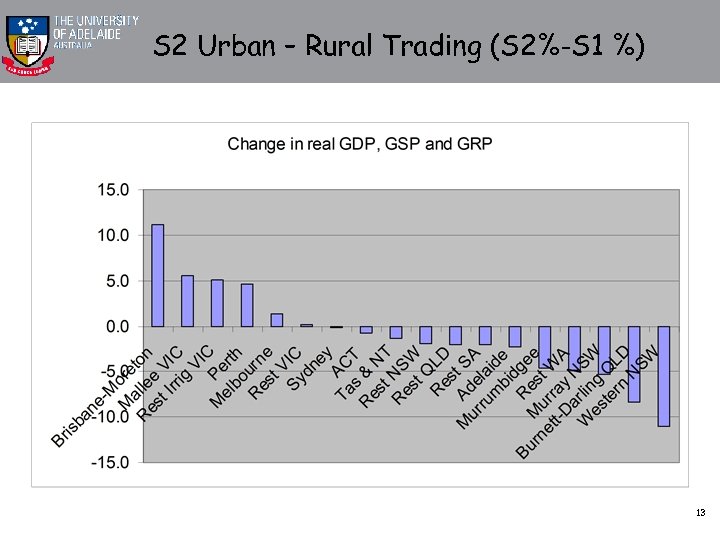
S 2 Urban – Rural Trading (S 2%-S 1 %) 13

Urban - Rural Trade Issues How much should do we worry about equity, given that water price - as an equity lever is very inefficient? How much do we expose urban & industrial Australia to rural price disciplines? Imagine § Households whose water charges are a direct function of the traded price of water and dam supplies § Industrial and Commercial Users with tradeable allocations § Developers having to buy the water to get sub-division approval § Households with an option and opportunity to trade “their” water allocations (Individually tailored inclining tarrifs) § People profiting from stormwater capture and waste water recycling 14

In cities, small volumes go a long way Contact: Prof Mike Young Water Economics and Management Email: Mike. Young@adelaide. edu. au Phone: +61 -8 -8303. 5279 Mobile: +61 -408 -488. 538
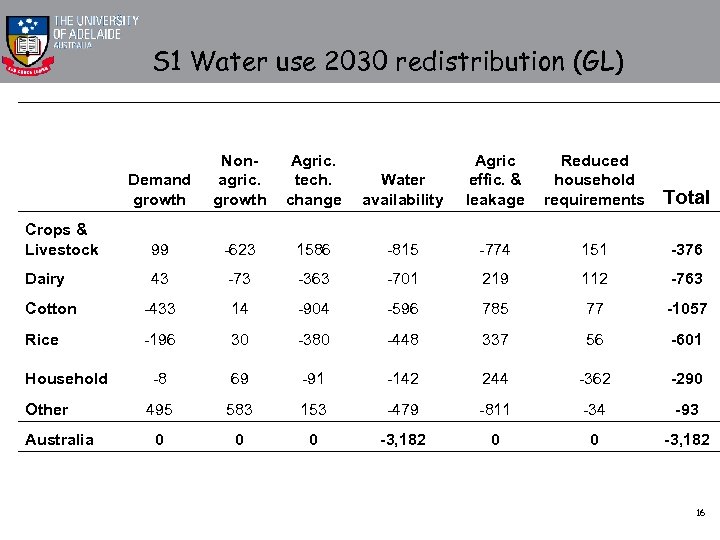
S 1 Water use 2030 redistribution (GL) Demand growth Nonagric. growth Agric. tech. change Crops & Livestock 99 -623 Dairy 43 Cotton Rice Household Other Australia Water availability Agric effic. & leakage Reduced household requirements Total 1586 -815 -774 151 -376 -73 -363 -701 219 112 -763 -433 14 -904 -596 785 77 -1057 -196 30 -380 -448 337 56 -601 -8 69 -91 -142 244 -362 -290 495 583 153 -479 -811 -34 -93 0 0 0 -3, 182 16
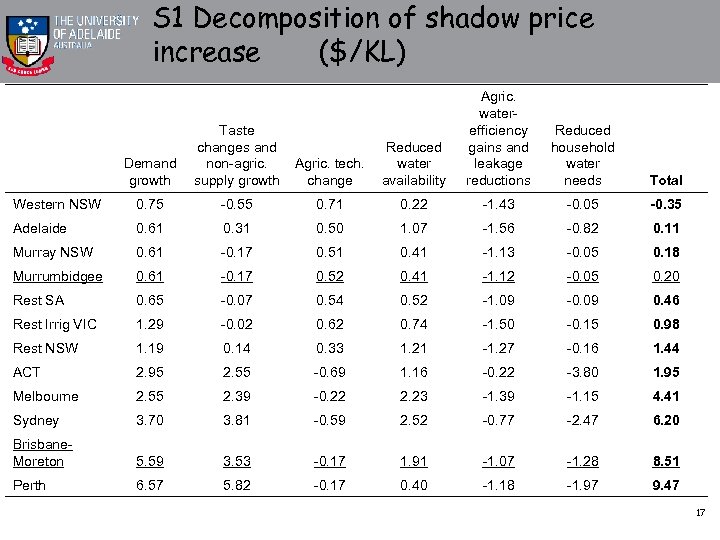
S 1 Decomposition of shadow price increase ($/KL) Taste changes and non-agric. Demand growth supply growth Reduced water Agric. tech. change availability Agric. waterefficiency gains and leakage reductions Reduced household water needs Total Western NSW 0. 75 -0. 55 0. 71 0. 22 -1. 43 -0. 05 -0. 35 Adelaide 0. 61 0. 31 0. 50 1. 07 -1. 56 -0. 82 0. 11 Murray NSW 0. 61 -0. 17 0. 51 0. 41 -1. 13 -0. 05 0. 18 Murrumbidgee 0. 61 -0. 17 0. 52 0. 41 -1. 12 -0. 05 0. 20 Rest SA 0. 65 -0. 07 0. 54 0. 52 -1. 09 -0. 09 0. 46 Rest Irrig VIC 1. 29 -0. 02 0. 62 0. 74 -1. 50 -0. 15 0. 98 Rest NSW 1. 19 0. 14 0. 33 1. 21 -1. 27 -0. 16 1. 44 ACT 2. 95 2. 55 -0. 69 1. 16 -0. 22 -3. 80 1. 95 Melbourne 2. 55 2. 39 -0. 22 2. 23 -1. 39 -1. 15 4. 41 Sydney 3. 70 3. 81 -0. 59 2. 52 -0. 77 -2. 47 6. 20 Brisbane. Moreton 5. 59 3. 53 -0. 17 1. 91 -1. 07 -1. 28 8. 51 Perth 6. 57 5. 82 -0. 17 0. 40 -1. 18 -1. 97 9. 47 17
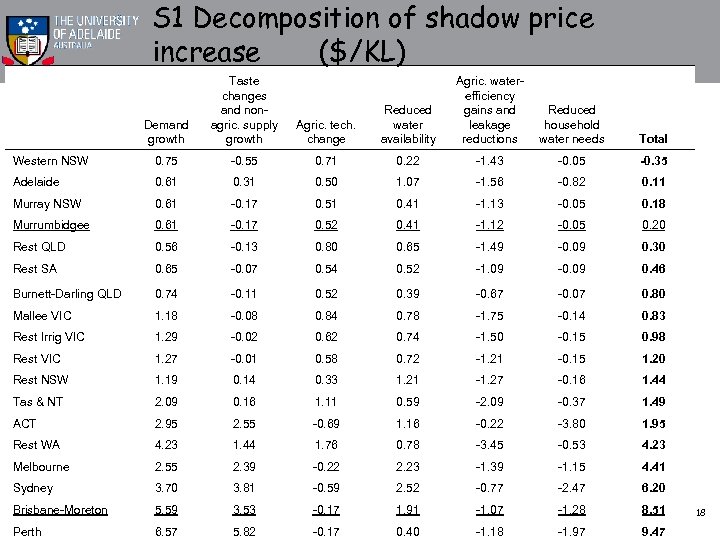
S 1 Decomposition of shadow price increase ($/KL) Demand growth Taste changes and nonagric. supply growth Agric. tech. change Reduced water availability Agric. waterefficiency gains and leakage reductions Reduced household water needs Total Western NSW 0. 75 -0. 55 0. 71 0. 22 -1. 43 -0. 05 -0. 35 Adelaide 0. 61 0. 31 0. 50 1. 07 -1. 56 -0. 82 0. 11 Murray NSW 0. 61 -0. 17 0. 51 0. 41 -1. 13 -0. 05 0. 18 Murrumbidgee 0. 61 -0. 17 0. 52 0. 41 -1. 12 -0. 05 0. 20 Rest QLD 0. 56 -0. 13 0. 80 0. 65 -1. 49 -0. 09 0. 30 Rest SA 0. 65 -0. 07 0. 54 0. 52 -1. 09 -0. 09 0. 46 Burnett-Darling QLD 0. 74 -0. 11 0. 52 0. 39 -0. 67 -0. 07 0. 80 Mallee VIC 1. 18 -0. 08 0. 84 0. 78 -1. 75 -0. 14 0. 83 Rest Irrig VIC 1. 29 -0. 02 0. 62 0. 74 -1. 50 -0. 15 0. 98 Rest VIC 1. 27 -0. 01 0. 58 0. 72 -1. 21 -0. 15 1. 20 Rest NSW 1. 19 0. 14 0. 33 1. 21 -1. 27 -0. 16 1. 44 Tas & NT 2. 09 0. 16 1. 11 0. 59 -2. 09 -0. 37 1. 49 ACT 2. 95 2. 55 -0. 69 1. 16 -0. 22 -3. 80 1. 95 Rest WA 4. 23 1. 44 1. 76 0. 78 -3. 45 -0. 53 4. 23 Melbourne 2. 55 2. 39 -0. 22 2. 23 -1. 39 -1. 15 4. 41 Sydney 3. 70 3. 81 -0. 59 2. 52 -0. 77 -2. 47 6. 20 Brisbane-Moreton 5. 59 3. 53 -0. 17 1. 91 -1. 07 -1. 28 8. 51 Perth 6. 57 5. 82 -0. 17 0. 40 -1. 18 -1. 97 9. 47 18
Скачать презентацию Economics of Restricting Rural-Urban Trade Prof Mike Young
aeaf85fbe15be487aae11f5bd70cb5b0.ppt