


 Скачать презентацию Economics of Integration Lecture Common Agricultural Policy
Lecture 6 - CAP.pptx
- Количество слайдов: 12
 Economics of Integration Lecture : Common Agricultural Policy
 Why integration in agriculture? • National governments often regulate agriculture to protect farmers and consumers from market risks (unstable conditions and prices), to ensure self-reliance in food, and to support rural communities; • But to leave agriculture outside integrated single market was not logical and not consistent with free flow of other goods and labour, because it would result in different price levels in different countries; • The solution was therefore to regulate agriculture at the community level;
 Why agricultural markets are specific? • Agricultural markets tend to be inherently unstable, much more than other goods markets; • Because foodstuffs are vital neccessities, demand for food is price-inelastic (does not change much in response to price changes); • But supply of food depends very much on weather conditions and on individual decisions of very many suppliers; in result, the supply of food fluctuates widely; • Individual farmers normally take production decisions based on past experience, but they don’t know production plans of other farmers and obviously the future weather conditions are unknown; this mechanism results in oversupply or in shortage of main agro products; • The combination of inelastic (rigid) demand flexible supply results in wide price fluctuations; • Price fluctuations strongly affect incomes levels of farmers, and the wellbeing of consumers, especially of the poor; • All this justifies government intervention and marketr regulation;
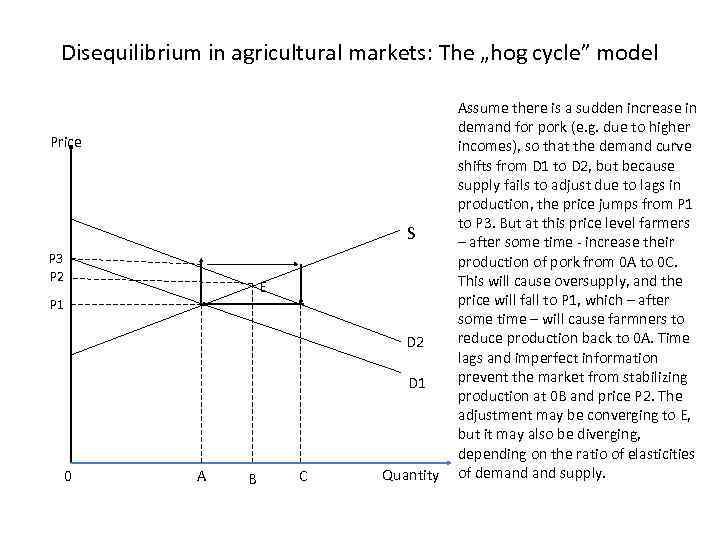 Disequilibrium in agricultural markets: The „hog cycle” model Price S P 3 P 2 E P 1 D 2 D 1 0 A B C Quantity Assume there is a sudden increase in demand for pork (e. g. due to higher incomes), so that the demand curve shifts from D 1 to D 2, but because supply fails to adjust due to lags in production, the price jumps from P 1 to P 3. But at this price level farmers – after some time - increase their production of pork from 0 A to 0 C. This will cause oversupply, and the price will fall to P 1, which – after some time – will cause farmners to reduce production back to 0 A. Time lags and imperfect information prevent the market from stabilizing production at 0 B and price P 2. The adjustment may be converging to E, but it may also be diverging, depending on the ratio of elasticities of demand supply.
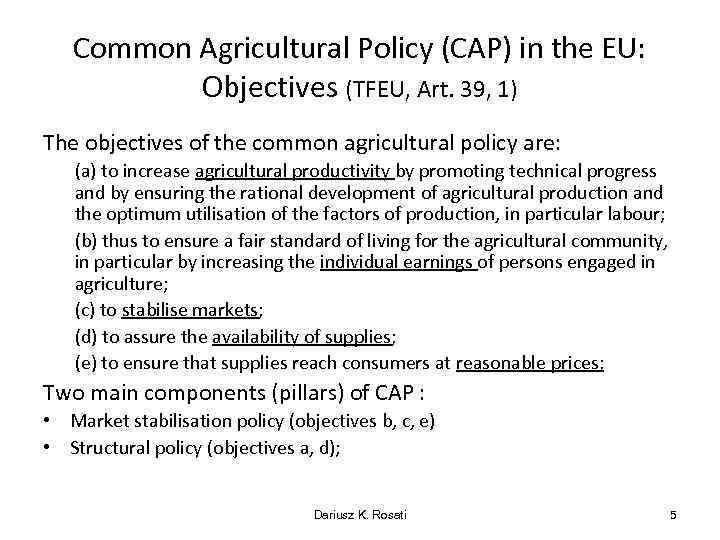 Common Agricultural Policy (CAP) in the EU: Objectives (TFEU, Art. 39, 1) The objectives of the common agricultural policy are: (a) to increase agricultural productivity by promoting technical progress and by ensuring the rational development of agricultural production and the optimum utilisation of the factors of production, in particular labour; (b) thus to ensure a fair standard of living for the agricultural community, in particular by increasing the individual earnings of persons engaged in agriculture; (c) to stabilise markets; (d) to assure the availability of supplies; (e) to ensure that supplies reach consumers at reasonable prices; Two main components (pillars) of CAP : • Market stabilisation policy (objectives b, c, e) • Structural policy (objectives a, d); Dariusz K. Rosati 5
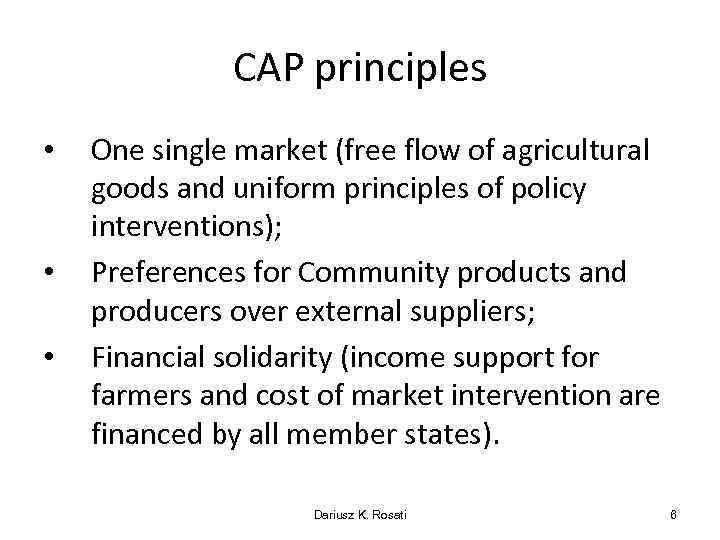 CAP principles • • • One single market (free flow of agricultural goods and uniform principles of policy interventions); Preferences for Community products and producers over external suppliers; Financial solidarity (income support for farmers and cost of market intervention are financed by all member states). Dariusz K. Rosati 6
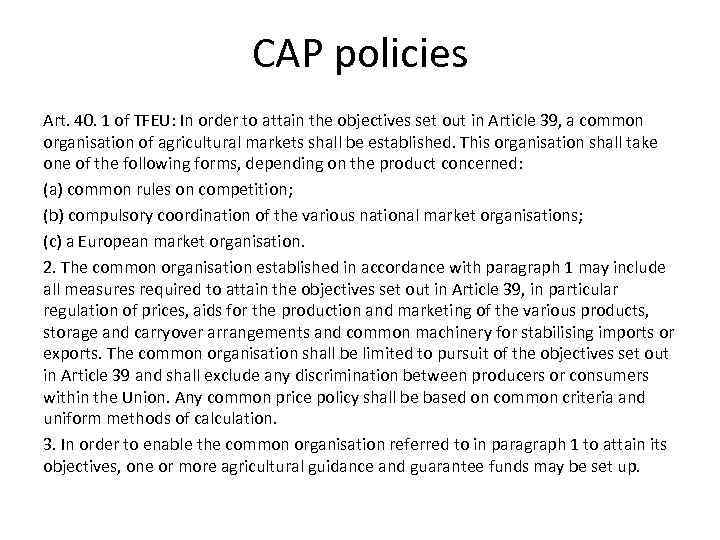 CAP policies Art. 40. 1 of TFEU: In order to attain the objectives set out in Article 39, a common organisation of agricultural markets shall be established. This organisation shall take one of the following forms, depending on the product concerned: (a) common rules on competition; (b) compulsory coordination of the various national market organisations; (c) a European market organisation. 2. The common organisation established in accordance with paragraph 1 may include all measures required to attain the objectives set out in Article 39, in particular regulation of prices, aids for the production and marketing of the various products, storage and carryover arrangements and common machinery for stabilising imports or exports. The common organisation shall be limited to pursuit of the objectives set out in Article 39 and shall exclude any discrimination between producers or consumers within the Union. Any common price policy shall be based on common criteria and uniform methods of calculation. 3. In order to enable the common organisation referred to in paragraph 1 to attain its objectives, one or more agricultural guidance and guarantee funds may be set up.
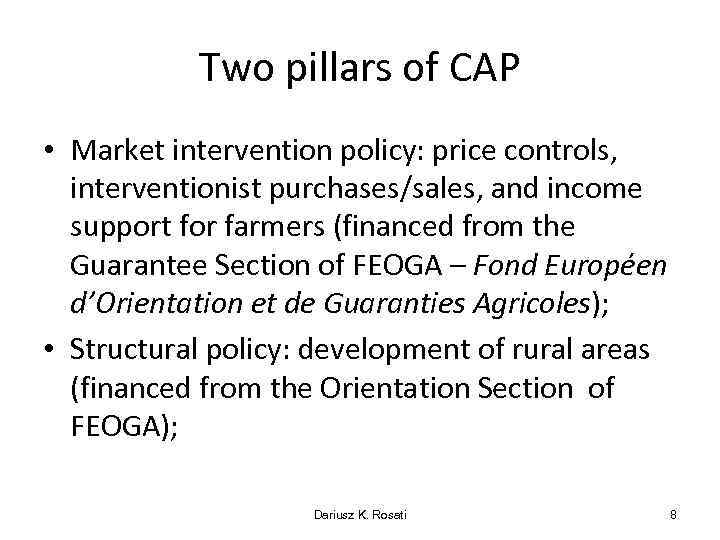 Two pillars of CAP • Market intervention policy: price controls, interventionist purchases/sales, and income support for farmers (financed from the Guarantee Section of FEOGA – Fond Européen d’Orientation et de Guaranties Agricoles); • Structural policy: development of rural areas (financed from the Orientation Section of FEOGA); Dariusz K. Rosati 8
 Ewolution of CAP WPR • • • – – – – – • Since 1962, a traditional model of market intervention and control: high market prices of agricultural products, external protection based on duties and variable levies; The outcomes: rapid growth of production leading to oversupply, accumulation of large stocks, increasing costs of CAP and dumping of foodstuffs on international markets; Mc. Sharry’s reform of 1992: A shift from a mechanism of supporting high prices support to subsidizing farmers’ incomes, and abolishing the link between growth of production and growth of farmers’ incomes (decoupling); Gradual reduction of intervention prices to reduce the gap between them and world market prices, while compensating farmers for lost income through direct subsidies; Lower intensity of agricultural production in the EU in order to reduce oversupply and better protect the natural environment through lower chemicals inputs and „set-aside” obligations; Change in agricultural expenditure structure in favour of support for rural areas, with less resources going to market interventions ; Agenda 2000 (Mc. Sharry’s reform continued): Further reduction of agricultural prices and increase of directr subsidies; WTO commitment to disontinue agricultural export subsidies and to replace variable levies with tariffs; Reduction of growth rate of CAP expenditures to 74% of GDP growth rate; Multifunctional development of rural areas (production plus environment protection); Cross compliance (direct subsidies dependent on compliance with environmental and animal protection conditions). Agreement Chirac-Schroeder (2002). Dariusz K. Rosati 9
 The current system of direct subsidies • Replacement of the old system of subsidizing production of individual agricultural products by a system of single payments per hectar (Single Payment Scheme – SPS), with their level dependent on the quality of food, environmental protection norms, sanitary and health standards; • Single payment per hectar calculated on the basisi of total subsidies in 2000 -2002, which in term were based on historical levels of agricultural production in 1987 -1992; • Gradual reduction of hectar payments in 2005 -2013; • Two categories of farms: faster reduction for farms receiving more than € 5, 000 subsidies; • Generally, these changes represent a departure from the product-support system to a farmer-support system;
 Modulation principle in CAP • Direct subsidies for farms receiving more than € 5000 support annually are systematically reduced by 5% a year in 20072013; • These resources saved on direct subsidies are partly used on development of rural areas (equivalent of 1%), and partly distrubuted at the EU level among member states (depending on the GDP/capita incomes level); • Smaller farms with direct subsidies of less than € 5000 are excluded from the modulation mechanism; Dariusz K. Rosati 11
 Types of agricultural intervention (until SPS is fully implemented in the whole EU) • • • Direct subsidies and external protection (variable levies and tariffs), and mandatory intervention on the market (interventionist purchase of all production at a fixed guaranteed price e. g. cereals); Direct subsidies and external protection (tariffs only), with conditional intervention activated when prices fall below a pre-determined level and within certain quotas (np. pork, beef, milk products); Direct subsidies and external protection (tariffs only), without market intervention (e. g. poultry); Only direct subsidies (e. g. beans, olives, sunflower); Other crops not covered by any intervention (potatoes, soft fruits, honey, coffee, horse meat, etc). Dariusz K. Rosati 12