


 Скачать презентацию Economics of Integration Lecture 9 Economic and Monetary
Lecture 9 - EMU.pptx
- Количество слайдов: 16
 Economics of Integration Lecture 9: Economic and Monetary Union
 Theory of optimum currency areas § Traditional theory of optimum currency area – OCA (Mundell, 1961; Mc. Kinnon, 1963): countries create a currency union if costs of having a national currency exceed benefits from national currency; § Benefits: independent monetary and exchange rate policy allows to stabilise output and employment vis-a-vis negative supply or demand shocks; § Costs: transaction costs in international trade and payments; § Contemporary OCA (Kenen, 1969; Ingram, 1969; Krugman, 1991; Bayoumi i Eichengreen, 1994; Frankel i Rose, 1996, De. Grauwe, 2000) includes other considerations, such as intraindustry trade, exchange rate risk, cost of capital, the risk of a currency crisis; § Contemporary OCA argues that costs of relinquishing national currency are lower, and benefits are higher, then assumed by the traditional OCA;
 Benefits of having a common currency • Creating a common currency eliminates costs of exchanging one national currency for other national currency (transaction costs, such as banks’ commissions); • This concerns all international transactions: goods, services, incomes, transfers, financial and capital transactions; • The higher is the share of international transactions in GDP, the higher are the benefits from common currency;
 Cost of having a common currency • A member of a currency union gives up its independent monetary and exchange rate policy, and cannot use these instruments for stabilization purposes according to its preferences; • In particular, the country cannot use its own monetary and exchange rate policy to react to asymmetric shocks; • The more integrated are countries concerned, the lower will be the cost of giving up independence monetary policy;
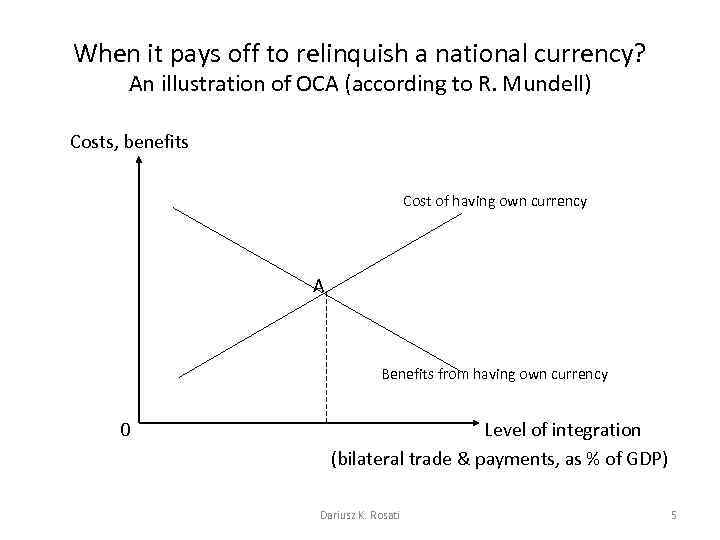 When it pays off to relinquish a national currency? An illustration of OCA (according to R. Mundell) Costs, benefits Cost of having own currency A Benefits from having own currency 0 Level of integration (bilateral trade & payments, as % of GDP) Dariusz K. Rosati 5
 An asymmetric shock • An asymmetric shock hits one country in a different way than other countries of the currency union (e. g. a fall of international demand for exports of one country); • Countries react to asymmetriuc shocks with monetary and/or exchange rate policies (a cut in interest rates, or a devaluation of the currency), which allow to restore demand; • The more is the country exposed to asymmetric shocks, the more it needs its own monetary and exchange rate policies, because instruments that are common for the whole currency union may not by appropriate for eliminating the impact of an asymmetric shock; Dariusz K. Rosati 6
 Possible reactions to asymmetric shocks • Under own national currency: – Monetary policy – lower interest rates, – Exchange rate policy - devaluation (depreciation) of the currency; • Under a monetary union: – Outflow of unemployed manpower to other countries of the union (depends on labor mobility); – Reduction of real wages to (depends on wage flexibility); – Increase of gevernment spending (depends on the condition of public finances); • Mundell argued, that countries differ in terms of preferences on inflation and unemployment, that in most countries the scope for asymmetric shocks is significant, that labor mobility is generally very limited, that wage flexibility is low, and that fiscal position of most governments is diffcult; Dariusz K. Rosati 7
 What chances for monetary unions? • Mundell has been very skeptical (and still is!) on the possibility of creating a currency union outside the USA; • However, since Mundell’s times, the world has changed: – Most currencies are now convertible; – In most countries there is free mobility of capital; – In most countries exchange rates are flexible (or floating); • In result, there are now more arguments in favor of currency unions;
 Costs of CU: summing up • The need to have national currency diminishes with more integration because of increasing convergence of business cycle; • The scope for asymmetric shocks diminishes for closely integrated countries, with synchronized cycle, and with diversified trade structure; • Effectiveness of own monetary policy is limited under free capital movements and open economy; • Effectiveness of exchange rate policy (devaluation) is very small or none in the longer run; • Cost of monetary integration is endogenous with respect to monetary union; Dariusz K. Rosati 9
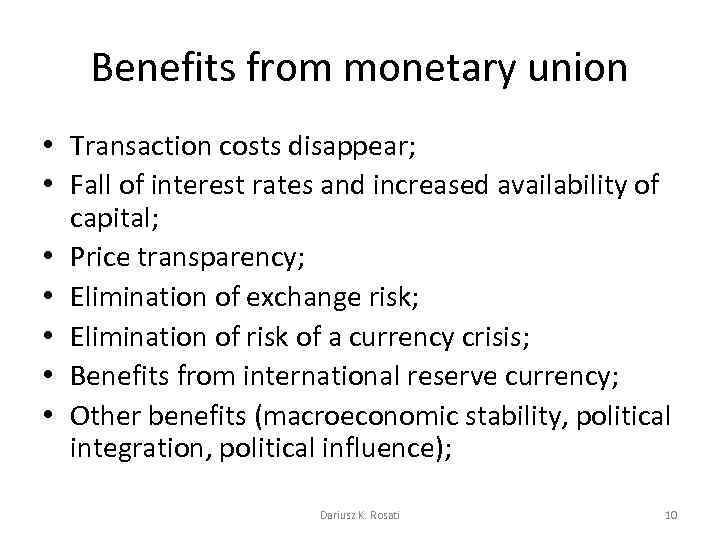 Benefits from monetary union • Transaction costs disappear; • Fall of interest rates and increased availability of capital; • Price transparency; • Elimination of exchange risk; • Elimination of risk of a currency crisis; • Benefits from international reserve currency; • Other benefits (macroeconomic stability, political integration, political influence); Dariusz K. Rosati 10
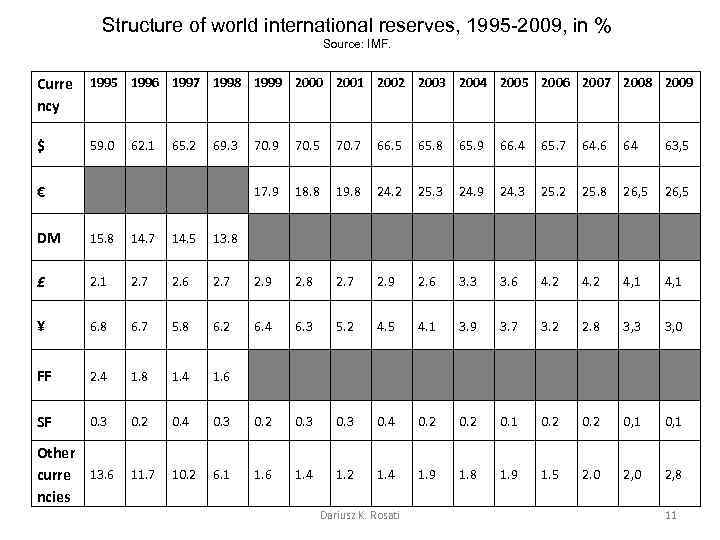 Structure of world international reserves, 1995 -2009, in % Source: IMF. Curre ncy 1995 1996 1997 1998 1999 2000 2001 2002 2003 2004 2005 2006 2007 2008 2009 $ 59. 0 62. 1 65. 2 69. 3 70. 5 70. 7 66. 5 65. 8 65. 9 66. 4 65. 7 64. 6 64 63, 5 17. 9 € 70. 9 18. 8 19. 8 24. 2 25. 3 24. 9 24. 3 25. 2 25. 8 26, 5 DM 15. 8 14. 7 14. 5 13. 8 £ 2. 1 2. 7 2. 6 2. 7 2. 9 2. 8 2. 7 2. 9 2. 6 3. 3 3. 6 4. 2 4, 1 ¥ 6. 8 6. 7 5. 8 6. 2 6. 4 6. 3 5. 2 4. 5 4. 1 3. 9 3. 7 3. 2 2. 8 3, 3 3, 0 FF 2. 4 1. 8 1. 4 1. 6 SF 0. 3 0. 2 0. 4 0. 3 0. 2 0. 3 0. 4 0. 2 0. 1 0. 2 0, 1 11. 7 10. 2 6. 1 1. 6 1. 4 1. 2 1. 4 1. 9 1. 8 1. 9 1. 5 2. 0 2, 8 Other curre 13. 6 ncies Dariusz K. Rosati 11
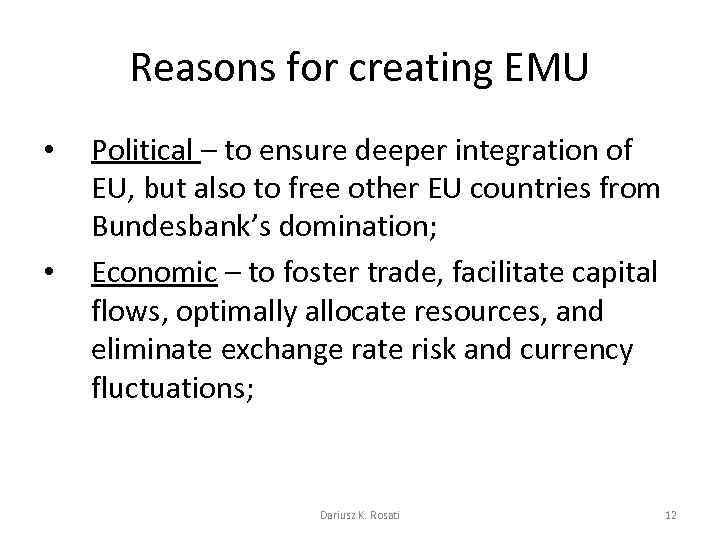 Reasons for creating EMU • • Political – to ensure deeper integration of EU, but also to free other EU countries from Bundesbank’s domination; Economic – to foster trade, facilitate capital flows, optimally allocate resources, and eliminate exchange rate risk and currency fluctuations; Dariusz K. Rosati 12
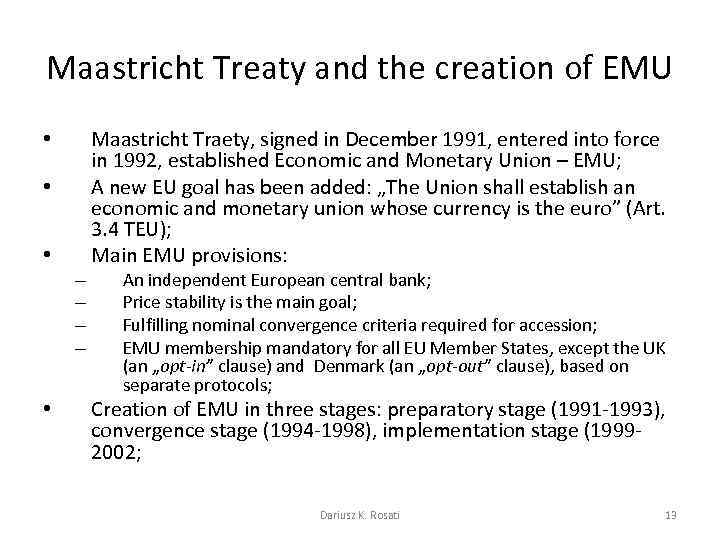 Maastricht Treaty and the creation of EMU • • • – – • Maastricht Traety, signed in December 1991, entered into force in 1992, established Economic and Monetary Union – EMU; A new EU goal has been added: „The Union shall establish an economic and monetary union whose currency is the euro” (Art. 3. 4 TEU); Main EMU provisions: An independent European central bank; Price stability is the main goal; Fulfilling nominal convergence criteria required for accession; EMU membership mandatory for all EU Member States, except the UK (an „opt-in” clause) and Denmark (an „opt-out” clause), based on separate protocols; Creation of EMU in three stages: preparatory stage (1991 -1993), convergence stage (1994 -1998), implementation stage (19992002; Dariusz K. Rosati 13
 Convergence criteria in EU Treaty (Art. 140 of TFEU) 1. At least once every two years, or at the request of a Member State with a derogation, the Commission and the European Central Bank shall report to the Council on the progress made by the Member States with a derogation in fulfilling their obligations regarding the achievement of economic C 115/108 EN Official Journal of the European Union 9. 5. 2008 and monetary union. These reports shall include an examination of the compatibility between the national legislation of each of these Member States, including the statutes of its national central bank, and Articles 130 and 131 and the Statute of the ESCB and of the ECB. The reports shall also examine the achievement of a high degree of sustainable convergence by reference to the fulfilment by each Member State of the following criteria: — the achievement of a high degree of price stability; this will be apparent from a rate of inflation which is close to that of, at most, the three best performing Member States in terms of price stability, — the sustainability of the government financial position; this will be apparent from having achieved a government budgetary position without a deficit that is excessive as determined in accordance with Article 126(6), — the observance of the normal fluctuation margins provided for by the exchange-rate mechanism of the European Monetary System, for at least two years, without devaluing against the euro, — the durability of convergence achieved by the Member State with a derogation and of its participation in the exchange-rate mechanism being reflected in the long-term interest-rate levels. The four criteria mentioned in this paragraph and the relevant periods over which they are to be respected are developed further in a Protocol annexed to the Treaties. The reports of the Commission and the European Central Bank shall also take account of the results of the integration of markets, the situation and development of the balances of payments on current account and an examination of the development of unit labour costs and other price indices.
 Specific reference values for the convergence criteria • • • Following Art. 140 of TFEU, specific reference values for the convergence criteria have been decided in the Protocol No 11 attached to the Treaty; The criterion on price stability shall mean that the Member State concerned has a price performance that is sustainable and an average rate of inflation, observed over a period of one year before the examination, that does not exceed by more than 1, 5 percentage points that of, at most, the three best performing Member States in terms of price stability. The criterion on the government budgetary position shall mean that at the time of the examination the Member State concerned is not the subject of excessive defict procedure (i. e. deficit remains below 3% of GDP). The criterion on participation in the exchange-rate mechanism of the European Monetary System shall mean that the Member State concerned has respected the normal fluctuation margins provided for by the exchange-rate mechanism of the European Monetary System without severe tensions for at least the last two years before the examination. In particular, the Member State shall not have devalued its currency's bilateral central rate against the euro on its own initiative for the same period. The criterion on the convergence of interest rates shall mean that, observed over a period of one year before the examination, the Member State concerned has had an average nominal long-term interest rate that does not exceed by more than 2 percentage points that of, at most, the three best performing Member States in terms of price stability. Interest rates shall be measured on the basis of long-term government bonds or comparable securities, taking into account differences in national definitions.
 Why convergence criteria? • Homogeneity of the economies forming a currency union is crucial for effective common monetary policy and avoiding conflicting macroeconomic stabilization goals; • Low inflation in all member countries allows for low interest rates and ensures stability of the common currency; • Low fiscal deficit (and debt) to avoid „free riding” and a „common pool” problem; • A critique of convergence criteria;