


 Скачать презентацию Economics of integration Lecture 7 Regional policy in
Lecture 8 - Regional policy.pptx
- Количество слайдов: 19
 Economics of integration Lecture 7: Regional policy in the EU
 What is regional/cohesion policy? • The EU is one of the richest regions in the world (second only to the USA and Japan), but intra-EU regions differ widely in terms of GDP/capita and development opportunities ; • The enlargement of 2004 -2007 increased these differences even further, as EU 10 was much poorer than EU 15 (eg. LUX 269, IRE 144, NET 129, …. . LAT 55, ROM 45, BUL 40, dla EU 27=100). • EU regional/cohesion policy consists of financial transfers from more to less developed regions with the aim to speed up development of the latter are thus reduce regional income differentials; • EU regional/cohesion policy is an instrument of financial solidarity, instrument of growth acceleration, and a driving factor of economic integration; • Recently the term „regional” policy” is replaced by the term „economic, social and territoriel cohesion” – broadly, the meaning and scope is similar;
 Main goals of EU regional/cohesion policy • To improve the economic well-being of regions in the EU; • More than one third of the EU’s budget is devoted to the cohesion policy, which aims to remove economic, social and territorial disparities across the EU, restructure declining industrial areas and diversify rural areas which have declining agriculture; • In doing so, EU cohesion policy is geared towards making regions more competitive, fostering economic growth and creating new jobs;
 A bit of theory • Regions/states tend to differ in terms of income and wealth, because of different history, location, institutional conditions, policies, agglomeration and diffusion effects, diverging trends in development; • In an integration, it makes sense to stimulate development of poorer countries to catch up with rich countries; • Convergence (to rich countries incomes levels) is a general regularity made possible by free trade and free flows of capital and technology; • However, convergence is not automatic: if markets are not functioning properly, or necessary institutions are not in place, or there are impediments to free flows of goods and factors, convergence will not occur; • Divergence may occur, when the initial disparities are aggravated by agglomeration tendencies, when investments tend to favour regions with technology lead, well developed infrastructure, highly skilled labor, low risks; • Divergence in an integration may lead to mass migrations, social conflicts and political instability;
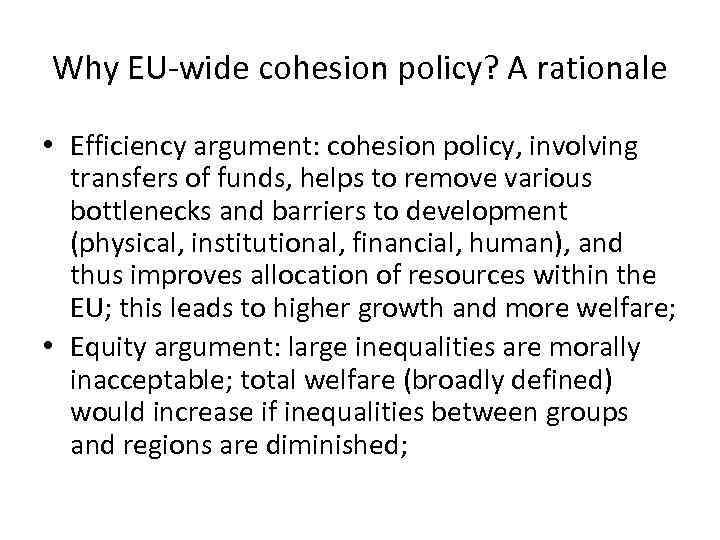 Why EU-wide cohesion policy? A rationale • Efficiency argument: cohesion policy, involving transfers of funds, helps to remove various bottlenecks and barriers to development (physical, institutional, financial, human), and thus improves allocation of resources within the EU; this leads to higher growth and more welfare; • Equity argument: large inequalities are morally inacceptable; total welfare (broadly defined) would increase if inequalities between groups and regions are diminished;
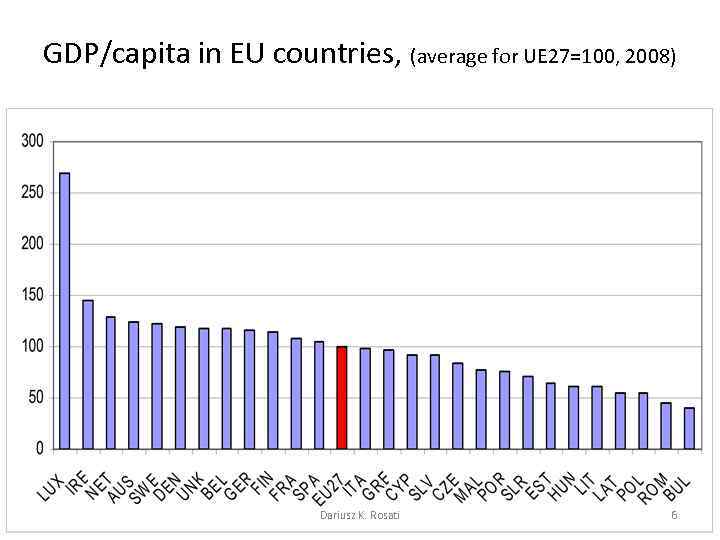 GDP/capita in EU countries, (average for UE 27=100, 2008) Dariusz K. Rosati 6
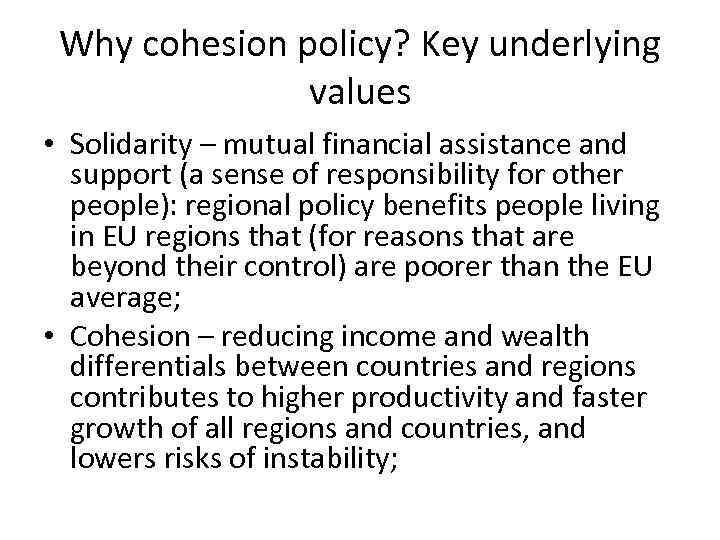 Why cohesion policy? Key underlying values • Solidarity – mutual financial assistance and support (a sense of responsibility for other people): regional policy benefits people living in EU regions that (for reasons that are beyond their control) are poorer than the EU average; • Cohesion – reducing income and wealth differentials between countries and regions contributes to higher productivity and faster growth of all regions and countries, and lowers risks of instability;
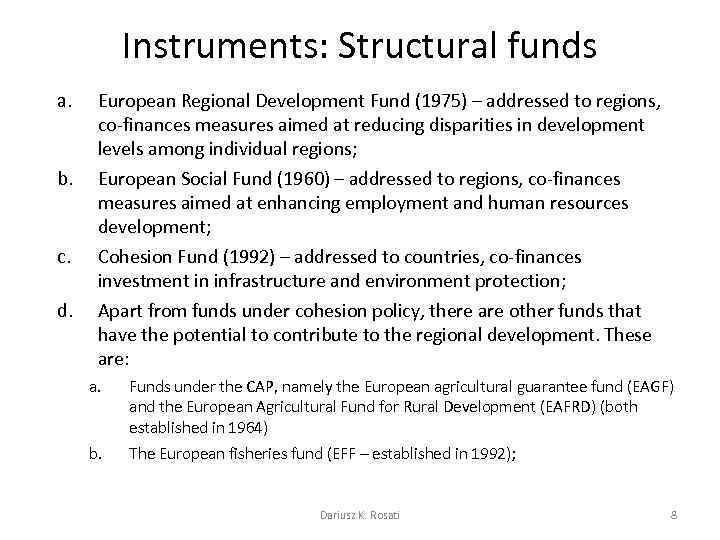 Instruments: Structural funds a. b. c. d. European Regional Development Fund (1975) – addressed to regions, co-finances measures aimed at reducing disparities in development levels among individual regions; European Social Fund (1960) – addressed to regions, co-finances measures aimed at enhancing employment and human resources development; Cohesion Fund (1992) – addressed to countries, co-finances investment in infrastructure and environment protection; Apart from funds under cohesion policy, there are other funds that have the potential to contribute to the regional development. These are: a. Funds under the CAP, namely the European agricultural guarantee fund (EAGF) and the European Agricultural Fund for Rural Development (EAFRD) (both established in 1964) b. The European fisheries fund (EFF – established in 1992); Dariusz K. Rosati 8
 Objective 1: Convergence • By far the largest amount of regional policy funding (over 80%) is dedicated to the regions falling under the Convergence objective. This objective covers Europe's poorest regions whose per capita GDP is less than 75% of the EU average. This includes nearly all the regions of the new member states, most of Southern Italy, East Germany, Greece and Portugal, some parts of Spain, and some parts of the United Kingdom. • With the addition of the newest member countries in 2004 and 2007, the EU average GDP has fallen. As a result, some regions in the EU's "old" member states, which used to be eligible for funding under the Convergence objective, are now above the 75% threshold (the statistical effect). These regions now receive transitional, "phasing out" support until 2013. • The Convergence objective aims to allow the regions affected to catch up with the EU's more prosperous regions, thereby reducing economic disparity within the European Union. Examples of types of projects funded under this objective include improving basic infrastructure, helping businesses, building or modernising waster and water treatment facilities, and improving access to high-speed Internet connections. Regional policy projects in Convergence regions are supported by three European funds: the European Regional Development Fund (ERDF), the European Social Fund (ESF) and the Cohesion Fund.
 Objective 2: Regional competitiveness and employment • This objective covers all European regions that are not covered by the Convergence objective. With 16% of the EU's regional policy budget dedicated to this objective, its main aim is to create jobs by promoting competitiveness and making the regions concerned more attractive to businesses and investors. Possible projects include developing clean transport, supporting research centres, universities, small businesses and start-ups, providing training, and creating jobs. Funding is managed through either the ERDF or the ESF.
 Objective 3: European territorial cooperation • This objective aims to reduce the importance of borders within Europe - both between and within countries - by improving regional cooperation. It allows for three different types of cooperation: cross-border, transnational and interregional cooperation. The objective is currently by far the least important in pure financial terms, accounting for only 2. 5% of the EU's regional policy budget. It is funded exclusively through the ERDF.
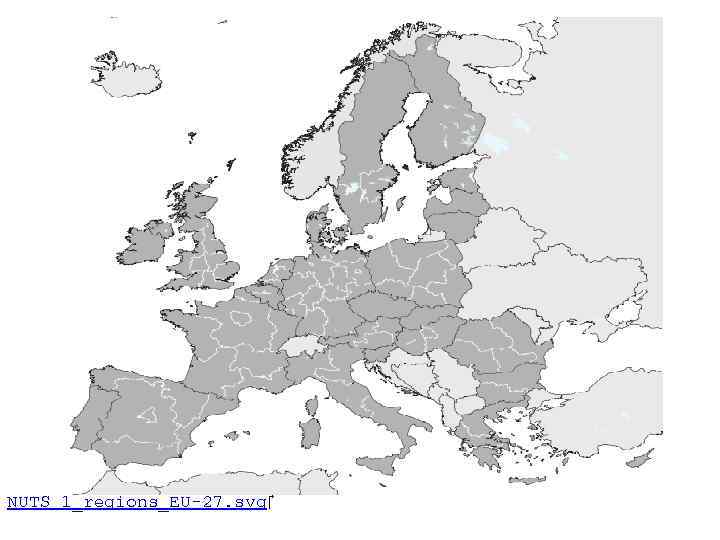
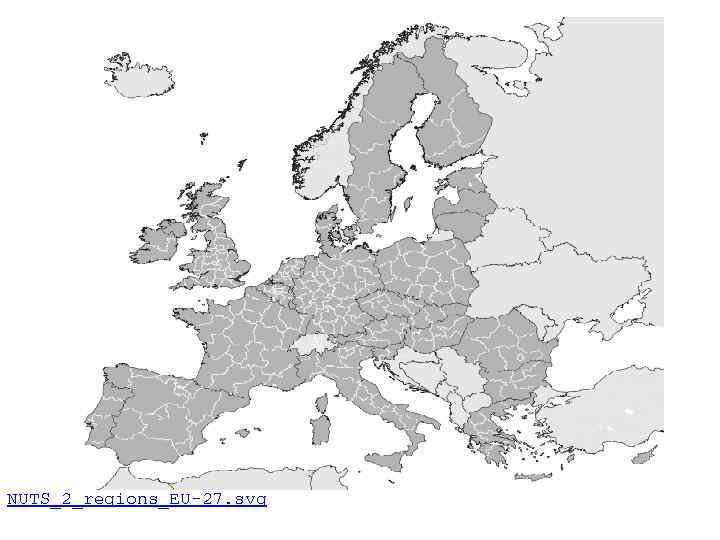
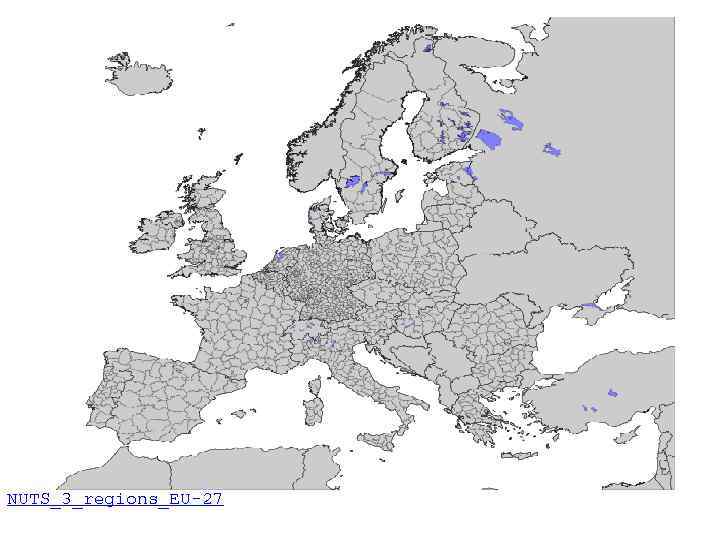
 European classification of regions (NUTS) • The Nomenclature of Territorial Units for Statistics or Nomenclature of Units for Territorial Statistics, (NUTS, after the French nomenclature d'unités territoriales statistiques) is a geocode standard for referencing the subdivisions of countries for statistical purposes. The standard is developed and regulated by the European Union, and thus only covers the member states of the EU in detail. The Nomenclature of Territorial Units for Statistics is instrumental in European Union's Structural Fund delivery mechanisms. • For each EU member country, a hierarchy of three NUTS levels is established by Eurostat; the subdivisions in some levels do not necessarily correspond to administrative divisions within the country. A NUTS code begins with a two-letter code referencing the country. The subdivision of the country is then referred to with one number. A second or third subdivision level is referred to with another number each. • NUTS 1 (97), NUTS 2 (271), NUTS 3 (1303);
 NUTS 1_regions_EU-27. svg
 NUTS_2_regions_EU-27. svg
 NUTS_3_regions_EU-27
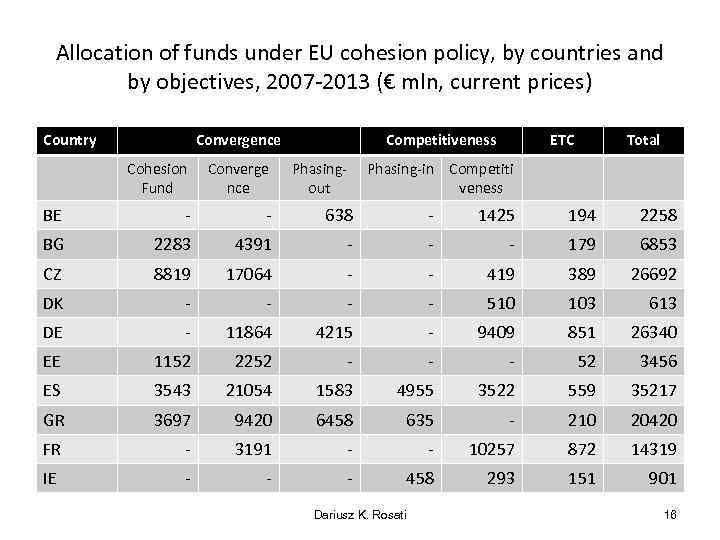 Allocation of funds under EU cohesion policy, by countries and by objectives, 2007 -2013 (€ mln, current prices) Country Convergence Competitiveness Phasingout ETC Total Cohesion Fund Converge nce Phasing-in Competiti veness BE - - 638 - 1425 194 2258 BG 2283 4391 - - - 179 6853 CZ 8819 17064 - - 419 389 26692 DK - - 510 103 613 DE - 11864 4215 - 9409 851 26340 EE 1152 2252 - - - 52 3456 ES 3543 21054 1583 4955 3522 559 35217 GR 3697 9420 6458 635 - 210 20420 FR - 3191 - - 10257 872 14319 IE - - - 458 293 151 901 Dariusz K. Rosati 16
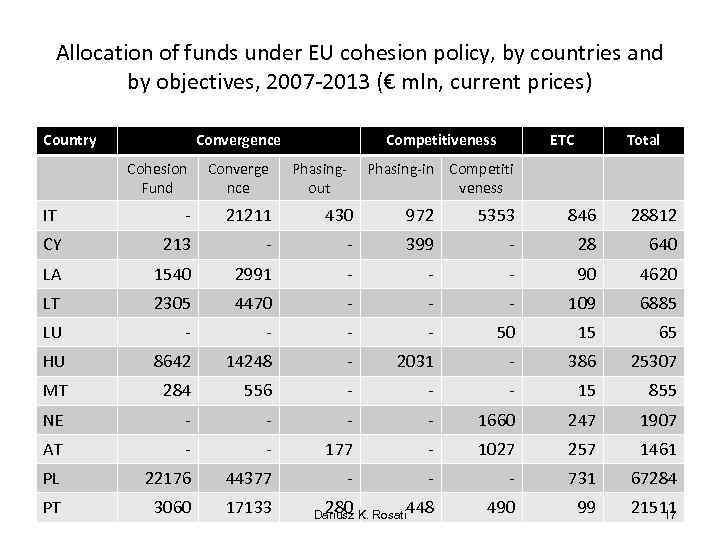 Allocation of funds under EU cohesion policy, by countries and by objectives, 2007 -2013 (€ mln, current prices) Country Convergence Competitiveness Phasingout ETC Total Cohesion Fund Converge nce Phasing-in Competiti veness IT - 21211 430 972 5353 846 28812 CY 213 - - 399 - 28 640 LA 1540 2991 - - - 90 4620 LT 2305 4470 - - - 109 6885 LU - - 50 15 65 HU 8642 14248 - 2031 - 386 25307 MT 284 556 - - - 15 855 NE - - 1660 247 1907 AT - - 177 - 1027 257 1461 PL 22176 44377 - - - 731 67284 PT 3060 17133 280 448 490 99 21511 17 Dariusz K. Rosati
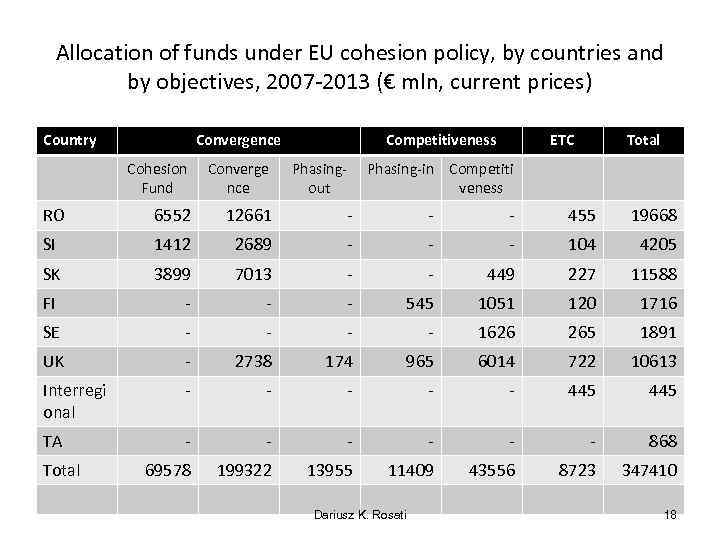 Allocation of funds under EU cohesion policy, by countries and by objectives, 2007 -2013 (€ mln, current prices) Country Convergence Competitiveness Total Cohesion Fund Converge nce RO 6552 12661 - - - 455 19668 SI 1412 2689 - - - 104 4205 SK 3899 7013 - - 449 227 11588 FI - - - 545 1051 120 1716 SE - - 1626 265 1891 UK - 2738 174 965 6014 722 10613 Interregi onal - - - 445 TA - - - 868 69578 199322 13955 11409 43556 8723 347410 Total Phasingout ETC Phasing-in Competiti veness Dariusz K. Rosati 18
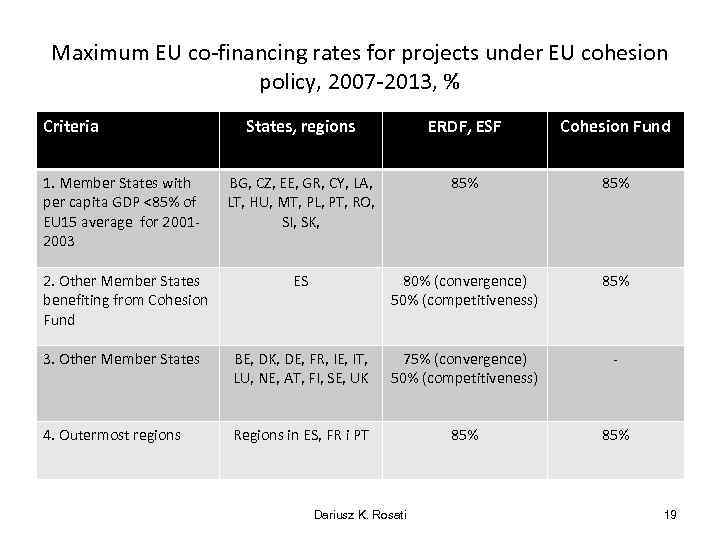 Maximum EU co-financing rates for projects under EU cohesion policy, 2007 -2013, % Criteria States, regions ERDF, ESF Cohesion Fund 1. Member States with per capita GDP <85% of EU 15 average for 20012003 BG, CZ, EE, GR, CY, LA, LT, HU, MT, PL, PT, RO, SI, SK, 85% 2. Other Member States benefiting from Cohesion Fund ES 80% (convergence) 50% (competitiveness) 85% 3. Other Member States BE, DK, DE, FR, IE, IT, LU, NE, AT, FI, SE, UK 75% (convergence) 50% (competitiveness) - 4. Outermost regions Regions in ES, FR i PT 85% Dariusz K. Rosati 19