


 Скачать презентацию Economics of integration Lecture 6 Common competition policy
Lecture 7 - Common competition policy.pptx
- Количество слайдов: 14
 Economics of integration Lecture 6: Common competition policy
 Competition: main concepts • Competition is deemed to exist, when there is no barriers to entry into a sector, and no market participant can alone influence market conditions (prices, supplies, demand); • Advantages: profit maximisation under competition leads to lower costs, higher quality, technological progress and innovation, and widens the available selection of goods and services (and it prevents the opposite); • Shortcomings: sometimes competition may lead to excessive exploitation of production factors and natural resources (when externalities exist), and can undermine social objectives (decent work conditions, woirking time limits, etc);
 Competitiveness of firms and economies • Competitiveness of firms: ability to increase sales rapidly and in sustainable manner, in absolute terms and relative to competitors; • Competitiveness of economies and nations: ability to create and develop competitive firms;
 Competitiveness among the goals of EU • Art. 3. 3 of TEU: The Union shall establish an internal market. It shall work for the sustainable development of Europe based on balanced economic growth and price stability, a highly competitive social market economy, aiming at full employment and social progress, and a high level of protection and improvement of the quality of the environment. It shall promote scientific and technological advance. • Why competition is important in EU? Because it affects the functionning of the internal market;
 Rules on competiton: prohibited undertakings (Art. 101 TFEU) • Prohibited are all agreements between undertakings and concerted practices which may affect trade between Member States and which have as their object or effect the prevention, restriction or distortion of competition within the internal market (Art. 101 TFEU); • Examples: price agreements, market sharing, discriminatory practices, unfair conditions, etc; • Such agreements and undertakings are void by definition;
 Rules on competition: abuse of dominant position (Art. 102 TFEU) • Any abuse by one or more undertakings of a dominant position within the internal market or in a substantial part of it shall be prohibited as incompatible with the internal market in so far as it may affect trade between Member States. • Examples: unfair purchase or selling prices, limiting production, markets or technical progress, discriminatory practices, unfair conditions;
 Enforcement (Art. 105 of TFEU) • The European Commission shall ensure the application of the principles laid down in Articles 101 and 102. The Commission shall investigate cases of suspected infringement of these principles. If it finds that there has been an infringement, it shall propose appropriate measures to bring it to an end; • If the infringement is not brought to an end, the Commission shall record such infringement of the principles in a reasoned decision. The Commission may publish its decision and authorise Member States to take the measures, the conditions and details of which it shall determine, needed to remedy the situation.
 Rules on competition: state aid (Art. 107 TFEU) • Save as otherwise provided in the Treaties, any aid granted by a Member State or through State resources in any form whatsoever which distorts or threatens to distort competition by favoring certain undertakings or the production of certain goods shall, in so far as it affects trade between Member States, be incompatible with the internal market; • Definition of state aid (by distinctive features taken jointly): – – Granted from state resources; Distorts competition; Discriminatory in nature; Affects trade between Member States; • Examples: direct subsidies, tax reliefs, state guarantees, concessionary credits at terms below market terms, subsidized inputs (utilities, energy, land), sales at preferential prices, debt-forequity, debt write-offs, etc;
 Sectors that can benefit from state aid in EU • Coal mining (only capacity reduction, R&D and environment protection); • Steel manufacturing (only capacity reduction, R&D and environment protection); • Synthetic fibers (only capacity reduction, R&D and environment protection); • Shipbuilding (only capacity reduction, R&D and regional aid); • Automotive production (restructuring only);
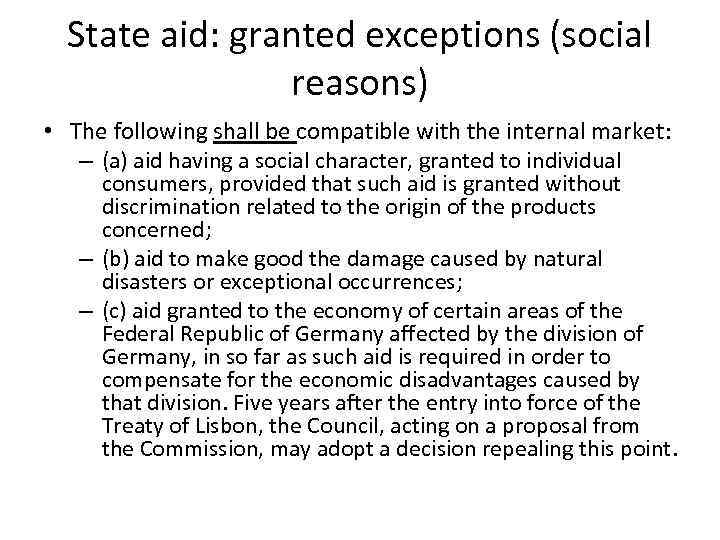 State aid: granted exceptions (social reasons) • The following shall be compatible with the internal market: – (a) aid having a social character, granted to individual consumers, provided that such aid is granted without discrimination related to the origin of the products concerned; – (b) aid to make good the damage caused by natural disasters or exceptional occurrences; – (c) aid granted to the economy of certain areas of the Federal Republic of Germany affected by the division of Germany, in so far as such aid is required in order to compensate for the economic disadvantages caused by that division. Five years after the entry into force of the Treaty of Lisbon, the Council, acting on a proposal from the Commission, may adopt a decision repealing this point.
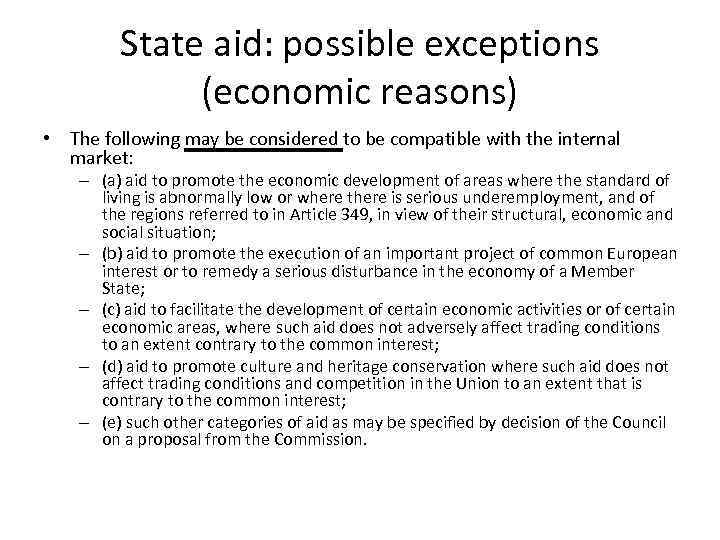 State aid: possible exceptions (economic reasons) • The following may be considered to be compatible with the internal market: – (a) aid to promote the economic development of areas where the standard of living is abnormally low or where there is serious underemployment, and of the regions referred to in Article 349, in view of their structural, economic and social situation; – (b) aid to promote the execution of an important project of common European interest or to remedy a serious disturbance in the economy of a Member State; – (c) aid to facilitate the development of certain economic activities or of certain economic areas, where such aid does not adversely affect trading conditions to an extent contrary to the common interest; – (d) aid to promote culture and heritage conservation where such aid does not affect trading conditions and competition in the Union to an extent that is contrary to the common interest; – (e) such other categories of aid as may be specified by decision of the Council on a proposal from the Commission.
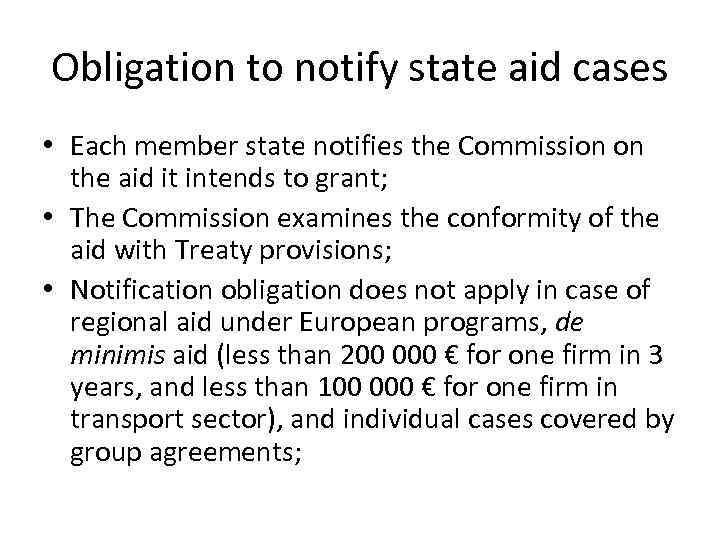 Obligation to notify state aid cases • Each member state notifies the Commission on the aid it intends to grant; • The Commission examines the conformity of the aid with Treaty provisions; • Notification obligation does not apply in case of regional aid under European programs, de minimis aid (less than 200 000 € for one firm in 3 years, and less than 100 000 € for one firm in transport sector), and individual cases covered by group agreements;
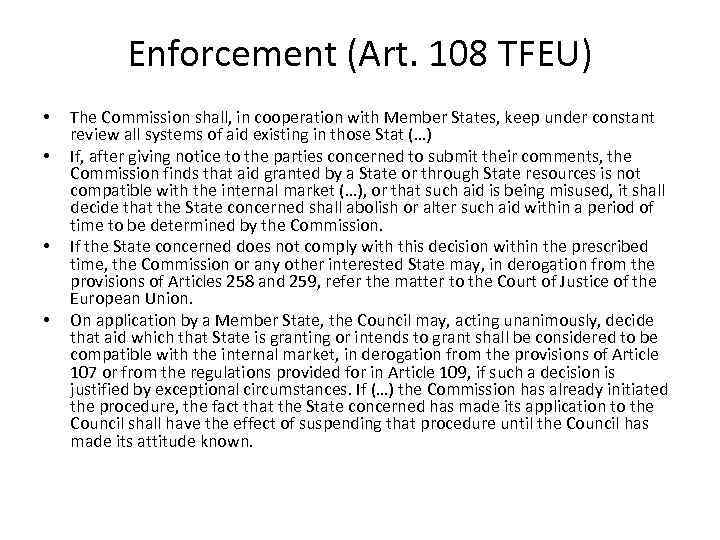 Enforcement (Art. 108 TFEU) • • The Commission shall, in cooperation with Member States, keep under constant review all systems of aid existing in those Stat (…) If, after giving notice to the parties concerned to submit their comments, the Commission finds that aid granted by a State or through State resources is not compatible with the internal market (…), or that such aid is being misused, it shall decide that the State concerned shall abolish or alter such aid within a period of time to be determined by the Commission. If the State concerned does not comply with this decision within the prescribed time, the Commission or any other interested State may, in derogation from the provisions of Articles 258 and 259, refer the matter to the Court of Justice of the European Union. On application by a Member State, the Council may, acting unanimously, decide that aid which that State is granting or intends to grant shall be considered to be compatible with the internal market, in derogation from the provisions of Article 107 or from the regulations provided for in Article 109, if such a decision is justified by exceptional circumstances. If (…) the Commission has already initiated the procedure, the fact that the State concerned has made its application to the Council shall have the effect of suspending that procedure until the Council has made its attitude known.
 Enforcement (Art. 259 TFEU) • If the Commission considers that the Member State concerned has not taken the necessary measures to comply with the judgment of the Court, it may bring the case before the Court after giving that State the opportunity to submit its observations. It shall specify the amount of the lump sum or penalty payment to be paid by the Member State concerned which it considers appropriate in the circumstances. • If the Court finds that the Member State concerned has not complied with its judgment it may impose a lump sum or penalty payment on it.