


 Скачать презентацию Economics of integration Lecture 3 Integration of factor
Lecture 3 - Integration of factor markets.pptx
- Количество слайдов: 16
 Economics of integration Lecture 3: Integration of factor markets
 Labour markets • Integration of labour markets involves: – Nationals of one member state may freely be employed in another member state; – Self-employed nationals of one member state may freely undertake their economic activity in another member state; • Restrictions: – Work/activity permits for non-residents; – Restricted access to functions and professions; – Accommodation obstacles (housing, schools, health care, etc); • In general, labour is not very mobile internationally; except for land (immobile), labour is least mobile of all factors and goods; this is because people attach value to cultural, social and family environment, and migration involves costs;
 Motives for restrictions on migration • In host countries: – Immigrants put downward pressure on wages through increased supply of labour; – Increase of unemployment (migrants crowd out local workers); – Rise in government expenditure on social goods (health, education, benefits, pensions); – Societal disruption (cultural differences, potential conflicts); • In home countries: – Loss of human capital; – Opportunity cost of lost output; – Deterioration of demographic balance; (mostly younger people migrate);
 Advantages of integration • For host countries: – Larger human resources with more and better skills; – Better match with demand for labour; – Improved competitiveness through lower wages and higher productivity; – Higher public revenues from taxes and social security contributions, and better demographic balance; • For home countries: – Lower unemployment; – Balance of payments improvement through remittances; – Improved skills (for temporary migrants who intend to return);
 Factors of migration • Push factors: low earnings and lack of job opportunities in home countries, poor social services, high taxes; • Pull factors: availability of jobs in host countries, higher earnings, better social protecion, more and better social services; • Cost of movement: depend on distance, cultural and linguistic differences, information networks; • Legal restrictions foreign workers and migrants;
 Capital markets • Free movement of capital implies that firms and households from one country can freely buy and sell financial and real assets in other countries; • The integration of capital markets involves: – removing of constraints on foreign exchange, of discriminatory taxes and of other obstacles („passive integration”); – Coordinating or harmonizing the rules of capital and financial markets, such as bank regulations, insurance regulations, stock exchange regulations, money markets, etc. („active integration”);
 Motives for barriers on capital flows • Countries often restrict capital outflows for the following reasons: – Capital is an important resource for investment and job creation, so capital drain reduces the growth potential of a country; – Capital ouflows entail a loss of international reserves and thus threaten the self-sufficiency of a country and increase the risk of a currency crisis; – Capital ouflows tend to raise maket interest rates; – Capital ouflows tend to weaken the exchange rate and thus increase inflation; • Countries sometimes also restrict capital inflows because: – Capital inflows may be considered as a threat to independence; – Large inflows disturb monetary policy and are inflationary; – Large inflows lead to currency appreciation which may be harmful for exports; – Large inflows may be reversed, causing macroeconomic instability; – Large inflows may be of speculative nature;
 Types of restrictions on capital mobility • Administrative and legal impediments (on buying stocks, on buying land real estate, on transferring profits, on remittances, on investing abroad, etc); • Currency convertibility restrictions; • Taxes (e. g. on financial transactions);
 Advantages of integration • Increases availability of capital for investment and consumption; • Lower market interest rates stimulate growth; • When markets are deep (? ) and liquid (? ), the risk of wide disturbances is lower; • Capital flows often go in tandem with technology transfer;
 Why capital moves internationally? • Capital moves in search of higher rates of return taking into account risks involved; • Capital is generally risk-averse – if the risk exceeds a certain level, capital will not come; • Rates of return on real investment vs rates of return on financial investment: production vs speculation; • Speculative capital is very mobile and very sensitive to changes in economic conditions and market sentiment; large inflows may be followed by large outflows (flow reversals); • Free capital mobility offers many advantages, but the higher are the inflows, the higher is the risk of sudden outflows; • „Negative integration” not sufficient to attract capital when risks are high; „positive integration” needed to reduce risks through credible policies and stable institutions;
 Forms of cross-border capital movements • Foreign direct investment (FDI): – „greenfield” – acquisitions; • Portfolio investment: – debt instruments (bonds, bills); – equity instruments (shares, common stock); • Other capital flows: – credits and loans; – changes in bank acounts; – derivative instruments; • All these forms differ in terms of motives and mobility;
 FDI • The transfer of capital by a company located in one country to another country to create (greenfield investment) or take over (acquisition) an establishment there which it wants to control; • Greenfield investment: Transfer of capital takes typically form of production resources (technology, know-how, management and marketing skills); • Acquisition: Transfer of capital takes typically form of money transfer, followed by other production resources; • Motives for FDI: – Local market motive; – Lower production cost motive; – Strategic asset acquisition motive;
 Impact of integration on FDI • Intra-union: a common market stimulates FDI because it offers better investment opportunities in other member countries (optimal location of production); • Extra-union: a common market attracts FDI from third countries because of its larger scale and purchasing power, and because they want to „jump-tariff”;
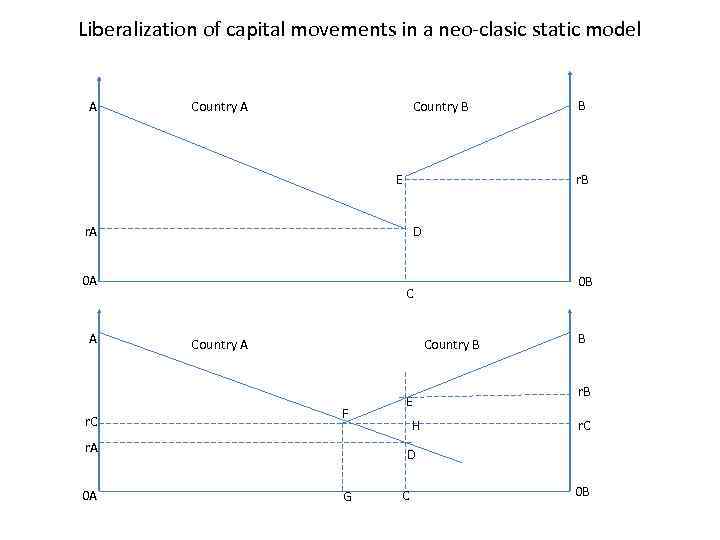 Liberalization of capital movements in a neo-clasic static model A Country B E r. B r. A D 0 A A r. C 0 B C Country A Country B F r. A 0 A B E H B r. C D G C 0 B
 Interpretation • Stock of capital in countries A and B is measured on the horizontal axis, price of capital (interest rate) is on the vertical axis, the areas under the sloping curves AD and BE indicate the level of production at each size of capital input (labour input given constant); • Separate markets: price of capital in each country equals to the marginal product of capital; as capital is more abundant in A than in B, the marginal productivity of capital in A is lower than in B, and its price (interest rate) is lower than in B (r. A < r. B); • Total output is 0 AADC in A, and 0 BCEB in B, with capital income 0 Ar. ADC in A, and 0 BCEr. B in B (the triangles r. AAD and r. BEB represent labour income); • Integated markets: removal of barriers will induce capital from A to flow into B because of higher rates of return in B; this will led to upward pressure on interest rates in A and downward pressure on interest rates in B, until equalization of marginal productivities and interest rates at r. C for the whole integrated market (A+B); • Total output falls in A to 0 AAFG, and increases in B to 0 BGFB, but the total output for (A+B) wil be always higher by the triangle FED; • Capital income of capital owners in A will increase (because of higher r. C), and in B falls; by contrast, labour income in A falls, and in B rises;
 Risks involved in integration of capital markets • Free flows of massive capital can be destabilising, as demonstrated by the recent crisis; • Under a fixed exchange regime, free flows require large international reserves: sudden inflows may be costly to sterilize, sudden outflows can deplete reserves and cause a currency crisis; • Under a floating exchange rate regime, free flows cause wide fluctuations of the exchange rate, which leads to higher uncertainty and results in higher risk premia in interest rates; • Countries should attract capital which is least mobile, like FDI, and avoid excessive inflows of higly mobile capital (portfolio, bank, derivatives);