


 Скачать презентацию Economics in review An evaluation of Economic Systems
94f6e6de18e7a0d55c6f1ee354de1226.ppt
- Количество слайдов: 29
 Economics (in review) An evaluation of Economic Systems
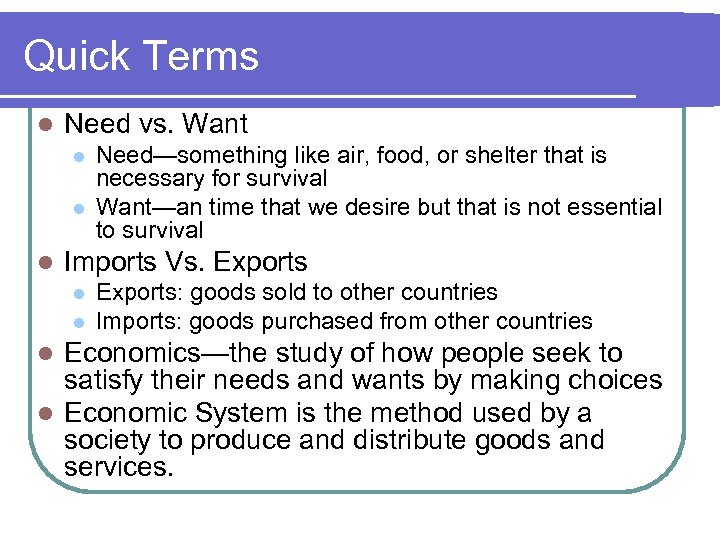 Quick Terms l Need vs. Want l l l Need—something like air, food, or shelter that is necessary for survival Want—an time that we desire but that is not essential to survival Imports Vs. Exports l l Exports: goods sold to other countries Imports: goods purchased from other countries Economics—the study of how people seek to satisfy their needs and wants by making choices l Economic System is the method used by a society to produce and distribute goods and services. l
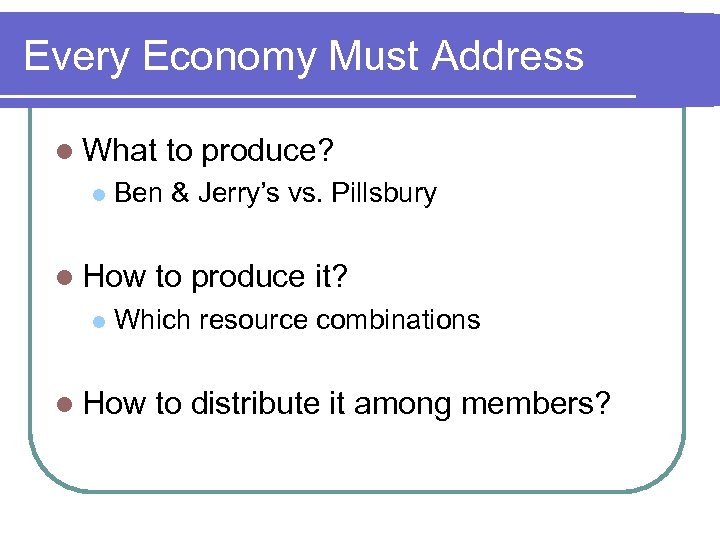 Every Economy Must Address l What l Ben & Jerry’s vs. Pillsbury l How l to produce? to produce it? Which resource combinations l How to distribute it among members?
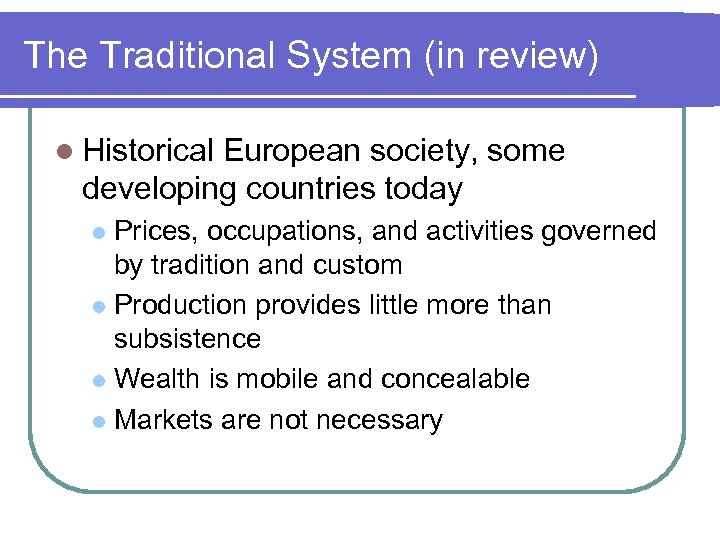 The Traditional System (in review) l Historical European society, some developing countries today Prices, occupations, and activities governed by tradition and custom l Production provides little more than subsistence l Wealth is mobile and concealable l Markets are not necessary l
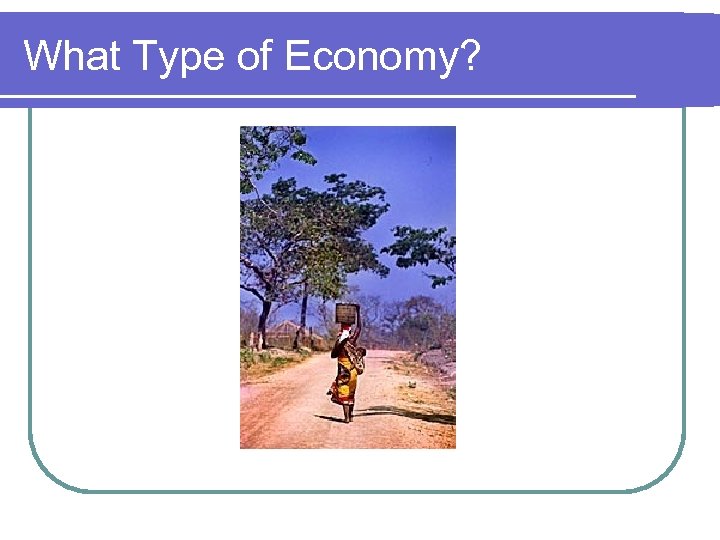
 Traditional Economy l Traditional Economy—relies on habit, custom, or ritual to decide questions of production and consumption of goods and services. l l Characteristics: small and close communities, agricultural and hunting practices usually remain at the heart Few mechanisms in place to deal with the effects of environmental disaster, such as a flood or drought. Slow at adapting new technology Low standard of living
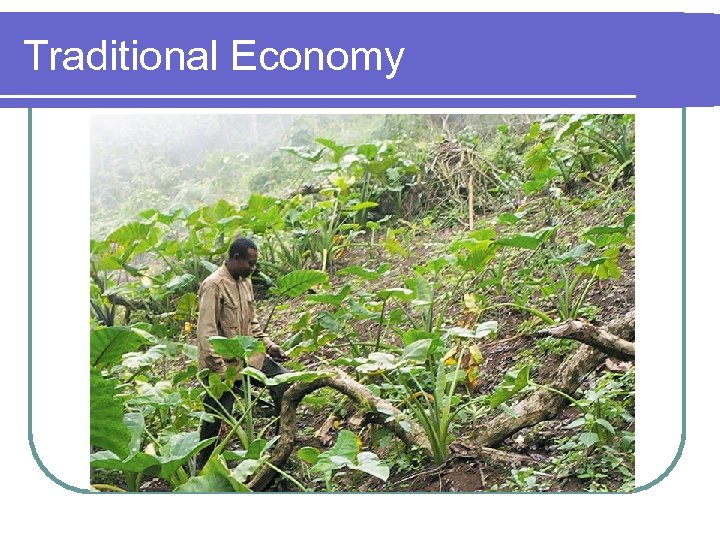 Traditional Economy
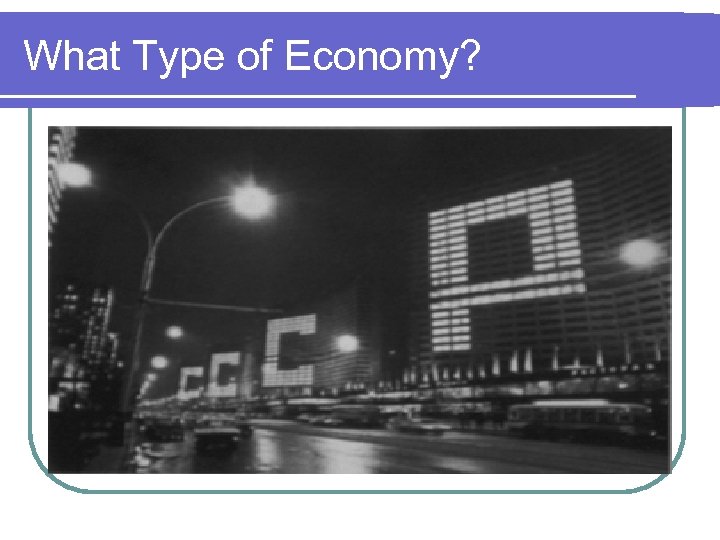
 Command Economy l Command Economy—central government alone decides the direction of the economy l l Socialism—social and political philosophy based on the belief that democratic means should be used to evenly distribute wealth Communism—a political system characterized by a centrally planned economy with all economic and political power resting in the hands of the central government.
 The Command System l Greater l control by leaders Greater equality Collective Farming l Heavy Industry—quickly produce items l l Repressed consumption Work incentives affected l Work was guaranteed & wages set by Government. l l Environmental Degradation
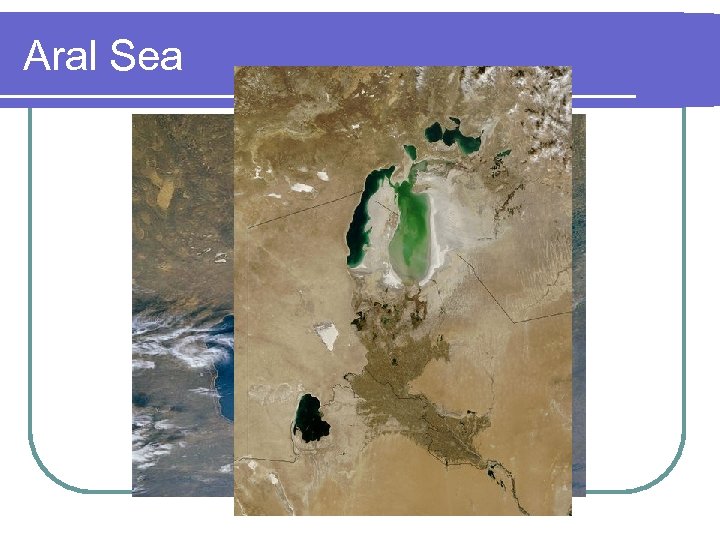 Aral Sea
 Command Economy (Soviet System continued) l Centralized decisions Broad goals passed down the hierarchy and eventually translated into production targets l Production targets set imprecisely l l l Shortages and surpluses prevailed Slow response to scarcity and consumer needs: l No incentive to act on behalf of consumers or individual citizens.
 Control in Command Economies l Licensing and restrictions on producers in the product market, including imports. l Mobility of labor, geographically and occupationally. l Employer inability to fire/hire l Restrictions on the use of property (sometimes no private property)
 Market Economy l Market Economy—economic system in which decisions on production and consumption of goods and services are based on voluntary exchange in markets. Characteristics: specialization & self-interest l Voluntary exchanges l Key Concept—invisible Hand, no government intervention whatsoever l
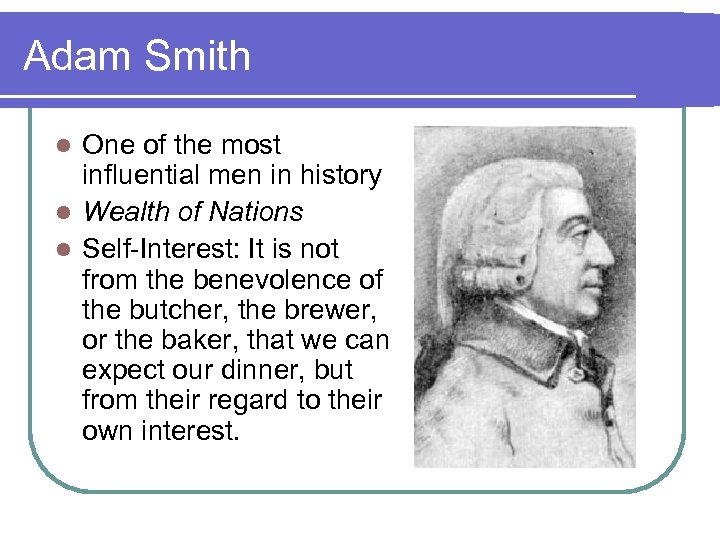 Adam Smith One of the most influential men in history l Wealth of Nations l Self-Interest: It is not from the benevolence of the butcher, the brewer, or the baker, that we can expect our dinner, but from their regard to their own interest. l
 The Market System l Decentralized decision making l Quick response to scarcity due to prices and self interest l Greater efficiency, less equality l Less control by leaders
 Mixed Economy l Mixed Economy—market based economic system with limited government involvement l l is not one single definition for a mixed economy, but relevant aspects include; a degree of private economic freedom (including privately owned industry) intermingled with centralized economic planning (which may include intervention for environmentalism and social welfare, or state ownership of some of means of production).
 Freedoms in Mixed Economy l l l l l possess means of production (farms, factories, stores, etc. ) travel (needed to transport all the items in commerce, to make deals in person, for workers and owners to go to where needed) buy (items for personal use, for resale; buy whole enterprises to make the organization that creates wealth a form of wealth itself) sell (same as buy) hire (to create organizations that create wealth) fire (to maintain organizations that create wealth) organize (private enterprise for profit, labor unions, workers' and professional associations, non-profit groups, religions, etc. ) communicate (free speech, newspapers, books, advertisements, make deals, create business partners, create markets) protest peacefully (marches, petitions, sue the government, make laws friendly to profit making and workers alike, remove pointless inefficiencies to maximize wealth creation)
 Mixed Economy: Role of Government: l Encouraging competition l Law and Order l Contracts and property rights l Management of public resources l Affecting comparative advantage l Stabilization
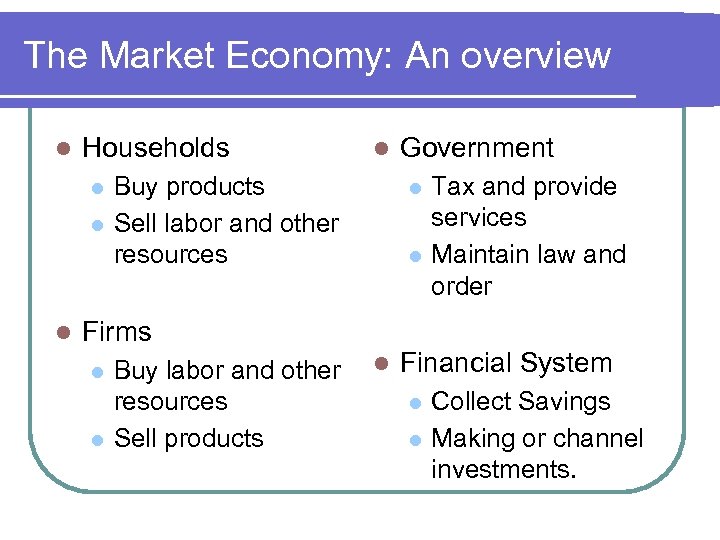 The Market Economy: An overview l Households l l Buy products Sell labor and other resources l l Firms l l Buy labor and other resources Sell products Government l Tax and provide services Maintain law and order Financial System l l Collect Savings Making or channel investments.
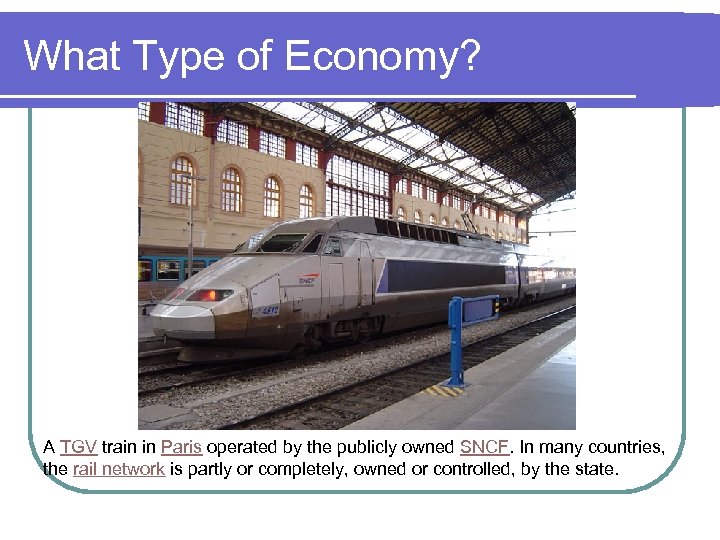 What Type of Economy? A TGV train in Paris operated by the publicly owned SNCF. In many countries, the rail network is partly or completely, owned or controlled, by the state.
 What Type of Economy?
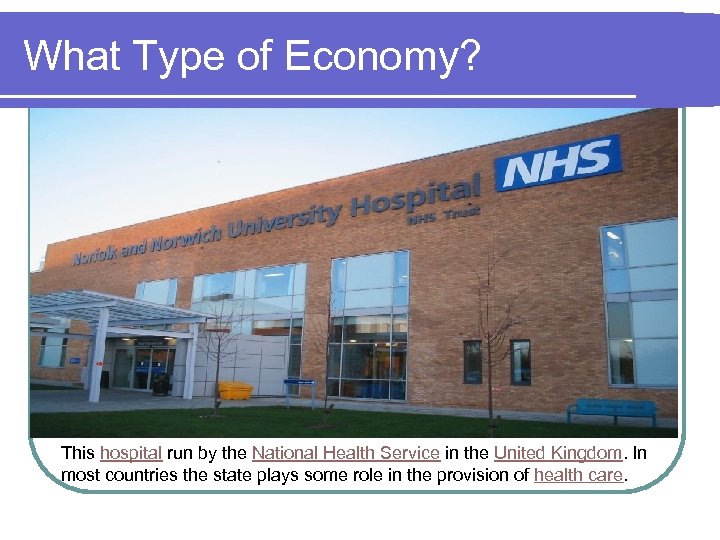 What Type of Economy? This hospital run by the National Health Service in the United Kingdom. In most countries the state plays some role in the provision of health care.
 What Type of Economy?
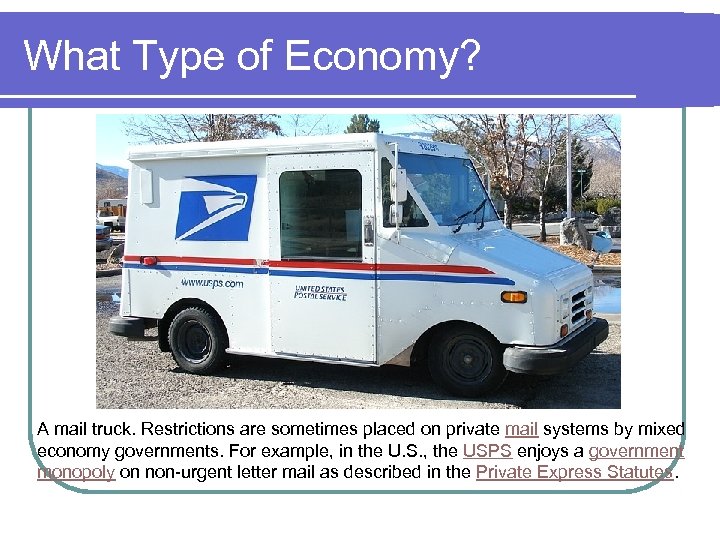 What Type of Economy? A mail truck. Restrictions are sometimes placed on private mail systems by mixed economy governments. For example, in the U. S. , the USPS enjoys a government monopoly on non-urgent letter mail as described in the Private Express Statutes.
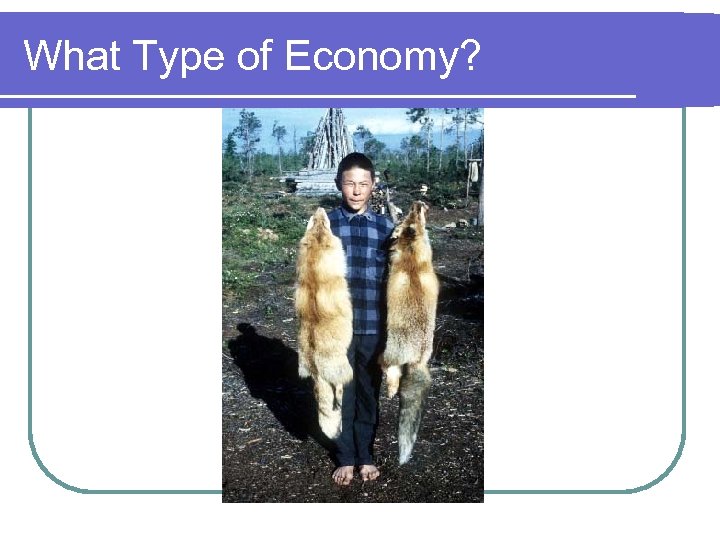
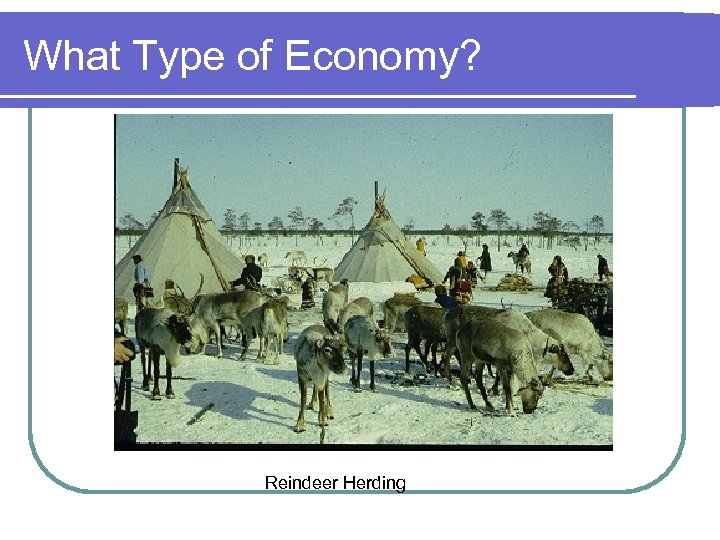 What Type of Economy? Reindeer Herding
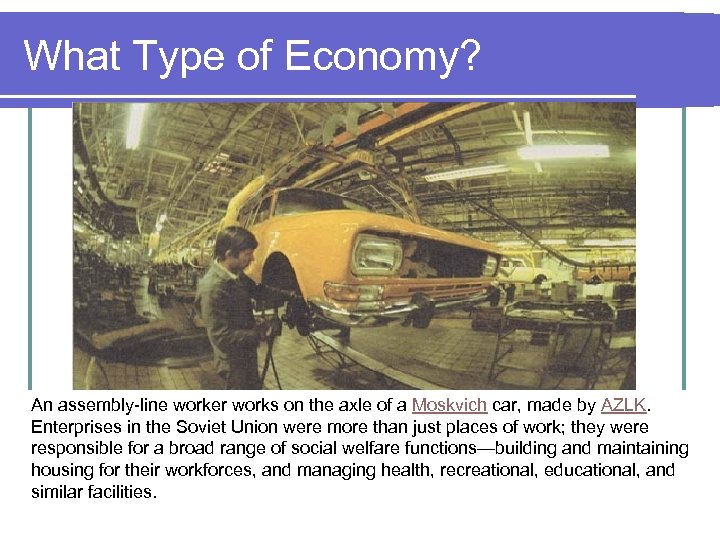 What Type of Economy? An assembly-line worker works on the axle of a Moskvich car, made by AZLK. Enterprises in the Soviet Union were more than just places of work; they were responsible for a broad range of social welfare functions—building and maintaining housing for their workforces, and managing health, recreational, educational, and similar facilities.
 What Type of Economy?
 Pros & Cons Mixed Economy l Pros l Cons
 Pros & Cons Command Economy l Pros l Cons
 Which System is Best l Can we really say one system is better than another system? l Does a mixed economy work best for all people/countries? l What was the United States Economy during WW 2?