


 Скачать презентацию Economics General Overview of CAPS 1 Activity
0c37313cc656873475c2c91ec6e08322.ppt
- Количество слайдов: 112
 Economics General Overview of CAPS 1
 Activity 1 a (From Plenary) 15 min Instructions: 1. Participants must work in pairs. 2. Each receives Worksheets 1 a. 3. Answer the questions in the worksheets. 4. At the end, the entire group discusses the answers. 5. Participants are provided with answers to consolidate the activities. 2
 Activity 1 b (From Plenary) 15 min Instructions: 1. Participants must work in pairs. 2. Each receives Worksheets 1 b. 3. Discuss and answer the questions in the worksheet. 4. At the end, the entire group discusses the answers. 5. Participants are provided with answers to consolidate the activities. 3
 Activity 1 c (From Plenary) 15 min Instructions: 1. Participants must work in pairs. 2. Each receives Worksheet 1 c. 3. Discuss and answer the questions in the worksheet. 4. At the end, the entire group discusses the answers. 5. Participants are provided with answers to consolidate the activities. 4
 Wrap up Activity 1 a, b & c 5
 Rationale, Features and Philosophy 6
 Economics Overview Activity 2 ( 30 Minutes) 1. Participants to form groups of 3 – 5 members. 2. Classify the topics from the ‘Overview of topics per term’ (Worksheet 2), according to the main topics and indicate the teaching weeks. 3. Report back the discussions. 4. Resources: CAPS/ Overview of topics, Koki pens and Flip charts 7
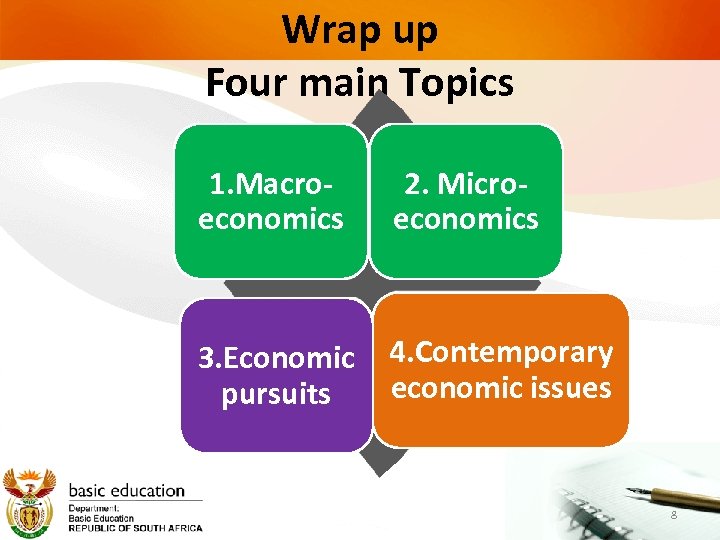 Wrap up Four main Topics 1. Macroeconomics 2. Microeconomics 3. Economic 4. Contemporary economic issues pursuits 8
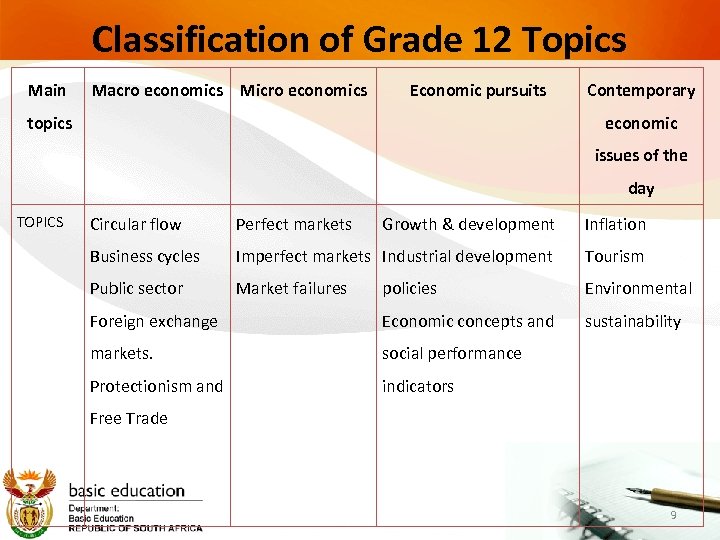 Classification of Grade 12 Topics Main Macro economics Micro economics Economic pursuits topics Contemporary economic issues of the day TOPICS Circular flow Perfect markets Growth & development Inflation Business cycles Imperfect markets Industrial development Tourism Public sector Market failures policies Environmental Foreign exchange Economic concepts and sustainability markets. social performance Protectionism and indicators Free Trade 9
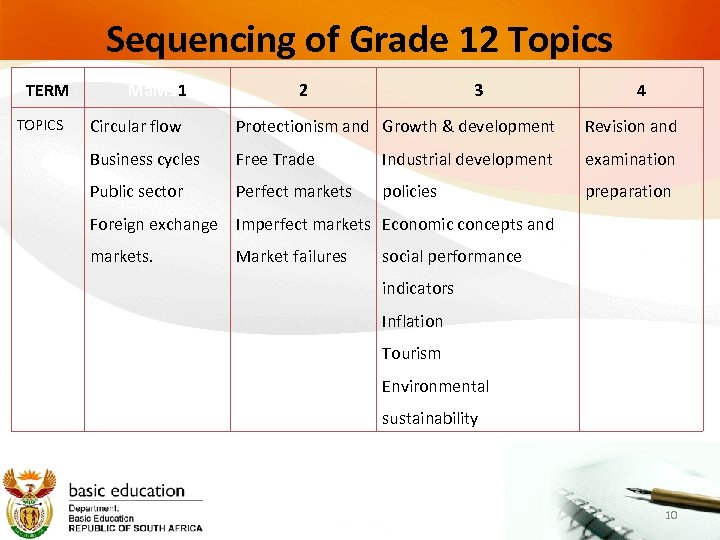 Sequencing of Grade 12 Topics TERM TOPICS Ma. M 11 2 3 4 Circular flow Protectionism and Growth & development Revision and Business cycles Free Trade Industrial development examination Public sector Perfect markets policies preparation Foreign exchange Imperfect markets Economic concepts and markets. Market failures social performance indicators Inflation Tourism Environmental sustainability 10
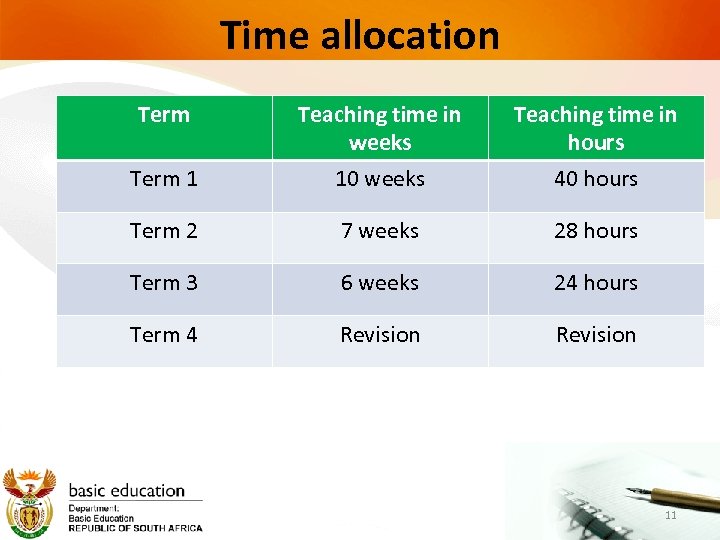 Time allocation Term 1 Teaching time in weeks 10 weeks Teaching time in hours 40 hours Term 2 7 weeks 28 hours Term 3 6 weeks 24 hours Term 4 Revision 11
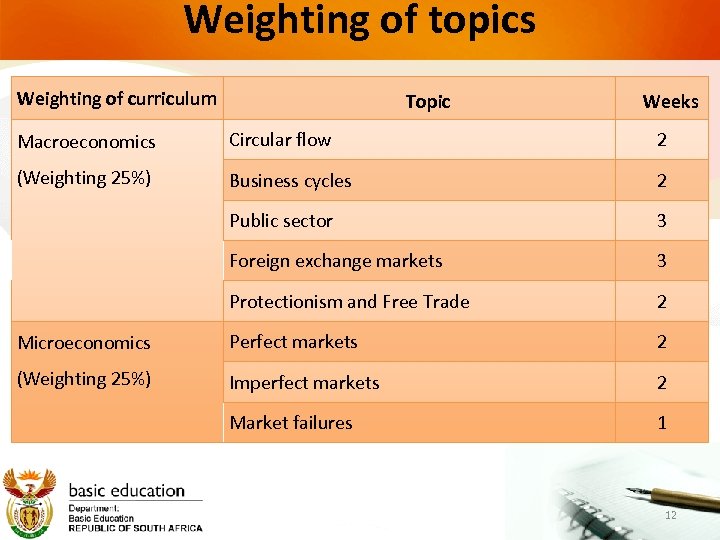 Weighting of topics Weighting of curriculum Topic Weeks Macroeconomics Circular flow 2 (Weighting 25%) Business cycles 2 Public sector 3 Foreign exchange markets 3 Protectionism and Free Trade 2 Microeconomics Perfect markets 2 (Weighting 25%) Imperfect markets 2 Market failures 1 12
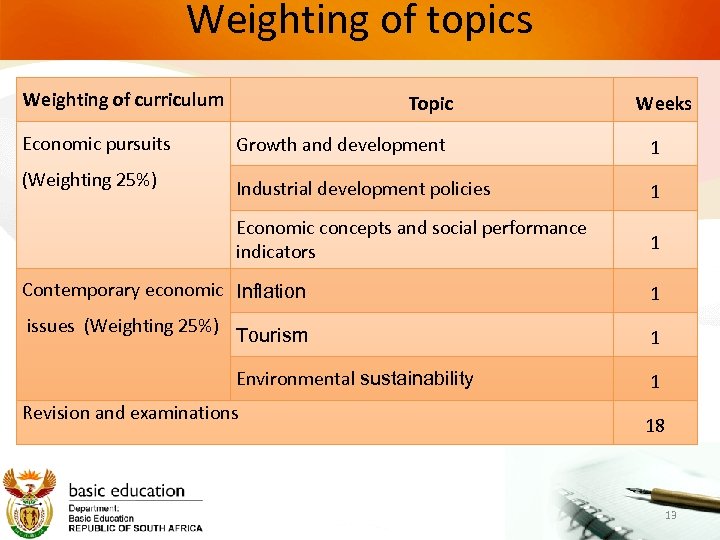 Weighting of topics Weighting of curriculum Topic Weeks Economic pursuits Growth and development 1 (Weighting 25%) Industrial development policies 1 Economic concepts and social performance indicators 1 Contemporary economic Inflation 1 issues (Weighting 25%) Tourism 1 Environmental sustainability Revision and examinations 1 18 13
 Content Mapping 14
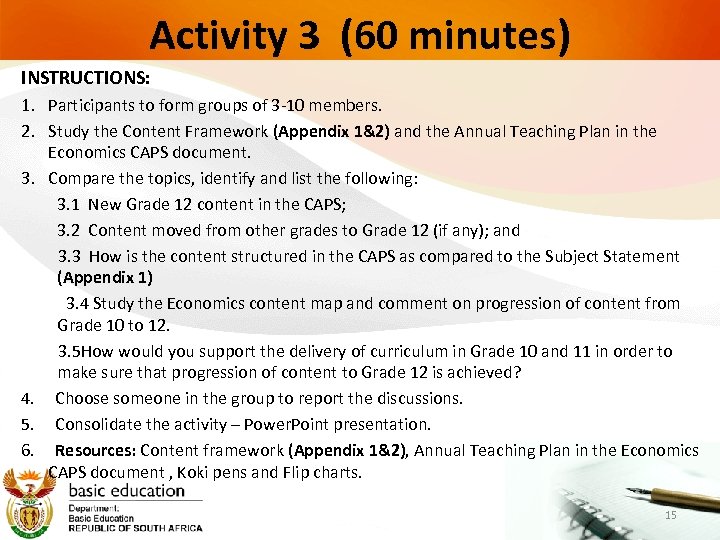 Activity 3 (60 minutes) INSTRUCTIONS: 1. Participants to form groups of 3 -10 members. 2. Study the Content Framework (Appendix 1&2) and the Annual Teaching Plan in the Economics CAPS document. 3. Compare the topics, identify and list the following: 3. 1 New Grade 12 content in the CAPS; 3. 2 Content moved from other grades to Grade 12 (if any); and 3. 3 How is the content structured in the CAPS as compared to the Subject Statement (Appendix 1) 3. 4 Study the Economics content map and comment on progression of content from Grade 10 to 12. 3. 5 How would you support the delivery of curriculum in Grade 10 and 11 in order to make sure that progression of content to Grade 12 is achieved? 4. Choose someone in the group to report the discussions. 5. Consolidate the activity – Power. Point presentation. 6. Resources: Content framework (Appendix 1&2), Annual Teaching Plan in the Economics CAPS document , Koki pens and Flip charts. 15
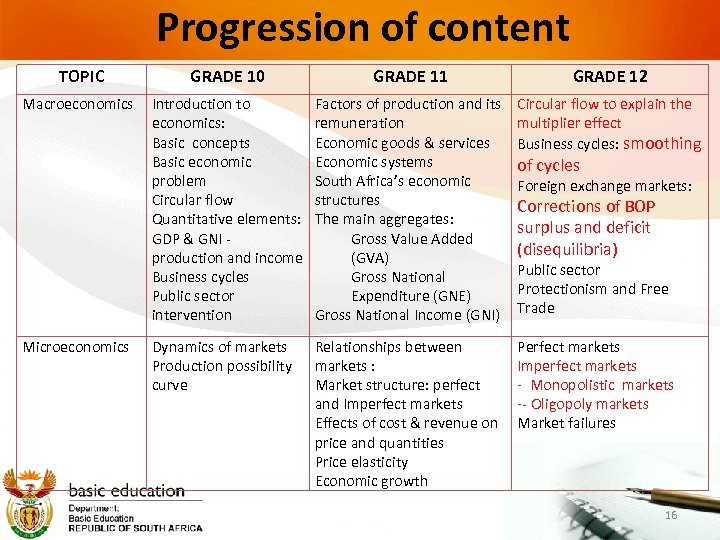 Progression of content TOPIC GRADE 10 GRADE 11 GRADE 12 Macroeconomics Introduction to Factors of production and its economics: remuneration Basic concepts Economic goods & services Basic economic Economic systems problem South Africa’s economic Circular flow structures Quantitative elements: The main aggregates: GDP & GNI - Gross Value Added production and income (GVA) Business cycles Gross National Public sector Expenditure (GNE) intervention Gross National Income (GNI) Circular flow to explain the multiplier effect Business cycles: smoothing Microeconomics Perfect markets Imperfect markets - Monopolistic markets -- Oligopoly markets Market failures Dynamics of markets Production possibility curve Relationships between markets : Market structure: perfect and Imperfect markets Effects of cost & revenue on price and quantities Price elasticity Economic growth of cycles Foreign exchange markets: Corrections of BOP surplus and deficit (disequilibria) Public sector Protectionism and Free Trade 16
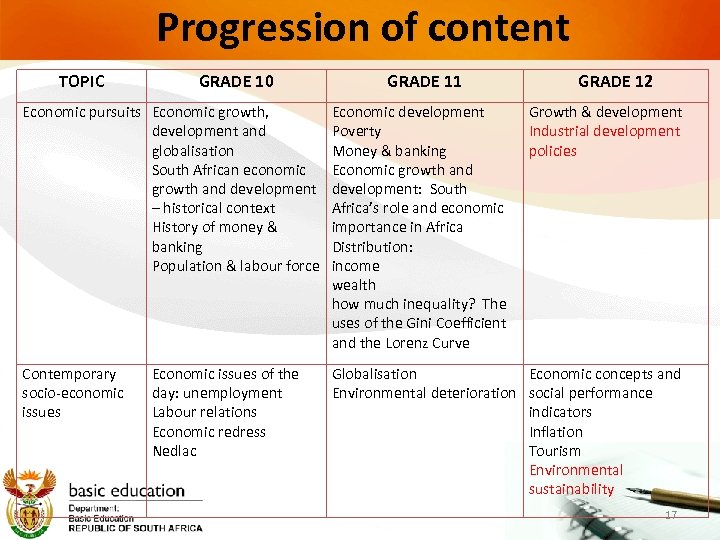 Progression of content TOPIC GRADE 10 GRADE 11 GRADE 12 Economic pursuits Economic growth, development and globalisation South African economic growth and development – historical context History of money & banking Population & labour force Economic development Poverty Money & banking Economic growth and development: South Africa’s role and economic importance in Africa Distribution: income wealth how much inequality? The uses of the Gini Coefficient and the Lorenz Curve Contemporary socio-economic issues Globalisation Economic concepts and Environmental deterioration social performance indicators Inflation Tourism Environmental sustainability Economic issues of the day: unemployment Labour relations Economic redress Nedlac Growth & development Industrial development policies 17
 Planning 18
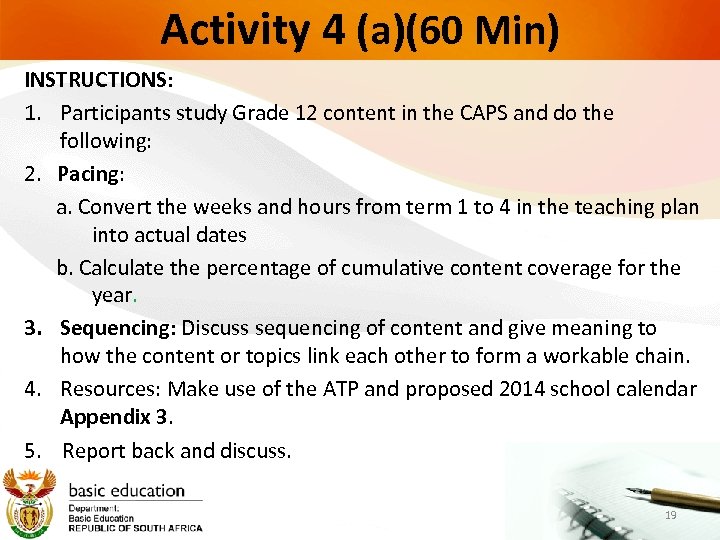 Activity 4 (a)(60 Min) INSTRUCTIONS: 1. Participants study Grade 12 content in the CAPS and do the following: 2. Pacing: a. Convert the weeks and hours from term 1 to 4 in the teaching plan into actual dates b. Calculate the percentage of cumulative content coverage for the year. 3. Sequencing: Discuss sequencing of content and give meaning to how the content or topics link each other to form a workable chain. 4. Resources: Make use of the ATP and proposed 2014 school calendar Appendix 3. 5. Report back and discuss. 19
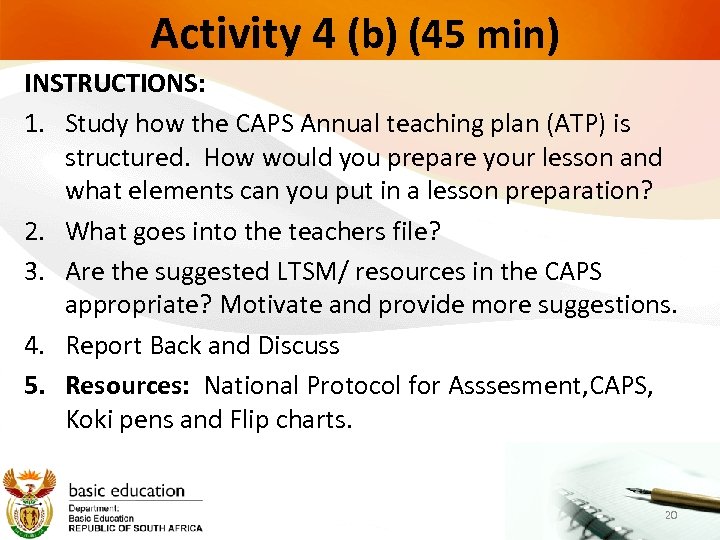 Activity 4 (b) (45 min) INSTRUCTIONS: 1. Study how the CAPS Annual teaching plan (ATP) is structured. How would you prepare your lesson and what elements can you put in a lesson preparation? 2. What goes into the teachers file? 3. Are the suggested LTSM/ resources in the CAPS appropriate? Motivate and provide more suggestions. 4. Report Back and Discuss 5. Resources: National Protocol for Asssesment, CAPS, Koki pens and Flip charts. 20
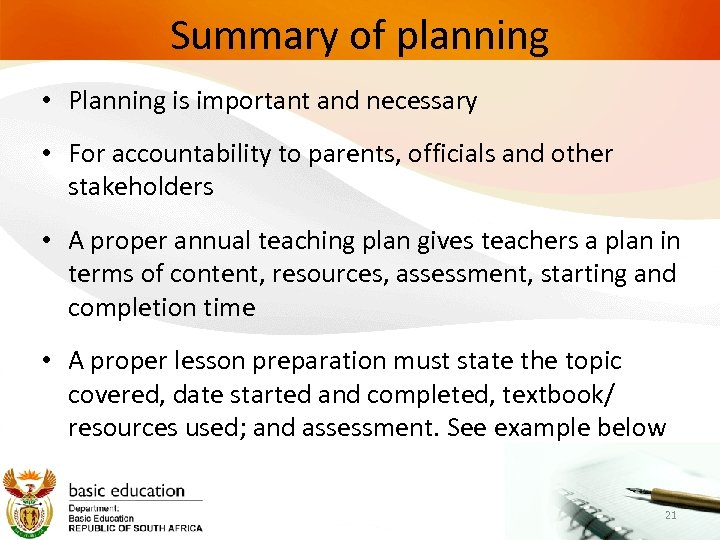 Summary of planning • Planning is important and necessary • For accountability to parents, officials and other stakeholders • A proper annual teaching plan gives teachers a plan in terms of content, resources, assessment, starting and completion time • A proper lesson preparation must state the topic covered, date started and completed, textbook/ resources used; and assessment. See example below 21
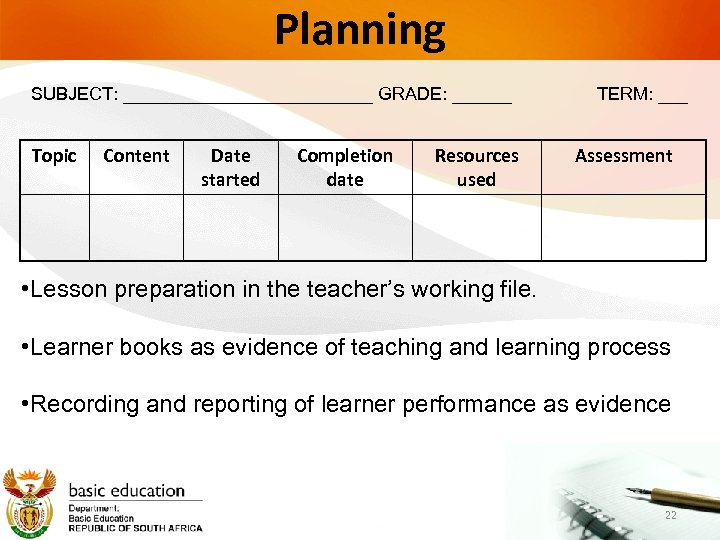 Planning SUBJECT: _____________ GRADE: ______ Topic Content Date started Completion date Resources used TERM: ___ Assessment • Lesson preparation in the teacher’s working file. • Learner books as evidence of teaching and learning process • Recording and reporting of learner performance as evidence 22
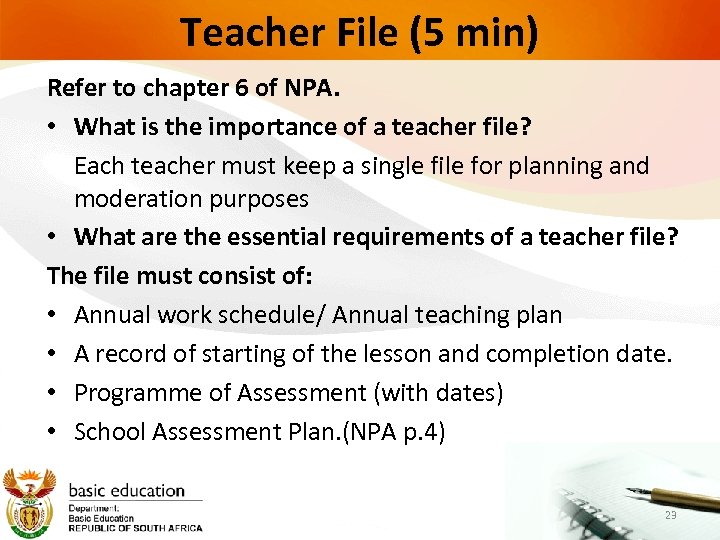 Teacher File (5 min) Refer to chapter 6 of NPA. • What is the importance of a teacher file? Each teacher must keep a single file for planning and moderation purposes • What are the essential requirements of a teacher file? The file must consist of: • Annual work schedule/ Annual teaching plan • A record of starting of the lesson and completion date. • Programme of Assessment (with dates) • School Assessment Plan. (NPA p. 4) 23
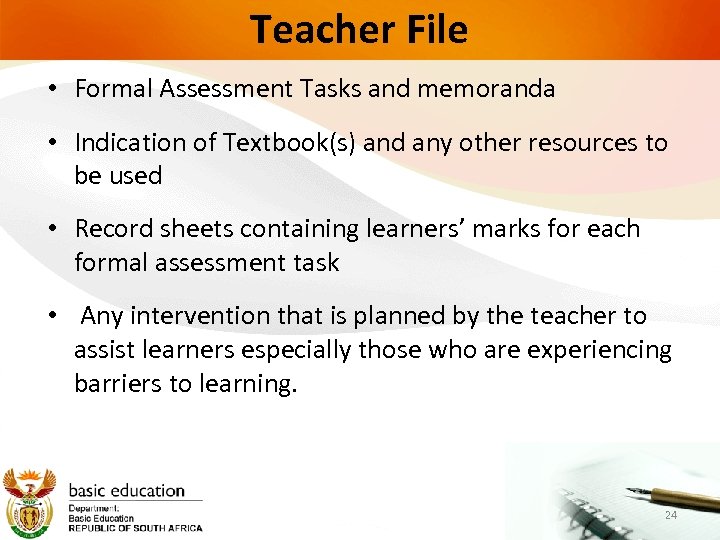 Teacher File • Formal Assessment Tasks and memoranda • Indication of Textbook(s) and any other resources to be used • Record sheets containing learners’ marks for each formal assessment task • Any intervention that is planned by the teacher to assist learners especially those who are experiencing barriers to learning. 24
 Resources (5 min) Resources to offer Economics as a subject are the responsibility of the school. • Each learner should have: – a textbook – stationery – other relevant resources. • The teacher should have: – A variety of textbooks for reference – Cartoons – Newspapers – Magazines (E. g. Financial magazines) – Statistics (e. g. Dept of Labour, SARB, Stats SA) – Year book (Department of Communications) – Previous question papers and memoranda – Moderators reports – Technical report on Learner Performance – TV, Radio and internet (where available) 25
 Textbook/ LTSM • effective tool for teaching and learning • presents all the topics in the content overview • knowledge and concepts are well scaffolded to provide understanding and insight • variety of activities/ exercises that are clear and address different cognitive levels. NB: Each learner should have a textbook per subject to take home to study and do homework. 26
 Advantages of a Textbooks • Textbooks are helpful for beginning teachers. • Textbooks provide organized units of work. • A textbook series provides you with a balanced, chronological presentation of information. • Textbooks are a detailed sequence of teaching procedures. • Textbooks provide teachers with a complete program. • Good textbooks are excellent teaching aids. They're a resource for both teachers and learners. 27
 Content and Methodology - Teaching Approach 28
 Activity 5: Managing Diversity : ( 45 minutes) INSTRUCTIONS: 1. Participants to form groups of 3 -5 members. 2. “The education system seeks to reduce barriers to learning, ensures that inclusivity is “everybody’s” business and requires an integrated approach”!! With this statement in mind, answer the following questions: 2. 1 In your class you have learners with different learning styles, e. g. visual, auditory and kinesthetic. 2. 1. 1 Present the open economy circular flow model as a macroeconomic model taking into consideration the different learning styles. 29
 The use of language in Economics 30
 The use of language in Economics • Instructions: • Read the text from the Training Manual page 14 -16. • Brainstorm why language is important in Economics. 31
 Activity 6: Language across Economics(120 minutes) INSTRUCTIONS 1. Participants to form groups of 3 -5 members. 2. Each receives a worksheet 3. Discuss and give the meaning of the action verbs in Worksheet 3. 4. Choose a concept from the main topics and map out a Vocabulary Tree from the chosen concept. . Make sure that you examine the context of each word used in the tree. 5. Use the Bloom’s or Anderson’s Taxonomy to complete Worksheet 4. Underline the key word/s or an action verb/s in the question. 6. At the end, the entire group discusses the answers. 7. Resources: CAPS - Annual Teaching Plan, Action verbs document, Koki pens and Flip 32
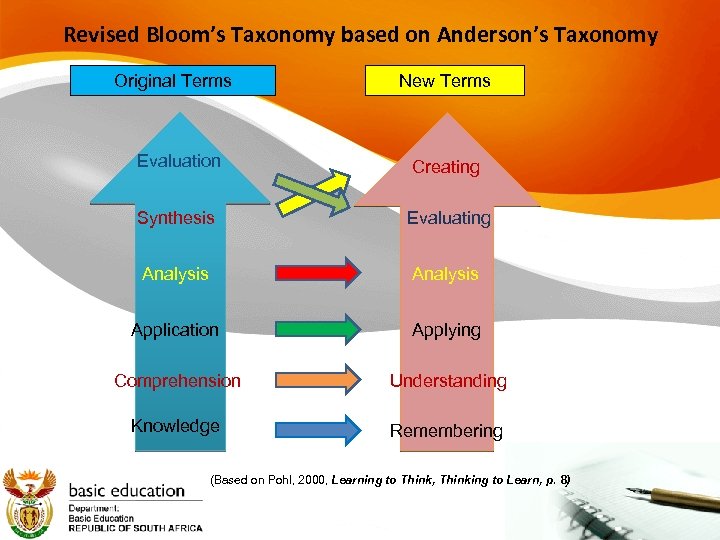 Revised Bloom’s Taxonomy based on Anderson’s Taxonomy Original Terms New Terms Evaluation Creating Synthesis Evaluating Analysis Application Applying Comprehension Understanding Knowledge Remembering (Based on Pohl, 2000, Learning to Think, Thinking to Learn, p. 8)
 Action Verbs 34
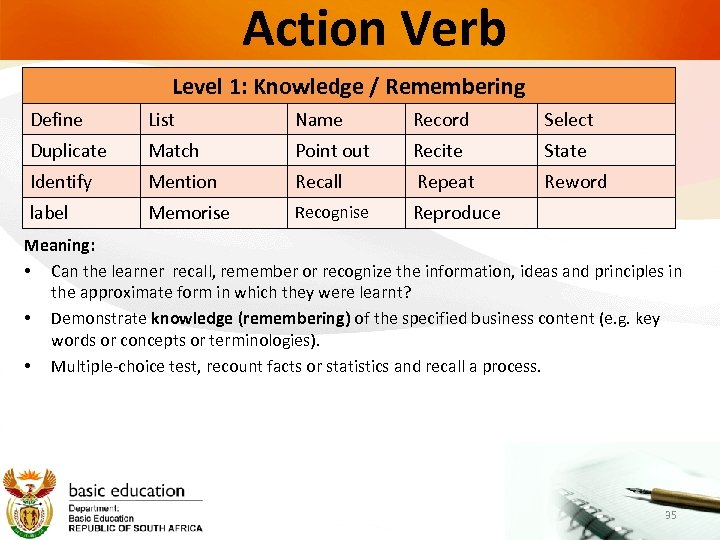 Action Verb Level 1: Knowledge / Remembering Define List Name Record Select Duplicate Match Point out Recite State Identify Mention Recall Repeat Reword label Memorise Recognise Reproduce Meaning: • Can the learner recall, remember or recognize the information, ideas and principles in the approximate form in which they were learnt? • Demonstrate knowledge (remembering) of the specified business content (e. g. key words or concepts or terminologies). • Multiple-choice test, recount facts or statistics and recall a process. 35
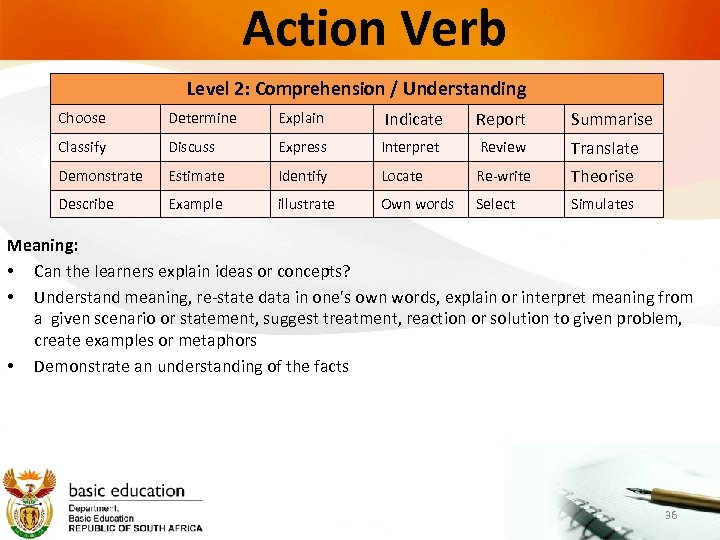 Action Verb Level 2: Comprehension / Understanding Choose Determine Explain Indicate Report Summarise Classify Discuss Express Interpret Review Translate Demonstrate Estimate Identify Locate Re-write Theorise Describe Example illustrate Own words Select Simulates Meaning: • Can the learners explain ideas or concepts? • Understand meaning, re-state data in one's own words, explain or interpret meaning from a given scenario or statement, suggest treatment, reaction or solution to given problem, create examples or metaphors • Demonstrate an understanding of the facts 36
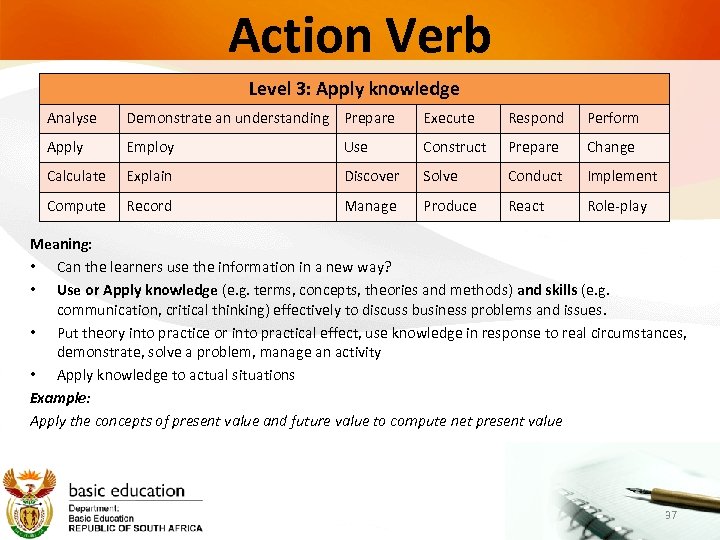 Action Verb Level 3: Apply knowledge Analyse Demonstrate an understanding Prepare Execute Respond Perform Apply Employ Use Construct Prepare Change Calculate Explain Discover Solve Conduct Implement Compute Record Manage Produce React Role-play Meaning: • Can the learners use the information in a new way? • Use or Apply knowledge (e. g. terms, concepts, theories and methods) and skills (e. g. communication, critical thinking) effectively to discuss business problems and issues. • Put theory into practice or into practical effect, use knowledge in response to real circumstances, demonstrate, solve a problem, manage an activity • Apply knowledge to actual situations Example: Apply the concepts of present value and future value to compute net present value 37
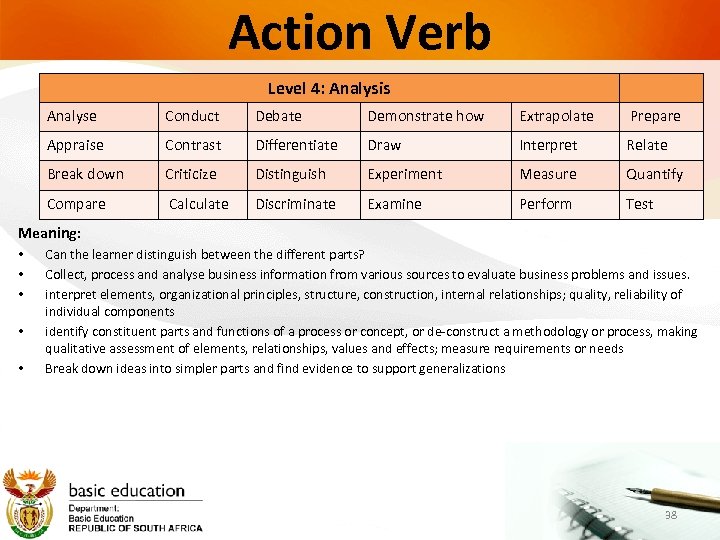 Action Verb Level 4: Analysis Analyse Conduct Debate Demonstrate how Extrapolate Prepare Appraise Contrast Differentiate Draw Interpret Relate Break down Criticize Distinguish Experiment Measure Quantify Compare Calculate Discriminate Examine Perform Test Meaning: • • • Can the learner distinguish between the different parts? Collect, process and analyse business information from various sources to evaluate business problems and issues. interpret elements, organizational principles, structure, construction, internal relationships; quality, reliability of individual components identify constituent parts and functions of a process or concept, or de-construct a methodology or process, making qualitative assessment of elements, relationships, values and effects; measure requirements or needs Break down ideas into simpler parts and find evidence to support generalizations 38
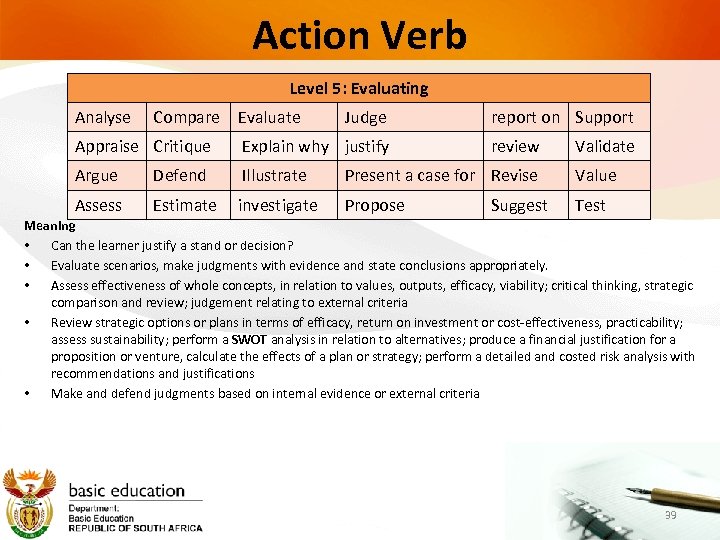 Action Verb Level 5: Evaluating Analyse Compare Evaluate Judge report on Support Appraise Critique Explain why justify review Argue Defend Illustrate Present a case for Revise Value Assess Estimate investigate Propose Test Suggest Validate Meaning • Can the learner justify a stand or decision? • Evaluate scenarios, make judgments with evidence and state conclusions appropriately. • Assess effectiveness of whole concepts, in relation to values, outputs, efficacy, viability; critical thinking, strategic comparison and review; judgement relating to external criteria • Review strategic options or plans in terms of efficacy, return on investment or cost-effectiveness, practicability; assess sustainability; perform a SWOT analysis in relation to alternatives; produce a financial justification for a proposition or venture, calculate the effects of a plan or strategy; perform a detailed and costed risk analysis with recommendations and justifications • Make and defend judgments based on internal evidence or external criteria 39
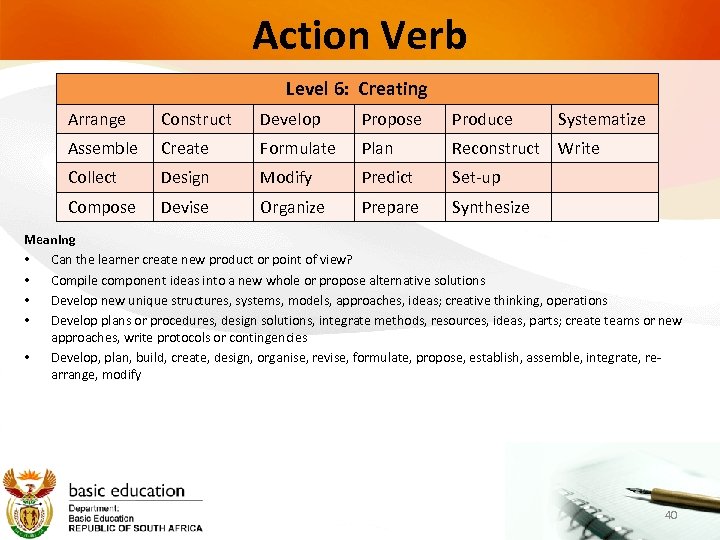 Action Verb Level 6: Creating Arrange Construct Develop Propose Produce Systematize Assemble Create Formulate Plan Reconstruct Write Collect Design Modify Predict Set-up Compose Devise Organize Prepare Synthesize Meaning • Can the learner create new product or point of view? • Compile component ideas into a new whole or propose alternative solutions • Develop new unique structures, systems, models, approaches, ideas; creative thinking, operations • Develop plans or procedures, design solutions, integrate methods, resources, ideas, parts; create teams or new approaches, write protocols or contingencies • Develop, plan, build, create, design, organise, revise, formulate, propose, establish, assemble, integrate, rearrange, modify 40
 Action verbs for Assessment 41
 Define • State precisely the meaning of a concept in concise manner • Meaning is usually specific to the academic discipline • State meaning and identify essential qualities 42
 Analyse Separate and examine the elements • Break the question/subject into its major parts • Describe, define, explain, or interpret each part • Explain how parts relate to each other • Judge overall quality of what has been analyzed 43
 Apply Use an abstraction to explain a concrete situation • Show an abstract idea, concept, principle, model or method explains a • concrete situation or solves a problem 44
 Describe • Write a detailed account or verbal picture in a logical sequence or story form. • Give a mental picture or idea • Identify main aspects, characteristics, components, and qualities • Clarify through illustration, comparison, and contrast 45
 Discuss Explore various points of view • Identify viewpoints and their respective positive / negative aspects • Evaluate the positive and negative merits of a matter to provide an overall • judgment on its validity, strength or worth 46
 Explain • Provide an answer in full. • A complete overview of the problem and solution for a particular issue or process. • Make plain or understandable • Provide a detailed presentation of the elements required to obtain the product • Identify factors that influence outcome; • Provide evidence for each factor and demonstrate how factors are related 47
 Examine • use your own judgment to explore (in writing) a topic and comment on significant elements, events, or acts. • Provide your opinion and explain how or why you came to your conclusions. 48
 Critique • Make informed and discriminating judgments • Identify positive/negative merit, validity / fallacy, etc. • Offer support for your judgments 49
 Subject Content 50
 Activity 7: Macroeconomics (120 minutes) 1. Participants to form 3 -5 groups 2. Study the circular flow model below and: 2. 1 Show the direction of flows between the participants 2. 2 Explain the following terms: 2. 2. 1 Multiplier. 2. 2. 2 Multiplier effect. 3. What is the impact of an increase in income and expenditure on the multiplier? 4. What are the factors that influence the size of the multiplier? 51
 Activity 7: Macroeconomics 5. Indicate whether the following statements about the multiplier effect are True or False. a. The impact of the multiplier effect depends on the size of the initial change in expenditures. b. The size of the multiplier depends on the size of the marginal propensity to consume. c. The reason a change in autonomous consumption may result in a much larger change in income is the result of the multiplier. d. The multiplier is part of the self-adjustment process that brings the private economy back into equilibrium at full employment. e. The cumulative decrease in total spending resulting from an initial decrease in expenditures is equal to the initial decrease multiplied by 1 ÷ mpc. f. Cyclical unemployment originates with an imbalance between injections and leakages, not the absolute size of injections or leakages. 52
 Activity 7: Macroeconomics Topic 1 6. Study the following scenarios and answer the questions: Scenario 1: A Government agency is building hotels around Gauteng. It receives extra income of R 10 million. Part of this money is spent on building materials and payment of employees; part is not spent. The agency spent R 8 million and saved R 2 million, extra spending requires firms to further increase output by hiring more factors so that its income rises, again. The initial injection of R 10 million generates further rounds of income, output and expenditure of R 8 million, R 6 million, etc. The overall increase in GDP is higher than the initial increase in government spending. Calculate the value of the multiplier. 53
 Scenario 2 A large corporation decides to build a factory in a small town. Spending on the factory for the first year is R 5 million. That R 5 million will go to electricians, engineers and other various people building the factory. If MPC is equal to 0. 8, those people will spend R 4 million on various goods and services. The various business and individual receiving that R 4 million will in turn spend R 3. 2 million and so on. Calculate the value of the multiplier. 54
 Scenario 3: An individual pays a gardener R 100 for a spring cleanup. The gardener saves R 10 of those R 100 but spends R 90 at the local hardware store for new tools. Of the R 90, the hardware storeowner saves R 9 and spends R 81 on a golf club. The golf storeowner spends 90 percent of the R 81 (R 73) to take his family out to dinner. The R 100 that was originally spent was re-spent three more times and, in the process, was turned into R 344 of income to others. This process continues and ultimately R 100 of spending could lead to as much as R 1000 of income. What is the multiplier effect in this scenario? 55
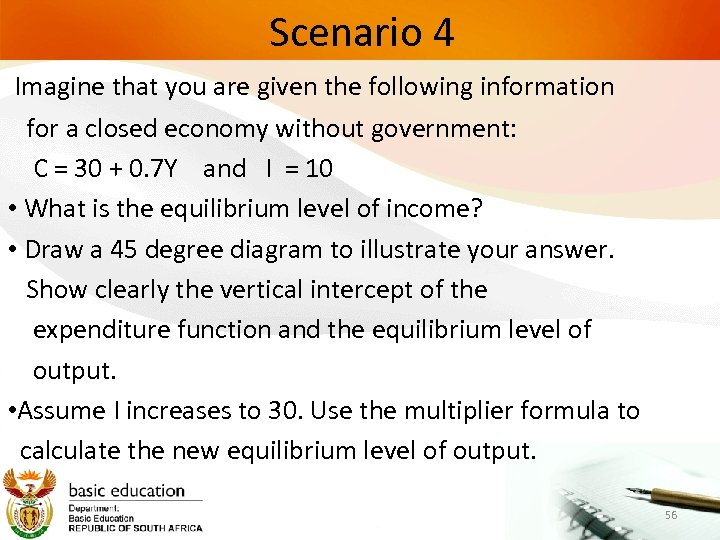 Scenario 4 Imagine that you are given the following information for a closed economy without government: C = 30 + 0. 7 Y and I = 10 • What is the equilibrium level of income? • Draw a 45 degree diagram to illustrate your answer. Show clearly the vertical intercept of the expenditure function and the equilibrium level of output. • Assume I increases to 30. Use the multiplier formula to calculate the new equilibrium level of output. 56
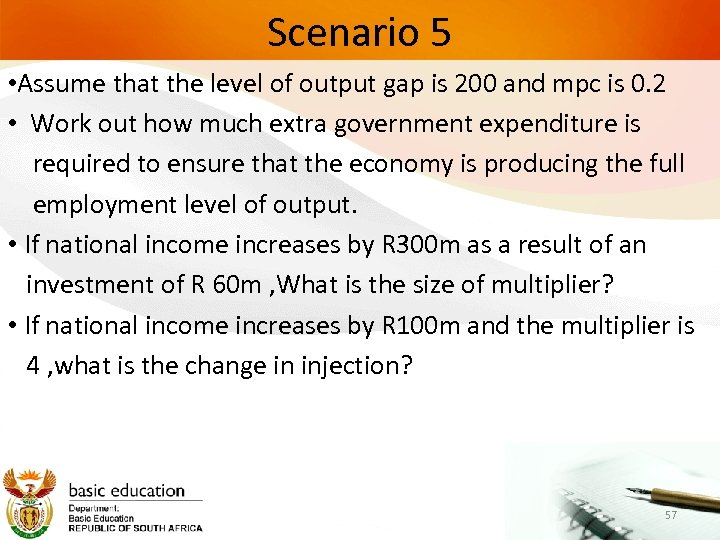 Scenario 5 • Assume that the level of output gap is 200 and mpc is 0. 2 • Work out how much extra government expenditure is required to ensure that the economy is producing the full employment level of output. • If national income increases by R 300 m as a result of an investment of R 60 m , What is the size of multiplier? • If national income increases by R 100 m and the multiplier is 4 , what is the change in injection? 57
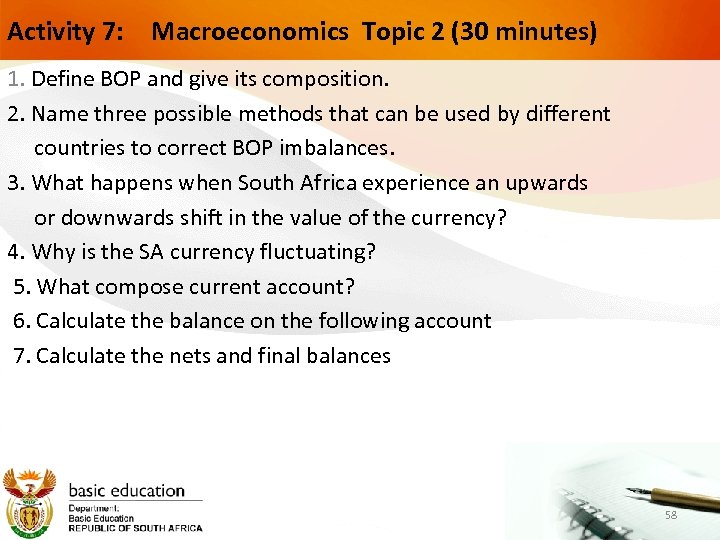 Activity 7: Macroeconomics Topic 2 (30 minutes) 1. Define BOP and give its composition. 2. Name three possible methods that can be used by different countries to correct BOP imbalances. 3. What happens when South Africa experience an upwards or downwards shift in the value of the currency? 4. Why is the SA currency fluctuating? 5. What compose current account? 6. Calculate the balance on the following account 7. Calculate the nets and final balances 58
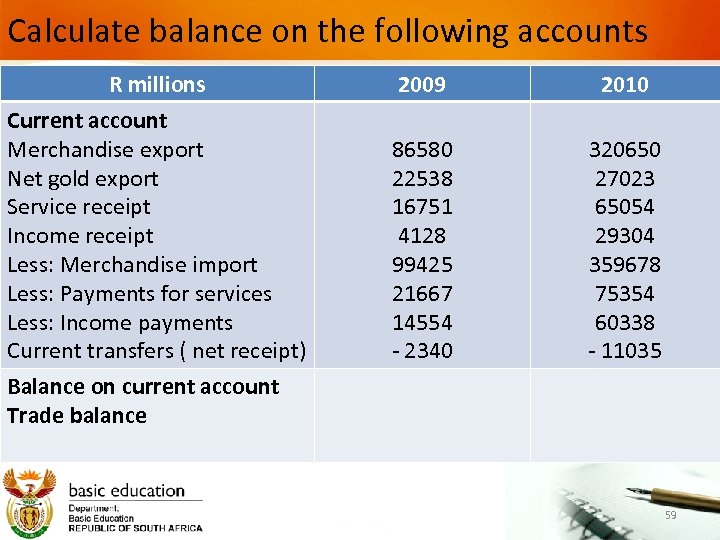 Calculate balance on the following accounts R millions 2009 2010 Current account Merchandise export Net gold export Service receipt Income receipt Less: Merchandise import Less: Payments for services Less: Income payments Current transfers ( net receipt) 86580 22538 16751 4128 99425 21667 14554 - 2340 320650 27023 65054 29304 359678 75354 60338 - 11035 Balance on current account Trade balance 59
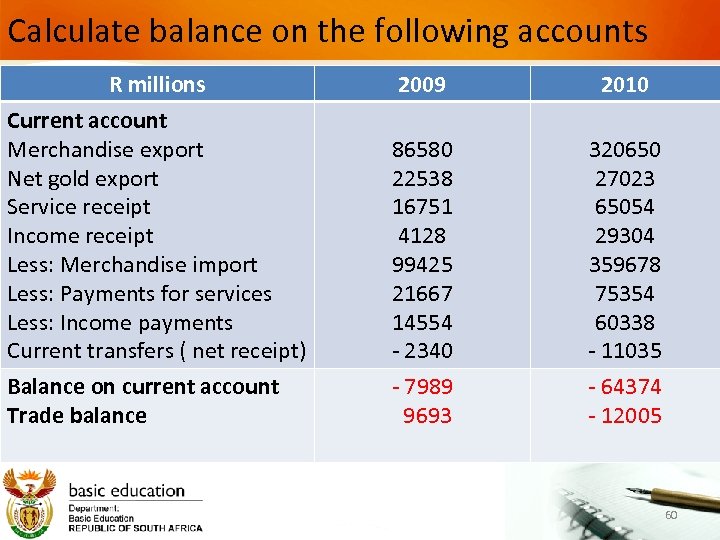 Calculate balance on the following accounts R millions 2009 2010 Current account Merchandise export Net gold export Service receipt Income receipt Less: Merchandise import Less: Payments for services Less: Income payments Current transfers ( net receipt) 86580 22538 16751 4128 99425 21667 14554 - 2340 320650 27023 65054 29304 359678 75354 60338 - 11035 Balance on current account Trade balance - 7989 9693 - 64374 - 12005 60
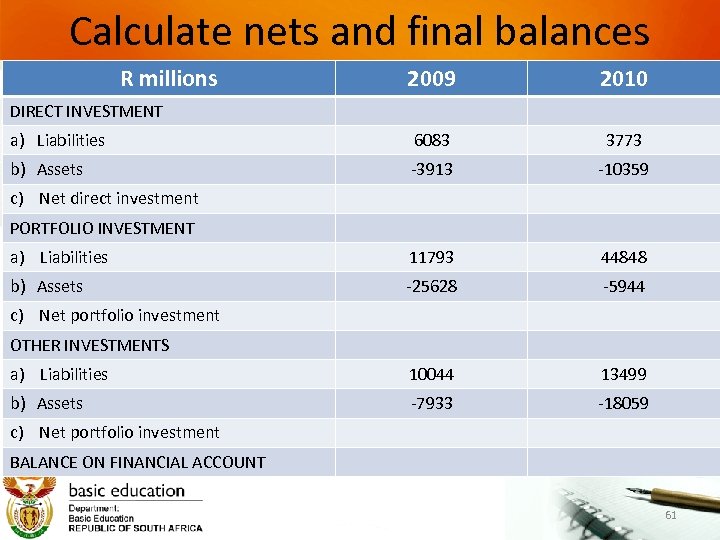 Calculate nets and final balances R millions 2009 2010 a) Liabilities 6083 3773 b) Assets -3913 -10359 a) Liabilities 11793 44848 b) Assets -25628 -5944 a) Liabilities 10044 13499 b) Assets -7933 -18059 DIRECT INVESTMENT c) Net direct investment PORTFOLIO INVESTMENT c) Net portfolio investment OTHER INVESTMENTS c) Net portfolio investment BALANCE ON FINANCIAL ACCOUNT 61
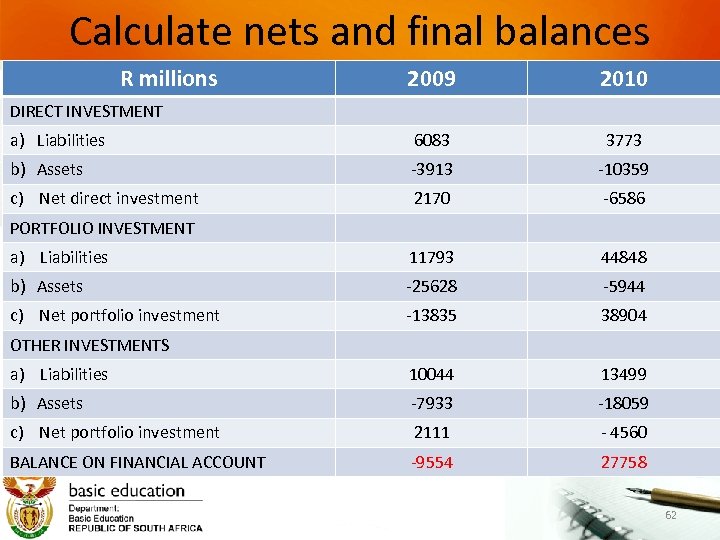 Calculate nets and final balances R millions 2009 2010 a) Liabilities 6083 3773 b) Assets -3913 -10359 c) Net direct investment 2170 -6586 a) Liabilities 11793 44848 b) Assets -25628 -5944 c) Net portfolio investment -13835 38904 a) Liabilities 10044 13499 b) Assets -7933 -18059 c) Net portfolio investment 2111 - 4560 BALANCE ON FINANCIAL ACCOUNT -9554 27758 DIRECT INVESTMENT PORTFOLIO INVESTMENT OTHER INVESTMENTS 62
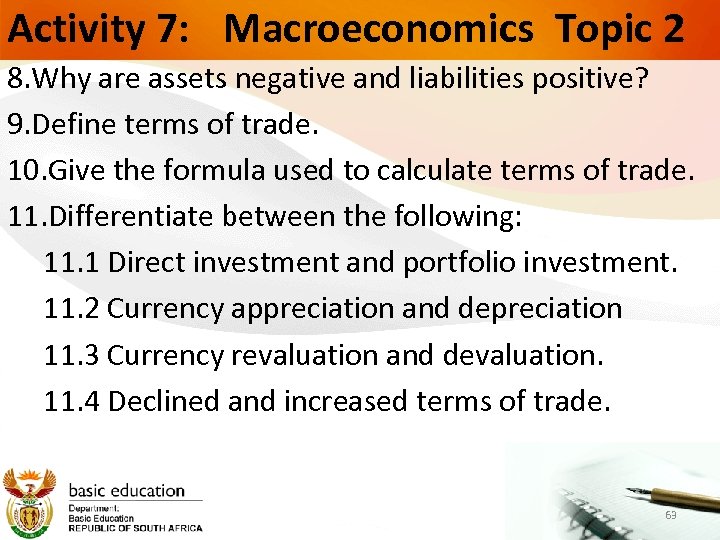 Activity 7: Macroeconomics Topic 2 8. Why are assets negative and liabilities positive? 9. Define terms of trade. 10. Give the formula used to calculate terms of trade. 11. Differentiate between the following: 11. 1 Direct investment and portfolio investment. 11. 2 Currency appreciation and depreciation 11. 3 Currency revaluation and devaluation. 11. 4 Declined and increased terms of trade. 63
 Activity 7: Macroeconomics Topic 2 12. Calculate the terms of trade given the following: 12. 1 Average price of exports = R 40 and average price of imports = R 50. Imagine that there is a change in the price of imports, ceteris paribus, to R 60. Calculate the new terms of trade and explain the implication of the change in the terms of trade for the people of the country. Say explicitly whether they are better off or worse off. 13. Report back 64
 Activity 8 : Microeconomics topic 1 FORM OF ACTIVITY: The dynamics of markets Activity 8 : Monopolistic competition INSTRUCTIONS: Participants to form groups of 3 -5 1. What are the characteristics of a monopolistic competition? 2. Give examples of monopolistic markets. 3. The table below presents revenue and cost information for Manny Mustard's House of Sandwich, a hypothetical example of a monopolistically competitive firm, that results from the production and sale of Deluxe Club Sandwiches, a tasty luncheon consumed by residents of Mokopane. Study the table and answer the following questions. 3. RESOURCES: Laptop, Data Projector, Curriculum and Assessment Policy Statement. Flip charts and Koki pens 65
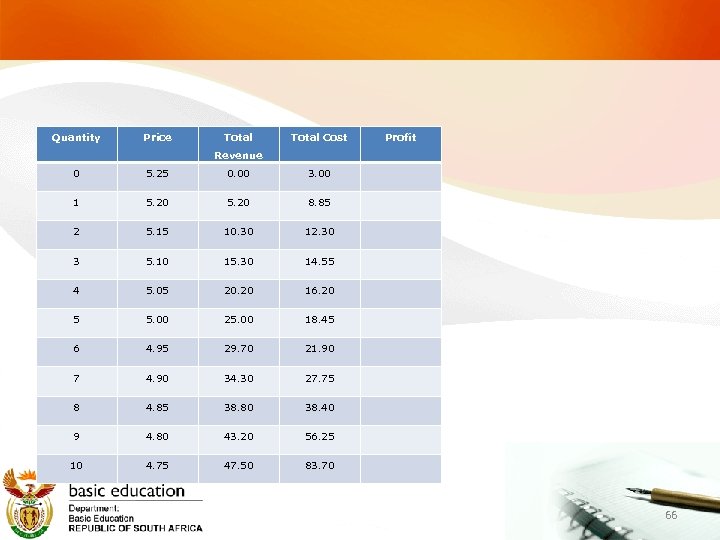 Quantity Price Total Cost Profit Revenue 0 5. 25 0. 00 3. 00 1 5. 20 8. 85 2 5. 15 10. 30 12. 30 3 5. 10 15. 30 14. 55 4 5. 05 20. 20 16. 20 5 5. 00 25. 00 18. 45 6 4. 95 29. 70 21. 90 7 4. 90 34. 30 27. 75 8 4. 85 38. 80 38. 40 9 4. 80 43. 20 56. 25 10 4. 75 47. 50 83. 70 66
 Activity 8 (Cont…) 3. 1. Identify the quantity of sandwich production that provides the maximum profit. 3. 2. Indicate the levels at which an economic loss can be incurred. 3. 3. Indicate the levels at which positive economic profit generated. 3. 4. What is the profit-maximizing level of sandwich production that Manny should produce? 67
 Activity 9 (Cont…) 4. Analyse the profit-maximization production decision facing a monopolistically competitive firm using the table below: 68
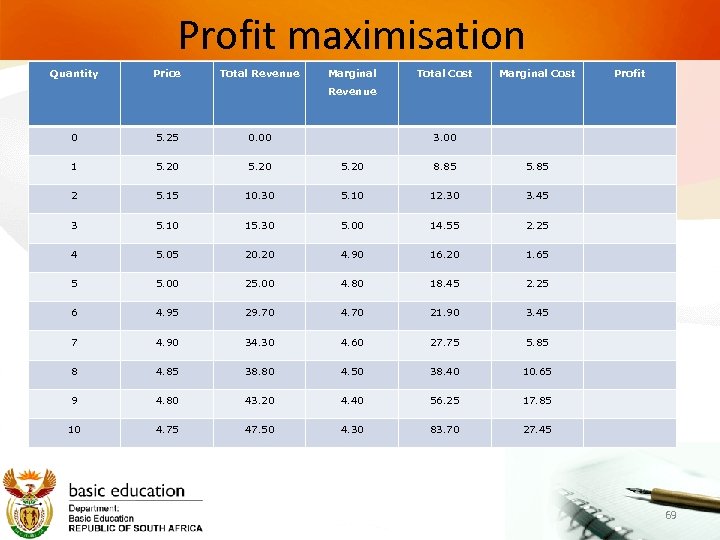 Profit maximisation Quantity Price Total Revenue Marginal Total Cost Marginal Cost Profit Revenue 0 5. 25 0. 00 3. 00 1 5. 20 8. 85 5. 85 2 5. 15 10. 30 5. 10 12. 30 3. 45 3 5. 10 15. 30 5. 00 14. 55 2. 25 4 5. 05 20. 20 4. 90 16. 20 1. 65 5 5. 00 25. 00 4. 80 18. 45 2. 25 6 4. 95 29. 70 4. 70 21. 90 3. 45 7 4. 90 34. 30 4. 60 27. 75 5. 85 8 4. 85 38. 80 4. 50 38. 40 10. 65 9 4. 80 43. 20 4. 40 56. 25 17. 85 10 4. 75 47. 50 4. 30 83. 70 27. 45 69
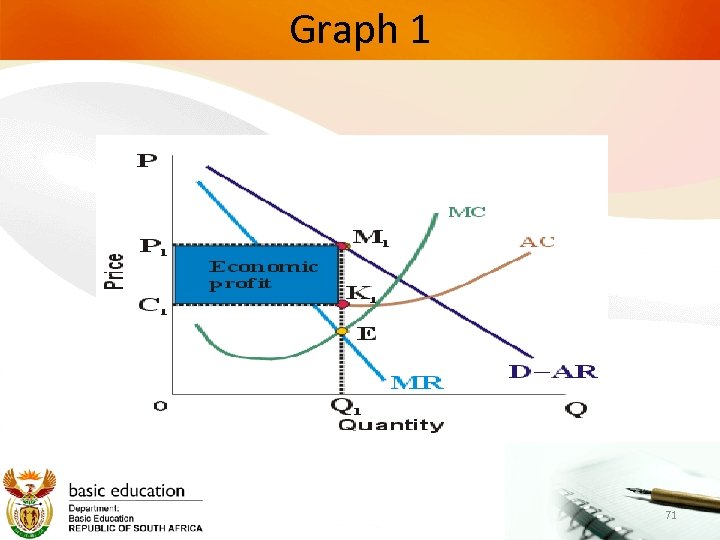
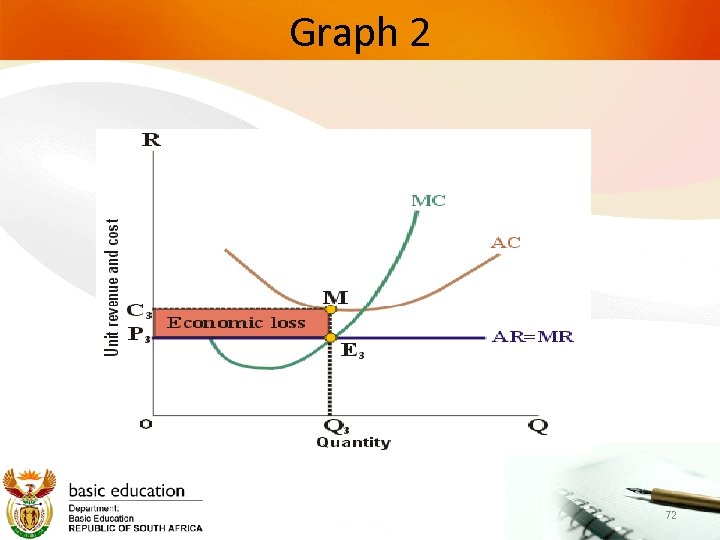
 Activity 8: Microeconomics: topic 1 5. Draw a graph illustrating the TR and TC curves. Show the profit maximizing output. 6. Study and interpret each of the graphs below. 7. Report back 70
 Graph 1 71
 Graph 2 72
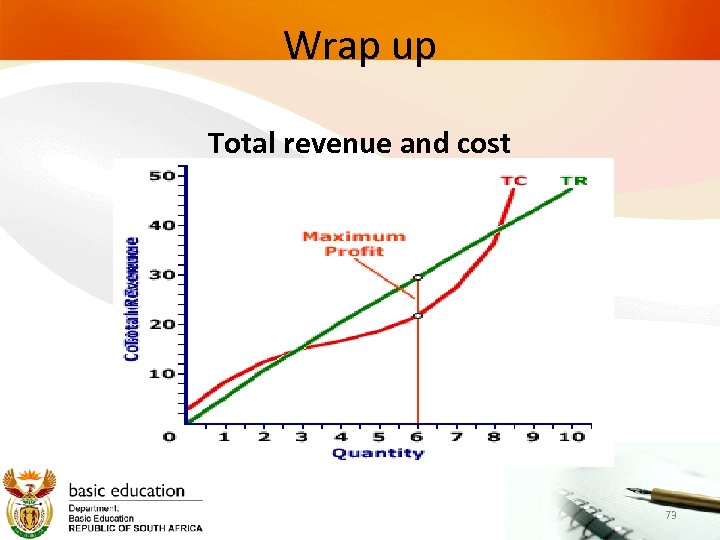 Wrap up Total revenue and cost 73
 Wrap up (cont…) Ø Labeling of graphs ØMR, AR, MC, AC curves ØNormal profit, economic profit & economic loss 74
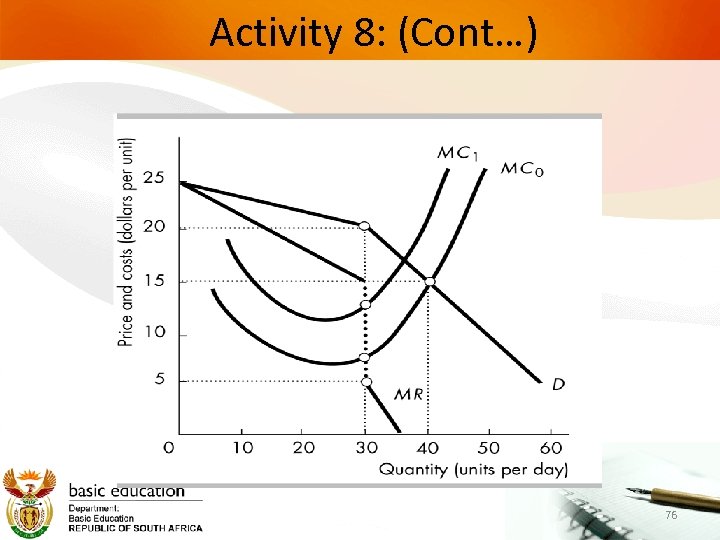
 Activity 8 : Topic 2 1. Discuss any three characteristics of oligopoly. 2. “Oligopolistic industries tend to be diverse; they also tend to exhibit several behavioral tendencies”. With this statement in mind, discuss five behavioral tendencies of oligopolistic industries. 3. What is the difference between monopolistic competition and oligopoly? 4. Explain what the kinked demand curve is. 5. Study the kinked demand curve below and answer the questions that follow: 75
 Activity 8: (Cont…) 76
 Activity 8 (Cont…) 1. In the figure above, if the firm’s marginal cost is MC 0, then the firm will produce a. less than 30 units per day. b. 30 units per day. c. more than 30 but less than 40 units per day. d. 40 units per day. 2 In the figure above, if the firm’s marginal cost curve is MC 0 then it will charge a price of a. R 5. b. more than R 5 and less than R 15. c. R 15. d. R 20. 77
 Activity 8 (Cont…) 3. In the figure above, if the firm’s marginal cost curve is MC 0 then its economic profit a. 0. b. R 150 per day. c. R 600 per day. d. cannot be determined. 4. The figure above illustrates the kinked demand curve model of oligopoly. In this figure, if the firm’s marginal cost curve shifts from MC 0 to MC 1, then the firm’s output level a. will increase. b. will decrease. c. will not change. d. could increase, decrease, or stay the same. 78
 Activity 8 (Cont…) 5. The figure above illustrates the kinked demand curve model of oligopoly. In this figure, if the firm’s marginal cost curve shifts from MC 0 to MC 1, then the price the firm charges a. will rise. b. will fall. c. will not change. d. could rise, fall, or stay the same depending on 6. In the kinked demand curve model of oligopoly, if the marginal cost curve shifts upward, then output a. will always decrease. b. will always stay the same. c. will decrease if the shift is small, but stay the same if the shift is large. d. will stay the same if the shift is small, but decrease if the shift is large. 79
 Wrap up • Report back • Discussion of solutions 80
 Activity 9: Industrial Development Policy (120 Minutes) INSTRUCTIONS: 1. Participants to form groups of 3 -5 2. In your groups discuss the aims and objectives , successes and challenges of the following South Africa`s growth and development policies: • RDP • GEAR • As. GISA • New Growth Path • Industrial Policy Framework • National Industrial Policy and Action Plan 1 & 2 3. Why was it necessary for the government to introduce the National Development Plan(NDP). 4. Report back 5. . Wrap-up: Discussion. 81
 Wrap up • In grade 10 a study on the historical view on South African economic growth and development was done. • In grade 11 we looked at South Africa`s role and relative economic importance in Africa e. g. SADC. • In grade 12 we will focus on South Africa`s industrial development policies and their suitability in terms of international best practice. 82
 Assessment 83
 Background: (10 minutes) • What is assessment? • What is informal assessment? – Role • What is formal assessment? – Role 84
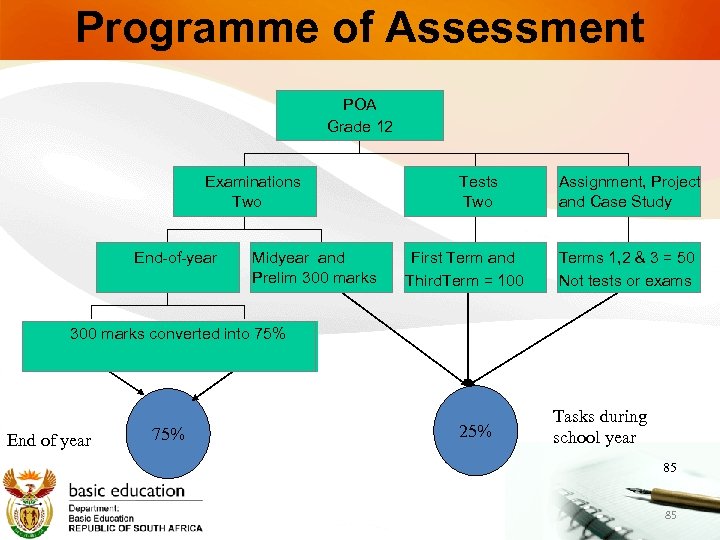 Programme of Assessment POA Grade 12 Examinations Two End-of-year Midyear and Prelim 300 marks Tests Two First Term and Third. Term = 100 Assignment, Project and Case Study Terms 1, 2 & 3 = 50 Not tests or exams 300 marks converted into 75% End of year 75% 25% Tasks during school year 85 85
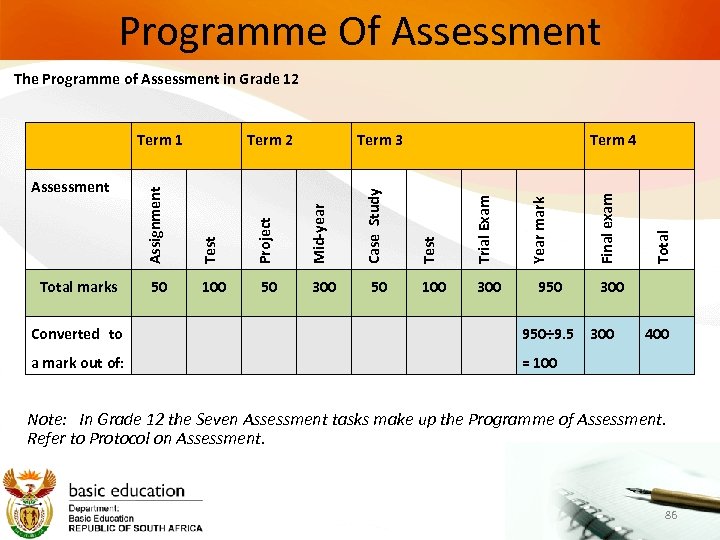 Programme Of Assessment The Programme of Assessment in Grade 12 100 300 50 950 Total 300 Final exam 100 Year mark Case Study Mid-year Project 50 Term 4 Trial Exam 50 Term 3 Test Total marks Term 2 Test Assessment Assignment Term 1 300 Converted to 950÷ 9. 5 300 a mark out of: 400 = 100 Note: In Grade 12 the Seven Assessment tasks make up the Programme of Assessment. Refer to Protocol on Assessment. 86
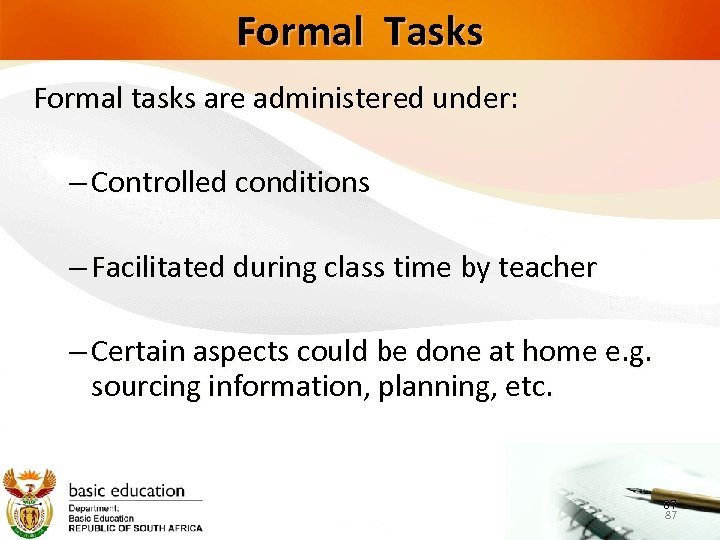 Formal Tasks Formal tasks are administered under: – Controlled conditions – Facilitated during class time by teacher – Certain aspects could be done at home e. g. sourcing information, planning, etc. 87 87
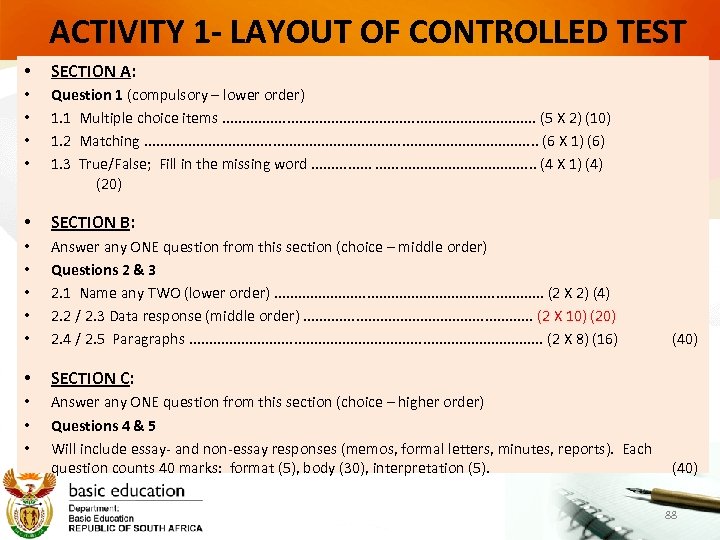 ACTIVITY 1 - LAYOUT OF CONTROLLED TEST • SECTION A: • • Question 1 (compulsory – lower order) 1. 1 Multiple choice items. . . . . (5 X 2) (10) 1. 2 Matching. . . . . . (6 X 1) (6) 1. 3 True/False; Fill in the missing word. . . . (4 X 1) (4) (20) • SECTION B: • • • Answer any ONE question from this section (choice – middle order) Questions 2 & 3 2. 1 Name any TWO (lower order). . . . . (2 X 2) (4) 2. 2 / 2. 3 Data response (middle order). . . . (2 X 10) (20) 2. 4 / 2. 5 Paragraphs. . . . . . (2 X 8) (16) • SECTION C: • • • Answer any ONE question from this section (choice – higher order) Questions 4 & 5 Will include essay- and non-essay responses (memos, formal letters, minutes, reports). Each question counts 40 marks: format (5), body (30), interpretation (5). (40) 88
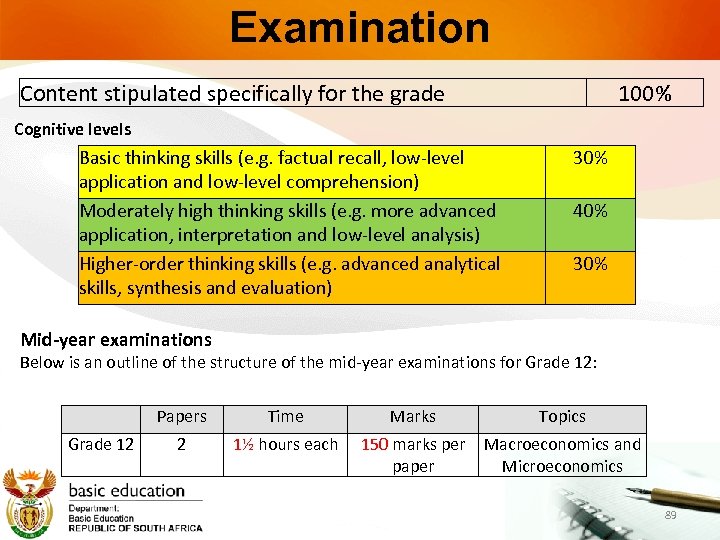 Examination Content stipulated specifically for the grade 100% Cognitive levels Basic thinking skills (e. g. factual recall, low-level application and low-level comprehension) Moderately high thinking skills (e. g. more advanced application, interpretation and low-level analysis) Higher-order thinking skills (e. g. advanced analytical skills, synthesis and evaluation) 30% 40% 30% Mid-year examinations Below is an outline of the structure of the mid-year examinations for Grade 12: Papers Grade 12 Time 2 1½ hours each Marks Topics 150 marks per Macroeconomics and paper Microeconomics 89
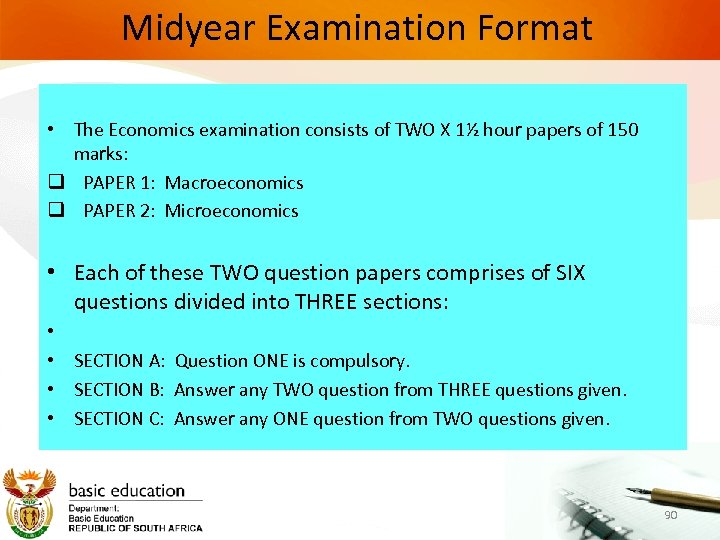 Midyear Examination Format • The Economics examination consists of TWO X 1½ hour papers of 150 marks: q PAPER 1: Macroeconomics q PAPER 2: Microeconomics • Each of these TWO question papers comprises of SIX questions divided into THREE sections: • • SECTION A: Question ONE is compulsory. SECTION B: Answer any TWO question from THREE questions given. SECTION C: Answer any ONE question from TWO questions given. 90
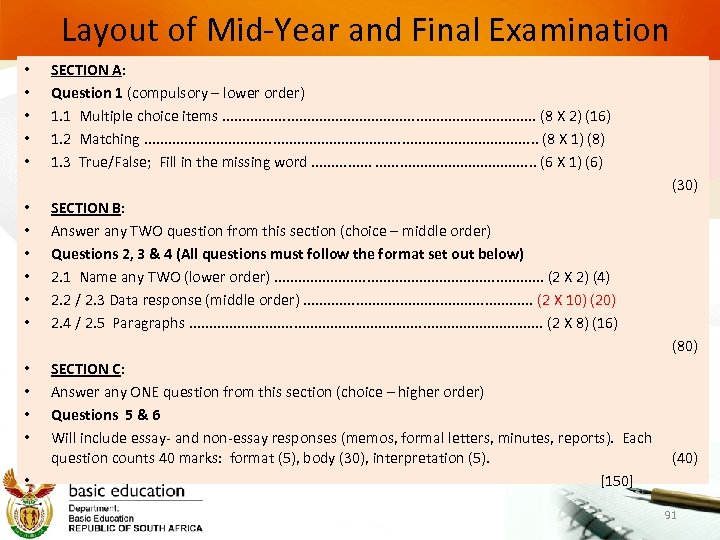 Layout of Mid-Year and Final Examination • • • SECTION A: Question 1 (compulsory – lower order) 1. 1 Multiple choice items. . . . . (8 X 2) (16) 1. 2 Matching. . . . . . (8 X 1) (8) 1. 3 True/False; Fill in the missing word. . . . (6 X 1) (6) (30) • • • SECTION B: Answer any TWO question from this section (choice – middle order) Questions 2, 3 & 4 (All questions must follow the format set out below) 2. 1 Name any TWO (lower order). . . . . (2 X 2) (4) 2. 2 / 2. 3 Data response (middle order). . . . (2 X 10) (20) 2. 4 / 2. 5 Paragraphs. . . . . . (2 X 8) (16) (80) • • • SECTION C: Answer any ONE question from this section (choice – higher order) Questions 5 & 6 Will include essay- and non-essay responses (memos, formal letters, minutes, reports). Each question counts 40 marks: format (5), body (30), interpretation (5). [150] (40) 91
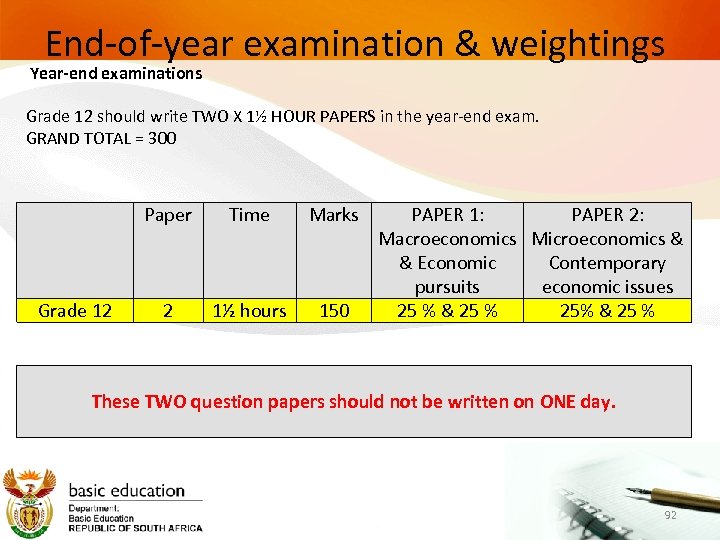 End-of-year examination & weightings Year-end examinations Grade 12 should write TWO X 1½ HOUR PAPERS in the year-end exam. GRAND TOTAL = 300 Paper Grade 12 Time Marks 2 1½ hours 150 PAPER 1: PAPER 2: Macroeconomics Microeconomics & & Economic Contemporary pursuits economic issues 25 % & 25 % 25% & 25 % These TWO question papers should not be written on ONE day. 92
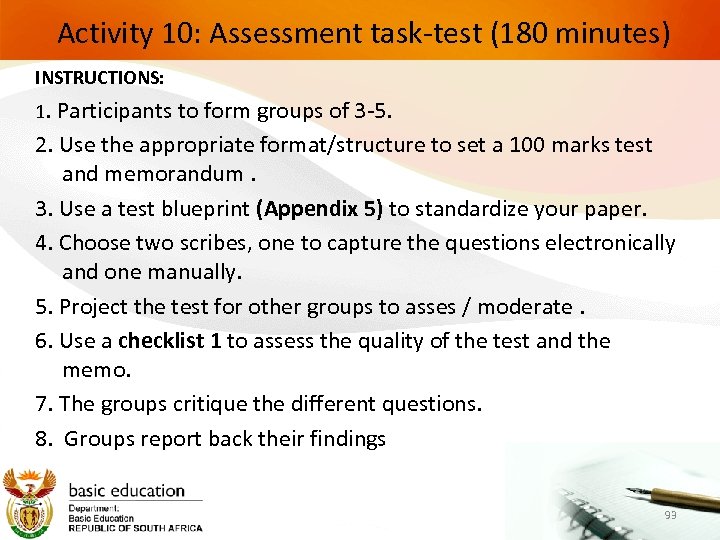 Activity 10: Assessment task-test (180 minutes) INSTRUCTIONS: 1. Participants to form groups of 3 -5. 2. Use the appropriate format/structure to set a 100 marks test and memorandum. 3. Use a test blueprint (Appendix 5) to standardize your paper. 4. Choose two scribes, one to capture the questions electronically and one manually. 5. Project the test for other groups to asses / moderate. 6. Use a checklist 1 to assess the quality of the test and the memo. 7. The groups critique the different questions. 8. Groups report back their findings 93
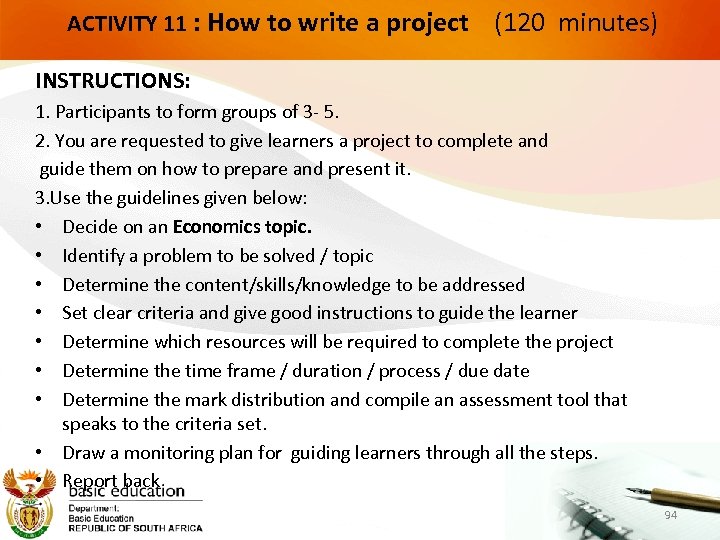 ACTIVITY 11 : How to write a project (120 minutes) INSTRUCTIONS: 1. Participants to form groups of 3 - 5. 2. You are requested to give learners a project to complete and guide them on how to prepare and present it. 3. Use the guidelines given below: • Decide on an Economics topic. • Identify a problem to be solved / topic • Determine the content/skills/knowledge to be addressed • Set clear criteria and give good instructions to guide the learner • Determine which resources will be required to complete the project • Determine the time frame / duration / process / due date • Determine the mark distribution and compile an assessment tool that speaks to the criteria set. • Draw a monitoring plan for guiding learners through all the steps. • Report back 94
 Wrap up: Project A project is given a longer period of time to complete as they involve some form of research, consolidating and choosing relevant information and preparing a written document (report) as evidence or constructing a model. Research will always form part of the project, in Other words the project is the evidence of the research conducted. 95
 Wrap up: Characteristics of a project A project should have the following characteristics: • A finite and defined life cycle • Defined and measurable output/products (Set clear criteria and give good instructions to guide the learner) • A corresponding set of activities (or elements) to achieve the output/products • A defined amount of resources • A defined responsibility, to manage the project. • Continuously monitor the project and guide the learners A project will take learners weeks to complete, hence in the Economics CAPS Document there are textboxes in which we indicated that “a project must always be given to learners a term before submission date”. 96
 Assignment • Unlike the project an assignment is an assessment task that learners can do in a shorter period (collecting of information) • Learners are given a task over a shorter period than a project, e. g. learners drawing up economic graphs, analyzing and interpreting them • Monitor the assignment and guide the learners • The completion of the task takes place under controlled conditions 97
 Activity 12 Case study INSTRUCTIONS: 1. Participants to form groups of 3 - 5. “One of the most effective educational tools is reality simulation. Case study is one such tool that gives ability to make real-life decisions without inflicting the liability”. 2. Use checklist 2 as a pre- moderation exercise to assess the quality of the designed case study in appendix 4. 3. Sometimes case studies are extracted from the other reading materials. How do you choose a case study for learners to analyse? 4. Report back 5. Wrap up. 98
 Wrap up: Case Study • Learners are presented with a real-life situation, a problem or an incident related to the topic • They may be expected to assume a particular role in articulating the position, e. g. a position of Reserve Bank Governor, a Bank manager, etc. • They would draw on their own experience, the experience of peers or prior learning to interpret, analyse and solve a problem or problems 99
 Wrap up: Case Study (cont…) • Newspaper articles, magazine articles, and TV or radio presentations form excellent case studies. Learners have to read and/or listen, digest the business or economic information and then make informed decisions. • Case studies in Economics are a very good way of keeping the subject up to date and relevant. They always form part of the examinations in Economics. • Case studies/scenarios need to be contextualized into Economics. • You may design a case study which will suite what you want to assess. 100
 Report • A report in Economics is generally a written evidence of analysis and interpretation of the economic information. It can be short or long. • In a project the report is longer. Other reports are shorter than a report in a project and it is specific to the topic, e. g. learners are given economics data to analyse, interpret and there after write a report. 101
 Presentation • Presentation is very important to Economics learners. • In future learners will be expected to present economics information such as analysis of exchange rates, the countries budget, etc. . • Some will be expected to present the analysed results of the economic conditions of a country or financial indicators to the public. • A presentation can be in writing or/and orally. 102
 Explanation of Forms of Assessment 103
 Formal Assessment Tasks Formal Assessment tasks in BCM include: • Assignments; • case studies; • projects; • tests. • Examination Other forms of assessment can be presented in the informal assessment. 104
 Examination(non-essays and essays) • • • Reports Minutes Memos Formal letters Essays 105
 Moderation 106
 Moderation of assessment • Moderation refers to the process that ensures that the assessment tasks are fair, valid and reliable. • Moderation should be implemented at school, district, provincial and national levels. • Comprehensive and appropriate moderation practices must be in place for the quality assurance of all subject assessments. 107
 Moderation of assessment • All Grade 12 tasks are internally and externally moderated, • The subject head for Economics or Head of Department for the Business, Commerce and Management (BCM) subjects at the school will generally manage this process. • All Po. A tasks: Ho. D moderates before the task is given to learners • Moderation at the school will be carried out once per school term. 108
 Moderation • Ho. D (or subject head) if the Ho. D did not specialise in the subject • Ho. D moderates 10% of learner responses to Po. A tasks and marking instruments. 109
 Activity 13: Group Activity on Moderation (60 Min) INSTRUCTIONS: • Participants to form groups of 3 - 5. • Identify aspects that need to be moderated at Grade 12 level. • Draft a moderation checklist that can be used when moderating the tasks in Programme of Assessment for Grade 12. • Report Back and Discussion. 110
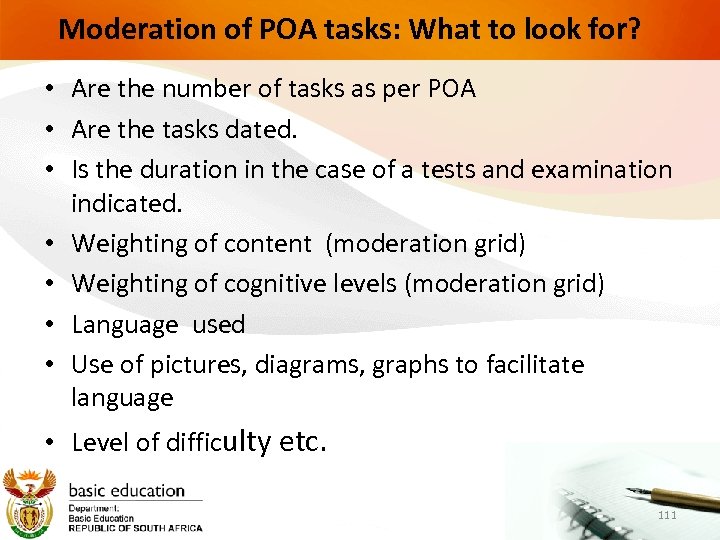 Moderation of POA tasks: What to look for? • Are the number of tasks as per POA • Are the tasks dated. • Is the duration in the case of a tests and examination indicated. • Weighting of content (moderation grid) • Weighting of cognitive levels (moderation grid) • Language used • Use of pictures, diagrams, graphs to facilitate language • Level of difficulty etc. 111
 Thank you! 112