 Скачать презентацию Economics for Sustainability Professor Wayne Hayes 10 23 2013 V
76e9b8eda828514e3dbca7c608396012.ppt
- Количество слайдов: 116



Economics for Sustainability Professor Wayne Hayes 10/23/2013 V. 3. 6 | Build #22 3/19/2018 Professor Wayne Hayes 1
Recall the Ecology, Economics, and Ethics Mission Statement: 3/19/2018 Professor Wayne Hayes 2
How can the economy be harnessed to serve world sustainability? What makes this question so ironic is that the growth in the physical scale of the economy under the prevailing regime of economic globalization has depleted resources, destroyed ecosystems, overwhelmed natural waste disposal sinks, waged war on subsistence cultures, and produced shocking maldistribution of wealth and income. How, then, can the economy be turned around to reinforce sustainable development rather than to destroy ecosystems, resource endowments, and indigenous cultures? 3/19/2018 Professor Wayne Hayes 3
This alchemy must be resolved to promote world sustainability. 3/19/2018 Professor Wayne Hayes 4
A main goal of the course is: You must discover and articulate in writing ways to think practically and strategically about sustainability. This presentation helps achieve that goal. 3/19/2018 Professor Wayne Hayes 5
The goals of this session are: 1. Explain the basics of economics to sustainers. 2. Lay out an approach for harmonizing economics and sustainability. 3/19/2018 Professor Wayne Hayes 6
Table of Contents: Economics for Sustainability 1. 2. 3. 4. 5. Framing: the Anthropocene Understanding the economy Brands of economics Ecological economics Eco-Economics 3/19/2018 Professor Wayne Hayes 7
This presentation covers and extends the material in my article, Economic Strategies for Sustainability. 3/19/2018 Professor Wayne Hayes 8
Part I: Framing We start by framing our approach to the intersection of economics and sustainability. The Anthropocene grounds us in the merging of Earth history with human history, with a focus on economic growth. Return to TOC. 3/19/2018 Professor Wayne Hayes 9
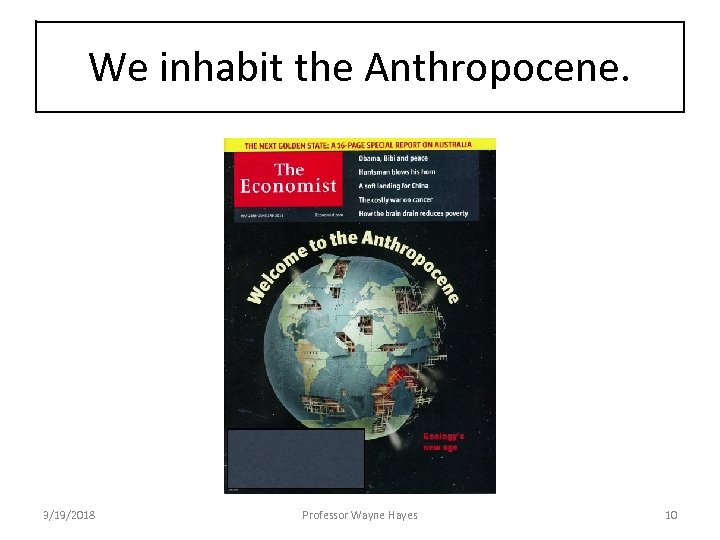
We inhabit the Anthropocene. 3/19/2018 Professor Wayne Hayes 10
The physical growth of the economy undermines sustainability: • • depletes resources exceeds global and bioregional carrying capacity destroys ecosystems overwhelms natural waste disposal sinks alters the climate wages war on subsistence cultures produces shocking maldistribution of wealth and income. 3/19/2018 Professor Wayne Hayes 11
How can the economy be turned around to reinforce sustainability? This alchemy must be resolved to promote sustainability. Economics and sustainability must be harmonized. 3/19/2018 Professor Wayne Hayes 12
We must revisit the paradigm. Following in the tradition of the Brundtland Report, we must explore anomalies in the prevailing paradigm and revise that paradigm. However, paradigms always resist revision. 3/19/2018 Professor Wayne Hayes 13
We need an expanded and updated context. Adam Smith invented classical economics with his seminal The Wealth of Nations in 1776. The Industrial Revolution and the Anthroocene had just started. We need to update and expand this context to integrate ecology, economics, and society. 3/19/2018 Professor Wayne Hayes 14
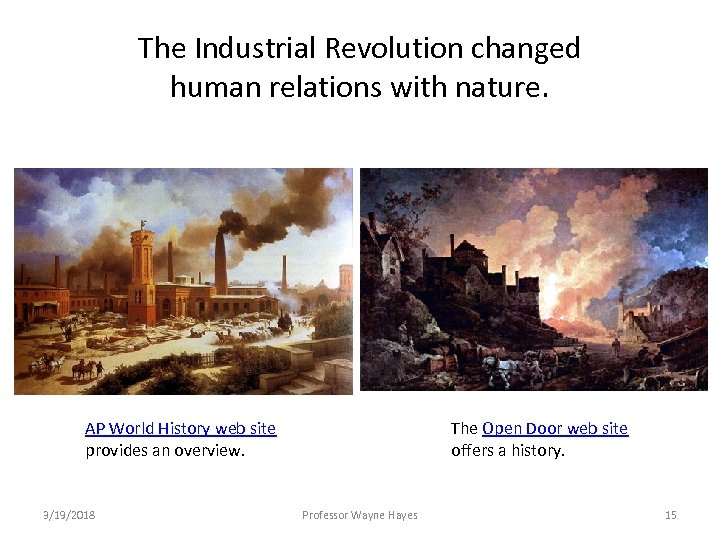
The Industrial Revolution changed human relations with nature. AP World History web site provides an overview. 3/19/2018 The Open Door web site offers a history. Professor Wayne Hayes 15
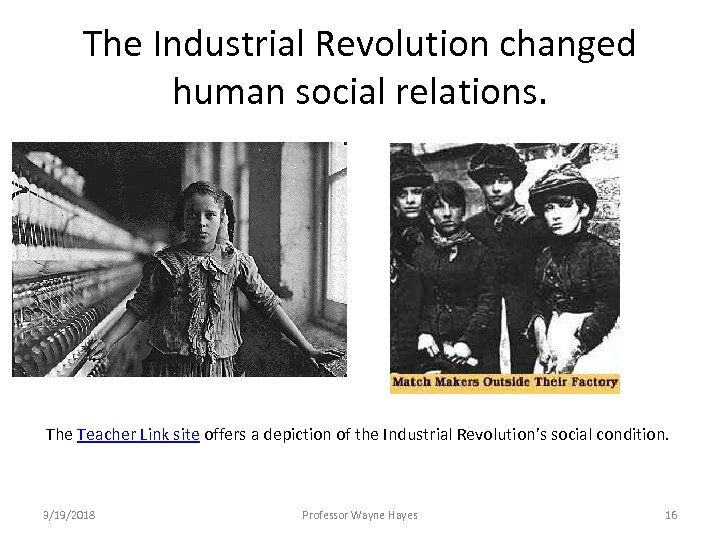
The Industrial Revolution changed human social relations. The Teacher Link site offers a depiction of the Industrial Revolution’s social condition. 3/19/2018 Professor Wayne Hayes 16
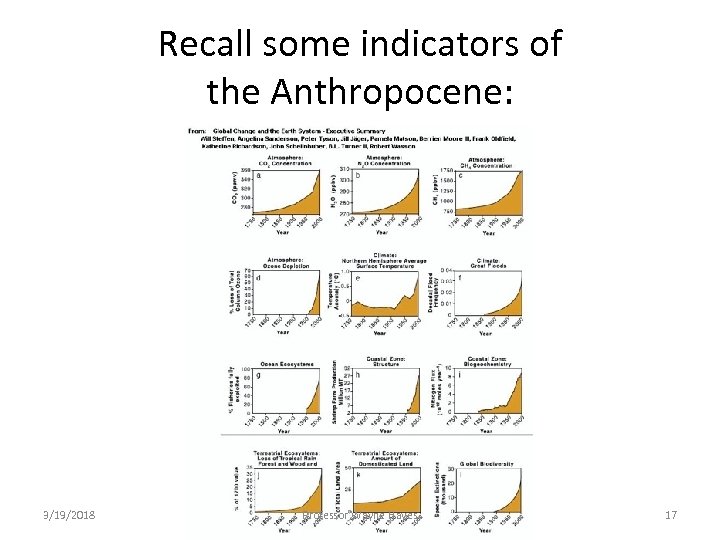
Recall some indicators of the Anthropocene: 3/19/2018 Professor Wayne Hayes 17
See the original report for indicators See especially table 1 and figure 2, page 617 of the original article on the Anthropocene. 3/19/2018 Professor Wayne Hayes 18
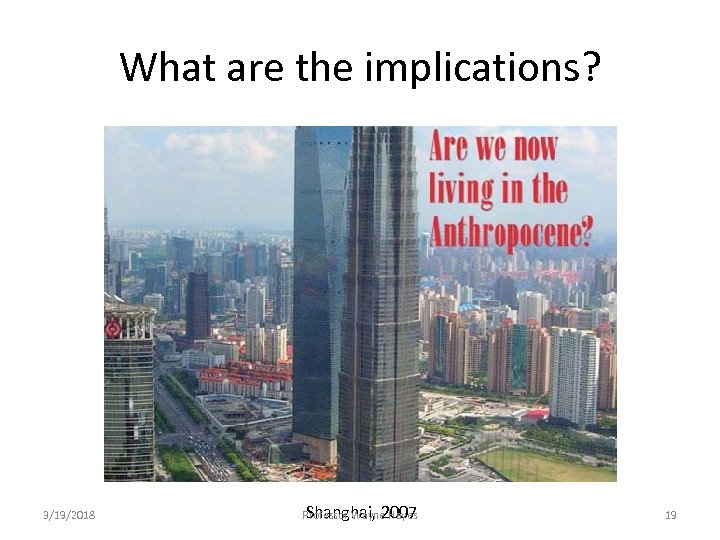
What are the implications? 3/19/2018 Shanghai, 2007 Professor Wayne Hayes 19
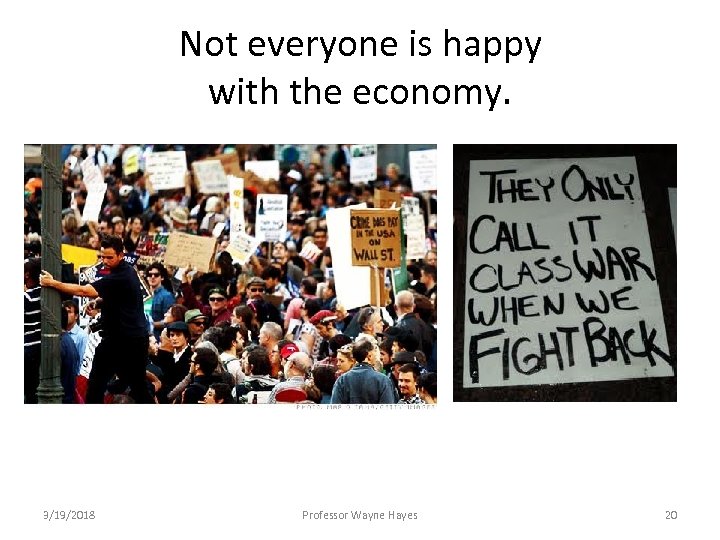
Not everyone is happy with the economy. 3/19/2018 Professor Wayne Hayes 20
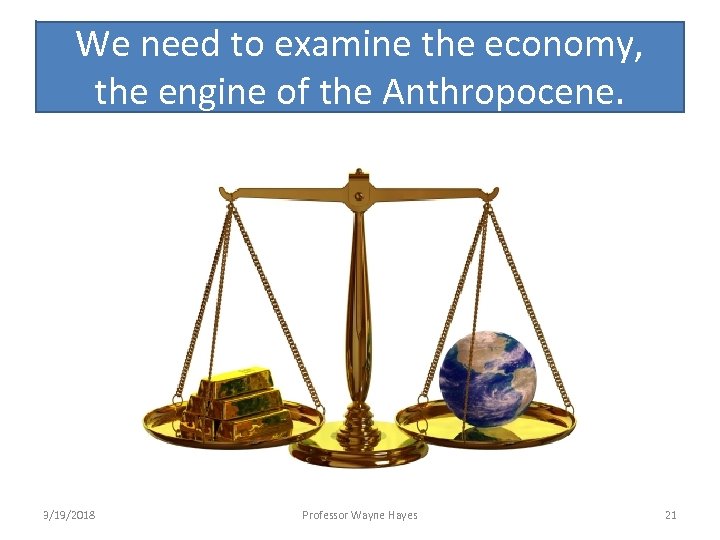
We need to examine the economy, the engine of the Anthropocene. 3/19/2018 Professor Wayne Hayes 21
How is economics defined? This standard definition of economics comes from the authoritative International Encyclopedia of the Social Sciences: "Economics. . . is the study of the allocation of scarce resources among unlimited and competing uses" (Vol. 4 472). I unpack the definition in my web site for the Economics of Sustainability. 3/19/2018 Professor Wayne Hayes 22
The factors of production must be used efficiently. The means of production, called resources, are neatly bundled among three broad categories: land, labor, and capital. These are the factors of production that must be efficiently applied to maintain production. The solution to the economic problem is thus rendered as a neutral and technical application of scarce resources to efficiently produce output, goods and services that can be confidently measured by price in the marketplace. The product of the economy by definition can only partially satiate the unlimited appetite for goods and services. The solution involves more production, called economic growth. 3/19/2018 Professor Wayne Hayes 23
The American economy is market-driven and growth-compelled. The national economy is measured as the monetized market value of all the goods and services produced in the nation in a calendar year. This is Gross Domestic Product, GDP. For more detail and definition, go to my web page defining economics. 3/19/2018 Professor Wayne Hayes 24
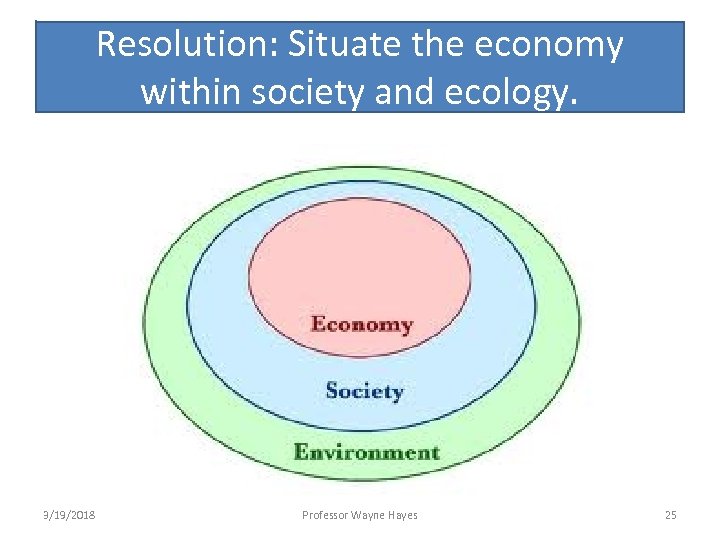
Resolution: Situate the economy within society and ecology. 3/19/2018 Professor Wayne Hayes 25
Resolve the antagonism between ecology and economy. Economy and ecology share the same Greek root, Oikos, meaning “the inhabited house” or “dwelling. ” 3/19/2018 Professor Wayne Hayes 26
Economy = Oikos + Nomos. The term “economy” derives from the Greek oikonomia, household management, based on oikos, "house, " and nemein, "manage. " 3/19/2018 Professor Wayne Hayes 27
Ecology = Oikos + Logos. Now consider the related term, “ecology, ” which is defined as "the branch of biology concerned with the relations of organisms to one another and to their physical surroundings. " Ecology also derives from the ancient Greek term oikos, but instead of management, focuses on logos, "reason" (Oxford English Dictionary). 3/19/2018 Professor Wayne Hayes 28
Which should come first, ecology or economy? Now, economy trumps ecology. But should we not understand our home, the Earth, before we muster the audacity to try to manage it? 3/19/2018 Professor Wayne Hayes 29
Consider ends and means. Like humanity, should ecology (nature) be considered as an end in itself? Doesn’t economics refer to the efficient, if not always wise, allocation of means to fulfill ends? 3/19/2018 Professor Wayne Hayes 30
Therefore, shouldn’t ecology precede economy? Consider this: The inversion of economy and ecology should be the first strategic move to harmonize ecology, economy, and society. 3/19/2018 Professor Wayne Hayes 31
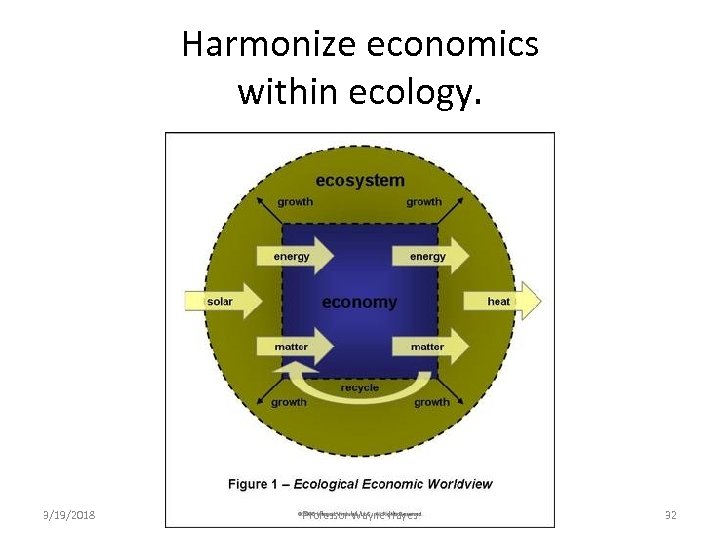
Harmonize economics within ecology. 3/19/2018 Professor Wayne Hayes 32
Aristotle distinguished between • Oikonomia: The real physical and social economy that produces and exchanges objects that contain use value. We can call this Main Street. • Chrematistics: The monetized economy that thrives on trade and commerce for the sake of exchange value. We can call this Wall Street. (See Oikonomia and Chrematistics) 3/19/2018 Professor Wayne Hayes 33
So, we ask: Has Wall Street trumped Main Street? 3/19/2018 Professor Wayne Hayes 34
Has use value trumped exchange value? See Aristotle Economic Thought. 3/19/2018 Professor Wayne Hayes 35
With this context in mind, we should examine how sustainable development provides another paradigm. 3/19/2018 Professor Wayne Hayes 36
We now review sustainable development. Peter Montague has written a famous summary of the main points of the seminal book on sustainable development by Herman Daly, the founder of ecological economics, Beyond Growth.
Development > Growth Herman Daly changes the language and discourse away from growth and toward development. This shift is not merely semantics, but makes all the difference. Here it is: Development > Growth
What are the limits to growth? To Herman Daly, growth is the increase in the physical scale of the economy. That is, the material throughputs exceed two limits: 1. The availability of resources. 2. The capacity of sinks, where waste is disposed.
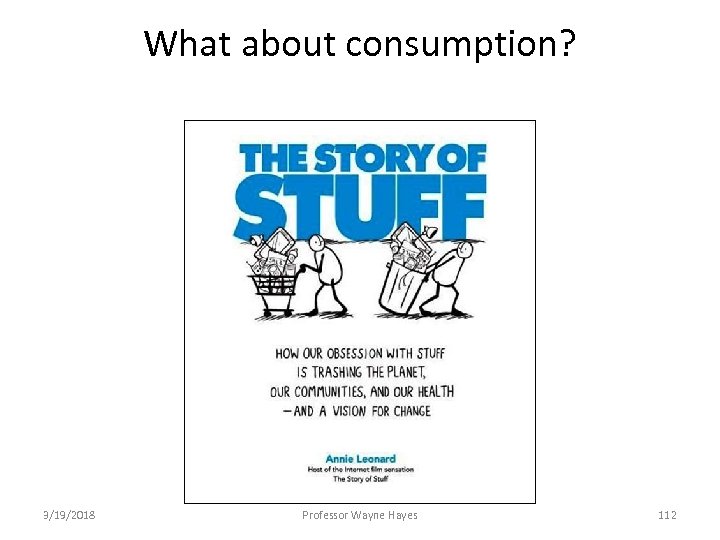
Does this sound familiar? Throughput is another word for the Materials Cycle. Daly does not explain the Materials Cycle but Annie Leonard does in her The Story of Stuff. Make this connection!
Growth pertains to throughputs in the Materials Cycle. 1. Resources are expended along the way, but begins with extraction. 2. Waste disposal is the end of the Materials Cycle. Annie Leonard fills in the vague notion of throughput with the more specific dynamics of the Materials Cycle.
Make the connection: throughput Materials Cycle. So doing gives specificity and meaning to the idea of throughput, central to ecological economics.
What brand of economics supports sustainability? We will consider three schools of thought: 1. Neo-classical economics, including contemporary neoliberalism 2. Ecological economics 3. Eco-economics. Return to TOC. 3/19/2018 Professor Wayne Hayes 43
Neo-classical economics includes micro- and macro-economics. • Neo-classical economics builds on the classical tradition that began with Adam Smith. • Microeconomics examines the basic economic units, firms and consumers. • Macroeconomics examines the aggregate economy as a unit of analysis. 3/19/2018 Professor Wayne Hayes 44
Microeconomics examines the market behavior of the firm and the consumer. Microeconomics extends Adam Smith, assuming perfect competition among small firms and independent consumers. Price theory and market analysis does not consider the reality of mammoth transnational corporations as the principal agent of economic globalization. 3/19/2018 Professor Wayne Hayes 45
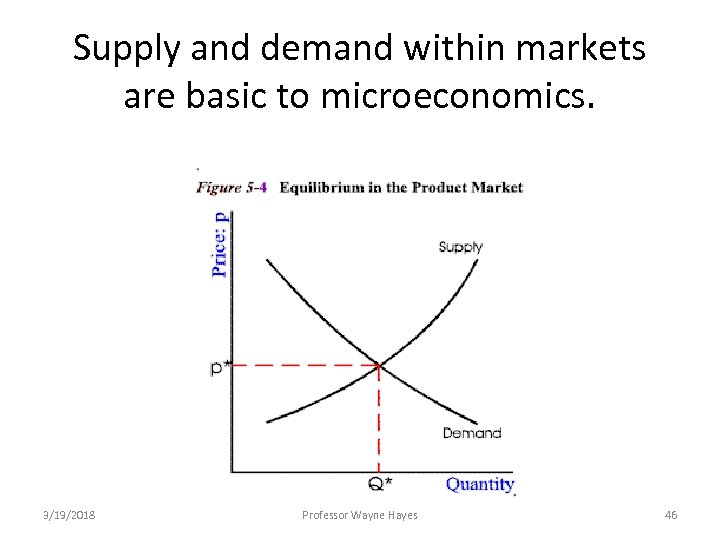
Supply and demand within markets are basic to microeconomics. 3/19/2018 Professor Wayne Hayes 46
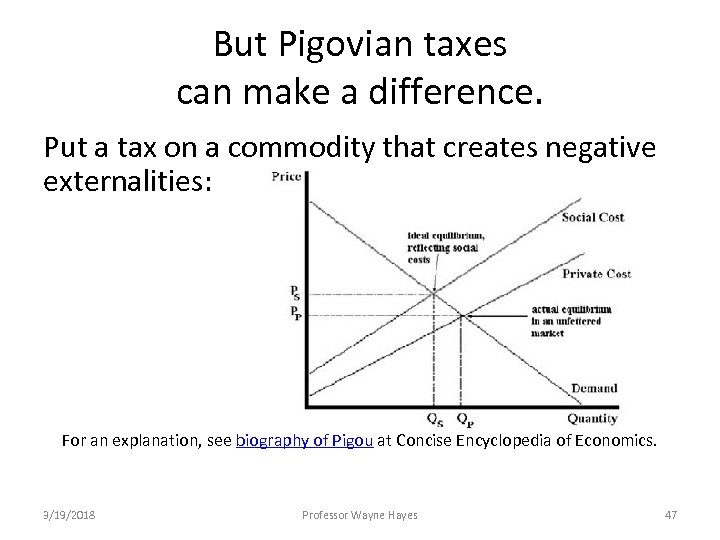
But Pigovian taxes can make a difference. Put a tax on a commodity that creates negative externalities: For an explanation, see biography of Pigou at Concise Encyclopedia of Economics. 3/19/2018 Professor Wayne Hayes 47
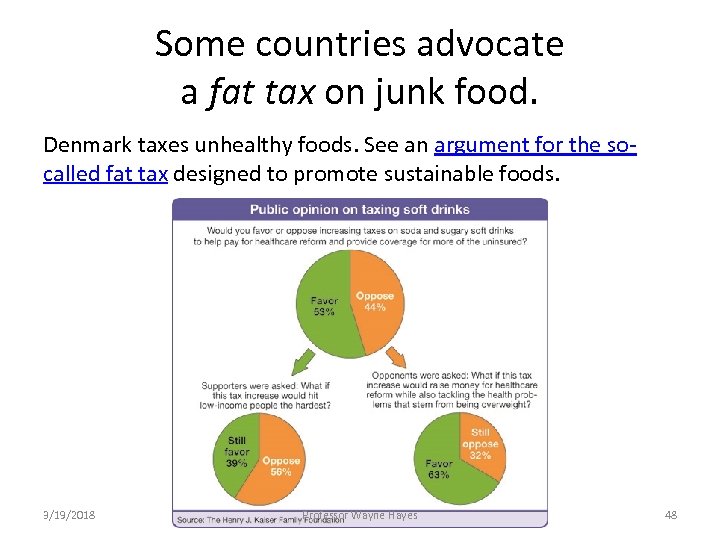
Some countries advocate a fat tax on junk food. Denmark taxes unhealthy foods. See an argument for the socalled fat tax designed to promote sustainable foods. 3/19/2018 Professor Wayne Hayes 48
Macroeconomics attempts to explain aggregate economic categories: • • Growth Consumption Unemployment Savings and investment Inflation Money and finance, including public finance The rates of interest The composition and level of imports and exports. 3/19/2018 Professor Wayne Hayes 49
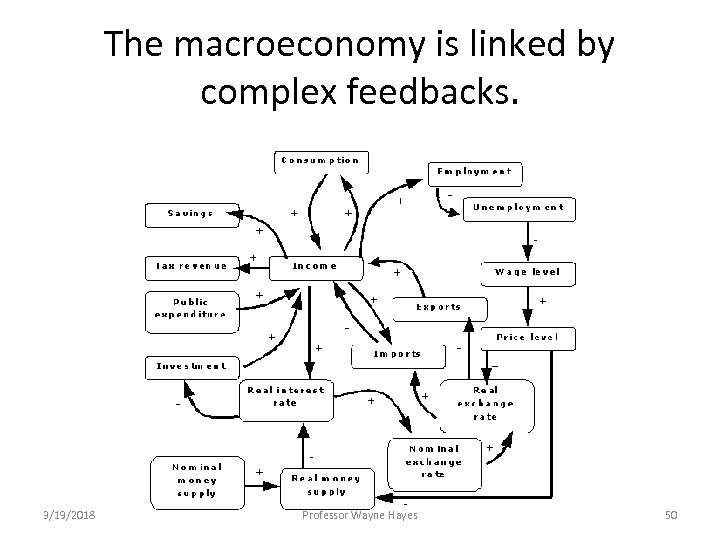
The macroeconomy is linked by complex feedbacks. 3/19/2018 Professor Wayne Hayes 50
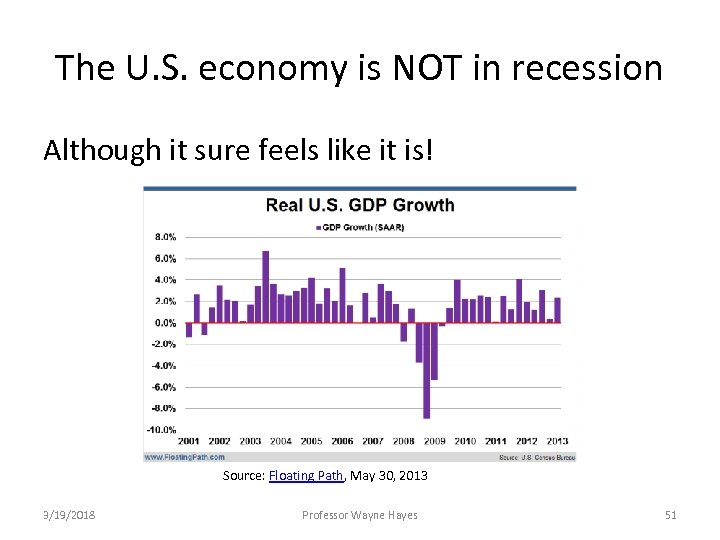
The U. S. economy is NOT in recession Although it sure feels like it is! Source: Floating Path, May 30, 2013 3/19/2018 Professor Wayne Hayes 51
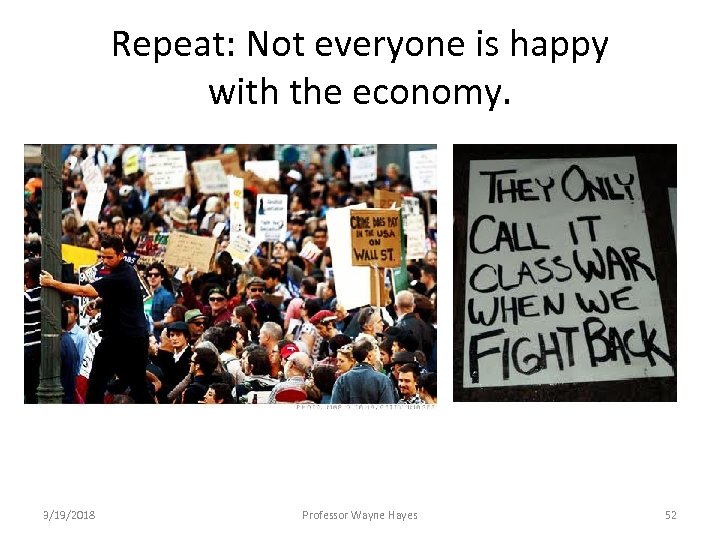
Repeat: Not everyone is happy with the economy. 3/19/2018 Professor Wayne Hayes 52
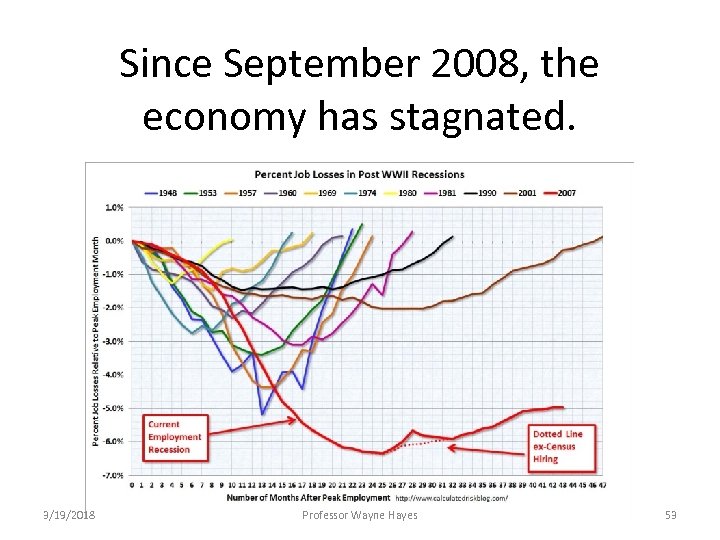
Since September 2008, the economy has stagnated. 3/19/2018 Professor Wayne Hayes 53
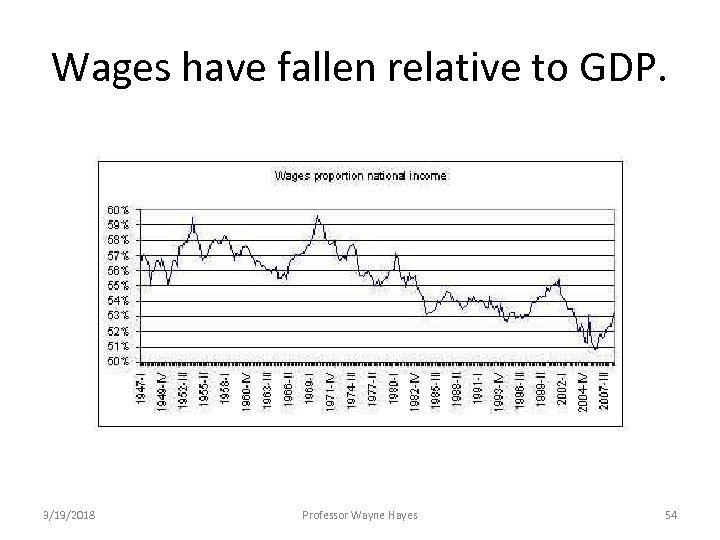
Wages have fallen relative to GDP. 3/19/2018 Professor Wayne Hayes 54
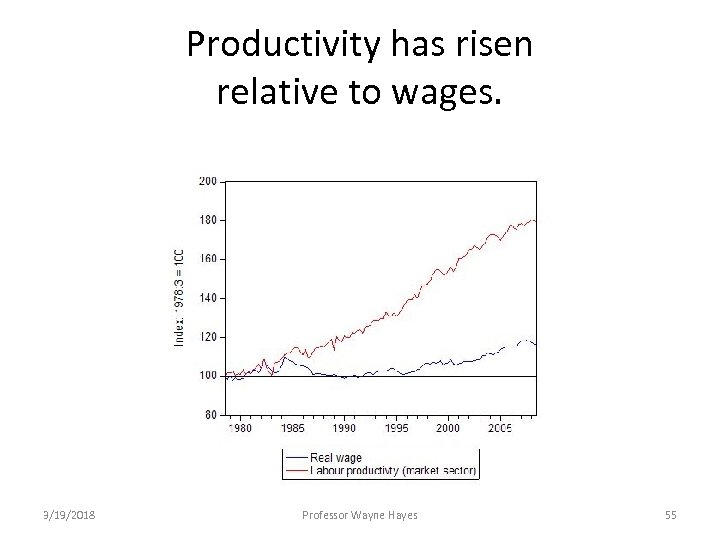
Productivity has risen relative to wages. 3/19/2018 Professor Wayne Hayes 55
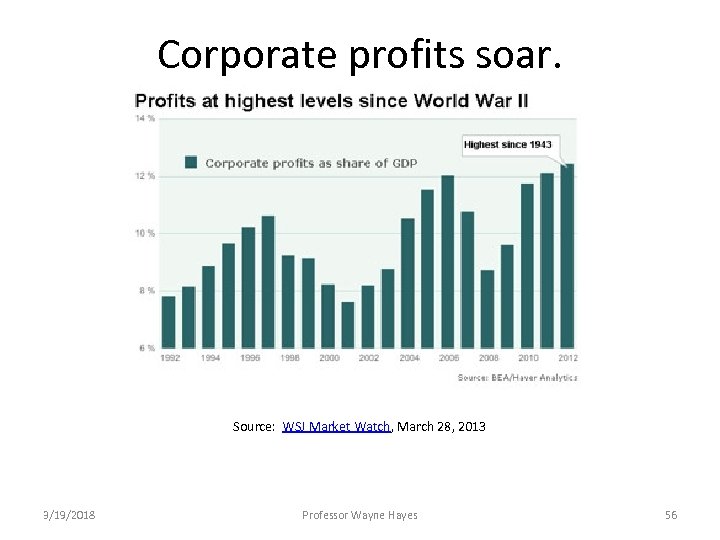
Corporate profits soar. Source: WSJ Market Watch, March 28, 2013 3/19/2018 Professor Wayne Hayes 56
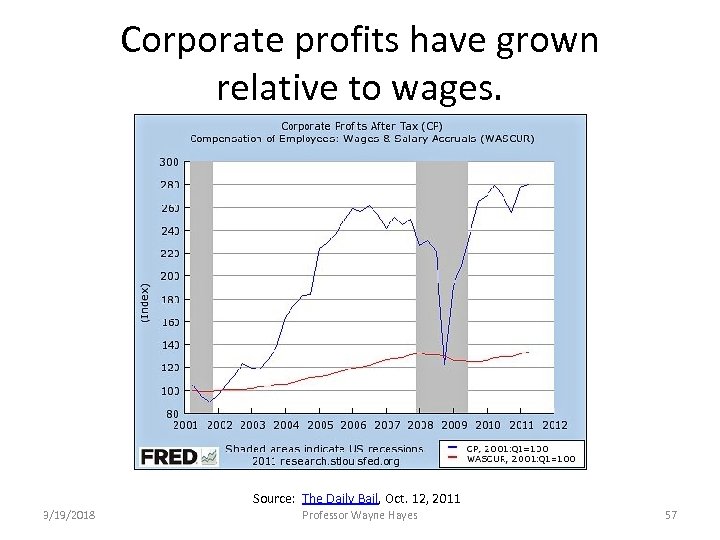
Corporate profits have grown relative to wages. Source: The Daily Bail, Oct. 12, 2011 3/19/2018 Professor Wayne Hayes 57
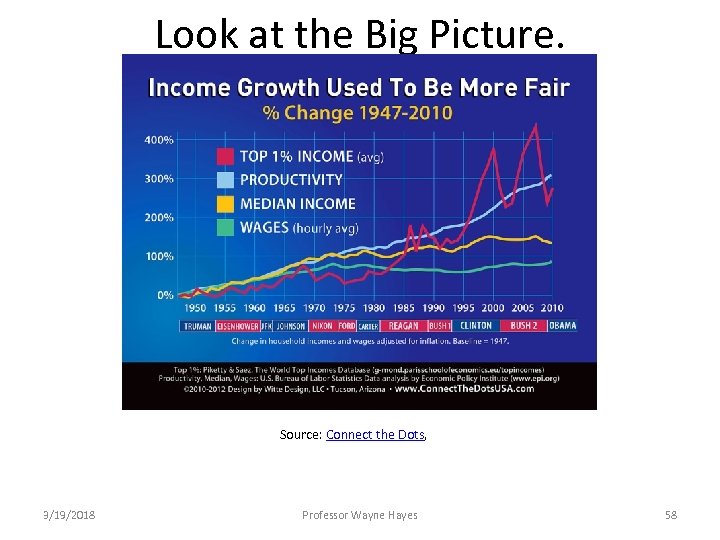
Look at the Big Picture. Source: Connect the Dots, 3/19/2018 Professor Wayne Hayes 58
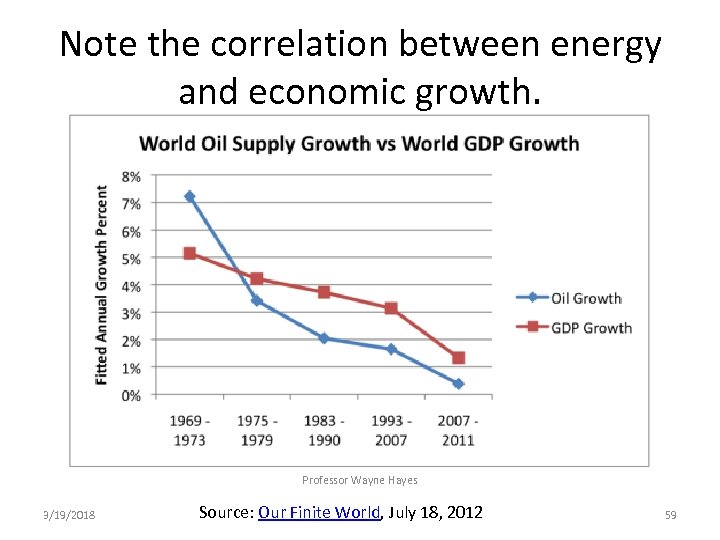
Note the correlation between energy and economic growth. Professor Wayne Hayes 3/19/2018 Source: Our Finite World, July 18, 2012 59
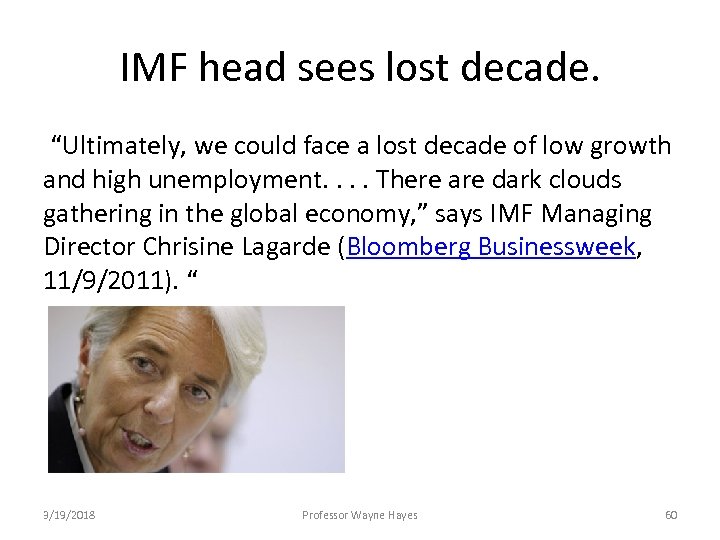
IMF head sees lost decade. “Ultimately, we could face a lost decade of low growth and high unemployment. . There are dark clouds gathering in the global economy, ” says IMF Managing Director Chrisine Lagarde (Bloomberg Businessweek, 11/9/2011). “ 3/19/2018 Professor Wayne Hayes 60
Ask yourself: How does the national economy work for me? What is my future as • a worker? • a consumer? • a borrower an investor? • a recipient of externalities? • a citizen? 3/19/2018 Professor Wayne Hayes 61
Economic growth is the engine of macroeconomics. In the world of macroeconomics, more is always better. No consideration is given to what is produced, so long as it enhances the total flow of goods and services. Prisons, bloated health care costs, responses to toxic spills, the repair of the damage caused by climate change all are "goods" that add to economic output--not "bads" which should be prevented. 3/19/2018 Professor Wayne Hayes 62
Neoclassical economics spawns economic globalization. The neoclassical brand projects economic globalization and the doctrine of neoliberalism to the world economy. Growth goes global! See my web-based presentation on economic globalization. 3/19/2018 Professor Wayne Hayes 63
Neoliberalism cannot be reconciled with sustainability. There exists no middle ground. The principles underlying each and the dynamics they drive are thoroughly incompatible. If neoliberalism triumphs, sustainability cannot be achieved, with drastic implications for future generations of humans and for the hospitality of the Earth for life. The stakes are high and the prospects grim. 3/19/2018 Professor Wayne Hayes 64
This conclusion is consistent with my Statement of Concern The Statement of Concern was listed in the schedule and was reviewed in class. 3/19/2018 Professor Wayne Hayes 65
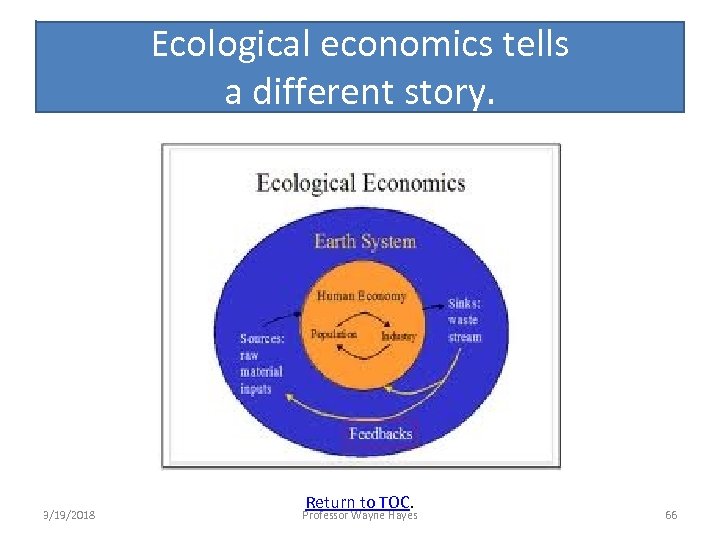
Ecological economics tells a different story. 3/19/2018 Return to TOC. Professor Wayne Hayes 66
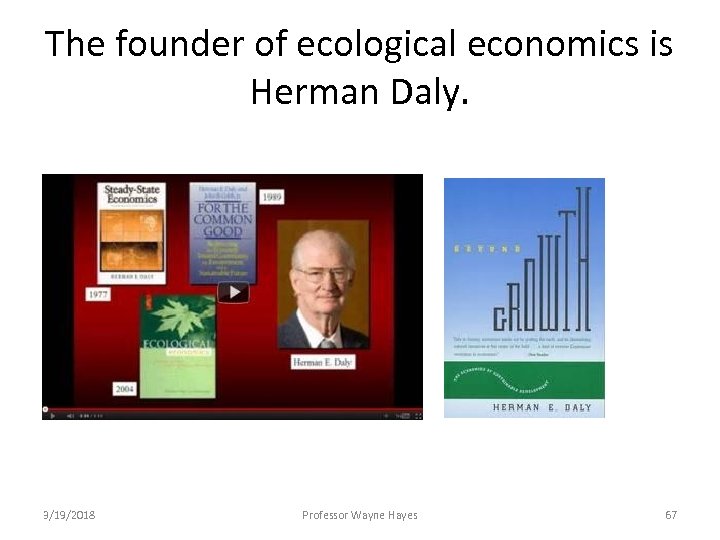
The founder of ecological economics is Herman Daly. 3/19/2018 Professor Wayne Hayes 67
Ecological economics recasts economics. Daly, still grounded in economics, expands the boundaries. The economy has three essential functions: 1. Allocation: efficiency of resource use 2. Distribution: fairness 3. Scale: appropriate size. The impulse is to get bigger, to grow in scale. 3/19/2018 Professor Wayne Hayes 68
Peter Montague summarizes Beyond Growth. Rachel’s Environment and Health News digests the essential arguments of Beyond Growth for sustainers to grasp. See Parts I, III, and IV. 3/19/2018 Professor Wayne Hayes 69
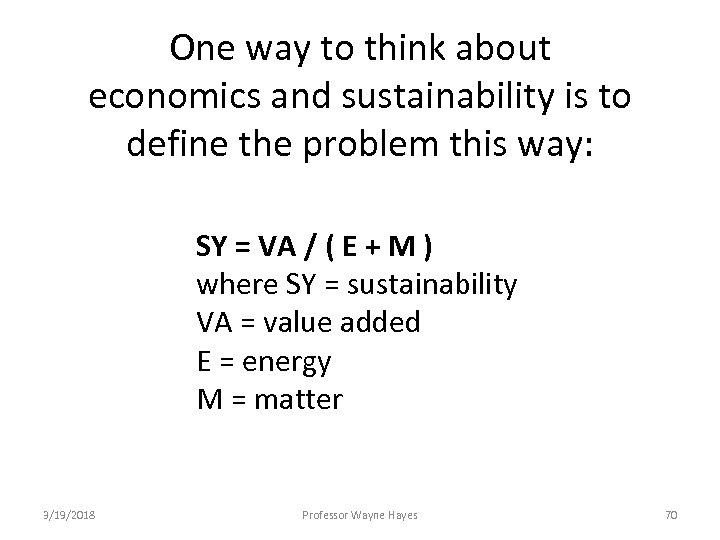
One way to think about economics and sustainability is to define the problem this way: SY = VA / ( E + M ) where SY = sustainability VA = value added E = energy M = matter 3/19/2018 Professor Wayne Hayes 70
What is an “externality” and why does it matter? An externality is a consequence, positive or negative, of an economic activity that affects other parties without this affect being incorporated into market prices. Thus, market price deviates from the "true" social cost, sending the wrong signal. 3/19/2018 Professor Wayne Hayes 71
Microeconomics ignores third-party effects, called externalities. Instead of recognizing such market distortions as externalities, neoclassical economists claim to catch sight of Adam Smith's "Invisible Hand" of the unfettered market. Neoclassical economics is not only blind to environmental degradation and social disintegration but is enthralled in a mystical séance of market perfection, a reification exceeded only by neoliberalism. 3/19/2018 Professor Wayne Hayes 72
Herman Daly comments on the trivialization of externalities by neoclassical economics: “When increasingly vital facts, including the very capacity of the earth to support life, have to be treated as ‘externalities, ’ then it is past time to change the basic framework of our thinking so that we can treat these critical issues internally and centrally. (45)” Daly, Herman E. Beyond Growth: The Economics Of Sustainable Development. Boston: Beacon Press, 1996. 3/19/2018 Professor Wayne Hayes 73
There are limits to the idea of externalities. Identifying externalities as a market failure is important but: 1. The political economic system, i. e. capitalism, staunchly resists internalizing externalities. 2. Beyond externalities is the essential issue of perverse subsidies and implicit industrial policy. 3/19/2018 Professor Wayne Hayes 74
There are limits to ecological economics. The transition from neoclassical economics to ecological economics is essential, but is not sufficient. Too much is left out of the story: Ecological economics must incorporate a theory of political economics. The Materials Cycle helps. 3/19/2018 Professor Wayne Hayes 75
Are externalities built into the business plan of corporations? The modern firm transcends Adam Smith’s idyllic village shops and now includes immense and diversified global corporations. Their quest to maximize shareholder returns includes dumping costs onto others. The political muscle of such corporations protects external costs from being internalized and seeks government subsidies and bail outs. (See Annie Leonard’s The Story of Stuff for details. ) 3/19/2018 Professor Wayne Hayes 76
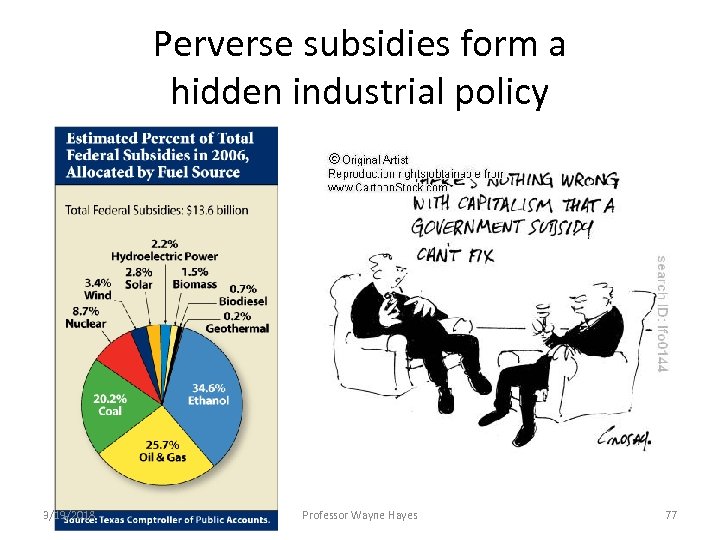
Perverse subsidies form a hidden industrial policy 3/19/2018 Professor Wayne Hayes 77
Myers and Kent estimate subsidies at 5. 6% of total global economy. • The 2001 study found total subsidies to be about two billion dollars, or 5. 6% of the prevailing world economy. (Myers, Norman, and Jennifer Kent. Perverse Subsidies: How Tax Dollars Can Undercut the Environment and the Economy. Washington, DC: Island Press, 2001. ) • Myers and Kent are scientists, not economists. • Note that economists have not, to my knowledge, attempted to estimate the total costs of externalities or subsidies. 3/19/2018 Professor Wayne Hayes 78
Distribution is ethical and political, not formal economics per se. The socially acceptable distribution of the goods and the bads produced by the economy is ultimately political and ethical. Left to itself, a market society (capitalism) will produce large maldistributions in wealth and income. 3/19/2018 Professor Wayne Hayes 79
The market distributes according to economic class. In practice, the market-driven returns to capital, as profits and capital gains, accrue to the wealthy few, the capitalist class, while the returns to labor, wages and salaries, go to a multitude, the working class. This dynamic produces a class-based inequality of both wealth and income, which translates into differential political power. 3/19/2018 Professor Wayne Hayes 80
In practice, distribution is done through politics as well as economics. • In economic theory, distribution is considered as an efficient return to factors of production (land, labor, capital). • But distribution is influenced by tax policy and government expenditures. 3/19/2018 Professor Wayne Hayes 81
Remember the motto of the Medici family: “Money to get power, power to protect money. ” 3/19/2018 Professor Wayne Hayes 82
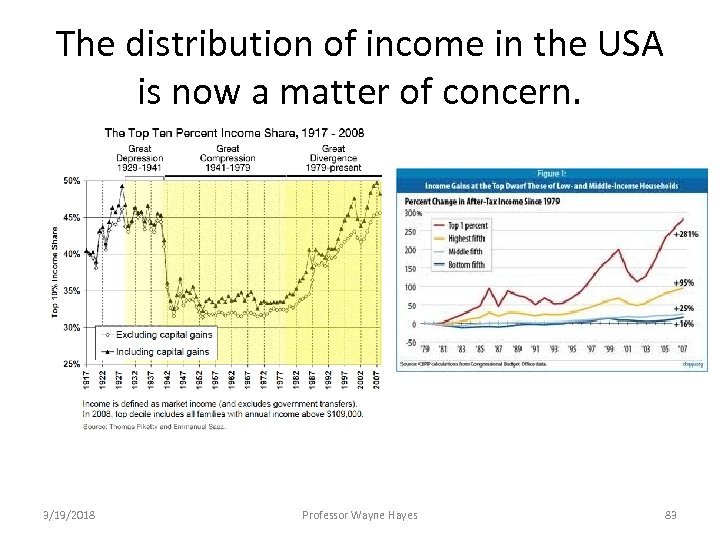
The distribution of income in the USA is now a matter of concern. 3/19/2018 Professor Wayne Hayes 83
Business as usual continues the wealth distortions. The 1% has done well under President Obama, especially banks. Meanwhile, poverty in the U. S. is at a record high of 49 million Americans, 16%. 3/19/2018 Professor Wayne Hayes 84
Scale is essential to ecological economics. But the growth of the economy is essential to orthodox economics, which never, ever questions scale. Close attention to scale is fundamental to ecological economics. 3/19/2018 Professor Wayne Hayes 85
Macroeconomics fosters growth: Bigger is always better. The appropriate size of the material economy is relative to nature's carrying capacity. This aspect of macroeconomics has been altogether disregarded by the dominant neoclassical school of economic thought. In sharp contrast, ecological economists such as Herman Daly have emphasized that scale is central to sustainability. 3/19/2018 Professor Wayne Hayes 86
Some, like Vandana Shiva, disagree: “Instead of living up to its promise to alleviate poverty, economic growth actually undermined ecological stability, thereby destroying people's livelihoods and causing further poverty. Moreover, development strategies have been based on the growth of the market economy, even when large numbers of people operate outside of this network. The emphasis on the market economy has resulted in the destruction of the other economies of nature's processes and of people's survival, but this destruction is seen as nothing more than the 'hidden negative externalities' of the development process. (87)” Shiva, Vandana. "Recovering the Real Meaning of Sustainability. " Ed. Rajaram Krishnan, Jonathon M. Harris, and Neva R. Goodwin. A Survey of Ecological Economics. Washington, DC: Island Press, 1995. 86 -88. 3/19/2018 Professor Wayne Hayes 87
The distinction between development and growth is essential. Herman Daly says this well: “Since physical growth is limited by physical laws, while qualitative development is not, or at least not in the same way, it is imperative to separate these two very different things. Failure to make this distinction is what has made `sustainable development’ so hard to define. With the distinction, it is easy to define sustainable development as `development without growth--without growth in throughput beyond environmental regenerative and absorptive capacities. ’ (69)” Daly, Herman E. Beyond Growth: The Economics Of Sustainable Development. Boston: Beacon Press, 1996. 3/19/2018 Professor Wayne Hayes 88
Growth in the physical scale of the economy must be distinguished from development. “`Development’ refers to qualitative change, realization of potentialities, transition to a fuller or better state. . Sustainable development is development without growth in the scale of the economy beyond some point that is within biospheric carrying capacity. (167, highlights added)” 3/19/2018 Professor Wayne Hayes 89
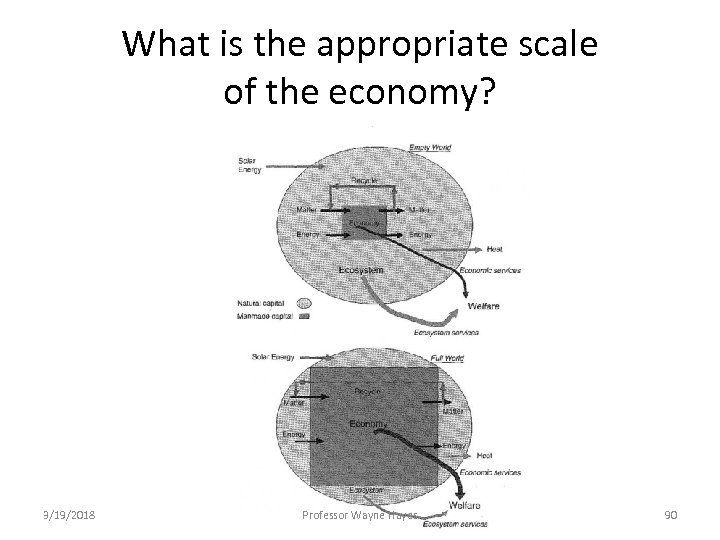
What is the appropriate scale of the economy? 3/19/2018 Professor Wayne Hayes 90
J. S. Mill defined a steady state economy in 1848. The seminal British philosopher and economist John Stuart Mill (1806 -1873) recognized that the economy could not grow indefinitely. He preferred a leisurely, aesthetic, and ethical stationary state to destruction of nature and diminished quality of life. See section IV. 6. 9 of Principles of Political Economy. 3/19/2018 Professor Wayne Hayes 91
An eco-economy must go beyond ecological economics Daly’s ecological economics challenges neoclassical defects, especially 1. Externalities as a market failure 2. The distinction between sustainable development and physical growth 3. The inherent differences in distribution of goods and bads. But ecological economics still emerges from economics. An eco-economy broadens the scope even further and includes non-economists in the conversation. 3/19/2018 Professor Wayne Hayes 92
Ecological economics is still a field within formal economics. This means that ecological economics is committed to reforms based on ecological and resource constraints. But ecological economics does not question beyond the reforms, which are rarely, if ever, enacted. 3/19/2018 Professor Wayne Hayes 93
So, ecological economics must be supplemented by eco-economics. That is, ecological economics should not be abandoned but should be extended. This draws on analysts who may not be formally trained in economics or true believers in its ontology and epistemology. 3/19/2018 Professor Wayne Hayes 95
Eco-economics emerges outside the domain of formal economics. • Seeks a holistic and pluralistic outlook. • Supports a symbiosis with nature and facilitates a restoration of ecosystems. • Respects the diversity of human culture. • Expands the time horizon to a long-term, generational perspective. • Practices critical thinking. 3/19/2018 Professor Wayne Hayes 96
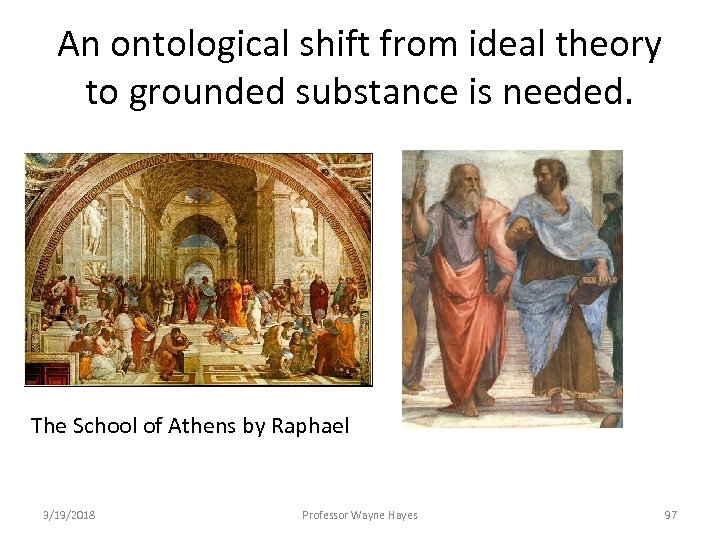
An ontological shift from ideal theory to grounded substance is needed. The School of Athens by Raphael 3/19/2018 Professor Wayne Hayes 97
Professor John Ikerd provides the common sense to grasp an ecoeconomy. Professor Ikerd, author of Sustainable Capitalism: A Matter of Common Sense, drives home his message in a short video. 3/19/2018 Professor Wayne Hayes 98
Some help comes from economic historians. Key insight comes from economic historians who grasp the larger dynamic and embed the economy in society and nature. We will examine thought of • Karl Polanyi • Henri Braudel • Gilbert Rist • Joseph Schumpeter --- and his intersection with Karl Marx. 3/19/2018 Professor Wayne Hayes 99
To Karl Polanyi, economics is simply the way society meets its material needs. Karl Polanyi proposes substantive economics rather than formal economics. His empirical approach grounds economics within history. His approach is neither an ideal model based on presumptions about human behavior nor does he ignore nature and society. Discovering Polanyi’s substantivism is foundational to the intersection of economics and sustainability found here. 3/19/2018 Professor Wayne Hayes 100
Formal versus substantive economics. Karl Polanyi proposed in The Great Transformation that the term 'economics' has two meanings: 1. The formal meaning refers to economics as the logic of efficient rational action and decision-making, as rational choice between the alternative uses of limited (scarce) means. 2. The substantive meaning presupposes neither rational decision-making nor conditions of scarcity. It simply refers to study of how humans make a living from their social and natural environment. The economy is embedded in nature and culture. 3/19/2018 Professor Wayne Hayes 101
Market economies must be embedded in society and nature. Markets are constructions which under neoliberalism destroy the social fabric and the natural environment within which markets are embedded. 3/19/2018 Professor Wayne Hayes 102
Markets thrive through a single process: Commodification 3/19/2018 Professor Wayne Hayes 103

3/19/2018 Professor Wayne Hayes 104
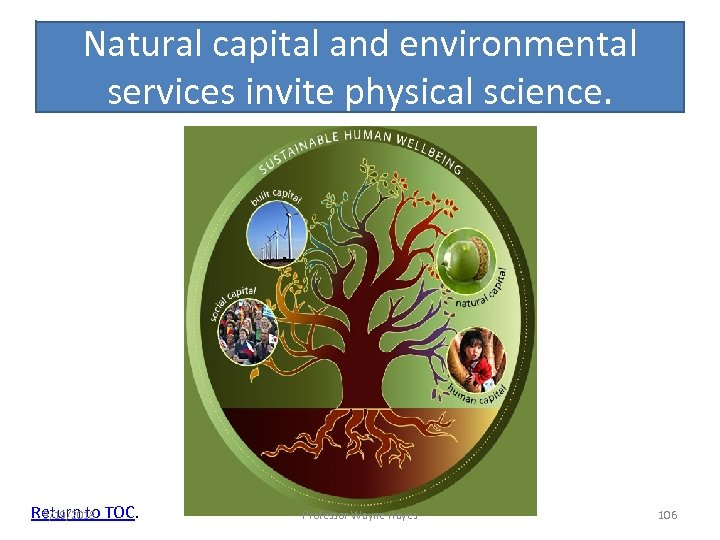
Natural capital and environmental services invite physical science. Return to TOC. 3/19/2018 Professor Wayne Hayes 106
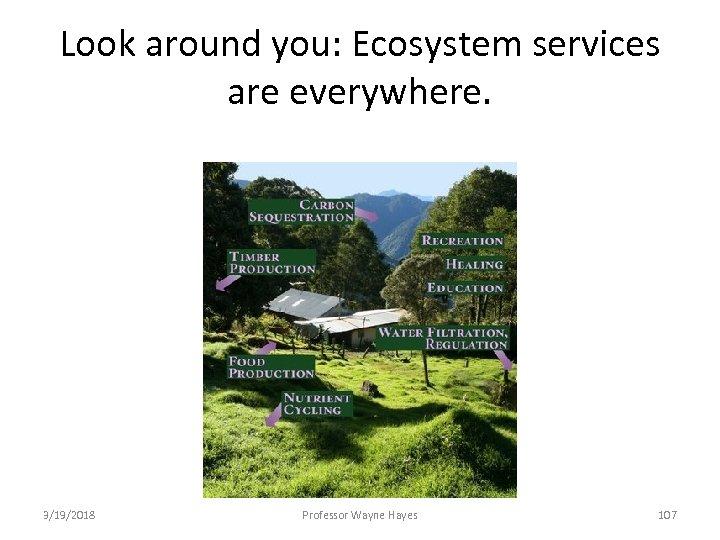
Look around you: Ecosystem services are everywhere. 3/19/2018 Professor Wayne Hayes 107
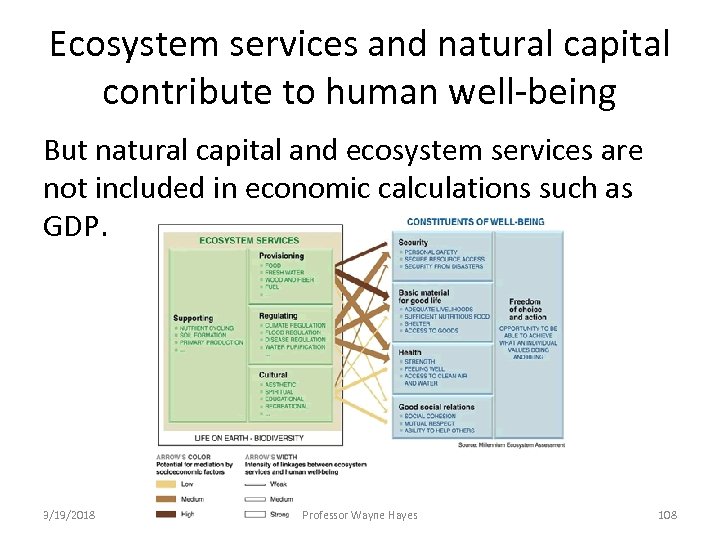
Ecosystem services and natural capital contribute to human well-being But natural capital and ecosystem services are not included in economic calculations such as GDP. 3/19/2018 Professor Wayne Hayes 108
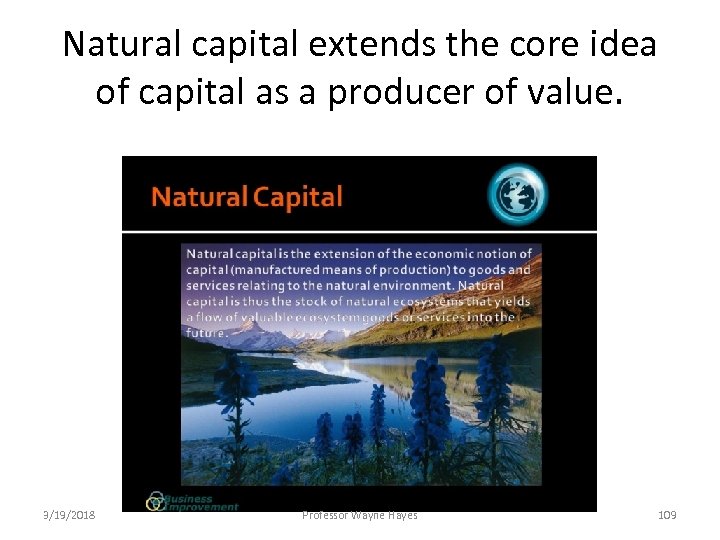
Natural capital extends the core idea of capital as a producer of value. 3/19/2018 Professor Wayne Hayes 109
But what is capital? 3/19/2018 Professor Wayne Hayes 110
Capital is a social relation and a physical means of production. Marx: “Accumulated labour that serves as a means to new production is capital. ” (Nature and Growth of Capital, 1867)” Capital is embedded labor produced under specific social relations. To Marx, natural capital is internally contradictory. Capital is an artifact and quite unnatural. 3/19/2018 Professor Wayne Hayes 111
What about consumption? 3/19/2018 Professor Wayne Hayes 112
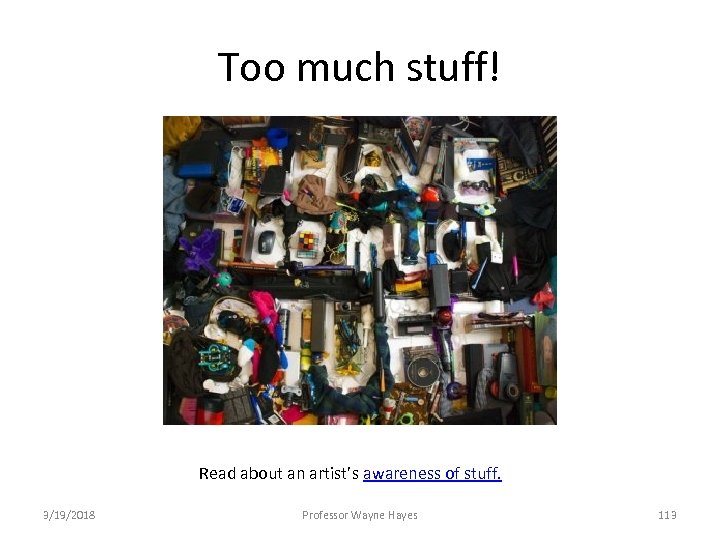
Too much stuff! Read about an artist’s awareness of stuff. 3/19/2018 Professor Wayne Hayes 113
Dematerialization is essential. Page 1. • Paperless offices substitute digits for pulp, dead trees. Example: Kindle. • De-growth replaces the growth imperative. See the Barcelona Declaration, 2010. Example: Cradle to Cradle design. • Reductions in environmental footprints can be calculated. • Service economy supersedes manufacturing economy. Example: Interface carpet company. • Spiritual values replace material values. 3/19/2018 Professor Wayne Hayes 114
Dematerialization is essential. Page 2. • Less matter and energy per unit of GDP, on the way since 1980 • Living with less, downsizing • Decrease in scale 3/19/2018 Professor Wayne Hayes 115
Where does eco-economics lead us? What’s next? Following the clue of substantivism and recognizing the absence of a political economy here, the next step is to explore andd try to define a Strategic Sustainability. Stay tuned! 3/19/2018 Professor Wayne Hayes 116
Sachs provides an example of embedding economics. Fairness in a Fragile World by Wolfgang Sachs exemplifies several principles: 1. How to invert and to embed the economy within nature and culture. 2. How sustainable development can occur within non-OECD nations. 3. How to equitably harmonize technology, ecology, and society. 3/19/2018 Professor Wayne Hayes 117
Thank You! The End of the presentation, Economics for Sustainability By Professor Wayne Hayes 3/19/2018 Professor Wayne Hayes 118
Скачать презентацию Economics for Sustainability Professor Wayne Hayes 10 23 2013 V
76e9b8eda828514e3dbca7c608396012.ppt