 Скачать презентацию Economics Chapter 4 Labour Labour l l
a06befb98843b1a31c43ab862403570f.ppt
- Количество слайдов: 38



Economics Chapter 4 Labour
Labour l l A factor of production Labour supply l l l Total number of working hours of all workers in a certain period of time Unit: Man-hour Labour supply = Labour force x Working hours per worker
Labour l E. g. Country A: l l l Number of workers = 100, 000 workers Working hours = 8 hours Labour supply = 100, 000 labour force x 8 hours = 800, 000 man-hours Number of workers, Labour supply Working hours, Labour supply
Practise l l Country X has 3 million workers. Each worker works 40 hours a week. Country Y has 2. 4 million workers. Each worker works 50 hours a week. (a) Which country has a great labour force? Ans: Country X. (3 million workers) (b) Which country has a great labour supply? Ans: Labour supply of Country X = 3, 000 x 40 = 120, 000 manhours Labour supply of Country Y = 2, 400, 000 x 50 = 120, 000 manhours ∴ Country X and Y have the same amount of labour supply.
Factors affecting labour supply l % of labour force in the population l l l Age distribution Gender Working incentives l l Wages Welfare benefit, e. g. medical allowance, housing allowance, insurance
Factors affecting labour supply l Government policy - Law and measures l l l Lower the minimum working / Raise the retirement age Tax - salary tax, incentive to work Allowance - unemployment allowance, incentive to work Labour Ordinance Lenient foreign labour policy Social customs and practices l l l Public holidays Festivals Proportion of working women (e. g. probability of pregnancy leave)
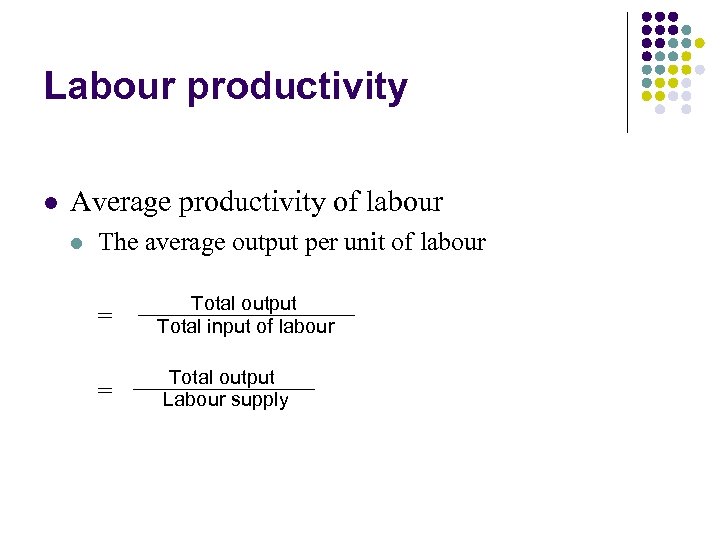
Labour productivity l Average productivity of labour l The average output per unit of labour = Total output Total input of labour = Total output Labour supply
Factors affecting labour productivity l Education and training l l l level of education more understanding productivity level of training more (specialised) skills productivity Hong Kong: l l l IVE – Institute of Vocational Education Continuing Education Fund Tertiary Education – universities and institutions
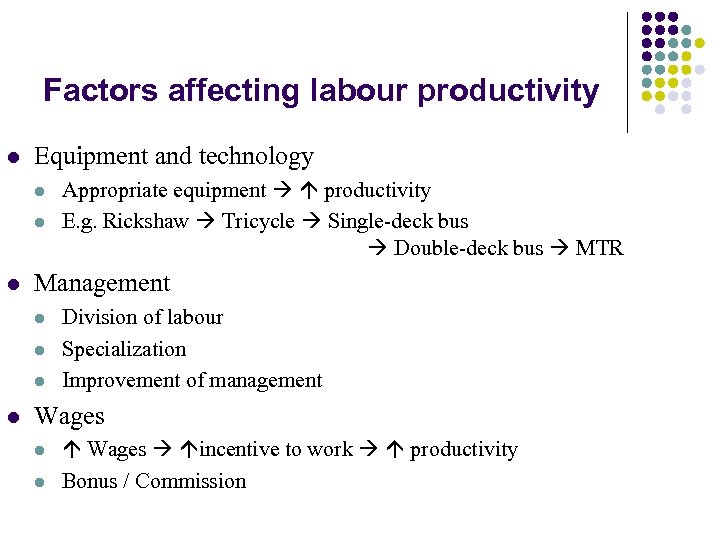
Factors affecting labour productivity l Equipment and technology l l l Management l l Appropriate equipment productivity E. g. Rickshaw Tricycle Single-deck bus Double-deck bus MTR Division of labour Specialization Improvement of management Wages l l Wages incentive to work productivity Bonus / Commission
Mobility of labour l Geographical mobility l l The ease of workers to move from one place to another to work. High mobility = High willingness and ability of movement
Factors affecting geographical mobility l Government policies l l restriction across regions (e. g. Mainland to HK) foreign labours immigration Transport l l transportation system save travelling time lower travelling expenses Better transportation system willingness to travel for work
Factors affecting geographical mobility l Economic, social and political factors l from poor region to a place with a better economic l l from unstable social region to stable area (sufficient of facilities) l l e. g. people from rural farmland to city e. g. from village to new town from unstable political region to stable area l e. g. immigration from China to HK since 1949
Factors affecting geographical mobility l Cultural differences l high mobility among countries with similar culture or language l l e. g. England to USA Hong Kong, as an international city with multi-cultural living environment, has high geographical mobility.
Occupational mobility l l The ease of workers to move from one occupation (job) to another. High mobility = High willingness and ability of job changing
Factors affecting occupational mobility l Economic structure l l Production cost related Economic development from declining industry to prospering industry e. g. manufacturing (toys production) to services (retailing)
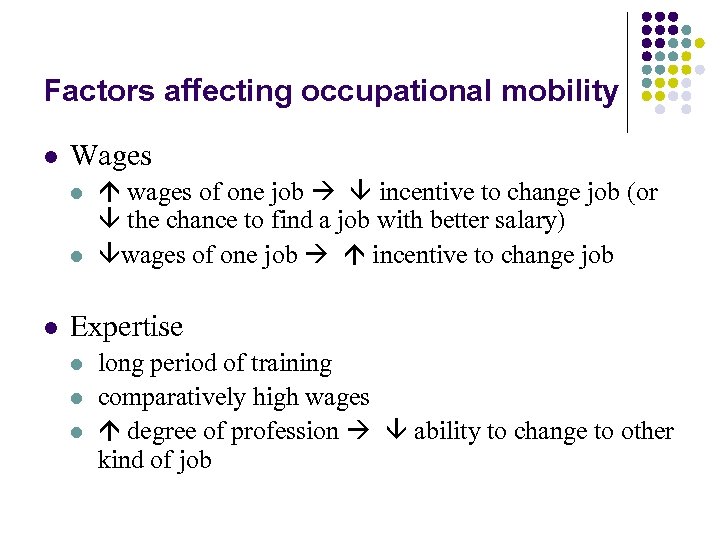
Factors affecting occupational mobility l Wages l l l wages of one job incentive to change job (or the chance to find a job with better salary) wages of one job incentive to change job Expertise l long period of training comparatively high wages degree of profession ability to change to other kind of job
Factors affecting occupational mobility l Enter restriction l l l professional qualification / license requirement difficult to enter into the field e. g. doctor, lawyer, teacher, estate agent, social worker
Factors affecting occupational mobility l Age l l l Young workers: energetic, willing to try new things easy to change job Elder workers: experienced but less energetic, less creativity hard to change job Others l l chance of promotion potential of industry prospects social status working environment
Wage payment methods l l l Piece rate Time rate Commission Bonus (Profit sharing) Others
Piece rate l Calculation of wages is based on the quatity of output. l l E. g. HKCEE Exam-paper markers, Webpage designers Suitable for… l l Production with large volume of output High degree of standardization Products can be counted easily e. g. tiling, exam-paper marking
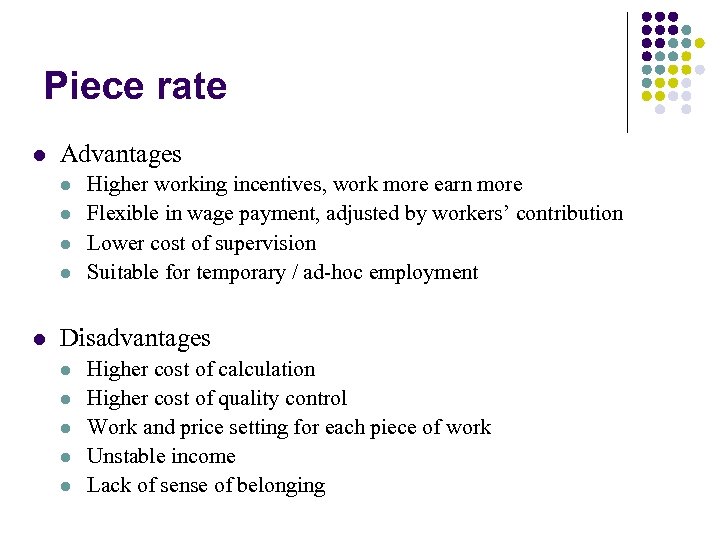
Piece rate l Advantages l l l Higher working incentives, work more earn more Flexible in wage payment, adjusted by workers’ contribution Lower cost of supervision Suitable for temporary / ad-hoc employment Disadvantages l l l Higher cost of calculation Higher cost of quality control Work and price setting for each piece of work Unstable income Lack of sense of belonging
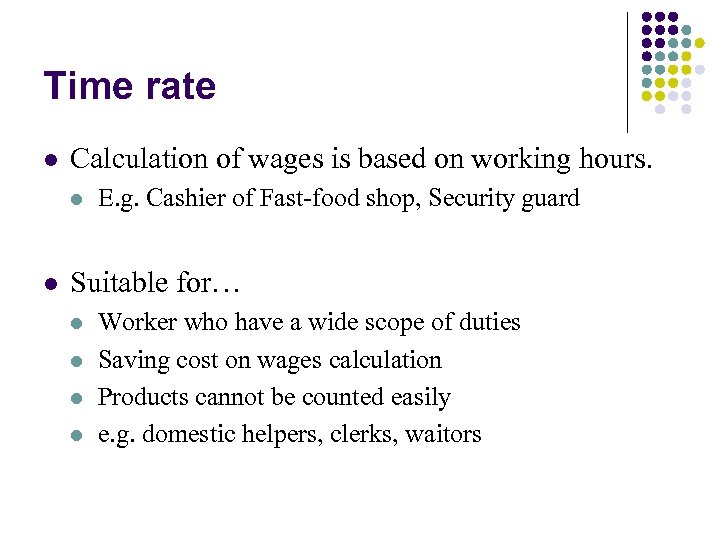
Time rate l Calculation of wages is based on working hours. l l E. g. Cashier of Fast-food shop, Security guard Suitable for… l l Worker who have a wide scope of duties Saving cost on wages calculation Products cannot be counted easily e. g. domestic helpers, clerks, waitors
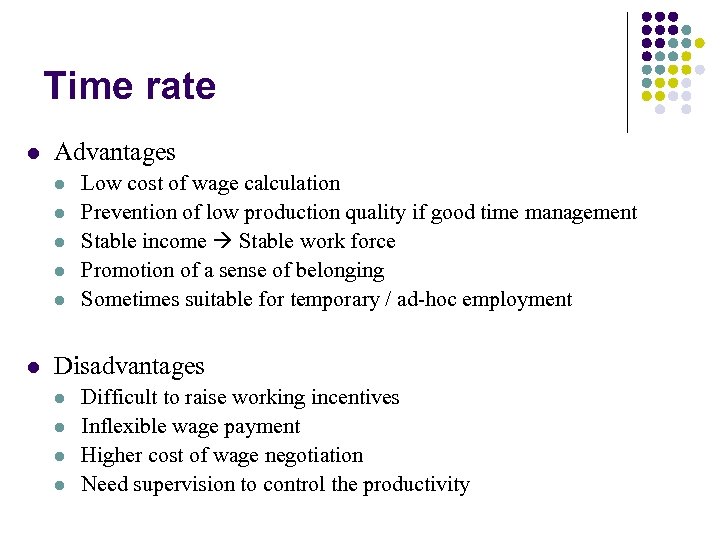
Time rate l Advantages l l l Low cost of wage calculation Prevention of low production quality if good time management Stable income Stable work force Promotion of a sense of belonging Sometimes suitable for temporary / ad-hoc employment Disadvantages l l Difficult to raise working incentives Inflexible wage payment Higher cost of wage negotiation Need supervision to control the productivity
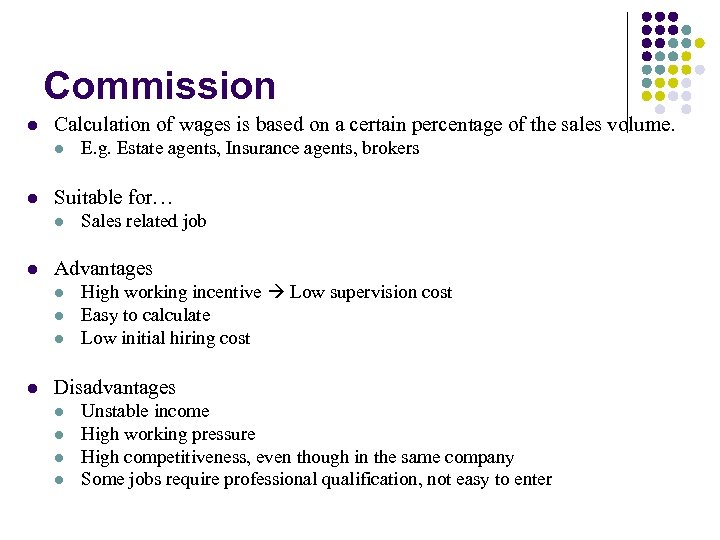
Commission l Calculation of wages is based on a certain percentage of the sales volume. l l Suitable for… l l Sales related job Advantages l l E. g. Estate agents, Insurance agents, brokers High working incentive Low supervision cost Easy to calculate Low initial hiring cost Disadvantages l l Unstable income High working pressure High competitiveness, even though in the same company Some jobs require professional qualification, not easy to enter
Bonus l Calculation of wages is based on a certain percentage of company’s profit. l l l Advantages l l l A lump-sum payment Extra, in addition to the basic wages High working incentive Strengthen the sense of belongings Boost morale Enhance workers’ performance Disadvantages l l Irregular Absence or Removal of bonus is a kind of punishment
Division of labour l The specialization of labour l l l Workers concentrate on the production of certain goods or services, or a certain production stage. Workers specialize in different jobs. Types of division of labour l l l Simple Complex Regional
Simple division of labour l Everyone engages in different occupations l l l Farmers farming Fishermen fishing Drivers driving Teachers teaching Everyone is responsible for the entire production process of a certain product.
Complex division of labour l l A firm Divides the production process into several stages Work in a cooperation of teams Different workers specialize in different stages l Production of laptop l l l l Making of IC + Making of LCD + Making of harddisk + Making of keyboard +… Combination of parts Quality control (testing) Packing Stocking Wholesaling Production of Econ. Textbook l l l l Writing by the writers Editing by the editors Proof-reading by the consultants Registering work by the administrators Promotion by the sales representatives Distribution by the wholesale officers Retailing by the shopkeepers After-sale services by the sales representatives
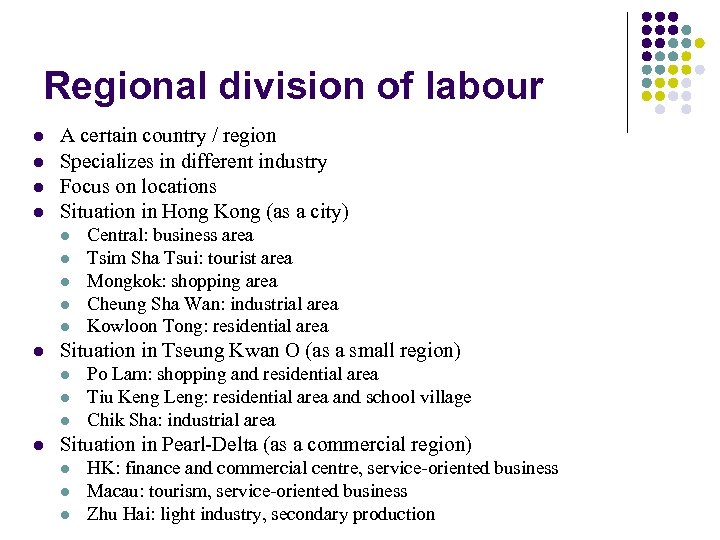
Regional division of labour l l A certain country / region Specializes in different industry Focus on locations Situation in Hong Kong (as a city) l l l Situation in Tseung Kwan O (as a small region) l l Central: business area Tsim Sha Tsui: tourist area Mongkok: shopping area Cheung Sha Wan: industrial area Kowloon Tong: residential area Po Lam: shopping and residential area Tiu Keng Leng: residential area and school village Chik Sha: industrial area Situation in Pearl-Delta (as a commercial region) l l l HK: finance and commercial centre, service-oriented business Macau: tourism, service-oriented business Zhu Hai: light industry, secondary production
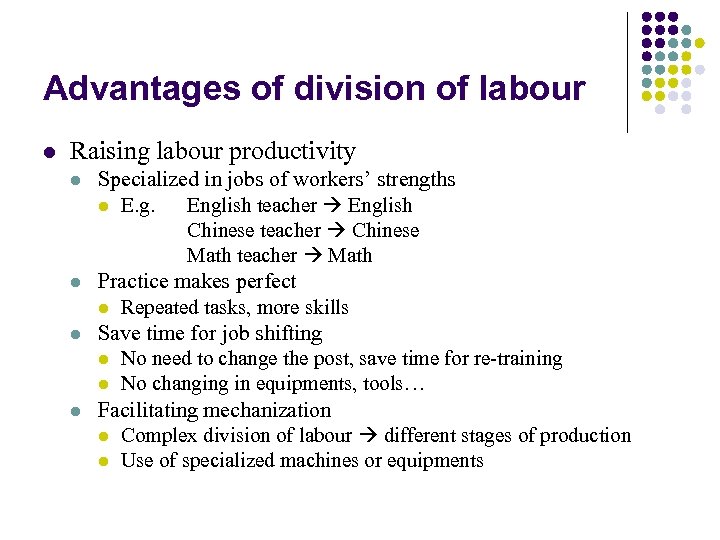
Advantages of division of labour l Raising labour productivity l l Specialized in jobs of workers’ strengths l E. g. English teacher English Chinese teacher Chinese Math teacher Math Practice makes perfect l Repeated tasks, more skills Save time for job shifting l No need to change the post, save time for re-training l No changing in equipments, tools… Facilitating mechanization l Complex division of labour different stages of production l Use of specialized machines or equipments
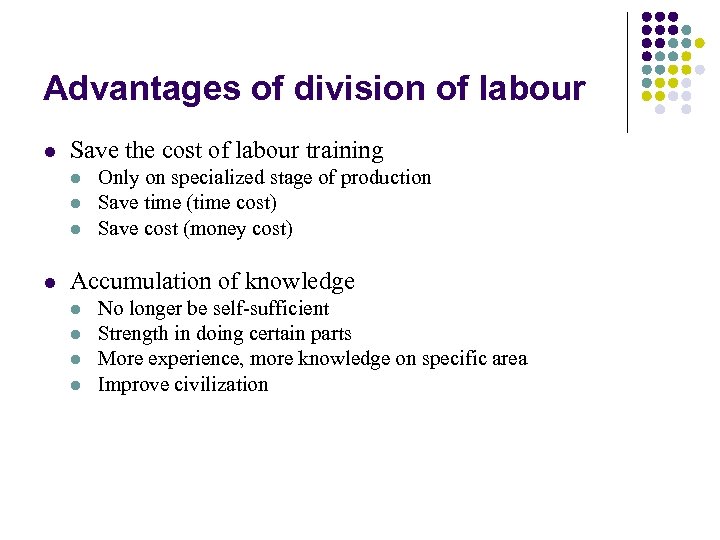
Advantages of division of labour l Save the cost of labour training l l Only on specialized stage of production Save time (time cost) Save cost (money cost) Accumulation of knowledge l l No longer be self-sufficient Strength in doing certain parts More experience, more knowledge on specific area Improve civilization
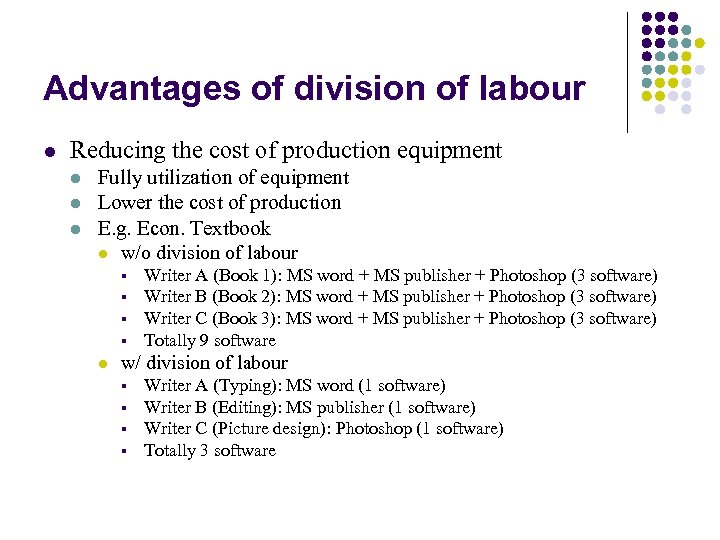
Advantages of division of labour l Reducing the cost of production equipment l l l Fully utilization of equipment Lower the cost of production E. g. Econ. Textbook l w/o division of labour § § l Writer A (Book 1): MS word + MS publisher + Photoshop (3 software) Writer B (Book 2): MS word + MS publisher + Photoshop (3 software) Writer C (Book 3): MS word + MS publisher + Photoshop (3 software) Totally 9 software w/ division of labour § § Writer A (Typing): MS word (1 software) Writer B (Editing): MS publisher (1 software) Writer C (Picture design): Photoshop (1 software) Totally 3 software
Disadvantages of division of labour l Monotonous and boring work l l l Lower the working incentive Lower workers’ creativity Higher risk of unemployment l l l Specialized skills, difficult to find another skills related job, especially when there’s a structural change Higher risk of unemployment Low occupational mobility
Disadvantages of division of labour l High risk of disruption l Stop in one production stage will affect or disrupt the whole or part of the production line l E. g. Damage of sewing machine unable to make cloth unable to produce different part of a shirt unable to assembly different parts nothing for packaging nothing for production delivery nothing for sales l Example: The strike of construction workers
Disadvantages of division of labour l Over-standardization & Decline in traditional craftsmanship l l Mass production Machinery Lack of individuality Less choice
Division of labour and Globalization l Regional specialization l l Advantages l l Comparative advantages Lowest opportunity cost Enhance international relationship Encourage employment Lower production cost Effective utilization of resources Disadvantages l l Poverty Inequality Injustice The erosion of traditional culture

Division of labour and Globalization l The OECD recently advised (28 June 2005) that: "Efficient policies to encourage employment and combat unemployment are essential if countries are to reap the full benefits of globalization and avoid a backlash against open trade. . . Job losses in some sectors, along with new job opportunities in other sectors, are an inevitable accompaniment of the process of globalization. . . The challenge is to ensure that the adjustment process involved in matching available workers with new job openings works as smoothly as possible. “ Extracted from http: //en. wikipedia. org/wiki/Division_of_labor
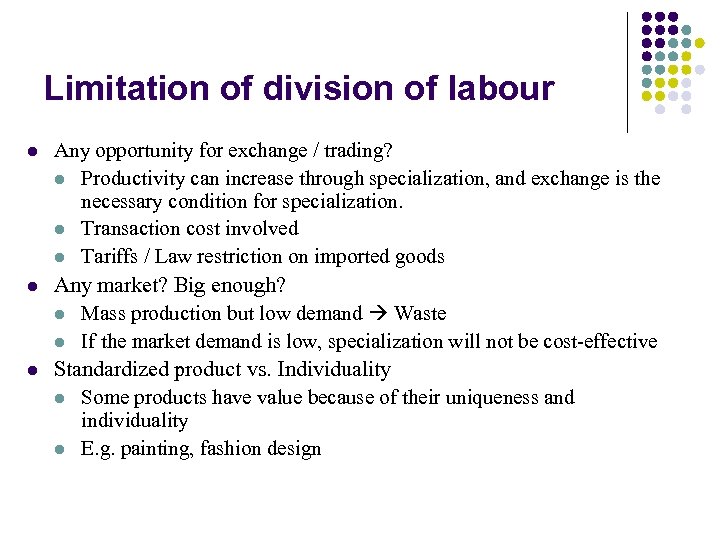
Limitation of division of labour l l l Any opportunity for exchange / trading? l Productivity can increase through specialization, and exchange is the necessary condition for specialization. l Transaction cost involved l Tariffs / Law restriction on imported goods Any market? Big enough? l Mass production but low demand Waste l If the market demand is low, specialization will not be cost-effective Standardized product vs. Individuality l Some products have value because of their uniqueness and individuality l E. g. painting, fashion design
Скачать презентацию Economics Chapter 4 Labour Labour l l
a06befb98843b1a31c43ab862403570f.ppt