


 Скачать презентацию Economics and Search Hal Varian SIGIR August 16
8b796e72d88c1951010f6f6f6d81837a.ppt
- Количество слайдов: 32
 Economics and Search Hal Varian SIGIR, August 16, 1999 http: //www. sims. berkeley. edu/~hal
 Three points of contact z 1. Value of information z 2. Estimating degree of relevance z 3. Optimal search behavior
 1. Value of information z. Economic value of information y. More information helps us make better decisions y. Economic value of information = value of best decision with information - value of best decision without the information x. Increase in expected utility due to the better decision, or decrease in expected cost
 Properties z. Information has non-negative private value (because it can be ignored) z. Information is valuable only when it is “new” -- when it changes a decision z. Example yfinancial information gets quickly incorporated into stock prices ysubsequent “news” may not move prices y“buy on the rumor, sell on the news”
 Relevance to search? z. Information is valuable when it is “new” z“Relevance” captures only part of information value since a document may be relevant but not “new” z. Example yrepeated occurrence of documents ymany similar documents
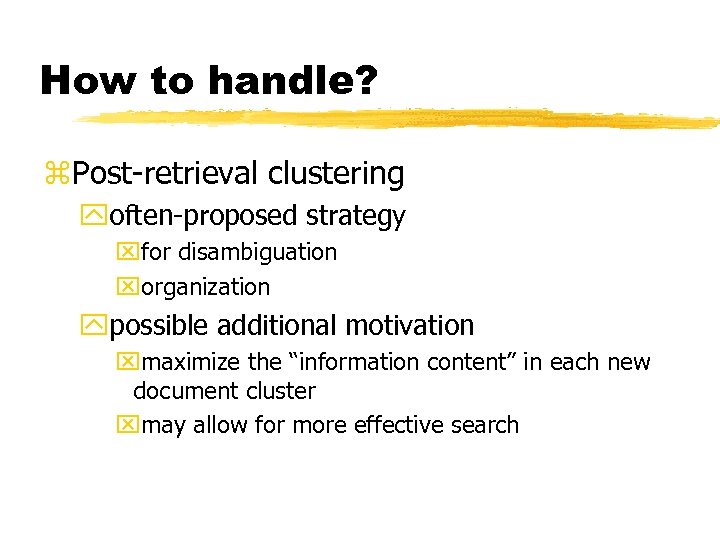 How to handle? z. Post-retrieval clustering yoften-proposed strategy xfor disambiguation xorganization ypossible additional motivation xmaximize the “information content” in each new document cluster xmay allow for more effective search
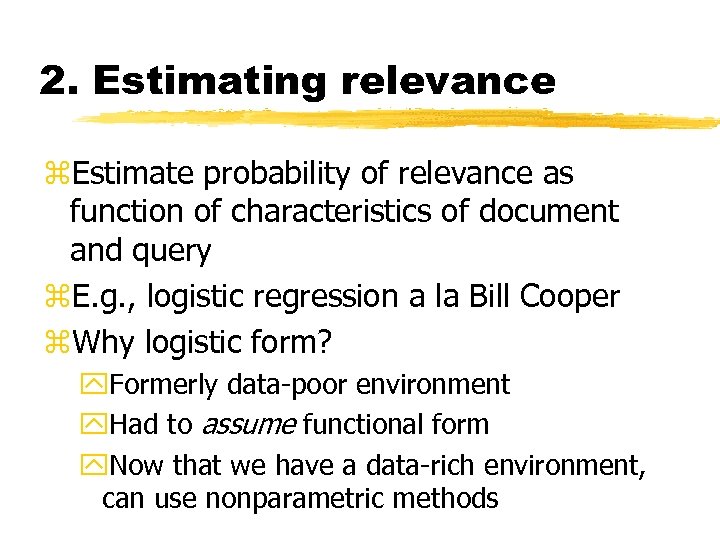 2. Estimating relevance z. Estimate probability of relevance as function of characteristics of document and query z. E. g. , logistic regression a la Bill Cooper z. Why logistic form? y. Formerly data-poor environment y. Had to assume functional form y. Now that we have a data-rich environment, can use nonparametric methods
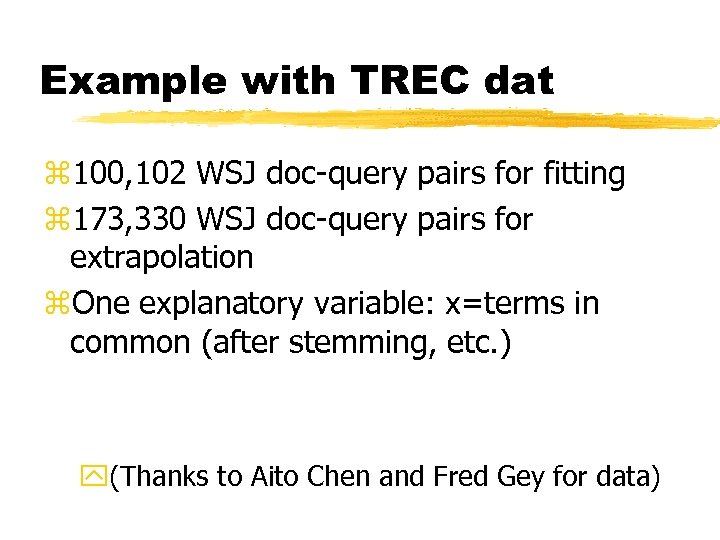 Example with TREC dat z 100, 102 WSJ doc-query pairs for fitting z 173, 330 WSJ doc-query pairs for extrapolation z. One explanatory variable: x=terms in common (after stemming, etc. ) y(Thanks to Aito Chen and Fred Gey for data)
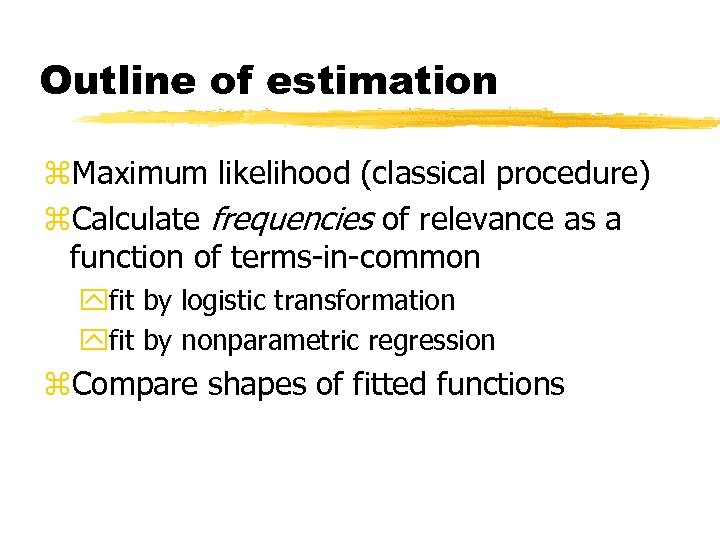 Outline of estimation z. Maximum likelihood (classical procedure) z. Calculate frequencies of relevance as a function of terms-in-common yfit by logistic transformation yfit by nonparametric regression z. Compare shapes of fitted functions
 Frequency of relevance z. Look at all document-query pairs with 1 word-in-common z. See what fraction of these are relevant z. Repeat for 2, 3, 4 … words in common ygenerates a histogram with words-incommon on horizontal axis, frequency of relevance on vertical axis
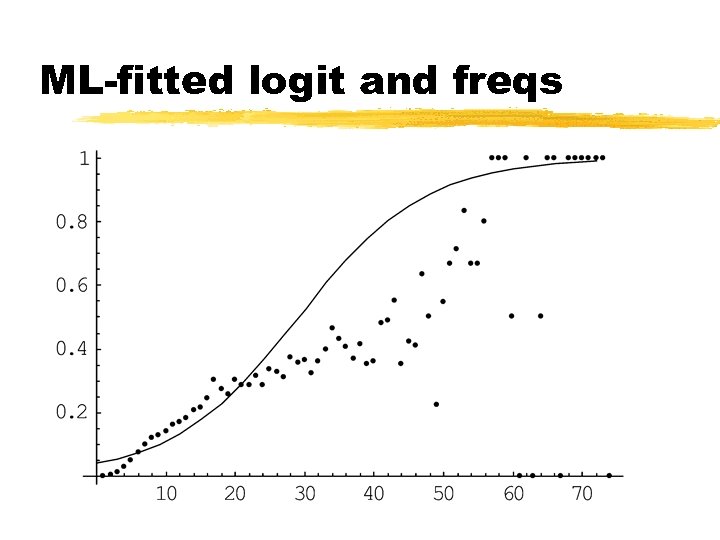 ML-fitted logit and freqs
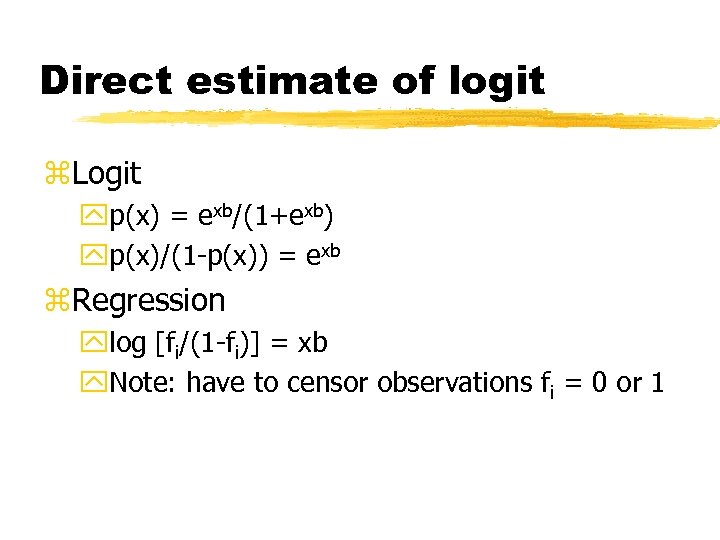 Direct estimate of logit z. Logit yp(x) = exb/(1+exb) yp(x)/(1 -p(x)) = exb z. Regression ylog [fi/(1 -fi)] = xb y. Note: have to censor observations fi = 0 or 1
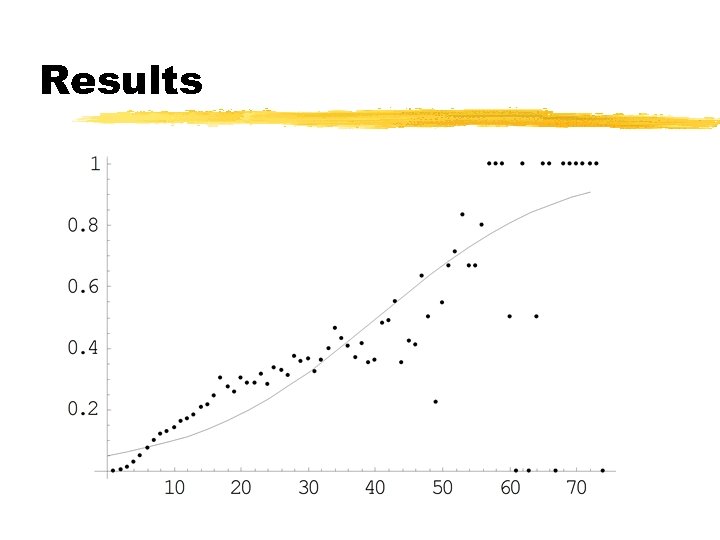 Results
 Nonparametric regression z. Find monotone function that minimizes sum of squared residuals between observations and fitted expression z. PAV = “pool adjacent violators” algorithm doesn’t require solving minimization problem directly
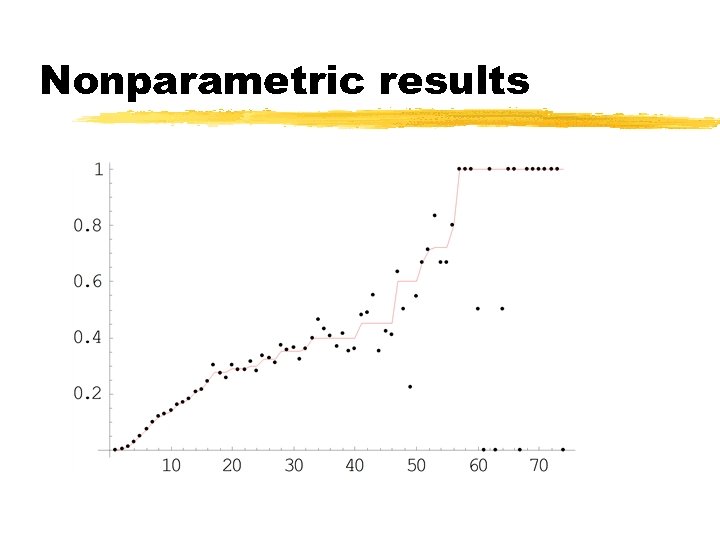 Nonparametric results
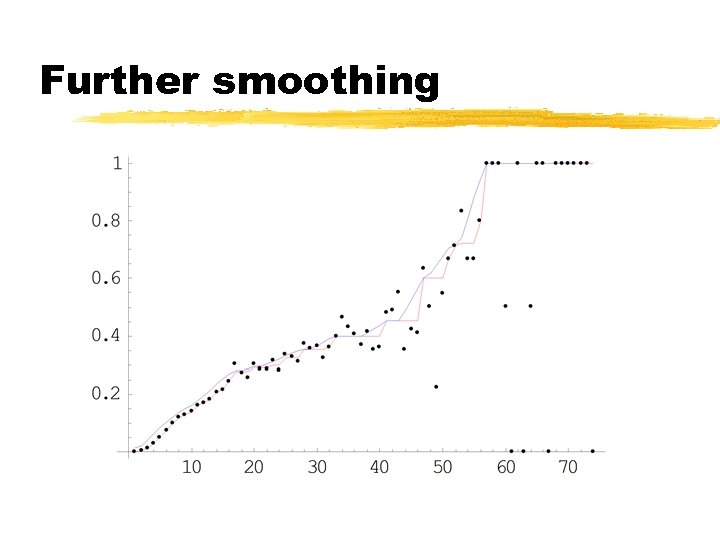 Further smoothing
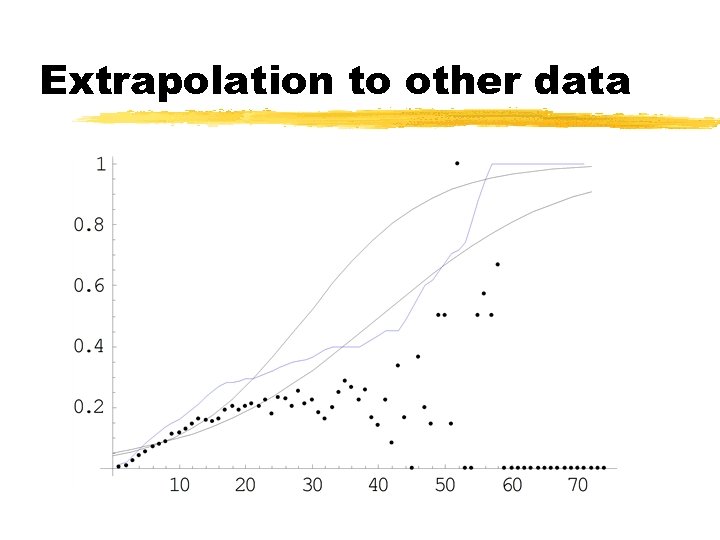 Extrapolation to other data
 Further work z. Add another variable, e. g. , yquery length/ document length y“inverse document frequency” z. Look at other collections z. Note: since there is only one variable, recall-precision is same for all estimators
 3. Search behavior z. Economic model: search for lowest price or highest wage z. With or without “recall” (revisit stores) z. Results do not cumulate, care only about the max y. May or may not be natural in IR context y. Of course, can generalize to k-best choices
 Example z. Marty Weitzman’s “Pandora problem” y“Optimal Search for the Best Alternative”, Econometrica, May 1979 yn boxes yreward in box i is random with cdf Fi(x) ycosts ci to open a box, time discount factor d<1 ypayoff is maximum value found up to point when you stop opening
 IR story z. You work at airport book store ypeople are in a hurry (d < 1) ymental effort to examining books (c > 0) ywill only take one book with them yyou have an idea of how likely it is that person will like the book (Fi(x)) z. Problem: in what order to show them books?
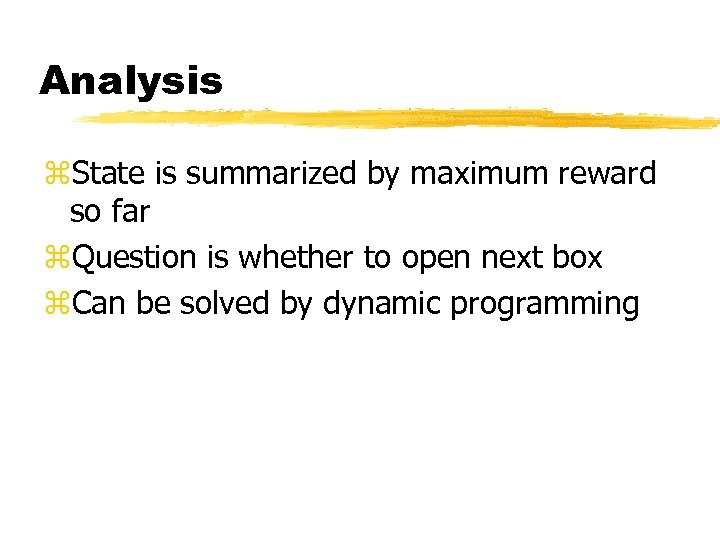 Analysis z. State is summarized by maximum reward so far z. Question is whether to open next box z. Can be solved by dynamic programming
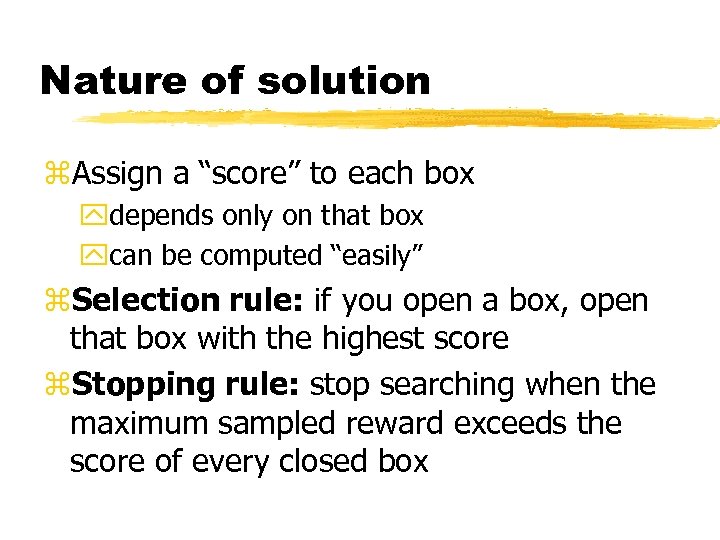 Nature of solution z. Assign a “score” to each box ydepends only on that box ycan be computed “easily” z. Selection rule: if you open a box, open that box with the highest score z. Stopping rule: stop searching when the maximum sampled reward exceeds the score of every closed box
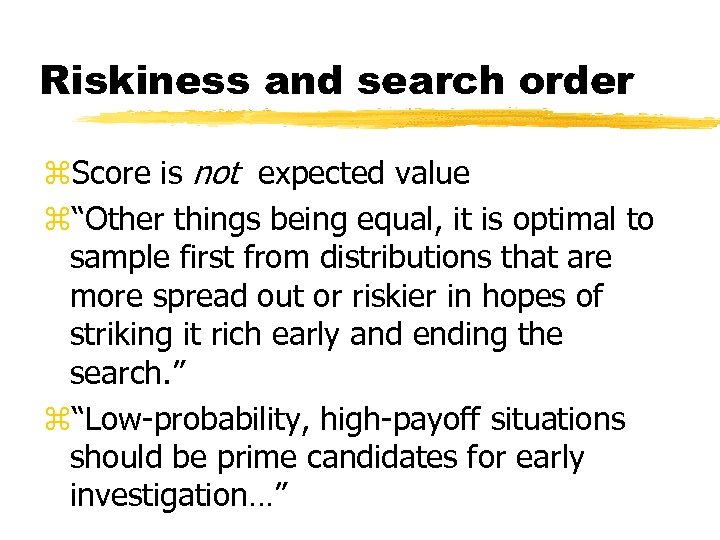 Riskiness and search order z. Score is not expected value z“Other things being equal, it is optimal to sample first from distributions that are more spread out or riskier in hopes of striking it rich early and ending the search. ” z“Low-probability, high-payoff situations should be prime candidates for early investigation…”
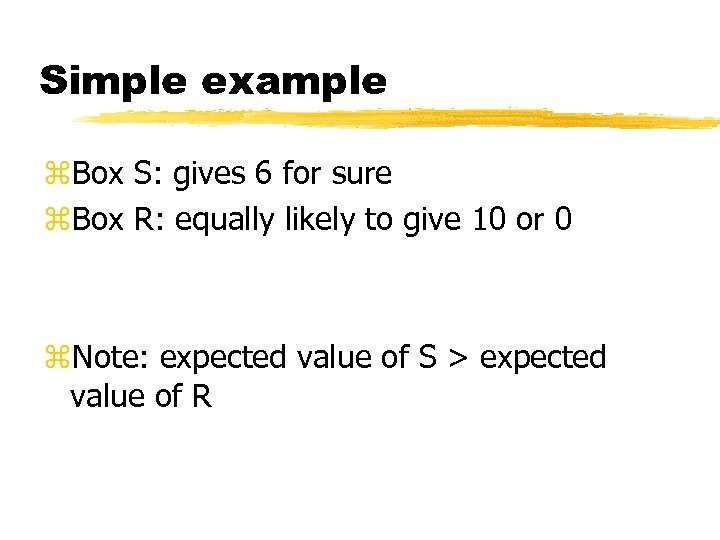 Simple example z. Box S: gives 6 for sure z. Box R: equally likely to give 10 or 0 z. Note: expected value of S > expected value of R
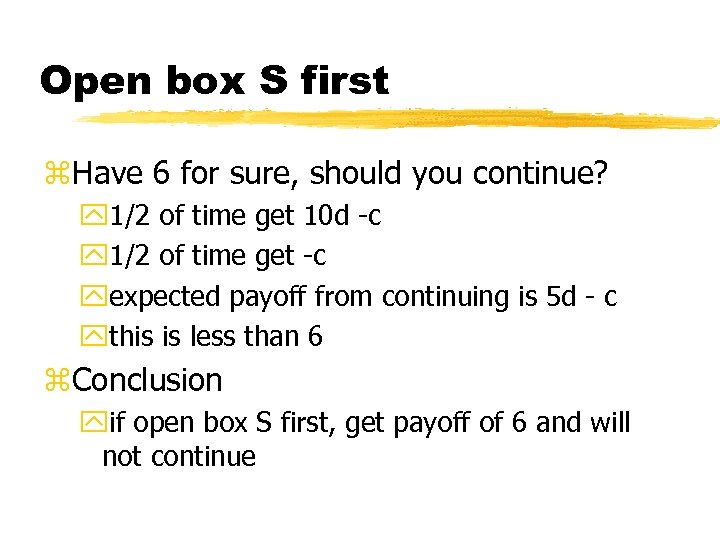 Open box S first z. Have 6 for sure, should you continue? y 1/2 of time get 10 d -c y 1/2 of time get -c yexpected payoff from continuing is 5 d - c ythis is less than 6 z. Conclusion yif open box S first, get payoff of 6 and will not continue
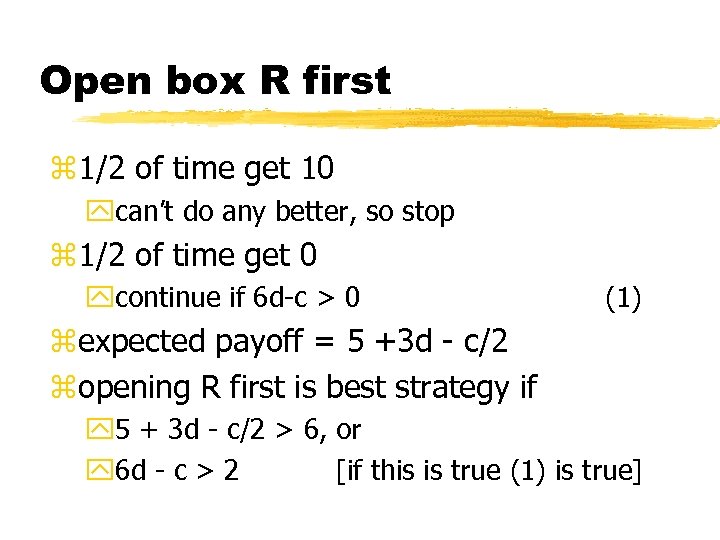 Open box R first z 1/2 of time get 10 ycan’t do any better, so stop z 1/2 of time get 0 ycontinue if 6 d-c > 0 (1) zexpected payoff = 5 +3 d - c/2 zopening R first is best strategy if y 5 + 3 d - c/2 > 6, or y 6 d - c > 2 [if this is true (1) is true]
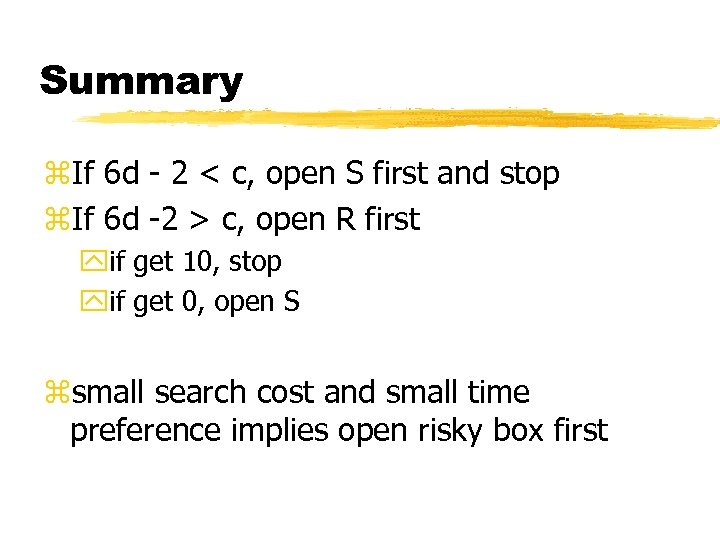 Summary z. If 6 d - 2 < c, open S first and stop z. If 6 d -2 > c, open R first yif get 10, stop yif get 0, open S zsmall search cost and small time preference implies open risky box first
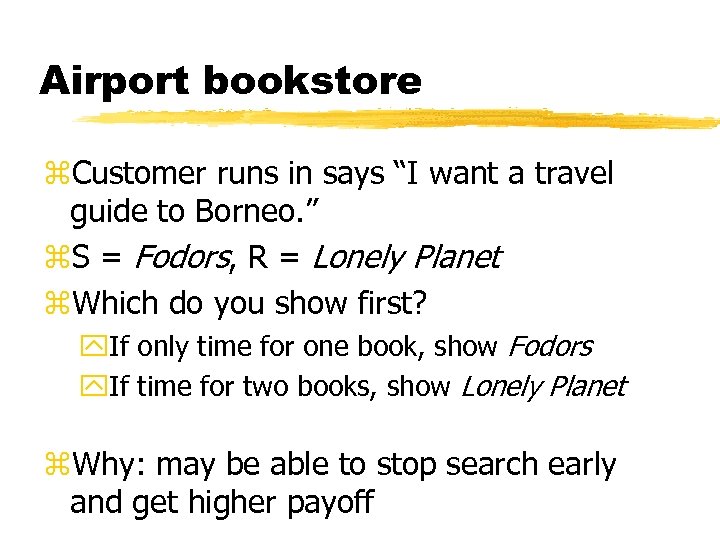 Airport bookstore z. Customer runs in says “I want a travel guide to Borneo. ” z. S = Fodors, R = Lonely Planet z. Which do you show first? y. If only time for one book, show Fodors y. If time for two books, show Lonely Planet z. Why: may be able to stop search early and get higher payoff
 Risk and search z. Don’t necessarily want to order search by expected payoff z. Want some high-variance choices early to reduce search costs/time z. Generalization y. Want to sample from high-variance populations (if they have similar means) y. Result depends on time-value, search cost, utility is maximum of choices
 Estimation of value? z. From a Bayesian perspective, forecast relevance (or value) is random variable yas in regressions described earlier z. Can apply a Weitzman-type rule to determine optimal order z. Is it worth the effort? Depends on how good an estimate of value, discount factor, search cost we have. . .
 Summary z. Information has economic value since it helps make better decisions z. Nonlinear estimation (which requires lots of data) may be useful in prediction z. Risk and search cost are important factors for determining optimal search order and stopping rule