 Скачать презентацию Economic Valuation of Coral Reefs in Tobago
f5fcab6f1f424c63e6a08a82238c7a77.ppt
- Количество слайдов: 63



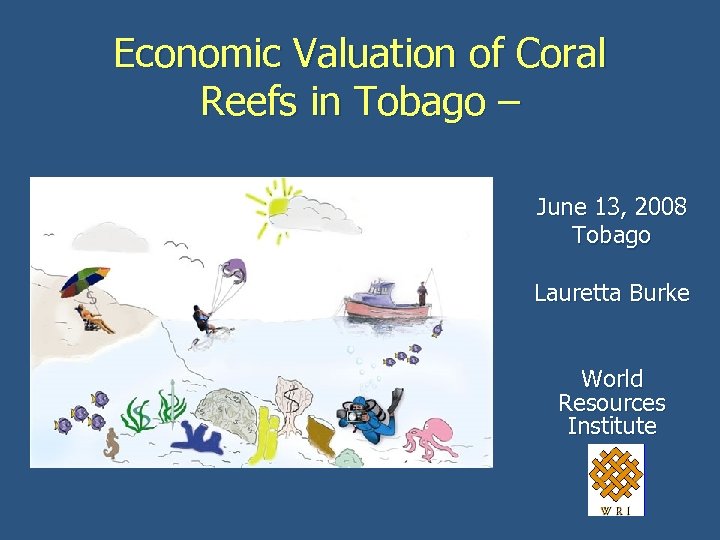
Economic Valuation of Coral Reefs in Tobago – June 13, 2008 Tobago Lauretta Burke World Resources Institute
Project Partners Include Trinidad and Tobago n Buccoo Reef Trust n T&T Institute of Marine Affairs (IMA) n n Tobago House of Assembly (THA) / Policy Research Development Institute (PRDI) T&T Central Statistics Office (CSO) n T&T Environmental Management Agency (EMA) n Environment Tobago and SOS Saint Lucia n Government of Saint Lucia Regional Partners n n University of the West Indies (UWI) / Sustainable Economic Development Unit (SEDU) Caribbean Natural Resources Institute (CANARI)
Financial Support n Macarthur Foundation n Ocean Foundation n Henry Foundation n Munson Foundation n n Dutch Ministry of Foreign Affairs Swed. Bio International Coral Reef Action Network (ICRAN) Buccoo Reef Trust
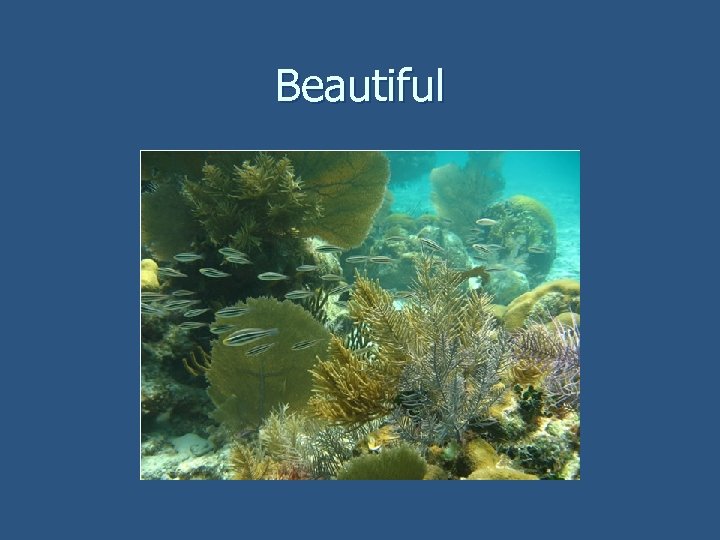
Beautiful
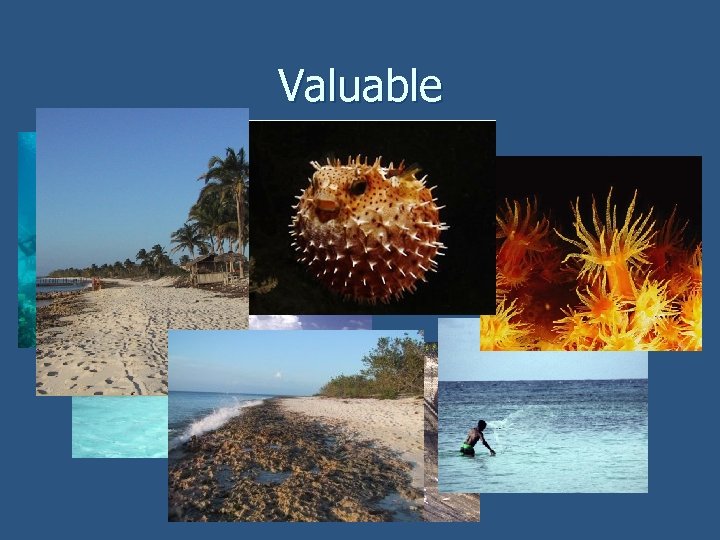
Valuable
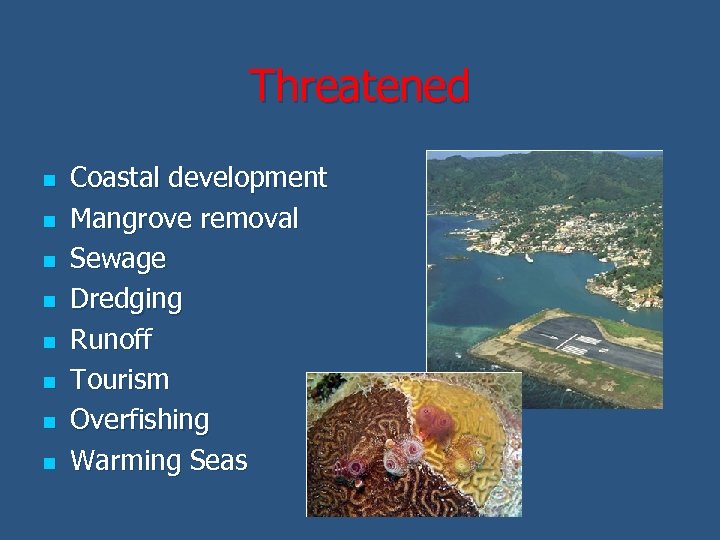
Threatened n n n n Coastal development Mangrove removal Sewage Dredging Runoff Tourism Overfishing Warming Seas
Influencing Better Management n Economic Valuation is a tool to guide coastal planning, investment and management in the long-term interest of local communities and the country
Evaluating trade-offs OPTIONS n Development options n Enforcement of regulations n Capping tourist numbers n Investing in pollution control OUTCOMES n Revenue streams from tourism n Societal benefits from reefs n Ecosystem goods and services
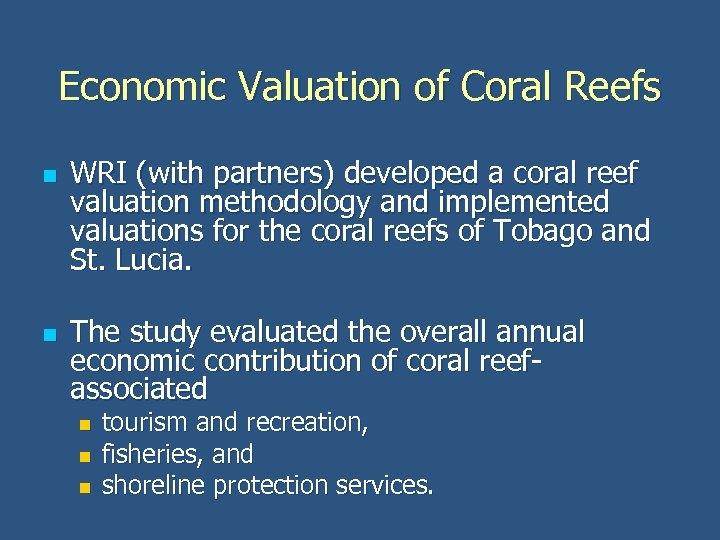
Economic Valuation of Coral Reefs n n WRI (with partners) developed a coral reef valuation methodology and implemented valuations for the coral reefs of Tobago and St. Lucia. The study evaluated the overall annual economic contribution of coral reefassociated n n n tourism and recreation, fisheries, and shoreline protection services.
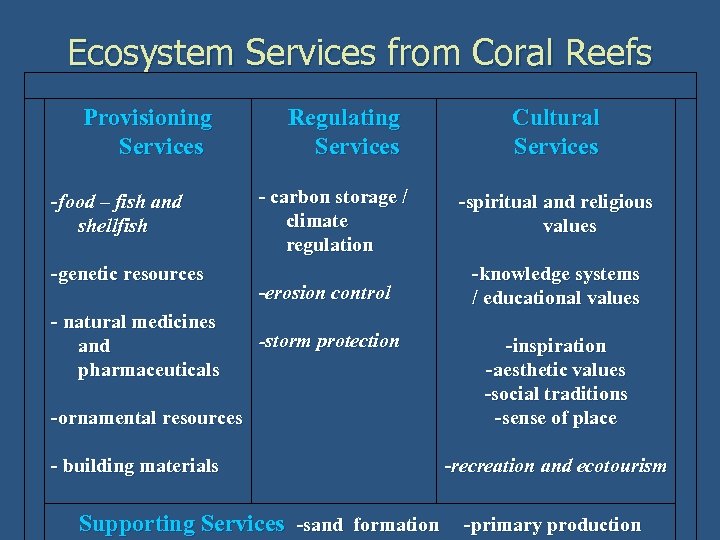
Ecosystem Services from Coral Reefs Provisioning Services -food – fish and shellfish -genetic resources - natural medicines and pharmaceuticals -ornamental resources - building materials Regulating Services - carbon storage / climate regulation -erosion control -storm protection Cultural Services -spiritual and religious values -knowledge systems / educational values -inspiration -aesthetic values -social traditions -sense of place -recreation and ecotourism Supporting Services -sand formation -primary production
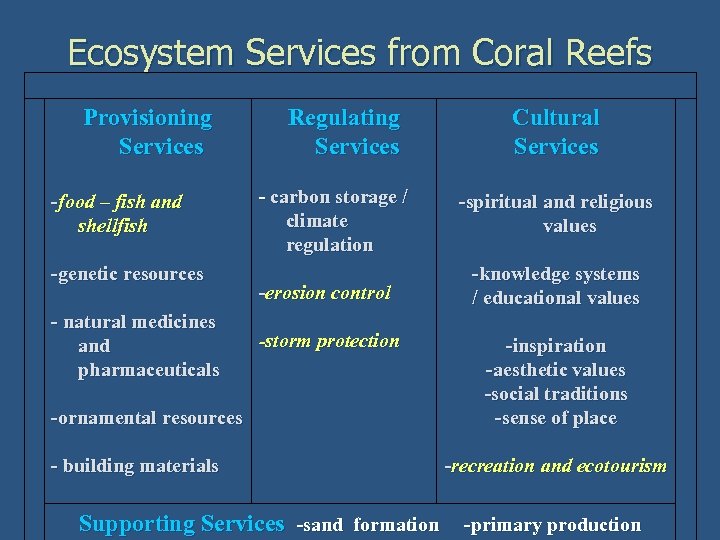
Ecosystem Services from Coral Reefs Provisioning Services -food – fish and shellfish -genetic resources - natural medicines and pharmaceuticals -ornamental resources - building materials Regulating Services - carbon storage / climate regulation -erosion control -storm protection Cultural Services -spiritual and religious values -knowledge systems / educational values -inspiration -aesthetic values -social traditions -sense of place -recreation and ecotourism Supporting Services -sand formation -primary production
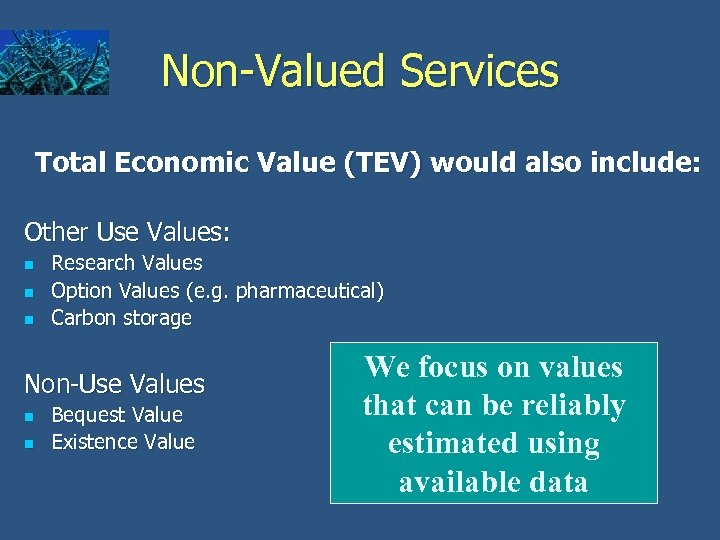
Non-Valued Services Total Economic Value (TEV) would also include: Other Use Values: n n n Research Values Option Values (e. g. pharmaceutical) Carbon storage Non-Use Values n n Bequest Value Existence Value We focus on values that can be reliably estimated using available data
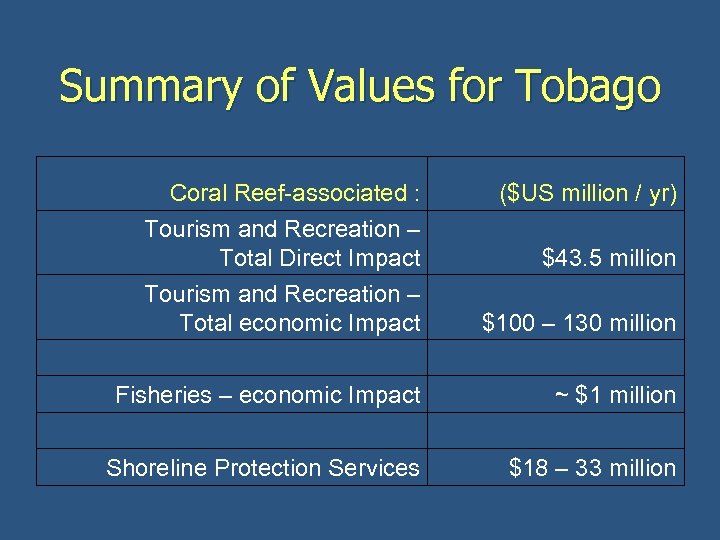
Summary of Values
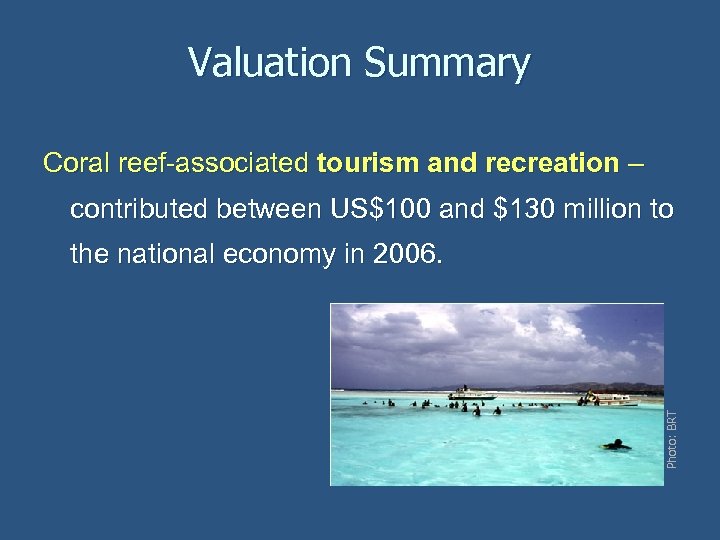
Valuation Summary Coral reef-associated tourism and recreation – contributed between US$100 and $130 million to Photo: BRT the national economy in 2006.
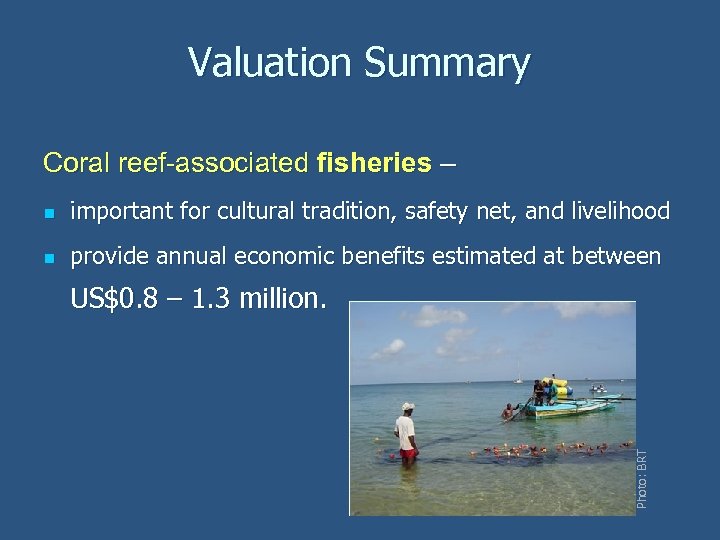
Valuation Summary Coral reef-associated fisheries – n important for cultural tradition, safety net, and livelihood n provide annual economic benefits estimated at between Photo: BRT US$0. 8 – 1. 3 million.
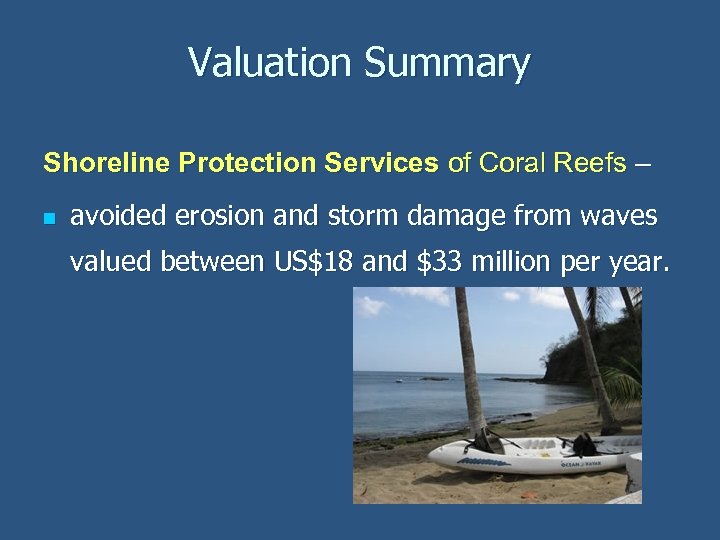
Valuation Summary Shoreline Protection Services of Coral Reefs – n avoided erosion and storm damage from waves valued between US$18 and $33 million per year.
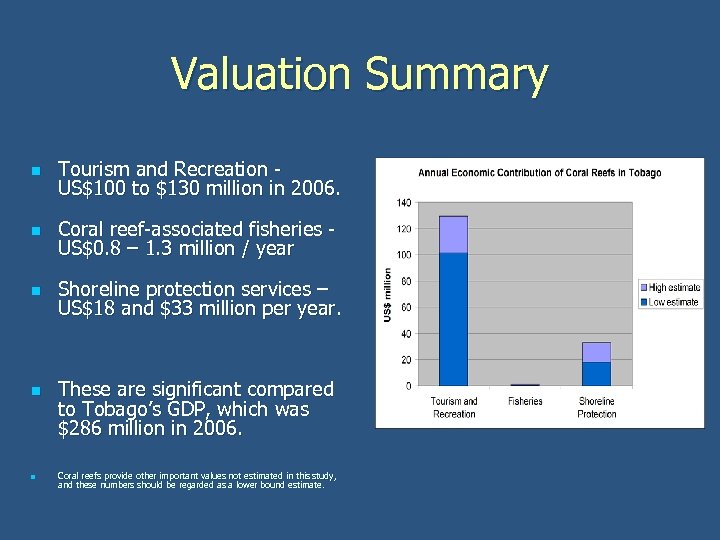
Valuation Summary n Tourism and Recreation US$100 to $130 million in 2006. n Coral reef-associated fisheries US$0. 8 – 1. 3 million / year n Shoreline protection services – US$18 and $33 million per year. n n These are significant compared to Tobago’s GDP, which was $286 million in 2006. Coral reefs provide other important values not estimated in this study, and these numbers should be regarded as a lower bound estimate.
Coral Reefs – Economically Important to Tobago Valuation can highlight: n n Significant contribution to GDP Taxes paid to government Jobs and wages dependent on coral reefs Value of social safety net Supports: n n Coastal Planning (shoreline protection analysis) Evaluation of trade-offs
Economic Valuation applications n Estimate Economic Contribution to GDP n Compare benefits of development / management options n Encourage increased investment in coastal management / MPAs / fisheries management n Identify sources of support for management / policy / protected areas n Set fees, such as visitor fees n Damage assessment
Tobago-specific examples n n Evaluate the costs and benefits of investing in more active management of Buccoo Reef Marine Park Evaluating the benefits of investment in improved sewage treatment in SW Tobago Examine changes in fisheries management and the impact on short-term livelihoods versus long-term benefits Comparing the benefits of consumptive vs. nonconsumptive use of sea turtles
Econ Val Project Characteristics 1. Develop method which is simple and replicable 2. Rely predominantly on existing, available data 3. Produce coral reef valuation estimates for two pilot areas (Tobago and St. Lucia) 4. Estimate likely economic loss due to coral reef degradation
Valuation – Main Components Tourism Method: Financial Analysis (Net revenues plus transfers) Fisheries Method: Financial Analysis (Net revenues plus transfers) Shoreline Protection Method: “Avoided Damages”
Tourism Components Accommodation n Reef Recreation – Diving n Reef Recreation – Snorkeling n Marine Park Revenues n Misc. Expenses (e. g. , departure taxes, visitor expenditure) n Local Use n Indirect economic effects n
Tourism Valuation issues 1. 2. 3. 4. Identifying “coastal” visitors Quantifying reef recreation Getting accurate MPA visitation numbers Tobago-specific data
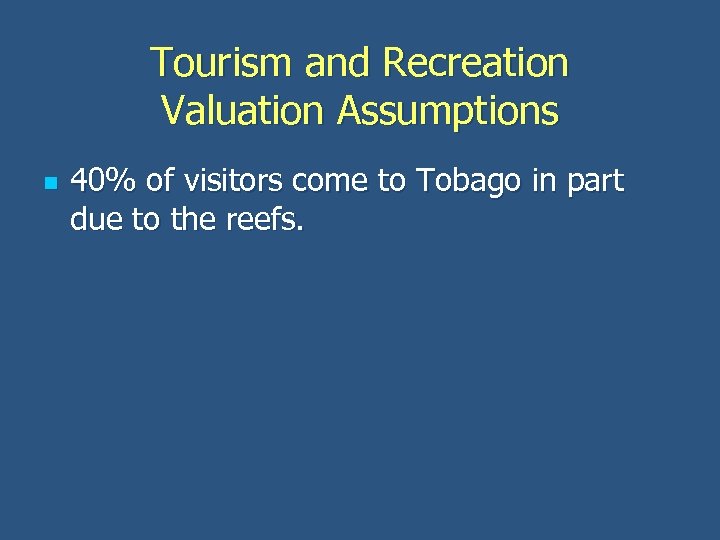
Tourism and Recreation Valuation Assumptions n 40% of visitors come to Tobago in part due to the reefs.
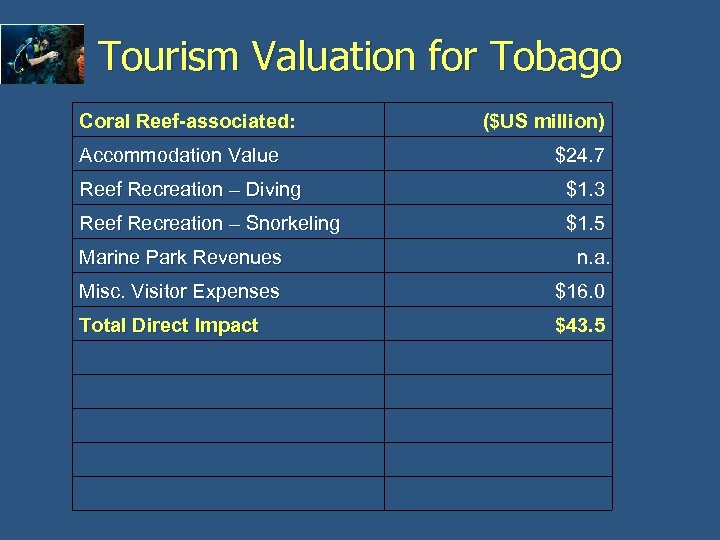
Tourism Valuation for Tobago Coral Reef-associated: Accommodation Value ($US million) $24. 7 Reef Recreation – Diving $1. 3 Reef Recreation – Snorkeling $1. 5 Marine Park Revenues n. a. Misc. Visitor Expenses $16. 0 Total Direct Impact $43. 5
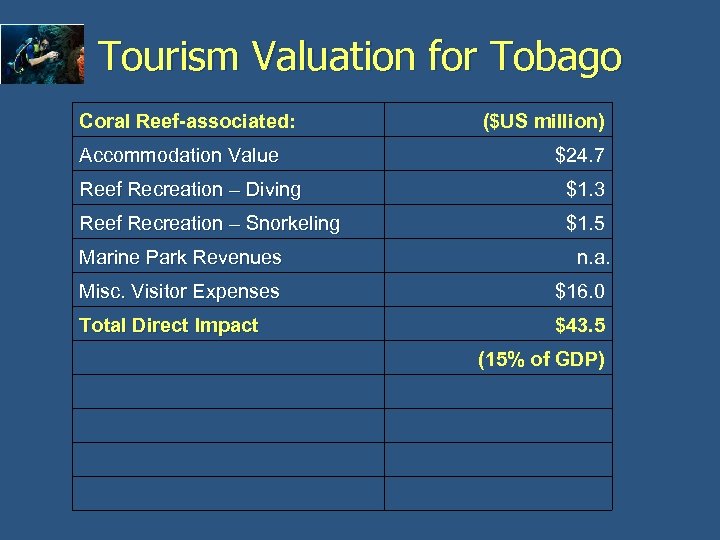
Tourism Valuation for Tobago Coral Reef-associated: Accommodation Value ($US million) $24. 7 Reef Recreation – Diving $1. 3 Reef Recreation – Snorkeling $1. 5 Marine Park Revenues n. a. Misc. Visitor Expenses $16. 0 Total Direct Impact $43. 5 (15% of GDP)
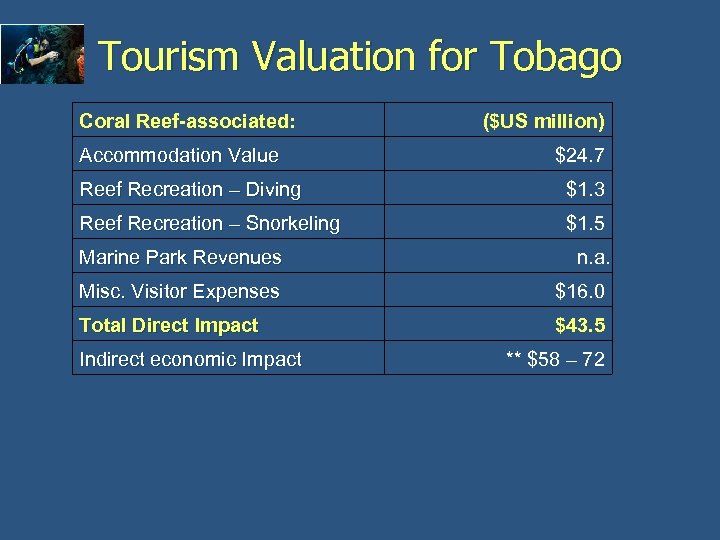
Tourism Valuation for Tobago Coral Reef-associated: Accommodation Value ($US million) $24. 7 Reef Recreation – Diving $1. 3 Reef Recreation – Snorkeling $1. 5 Marine Park Revenues n. a. Misc. Visitor Expenses $16. 0 Total Direct Impact $43. 5 Indirect economic Impact ** $58 – 72
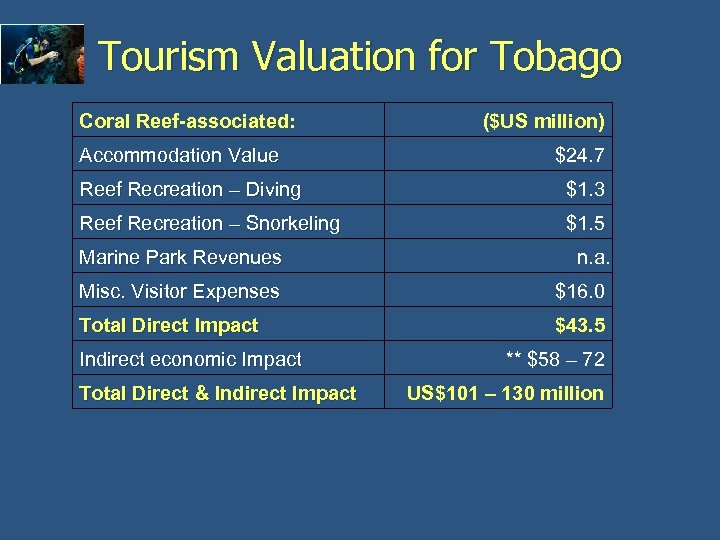
Tourism Valuation for Tobago Coral Reef-associated: Accommodation Value ($US million) $24. 7 Reef Recreation – Diving $1. 3 Reef Recreation – Snorkeling $1. 5 Marine Park Revenues n. a. Misc. Visitor Expenses $16. 0 Total Direct Impact $43. 5 Indirect economic Impact Total Direct & Indirect Impact ** $58 – 72 US$101 – 130 million
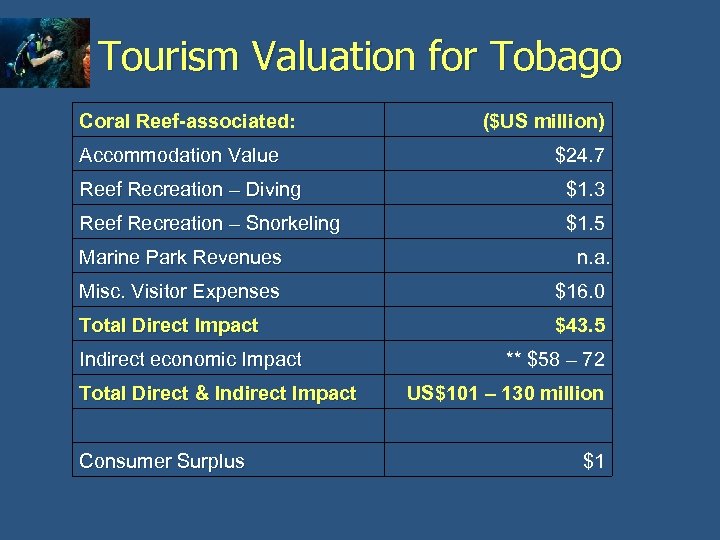
Tourism Valuation for Tobago Coral Reef-associated: Accommodation Value ($US million) $24. 7 Reef Recreation – Diving $1. 3 Reef Recreation – Snorkeling $1. 5 Marine Park Revenues n. a. Misc. Visitor Expenses $16. 0 Total Direct Impact $43. 5 Indirect economic Impact Total Direct & Indirect Impact Consumer Surplus ** $58 – 72 US$101 – 130 million $1
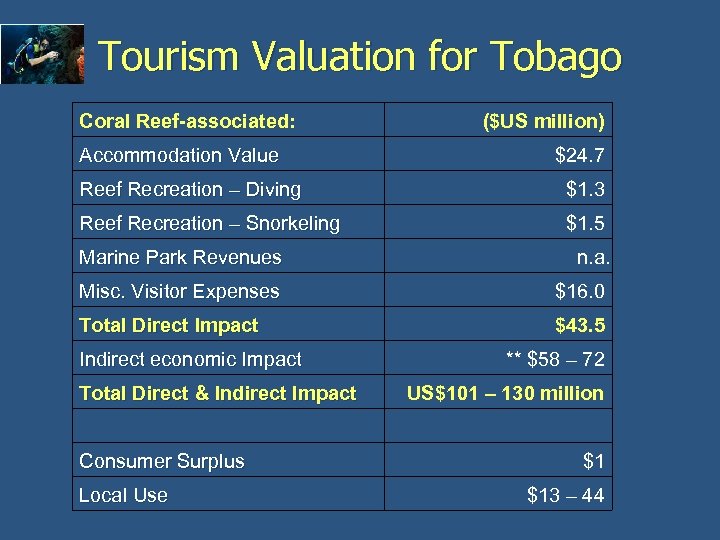
Tourism Valuation for Tobago Coral Reef-associated: Accommodation Value ($US million) $24. 7 Reef Recreation – Diving $1. 3 Reef Recreation – Snorkeling $1. 5 Marine Park Revenues n. a. Misc. Visitor Expenses $16. 0 Total Direct Impact $43. 5 Indirect economic Impact Total Direct & Indirect Impact Consumer Surplus Local Use ** $58 – 72 US$101 – 130 million $1 $13 – 44
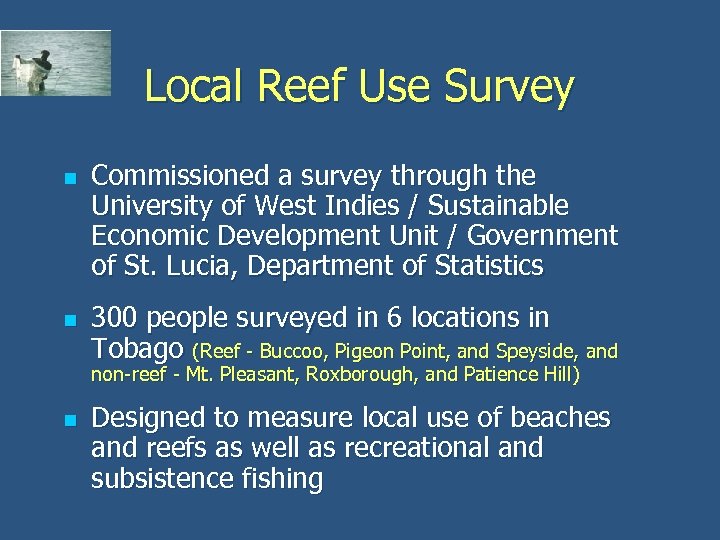
Local Reef Use Survey n n Commissioned a survey through the University of West Indies / Sustainable Economic Development Unit / Government of St. Lucia, Department of Statistics 300 people surveyed in 6 locations in Tobago (Reef - Buccoo, Pigeon Point, and Speyside, and non-reef - Mt. Pleasant, Roxborough, and Patience Hill) n Designed to measure local use of beaches and reefs as well as recreational and subsistence fishing
Fisheries Components n Commercial Fisheries n Fish Processing and Cleaning n Local Use (fishing) n Indirect economic effects n Focus on reef-associated species – snapper, grouper, grunts, squirrelfish, parrot fish, lobster and conch.
Fisheries Valuation Issues 1. Lack of meaningful data on fish landings 2. Limited data on sales and exports 3. Limited data on local use 4. Focus on economic impact – does not fully capture social values.
Commercial Fishing in Tobago n Estimate derived from two approaches – 1. 2. n reef fish productivity estimated pot fishing effort Coral reefs are over-fished Tobago / productivity is declining
a) Reef Fish Productivity n n n Reef Area: 30 km 2 (from this project) Estimated fish productivity rate: range of 2 to 5 MT of fish / km 2 of coral reef Potential sustainable harvest of 130, 000 to 330, 000 lb of reef fish
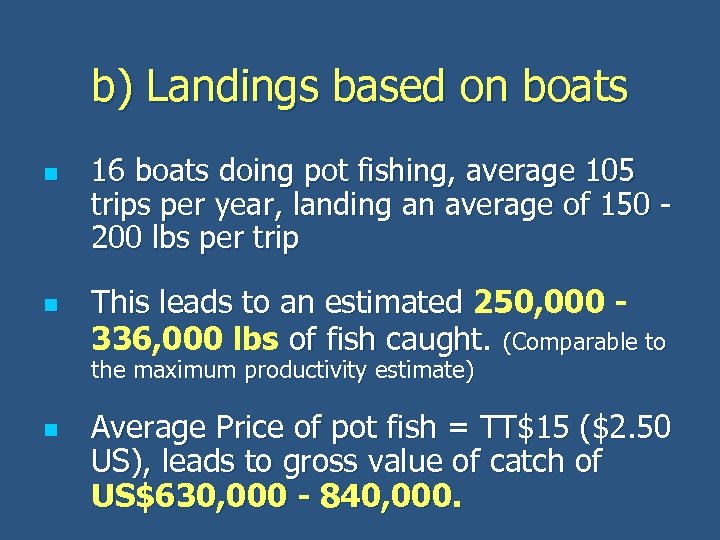
b) Landings based on boats n n 16 boats doing pot fishing, average 105 trips per year, landing an average of 150 200 lbs per trip This leads to an estimated 250, 000 336, 000 lbs of fish caught. (Comparable to the maximum productivity estimate) n Average Price of pot fish = TT$15 ($2. 50 US), leads to gross value of catch of US$630, 000 - 840, 000.
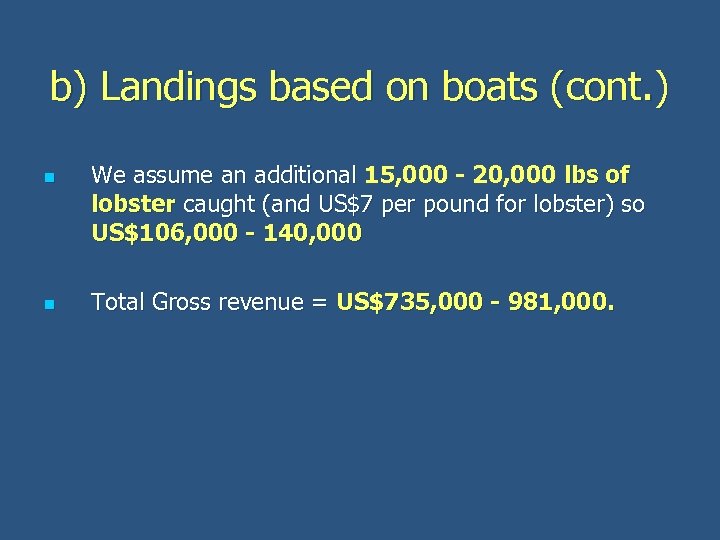
b) Landings based on boats (cont. ) n n We assume an additional 15, 000 - 20, 000 lbs of lobster caught (and US$7 per pound for lobster) so US$106, 000 - 140, 000 Total Gross revenue = US$735, 000 - 981, 000.
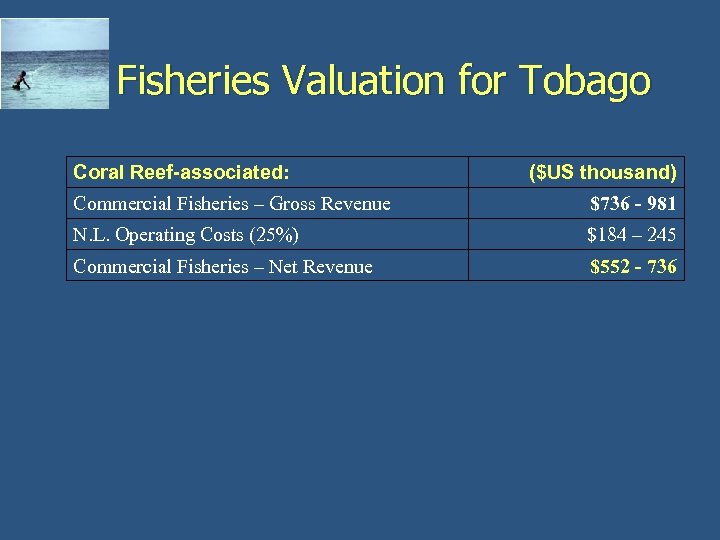
Fisheries Valuation for Tobago Coral Reef-associated: ($US thousand) Commercial Fisheries – Gross Revenue $736 - 981 N. L. Operating Costs (25%) $184 – 245 Commercial Fisheries – Net Revenue $552 - 736
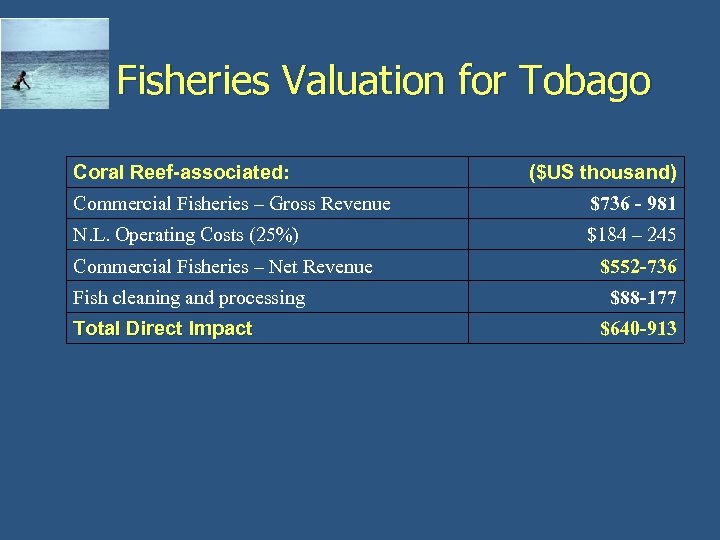
Fisheries Valuation for Tobago Coral Reef-associated: ($US thousand) Commercial Fisheries – Gross Revenue $736 - 981 N. L. Operating Costs (25%) $184 – 245 Commercial Fisheries – Net Revenue Fish cleaning and processing Total Direct Impact $552 -736 $88 -177 $640 -913
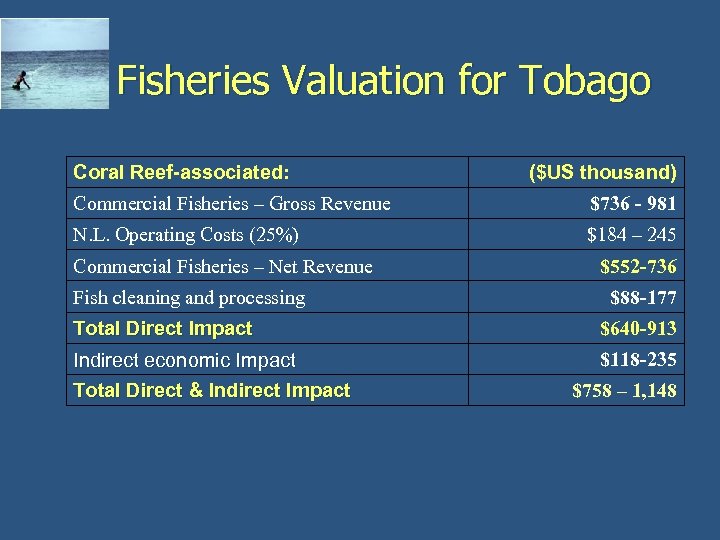
Fisheries Valuation for Tobago Coral Reef-associated: ($US thousand) Commercial Fisheries – Gross Revenue $736 - 981 N. L. Operating Costs (25%) $184 – 245 Commercial Fisheries – Net Revenue Fish cleaning and processing $552 -736 $88 -177 Total Direct Impact $640 -913 Indirect economic Impact Total Direct & Indirect Impact $118 -235 $758 – 1, 148
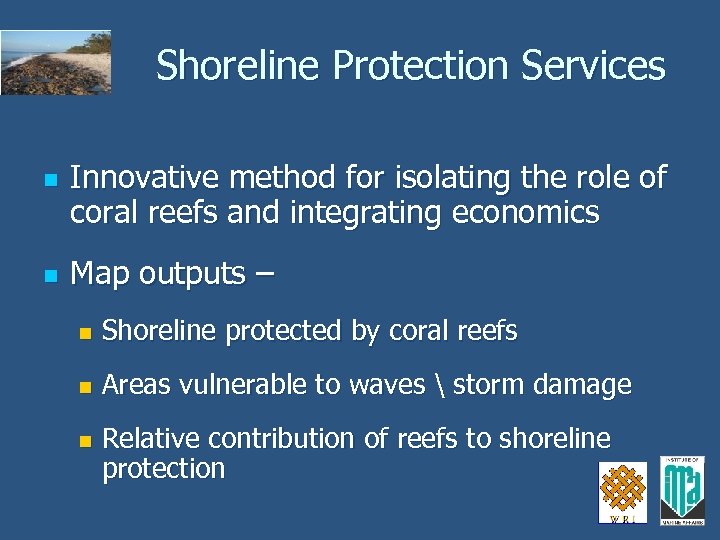
Shoreline Protection Services n n Innovative method for isolating the role of coral reefs and integrating economics Map outputs – n Shoreline protected by coral reefs n Areas vulnerable to waves storm damage n Relative contribution of reefs to shoreline protection
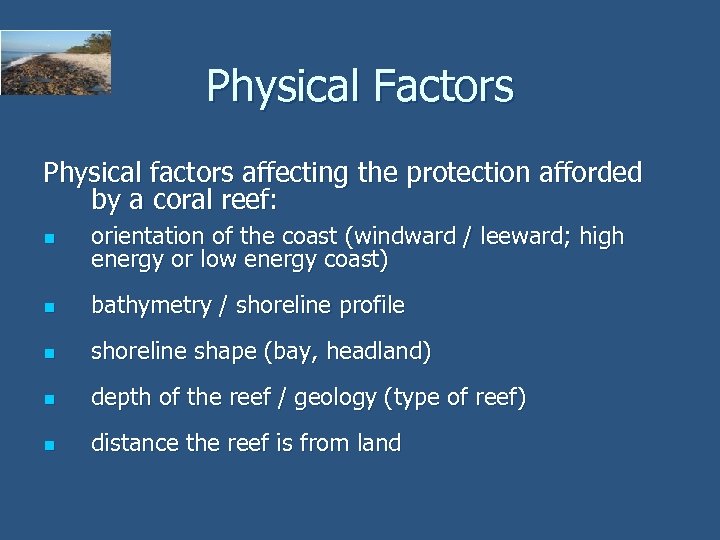
Physical Factors Physical factors affecting the protection afforded by a coral reef: n orientation of the coast (windward / leeward; high energy or low energy coast) n bathymetry / shoreline profile n shoreline shape (bay, headland) n depth of the reef / geology (type of reef) n distance the reef is from land
Complex Analysis n n IMA developed shoreline protection framework - rules for how much protection the reef affords this coastline situation. Can be adapted for climate scenarios
Shoreline Protection Analysis (5 Steps) 1. Identify vulnerable areas 2. Identify areas protected by coral reefs 3. 4. 5. Evaluate the relative protection provided by reefs Incorporate property values Combine to evaluate potential storm damage avoided
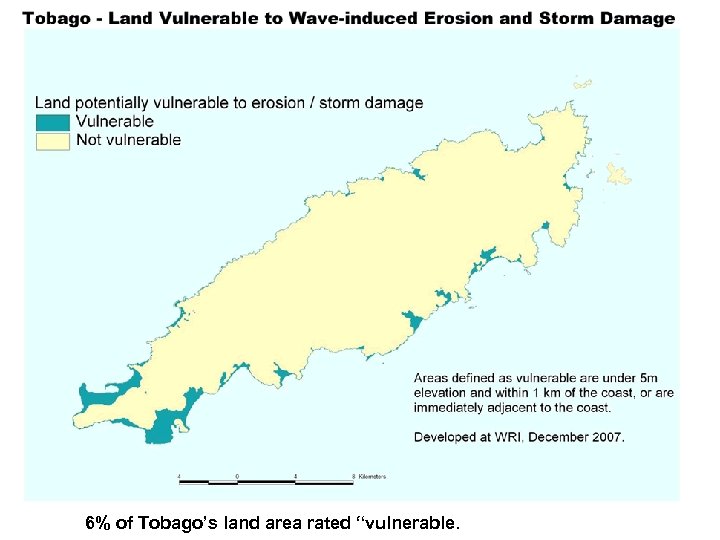
1. 6% of Tobago’s land area rated “vulnerable.
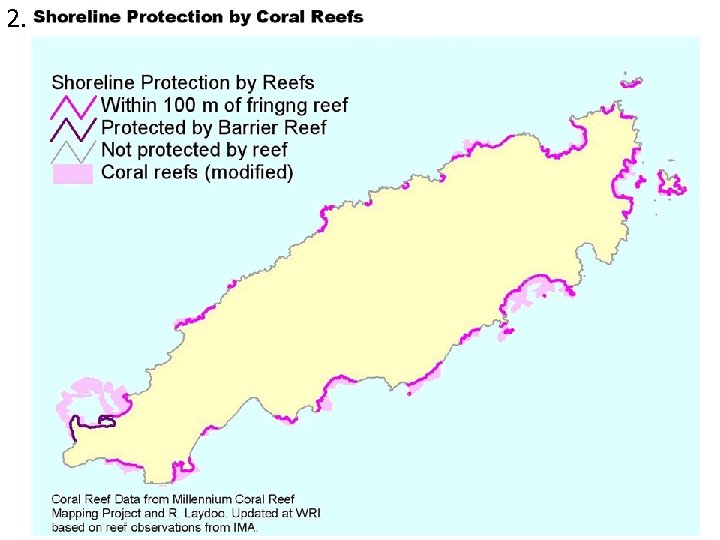
2. Reef Protection 0 Not protected by reef 51% 2 Within 100 m of fringing reef 45% 3 Protected by Barrier Reef 4%
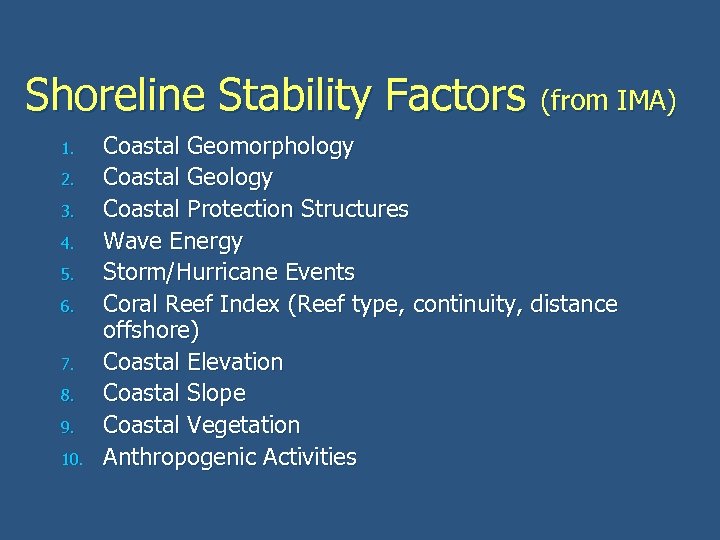
Shoreline Stability Factors (from IMA) 1. 2. 3. 4. 5. 6. 7. 8. 9. 10. Coastal Geomorphology Coastal Geology Coastal Protection Structures Wave Energy Storm/Hurricane Events Coral Reef Index (Reef type, continuity, distance offshore) Coastal Elevation Coastal Slope Coastal Vegetation Anthropogenic Activities
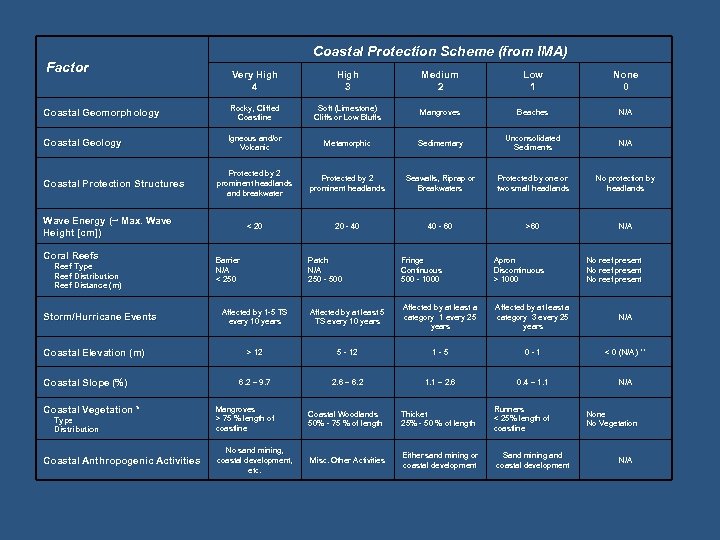
Factor Coastal Protection Scheme (from IMA) Very High 4 High 3 Medium 2 Low 1 None 0 Coastal Geomorphology Rocky, Cliffed Coastline Soft (Limestone) Cliffs or Low Bluffs Mangroves Beaches N/A Coastal Geology Igneous and/or Volcanic Metamorphic Sedimentary Unconsolidated Sediments N/A Protected by 2 prominent headlands and breakwater Protected by 2 prominent headlands Seawalls, Riprap or Breakwaters Protected by one or two small headlands No protection by headlands < 20 20 - 40 40 - 60 >60 N/A Coastal Protection Structures Wave Energy (~ Max. Wave Height [cm]) Coral Reefs Reef Type Reef Distribution Reef Distance (m) Storm/Hurricane Events Coastal Elevation (m) Coastal Slope (%) Coastal Vegetation * Type Distribution Coastal Anthropogenic Activities Barrier N/A < 250 Patch N/A 250 - 500 Fringe Continuous 500 - 1000 Apron Discontinuous > 1000 No reef present Affected by 1 -5 TS every 10 years Affected by at least a category 1 every 25 years Affected by at least a category 3 every 25 years N/A > 12 5 - 12 1 - 5 0 - 1 < 0 (N/A) ** 6. 2 – 9. 7 2. 6 – 6. 2 1. 1 – 2. 6 0. 4 – 1. 1 N/A Mangroves > 75 % length of coastline Coastal Woodlands 50% - 75 % of length Thicket 25% - 50 % of length Runners < 25% length of coastline No sand mining, coastal development, etc. Misc. Other Activities Either sand mining or coastal development Sand mining and coastal development None No Vegetation N/A
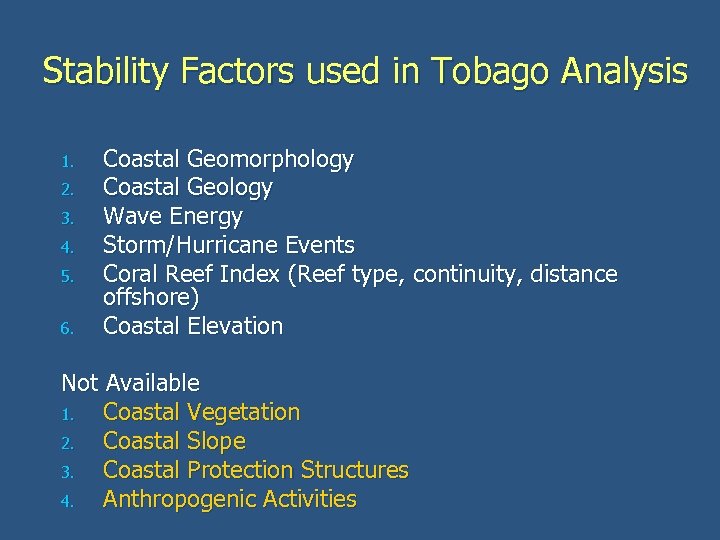
Stability Factors used in Tobago Analysis 1. 2. 3. 4. 5. 6. Coastal Geomorphology Coastal Geology Wave Energy Storm/Hurricane Events Coral Reef Index (Reef type, continuity, distance offshore) Coastal Elevation Not Available 1. Coastal Vegetation 2. Coastal Slope 3. Coastal Protection Structures 4. Anthropogenic Activities
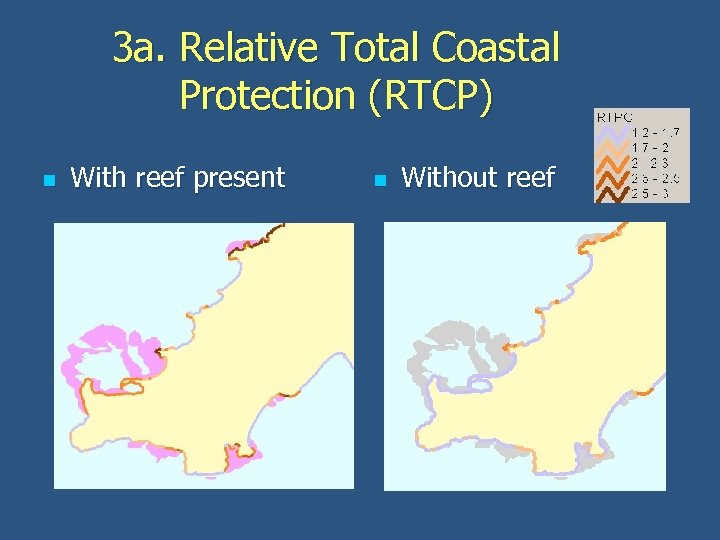
3 a. Relative Total Coastal Protection (RTCP) n With reef present n Without reef
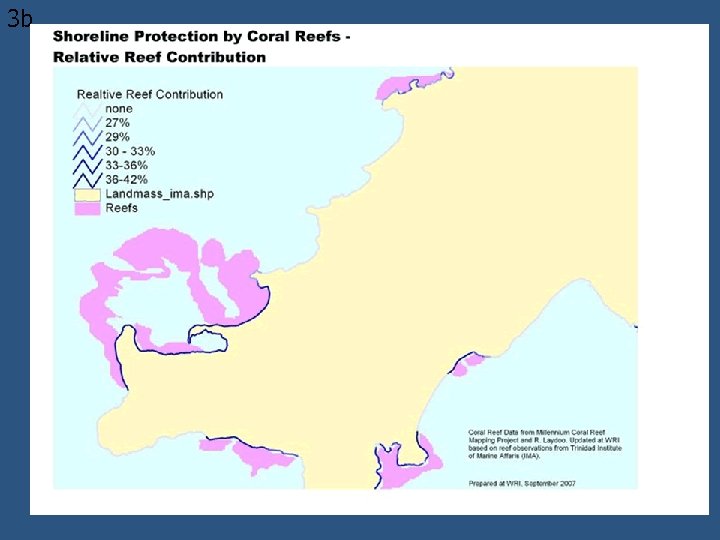
3 b.
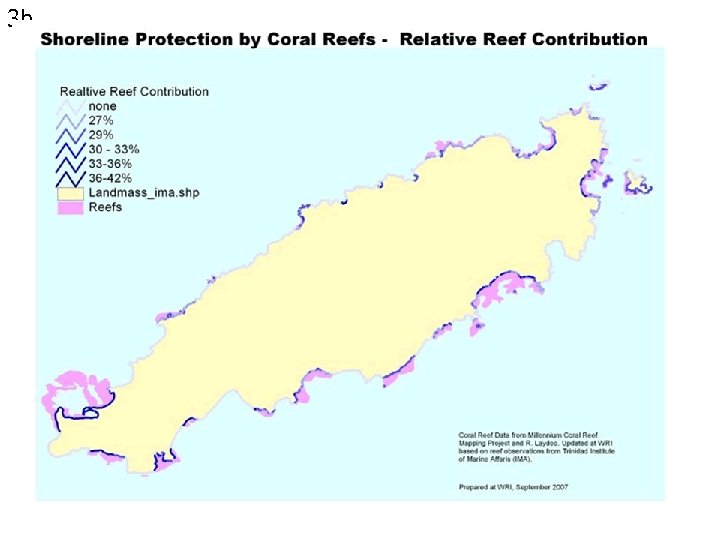
3 b.
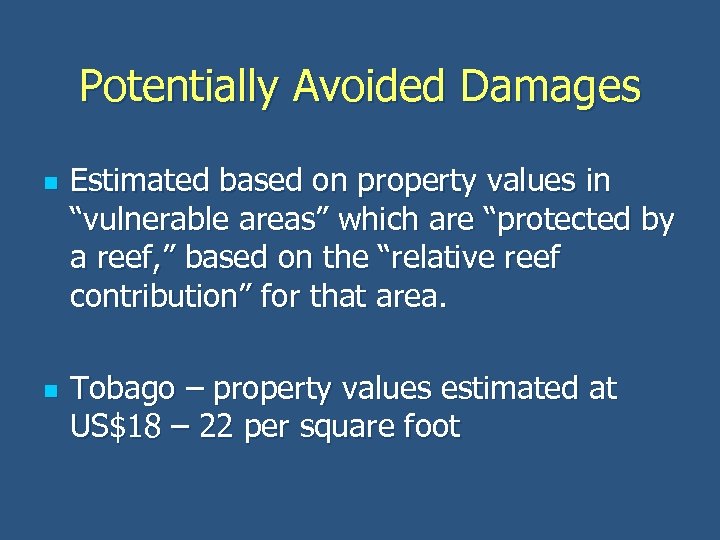
Potentially Avoided Damages n n Estimated based on property values in “vulnerable areas” which are “protected by a reef, ” based on the “relative reef contribution” for that area. Tobago – property values estimated at US$18 – 22 per square foot
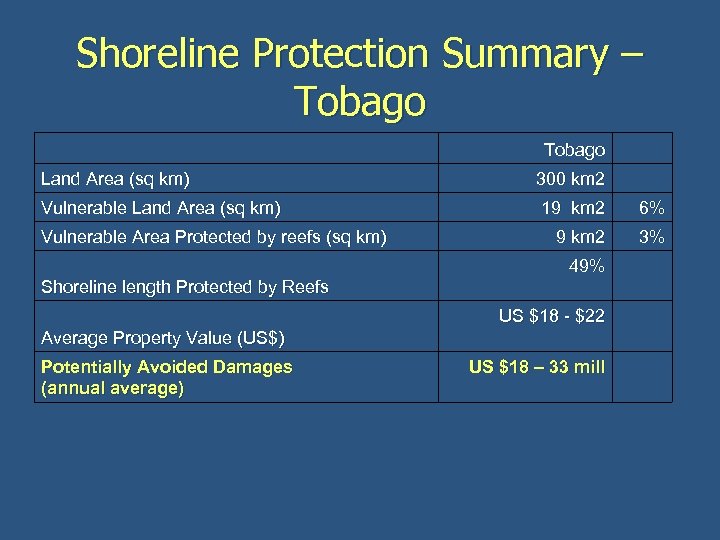
Shoreline Protection Summary – Tobago Land Area (sq km) 300 km 2 Vulnerable Land Area (sq km) 19 km 2 6% 9 km 2 3% Vulnerable Area Protected by reefs (sq km) 49% Shoreline length Protected by Reefs Average Property Value (US$) Potentially Avoided Damages (annual average) US $18 - $22 US $18 – 33 mill
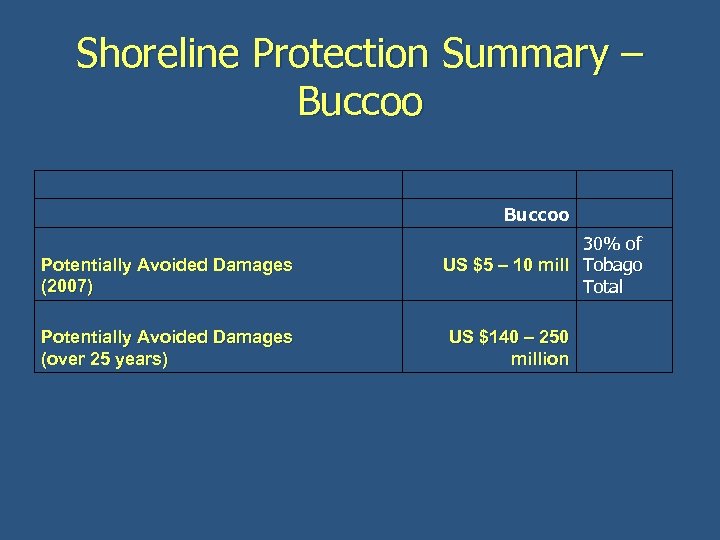
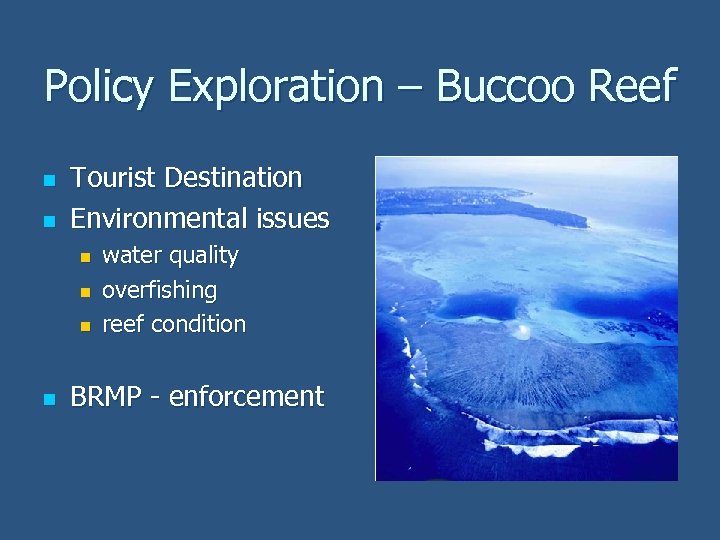
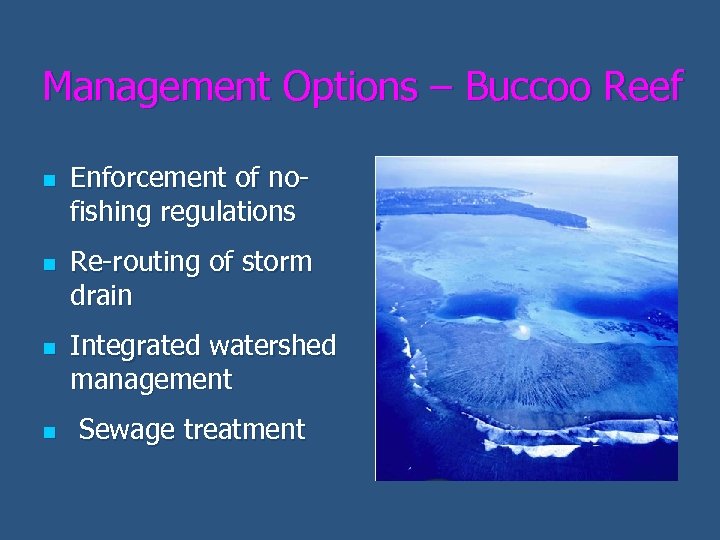
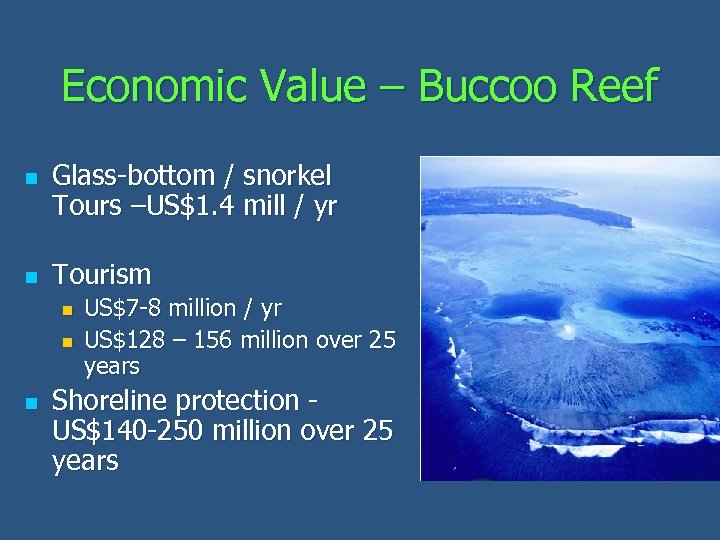
Shoreline Protection Summary – Buccoo Potentially Avoided Damages (2007) Potentially Avoided Damages (over 25 years) 30% of US $5 – 10 mill Tobago Total US $140 – 250 million
Summary of Values for Tobago Coral Reef-associated : Tourism and Recreation – Total Direct Impact Tourism and Recreation – Total economic Impact $100 – 130 million Fisheries – economic Impact ~ $1 million Shoreline Protection Services ($US million / yr) $43. 5 million $18 – 33 million
Policy Exploration – Buccoo Reef n n Tourist Destination Environmental issues n n water quality overfishing reef condition BRMP - enforcement
Management Options – Buccoo Reef n n Enforcement of nofishing regulations Re-routing of storm drain Integrated watershed management Sewage treatment
Economic Value – Buccoo Reef n n Glass-bottom / snorkel Tours –US$1. 4 mill / yr Tourism n n n US$7 -8 million / yr US$128 – 156 million over 25 years Shoreline protection US$140 -250 million over 25 years
Policy Recommendations for Tobago n n n Improve coastal water quality Maintain coastal mangroves Establish an entrance fee to BRMP and use revenue for park management Monitor marine recreation and manage within sustainable limits Improve mapping and monitoring of coral reefs and mangroves
Policy Recommendations for Tobago (continued) n n n Improve fishing survey design, data collection and information management at THA to allow tracking of fishing effort and catch over time Monitor sea turtle populations – manage sustainably Use the coral reef valuation methodology and Tool to track the economic contribution of coral reefs over time
Available online at www. buccooreef. org and www. wri. org/project/valuation-caribbean-reefs Contacts: WRI –Lauretta Burke, +1 (202) 729 7774, lauretta@wri. org BRT – Hyacinth Armstrong, +868 635 2000, h. armstrong@buccooreef. org IMA – Sean Paddy, (868) 634 4291 x 405, spaddy@ima. gov. tt
Скачать презентацию Economic Valuation of Coral Reefs in Tobago
f5fcab6f1f424c63e6a08a82238c7a77.ppt