


 Скачать презентацию Economic Systems 1 Four Economic Systems An
91c7a3f44a933b21d95242bf91a22a74.ppt
- Количество слайдов: 62
 Economic Systems 1
 Four Economic Systems An economic system is the method used by a society to produce and distribute goods and services. Which system to use, depends on that society’s goals and values Because resources are limited, societies must answer 3 questions 2
 Question # 1 l What goods and services should be produced? l Guns or butter (should resources be used for national defense, education, public health, welfare and consumer goods) 3
 Question # 2 l How should goods and services be produced? l Produce electricity and energy with oil, wind, solar or nuclear power? l Should food be produced on large corporate farms, or small dairy farms? 4
 Question # 3 l Who consumes goods and services? l Who gets to buy a new luxury car and who can only afford a bus or subway pass l Who attends concerts and sporting events and who stays home? l Who eats a healthy, well balanced diet daily and who eats hot dogs and mac & cheese for every meal l Who gets access to a good education and who is unable to attend college? 5
 Question # 3 Cont… l This question is answered by how societies choose to distribute income. l FACTOR PAYMENTS: are the income people receive for supplying factors of production, land, labor and capital, or entrepreneurship l Each society answers this question based on its combination of social values and goals 6
 Economic Goals & Societal Values l 1. ) Economic Efficiency: l Because resources are scarce, most societies try to maximize what they can get for the resources they have to work with. l Example = VCR tapes Vs. DVD’s Original Nintendo Vs. Nintendo Wii 7
 Goals and Values Cont… l 2. ) Economic Freedom: l Laws that keep you from earning an income l Laws that forbid you from making certain purchases or possessing certain items. l Americans freedoms enjoy a variety of economic l Freedom from government intervention in the production of goods and services, unless the government needs to give assistance. 8
 Goals and Values Cont… l 3. ) Economic Security and Predictability: l Goods and services are available when we need them and our paychecks too. (Milk and bread will be in the store for us to purchase) l. A Safety Net is available by the gov’t to protect people experiencing unfavorable economic conditions l Example disasters = injuries, layoffs and natural 9
 Goals and Values Cont… l 4. ) Economic Equity l Should everyone get the same amount of income, goods and services? l Many people believe in equal pay for equal work, but society does not value each job equally. Most lawyers earn more than nurses. Most computer programmers earn more than truck drivers. CEO’s in 1 year earn more than their employees in a lifetime l How do we provide for the ill who are not able to work? 10
 Goals and Values Cont… l 5. ) Economic Growth and Innovation: l Standard of Living: level of economic prosperity l Innovation leads to economic growth, and economic growth leads to a better standard living. l If a country’s population is growing, the economy must grow to provide jobs and income for people. l l Example = Phoenix, Las Vegas, California (The U. S. in general) Innovation in technology increases the efficiency of production and ushers in new goods and services. l Example = Computers/Internet , Cell Phones, IPods 11
 Goals and Values Cont… l Four different economic systems have developed to address the three key economic questions. Each of the four economic systems reflects a different prioritization of economic goals. It also reflects the values of the societies in which these systems are present l l 1. Traditional Economies 2. Market Economies 3. Centrally Planned / Command Economies 4. Mixed Economies 12
 Traditional Economies relies on habit, custom, or ritual to decide what to produce, how to produce it, and to whom to distribute it. 13
 Traditional Economy Cont… l l l l There is little room for innovation or change Revolves around the family Work tends to be divided along gender lines. Boys take up occupations of their fathers, girls of their mothers. Communities that stay relatively close and small Societies that work to support and entire group Agricultural and hunting lie at the heart of people’s lives, laws and religious beliefs Communities have a low standard of living 14
 Market Economy An economic system in which decisions are made by individuals (consumers) and are based on exchange, or trade. Examples = Free Markets / Capitalism (No 1 country is a pure free market economy) The choices made by individuals determine what gets made and how, as well as who consumes the goods and services produced. 15
 Command Economy A system in which the central government makes all decisions about the production and consumption of goods and services. The Central gov’t answers all 3 questions Example = Communist / Socialist 16
 Mixed Economy are systems that combine tradition and the free market with limited government intervention. Example = The United States and most modern economies 17
 Section 1 Questions l What key economic questions must every society answer? l What basic economic goals do societies have? l What types of economic systems exist today? 18
 Section 1 Review 1. How do a traditional, market, command mixed economy differ? 2. Why aren’t all people paid the same amount in factor payments for the resources they provide? Should standards be adopted? If so, who determines them? 3. Why do gov’ts provide safety nets for it’s citizens? 19
 Section 1 Review 1. Each society determines who will consume what is produced based on A) its unique combination of social values and goals. B) the amount of factor payments. C) its needs and wants. D) economic equity. 2. Which of these is a key economic question faced by countries? A) how big should the army be B) how much money should be raised in taxes C) how many schools should be built D) what goods and services should be produced 20
 Section 1 Review 3. To improve its standard of living, a nation’s economy must A) remain stable. B) grow through innovation. C) reach economic equity. D) allow the central gov’t to make economic decisions. 4. In a traditional economy, economic decisions are based largely on: A) custom B) science C) socialism D) technology 21
 Section 1 Review 5. Which of the following is characteristic of a traditional economy? A) communities tend to be fast growing B) they’re based on light industrial production C) they have a high standard of living D) children tend to have the same job as their parents 6. What is the function of an economic system? A) to make sure all people have equal access to goods B) to produce and distribute goods and services C) to give all producers the same access to consumers 22 D) to make sure people are paid for their labor
 Why Do Markets Exist? Markets exist because none of us produce all the goods and services we require to satisfy our needs and wants. A nurse specializes in caring for the sick, a mechanic specializes in building machinery. A baker specializes in making bread, cakes and cookies l A market is an arrangement that allows buyers and sellers to exchange goods and services. Specialization is the concentration of the productive efforts of individuals and firms on a limited number of activities. 23
 The Free Market Economy In a free market economy, households and business firms use markets to exchange money and products. 24
 Free Market • In a free market system, individuals own the factors of production, make what they want, and buy what they want. In other words, individuals answer the three key economic questions of what to produce, how to produce it, and who consumes that which is produced. 25
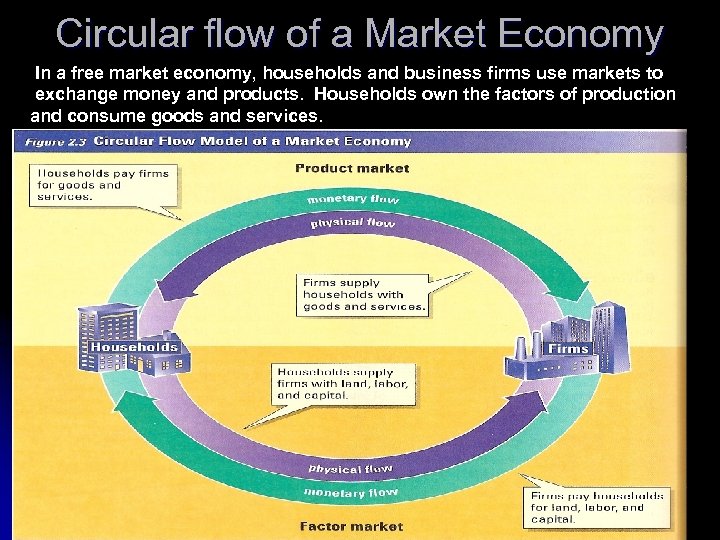 Circular flow of a Market Economy In a free market economy, households and business firms use markets to exchange money and products. Households own the factors of production and consume goods and services. 26
 House Holds & Firms l Household = Players in the free market economy, which consist of a person or group of people living in the same residence. l Households own the factors of production l Households are also the consumers of goods and services l Firm = business/organization that uses resources to produce a product, which it then sells. Firms transform “inputs, ” or factors of production, into “outputs, ” or products. Firms purchase factors of production from households 27
 Factor Market l Factor Market = Area of exchange between households and firms. Firms purchase or rent land (natural resources), they hire workers, paying them wages or salaries for their labor. Firms borrow money from households to buy capital paying households interest or profit in return. l Profit = financial gain made in a transaction. 28
 Product Market l Product Market = Goods and services that firms produce are purchased by households. l Households purchase the products made by firms with the money they received from firms in the factor market 29
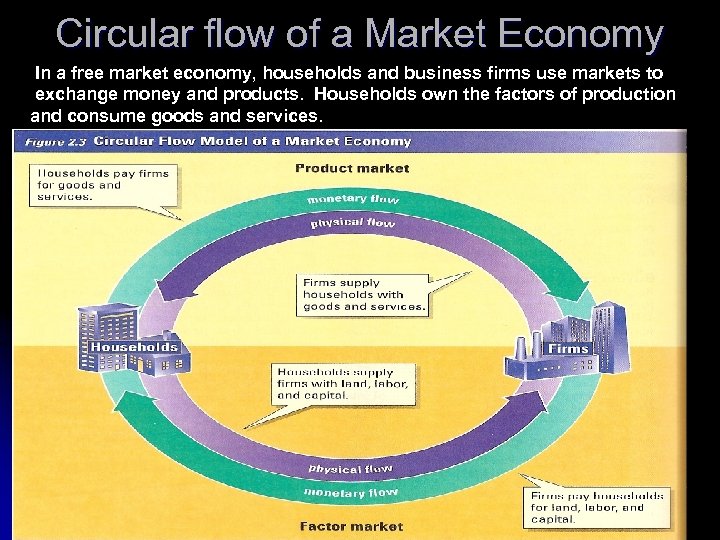 Circular flow of a Market Economy In a free market economy, households and business firms use markets to exchange money and products. Households own the factors of production and consume goods and services. 30
 The Market’s Self-Regulating Nature l In every transaction, the buyer and seller consider only their self-interest, or their own personal gain. Self-interest is the motivating force in the free market. 31
 Self Regulating Nature l Consumers (households) in pursuit of their self-interest have the incentive to look for lower prices. Incentive = the hope of reward or the fear of punishment that encourages a person to behave in a certain way 32
 The Market’s Self-Regulating Nature l Producers in a free market struggle for the dollars of consumers. This is known as competition, and is the regulating force of the free market. 33
 The Market’s Self-Regulating Nature The interaction of buyers and sellers, motivated by self -interest and regulated by competition, all happens without a central plan. This phenomenon is called “the invisible hand of the marketplace. ” 34
 Advantages of the Free Market Economic Efficiency l. As a self-regulating system, a free market economy is efficient. l. Producers make only what consumers want, when they want it and generally at prices they are willing to pay Economic Freedom l. Free market economies have the highest degree of econom freedom of any economic system. • This includes the freedom of workers to work where they want, or firms to produce what they want and consumers 35 To purchase what they want
 Advantages of the Free Market Economic Growth l. Because competition encourages innovation, free markets encourage growth. Additional Goods l. Free markets offer a wider variety of goods and services than any other economic system. 36
 SECTION 2 The Free Market l How do free markets operate? l How can markets regulate themselves? l What are the advantages of a free market economy? 37
 Section 2 Review 1. Why do people need to buy and sell goods or services? A) People need to buy and sell goods to make a profit. B) People buy and sell to maintain a competitive society. C) No one is self-sufficient. D) People need to provide the market with goods and services. 2. Markets allow us to? A) get the highest prices for what we sell B) get the lowest prices for what we buy C) sell the most goods we possibly can D) exchange things we have for the things we need 38
 Section 2 Review 3. What factors create the phenomenon of the “invisible hand”? A) incentives and efficiency B) specialization and efficiency C) competition between firms D) competition and self-interest 4. Competition and self interest are two important forces in: A) free market economies B) traditional economies C) centrally planned economies D) communist economies 39
 Section 2 Review 5. What is the purpose of competition? A) to act as a regulating force in the marketplace B) to cause producers to attempt to put each other out of business C) to cause buyers to have to be careful about spending their money D) to act as the motivating force behind the free market 6. What is the product market? A) the market in which payments are received for selling products to consumers B) the market in which income is received for supplying land, labor or capital C) the market in which firms purchase the factors of production from households D) the market in which households purchase the goods and services that 40 firms produce
 Section 2 Review 7. What is an important advantage of the a free market? A) it does not change unless the government directs it B) it offers a wide variety of goods and services C) it is easy to regulate D) it protects the less fortunate 41
 Centrally Planned Economies l Centrally planned economies operate in direct contrast (opposite) to free market systems. l Centrally planned economies oppose private property, free market pricing, competition and consumer choice 42
 Organization of Centrally Planned Economies l 1. In a centrally planned economy, the central government owns the land capital. The government decides what to produce, how much to charge who gets what, and where people will work. l 2. After collecting information, bureaucrats (government leaders) tell each firm what and how much to produce. It is up to the bureaucrat to ensure that each firm has enough raw materials and workers to meet production goals. 43
 Organization of Centrally Planned Economies l 3. The central government owns the labor by controlling where individuals work and what wages they are paid. 4. Once production quota is met, there is no reason to produce more goods. Workers have little incentive to work harder or to be innovative 44
 Organization of Centrally Planned Economies Socialism is a social and political philosophy based on the belief that democratic means should be used to distribute wealth evenly throughout a society. Communism is a political system characterized by a centrally planned economy with all economic and political power resting in the hands of the government. 45
 The Former Soviet Union l Soviet Agriculture l In the Soviet Union, the government created large state-owned farms and collectives for most of the country’s agricultural production. l Soviet Industry l Soviet planners favored heavy-industry production (such as steel and machinery), over the production of consumer goods. l Soviet Consumers l Consumer goods in the Soviet Union were scarce and usually of poor quality. 46
 The Former Soviet Union l Soviet Producers l Manufactures had the incentive to focus on quantity, not quality. l EXAMPLE = a manufacturer assigned to produce a certain number of suits could loosely stitch the buttons and mismatch coats and trousers. Still, the state store had to accept delivery of the suits and the consumers would be left with no alternative 47
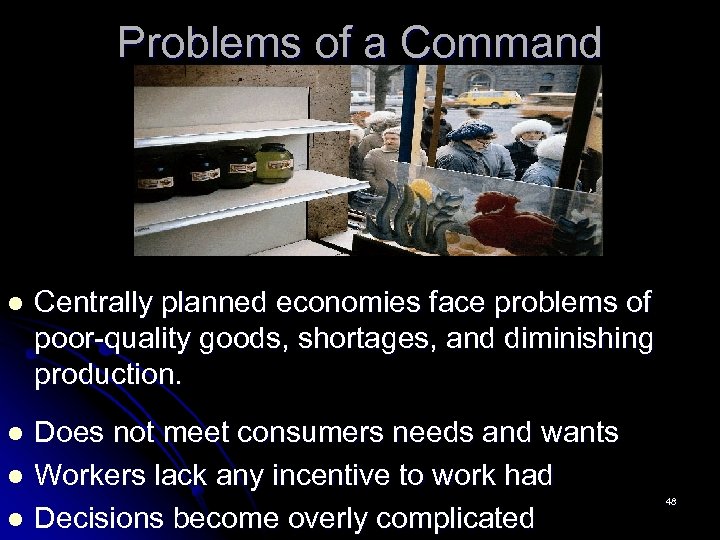 Problems of a Command Economy l Centrally planned economies face problems of poor-quality goods, shortages, and diminishing production. Does not meet consumers needs and wants l Workers lack any incentive to work had l Decisions become overly complicated l 48
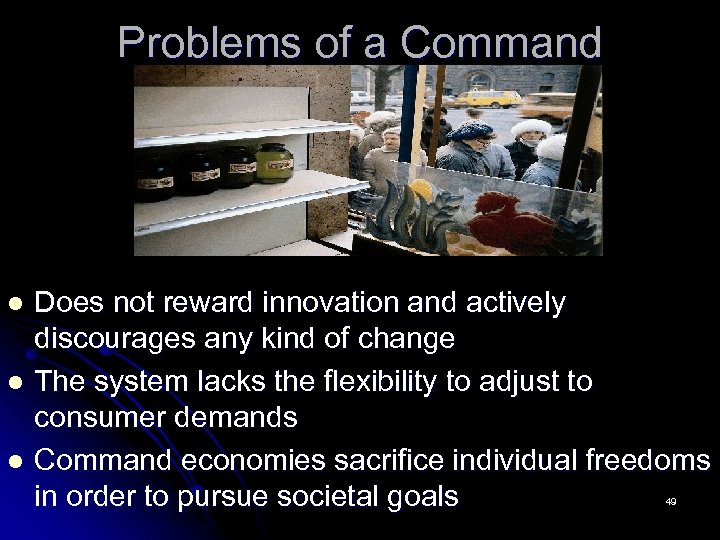 Problems of a Command Economy Does not reward innovation and actively discourages any kind of change l The system lacks the flexibility to adjust to consumer demands l Command economies sacrifice individual freedoms in order to pursue societal goals l 49
 Centrally Planned Economies l How are centrally planned economies organized? l How did the centrally planned economy of the former Soviet Union function? l What problems exist within centrally planned economies? 50
 The Rise of Mixed Economies Today, most economies are a mixture of economic systems. Most mixed economies blend the free market with government intervention, or involvement in the market place. Market economies, with all their advantages, have certain drawbacks. 51
 The NEED for Gov’t Intervention Laissez faire is the doctrine that government generally should not interfere in the marketplace. Government intervention has become necessary because some needs and wants of modern society are difficult to answer in the marketplace. EXAMPLE = how well could the market provide for the following: national defense, interstate highway system, education, health care & public transportation? 52
 The NEED for Gov’t Intervention Governments create laws protecting property rights and enforcing contracts. They also encourage innovation through patent laws. Without laws insisting on competition, many people fear that some firms will dominate others in their industry and be able to charge consumers any price (monopoly) 53
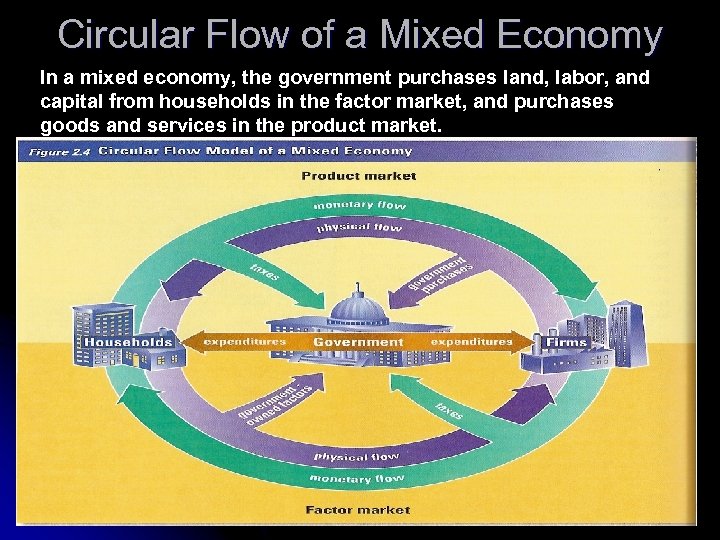 Circular Flow of a Mixed Economy In a mixed economy, the government purchases land, labor, and capital from households in the factor market, and purchases goods and services in the product market. 54
 Gov’t in the Factor Market l Just like businesses, the gov’t purchases land, labor and capital from households in the factor market l Example = The U. S. government pays 2. 8 million employees $9. 7 billion a year for labor l The U. S. government provided $700 billion in bailout money in 2008 and an expected $800 billion in 2009 to support the economy. 55
 Gov’t in the Product Market l Governments purchase goods and services in the product market. They needs buildings and office supplies, telephones and computers l EXAMPLE = l The U. S. government provided $700 billion in bailout money in 2008 and an expected $800 billion in 2009 to support the economy. l The federal, state and local governments in the U. S. provide over 4 million miles of roads 56
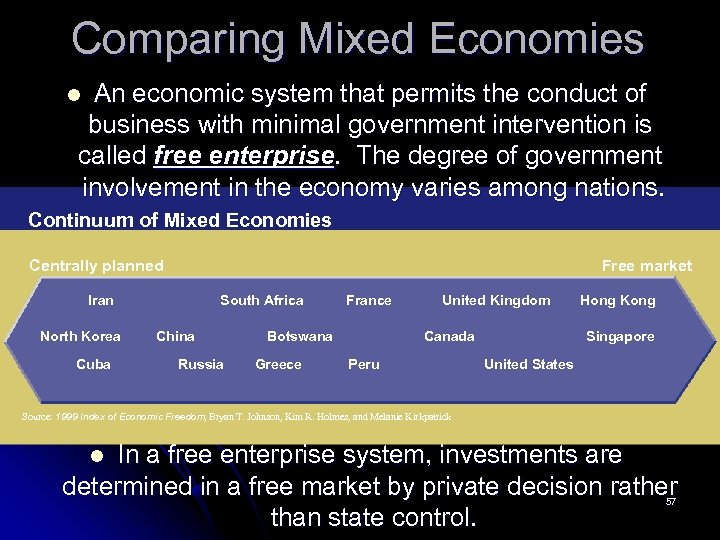 Comparing Mixed Economies An economic system that permits the conduct of business with minimal government intervention is called free enterprise. The degree of government involvement in the economy varies among nations. l Continuum of Mixed Economies Centrally planned Free market Iran North Korea Cuba South Africa China Russia France Botswana Greece United Kingdom Canada Peru Hong Kong Singapore United States Source: 1999 Index of Economic Freedom, Bryan T. Johnson, Kim R. Holmes, and Melanie Kirkpatrick In a free enterprise system, investments are determined in a free market by private decision rather than state control. l 57
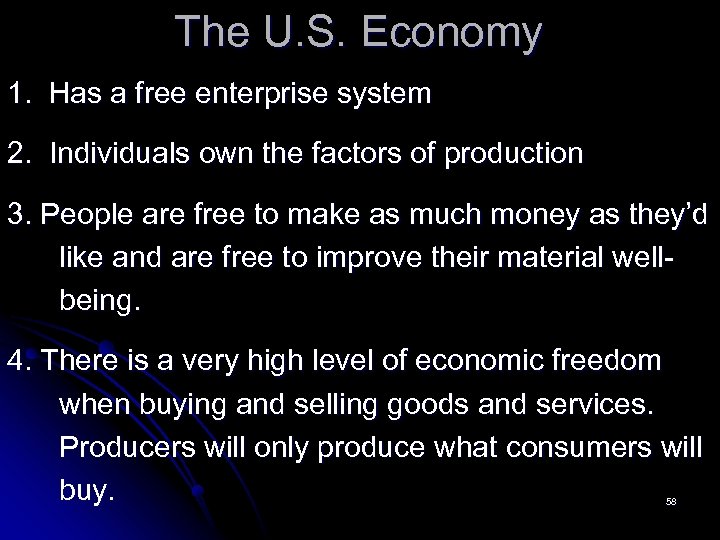 The U. S. Economy 1. Has a free enterprise system 2. Individuals own the factors of production 3. People are free to make as much money as they’d like and are free to improve their material wellbeing. 4. There is a very high level of economic freedom when buying and selling goods and services. Producers will only produce what consumers will buy. 58
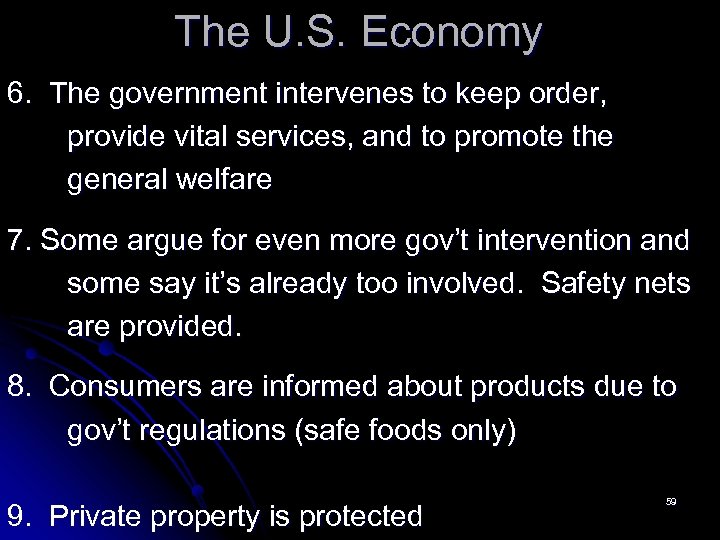 The U. S. Economy 6. The government intervenes to keep order, provide vital services, and to promote the general welfare 7. Some argue for even more gov’t intervention and some say it’s already too involved. Safety nets are provided. 8. Consumers are informed about products due to gov’t regulations (safe foods only) 9. Private property is protected 59
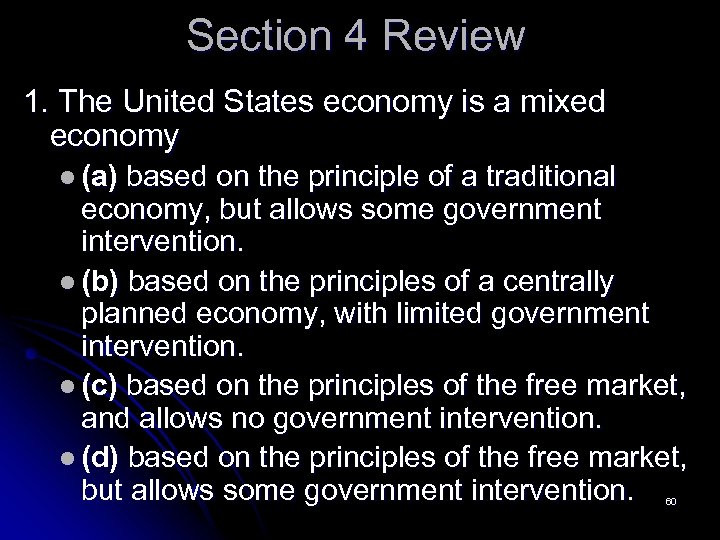 Section 4 Review 1. The United States economy is a mixed economy l (a) based on the principle of a traditional economy, but allows some government intervention. l (b) based on the principles of a centrally planned economy, with limited government intervention. l (c) based on the principles of the free market, and allows no government intervention. l (d) based on the principles of the free market, but allows some government intervention. 60
 Section 4 Review 2. Government intervention in a modern economy is useful because l (a) the needs and wants of modern society are always met by the marketplace. l (b) the marketplace has many incentives to create public goods such as parks and libraries. l (c) governments are able to provide some goods and services that the marketplace has no incentive to produce. l (d) the marketplace provides all of its own laws. 61
 Modern Economies Why are many modern economies mixed economies? l What role does the government play in a mixed economy? l How do mixed economies in different countries compare? l What role does free enterprise play in the United States economy? l 62