 Скачать презентацию Economic Renaissance Megapower Middle East VICTOR CONFERENCE Baden
8ac1fff8849b92e4e27aef6caa4d64e0.ppt
- Количество слайдов: 42



Economic Renaissance: Megapower Middle East VICTOR CONFERENCE Baden, Austria 18 September 2008 Dr Nasser Al Saidi Chief Economist Dubai International Financial Center Authority
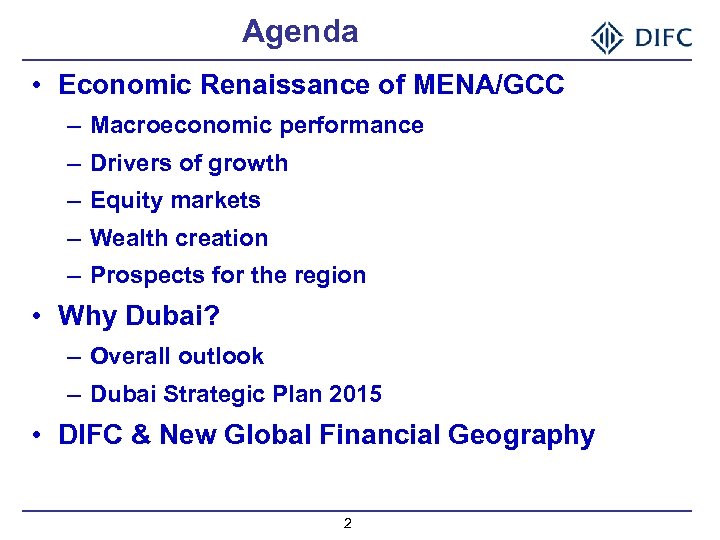
Agenda • Economic Renaissance of MENA/GCC – Macroeconomic performance – Drivers of growth – Equity markets – Wealth creation – Prospects for the region • Why Dubai? – Overall outlook – Dubai Strategic Plan 2015 • DIFC & New Global Financial Geography 2
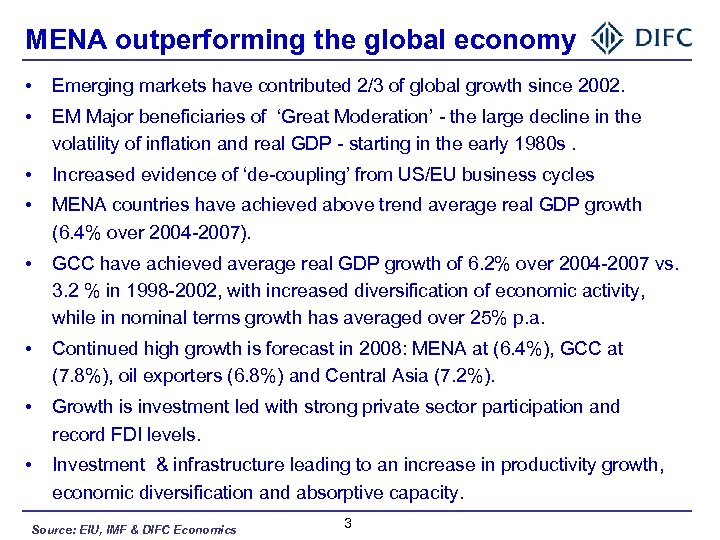
MENA outperforming the global economy • Emerging markets have contributed 2/3 of global growth since 2002. • EM Major beneficiaries of ‘Great Moderation’ - the large decline in the volatility of inflation and real GDP - starting in the early 1980 s. • Increased evidence of ‘de-coupling’ from US/EU business cycles • MENA countries have achieved above trend average real GDP growth (6. 4% over 2004 -2007). • GCC have achieved average real GDP growth of 6. 2% over 2004 -2007 vs. 3. 2 % in 1998 -2002, with increased diversification of economic activity, while in nominal terms growth has averaged over 25% p. a. • Continued high growth is forecast in 2008: MENA at (6. 4%), GCC at (7. 8%), oil exporters (6. 8%) and Central Asia (7. 2%). • Growth is investment led with strong private sector participation and record FDI levels. • Investment & infrastructure leading to an increase in productivity growth, economic diversification and absorptive capacity. Source: EIU, IMF & DIFC Economics 3
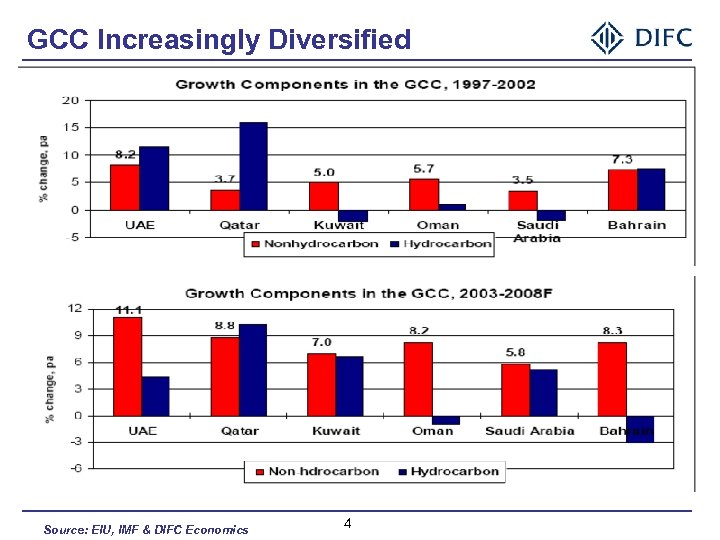
GCC Increasingly Diversified Source: EIU, IMF & DIFC Economics 4
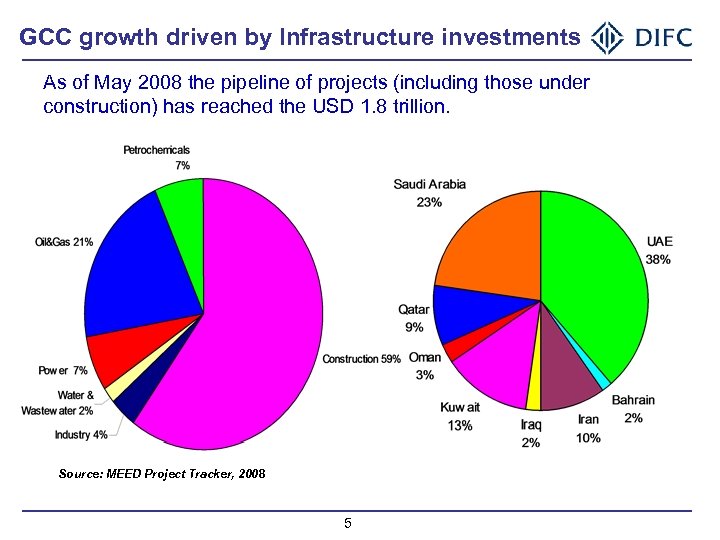
GCC growth driven by Infrastructure investments As of May 2008 the pipeline of projects (including those under construction) has reached the USD 1. 8 trillion. Source: MEED Project Tracker, 2008 5
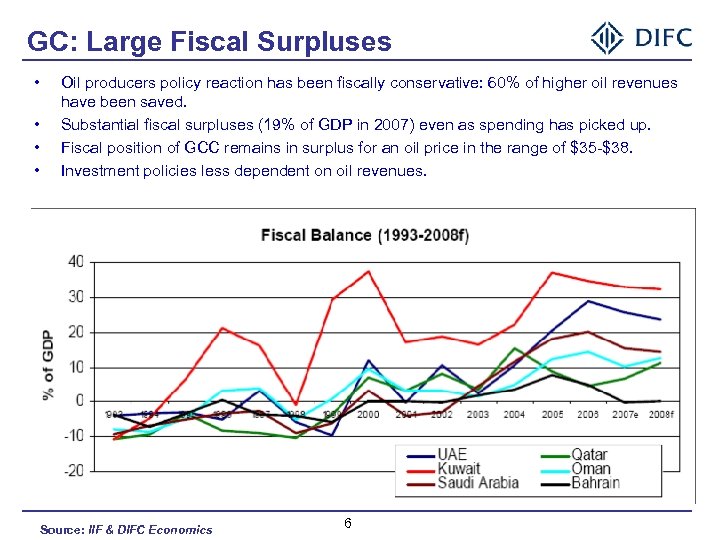
GC: Large Fiscal Surpluses • • Oil producers policy reaction has been fiscally conservative: 60% of higher oil revenues have been saved. Substantial fiscal surpluses (19% of GDP in 2007) even as spending has picked up. Fiscal position of GCC remains in surplus for an oil price in the range of $35 -$38. Investment policies less dependent on oil revenues. Source: IIF & DIFC Economics 6
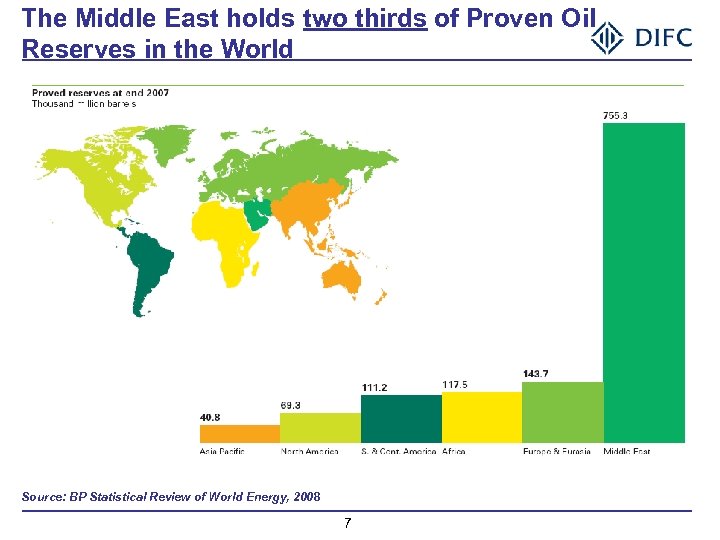
The Middle East holds two thirds of Proven Oil Reserves in the World Source: BP Statistical Review of World Energy, 2008 7
Increase in Wealth and Liquidity • Massive Wealth Creation – Value of oil reserves of GCC increased by about $24 trillion between 2001 and 2008. Analogously the value of gas reserves has increased by more than $7 trillion. – Oil revenues for the GCC countries increase by $4. 5 billion for every $1 increase in oil price. Likewise a $1 increase in natural gas prices (which represents a much larger percentage increase compared to a $1 increase in oil price) leads to a $5. 2 billion increase in revenues. • Increased liquidity resulted in an investment driven boom: – Real estate boom and asset price appreciation – Stock market boom • Financial wealth of high net worth individuals in the Middle East region is estimated to be growing at 17. 5% p. a. Source: EIU, IMF, BP & DIFC Economics 8
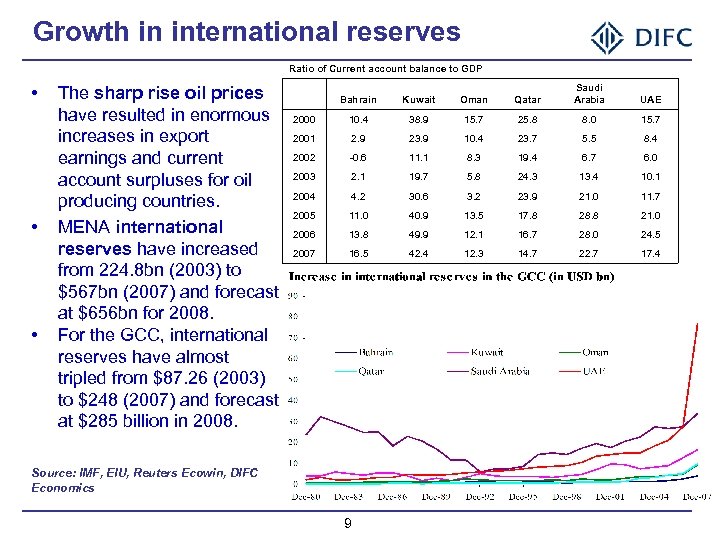
Growth in international reserves Ratio of Current account balance to GDP • • • The sharp rise oil prices have resulted in enormous increases in export earnings and current account surpluses for oil producing countries. MENA international reserves have increased from 224. 8 bn (2003) to $567 bn (2007) and forecast at $656 bn for 2008. For the GCC, international reserves have almost tripled from $87. 26 (2003) to $248 (2007) and forecast at $285 billion in 2008. Bahrain Kuwait Oman Qatar Saudi Arabia UAE 2000 10. 4 38. 9 15. 7 25. 8 8. 0 15. 7 2001 2. 9 23. 9 10. 4 23. 7 5. 5 8. 4 2002 -0. 6 11. 1 8. 3 19. 4 6. 7 6. 0 2003 2. 1 19. 7 5. 8 24. 3 13. 4 10. 1 2004 4. 2 30. 6 3. 2 23. 9 21. 0 11. 7 2005 11. 0 40. 9 13. 5 17. 8 28. 8 21. 0 2006 13. 8 49. 9 12. 1 16. 7 28. 0 24. 5 2007 16. 5 42. 4 12. 3 14. 7 22. 7 17. 4 Source: IMF, EIU, Reuters Ecowin, DIFC Economics 9
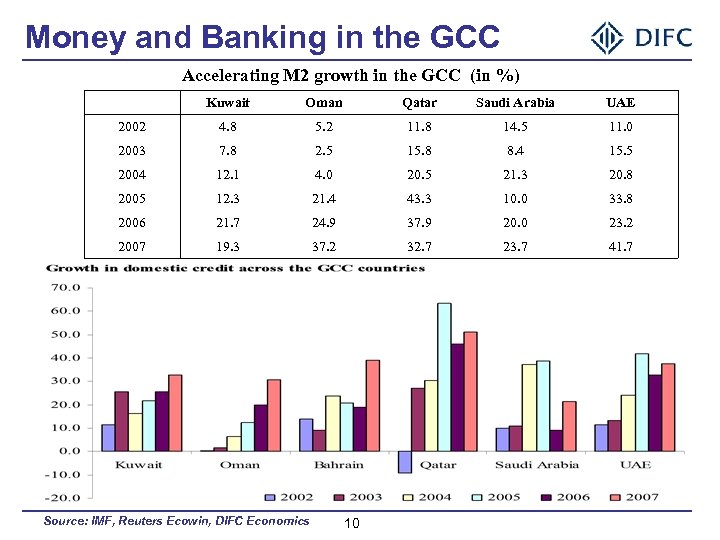
Money and Banking in the GCC Accelerating M 2 growth in the GCC (in %) Kuwait Oman Qatar Saudi Arabia UAE 2002 4. 8 5. 2 11. 8 14. 5 11. 0 2003 7. 8 2. 5 15. 8 8. 4 15. 5 2004 12. 1 4. 0 20. 5 21. 3 20. 8 2005 12. 3 21. 4 43. 3 10. 0 33. 8 2006 21. 7 24. 9 37. 9 20. 0 23. 2 2007 19. 3 37. 2 32. 7 23. 7 41. 7 Source: IMF, Reuters Ecowin, DIFC Economics 10
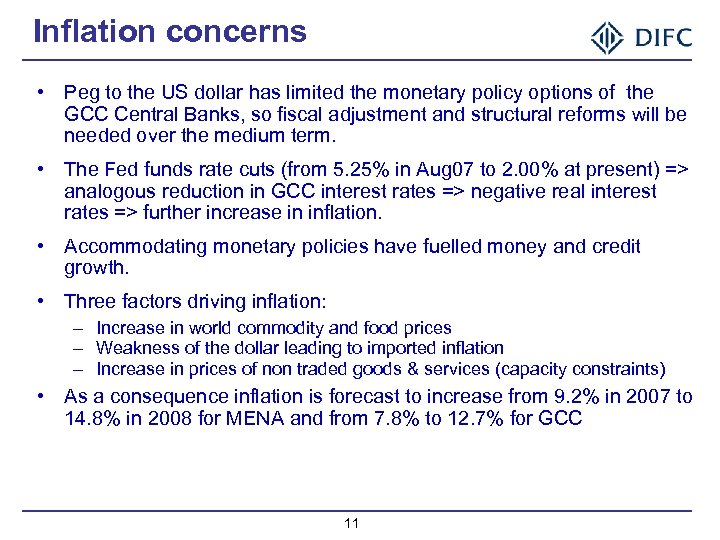
Inflation concerns • Peg to the US dollar has limited the monetary policy options of the GCC Central Banks, so fiscal adjustment and structural reforms will be needed over the medium term. • The Fed funds rate cuts (from 5. 25% in Aug 07 to 2. 00% at present) => analogous reduction in GCC interest rates => negative real interest rates => further increase in inflation. • Accommodating monetary policies have fuelled money and credit growth. • Three factors driving inflation: – Increase in world commodity and food prices – Weakness of the dollar leading to imported inflation – Increase in prices of non traded goods & services (capacity constraints) • As a consequence inflation is forecast to increase from 9. 2% in 2007 to 14. 8% in 2008 for MENA and from 7. 8% to 12. 7% for GCC 11
12
Prospects • GCC bloc emerging as economic and financial hub for MENASA region • Infrastructure development => greater economic & financial integration, increased absorptive capacity, economic/financial diversification • GCC Monetary Union and Gulf CB • GCC Common Currency can emerge as 3 rd global currency Bank • Management & Control of wealth: emergence of a new global financial geography 14
Why Dubai? Political and Economic stability v Government policies aimed at fostering economic diversification and liberalization v Rule of Law which provides safe and secure working and living environment Business Centric v Well recognized and growing financial hub with a successful and credible track record v 100% repatriation of capital and profit v Diversely skilled, well educated, multi cultural & multi lingual workforce v Modern infrastructure complying with the most efficient international standards. Investment in infrastructure has resulted in more efficient business environment, logistics and delivery of services v Modern telecommunication networks, high internet penetration (28% in Dubai vs. 17% in the MENA region including 2. 5 million mobile users for a population of 1. 5 million) v A destination of choice for FDI in the region: 18 companies out of top 50 in the Global Fortune 500 list such as GE, Citigroup, J. P. Morgan Chase, Samsung Electronic, Honda, Nissan, Siemens, HSBC, Deutsche Bank, Goldman Sachs & IBM have substantial operations in Dubai Source: Dubai Statistics & World Internet Usage Statistics, 2008; & Zawya Investor 15
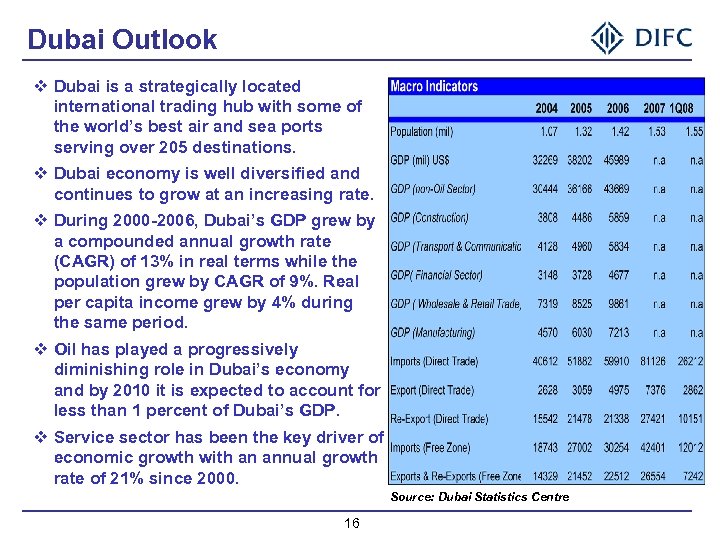
Dubai Outlook v Dubai is a strategically located international trading hub with some of the world’s best air and sea ports serving over 205 destinations. v Dubai economy is well diversified and continues to grow at an increasing rate. v During 2000 -2006, Dubai’s GDP grew by a compounded annual growth rate (CAGR) of 13% in real terms while the population grew by CAGR of 9%. Real per capita income grew by 4% during the same period. v Oil has played a progressively diminishing role in Dubai’s economy and by 2010 it is expected to account for less than 1 percent of Dubai’s GDP. v Service sector has been the key driver of economic growth with an annual growth rate of 21% since 2000. Source: Dubai Statistics Centre 16
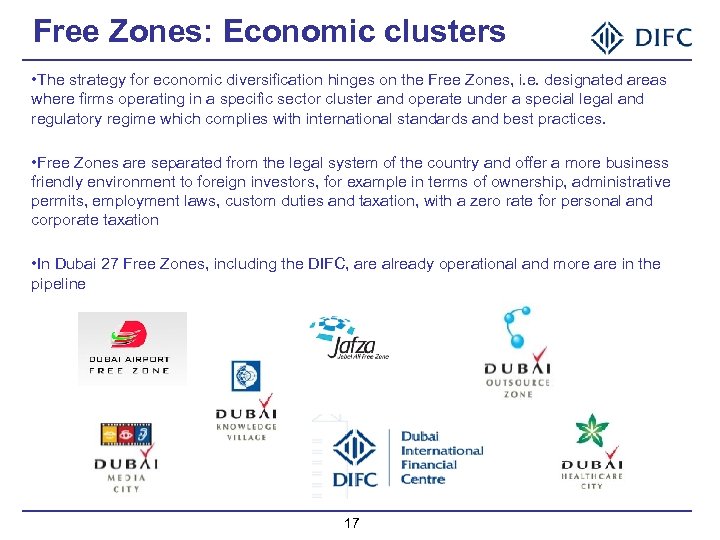
Free Zones: Economic clusters • The strategy for economic diversification hinges on the Free Zones, i. e. designated areas where firms operating in a specific sector cluster and operate under a special legal and regulatory regime which complies with international standards and best practices. • Free Zones are separated from the legal system of the country and offer a more business friendly environment to foreign investors, for example in terms of ownership, administrative permits, employment laws, custom duties and taxation, with a zero rate for personal and corporate taxation • In Dubai 27 Free Zones, including the DIFC, are already operational and more are in the pipeline 17
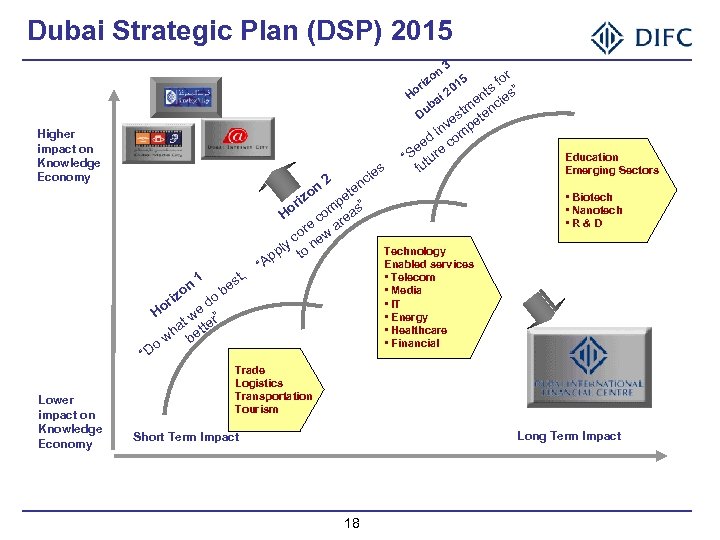
Dubai Strategic Plan (DSP) 2015 3 r on 15 fo ” riz 0 ts s Ho ai 2 en cie b tm n Du es te Higher impact on Knowledge Economy 1 t, es b 2 en et p ” r Ho com reas re a co new ply to p n izo on ies c “A o d e t w ter” a t wh be o iz r Ho “D Lower impact on Knowledge Economy e v in omp d ee re c “S tu fu Education Emerging Sectors • Biotech • Nanotech • R&D Technology Enabled services • Telecom • Media • IT • Energy • Healthcare • Financial Trade Logistics Transportation Tourism Long Term Impact Short Term Impact 18
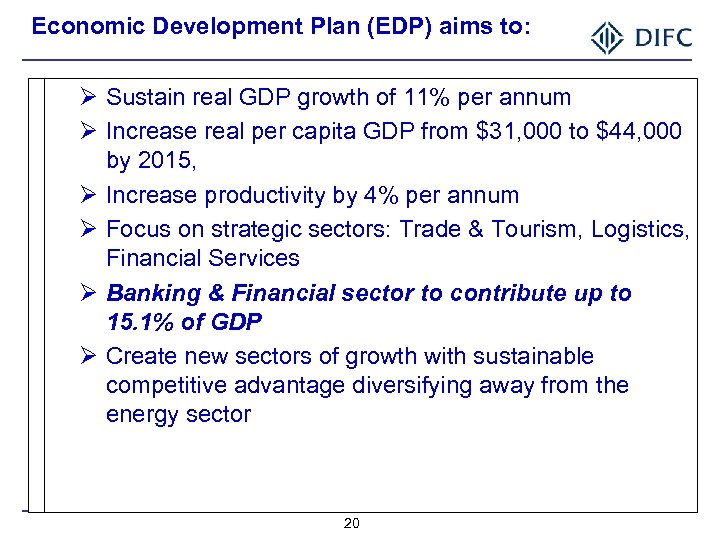
Economic Development Plan (EDP) aims to: Ø Sustain real GDP growth of 11% per annum Ø Increase real per capita GDP from $31, 000 to $44, 000 by 2015, Ø Increase productivity by 4% per annum Ø Focus on strategic sectors: Trade & Tourism, Logistics, Financial Services Ø Banking & Financial sector to contribute up to 15. 1% of GDP Ø Create new sectors of growth with sustainable competitive advantage diversifying away from the energy sector 20
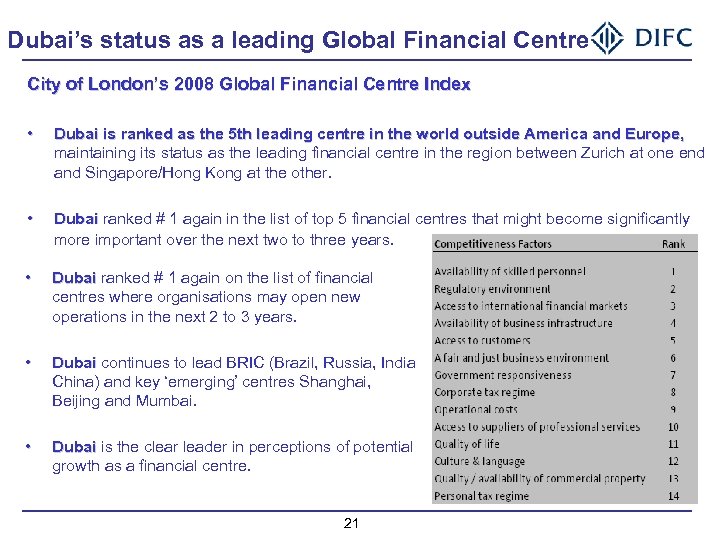
Dubai’s status as a leading Global Financial Centre City of London’s 2008 Global Financial Centre Index • Dubai is ranked as the 5 th leading centre in the world outside America and Europe, maintaining its status as the leading financial centre in the region between Zurich at one end and Singapore/Hong Kong at the other. • Dubai ranked # 1 again in the list of top 5 financial centres that might become significantly more important over the next two to three years. • Dubai ranked # 1 again on the list of financial centres where organisations may open new operations in the next 2 to 3 years. • Dubai continues to lead BRIC (Brazil, Russia, India China) and key ‘emerging’ centres Shanghai, Beijing and Mumbai. • Dubai is the clear leader in perceptions of potential Dubai growth as a financial centre. 21
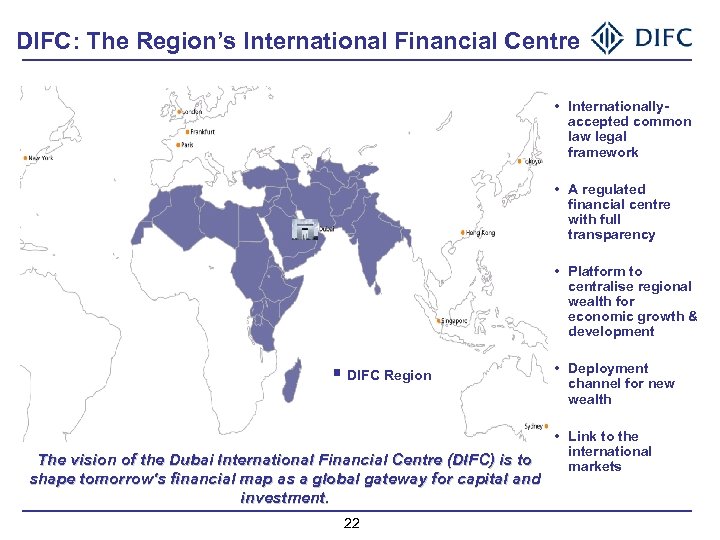
DIFC: The Region’s International Financial Centre • Internationallyaccepted common law legal framework • A regulated financial centre with full transparency • Platform to centralise regional wealth for economic growth & development DIFC Region The vision of the Dubai International Financial Centre (DIFC) is to shape tomorrow's financial map as a global gateway for capital and investment. 22 • Deployment channel for new wealth • Link to the international markets
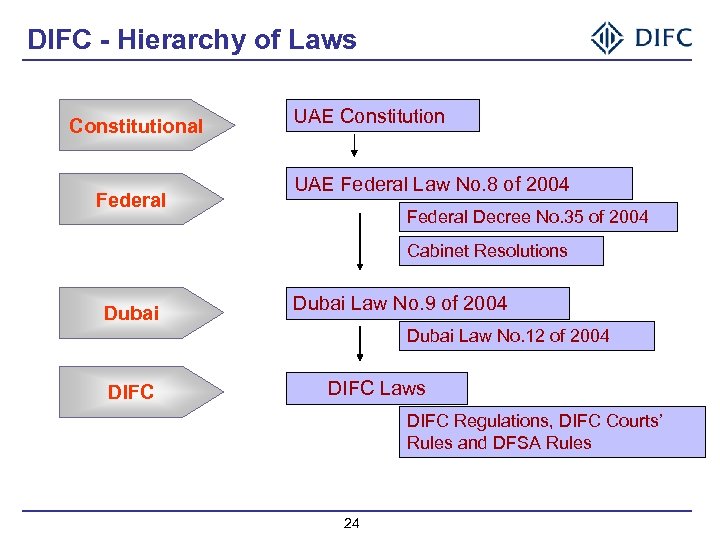
DIFC - Hierarchy of Laws Constitutional Federal UAE Constitution UAE Federal Law No. 8 of 2004 Federal Decree No. 35 of 2004 Cabinet Resolutions Dubai Law No. 9 of 2004 Dubai Law No. 12 of 2004 DIFC Laws DIFC Regulations, DIFC Courts’ Rules and DFSA Rules 24
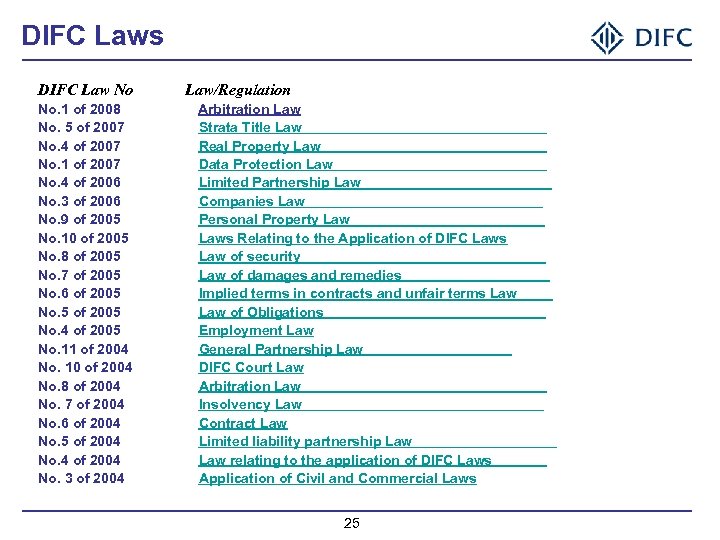
DIFC Laws DIFC Law No No. 1 of 2008 No. 5 of 2007 No. 4 of 2007 No. 1 of 2007 No. 4 of 2006 No. 3 of 2006 No. 9 of 2005 No. 10 of 2005 No. 8 of 2005 No. 7 of 2005 No. 6 of 2005 No. 5 of 2005 No. 4 of 2005 No. 11 of 2004 No. 10 of 2004 No. 8 of 2004 No. 7 of 2004 No. 6 of 2004 No. 5 of 2004 No. 4 of 2004 No. 3 of 2004 Law/Regulation Arbitration Law Strata Title Law Real Property Law Data Protection Law Limited Partnership Law Companies Law Personal Property Laws Relating to the Application of DIFC Laws Law of security Law of damages and remedies Implied terms in contracts and unfair terms Law of Obligations Employment Law General Partnership Law DIFC Court Law Arbitration Law Insolvency Law Contract Law Limited liability partnership Law relating to the application of DIFC Laws Application of Civil and Commercial Laws 25
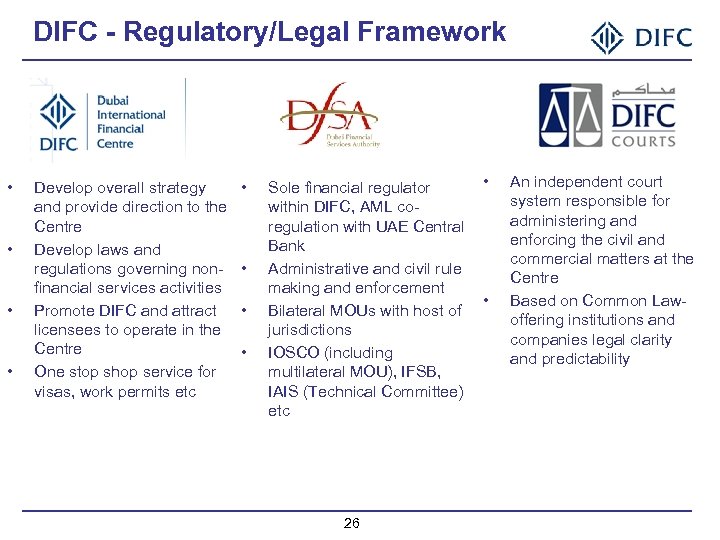
DIFC - Regulatory/Legal Framework • • Develop overall strategy and provide direction to the Centre Develop laws and regulations governing nonfinancial services activities Promote DIFC and attract licensees to operate in the Centre One stop shop service for visas, work permits etc • • • Sole financial regulator within DIFC, AML coregulation with UAE Central Bank Administrative and civil rule making and enforcement • Bilateral MOUs with host of jurisdictions IOSCO (including multilateral MOU), IFSB, IAIS (Technical Committee) etc 26 An independent court system responsible for administering and enforcing the civil and commercial matters at the Centre Based on Common Law- offering institutions and companies legal clarity and predictability
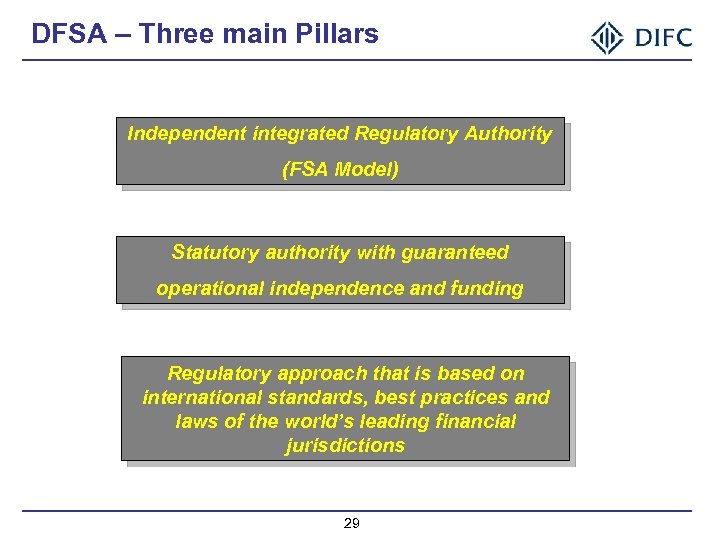
DFSA – Three main Pillars Independent integrated Regulatory Authority (FSA Model) Statutory authority with guaranteed operational independence and funding Regulatory approach that is based on international standards, best practices and laws of the world’s leading financial jurisdictions 29
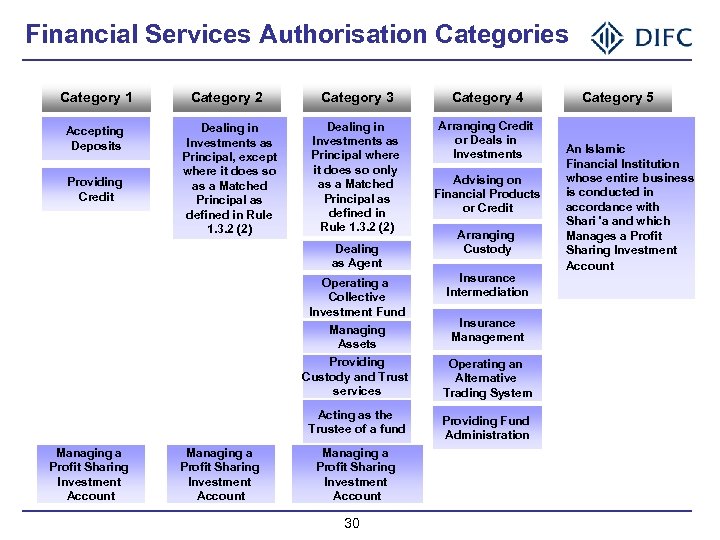
Financial Services Authorisation Categories Category 1 Category 2 Category 3 Category 4 Accepting Deposits Dealing in Investments as Principal, except where it does so as a Matched Principal as defined in Rule 1. 3. 2 (2) Dealing in Investments as Principal where it does so only as a Matched Principal as defined in Rule 1. 3. 2 (2) Arranging Credit or Deals in Investments Providing Credit Dealing as Agent Operating a Collective Investment Fund Managing Assets Advising on Financial Products or Credit Arranging Custody Insurance Intermediation Insurance Management Providing Custody and Trust services Acting as the Trustee of a fund Managing a Profit Sharing Investment Account Operating an Alternative Trading System Providing Fund Administration Managing a Profit Sharing Investment Account 30 Category 5 An Islamic Financial Institution whose entire business is conducted in accordance with Shari 'a and which Manages a Profit Sharing Investment Account
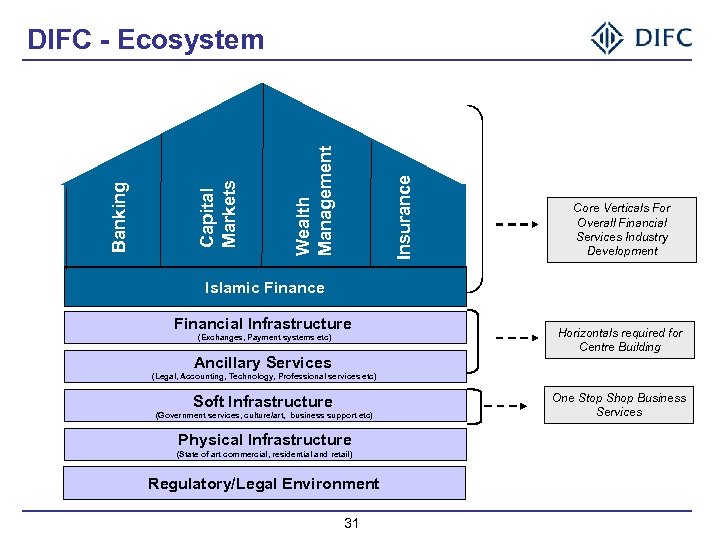
Insurance Wealth Management Capital Markets Banking DIFC - Ecosystem Core Verticals For Overall Financial Services Industry Development Islamic Finance Financial Infrastructure (Exchanges, Payment systems etc) Ancillary Services Horizontals required for Centre Building (Legal, Accounting, Technology, Professional services etc) Soft Infrastructure (Government services, culture/art, business support etc) Physical Infrastructure (State of art commercial, residential and retail) Regulatory/Legal Environment 31 One Stop Shop Business Services
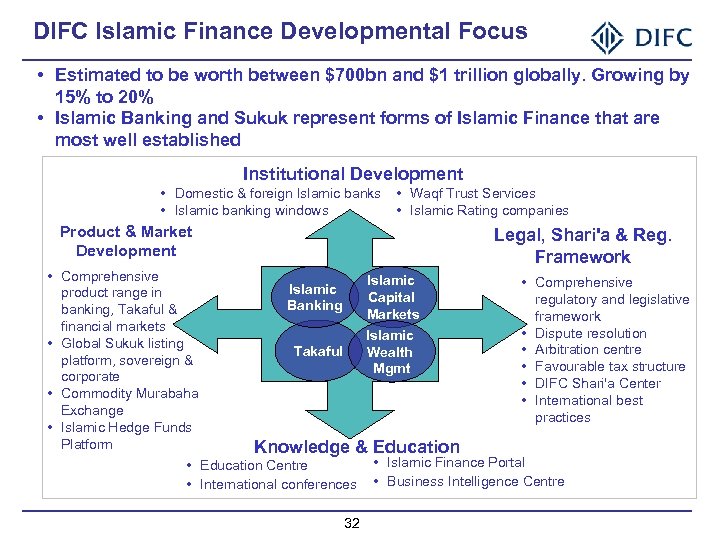
DIFC Islamic Finance Developmental Focus • Estimated to be worth between $700 bn and $1 trillion globally. Growing by 15% to 20% • Islamic Banking and Sukuk represent forms of Islamic Finance that are most well established Institutional Development • Domestic & foreign Islamic banks • Waqf Trust Services • Islamic banking windows • Islamic Rating companies Product & Market Development Legal, Shari'a & Reg. Framework • Comprehensive Islamic product range in Capital regulatory and legislative Banking banking, Takaful & Markets framework financial markets • Dispute resolution Islamic • Global Sukuk listing • Arbitration centre Takaful Wealth platform, sovereign & • Favourable tax structure Mgmt corporate • DIFC Shari'a Center • Commodity Murabaha • International best Exchange practices • Islamic Hedge Funds Platform Knowledge & Education • Islamic Finance Portal • Education Centre • International conferences • Business Intelligence Centre 32
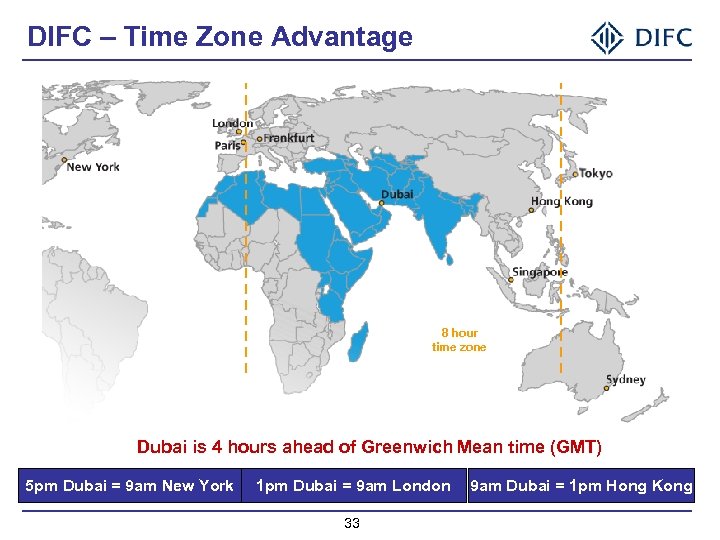
DIFC – Time Zone Advantage 8 hour time zone Dubai is 4 hours ahead of Greenwich Mean time (GMT) 5 pm Dubai = 9 am New York 1 pm Dubai = 9 am London 33 9 am Dubai = 1 pm Hong Kong
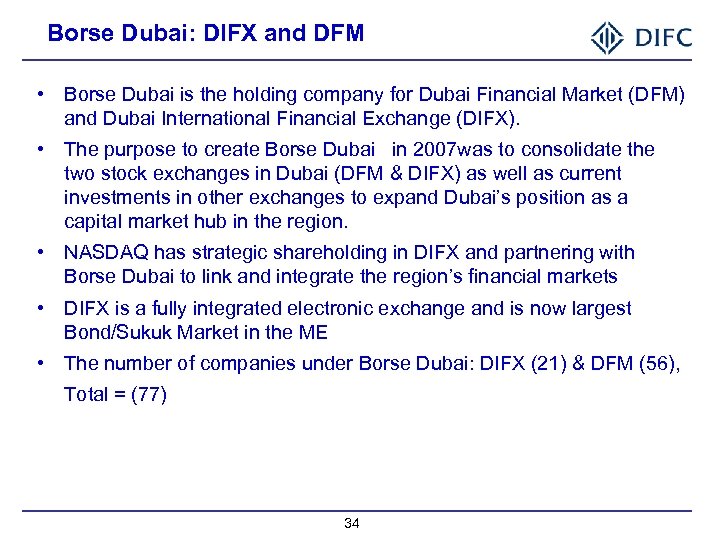
Borse Dubai: DIFX and DFM • Borse Dubai is the holding company for Dubai Financial Market (DFM) and Dubai International Financial Exchange (DIFX). • The purpose to create Borse Dubai in 2007 was to consolidate the two stock exchanges in Dubai (DFM & DIFX) as well as current investments in other exchanges to expand Dubai’s position as a capital market hub in the region. • NASDAQ has strategic shareholding in DIFX and partnering with Borse Dubai to link and integrate the region’s financial markets • DIFX is a fully integrated electronic exchange and is now largest Bond/Sukuk Market in the ME • The number of companies under Borse Dubai: DIFX (21) & DFM (56), Total = (77) 34
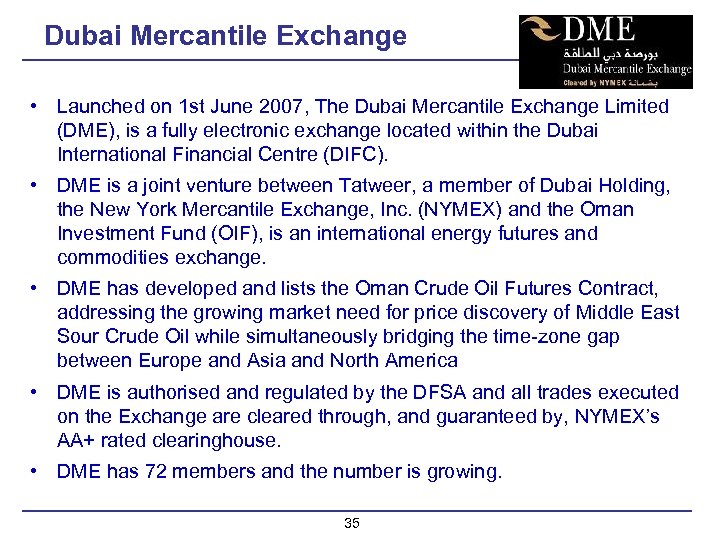
Dubai Mercantile Exchange • Launched on 1 st June 2007, The Dubai Mercantile Exchange Limited (DME), is a fully electronic exchange located within the Dubai International Financial Centre (DIFC). • DME is a joint venture between Tatweer, a member of Dubai Holding, the New York Mercantile Exchange, Inc. (NYMEX) and the Oman Investment Fund (OIF), is an international energy futures and commodities exchange. • DME has developed and lists the Oman Crude Oil Futures Contract, addressing the growing market need for price discovery of Middle East Sour Crude Oil while simultaneously bridging the time-zone gap between Europe and Asia and North America • DME is authorised and regulated by the DFSA and all trades executed on the Exchange are cleared through, and guaranteed by, NYMEX’s AA+ rated clearinghouse. • DME has 72 members and the number is growing. 35
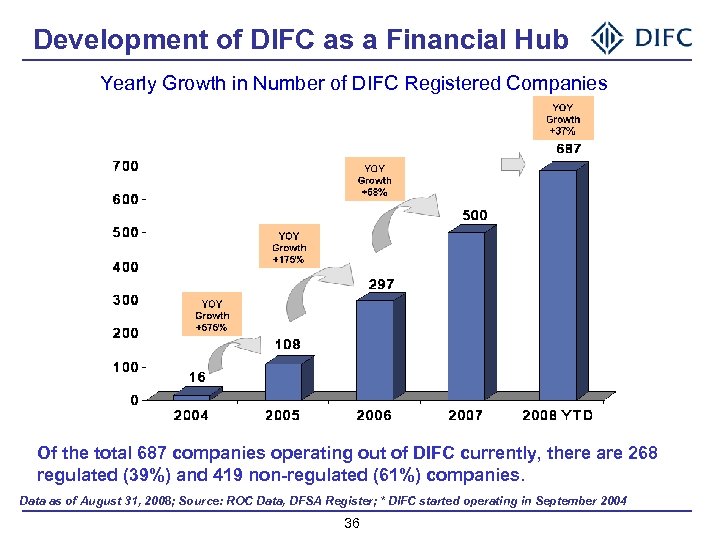
Development of DIFC as a Financial Hub Yearly Growth in Number of DIFC Registered Companies Of the total 687 companies operating out of DIFC currently, there are 268 regulated (39%) and 419 non-regulated (61%) companies. Data as of August 31, 2008; Source: ROC Data, DFSA Register; * DIFC started operating in September 2004 36
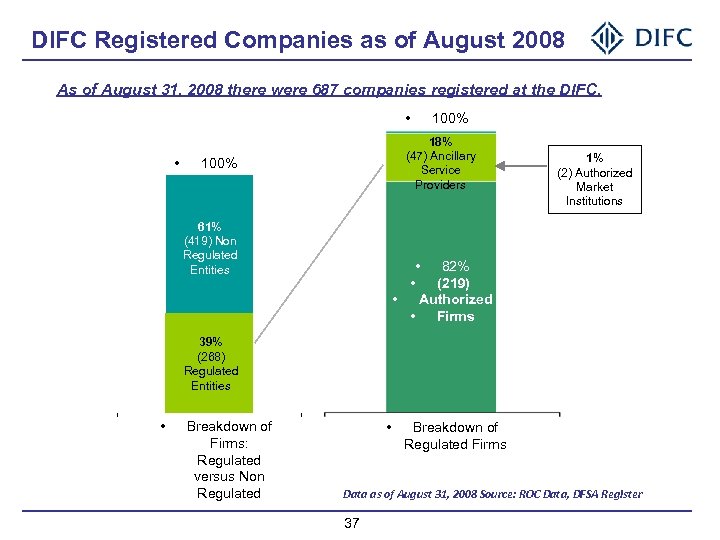
DIFC Registered Companies as of August 2008 As of August 31, 2008 there were 687 companies registered at the DIFC. • • 100% 18% (47) Ancillary Service Providers 100% 61% (419) Non Regulated Entities 1% (2) Authorized Market Institutions • 82% • (219) • Authorized • Firms 39% (268) Regulated Entities • Breakdown of Firms: Regulated versus Non Regulated • Breakdown of Regulated Firms Data as of August 31, 2008 Source: ROC Data, DFSA Register 37
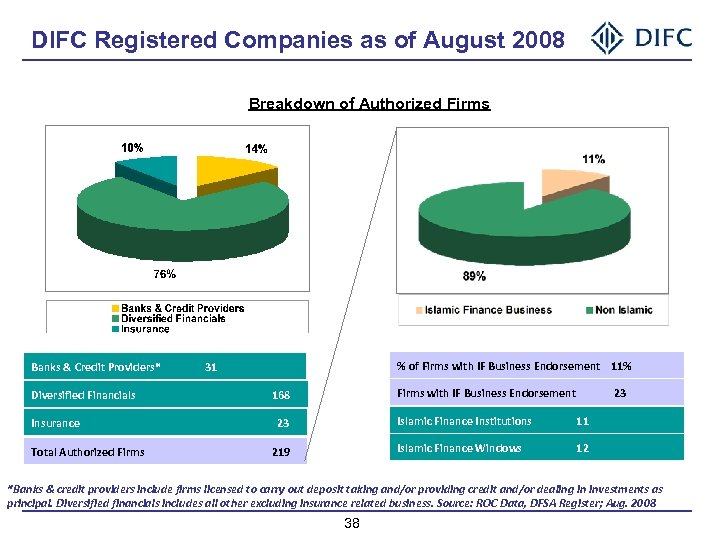
DIFC Registered Companies as of August 2008 Breakdown of Authorized Firms Banks & Credit Providers* Diversified Financials Insurance Total Authorized Firms % of Firms with IF Business Endorsement 11% 31 Firms with IF Business Endorsement 168 23 Islamic Finance Institutions 219 11 Islamic Finance Windows 23 12 *Banks & credit providers include firms licensed to carry out deposit taking and/or providing credit and/or dealing in investments as principal. Diversified financials includes all other excluding insurance related business. Source: ROC Data, DFSA Register; Aug. 2008 38
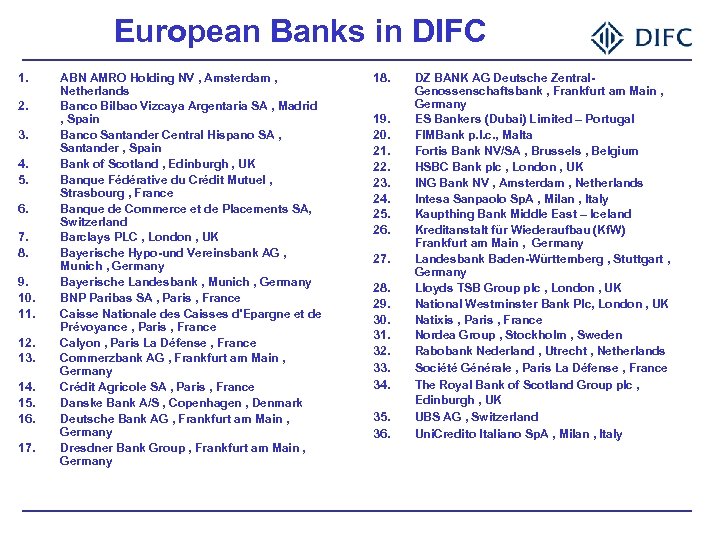
European Banks in DIFC 1. 2. 3. 4. 5. 6. 7. 8. 9. 10. 11. 12. 13. 14. 15. 16. 17. ABN AMRO Holding NV , Amsterdam , Netherlands Banco Bilbao Vizcaya Argentaria SA , Madrid , Spain Banco Santander Central Hispano SA , Santander , Spain Bank of Scotland , Edinburgh , UK Banque Fédérative du Crédit Mutuel , Strasbourg , France Banque de Commerce et de Placements SA, Switzerland Barclays PLC , London , UK Bayerische Hypo-und Vereinsbank AG , Munich , Germany Bayerische Landesbank , Munich , Germany BNP Paribas SA , Paris , France Caisse Nationale des Caisses d'Epargne et de Prévoyance , Paris , France Calyon , Paris La Défense , France Commerzbank AG , Frankfurt am Main , Germany Crédit Agricole SA , Paris , France Danske Bank A/S , Copenhagen , Denmark Deutsche Bank AG , Frankfurt am Main , Germany Dresdner Bank Group , Frankfurt am Main , Germany 18. 19. 20. 21. 22. 23. 24. 25. 26. 27. 28. 29. 30. 31. 32. 33. 34. 35. 36. DZ BANK AG Deutsche Zentral. Genossenschaftsbank , Frankfurt am Main , Germany ES Bankers (Dubai) Limited – Portugal FIMBank p. l. c. , Malta Fortis Bank NV/SA , Brussels , Belgium HSBC Bank plc , London , UK ING Bank NV , Amsterdam , Netherlands Intesa Sanpaolo Sp. A , Milan , Italy Kaupthing Bank Middle East – Iceland Kreditanstalt für Wiederaufbau (Kf. W) Frankfurt am Main , Germany Landesbank Baden-Württemberg , Stuttgart , Germany Lloyds TSB Group plc , London , UK National Westminster Bank Plc, London , UK Natixis , Paris , France Nordea Group , Stockholm , Sweden Rabobank Nederland , Utrecht , Netherlands Société Générale , Paris La Défense , France The Royal Bank of Scotland Group plc , Edinburgh , UK UBS AG , Switzerland Uni. Credito Italiano Sp. A , Milan , Italy
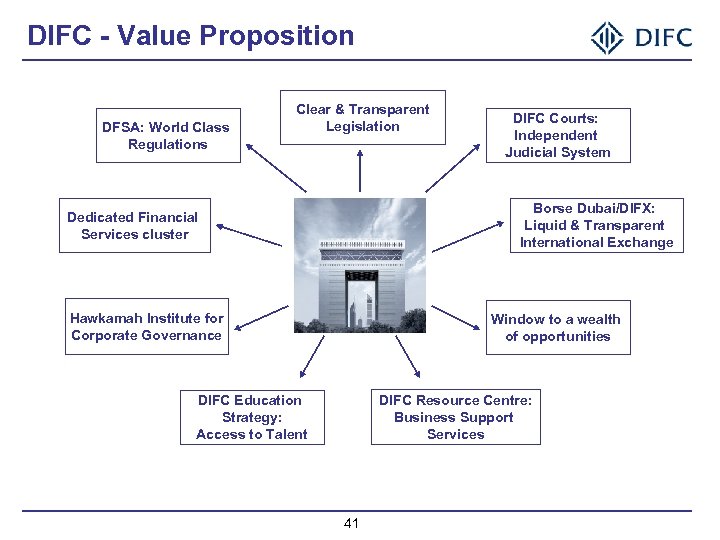
DIFC - Value Proposition DFSA: World Class Regulations Clear & Transparent Legislation DIFC Courts: Independent Judicial System Borse Dubai/DIFX: Liquid & Transparent International Exchange Dedicated Financial Services cluster Hawkamah Institute for Corporate Governance Window to a wealth of opportunities DIFC Resource Centre: Business Support Services DIFC Education Strategy: Access to Talent 41
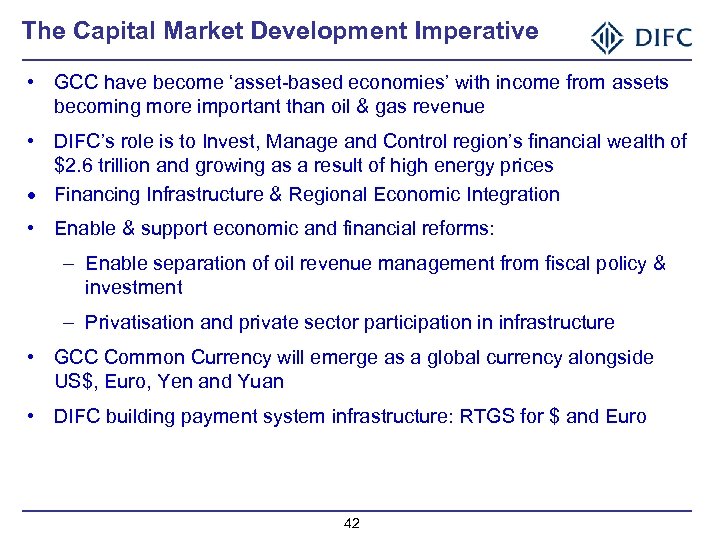
The Capital Market Development Imperative • GCC have become ‘asset-based economies’ with income from assets becoming more important than oil & gas revenue • DIFC’s role is to Invest, Manage and Control region’s financial wealth of $2. 6 trillion and growing as a result of high energy prices Financing Infrastructure & Regional Economic Integration • Enable & support economic and financial reforms: – Enable separation of oil revenue management from fiscal policy & investment – Privatisation and private sector participation in infrastructure • GCC Common Currency will emerge as a global currency alongside US$, Euro, Yen and Yuan • DIFC building payment system infrastructure: RTGS for $ and Euro 42
GCC/Dubai-EU-Austria Areas for Cooperation • Global economic & financial geography is changing, there is a need for establishing and strengthening of links and channels for communication, transactions, trade, investment and mutually beneficial cooperation. • The GCC and EU have an opportunity to develop institutional and working relationships between each other: Free Trade Agreement • Promote Financial market integration: linking stock exchanges • Financing of infrastructure in Mediterranean • Austrian banks, financial institutions can establish presence in DIFC • Listing of Austrian securities on DIFC and GCC exchanges • Austrian companies participating in GCC infrastructure projects 43
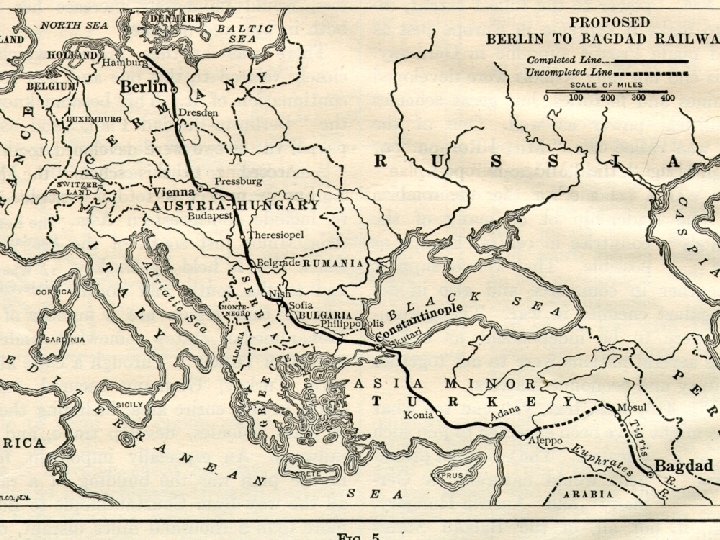
The Capital Market Development Imperative • GCC have become ‘asset-based economies’ with income from assets becoming more important than oil & gas revenue • DIFC’s role is to Invest, Manage and Control region’s financial wealth of $2. 6 trillion and growing as a result of high energy prices Financing Infrastructure & Regional Economic Integration • Enable & support economic and financial reforms: – Enable separation of oil revenue management from fiscal policy & investment – Privatisation and private sector participation in infrastructure • GCC Common Currency will emerge as a global currency alongside US$, Euro and Remimbi • DIFC building payment system infrastructure: RTGS for $ and Euro Change in Global Economic Geography requires accompanying change in Global Financial Geography 44
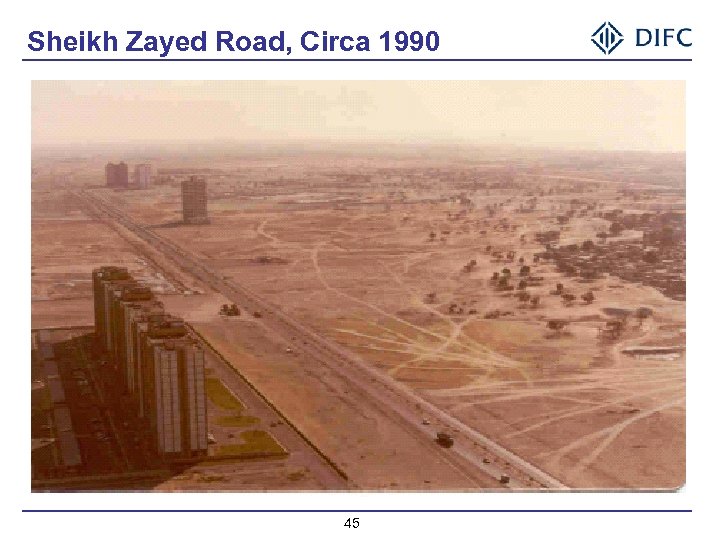
Sheikh Zayed Road, Circa 1990 45
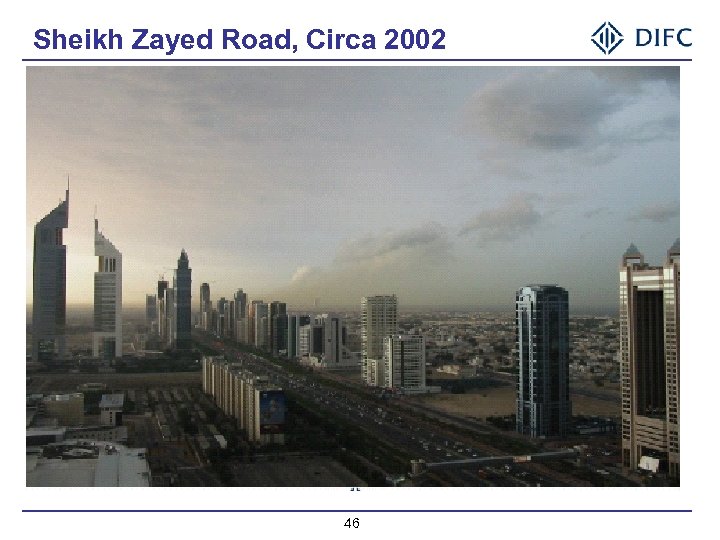
Sheikh Zayed Road, Circa 2002 46
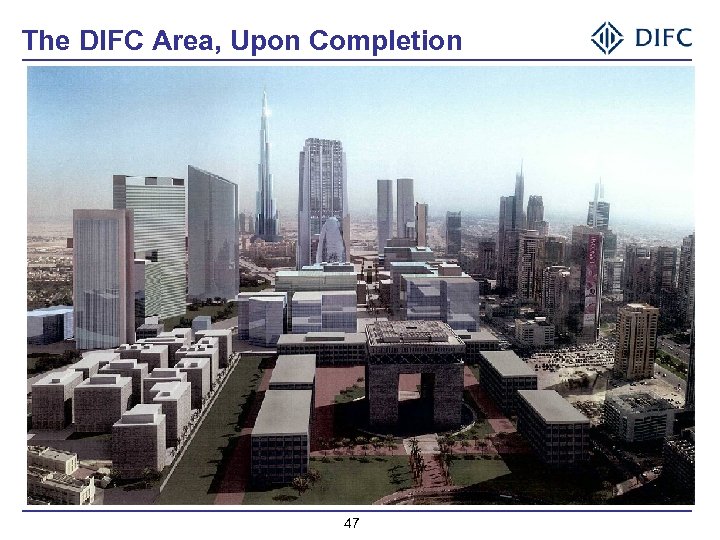
The DIFC Area, Upon Completion 47
Economic Renaissance: Megapower Middle East Thank you Q&A Dr. Nasser Al Saidi Tel: +9714 -362 -2550 nasser. saidi@difc. ae 48
Скачать презентацию Economic Renaissance Megapower Middle East VICTOR CONFERENCE Baden
8ac1fff8849b92e4e27aef6caa4d64e0.ppt