 Скачать презентацию Economic Liberalization in India Past Achievements and Future
e32a8340ef3cdaf07ae3999c58bde06e.ppt
- Количество слайдов: 18



Economic Liberalization in India Past Achievements and Future Challenges 6 August 2011 © Confederation of Indian Industry
Economic Reforms • The early burst of reforms in the early to mid nineties made sweeping changes such as • • • Reduction in tariff barriers Removal of barriers to entry in industry Removal of controls in the financial sector Encouragement to foreign investment and technology Rationalization of tax structure • These have ensured macroeconomic stability and driven the economy towards greater competitiveness • These measures have also helped India in emerging as a resurgent, vibrant and dynamic nation, leading global growth • • • India is the second fastest growing economy in the world after China India was able to withstand the repercussion of the global economic crisis India’s participation is required in all global negotiations ranging from global trade to climate related deals
CII’s Role • Post-1991, CII worked on multiple fronts to facilitate liberalization: • Engaged with administration to calibrate policies to sequence reforms and minimize industry adjustment pains • Sensitized officials and Members of Parliament for reforms through sustained interaction • Worked with industry to build consensus recommendations • Organized seminars to disseminate awareness among industry • Interacted persuasively with different stakeholders across society to create buy-in • Globalisation was a key plank of CII’s endeavours since 1991. Some of CII’s pioneering initiatives that helped industry to align with global imperatives include: • • • Arranging outward missions through networking with international governments, industry associations, institutes and academia for opening new avenues for Indian industry Initiating Quality Movement in India; Sundaram Fasteners first company to get ISO 9000 certification (1991) Organising exhibitions/shows to showcase Indian products Initiating debate on key economy/ industry issues Laying thrust on Corporate Governance: Developing Code of Corporate Governance
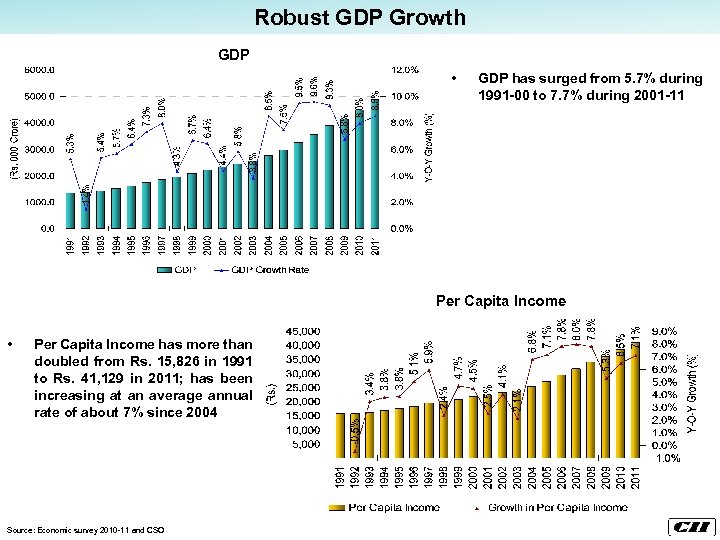
Robust GDP Growth GDP • GDP has surged from 5. 7% during 1991 -00 to 7. 7% during 2001 -11 Per Capita Income • Per Capita Income has more than doubled from Rs. 15, 826 in 1991 to Rs. 41, 129 in 2011; has been increasing at an average annual rate of about 7% since 2004 Source: Economic survey 2010 -11 and CSO
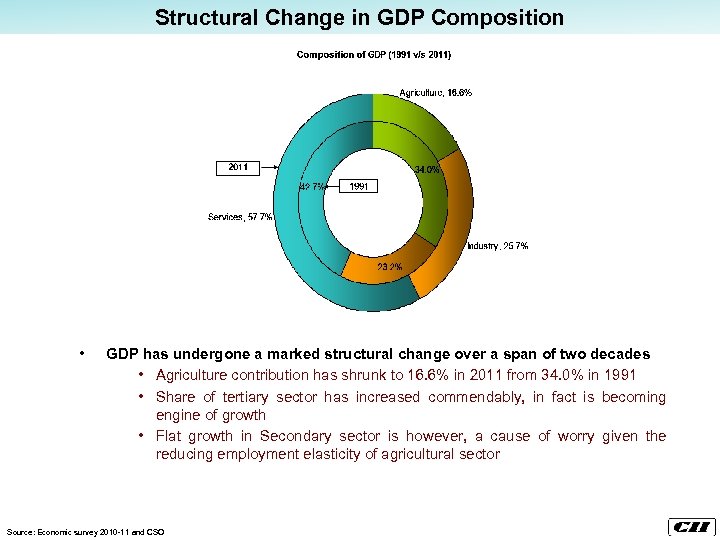
Structural Change in GDP Composition • GDP has undergone a marked structural change over a span of two decades • Agriculture contribution has shrunk to 16. 6% in 2011 from 34. 0% in 1991 • Share of tertiary sector has increased commendably, in fact is becoming engine of growth • Flat growth in Secondary sector is however, a cause of worry given the reducing employment elasticity of agricultural sector Source: Economic survey 2010 -11 and CSO
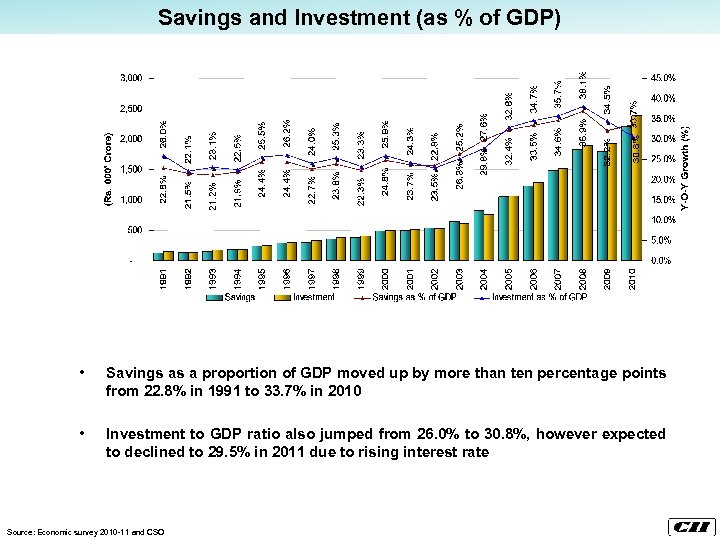
Savings and Investment (as % of GDP) • Savings as a proportion of GDP moved up by more than ten percentage points from 22. 8% in 1991 to 33. 7% in 2010 • Investment to GDP ratio also jumped from 26. 0% to 30. 8%, however expected to declined to 29. 5% in 2011 due to rising interest rate Source: Economic survey 2010 -11 and CSO
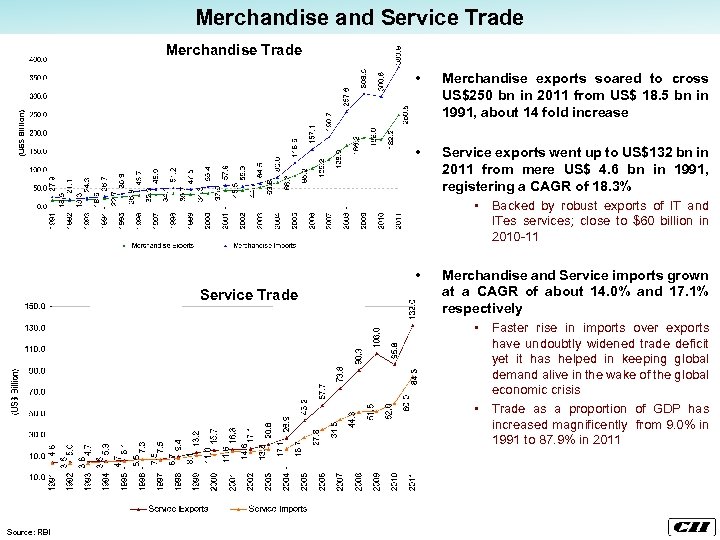
Merchandise and Service Trade Merchandise Trade • Merchandise exports soared to cross US$250 bn in 2011 from US$ 18. 5 bn in 1991, about 14 fold increase • Service exports went up to US$132 bn in 2011 from mere US$ 4. 6 bn in 1991, registering a CAGR of 18. 3% • Backed by robust exports of IT and ITes services; close to $60 billion in 2010 -11 • Service Trade Merchandise and Service imports grown at a CAGR of about 14. 0% and 17. 1% respectively • Faster rise in imports over exports • Source: RBI have undoubtly widened trade deficit yet it has helped in keeping global demand alive in the wake of the global economic crisis Trade as a proportion of GDP has increased magnificently from 9. 0% in 1991 to 87. 9% in 2011
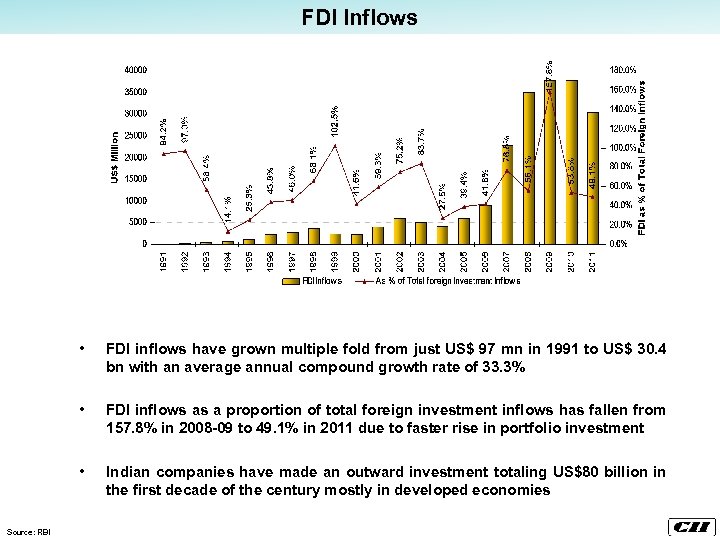
FDI Inflows • • FDI inflows as a proportion of total foreign investment inflows has fallen from 157. 8% in 2008 -09 to 49. 1% in 2011 due to faster rise in portfolio investment • Source: RBI FDI inflows have grown multiple fold from just US$ 97 mn in 1991 to US$ 30. 4 bn with an average annual compound growth rate of 33. 3% Indian companies have made an outward investment totaling US$80 billion in the first decade of the century mostly in developed economies
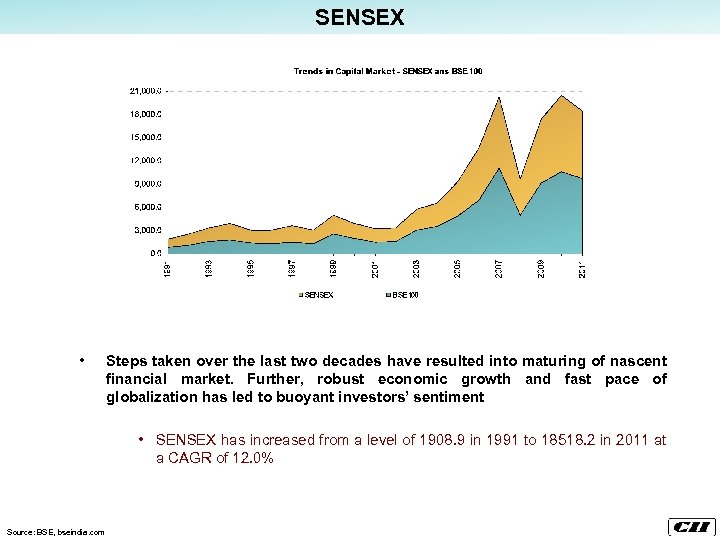
SENSEX • Steps taken over the last two decades have resulted into maturing of nascent financial market. Further, robust economic growth and fast pace of globalization has led to buoyant investors’ sentiment • SENSEX has increased from a level of 1908. 9 in 1991 to 18518. 2 in 2011 at a CAGR of 12. 0% Source: BSE, bseindia. com
Move Towards Inclusive Growth • While the first phase of reforms had unleashed economic growth, it was felt that the benefits of growth must be more equitably distributed • Starting 2005, the UPA government has shifted the focus to inclusive growth through greater allocation to socially beneficial schemes and programmes • Total Plan Allocation increased markedly from Rs. 9. 6 thousand crore in 1991 to Rs. 335. 5 thousand crore in 2011 -12, nearly 35 fold increase Some flagship schemes • Bharat Nirman - Total Budget allocation for 2011 -12: Rs. 58, 000 crore • NREGA - Total Budget allocation for 2011 -12: Rs. 40, 000 crore • JNNURM - Total Budget allocation for 2011 -12: Rs. 49 crore Source: Budget and Government Sources
CII’s Initiative on Socio Responsibilities • Corporate Social Responsibility • Set up Social Development and Community Affairs Council in 1995 • Developed Action Agenda for Affirmative Action and worked to generate awareness and intensify industry efforts • Facilitates industry interventions in society through NGO partnerships • Undertakes public health and community welfare activities in factories • Spearheaded the India Business Trust for HIV/AIDS • Environment Management • Set up Environment Management Division after Rio Summit in 1992 • Initiated Green Building movement in India through its Centre of Excellence Green Business Center • Engages in climate change mitigation efforts
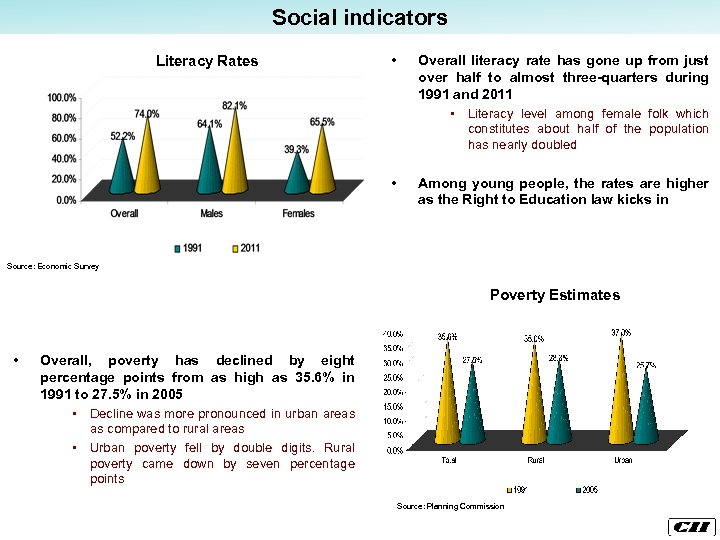
Social indicators Literacy Rates • Overall literacy rate has gone up from just over half to almost three-quarters during 1991 and 2011 • Literacy level among female folk which constitutes about half of the population has nearly doubled • Among young people, the rates are higher as the Right to Education law kicks in Source: Economic Survey Poverty Estimates • Overall, poverty has declined by eight percentage points from as high as 35. 6% in 1991 to 27. 5% in 2005 • Decline was more pronounced in urban areas • as compared to rural areas Urban poverty fell by double digits. Rural poverty came down by seven percentage points Source: Planning Commission
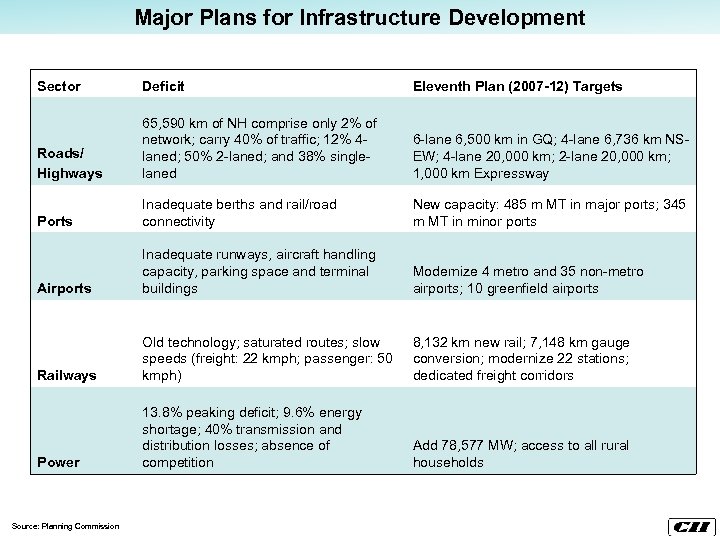
Major Plans for Infrastructure Development Sector Deficit Eleventh Plan (2007 -12) Targets Roads/ Highways 65, 590 km of NH comprise only 2% of network; carry 40% of traffic; 12% 4 laned; 50% 2 -laned; and 38% singlelaned 6 -lane 6, 500 km in GQ; 4 -lane 6, 736 km NSEW; 4 -lane 20, 000 km; 2 -lane 20, 000 km; 1, 000 km Expressway Ports Inadequate berths and rail/road connectivity New capacity: 485 m MT in major ports; 345 m MT in minor ports Airports Inadequate runways, aircraft handling capacity, parking space and terminal buildings Modernize 4 metro and 35 non-metro airports; 10 greenfield airports Railways Old technology; saturated routes; slow speeds (freight: 22 kmph; passenger: 50 kmph) 8, 132 km new rail; 7, 148 km gauge conversion; modernize 22 stations; dedicated freight corridors Power 13. 8% peaking deficit; 9. 6% energy shortage; 40% transmission and distribution losses; absence of competition Add 78, 577 MW; access to all rural households Source: Planning Commission
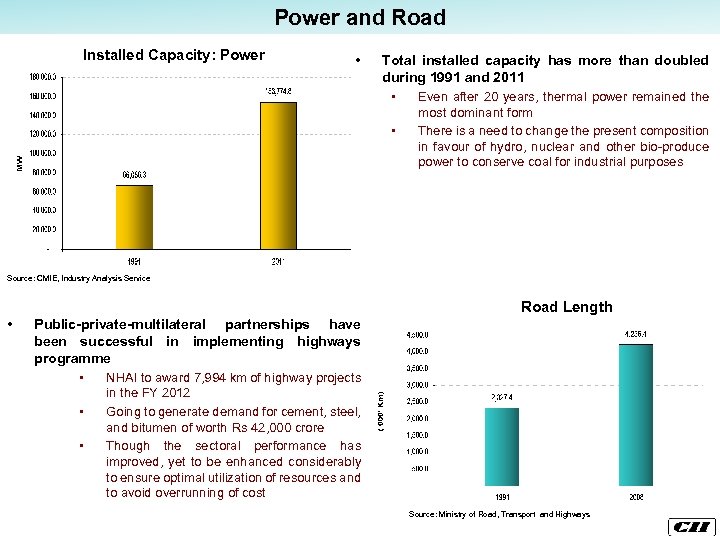
Power and Road Installed Capacity: Power • Total installed capacity has more than doubled during 1991 and 2011 • Even after 20 years, thermal power remained the • most dominant form There is a need to change the present composition in favour of hydro, nuclear and other bio-produce power to conserve coal for industrial purposes Source: CMIE, Industry Analysis Service Road Length • Public-private-multilateral partnerships have been successful in implementing highways programme • NHAI to award 7, 994 km of highway projects • • in the FY 2012 Going to generate demand for cement, steel, and bitumen of worth Rs 42, 000 crore Though the sectoral performance has improved, yet to be enhanced considerably to ensure optimal utilization of resources and to avoid overrunning of cost Source: Ministry of Road, Transport and Highways
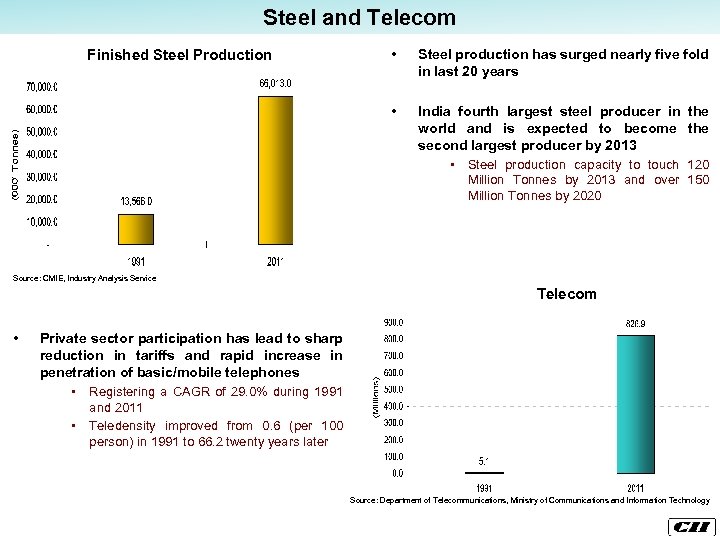
Steel and Telecom • Steel production has surged nearly five fold in last 20 years • Finished Steel Production India fourth largest steel producer in the world and is expected to become the second largest producer by 2013 • Steel production capacity to touch 120 Million Tonnes by 2013 and over 150 Million Tonnes by 2020 Source: CMIE, Industry Analysis Service Telecom • Private sector participation has lead to sharp reduction in tariffs and rapid increase in penetration of basic/mobile telephones • Registering a CAGR of 29. 0% during 1991 • and 2011 Teledensity improved from 0. 6 (per 100 person) in 1991 to 66. 2 twenty years later Source: Department of Telecommunications, Ministry of Communications and Information Technology
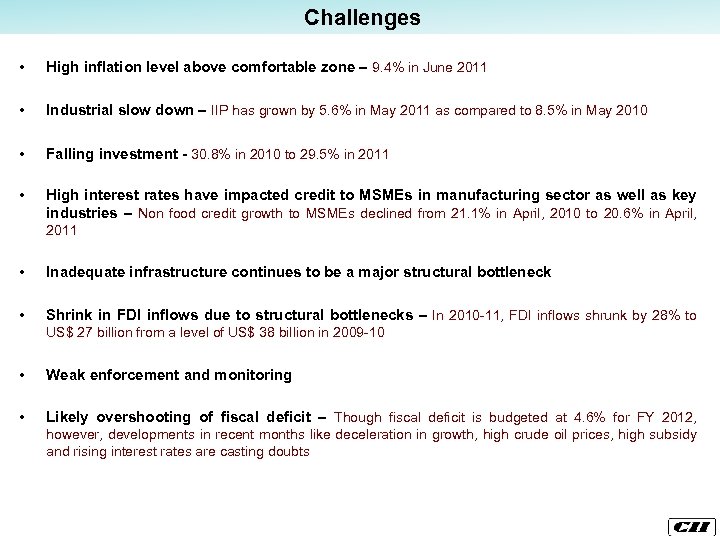
Challenges • High inflation level above comfortable zone – 9. 4% in June 2011 • Industrial slow down – IIP has grown by 5. 6% in May 2011 as compared to 8. 5% in May 2010 • Falling investment - 30. 8% in 2010 to 29. 5% in 2011 • High interest rates have impacted credit to MSMEs in manufacturing sector as well as key industries – Non food credit growth to MSMEs declined from 21. 1% in April, 2010 to 20. 6% in April, 2011 • Inadequate infrastructure continues to be a major structural bottleneck • Shrink in FDI inflows due to structural bottlenecks – In 2010 -11, FDI inflows shrunk by 28% to US$ 27 billion from a level of US$ 38 billion in 2009 -10 • Weak enforcement and monitoring • Likely overshooting of fiscal deficit – Though fiscal deficit is budgeted at 4. 6% for FY 2012, however, developments in recent months like deceleration in growth, high crude oil prices, high subsidy and rising interest rates are casting doubts
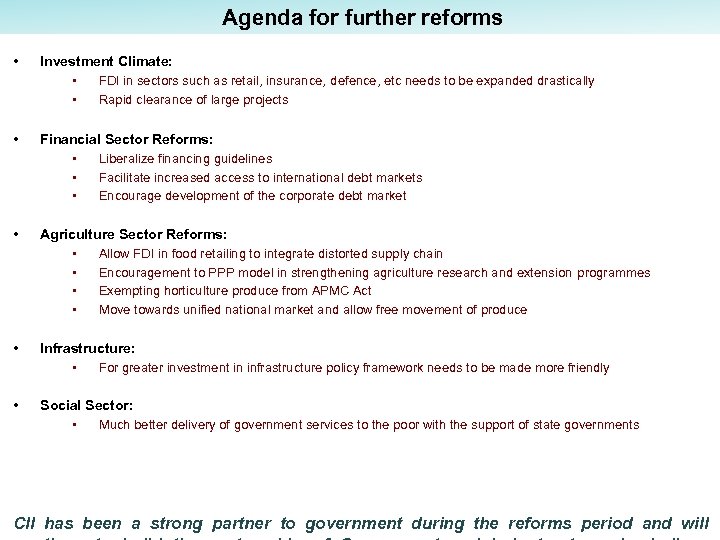
Agenda for further reforms • Investment Climate: • FDI in sectors such as retail, insurance, defence, etc needs to be expanded drastically • Rapid clearance of large projects • Financial Sector Reforms: • Liberalize financing guidelines • Facilitate increased access to international debt markets • Encourage development of the corporate debt market • Agriculture Sector Reforms: • Allow FDI in food retailing to integrate distorted supply chain • Encouragement to PPP model in strengthening agriculture research and extension programmes • Exempting horticulture produce from APMC Act • Move towards unified national market and allow free movement of produce • Infrastructure: • For greater investment in infrastructure policy framework needs to be made more friendly • Social Sector: • Much better delivery of government services to the poor with the support of state governments CII has been a strong partner to government during the reforms period and will
Thank You
Скачать презентацию Economic Liberalization in India Past Achievements and Future
e32a8340ef3cdaf07ae3999c58bde06e.ppt