 Скачать презентацию Economic Initiative for the Palestinian economy Nairobi July
4b2ee97766a283251957b517ef09435e.ppt
- Количество слайдов: 23



Economic Initiative for the Palestinian economy Nairobi July 2014
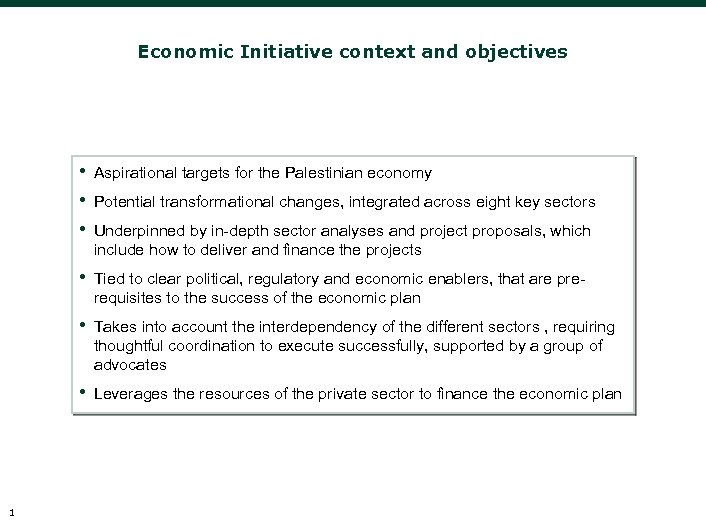
Economic Initiative context and objectives • • Tied to clear political, regulatory and economic enablers, that are prerequisites to the success of the economic plan • Takes into account the interdependency of the different sectors , requiring thoughtful coordination to execute successfully, supported by a group of advocates • 1 Aspirational targets for the Palestinian economy Leverages the resources of the private sector to finance the economic plan Potential transformational changes, integrated across eight key sectors Underpinned by in-depth sector analyses and project proposals, which include how to deliver and finance the projects
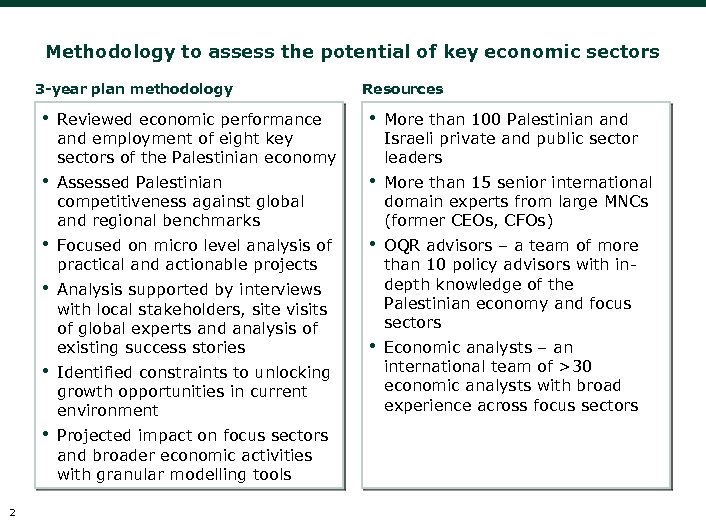
Methodology to assess the potential of key economic sectors 3 -year plan methodology Resources • Reviewed economic performance and employment of eight key sectors of the Palestinian economy • More than 100 Palestinian and Israeli private and public sector leaders • Assessed Palestinian competitiveness against global and regional benchmarks • More than 15 senior international domain experts from large MNCs (former CEOs, CFOs) • Focused on micro level analysis of practical and actionable projects • • Analysis supported by interviews with local stakeholders, site visits of global experts and analysis of existing success stories OQR advisors – a team of more than 10 policy advisors with indepth knowledge of the Palestinian economy and focus sectors • Economic analysts – an international team of >30 economic analysts with broad experience across focus sectors • • 2 Identified constraints to unlocking growth opportunities in current environment Projected impact on focus sectors and broader economic activities with granular modelling tools
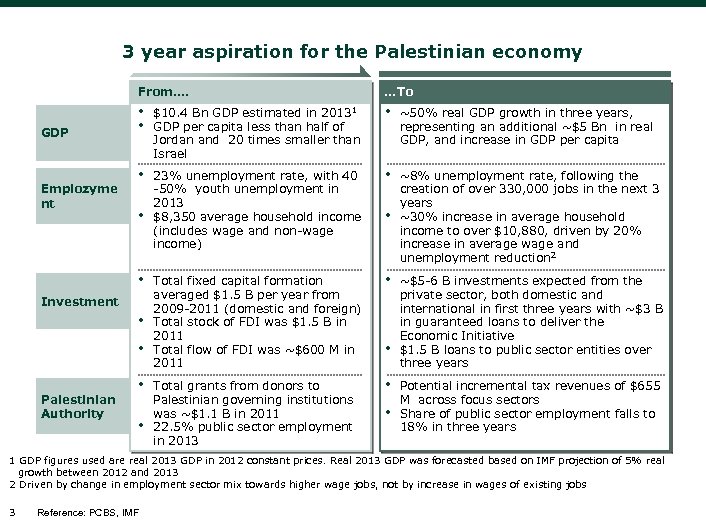
3 year aspiration for the Palestinian economy From…. GDP Emplozyme nt …To • • $10. 4 Bn GDP estimated in 20131 GDP per capita less than half of Jordan and 20 times smaller than Israel • ~50% real GDP growth in three years, representing an additional ~$5 Bn in real GDP, and increase in GDP per capita • 23% unemployment rate, with 40 -50% youth unemployment in 2013 $8, 350 average household income (includes wage and non-wage income) • ~8% unemployment rate, following the creation of over 330, 000 jobs in the next 3 years ~30% increase in average household income to over $10, 880, driven by 20% increase in average wage and unemployment reduction 2 Total fixed capital formation averaged $1. 5 B per year from 2009 -2011 (domestic and foreign) Total stock of FDI was $1. 5 B in 2011 Total flow of FDI was ~$600 M in 2011 • Total grants from donors to Palestinian governing institutions was ~$1. 1 B in 2011 22. 5% public sector employment in 2013 • • • Investment • • Palestinian Authority • • • ~$5 -6 B investments expected from the private sector, both domestic and international in first three years with ~$3 B in guaranteed loans to deliver the Economic Initiative $1. 5 B loans to public sector entities over three years Potential incremental tax revenues of $655 M across focus sectors Share of public sector employment falls to 18% in three years 1 GDP figures used are real 2013 GDP in 2012 constant prices. Real 2013 GDP was forecasted based on IMF projection of 5% real growth between 2012 and 2013 2 Driven by change in employment sector mix towards higher wage jobs, not by increase in wages of existing jobs 3 Reference: PCBS, IMF
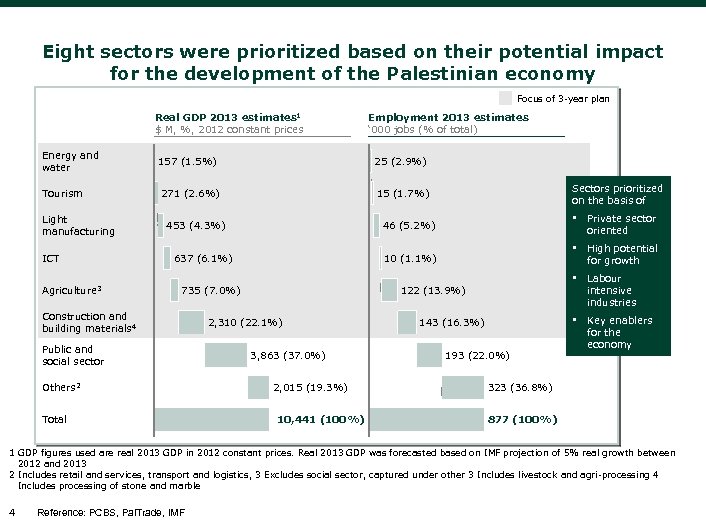
Eight sectors were prioritized based on their potential impact for the development of the Palestinian economy Focus of 3 -year plan Real GDP 2013 estimates 1 $ M, %, 2012 constant prices Employment 2013 estimates ‘ 000 jobs (% of total) Energy and water 157 (1. 5%) 25 (2. 9%) Tourism 271 (2. 6%) 15 (1. 7%) Light manufacturing ICT Agriculture 3 453 (4. 3%) Others 2 Total 2, 310 (22. 1%) 3, 863 (37. 0%) 2, 015 (19. 3%) 10, 441 (100%) 193 (22. 0%) Labour intensive industries • 143 (16. 3%) High potential for growth • 122 (13. 9%) Private sector oriented • 10 (1. 1%) 735 (7. 0%) Public and social sector • 46 (5. 2%) 637 (6. 1%) Construction and building materials 4 Sectors prioritized on the basis of Key enablers for the economy 323 (36. 8%) 877 (100%) 1 GDP figures used are real 2013 GDP in 2012 constant prices. Real 2013 GDP was forecasted based on IMF projection of 5% real growth between 2012 and 2013 2 Includes retail and services, transport and logistics, 3 Excludes social sector, captured under other 3 Includes livestock and agri-processing 4 Includes processing of stone and marble 4 Reference: PCBS, Pal. Trade, IMF
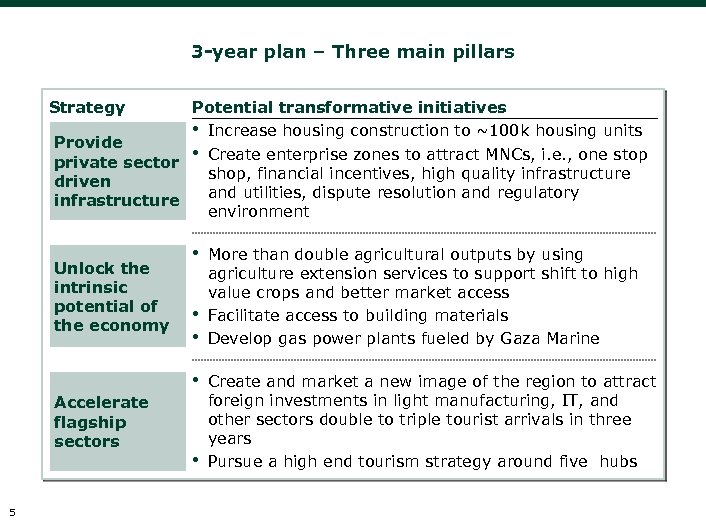
3 -year plan – Three main pillars Strategy Potential transformative initiatives • Increase housing construction to ~100 k housing units Provide • Create enterprise zones to attract MNCs, i. e. , one stop private sector shop, financial incentives, high quality infrastructure driven and utilities, dispute resolution and regulatory infrastructure environment Unlock the intrinsic potential of the economy • • Accelerate flagship sectors 5 • More than double agricultural outputs by using agriculture extension services to support shift to high value crops and better market access Facilitate access to building materials Develop gas power plants fueled by Gaza Marine Create and market a new image of the region to attract foreign investments in light manufacturing, IT, and other sectors double to triple tourist arrivals in three years Pursue a high end tourism strategy around five hubs
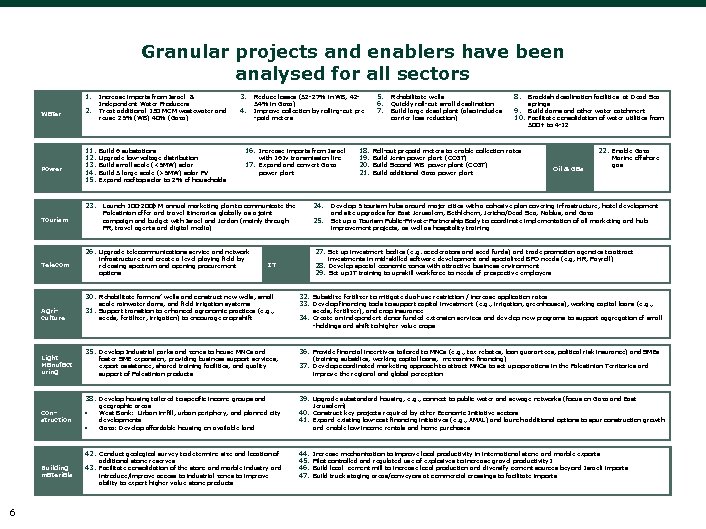
Granular projects and enablers have been analysed for all sectors 1. Water Power 2. 11. 12. 13. 14. 15. 23. Tourism Increase imports from Israel & Independent Water Producers Treat additional 130 MCM wastewater and reuse 25% (WB) 40% (Gaza) 3. 4. Build 6 substations Upgrade low-voltage distribution Build small scale (<5 MW) solar Build 3 large scale (>5 MW) solar PV Expand rooftop solar to 2% of households Reduce losses (32 -27% in WB, 4234% in Gaza) Improve collection by rolling-out pre -paid meters 16. Increase imports from Israel with 161 v transmission line 17. Expand convert Gaza power plant 24. Launch 100 -200$ M annual marketing plan to communicate the Palestinian offer and travel itineraries globally as a joint campaign and budget with Israel and Jordan (mainly through PR, travel agents and digital media) 25. 26. Upgrade telecommunications service and network infrastructure and create a level playing field by releasing spectrum and opening procurement options Telecom Light Manufact uring Rehabilitate wells Quickly roll-out small desalination Build large desal plant (also includes carrier loss reduction) 8. Brackish desalination facilities at Dead Sea springs 9. Build dams and other water catchment 10. Facilitate consolidation of water utilities from 300+ to 4 -12 Roll-out prepaid meters to enable collection rates Build Jenin power plant (CCGT) Build Second WB power plant (CCGT) Build additional Gaza power plant 22. Enable Gaza Oil & Gas Marine offshore gas Develop 5 tourism hubs around major cities with a cohesive plan covering infrastructure, hotel development and site upgrades for East Jerusalem, Bethlehem, Jericho/Dead Sea, Nablus, and Gaza Set up a Tourism Public-Private-Partnership Body to coordinate implementation of all marketing and hub improvement projects, as well as hospitality training 27. Set up investment bodies (e. g. accelerators and seed funds) and trade promotion agencies to attract investments in mid-skilled software development and specialized BPO needs (e. g, HR, Payroll) IT 30. Rehabilitate farmers’ wells and construct new wells, small Agriculture 18. 19. 20. 21. 5. 6. 7. scale rainwater dams, and field irrigation systems 31. Support transition to enhanced agronomic practices (e. g. , seeds, fertilizer, irrigation) to encourage crop-shift 35. Develop Industrial parks and zones to house MNCs and foster SME expansion, providing business support services, export assistance, shared training facilities, and quality support of Palestinian products 28. Develop special economic zones with attractive business environment 29. Set up IT training to up-skill workforce to needs of prospective employers 32. Subsidize fertilizer to mitigate dual-use restriction / increase application rates 33. Develop financing tools to support capital investment (e. g. , irrigation, greenhouses), working capital loans (e. g. , seeds, fertilizer), and crop insurance 34. Create an independent donor funded extension services and develop new programs to support aggregation of small -holdings and shift to higher value crops 36. Provide financial incentives tailored to MNCs (e. g. , tax rebates, loan guarantees, political risk insurance) and SMEs (training subsidies, working capital loans, mezzanine financing) 37. Develop coordinated marketing approach to attract MNCs to set up operations in the Palestinian Territories and improve the regional and global perception 38. Develop housing tailored to specific income groups and Construction 39. Upgrade substandard housing, e. g. , connect to public water and sewage networks (focus on Gaza and East • 40. Construct key projects required by other Economic Initiative sectors 41. Expand existing low-cost financing initiatives (e. g. , AMAL) and launch additional options to spur construction growth • geographic areas West Bank: Urban in-fill, urban periphery, and planned city developments Gaza: Develop affordable housing on available land 42. Conduct geological survey to determine size and location of Building materials 6 additional stone reserves 43. Facilitate consolidation of the stone and marble industry and introduce/improve access to industrial zones to improve ability to export higher value stone products Jerusalem) and enable low-income rentals and home purchases 44. 45. 46. 47. Increase mechanization to improve local productivity in international stone and marble exports Pilot controlled and regulated use of explosives to increase gravel productivity 1 Build local cement mill to increase local production and diversify cement sources beyond Israeli imports Build truck staging areas/conveyors at commercial crossings to facilitate imports
SECTOR SUMMARY Initiative for the Palestinian Economy Tourism
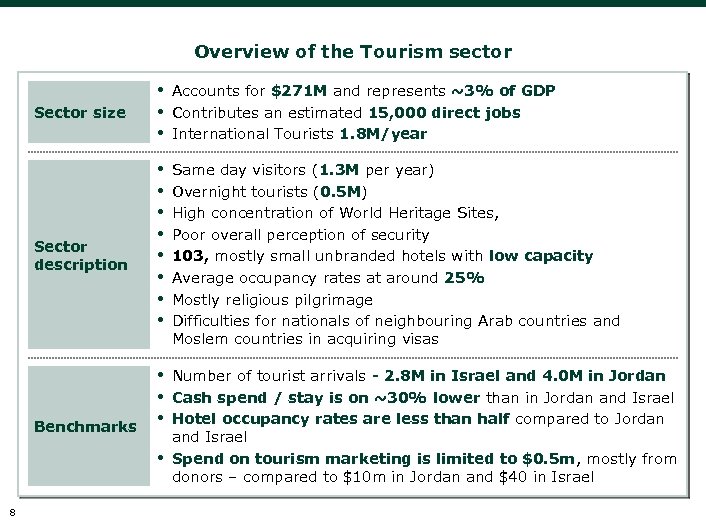
Overview of the Tourism sector Sector size Sector description Benchmarks • • • Accounts for $271 M and represents ~3% of GDP Contributes an estimated 15, 000 direct jobs International Tourists 1. 8 M/year • • Same day visitors (1. 3 M per year) Overnight tourists (0. 5 M) High concentration of World Heritage Sites, Poor overall perception of security 103, mostly small unbranded hotels with low capacity Average occupancy rates at around 25% Mostly religious pilgrimage Difficulties for nationals of neighbouring Arab countries and Moslem countries in acquiring visas • • • Number of tourist arrivals - 2. 8 M in Israel and 4. 0 M in Jordan Cash spend / stay is on ~30% lower than in Jordan and Israel Hotel occupancy rates are less than half compared to Jordan and Israel Spend on tourism marketing is limited to $0. 5 m, mostly from donors – compared to $10 m in Jordan and $40 in Israel • 8
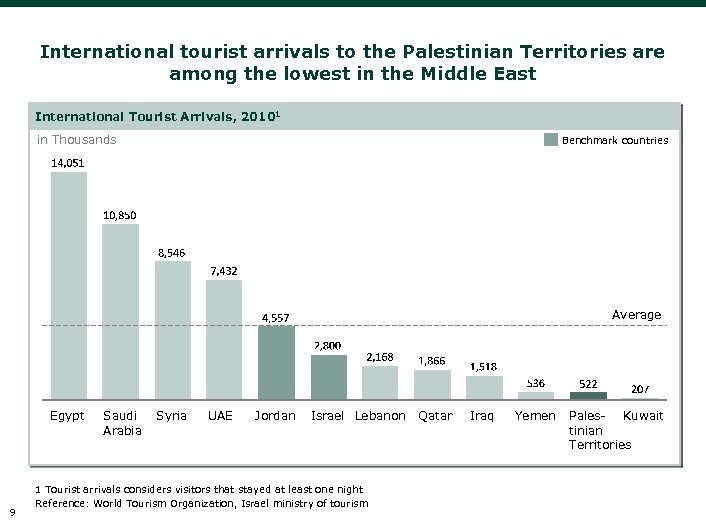
International tourist arrivals to the Palestinian Territories are among the lowest in the Middle East International Tourist Arrivals, 20101 in Thousands Benchmark countries Average Egypt 9 Saudi Arabia Syria UAE Jordan Israel Lebanon 1 Tourist arrivals considers visitors that stayed at least one night Reference: World Tourism Organization, Israel ministry of tourism Qatar Iraq Yemen Pales- Kuwait tinian Territories
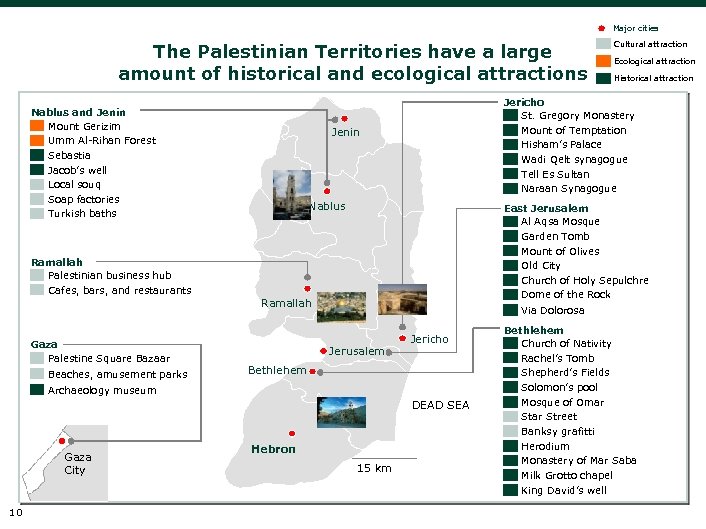
Major cities The Palestinian Territories have a large amount of historical and ecological attractions Nablus and Jenin Mount Gerizim Umm Al-Rihan Forest Sebastia Jacob’s well Local souq Soap factories Turkish baths Ramallah Palestinian business hub Cafes, bars, and restaurants Gaza Palestine Square Bazaar Beaches, amusement parks Jenin Nablus Historical attraction East Jerusalem Al Aqsa Mosque Garden Tomb Mount of Olives Old City Church of Holy Sepulchre Dome of the Rock Ramallah Via Dolorosa Jerusalem Jericho Bethlehem DEAD SEA 10 Ecological attraction Jericho St. Gregory Monastery Mount of Temptation Hisham’s Palace Wadi Qelt synagogue Tell Es Sultan Naraan Synagogue Archaeology museum Gaza City Cultural attraction Hebron 15 km Bethlehem Church of Nativity Rachel’s Tomb Shepherd’s Fields Solomon’s pool Mosque of Omar Street Banksy grafitti Herodium Monastery of Mar Saba Milk Grotto chapel King David’s well
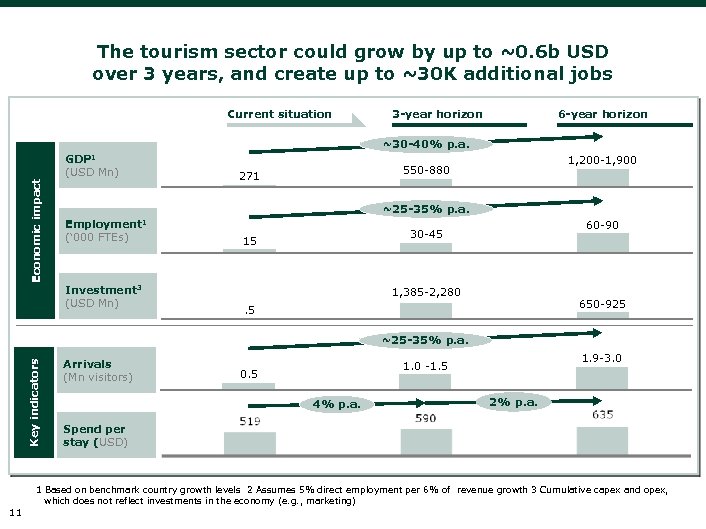
The tourism sector could grow by up to ~0. 6 b USD over 3 years, and create up to ~30 K additional jobs Current situation 3 -year horizon 6 -year horizon Economic impact ~30 -40% p. a. GDP 1 (USD Mn) 1, 200 -1, 900 550 -880 271 ~25 -35% p. a. Employment 1 (‘ 000 FTEs) Investment 3 (USD Mn) 60 -90 30 -45 15 1, 385 -2, 280 650 -925 . 5 Key indicators ~25 -35% p. a. Arrivals (Mn visitors) 1. 9 -3. 0 1. 0 -1. 5 0. 5 4% p. a. 2% p. a. Spend per stay (USD) 1 Based on benchmark country growth levels 2 Assumes 5% direct employment per 6% of revenue growth 3 Cumulative capex and opex, which does not reflect investments in the economy (e. g. , marketing) 11
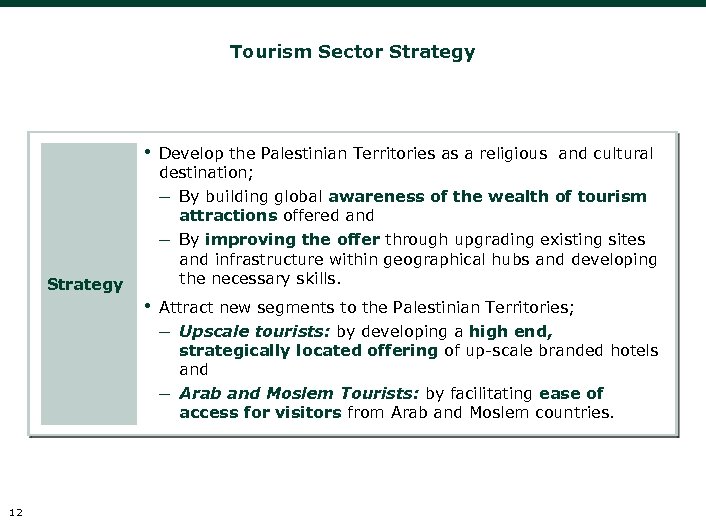
Tourism Sector Strategy • Develop the Palestinian Territories as a religious and cultural destination; – By building global awareness of the wealth of tourism attractions offered and – By improving the offer through upgrading existing sites and infrastructure within geographical hubs and developing the necessary skills. • Attract new segments to the Palestinian Territories; Strategy – Upscale tourists: by developing a high end, strategically located offering of up-scale branded hotels and – Arab and Moslem Tourists: by facilitating ease of access for visitors from Arab and Moslem countries. 12
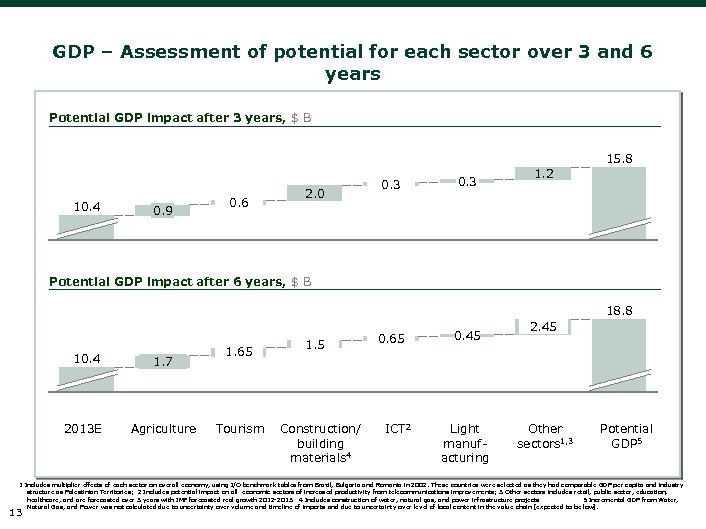
GDP – Assessment of potential for each sector over 3 and 6 years Potential GDP impact after 3 years, $ B 15. 8 10. 4 0. 9 0. 6 2. 0 0. 3 1. 2 Potential GDP impact after 6 years, $ B 18. 8 10. 4 2013 E 1. 7 Agriculture 1. 65 Tourism 1. 5 Construction/ building materials 4 0. 65 ICT 2 0. 45 Light manufacturing 2. 45 Other sectors 1, 3 Potential GDP 5 1 Includes multiplier effects of each sector on overall economy, using I/O benchmark tables from Brazil, Bulgaria and Romania in 2002. These countries were selected as they had comparable GDP per capita and industry structure as Palestinian Territories; 2 Includes potential impact on all economic sectors of increased productivity from telecommunications improvements; 3 Other sectors includes retail, public sector, education, healthcare, and are forecasted over 3 years with IMF forecasted real growth 2012 -2013 4 Includes construction of water, natural gas, and power infrastructure projects 5 Incremental GDP from Water, Natural Gas, and Power was not calculated due to uncertainty over volume and timeline of imports and due to uncertainty over level of local content in the value chain [expected to be low]. 13
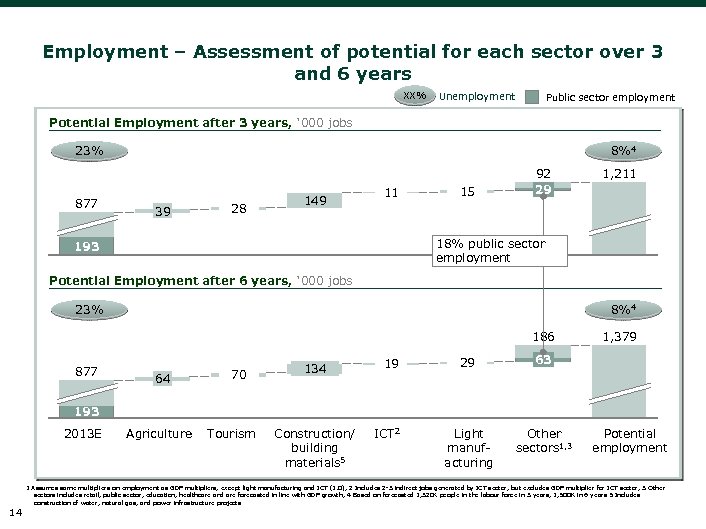
Employment – Assessment of potential for each sector over 3 and 6 years XX% Unemployment Public sector employment Potential Employment after 3 years, ‘ 000 jobs 23% 877 8%4 39 28 149 11 15 92 29 1, 211 18% public sector employment 193 Potential Employment after 6 years, ‘ 000 jobs 23% 8%4 186 877 64 70 134 19 29 63 Light manufacturing Other sectors 1, 379 193 2013 E Agriculture Tourism Construction/ building materials 5 ICT 2 Potential employment 1 Assumes same multipliers on employment as GDP multipliers, except light manufacturing and ICT (1. 0), 2 Includes 2 -3 indirect jobs generated by ICT sector, but excludes GDP multiplier for ICT sector, 3 Other sectors includes retail, public sector, education, healthcare and are forecasted in line with GDP growth, 4 Based on forecasted 1, 320 K people in the labour force in 3 years, 1, 500 K in 6 years 5 Includes construction of water, natural gas, and power infrastructure projects 14
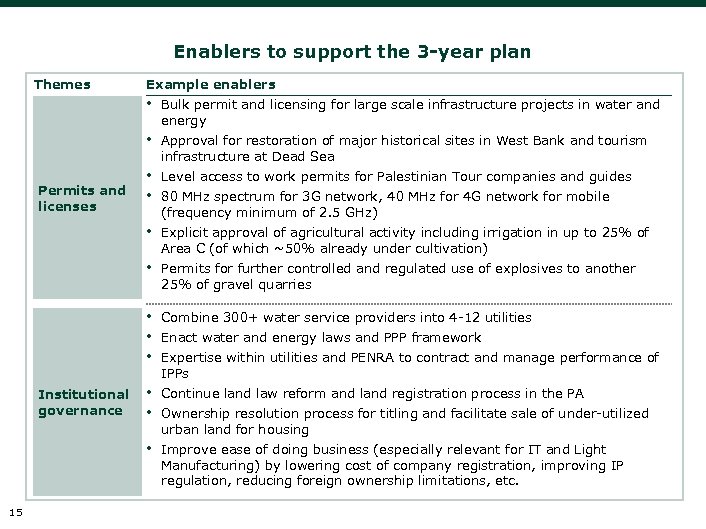
Enablers to support the 3 -year plan Themes Example enablers • • Level access to work permits for Palestinian Tour companies and guides Explicit approval of agricultural activity including irrigation in up to 25% of Area C (of which ~50% already under cultivation) Permits for further controlled and regulated use of explosives to another 25% of gravel quarries • • • Combine 300+ water service providers into 4 -12 utilities • • Continue land law reform and land registration process in the PA • 15 • • • Institutional governance Approval for restoration of major historical sites in West Bank and tourism infrastructure at Dead Sea • Permits and licenses Bulk permit and licensing for large scale infrastructure projects in water and energy Improve ease of doing business (especially relevant for IT and Light Manufacturing) by lowering cost of company registration, improving IP regulation, reducing foreign ownership limitations, etc. 80 MHz spectrum for 3 G network, 40 MHz for 4 G network for mobile (frequency minimum of 2. 5 GHz) Enact water and energy laws and PPP framework Expertise within utilities and PENRA to contract and manage performance of IPPs Ownership resolution process for titling and facilitate sale of under-utilized urban land for housing
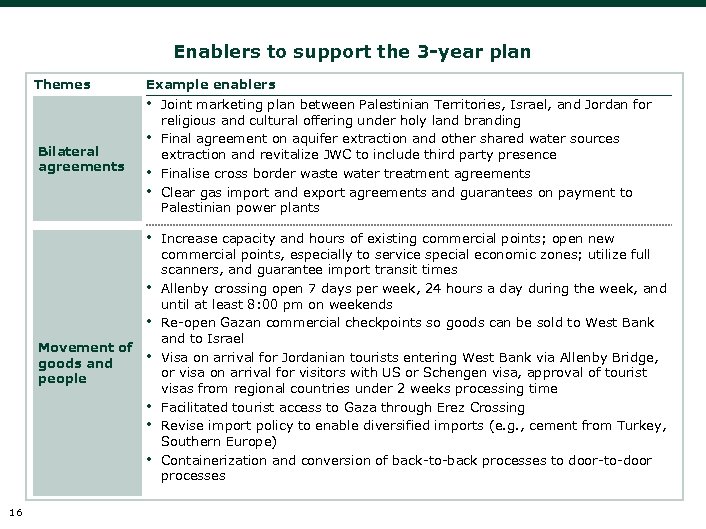
Enablers to support the 3 -year plan Themes Example enablers • Bilateral agreements • • • Movement of goods and people • • 16 Joint marketing plan between Palestinian Territories, Israel, and Jordan for religious and cultural offering under holy land branding Final agreement on aquifer extraction and other shared water sources extraction and revitalize JWC to include third party presence Finalise cross border waste water treatment agreements Clear gas import and export agreements and guarantees on payment to Palestinian power plants Increase capacity and hours of existing commercial points; open new commercial points, especially to service special economic zones; utilize full scanners, and guarantee import transit times Allenby crossing open 7 days per week, 24 hours a day during the week, and until at least 8: 00 pm on weekends Re-open Gazan commercial checkpoints so goods can be sold to West Bank and to Israel Visa on arrival for Jordanian tourists entering West Bank via Allenby Bridge, or visa on arrival for visitors with US or Schengen visa, approval of tourist visas from regional countries under 2 weeks processing time Facilitated tourist access to Gaza through Erez Crossing Revise import policy to enable diversified imports (e. g. , cement from Turkey, Southern Europe) Containerization and conversion of back-to-back processes to door-to-door processes
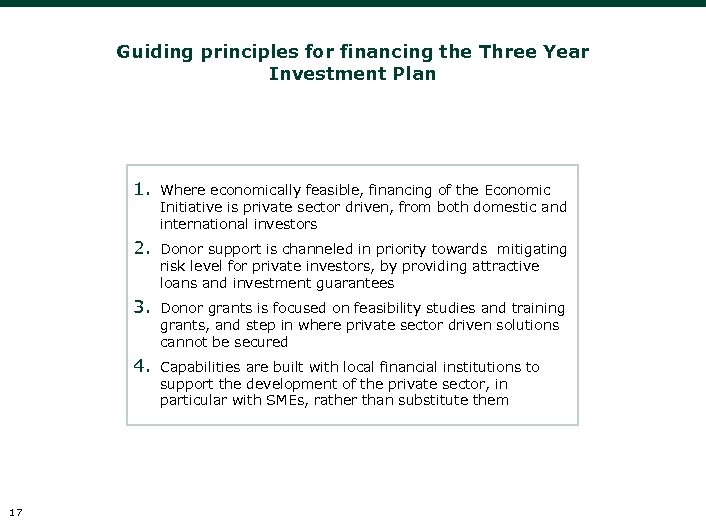
Guiding principles for financing the Three Year Investment Plan 1. 2. Donor support is channeled in priority towards mitigating risk level for private investors, by providing attractive loans and investment guarantees 3. Donor grants is focused on feasibility studies and training grants, and step in where private sector driven solutions cannot be secured 4. 17 Where economically feasible, financing of the Economic Initiative is private sector driven, from both domestic and international investors Capabilities are built with local financial institutions to support the development of the private sector, in particular with SMEs, rather than substitute them
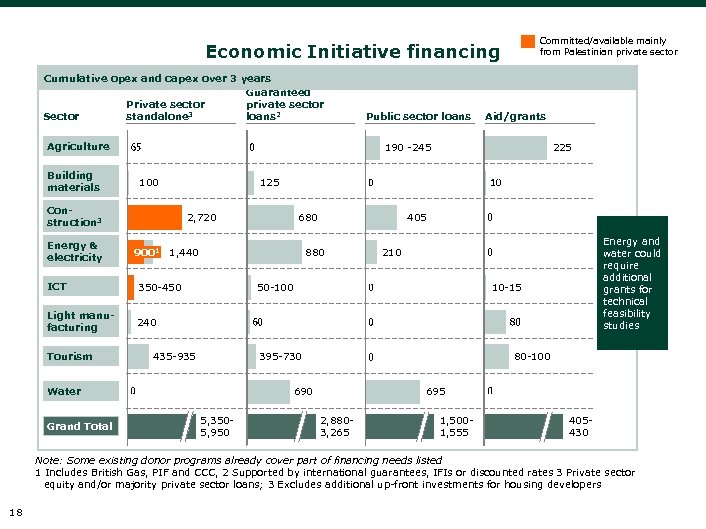
Committed/available mainly from Palestinian private sector Economic Initiative financing Cumulative opex and capex over 3 years Guaranteed Private sector private sector Sector standalone 3 loans 2 Agriculture Building materials Aid/grants 190 -245 100 Construction 3 Energy & electricity Public sector loans 125 2, 720 680 9001 1, 440 ICT 405 880 350 -450 Light manufacturing 225 Energy and water could require additional grants for technical feasibility studies 210 240 Tourism 50 -100 435 -935 395 -730 Water Grand Total 10 -15 80 -100 690 5, 3505, 950 695 2, 8803, 265 1, 5001, 555 405430 Note: Some existing donor programs already cover part of financing needs listed 1 Includes British Gas, PIF and CCC, 2 Supported by international guarantees, IFIs or discounted rates 3 Private sector equity and/or majority private sector loans; 3 Excludes additional up-front investments for housing developers 18
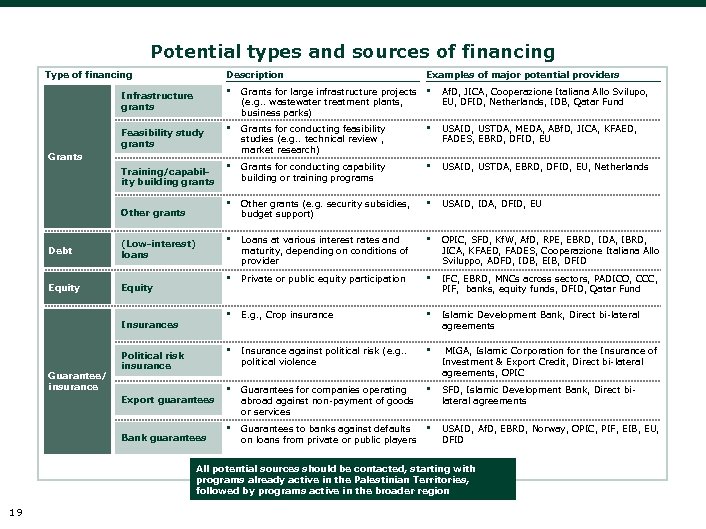
Potential types and sources of financing Type of financing Description • Debt (Low-interest) loans Equity Insurances Guarantee/ insurance Political risk insurance Export guarantees Bank guarantees Grants for conducting feasibility studies (e. g. . technical review , market research) • USAID, USTDA, MEDA, ABf. D, JICA, KFAED, FADES, EBRD, DFID, EU • Grants for conducting capability building or training programs • USAID, USTDA, EBRD, DFID, EU, Netherlands Other grants (e. g. security subsidies, budget support) • USAID, IDA, DFID, EU Loans at various interest rates and maturity, depending on conditions of provider • OPIC, SFD, Kf. W, Af. D, RPE, EBRD, IDA, IBRD, JICA, KFAED, FADES, Cooperazione Italiana Allo Sviluppo, ADFD, IDB, EIB, DFID Private or public equity participation • IFC, EBRD, MNCs across sectors, PADICO, CCC, PIF, banks, equity funds, DFID, Qatar Fund E. g. , Crop insurance • Islamic Development Bank, Direct bi-lateral agreements • Other grants • • Training/capability building grants Af. D, JICA, Cooperazione Italiana Allo Svilupo, EU, DFID, Netherlands, IDB, Qatar Fund • Grants • • Feasibility study grants Grants for large infrastructure projects (e. g. . wastewater treatment plants, business parks) • Infrastructure grants Examples of major potential providers Insurance against political risk (e. g. . political violence • MIGA, Islamic Corporation for the Insurance of Investment & Export Credit, Direct bi-lateral agreements, OPIC • Guarantees for companies operating abroad against non-payment of goods or services • SFD, Islamic Development Bank, Direct bilateral agreements • Guarantees to banks against defaults on loans from private or public players • USAID, Af. D, EBRD, Norway, OPIC, PIF, EIB, EU, DFID All potential sources should be contacted, starting with programs already active in the Palestinian Territories, followed by programs active in the broader region 19
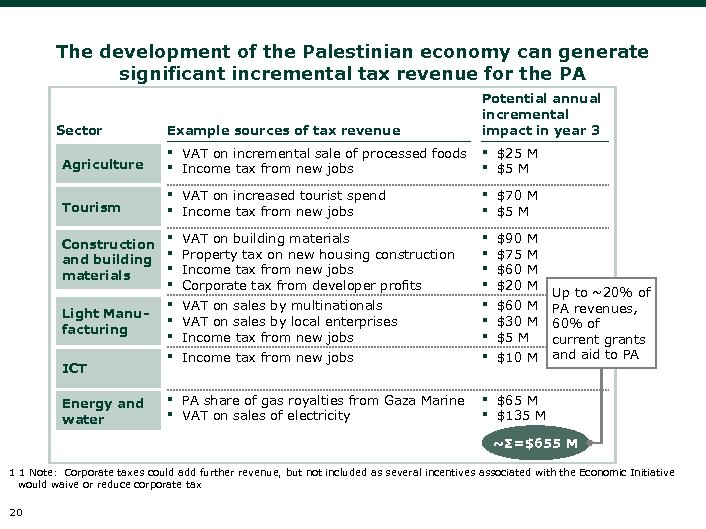
The development of the Palestinian economy can generate significant incremental tax revenue for the PA Example sources of tax revenue Potential annual incremental impact in year 3 Agriculture ▪ ▪ VAT on incremental sale of processed foods Income tax from new jobs ▪ ▪ $25 M $5 M Tourism ▪ ▪ VAT on increased tourist spend Income tax from new jobs ▪ ▪ $70 M $5 M ▪ ▪ ▪ ▪ VAT on building materials Property tax on new housing construction Income tax from new jobs Corporate tax from developer profits $90 $75 $60 $20 Income tax from new jobs ▪ ▪ ▪ ▪ ▪ PA share of gas royalties from Gaza Marine VAT on sales of electricity ▪ ▪ $65 M $135 M Sector Construction and building materials Light Manufacturing ICT Energy and water VAT on sales by multinationals VAT on sales by local enterprises Income tax from new jobs M M $60 M $30 M $5 M $10 M Up to ~20% of PA revenues, 60% of current grants and aid to PA ~Σ=$655 M 1 1 Note: Corporate taxes could add further revenue, but not included as several incentives associated with the Economic Initiative would waive or reduce corporate tax 20
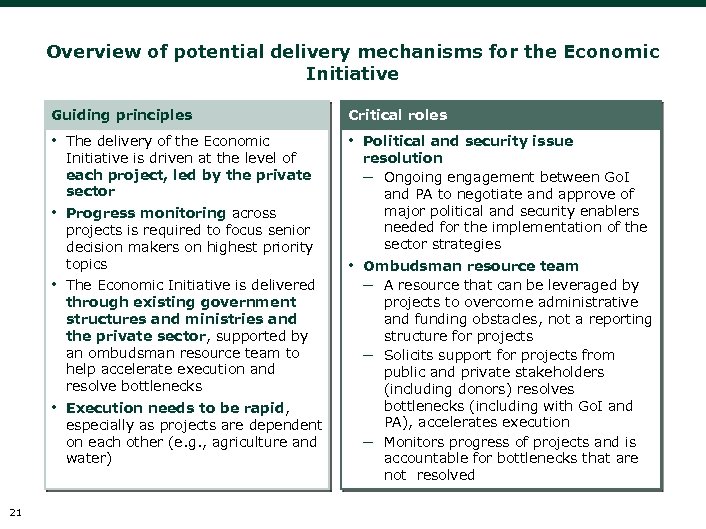
Overview of potential delivery mechanisms for the Economic Initiative Guiding principles Critical roles • The delivery of the Economic Initiative is driven at the level of each project, led by the private sector • • Progress monitoring across projects is required to focus senior decision makers on highest priority topics Political and security issue resolution – Ongoing engagement between Go. I and PA to negotiate and approve of major political and security enablers needed for the implementation of the sector strategies • Ombudsman resource team – A resource that can be leveraged by projects to overcome administrative and funding obstacles, not a reporting structure for projects – Solicits support for projects from public and private stakeholders (including donors) resolves bottlenecks (including with Go. I and PA), accelerates execution – Monitors progress of projects and is accountable for bottlenecks that are not resolved • • 21 The Economic Initiative is delivered through existing government structures and ministries and the private sector, supported by an ombudsman resource team to help accelerate execution and resolve bottlenecks Execution needs to be rapid, especially as projects are dependent on each other (e. g. , agriculture and water)
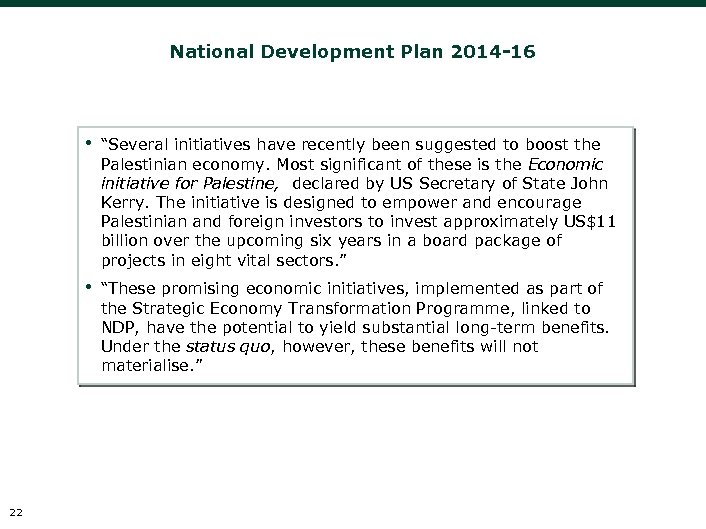
National Development Plan 2014 -16 • • 22 “Several initiatives have recently been suggested to boost the Palestinian economy. Most significant of these is the Economic initiative for Palestine, declared by US Secretary of State John Kerry. The initiative is designed to empower and encourage Palestinian and foreign investors to invest approximately US$11 billion over the upcoming six years in a board package of projects in eight vital sectors. ” “These promising economic initiatives, implemented as part of the Strategic Economy Transformation Programme, linked to NDP, have the potential to yield substantial long-term benefits. Under the status quo, however, these benefits will not materialise. ”
Скачать презентацию Economic Initiative for the Palestinian economy Nairobi July
4b2ee97766a283251957b517ef09435e.ppt