


 Скачать презентацию Economic Information Empowering Change Presentation of the WDR
f24de01d837f481d9e3801f862a17903.ppt
- Количество слайдов: 24
 Economic Information Empowering Change Presentation of the WDR ’ 01 Consultative Meeting on Role of Media: Access to Business and Economic Information April 12, 2001 World Bank Institute D. Kaufmann & M. Nelson with R. Mac. Donell, R. Stapenhurst, and T. Carrington http: //www. worldbank. org/wbi/governance
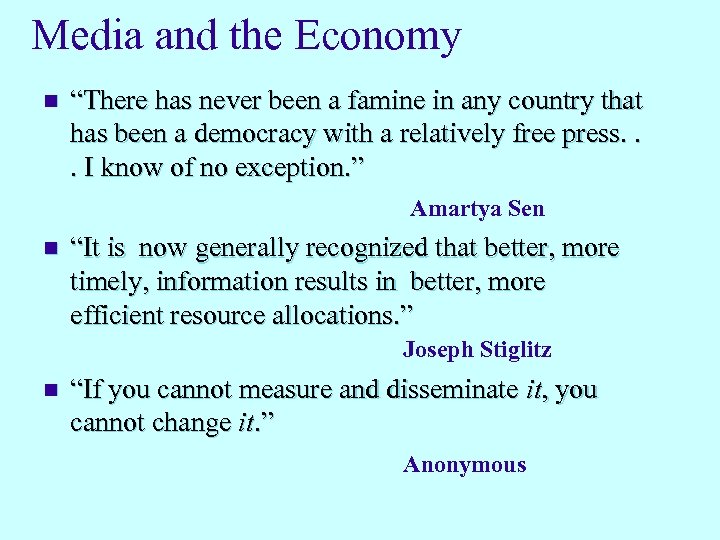 Media and the Economy n “There has never been a famine in any country that has been a democracy with a relatively free press. . . I know of no exception. ” Amartya Sen n “It is now generally recognized that better, more timely, information results in better, more efficient resource allocations. ” Joseph Stiglitz n “If you cannot measure and disseminate it, you cannot change it. ” Anonymous
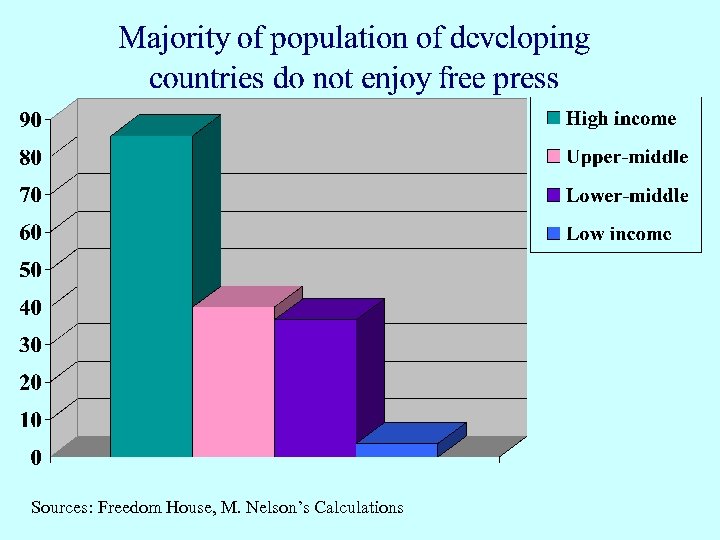 Sources: Freedom House, M. Nelson’s Calculations
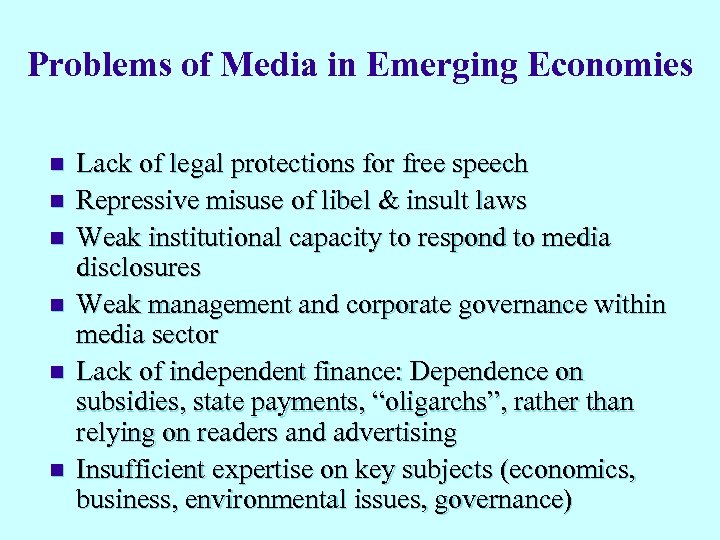 Problems of Media in Emerging Economies n n n Lack of legal protections for free speech Repressive misuse of libel & insult laws Weak institutional capacity to respond to media disclosures Weak management and corporate governance within media sector Lack of independent finance: Dependence on subsidies, state payments, “oligarchs”, rather than relying on readers and advertising Insufficient expertise on key subjects (economics, business, environmental issues, governance)
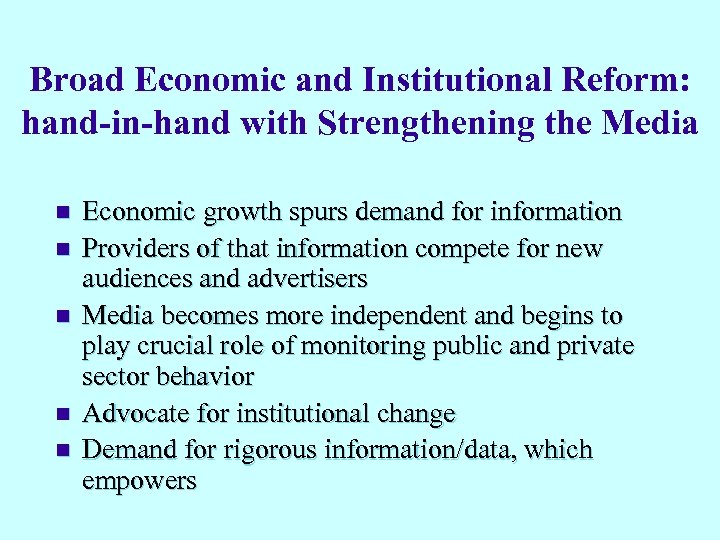 Broad Economic and Institutional Reform: hand-in-hand with Strengthening the Media n n n Economic growth spurs demand for information Providers of that information compete for new audiences and advertisers Media becomes more independent and begins to play crucial role of monitoring public and private sector behavior Advocate for institutional change Demand for rigorous information/data, which empowers
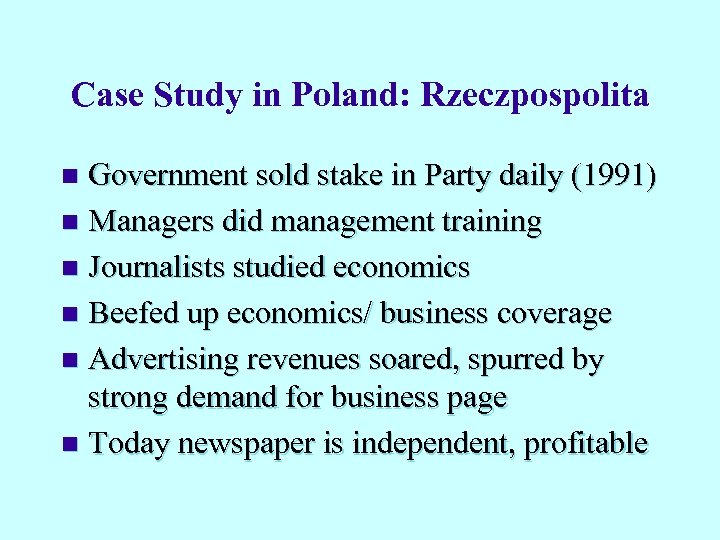 Case Study in Poland: Rzeczpospolita Government sold stake in Party daily (1991) n Managers did management training n Journalists studied economics n Beefed up economics/ business coverage n Advertising revenues soared, spurred by strong demand for business page n Today newspaper is independent, profitable n
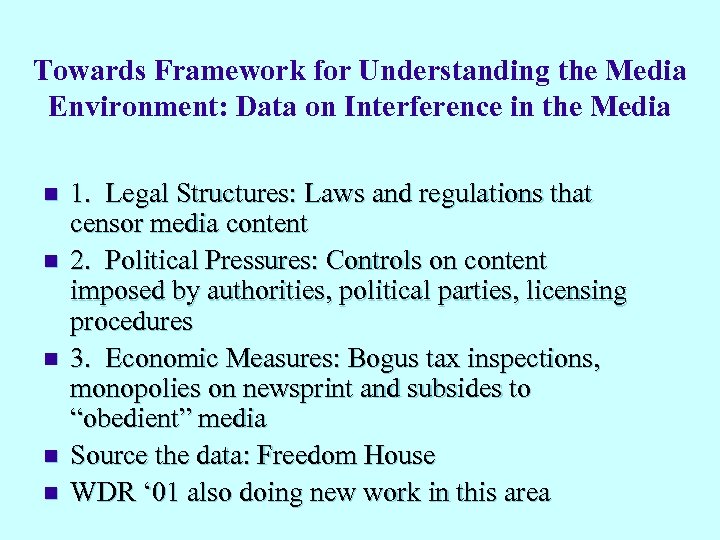 Towards Framework for Understanding the Media Environment: Data on Interference in the Media n n n 1. Legal Structures: Laws and regulations that censor media content 2. Political Pressures: Controls on content imposed by authorities, political parties, licensing procedures 3. Economic Measures: Bogus tax inspections, monopolies on newsprint and subsides to “obedient” media Source the data: Freedom House WDR ‘ 01 also doing new work in this area
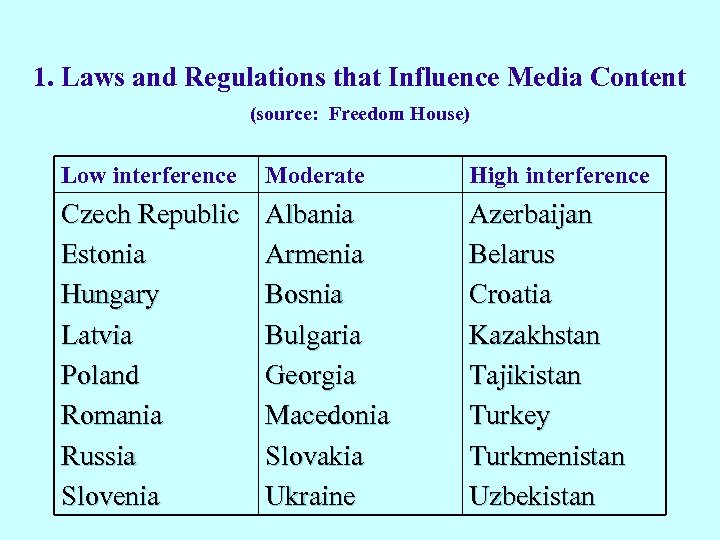 1. Laws and Regulations that Influence Media Content (source: Freedom House) Low interference Moderate High interference Czech Republic Estonia Hungary Latvia Poland Romania Russia Slovenia Albania Armenia Bosnia Bulgaria Georgia Macedonia Slovakia Ukraine Azerbaijan Belarus Croatia Kazakhstan Tajikistan Turkey Turkmenistan Uzbekistan
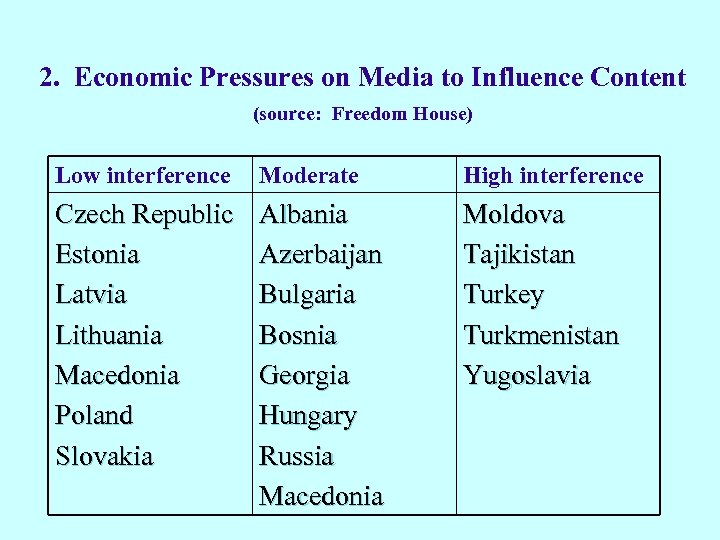 2. Economic Pressures on Media to Influence Content (source: Freedom House) Low interference Moderate High interference Czech Republic Estonia Latvia Lithuania Macedonia Poland Slovakia Albania Azerbaijan Bulgaria Bosnia Georgia Hungary Russia Macedonia Moldova Tajikistan Turkey Turkmenistan Yugoslavia
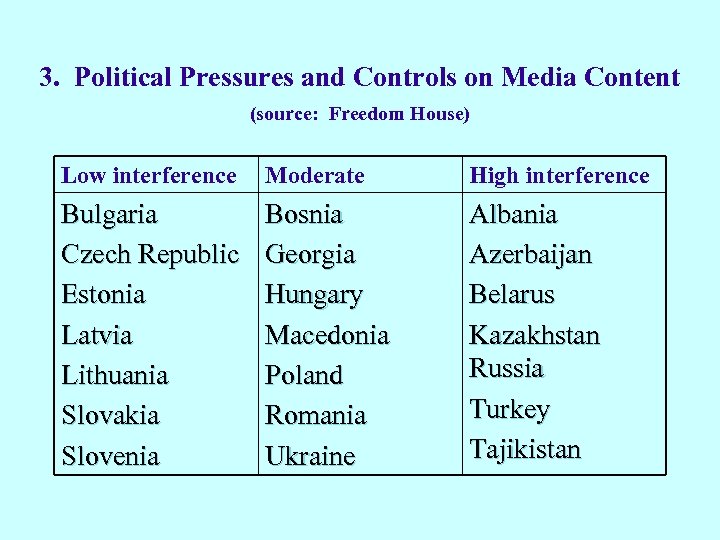 3. Political Pressures and Controls on Media Content (source: Freedom House) Low interference Moderate High interference Bulgaria Czech Republic Estonia Latvia Lithuania Slovakia Slovenia Bosnia Georgia Hungary Macedonia Poland Romania Ukraine Albania Azerbaijan Belarus Kazakhstan Russia Turkey Tajikistan
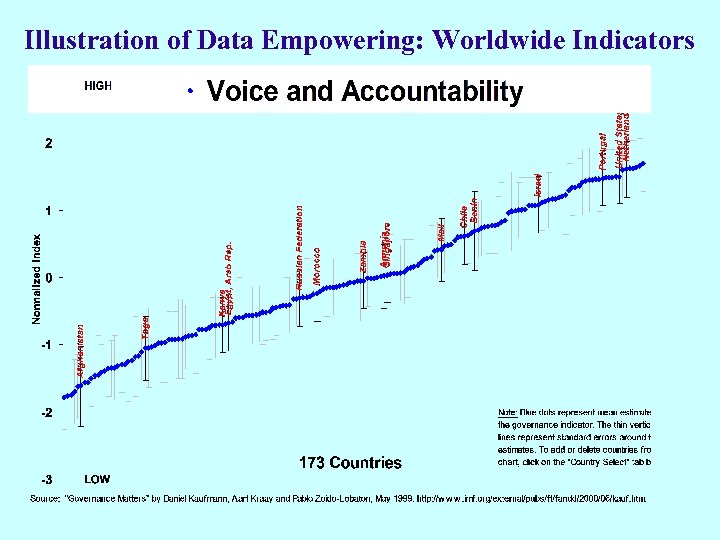 Illustration of Data Empowering: Worldwide Indicators
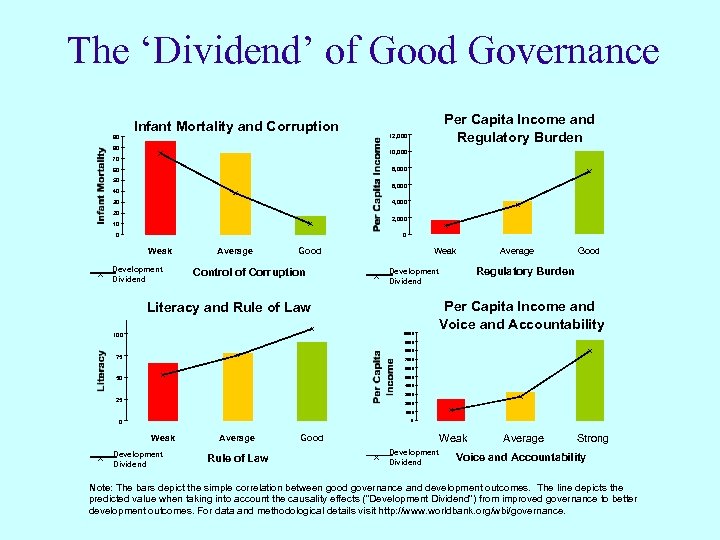
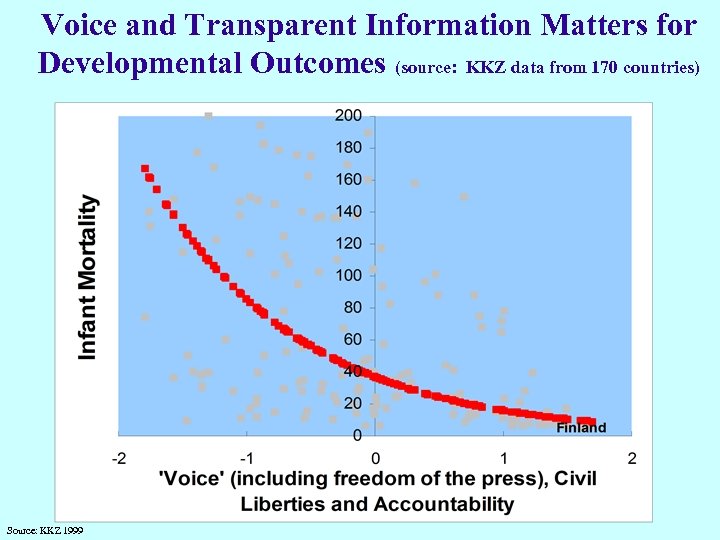 Voice and Transparent Information Matters for Developmental Outcomes (source: KKZ data from 170 countries) Source: KKZ 1999
![Control of Corruption and Freedom of the Press Control of Corruption [kkz] High Low](https://present5.com/presentation/f24de01d837f481d9e3801f862a17903/image-13.jpg "Control of Corruption and Freedom of the Press Control of Corruption [kkz] High Low") Control of Corruption and Freedom of the Press Control of Corruption [kkz] High Low Freedom of the Press (Freedom House) High
Control of Corruption and Freedom of the Press Control of Corruption [kkz] High Low Freedom of the Press (Freedom House) High
 The ‘Dividend’ of Good Governance Infant Mortality and Corruption Per Capita Income and Regulatory Burden 12, 000 90 80 10, 000 70 8, 000 60 50 6, 000 40 4, 000 30 20 2, 000 10 0 0 Weak x Development Dividend Average Weak Good Control of Corruption x 10000 Good Regulatory Burden Development Dividend Literacy and Rule of Law Average Per Capita Income and Voice and Accountability 9000 8000 75 7000 6000 50 4000 3000 25 2000 1000 0 0 Weak x Development Dividend Average Rule of Law Weak Good x Development Dividend Average Strong Voice and Accountability Note: The bars depict the simple correlation between good governance and development outcomes. The line depicts the predicted value when taking into account the causality effects (“Development Dividend”) from improved governance to better development outcomes. For data and methodological details visit http: //www. worldbank. org/wbi/governance.
 %of all Firms report negative impact of grand corruption Firms Reporting Negative Impact of High Level Corruption ‘State Capture’ Source: WBES Survey 1999, 20 transition countries 50 % 45 % 40 % 35 % 30 % 25 % 20 % 15 % 10 % 5% 0 Hungary Estonia Adverse Impact of ‘Purchases’ of: Russia Parliamentary legislation Azerbaijan Decrees Central Bank Influence
 State Capture exists where incomplete Civil Liberties and slow Economic Reforms Very High State Capture Degree of Economic Reforms Degree of Civil Liberties in Transition Economies http: //www. worldbank. org/wbi/governance
 The Media within Institutional Reform n n n Controlled media is at the heart of political power in many weak, unstable regimes Media was also central to establishment of oligarchy in post-Soviet states When free and competent, has huge cross-sectoral and cross-institutional reach Deregulation of media early in reform process has big impact (Poland) Must be coupled with other institutional reforms (Russia)
 What Some Countries Do Public sector reforms that stress public access to records, documents, decisions n Eliminate “insult laws” aimed to protect leaders; liberalize libel laws; strengthen free speech protections n Privatize state media and detach broadcasting regulators from political influence n
 Role of IFI’s and Donors n n n Set an example by providing access to documents, decisions, people, data – internet power… Emphasize access in public sector reforms Encourage governments (central, regional, local) to end subsidies to media Involve media early in governance diagnostics, in good governance programs, CDF, PRSP and other consultative processes Train media in management, specialized journalistic fields
 A Learning Program Illustration: Regional Media Capacity Building in Russia/CIS n n n Based on needs assessment done 1999 -2000 Management training network in five Russian cities (expand to Ukraine later) Will train 1200 managers of local and regional newspapers over three years Focus: Financial independence, budgeting Follow-up training of journalists in economics and business and investigative journalism General: Also, major learning programs in business/economic journalism and in media development in Latin America, Asia, Africa.
 WBI Investigative Journalism Program – Current Developments n n Ø n n Core Course Offered by DL – approx 500 journalists in FY 01 in Africa, LAC (English, French, Spanish + Portuguese) Internet Course – advanced stage of development – will be offered on a pilot basis Spring 2001. Access to information a key component of these courses Media self regulation + codes of conduct under development, in collaboration with Commonwealth Press Union Major program of learning/training with partners for thousands of journalists in latin america
 Setting Priorities n n n Because nature of media-power relationship, many nonfree states fear freedom of media But many also realize early need for strong business and economics coverage (“Asian Tigers, ” now China) An hypothesis: competent economics journalism leads to stronger independent financial position and political opening for all media (SE Asia, Central Europe, Baltics)
 Issues within the Media n n Television and radio are last to leave state control (Western Europe, BBC) Distinction between printed media (no subsidies should be given? ) and other media? Cultural and language issues also play a role (France, Belgium) Newspapers and power of internet can have big impact on accountability and raising overall quality of all media
 Myths? n n State ownership is main problem for media in developing countries (instead: political, economic and legal obstructiveness is much more rampant and difficult to address) The media is a “tool” for development, education, environmental awareness (instead: a free media will increase the flow of information among players in developmental processes but independence demands that it be no one’s tool)