


 Скачать презентацию Economic Impacts of Large Scale Freight Investments presented
bc6994b9e3571cc6f607e60ed18fe9d3.ppt
- Количество слайдов: 27
 Economic Impacts of Large Scale Freight Investments presented to Talking Freight Seminar presented by Michael Fischer Cambridge Systematics, Inc. December 12, 2007 Transportation leadership you can trust.
 Overview Background and Purpose Economic Impact Analysis Framework Case Study – Baltimore Rail Tunnel Overview of Toolbox 1
 What Is Economic Impact Analysis? Investments affect transportation system performance Transportation system performance affects business costs, output, and profitability – economic effects Economic effects impact general economy • Output (GDP), employment, income – macro economy • Geography of effects • Incidence of effects Focus of guidebook is economic effects • National scale of benefits – large scale • Public vs. private impacts • Logistics and supply chain effects – second order 2
 Challenges for Evaluating Large Scale Projects Public benefit consideration National level significance Multiple modes of travel Allocation of costs and benefits among wide array of stakeholders 3
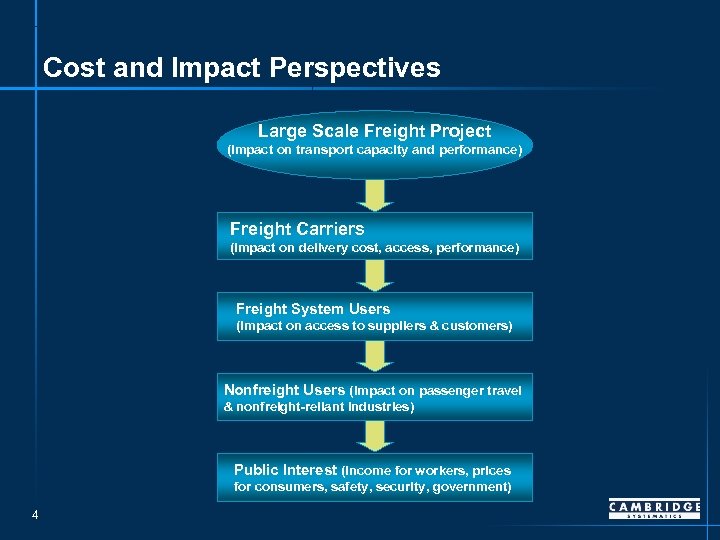 Cost and Impact Perspectives Large Scale Freight Project (impact on transport capacity and performance) Freight Carriers (impact on delivery cost, access, performance) Freight System Users (impact on access to suppliers & customers) Nonfreight Users (impact on passenger travel (impact on Freight Users Non & nonfreight-reliant industries) Public Interest (income for workers, prices for consumers, safety, security, government) 4
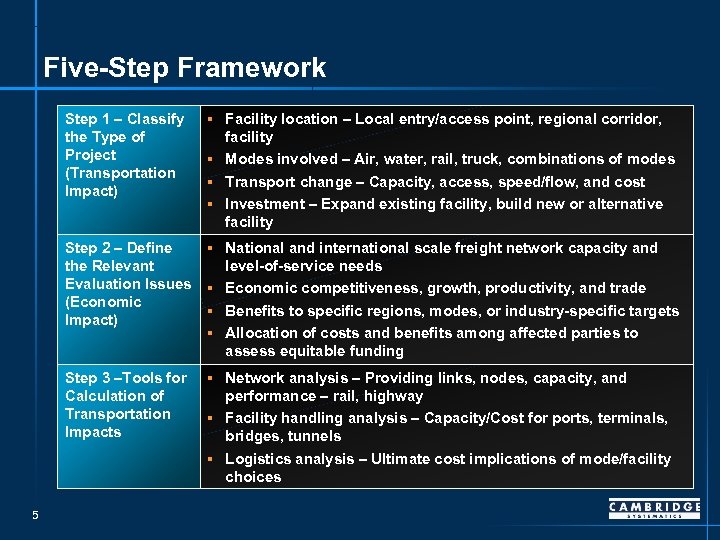 Five-Step Framework Step 1 – Classify the Type of Project (Transportation Impact) Facility location – Local entry/access point, regional corridor, facility § Modes involved – Air, water, rail, truck, combinations of modes § Transport change – Capacity, access, speed/flow, and cost § Investment – Expand existing facility, build new or alternative facility § Step 2 – Define § National and international scale freight network capacity and the Relevant level-of-service needs Evaluation Issues § Economic competitiveness, growth, productivity, and trade (Economic § Benefits to specific regions, modes, or industry-specific targets Impact) § Allocation of costs and benefits among affected parties to assess equitable funding Step 3 –Tools for Calculation of Transportation Impacts 5 Network analysis – Providing links, nodes, capacity, and performance – rail, highway § Facility handling analysis – Capacity/Cost for ports, terminals, bridges, tunnels § Logistics analysis – Ultimate cost implications of mode/facility choices §
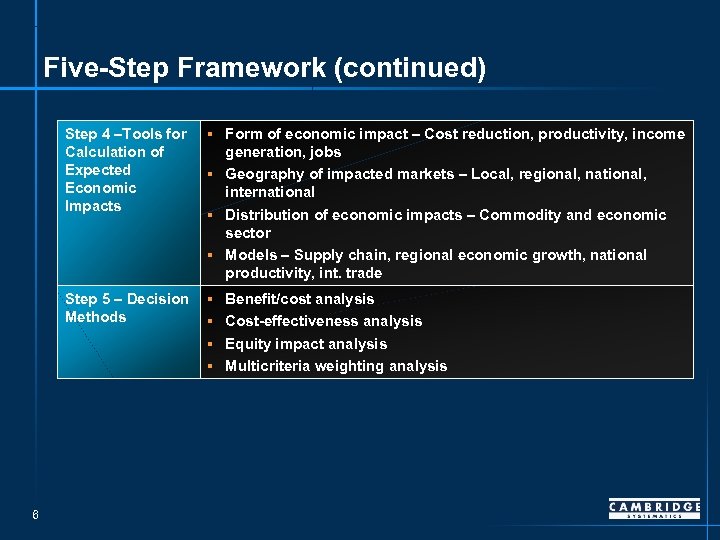 Five-Step Framework (continued) Step 4 –Tools for Calculation of Expected Economic Impacts Form of economic impact – Cost reduction, productivity, income generation, jobs § Geography of impacted markets – Local, regional, national, international § Distribution of economic impacts – Commodity and economic sector § Models – Supply chain, regional economic growth, national productivity, int. trade § Step 5 – Decision § Benefit/cost analysis Methods § Cost-effectiveness analysis § Equity impact analysis § Multicriteria weighting analysis 6
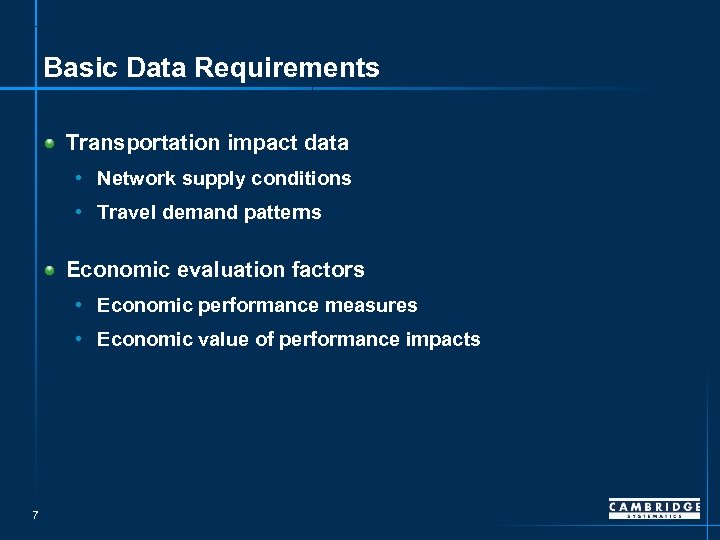 Basic Data Requirements Transportation impact data • Network supply conditions • Travel demand patterns Economic evaluation factors • Economic performance measures • Economic value of performance impacts 7
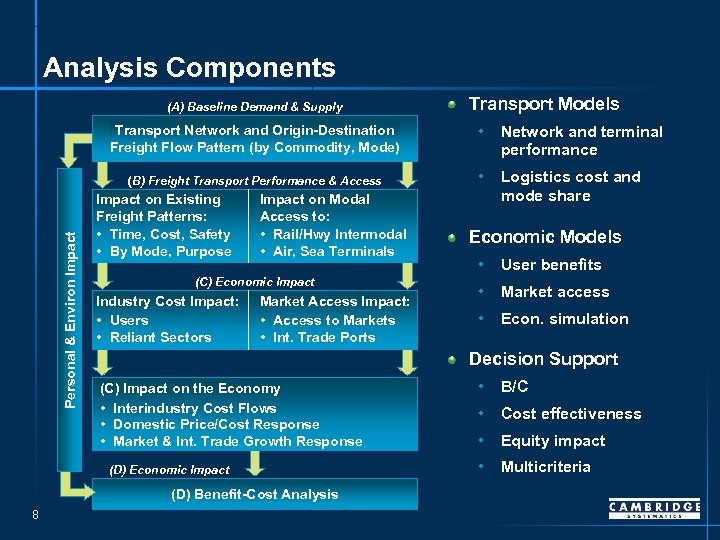 Analysis Components (A) Baseline Demand & Supply Transport Network and Origin-Destination Freight Flow Pattern (by Commodity, Mode) Personal & Environ Impact (B) Freight Transport Performance & Access Impact on Existing Freight Patterns: • Time, Cost, Safety • By Mode, Purpose Impact on Modal Access to: • Rail/Hwy Intermodal • Air, Sea Terminals (C) Economic Impact Industry Cost Impact: • Users • Reliant Sectors Market Access Impact: • Access to Markets • Int. Trade Ports • Network and terminal performance • Logistics cost and mode share Economic Models • User benefits • Market access • Econ. simulation Decision Support (C) Impact on the Economy • Interindustry Cost Flows • Domestic Price/Cost Response • Market & Int. Trade Growth Response (D) Economic Impact (D) Benefit-Cost Analysis 8 Transport Models • B/C • Cost effectiveness • Equity impact • Multicriteria
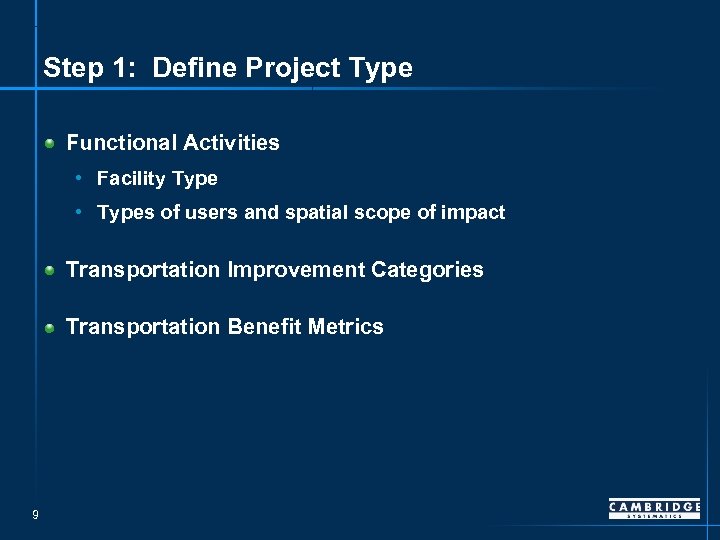 Step 1: Define Project Type Functional Activities • Facility Type • Types of users and spatial scope of impact Transportation Improvement Categories Transportation Benefit Metrics 9
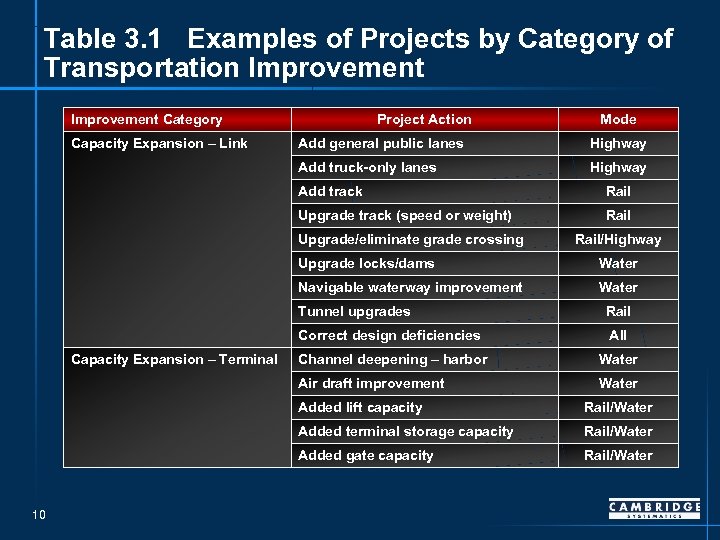 Table 3. 1 Examples of Projects by Category of Transportation Improvement Category Capacity Expansion – Link Project Action Mode Add general public lanes Highway Add truck-only lanes Highway Add track Rail Upgrade track (speed or weight) Rail Upgrade/eliminate grade crossing Rail/Highway Upgrade locks/dams Water Navigable waterway improvement Water Tunnel upgrades Correct design deficiencies All Channel deepening – harbor Water Air draft improvement Capacity Expansion – Terminal Rail Water Added lift capacity Added terminal storage capacity Rail/Water Added gate capacity 10 Rail/Water
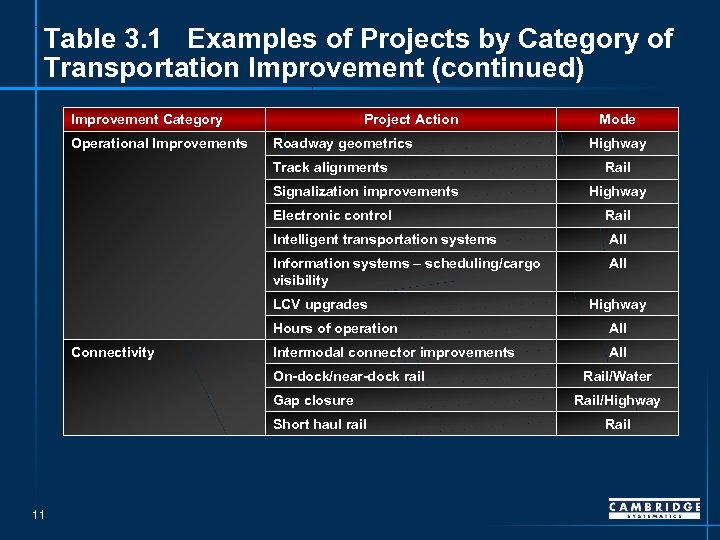 Table 3. 1 Examples of Projects by Category of Transportation Improvement (continued) Improvement Category Operational Improvements Project Action Roadway geometrics Track alignments Signalization improvements Mode Highway Rail Highway Electronic control Rail Intelligent transportation systems All Information systems – scheduling/cargo visibility All LCV upgrades Highway Hours of operation Connectivity All Intermodal connector improvements All On-dock/near-dock rail Gap closure Short haul rail 11 Rail/Water Rail/Highway Rail
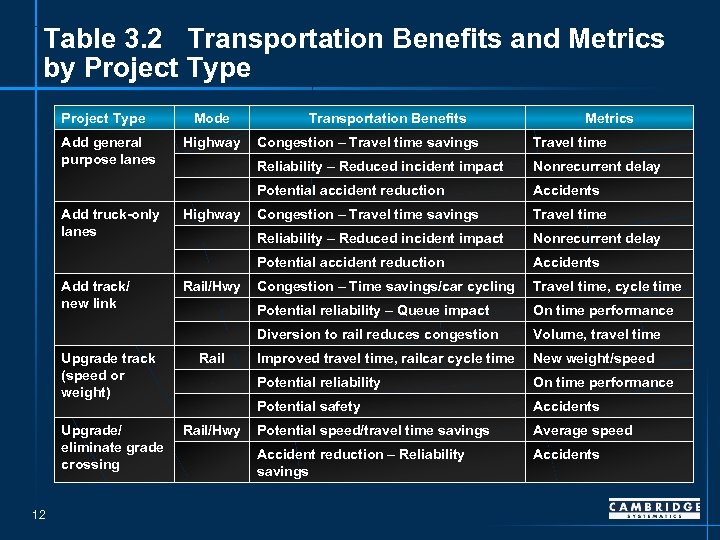 Table 3. 2 Transportation Benefits and Metrics by Project Type Add general purpose lanes Mode Metrics Upgrade/ eliminate grade crossing 12 Nonrecurrent delay Accidents Congestion – Time savings/car cycling Travel time, cycle time On time performance Volume, travel time Improved travel time, railcar cycle time New weight/speed Potential reliability On time performance Potential safety Rail/Hwy Travel time Potential reliability – Queue impact Rail Congestion – Travel time savings Diversion to rail reduces congestion Upgrade track (speed or weight) Accidents Reliability – Reduced incident impact Rail/Hwy Nonrecurrent delay Potential accident reduction Add track/ new link Travel time Reliability – Reduced incident impact Highway Congestion – Travel time savings Potential accident reduction Add truck-only lanes Highway Transportation Benefits Accidents Potential speed/travel time savings Average speed Accident reduction – Reliability savings Accidents
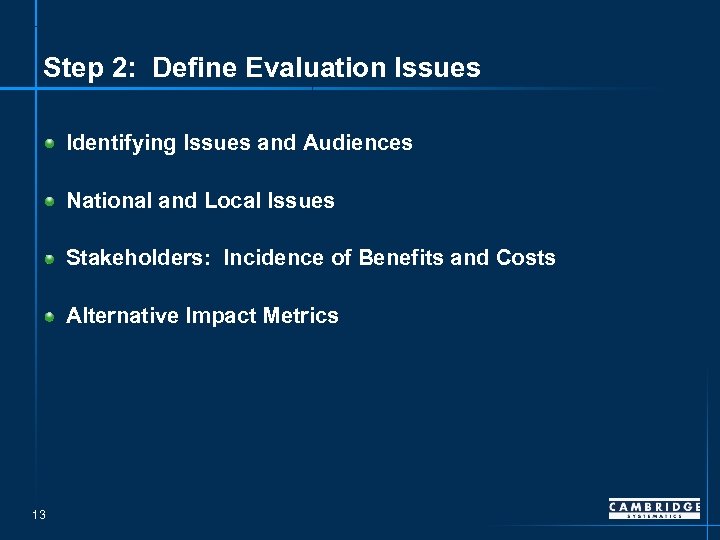 Step 2: Define Evaluation Issues Identifying Issues and Audiences National and Local Issues Stakeholders: Incidence of Benefits and Costs Alternative Impact Metrics 13
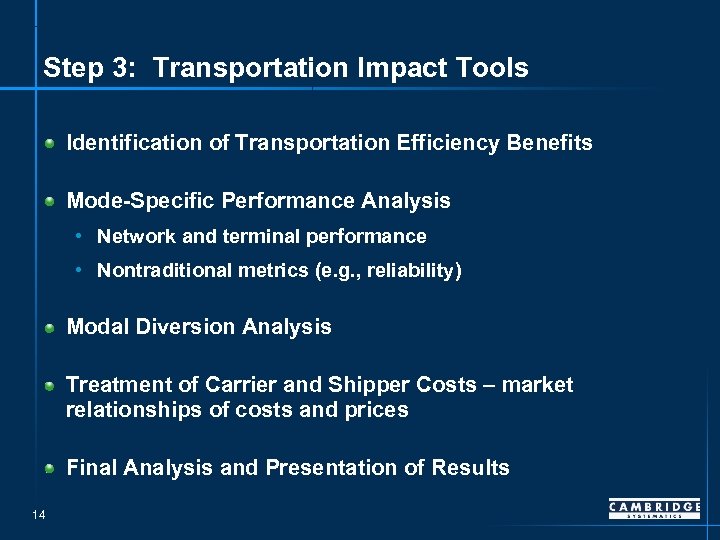 Step 3: Transportation Impact Tools Identification of Transportation Efficiency Benefits Mode-Specific Performance Analysis • Network and terminal performance • Nontraditional metrics (e. g. , reliability) Modal Diversion Analysis Treatment of Carrier and Shipper Costs – market relationships of costs and prices Final Analysis and Presentation of Results 14
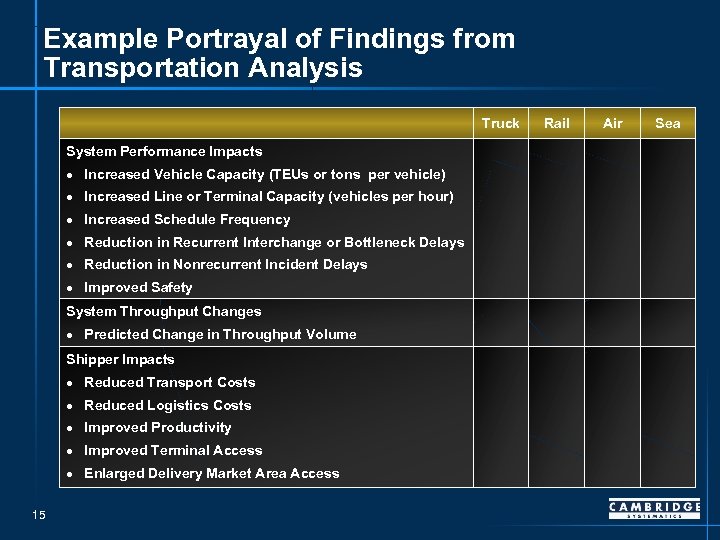 Example Portrayal of Findings from Transportation Analysis Truck System Performance Impacts Increased Vehicle Capacity (TEUs or tons per vehicle) Increased Line or Terminal Capacity (vehicles per hour) Increased Schedule Frequency Reduction in Recurrent Interchange or Bottleneck Delays Reduction in Nonrecurrent Incident Delays Improved Safety System Throughput Changes Predicted Change in Throughput Volume Shipper Impacts Reduced Transport Costs Reduced Logistics Costs Improved Productivity Improved Terminal Access Enlarged Delivery Market Area Access 15 Rail Air Sea
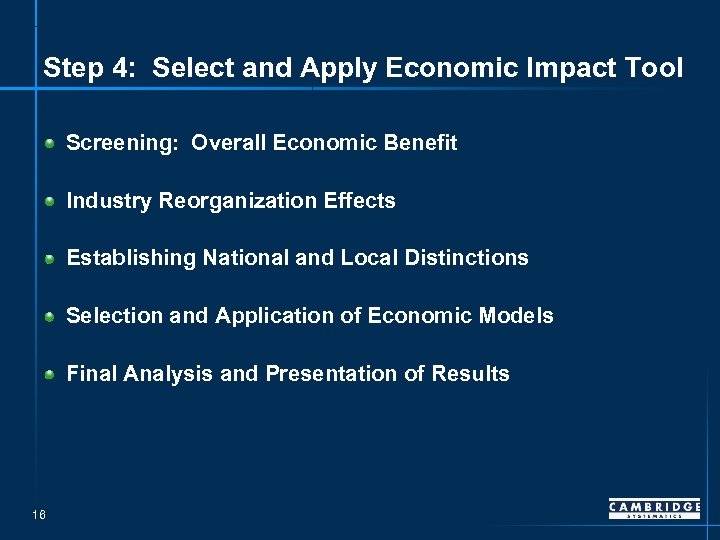 Step 4: Select and Apply Economic Impact Tool Screening: Overall Economic Benefit Industry Reorganization Effects Establishing National and Local Distinctions Selection and Application of Economic Models Final Analysis and Presentation of Results 16
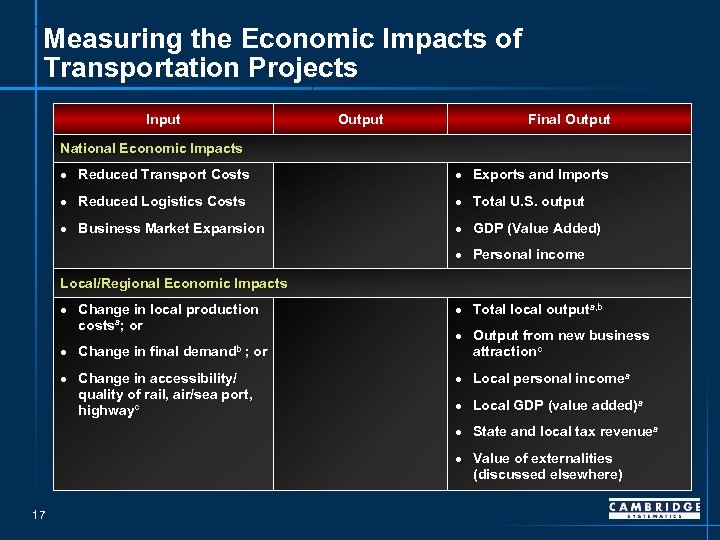 Measuring the Economic Impacts of Transportation Projects Input Output Final Output National Economic Impacts Reduced Transport Costs Exports and Imports Reduced Logistics Costs Total U. S. output Business Market Expansion GDP (Value Added) Personal income Local/Regional Economic Impacts Change in local production costsa; or Change in final demandb ; or Change in accessibility/ quality of rail, air/sea port, highwayc Total local outputa, b Output from new business attractionc Local personal incomea Local GDP (value added)a State and local tax revenuea Value of externalities (discussed elsewhere) 17
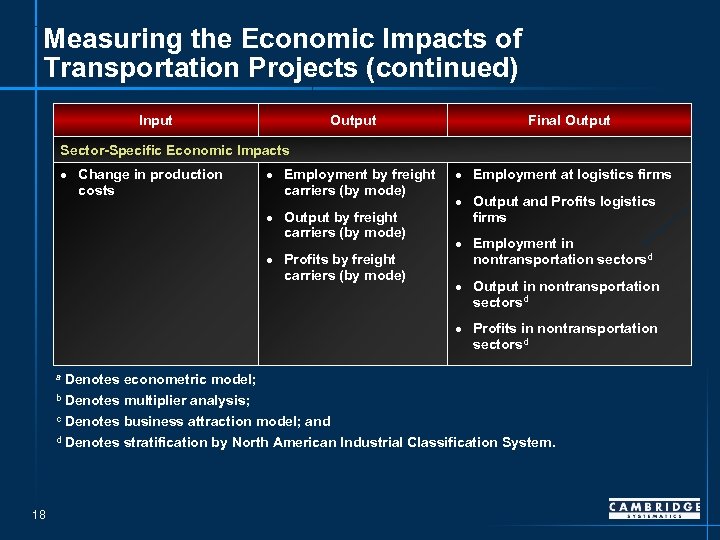 Measuring the Economic Impacts of Transportation Projects (continued) Input Output Final Output Sector-Specific Economic Impacts Change in production costs Employment by freight carriers (by mode) Output by freight carriers (by mode) Profits by freight carriers (by mode) Employment at logistics firms Output and Profits logistics firms Employment in nontransportation sectorsd Output in nontransportation sectorsd Profits in nontransportation sectorsd a Denotes econometric model; b Denotes multiplier analysis; Denotes business attraction model; and d Denotes stratification by North American Industrial Classification System. c 18
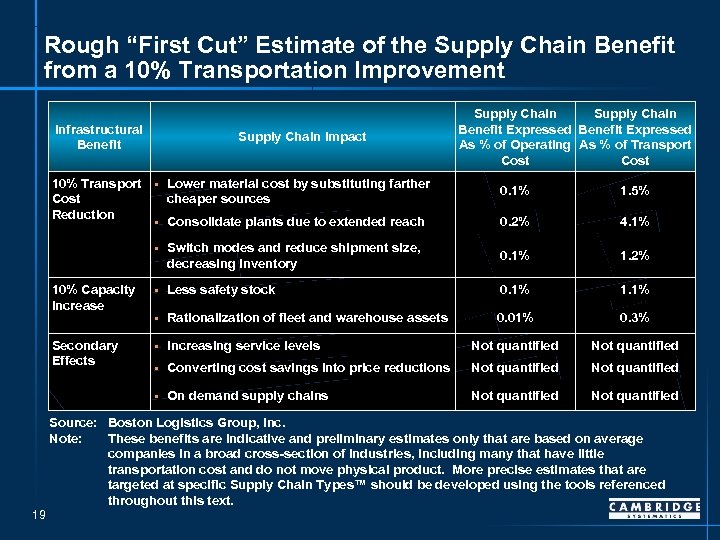 Rough “First Cut” Estimate of the Supply Chain Benefit from a 10% Transportation Improvement Infrastructural Benefit Supply Chain Impact 10% Transport § Lower material cost by substituting farther Cost cheaper sources Reduction § Consolidate plants due to extended reach § Switch modes and reduce shipment size, decreasing inventory Supply Chain Benefit Expressed As % of Operating As % of Transport Cost 0. 1% 1. 5% 0. 2% 4. 1% 0. 1% 1. 2% 0. 1% 1. 1% 0. 01% 0. 3% 10% Capacity Increase § Less safety stock Secondary Effects § Increasing service levels Not quantified § Converting cost savings into price reductions Not quantified § On demand supply chains Not quantified § Rationalization of fleet and warehouse assets Source: Boston Logistics Group, Inc. Note: These benefits are indicative and preliminary estimates only that are based on average companies in a broad cross-section of industries, including many that have little transportation cost and do not move physical product. More precise estimates that are targeted at specific Supply Chain Types™ should be developed using the tools referenced throughout this text. 19
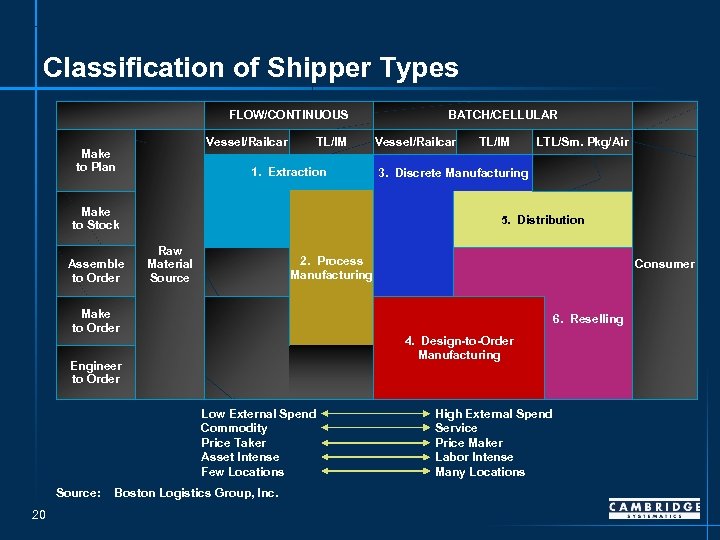 Classification of Shipper Types FLOW/CONTINUOUS Vessel/Railcar Make to Plan TL/IM 1. Extraction Make to Stock Assemble to Order Raw Material Source TL/IM LTL/Sm. Pkg/Air 3. Discrete Manufacturing 2. Process Manufacturing Consumer 6. Reselling 4. Design-to-Order Manufacturing Engineer to Order Low External Spend Commodity Price Taker Asset Intense Few Locations 20 Vessel/Railcar 5. Distribution Make to Order Source: BATCH/CELLULAR Boston Logistics Group, Inc. High External Spend Service Price Maker Labor Intense Many Locations
 Step 5: Select and Apply Decision Models Alternative Views of Benefits Benefit-Cost Calculation and Presentation Incidence and Equity of Benefits and Costs 21
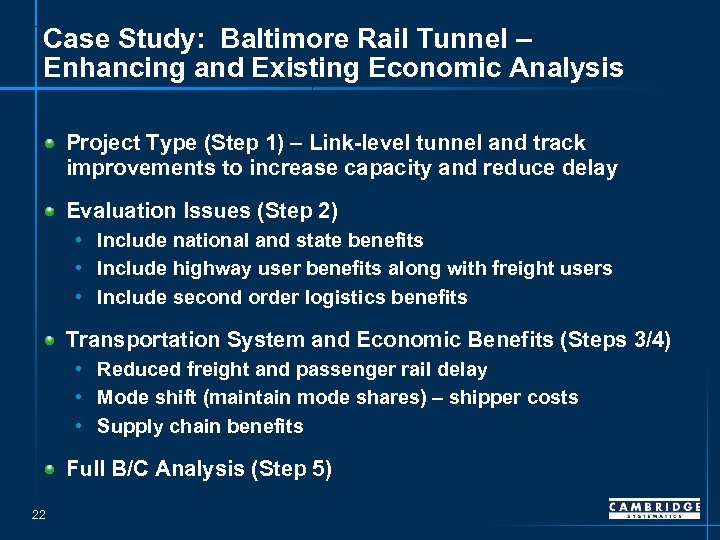 Case Study: Baltimore Rail Tunnel – Enhancing and Existing Economic Analysis Project Type (Step 1) – Link-level tunnel and track improvements to increase capacity and reduce delay Evaluation Issues (Step 2) • Include national and state benefits • Include highway user benefits along with freight users • Include second order logistics benefits Transportation System and Economic Benefits (Steps 3/4) • Reduced freight and passenger rail delay • Mode shift (maintain mode shares) – shipper costs • Supply chain benefits Full B/C Analysis (Step 5) 22
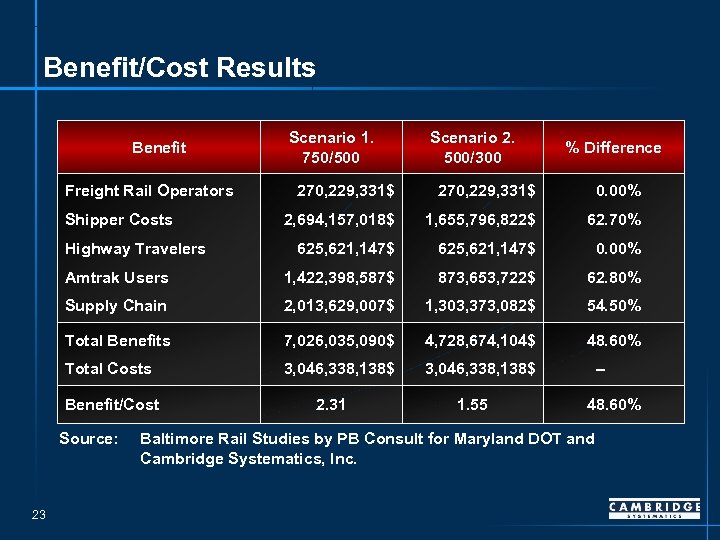 Benefit/Cost Results Benefit Freight Rail Operators Scenario 1. 750/500 Scenario 2. 500/300 % Difference 270, 229, 331$ 0. 00% 2, 694, 157, 018$ 1, 655, 796, 822$ 62. 70% 625, 621, 147$ 0. 00% Amtrak Users 1, 422, 398, 587$ 873, 653, 722$ 62. 80% Supply Chain 2, 013, 629, 007$ 1, 303, 373, 082$ 54. 50% Total Benefits 7, 026, 035, 090$ 4, 728, 674, 104$ 48. 60% Total Costs 3, 046, 338, 138$ Shipper Costs Highway Travelers Benefit/Cost Source: 23 2. 31 1. 55 – 48. 60% Baltimore Rail Studies by PB Consult for Maryland DOT and Cambridge Systematics, Inc.
 Extending the Case Study Analysis Analyze commodity traffic and train types in rail simulations – refined user benefits estimates Service/cost-based modal diversion modeling Network travel demand model for highway user benefits • Direct travel time savings • Reliability • Crashes • Emissions Economic simulation (GRP/GSP, employment impacts) 24
 Toolbox Freight Network and Terminal Performance Modal Diversion and Logistics Cost Models Cost and Access Benefit Calculations Economic Simulation Models Decision Support Tools 25
 For More Information Copies of the guidebook are available at: http: //www. dot. gov/freight/guide 061018/index. htm Contact: Michael Fischer, Cambridge Systematics, mfischer@camsys. com 26