


 Скачать презентацию Economic Evaluation of Residential Air Conditioner Designs for
7d155e4b479ac06204db62ec1272653c.ppt
- Количество слайдов: 20
 Economic Evaluation of Residential Air Conditioner Designs for Hot and Dry Climates Arthur Rosenfeld, California Energy Commission Gregory Rosenquist, Lawrence Berkeley National Laboratory C. Keith Rice, Oak Ridge National Laboratory ARI Spring Product Section Meeting Reston, VA. April 18, 2005, modified on 4 -20 ARosenfe@Energy. State. CA. US
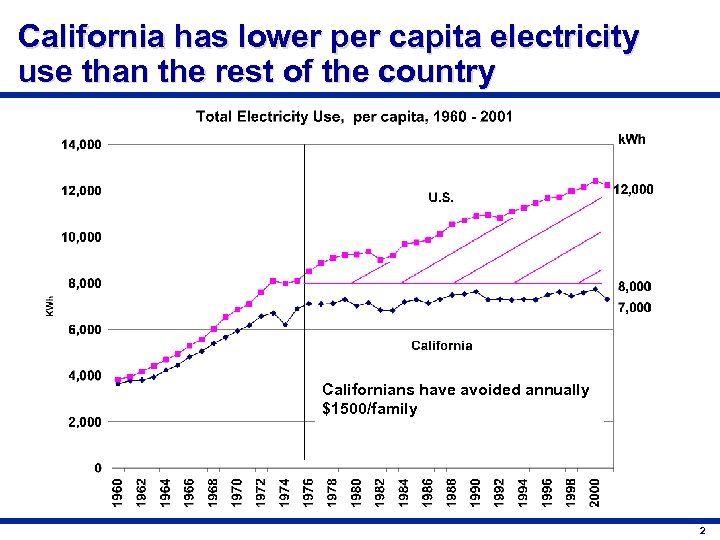 California has lower per capita electricity use than the rest of the country Californians have avoided annually $1500/family 2
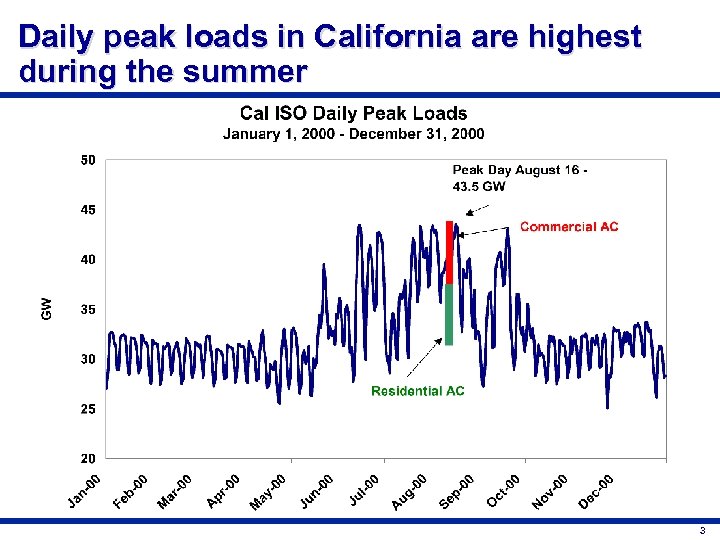 Daily peak loads in California are highest during the summer 3
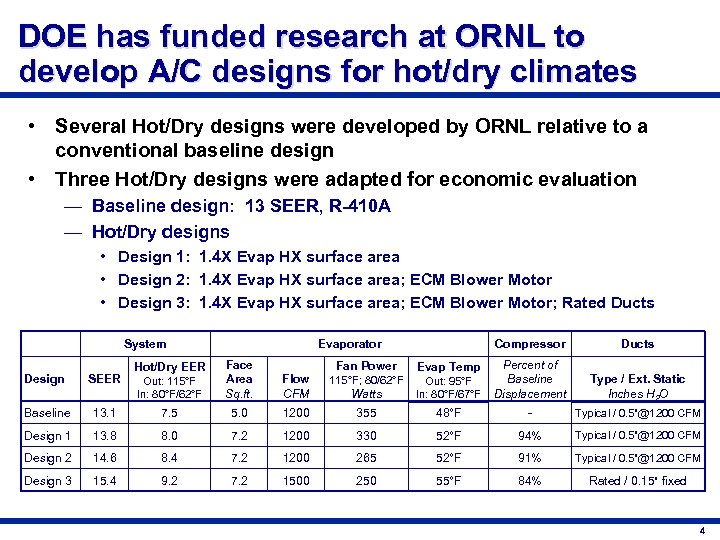 DOE has funded research at ORNL to develop A/C designs for hot/dry climates • Several Hot/Dry designs were developed by ORNL relative to a conventional baseline design • Three Hot/Dry designs were adapted for economic evaluation — Baseline design: 13 SEER, R-410 A — Hot/Dry designs • Design 1: 1. 4 X Evap HX surface area • Design 2: 1. 4 X Evap HX surface area; ECM Blower Motor • Design 3: 1. 4 X Evap HX surface area; ECM Blower Motor; Rated Ducts System Design SEER Evaporator Compressor Out: 115°F In: 80°F/62°F Face Area Sq. ft. Flow CFM 115°F; 80/62°F Watts Out: 95°F In: 80°F/67°F Hot/Dry EER Fan Power Evap Temp Ducts Percent of Baseline Displacement Type / Ext. Static Inches H 2 O Baseline 13. 1 7. 5 5. 0 1200 355 48°F - Typical / 0. 5"@1200 CFM Design 1 13. 8 8. 0 7. 2 1200 330 52°F 94% Typical / 0. 5"@1200 CFM Design 2 14. 6 8. 4 7. 2 1200 265 52°F 91% Typical / 0. 5"@1200 CFM Design 3 15. 4 9. 2 7. 2 1500 250 55°F 84% Rated / 0. 15" fixed 4
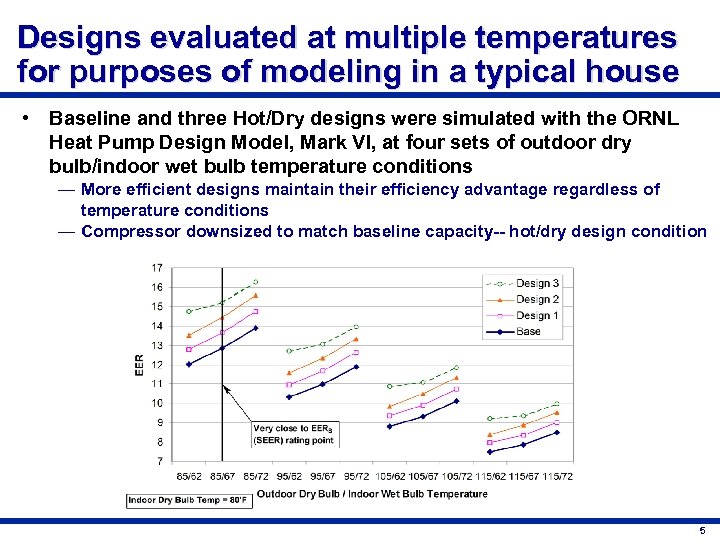 Designs evaluated at multiple temperatures for purposes of modeling in a typical house • Baseline and three Hot/Dry designs were simulated with the ORNL Heat Pump Design Model, Mark VI, at four sets of outdoor dry bulb/indoor wet bulb temperature conditions — More efficient designs maintain their efficiency advantage regardless of temperature conditions — Compressor downsized to match baseline capacity-- hot/dry design condition 5
 Prototypical house chosen for two hot/dry locations: Fresno, CA and Phoenix, AZ • California prototypical house for Fresno • Fresno house modeled in Phoenix (only weather changed) • Both locations modeled with DOE-2 — Square footage: 2258 sq. ft. — Number of floors: 2 — Floor type: Slab-on-grade — Exterior wall • Area: 1584 sq. ft. • Insulation: R-13 — Ceiling insulation: R-30 — Windows • Area: 251 sq. ft. • Window-to-Wall Ratio: 16% • R-value: R-1. 2 (double-glazing) 6
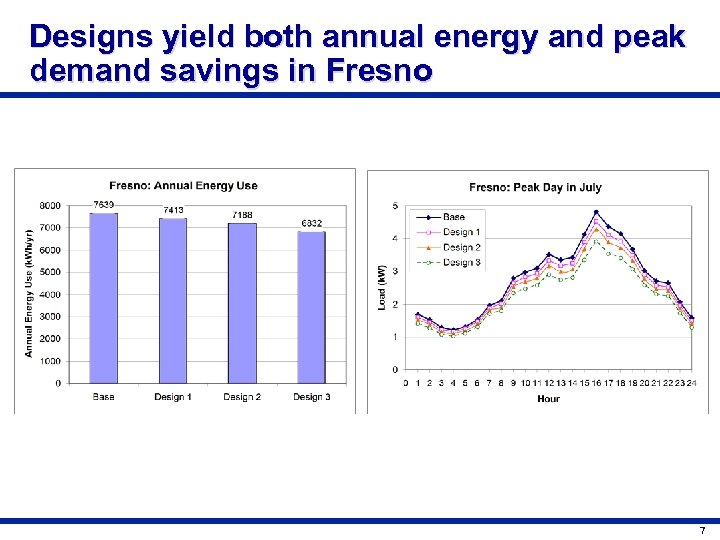 Designs yield both annual energy and peak demand savings in Fresno 7
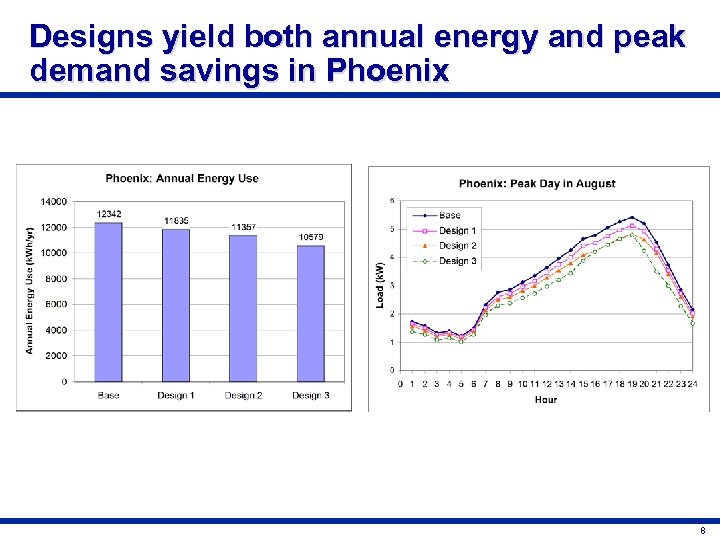 Designs yield both annual energy and peak demand savings in Phoenix 8
 CEC-PIER Hot-Dry a/c Proof of Concept Project • Proctor Engineering et al. have modified Keith Rice’s Designs and built two early prototypes optimized for California a/c loads, one 3 -ton residential split system, one 5 -ton commercial package unit. Actual measurements to date support the calculations provided in earlier slides • See http: //www. hdac-des-pier. com/project. html 9
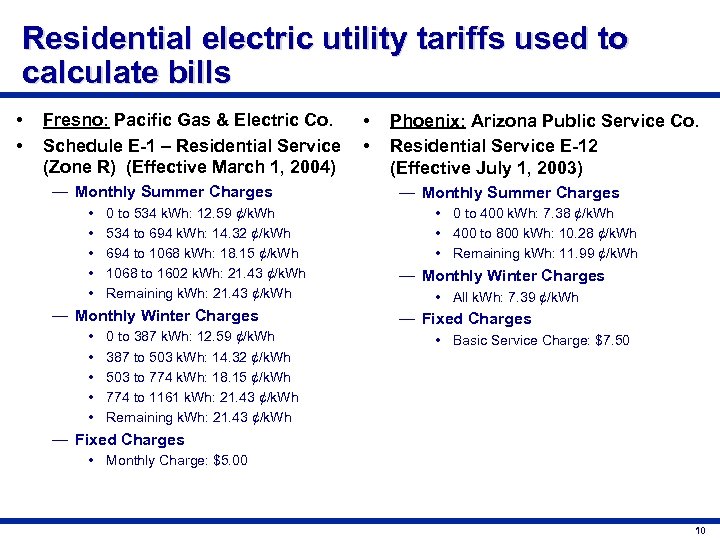 Residential electric utility tariffs used to calculate bills • • Fresno: Pacific Gas & Electric Co. Schedule E-1 – Residential Service (Zone R) (Effective March 1, 2004) — Monthly Summer Charges • • • 0 to 534 k. Wh: 12. 59 ¢/k. Wh 534 to 694 k. Wh: 14. 32 ¢/k. Wh 694 to 1068 k. Wh: 18. 15 ¢/k. Wh 1068 to 1602 k. Wh: 21. 43 ¢/k. Wh Remaining k. Wh: 21. 43 ¢/k. Wh — Monthly Winter Charges • • • 0 to 387 k. Wh: 12. 59 ¢/k. Wh 387 to 503 k. Wh: 14. 32 ¢/k. Wh 503 to 774 k. Wh: 18. 15 ¢/k. Wh 774 to 1161 k. Wh: 21. 43 ¢/k. Wh Remaining k. Wh: 21. 43 ¢/k. Wh • • Phoenix: Arizona Public Service Co. Residential Service E-12 (Effective July 1, 2003) — Monthly Summer Charges • 0 to 400 k. Wh: 7. 38 ¢/k. Wh • 400 to 800 k. Wh: 10. 28 ¢/k. Wh • Remaining k. Wh: 11. 99 ¢/k. Wh — Monthly Winter Charges • All k. Wh: 7. 39 ¢/k. Wh — Fixed Charges • Basic Service Charge: $7. 50 — Fixed Charges • Monthly Charge: $5. 00 10
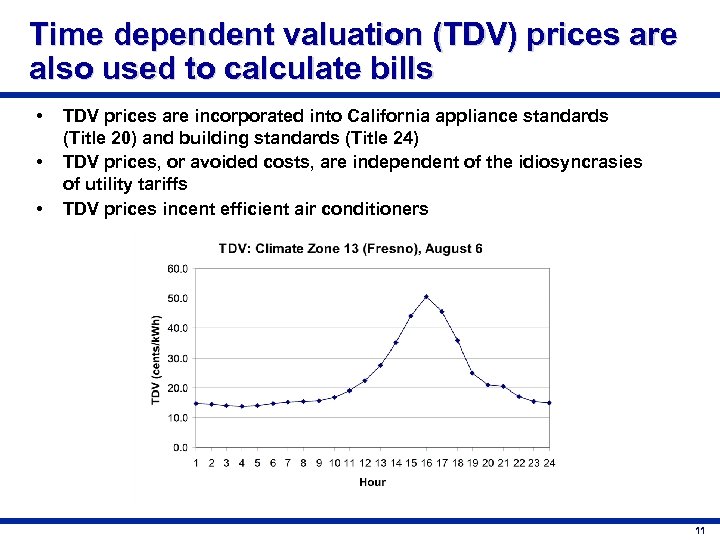 Time dependent valuation (TDV) prices are also used to calculate bills • • • TDV prices are incorporated into California appliance standards (Title 20) and building standards (Title 24) TDV prices, or avoided costs, are independent of the idiosyncrasies of utility tariffs TDV prices incent efficient air conditioners 11
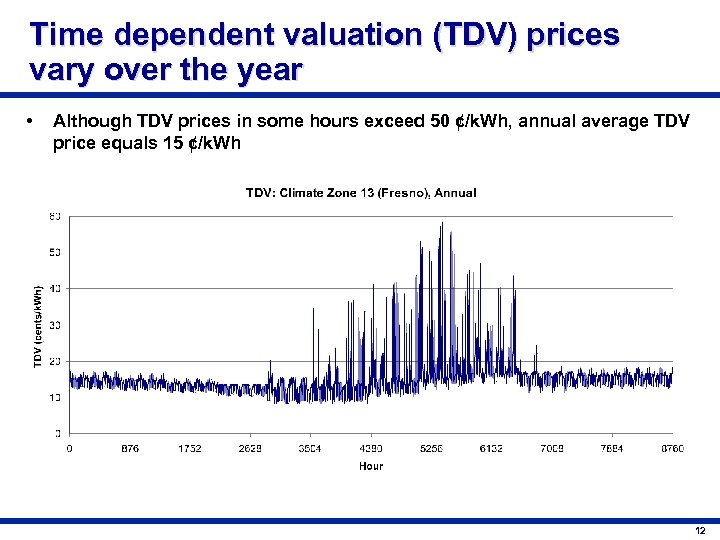 Time dependent valuation (TDV) prices vary over the year • Although TDV prices in some hours exceed 50 ¢/k. Wh, annual average TDV price equals 15 ¢/k. Wh 12
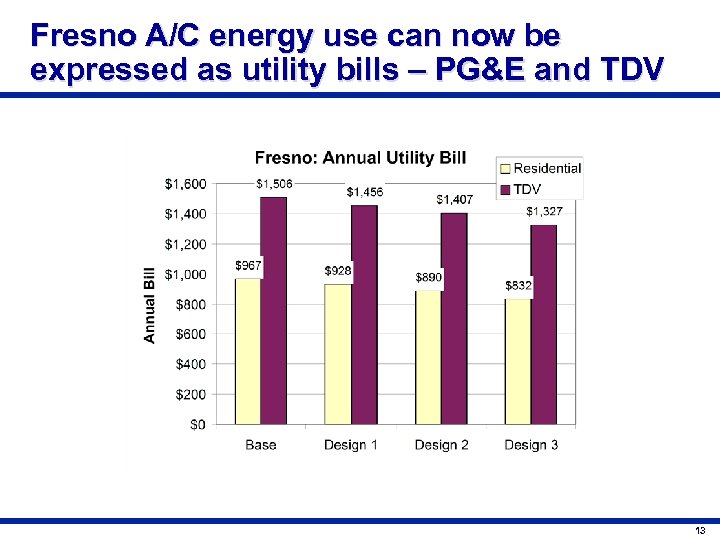 Fresno A/C energy use can now be expressed as utility bills – PG&E and TDV 13
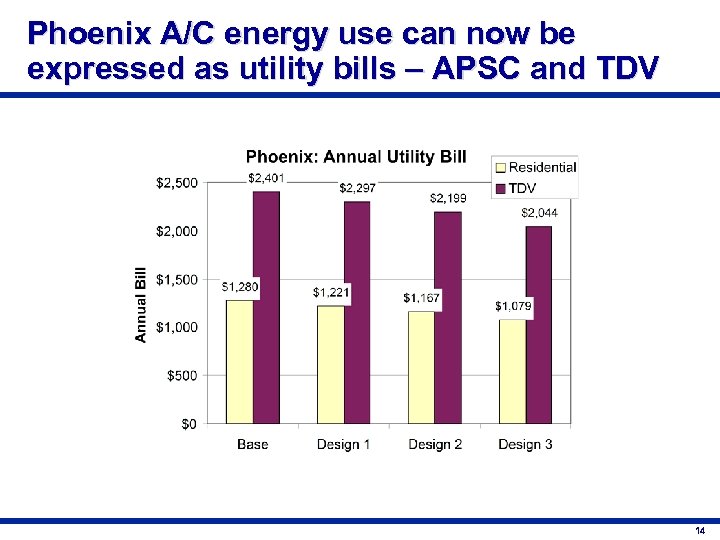 Phoenix A/C energy use can now be expressed as utility bills – APSC and TDV 14
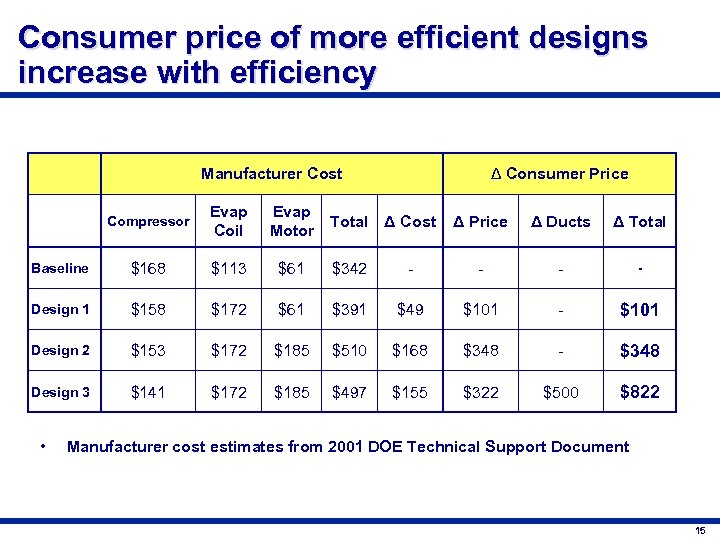 Consumer price of more efficient designs increase with efficiency Manufacturer Cost Compressor Evap Coil Evap Motor Baseline $168 $113 $61 $342 Design 1 $158 $172 $61 Design 2 $153 $172 Design 3 $141 $172 • Δ Consumer Price Total Δ Cost Δ Price Δ Ducts Δ Total - - $391 $49 $101 - $101 $185 $510 $168 $348 - $348 $185 $497 $155 $322 $500 $822 Manufacturer cost estimates from 2001 DOE Technical Support Document 15
 Cost-effectiveness of designs based upon LCC savings and payback • Life-cycle cost (LCC) is the sum of the total installed cost plus the present value of the lifetime operating cost savings — For residential tariff calculations, present value of future operating cost savings calculated with a 5. 6% real discount rate — Equipment lifetime set to 18. 4 years — Future electricity price trends based upon DOE-EIA’s 2004 Annual Energy Outlook — Both the discount rate and lifetime are taken from DOE’s central air conditioner rulemaking analysis • Payback period is the increase in total installed cost divided by the annual operating cost savings 16
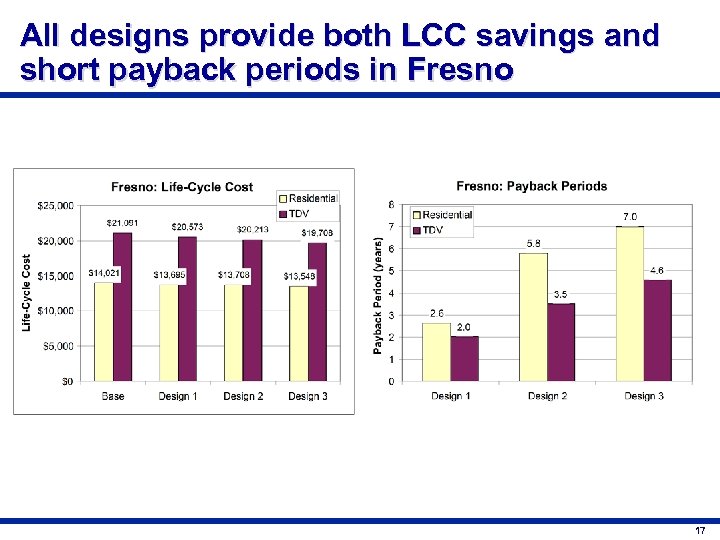 All designs provide both LCC savings and short payback periods in Fresno 17
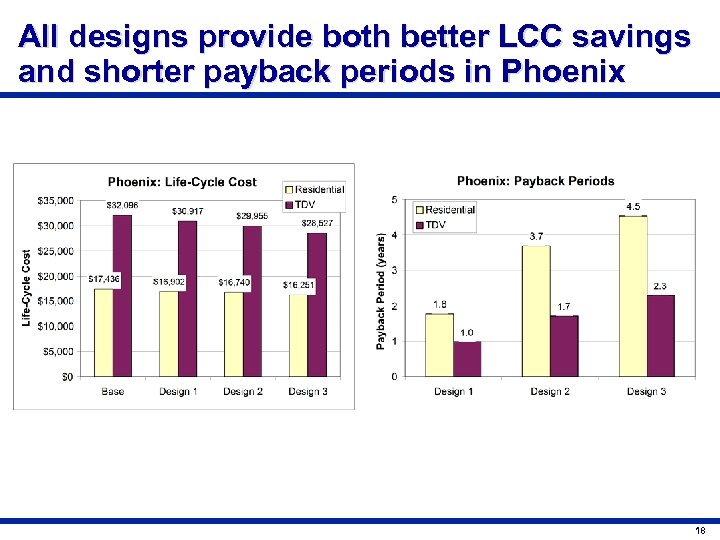 All designs provide both better LCC savings and shorter payback periods in Phoenix 18
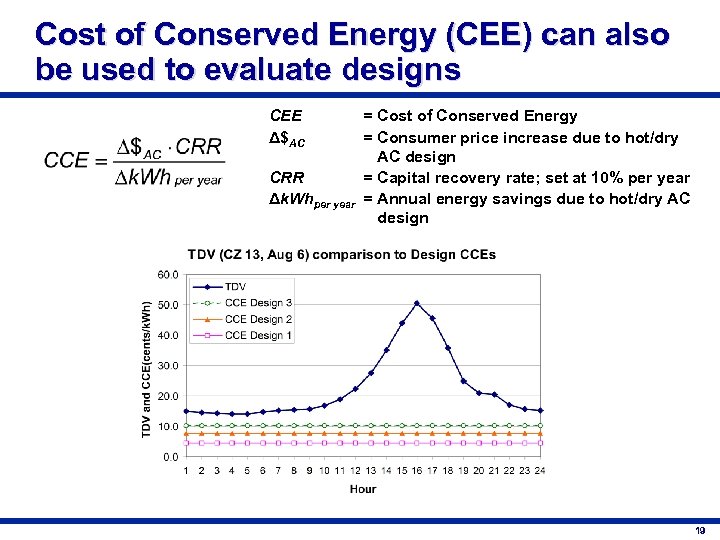 Cost of Conserved Energy (CEE) can also be used to evaluate designs CEE Δ$AC CRR Δk. Whper year = Cost of Conserved Energy = Consumer price increase due to hot/dry AC design = Capital recovery rate; set at 10% per year = Annual energy savings due to hot/dry AC design 19
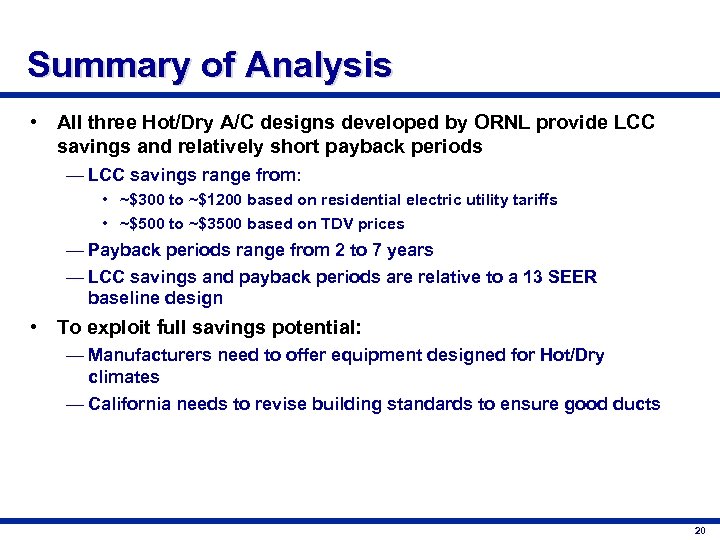 Summary of Analysis • All three Hot/Dry A/C designs developed by ORNL provide LCC savings and relatively short payback periods — LCC savings range from: • ~$300 to ~$1200 based on residential electric utility tariffs • ~$500 to ~$3500 based on TDV prices — Payback periods range from 2 to 7 years — LCC savings and payback periods are relative to a 13 SEER baseline design • To exploit full savings potential: — Manufacturers need to offer equipment designed for Hot/Dry climates — California needs to revise building standards to ensure good ducts 20