 Скачать презентацию Economic developments globally and in Europe The CNB
bc62dc3bfd9a5fdd65ca24c37a19d5fc.ppt
- Количество слайдов: 17




Economic developments globally and in Europe: The CNB view Miroslav Singer Governor, Czech National Bank 2012 Israel Business Conference Tel Aviv, 9 December 2012 M. Singer – – Economic developmentscrisis from. CROutlookfor Czech. CNB view banks - Czech Republic: Stayingchallenges and Economy, Risksto Republic Present Conditions, Current the CR and opportunities for Monetary M. Singer – The Czech economy. Impacts of theand Czech case theand Outlook Recent Developmentsexperience in Europe: Inside money: Likely development Curve be view Czech economy Monetary Policy and point sustained? Supervisors Sound Republic: and the Czechandinwith in the Czech in globally Outlook M. Singer: The Presentand financialrecord thefinancial. Regard. Supervisors approach economic Future on crisis M. Singer Czech Republic: Conditions, onin. The. Lessons of. Outlook the Czech Policy CR –Waiting. Crisis: Impacts. Ahead Monetary. Europe: of Czech Republic: Can Situation rates Lessons Czech with the Adoption: M. Singer Financialor Outside. Euro Areain Eurozone: CNB viewand CNB for Singer: Consumer protection lowtheand. Policy and Outlook services: Challenges M. Singer – Macroeconomic developments, monetary policy and financial sector
Overview • • Global macroeconomic developments Debt crisis in euro area Some adjustments and policies adopted recently in euro area Risks in euro area M. Singer – Economic developments globally and in Europe: The CNB view
Recent developments in advanced economies • Growth in advanced economies is low and slowing in most countries (negative feedback through foreign trade) • Unemployment remains high in advanced economies • Domestic demand is weak (uncertainty among households and investors) • Simultaneous fiscal consolidation is going on in many countries • Households, banks and sovereigns are reducing their leverage • Some imbalances are decreasing (current account) • Persisting tensions on financial markets – banks are maintaining strict credit standards (partly due to regulatory pressures) • Central banks do not have much scope for stimulation Advanced economies are vulnerable and remain a brake on, and the main uncertainty for, global growth M. Singer – Economic developments globally and in Europe: The CNB view
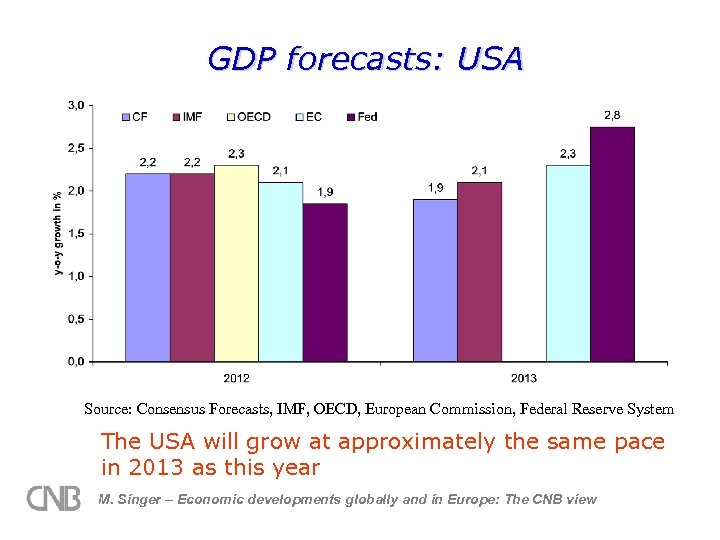
GDP forecasts: USA Source: Consensus Forecasts, IMF, OECD, European Commission, Federal Reserve System The USA will grow at approximately the same pace in 2013 as this year M. Singer – Economic developments globally and in Europe: The CNB view
Risks to global economy • USA u u Fall off fiscal cliff in USA (major automatic budget cuts) Insufficiently credible medium-term fiscal consolidation framework • Asia and Japan u u u Imbalances in China Under-ambitious medium-term fiscal consolidation in Japan Fading of post-earthquake stimulus and new taxes in Japan in 2014 • EMU u u Spread of recession from periphery to core of EMU Excessive fiscal consolidation in some countries slowing growth (high fiscal multipliers) The financial risks have decreased slightly in recent weeks but remain high; the risks to growth are on the downside M. Singer – Economic developments globally and in Europe: The CNB view
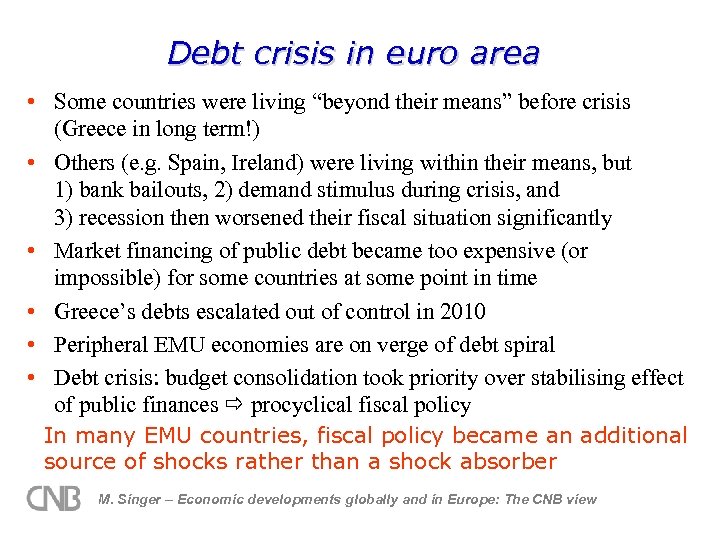
Debt crisis in euro area • Some countries were living “beyond their means” before crisis (Greece in long term!) • Others (e. g. Spain, Ireland) were living within their means, but 1) bank bailouts, 2) demand stimulus during crisis, and 3) recession then worsened their fiscal situation significantly • Market financing of public debt became too expensive (or impossible) for some countries at some point in time • Greece’s debts escalated out of control in 2010 • Peripheral EMU economies are on verge of debt spiral • Debt crisis: budget consolidation took priority over stabilising effect of public finances procyclical fiscal policy In many EMU countries, fiscal policy became an additional source of shocks rather than a shock absorber M. Singer – Economic developments globally and in Europe: The CNB view
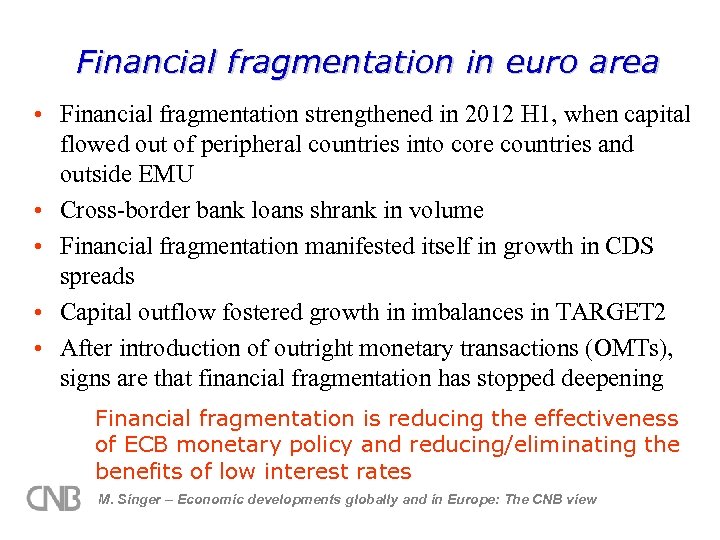
Financial fragmentation in euro area • Financial fragmentation strengthened in 2012 H 1, when capital flowed out of peripheral countries into core countries and outside EMU • Cross-border bank loans shrank in volume • Financial fragmentation manifested itself in growth in CDS spreads • Capital outflow fostered growth in imbalances in TARGET 2 • After introduction of outright monetary transactions (OMTs), signs are that financial fragmentation has stopped deepening Financial fragmentation is reducing the effectiveness of ECB monetary policy and reducing/eliminating the benefits of low interest rates M. Singer – Economic developments globally and in Europe: The CNB view
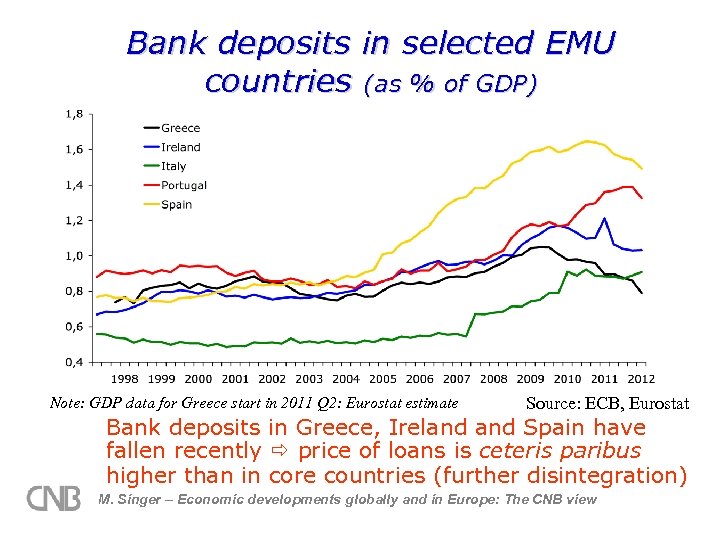
Bank deposits in selected EMU countries (as % of GDP) Note: GDP data for Greece start in 2011 Q 2: Eurostat estimate Source: ECB, Eurostat Bank deposits in Greece, Ireland Spain have fallen recently price of loans is ceteris paribus higher than in core countries (further disintegration) M. Singer – Economic developments globally and in Europe: The CNB view
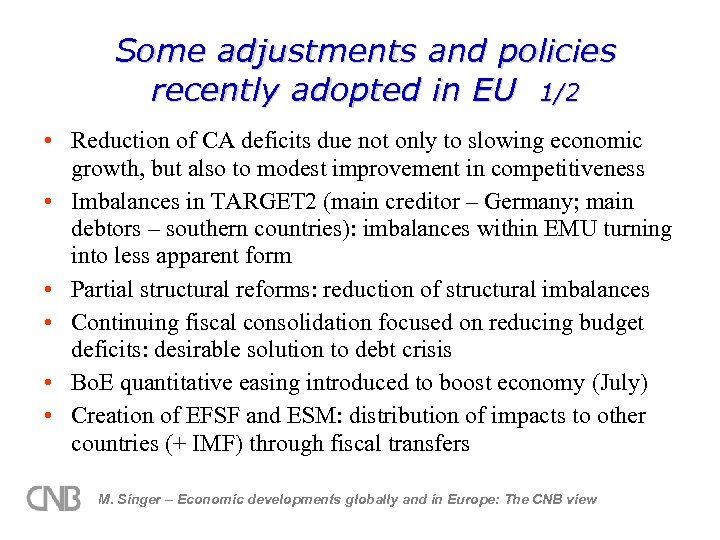
Some adjustments and policies recently adopted in EU 1/2 • Reduction of CA deficits due not only to slowing economic growth, but also to modest improvement in competitiveness • Imbalances in TARGET 2 (main creditor – Germany; main debtors – southern countries): imbalances within EMU turning into less apparent form • Partial structural reforms: reduction of structural imbalances • Continuing fiscal consolidation focused on reducing budget deficits: desirable solution to debt crisis • Bo. E quantitative easing introduced to boost economy (July) • Creation of EFSF and ESM: distribution of impacts to other countries (+ IMF) through fiscal transfers M. Singer – Economic developments globally and in Europe: The CNB view
Some adjustments and policies recently adopted in EU 2/2 • Activation of Outright Monetary Transactions (government bond purchases on secondary markets) in September; aim: u u to enhance functioning of monetary policy transmission mechanism to reduce high government bond yields distribution of impacts of crisis via ECB balance sheet • Entry into force of European Stability Mechanism (ESM) (Oct. ) • Progress towards establishing Banking Union timetable for establishment of Single Supervisory Mechanism (SSM) • Since September, tensions on financial markets have eased and yields on gov. bonds of southern countries have fallen slightly While fiscal consolidation is the solution to the causes of the debt crisis, other policies are distributing the load of the debt crisis to others and are “buying time” M. Singer – Economic developments globally and in Europe: The CNB view
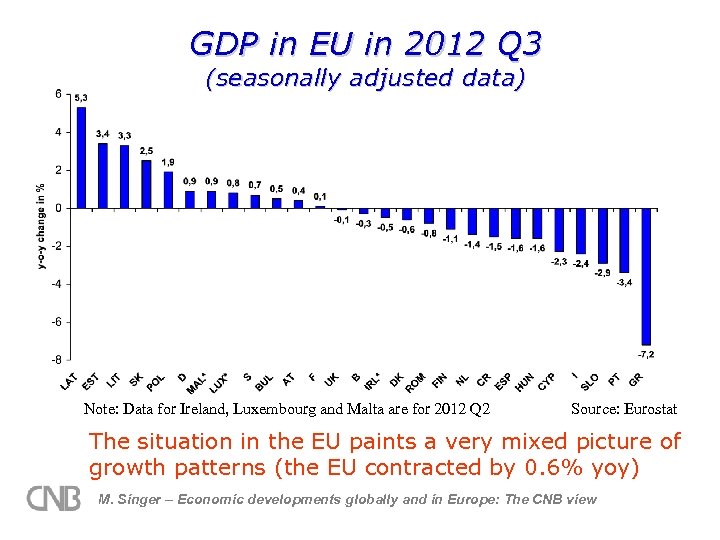
GDP in EU in 2012 Q 3 (seasonally adjusted data) Note: Data for Ireland, Luxembourg and Malta are for 2012 Q 2 Source: Eurostat The situation in the EU paints a very mixed picture of growth patterns (the EU contracted by 0. 6% yoy) M. Singer – Economic developments globally and in Europe: The CNB view
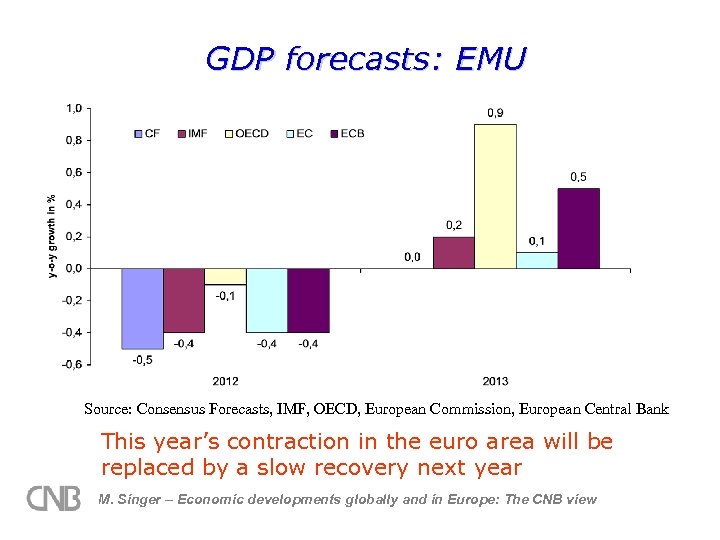
GDP forecasts: EMU Source: Consensus Forecasts, IMF, OECD, European Commission, European Central Bank This year’s contraction in the euro area will be replaced by a slow recovery next year M. Singer – Economic developments globally and in Europe: The CNB view
Risks in euro area 1/2 • Negative feedback between: 1) vulnerable financial system 2) slowly growing economies and 3) indebted public finance – fragile equilibrium persists • Fiscal consolidation is strongly procyclical pressures to ease fiscal restriction are growing • Some countries’ debts will stabilise only in a few years’ time and at high level – with economic growth slowing there is growing risk of debt spiral in some countries • Persisting problems in following areas: u u u lack of structural cohesion (slow introduction of structural reforms) unsatisfactory institutional framework (some changes happening, but not always in right direction) inadequate functioning of (and compliance with) regulations M. Singer – Economic developments globally and in Europe: The CNB view
Risks in euro area 2/2 • ECB single monetary policy is fostering widening differences between southern countries and core countries: u interest rates are still too high for southern periphery u exchange rate of euro is weak for core but strong for periphery • Absence of exchange rate adjustment mechanism within EMU is leading to adjustment via: u economic growth u wages and prices (competitive disinflation) u unemployment and outflow of labour force (brain drain) • Survival of euro area in its current form is conditional on: u non-standard policies of ECB u loans and fiscal transfers between countries u political “solidarity” between member countries (and others) The threat of collapse of the euro area, with potentially catastrophic consequences, has decreased recently M. Singer – Economic developments globally and in Europe: The CNB view
Thank you Miroslav Singer Miroslav. Singer@cnb. cz Tel: +420 224 412 000 Česká národní banka Na Příkopě 28 115 03 Praha 1 M. Singer – Economic developments globally and in Europe: The CNB view
Additional slides M. Singer – Economic developments globally and in Europe: The CNB view
Czech Republic and euro • Any escalation of debt crisis can be expected, ceteris paribus, to increase projected costs of euro area membership • Situation in euro area is developing extremely quickly • It is very uncertain how euro area will look in two or three years balance of costs and benefits of euro adoption is subject to exceptionally high uncertainty; this uncertainty has increased compared to last year • Delaying euro adoption seems to be most sensible response to future uncertainties and unknown distribution of costs and benefits Given the current uncertainties about the future form of the euro area, a commitment to adopt the euro would be tantamount to a blank cheque M. Singer – Economic developments globally and in Europe: The CNB view
Скачать презентацию Economic developments globally and in Europe The CNB
bc62dc3bfd9a5fdd65ca24c37a19d5fc.ppt