 Скачать презентацию Economic Development Association of Alabama Historic Tax Credit
68c259547e7199e35e87a709808e8367.ppt
- Количество слайдов: 23



Economic Development Association of Alabama Historic Tax Credit – Assembling and Structuring the Deal November 7, 2017 Presented by: Beau Byrd & Jimmy Long ©Bradley Arant Boult Cummings LLP Attorney-Client Privilege.
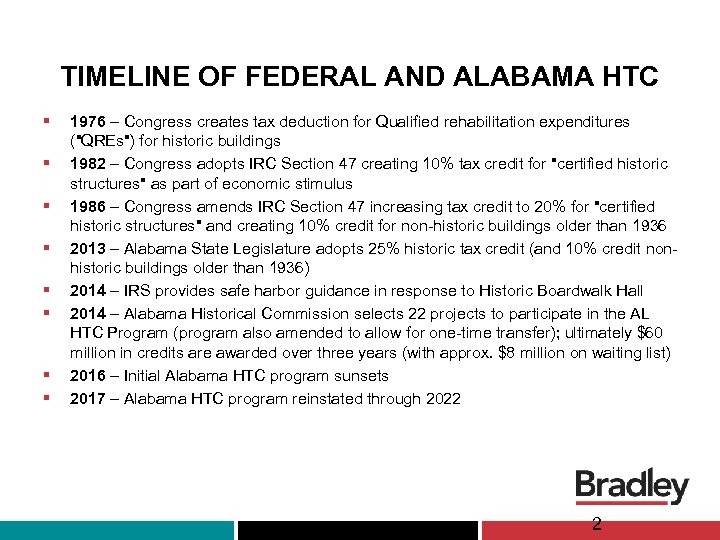
TIMELINE OF FEDERAL AND ALABAMA HTC § § § § 1976 – Congress creates tax deduction for Qualified rehabilitation expenditures ("QREs") for historic buildings 1982 – Congress adopts IRC Section 47 creating 10% tax credit for "certified historic structures" as part of economic stimulus 1986 – Congress amends IRC Section 47 increasing tax credit to 20% for "certified historic structures" and creating 10% credit for non-historic buildings older than 1936 2013 – Alabama State Legislature adopts 25% historic tax credit (and 10% credit nonhistoric buildings older than 1936) 2014 – IRS provides safe harbor guidance in response to Historic Boardwalk Hall 2014 – Alabama Historical Commission selects 22 projects to participate in the AL HTC Program (program also amended to allow for one-time transfer); ultimately $60 million in credits are awarded over three years (with approx. $8 million on waiting list) 2016 – Initial Alabama HTC program sunsets 2017 – Alabama HTC program reinstated through 2022 2
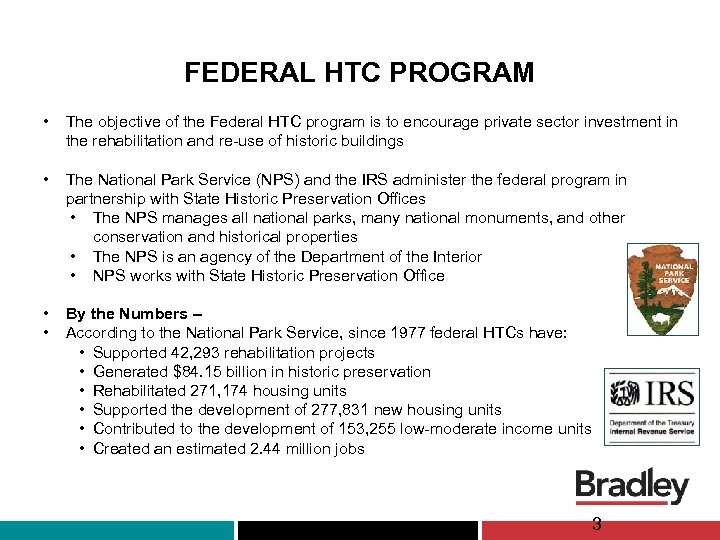
FEDERAL HTC PROGRAM • The objective of the Federal HTC program is to encourage private sector investment in the rehabilitation and re-use of historic buildings • The National Park Service (NPS) and the IRS administer the federal program in partnership with State Historic Preservation Offices • The NPS manages all national parks, many national monuments, and other conservation and historical properties • The NPS is an agency of the Department of the Interior • NPS works with State Historic Preservation Office • • By the Numbers – According to the National Park Service, since 1977 federal HTCs have: • Supported 42, 293 rehabilitation projects • Generated $84. 15 billion in historic preservation • Rehabilitated 271, 174 housing units • Supported the development of 277, 831 new housing units • Contributed to the development of 153, 255 low-moderate income units • Created an estimated 2. 44 million jobs 3
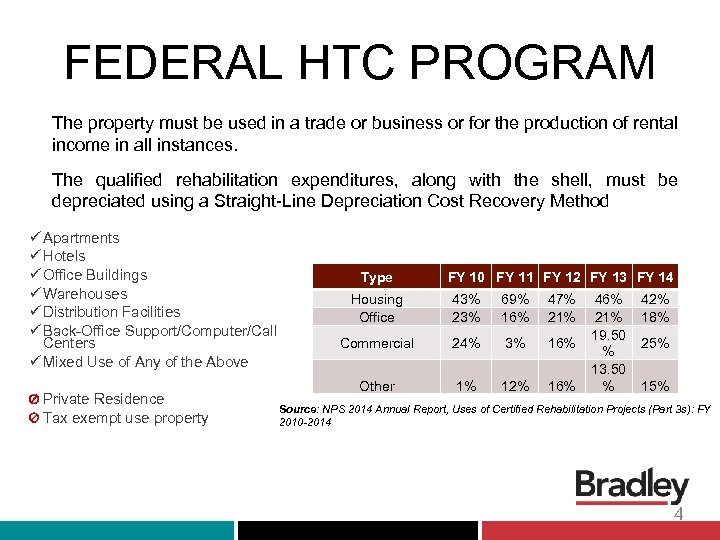
FEDERAL HTC PROGRAM The property must be used in a trade or business or for the production of rental income in all instances. The qualified rehabilitation expenditures, along with the shell, must be depreciated using a Straight-Line Depreciation Cost Recovery Method ü Apartments ü Hotels ü Office Buildings ü Warehouses ü Distribution Facilities ü Back-Office Support/Computer/Call Centers ü Mixed Use of Any of the Above Private Residence Tax exempt use property Type FY 10 FY 11 FY 12 FY 13 FY 14 Housing Office 43% 23% 69% 16% 47% 21% Commercial 24% 3% 16% Other 1% 12% 16% 46% 21% 19. 50 % 13. 50 % 42% 18% 25% 15% Source: NPS 2014 Annual Report, Uses of Certified Rehabilitation Projects (Part 3 s): FY 2010 -2014 4
FEDERAL HTC PROGRAM – 20% • Three Part Process: • Part 1 – Confirming the Building Qualifies • Part 2 – Plans for the Rehab • Part 3 – Confirmation the Rehab was consistent with the architectural standards • Developer’s Primary Contact is State Historic Preservation Officer • Ultimate Approval is Under Control of the National Park Service • Residential rental property and real property are eligible • Building need not be currently listed on the National Register, but must be eligible for listing 5
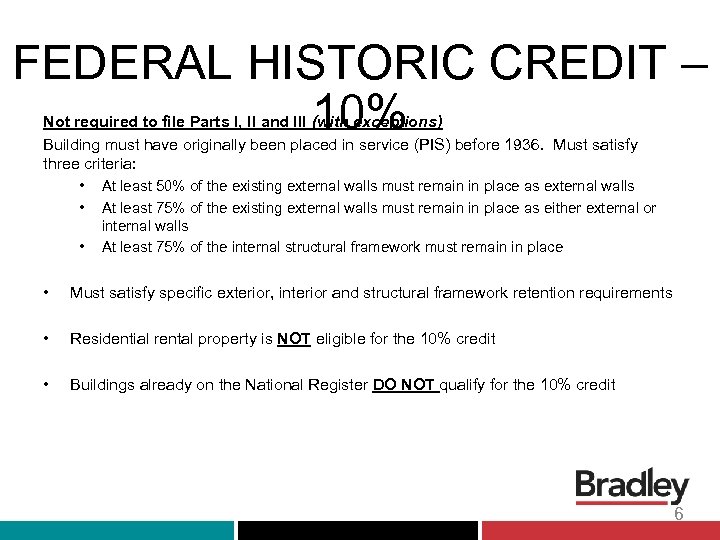
FEDERAL HISTORIC CREDIT – 10% Not required to file Parts I, II and III (with exceptions) Building must have originally been placed in service (PIS) before 1936. Must satisfy three criteria: • At least 50% of the existing external walls must remain in place as external walls • At least 75% of the existing external walls must remain in place as either external or • internal walls At least 75% of the internal structural framework must remain in place • Must satisfy specific exterior, interior and structural framework retention requirements • Residential rental property is NOT eligible for the 10% credit • Buildings already on the National Register DO NOT qualify for the 10% credit 6
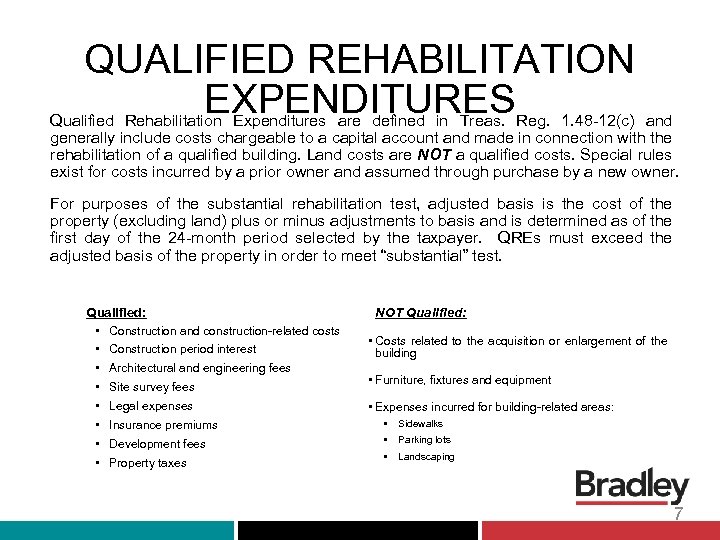
QUALIFIED REHABILITATION EXPENDITURES Qualified Rehabilitation Expenditures are defined in Treas. Reg. 1. 48 -12(c) and generally include costs chargeable to a capital account and made in connection with the rehabilitation of a qualified building. Land costs are NOT a qualified costs. Special rules exist for costs incurred by a prior owner and assumed through purchase by a new owner. For purposes of the substantial rehabilitation test, adjusted basis is the cost of the property (excluding land) plus or minus adjustments to basis and is determined as of the first day of the 24 -month period selected by the taxpayer. QREs must exceed the adjusted basis of the property in order to meet “substantial” test. Qualified: • Construction and construction-related costs • Construction period interest • Architectural and engineering fees • Site survey fees • Legal expenses • Insurance premiums • Development fees • Property taxes NOT Qualified: • Costs related to the acquisition or enlargement of the building • Furniture, fixtures and equipment • Expenses incurred for building-related areas: • Sidewalks • Parking lots • Landscaping 7
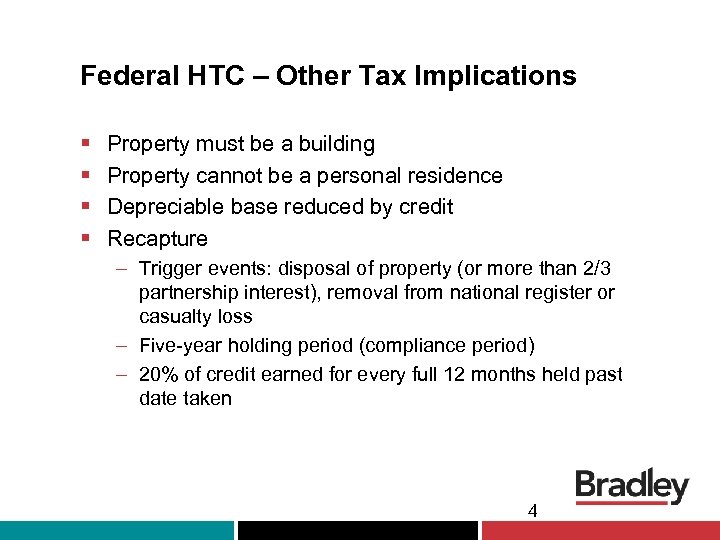
Federal HTC – Other Tax Implications § § Property must be a building Property cannot be a personal residence Depreciable base reduced by credit Recapture – Trigger events: disposal of property (or more than 2/3 partnership interest), removal from national register or casualty loss – Five-year holding period (compliance period) – 20% of credit earned for every full 12 months held past date taken 4
Federal HTC – Other Tax Implications § At risk rules – Do not apply if widely held C corp. investor – Property cannot be financed by person related to buyer of property – Non-recourse financing cannot exceed 80% of credit base § AMT and Passive Activity restrictions also create problems for individual investors/owners § Unused credits can be carried back 1 year and forward for 20 years § Credits are allocated based on profit percentage 5
Alabama Historic Tax Credit Reinstated § Act 2017 -380 (House Bill 345) reauthorizes the Alabama income tax credit for the rehabilitation of certain historic structures. Notable differences from prior program: – – Refundable credit Lottery replaced with 9 member evaluating committee Rural preference during first six months Historical property must be at least 60 years (as opposed to 50 for federal) – Required completion milestones (50% within 36 months; 100% within 5 years)
Calculation of Credit § Tax credit is vested when property is placed in service and the amount is: – 25% of the QREs for certified historic structures – 10% of the QREs for pre-1936 non-historic structures – $5 million max for commercial project; $50 k for residential – Alabama QRE = Federal QRE § Refundable credit claimed at the owner level (including pass-through entity) § One-time transfer still permitted; must be sold for at least $. 85 per dollar of credit
Application Timeline § Applications may be submitted on November 1, 2017 (quarterly review) – Must submit both Part A and B at same time § Can incur certain A&E and mitigation costs six months prior to application § Owner must “commence rehabilitation” (incur at least 20% of costs) within 18 months of reservation § Annual cap on credit reservations - $20 million § Sunset date – December 31, 2022
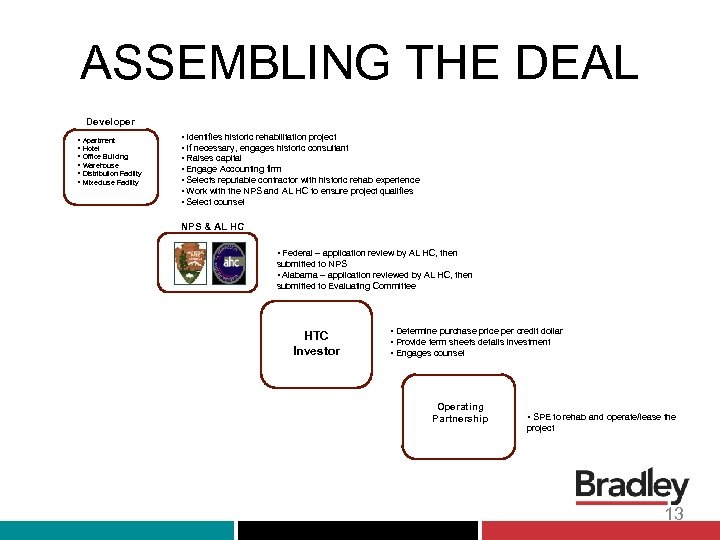
ASSEMBLING THE DEAL Participants and the Process Developer ▪ Apartment ▪ Hotel ▪ Office Building ▪ Warehouse ▪ Distribution Facility ▪ Mixed use Facility ▪ Identifies historic rehabilitation project ▪ If necessary, engages historic consultant ▪ Raises capital ▪ Engage Accounting firm ▪ Selects reputable contractor with historic rehab experience ▪ Work with the NPS and AL HC to ensure project qualifies ▪ Select counsel NPS & AL HC ▪ Federal – application review by AL HC, then submitted to NPS ▪ Alabama – application reviewed by AL HC, then submitted to Evaluating Committee HTC Investor ▪ Determine purchase price per credit dollar ▪ Provide term sheets details investment ▪ Engages counsel Operating Partnership ▪ SPE to rehab and operate/lease the project 13
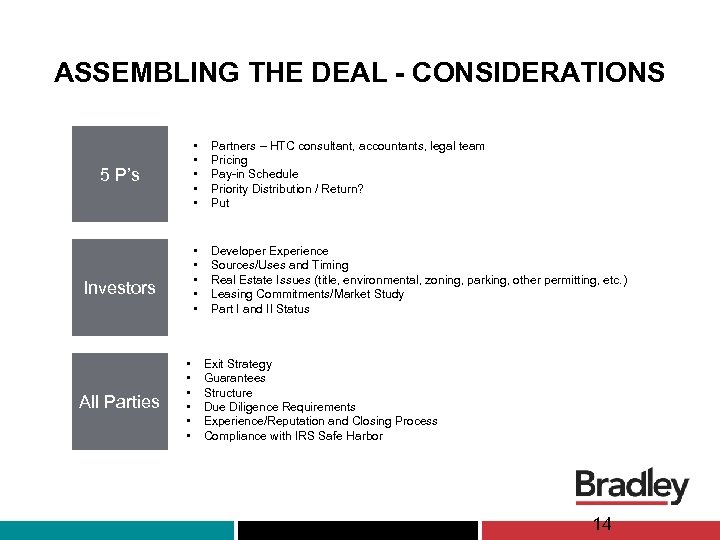
ASSEMBLING THE DEAL - CONSIDERATIONS • • • 5 P’s Investors All Parties • • • Partners – HTC consultant, accountants, legal team Pricing Pay-in Schedule Priority Distribution / Return? Put Developer Experience Sources/Uses and Timing Real Estate Issues (title, environmental, zoning, parking, other permitting, etc. ) Leasing Commitments/Market Study Part I and II Status Exit Strategy Guarantees Structure Due Diligence Requirements Experience/Reputation and Closing Process Compliance with IRS Safe Harbor 14
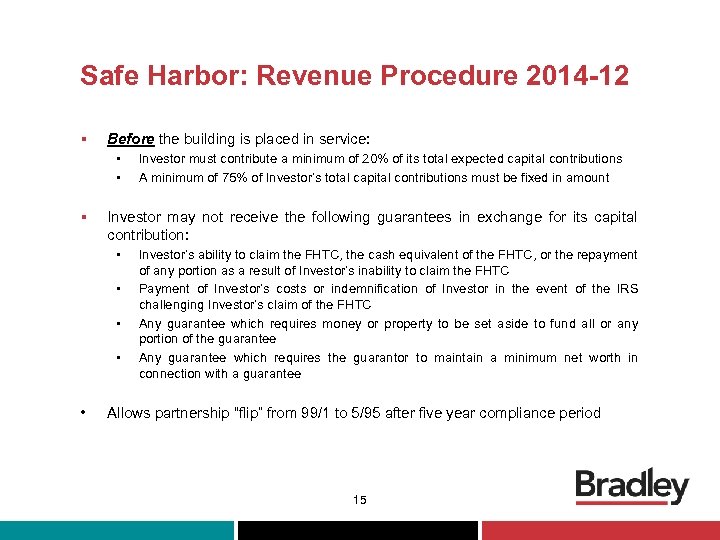
Safe Harbor: Revenue Procedure 2014 -12 § Before the building is placed in service: • • § Investor may not receive the following guarantees in exchange for its capital contribution: • • • Investor must contribute a minimum of 20% of its total expected capital contributions A minimum of 75% of Investor’s total capital contributions must be fixed in amount Investor’s ability to claim the FHTC, the cash equivalent of the FHTC, or the repayment of any portion as a result of Investor’s inability to claim the FHTC Payment of Investor’s costs or indemnification of Investor in the event of the IRS challenging Investor’s claim of the FHTC Any guarantee which requires money or property to be set aside to fund all or any portion of the guarantee Any guarantee which requires the guarantor to maintain a minimum net worth in connection with a guarantee Allows partnership “flip” from 99/1 to 5/95 after five year compliance period 15
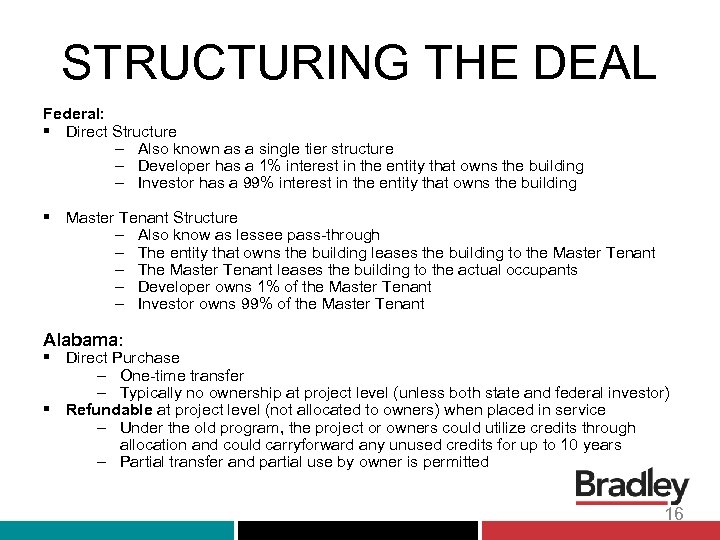
STRUCTURING THE DEAL Federal: § Direct Structure – Also known as a single tier structure – Developer has a 1% interest in the entity that owns the building – Investor has a 99% interest in the entity that owns the building § Master Tenant Structure – Also know as lessee pass-through – The entity that owns the building leases the building to the Master Tenant – The Master Tenant leases the building to the actual occupants – Developer owns 1% of the Master Tenant – Investor owns 99% of the Master Tenant Alabama: § Direct Purchase – One-time transfer – Typically no ownership at project level (unless both state and federal investor) § Refundable at project level (not allocated to owners) when placed in service – Under the old program, the project or owners could utilize credits through allocation and could carryforward any unused credits for up to 10 years – Partial transfer and partial use by owner is permitted 16
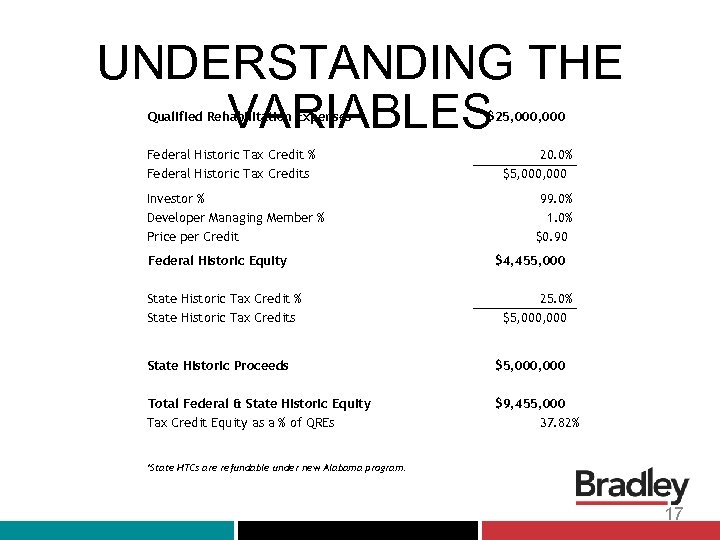
UNDERSTANDING THE VARIABLES Qualified Rehabilitation Expenses Federal Historic Tax Credit % Federal Historic Tax Credits Investor % Developer Managing Member % Price per Credit Federal Historic Equity State Historic Tax Credit % State Historic Tax Credits $25, 000 20. 0% $5, 000 99. 0% 1. 0% $0. 90 $4, 455, 000 25. 0% $5, 000 State Historic Proceeds $5, 000 Total Federal & State Historic Equity Tax Credit Equity as a % of QREs $9, 455, 000 37. 82% *State HTCs are refundable under new Alabama program. 17
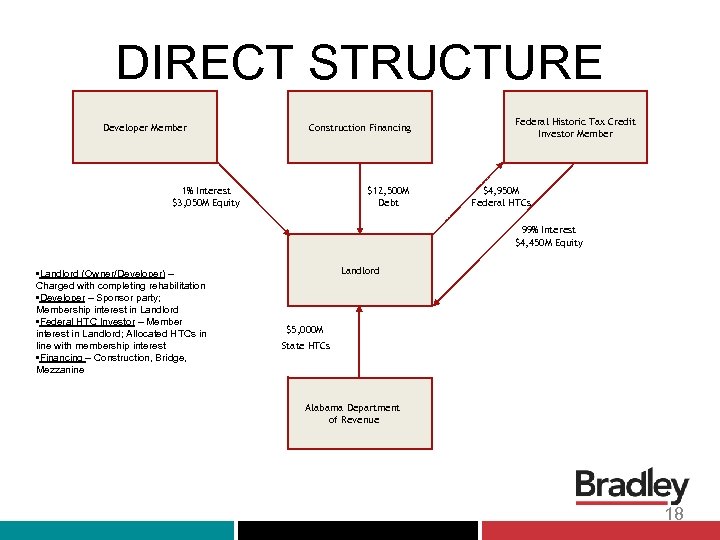
DIRECT STRUCTURE Developer Member Construction Financing 1% Interest $3, 050 M Equity $12, 500 M Debt Federal Historic Tax Credit Investor Member $4, 950 M Federal HTCs 99% Interest $4, 450 M Equity • Landlord (Owner/Developer) – Charged with completing rehabilitation • Developer – Sponsor party; Membership interest in Landlord • Federal HTC Investor – Member interest in Landlord; Allocated HTCs in line with membership interest • Financing – Construction, Bridge, Mezzanine Landlord $5, 000 M State HTCs Alabama Department of Revenue 18
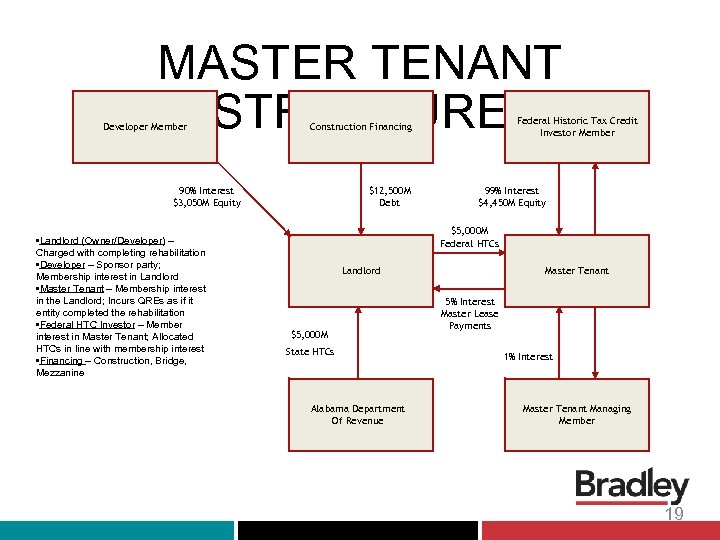
MASTER TENANT STRUCTURE Developer Member 90% Interest $3, 050 M Equity • Landlord (Owner/Developer) – Charged with completing rehabilitation • Developer – Sponsor party; Membership interest in Landlord • Master Tenant – Membership interest in the Landlord; Incurs QREs as if it entity completed the rehabilitation • Federal HTC Investor – Member interest in Master Tenant; Allocated HTCs in line with membership interest • Financing – Construction, Bridge, Mezzanine Federal Historic Tax Credit Investor Member Construction Financing $12, 500 M Debt 99% Interest $4, 450 M Equity $5, 000 M Federal HTCs Landlord $5, 000 M State HTCs Alabama Department Of Revenue Master Tenant 5% Interest Master Lease Payments 1% Interest Master Tenant Managing Member 19
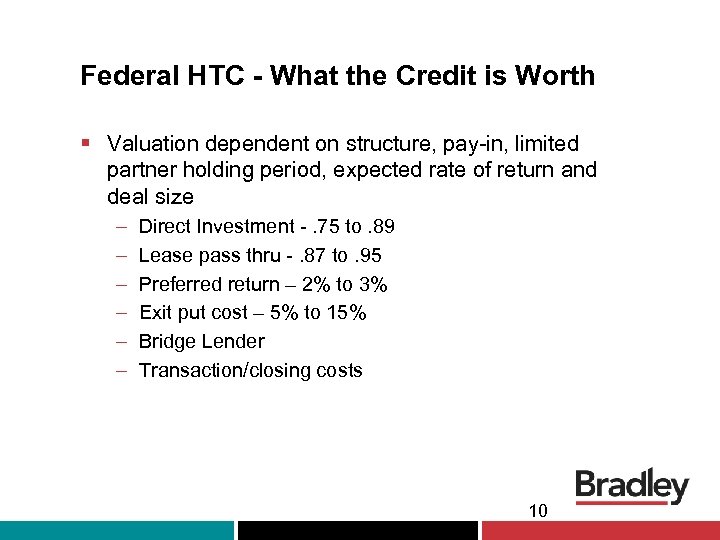
Federal HTC - What the Credit is Worth § Valuation dependent on structure, pay-in, limited partner holding period, expected rate of return and deal size – – – Direct Investment -. 75 to. 89 Lease pass thru -. 87 to. 95 Preferred return – 2% to 3% Exit put cost – 5% to 15% Bridge Lender Transaction/closing costs 10
Federal HTC - What the Credit is Worth § Investor candidates – Investment funds/syndicators – Local financial institutions with unfulfilled community reinvestment requirements – Profitable locally-based national company – Most local companies are not profitable enough to overcome alternate minimum tax limitations – Large national companies 11
Related Incentives in Alabama § Downtown Redevelopment Authority § TIRA Abatements / Other Local Assistance § Leverage with other federal credits – Low-Income Housing Tax Credit – New Markets Tax Credit § Conservation Easement – Generally complete prior to commencing rehabilitation to avoid recapture – High probability of audit 22
Questions? Beau Byrd bbyrd@bradley. com Jimmy Long jelong@bradley. com
Скачать презентацию Economic Development Association of Alabama Historic Tax Credit
68c259547e7199e35e87a709808e8367.ppt