 Скачать презентацию Economic Constraints The Balance of Payments Milton Friedman
0e46e3938a7bb639955f67bfdb9e1d32.ppt
- Количество слайдов: 75



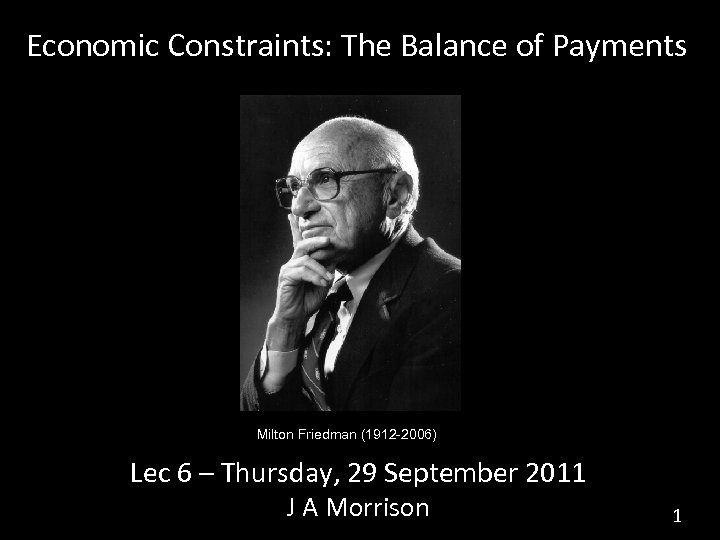
Economic Constraints: The Balance of Payments Milton Friedman (1912 -2006) Lec 6 – Thursday, 29 September 2011 J A Morrison 1
Economic Constraints: The Balance of Payments I. Economic Constraints II. The Balance of Payments III. Choosing the Means to Achieve Balance IV. The Bo. P and the Current Financial Crisis 2
Economic Constraints: The Balance of Payments I. Economic Constraints II. The Balance of Payments III. Choosing the Means to Achieve Balance IV. The Bo. P and the Current Financial Crisis 3
Up to this point, all of our explanations of foreign economic policy have centered around political variables: the structure of the international system and policymakers’ ideas, interests, and institutions. But markets also constrain and enable policymakers. 4
I. Economic Constraints 1. Empower Interest Groups 2. Mold Policy & Behavior 3. Negate State Action 5
Remember that Smith & Rogowski argued that interest groups lobby policymakers to secure policies that benefit them. Interest groups’ lobbying power, however, depends to some extent on their economic status. 6
Wealth brings status and power. At a minimum, markets influence the strength of societies’ various interest groups. 7
I. Economic Constraints 1. Empower Interest Groups 2. Mold Policy & Behavior • Negate State Action 8
Remember that market actors often enjoy exit options. If they don’t like certain policies, they can frequently work around them or even relocate to other jurisdictions. 9
Because states fret at the potential loss of these valuable actors, policymakers are somewhat beholden to market actors. Market actors can thus reward and punish certain types of behavior. 10
Remember this slide from last Thursday? 11
Example: Sovereign Debt • Sovereign has the power to repudiate debt • Lenders have several possible responses – Raise interest rates – Refuse to lend – Hide assets – Emigrate • By consistently repaying debts, sovereign ensures larger supply of capital and better terms (lower interest rate) 12
I. Economic Constraints 1. Empower Interest Groups 2. Mold Policy & Behavior 3. Negate State Action 13
If market actors find policy completely noxious, they may take action—deliberate or indeliberate —that negates state policy. 14
Example: Avoiding Taxes • Hoping to increase tax revenues, a state raises its income tax • Most citizens acquiesce since the costs of circumventing the law outweigh the benefits • But the richest citizens have the most to lose and can emigrate at the lowest cost • Ultimately, the state’s revenues decrease as the richest citizens leave and no longer pay any tax 15
Economic Constraints: The Balance of Payments I. Economic Constraints II. The Balance of Payments III. Choosing the Means to Achieve Balance IV. The Bo. P and the Current Financial Crisis 16
II. The Balance of Payments 1. Studying the Balance of Payments 2. The Balance of Payments 3. Achieving Balance 17
The “balance of payments constraint” is one of the most significant constraints policymakers face when setting foreign (and domestic!) economic policy. 18
But it is also the most difficult to understand! It can be a bit abstract and complex, but we need to understand it. 19
(I’ll try to spice things up with a few pictures of my daughters along the way!) Hadley Samantha 20
Learning Objectives 1. Familiarity with the major components of the Bo. P 2. Understand constraints imposed by the Bo. P 3. Identify policymakers’ options for managing the Bo. P We’ll revisit the Bo. P frequently throughout the term! 21
II. The Balance of Payments 1. Studying the Balance of Payments 2. The Balance of Payments 3. Achieving Balance 22
What is the balance of payments (Bo. P)? 23
The balance of payments (Bo. P) reconciles all of a country’s financial transactions with the world. This includes trade, remittances, investment, loans, &c. As an accounting matter, the Bo. P must always balance, by design. 24
But that balance can be achieved in more or less painful ways… that balance can be achieved with more or fewer implications for other policy areas. 25
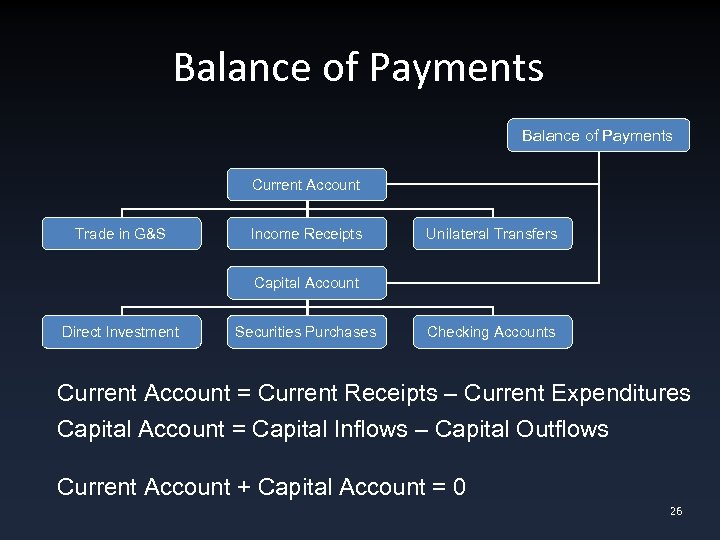
Balance of Payments Current Account Trade in G&S Income Receipts Unilateral Transfers Capital Account Direct Investment Securities Purchases Checking Accounts Current Account = Current Receipts – Current Expenditures Capital Account = Capital Inflows – Capital Outflows Current Account + Capital Account = 0 26
Let’s look at an actual year (1997) for the US. (This is detailed in Grieco & Ikenberry, Ch 3. ) 27
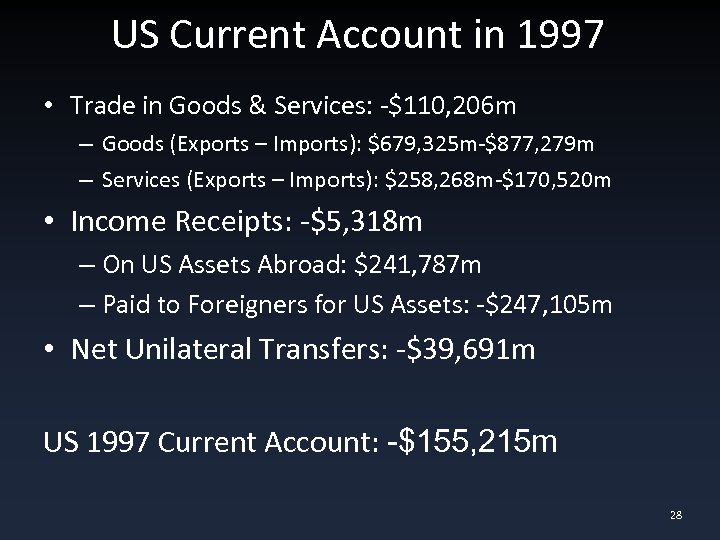
US Current Account in 1997 • Trade in Goods & Services: -$110, 206 m – Goods (Exports – Imports): $679, 325 m-$877, 279 m – Services (Exports – Imports): $258, 268 m-$170, 520 m • Income Receipts: -$5, 318 m – On US Assets Abroad: $241, 787 m – Paid to Foreigners for US Assets: -$247, 105 m • Net Unilateral Transfers: -$39, 691 m US 1997 Current Account: -$155, 215 m 28
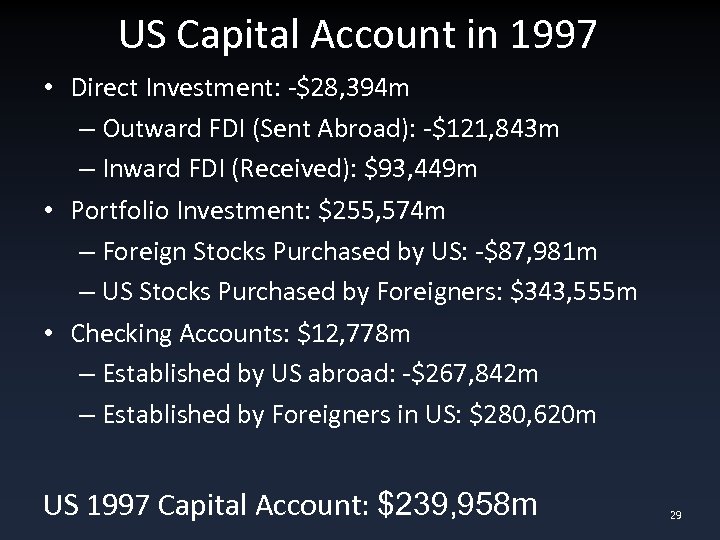
US Capital Account in 1997 • Direct Investment: -$28, 394 m – Outward FDI (Sent Abroad): -$121, 843 m – Inward FDI (Received): $93, 449 m • Portfolio Investment: $255, 574 m – Foreign Stocks Purchased by US: -$87, 981 m – US Stocks Purchased by Foreigners: $343, 555 m • Checking Accounts: $12, 778 m – Established by US abroad: -$267, 842 m – Established by Foreigners in US: $280, 620 m US 1997 Capital Account: $239, 958 m 29
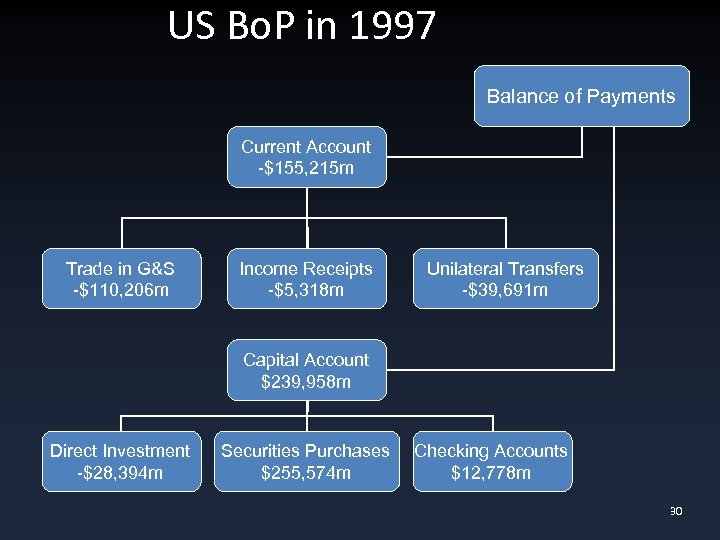
US Bo. P in 1997 Balance of Payments Current Account -$155, 215 m Trade in G&S -$110, 206 m Income Receipts -$5, 318 m Unilateral Transfers -$39, 691 m Capital Account $239, 958 m Direct Investment -$28, 394 m Securities Purchases $255, 574 m Checking Accounts $12, 778 m 30
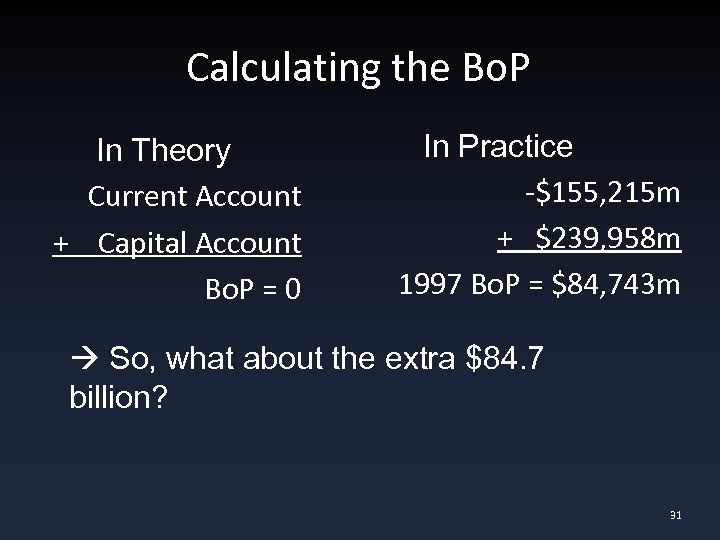
Calculating the Bo. P In Theory Current Account + Capital Account Bo. P = 0 In Practice -$155, 215 m + $239, 958 m 1997 Bo. P = $84, 743 m So, what about the extra $84. 7 billion? 31
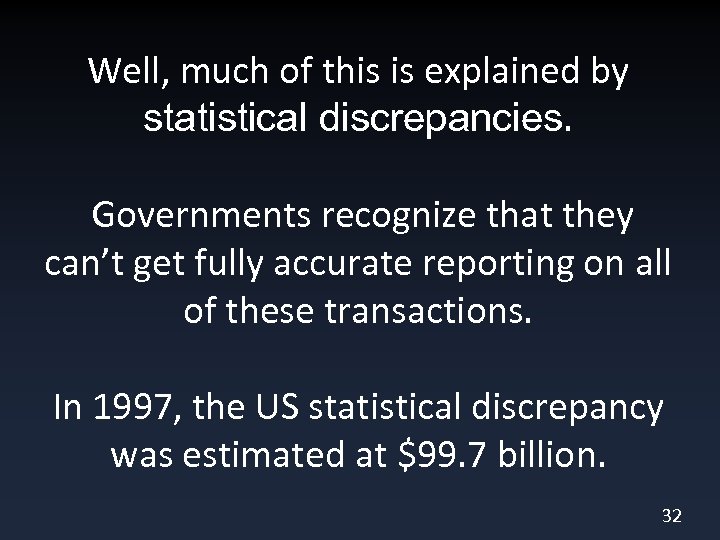
Well, much of this is explained by statistical discrepancies. Governments recognize that they can’t get fully accurate reporting on all of these transactions. In 1997, the US statistical discrepancy was estimated at $99. 7 billion. 32
But that still leaves $14. 8 billion!!! I thought the balance of payments always balances! 33
It does--but often not without some help! 34
(And people thought I was cute…) 35
II. The Balance of Payments 1. Studying the Balance of Payments 2. The Balance of Payments 3. Achieving Balance 36
Milton Friedman describes the various mechanisms available to states to redress imbalances of payments. (p 202) 37
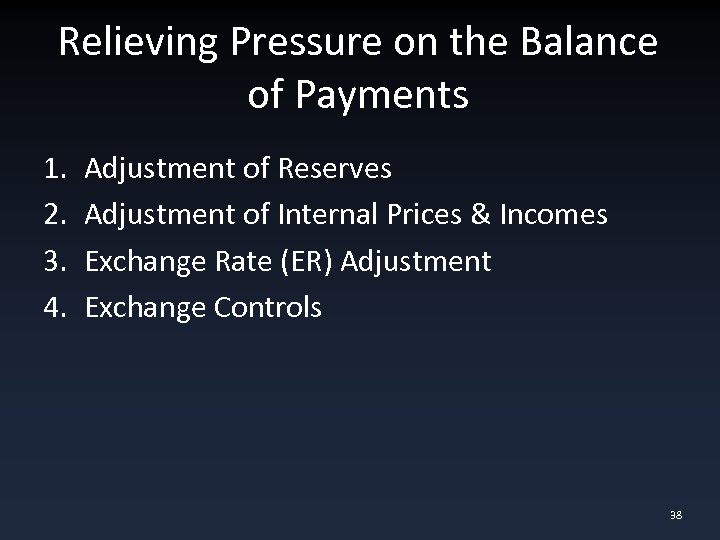
Relieving Pressure on the Balance of Payments 1. 2. 3. 4. Adjustment of Reserves Adjustment of Internal Prices & Incomes Exchange Rate (ER) Adjustment Exchange Controls 38
(1) Adjustment of Reserves • The first option is to “adjust reserves” using “official transactions” • Reserves: non-domestic financial assets (foreign currency, bonds, &c. ) held & used by govts to support their currency • Official Transactions: govt purchase/sale of foreign reserves so as to alleviate pressure on the balance of payments 39
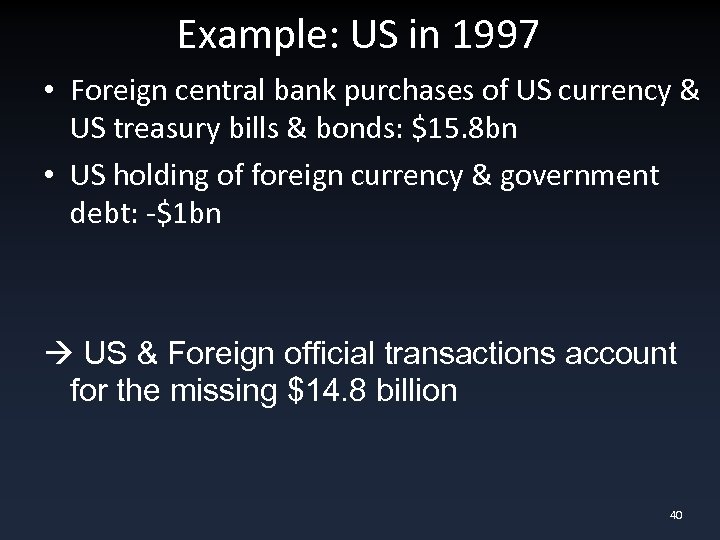
Example: US in 1997 • Foreign central bank purchases of US currency & US treasury bills & bonds: $15. 8 bn • US holding of foreign currency & government debt: -$1 bn US & Foreign official transactions account for the missing $14. 8 billion 40
Oh, that must be nice: you can clear your imbalances just by adjusting your reserves! That does sound nice. But is there any limit to the amount of “adjusting” you can do? 41
Asymmetric Options • Selling Reserves – A central bank cannot sell more reserves than it has initially • Amassing Reserves – There is, theoretically, no upper limit to the quantity of reserves a central bank can acquire – A central bank can purchase limitless foreign currency by continually printing and selling its own currency in exchange – To prevent inflation, it might employ sterilization: selling govt bonds and “soaking up” excess currency This is precisely what China has been doing. 42
Returning to the US Bo. P in 1997, we’re all set: The official transactions and “statistical discrepancy” resolve the US autonomous surplus of $84. 7 billion. 43
But Friedman listed three other mechanisms that can be used to maintain balance. These mechanisms, however, work dynamically—so we don’t always see their effects on the balance sheet. 44
(2) Adjustment of Internal Prices & Incomes • Central bank influences domestic rate of interest (Ro. I) • Double effect of Ro. I adjustments 1. Influences domestic price level current account 2. Influences int’l capital flows capital account 45
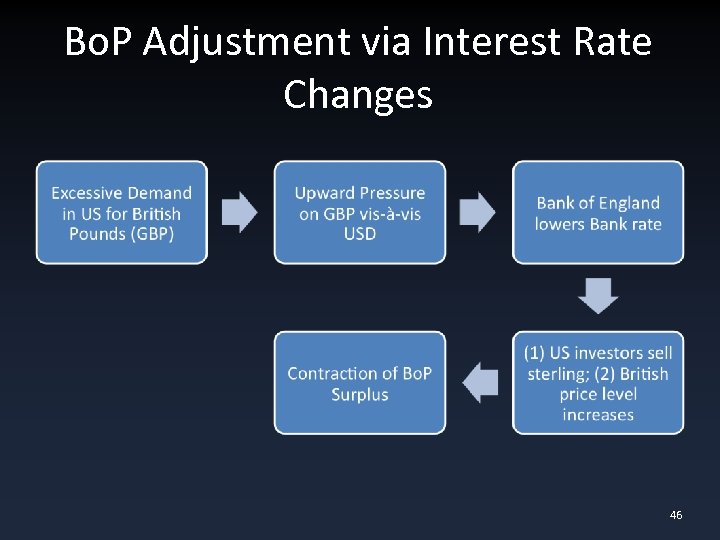
Bo. P Adjustment via Interest Rate Changes 46
(3) ER Adjustments • Mechanism 2 maintained the external value of currency (the ER) at the expense of adjusting the internal value (the domestic price level) • Mechanism 3 does the opposite: maintain the domestic price level but allow the ER to adjust 47
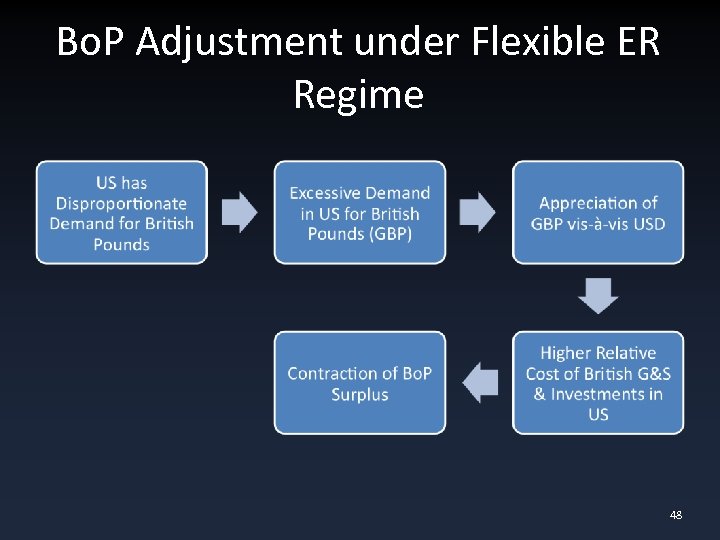
Bo. P Adjustment under Flexible ER Regime 48
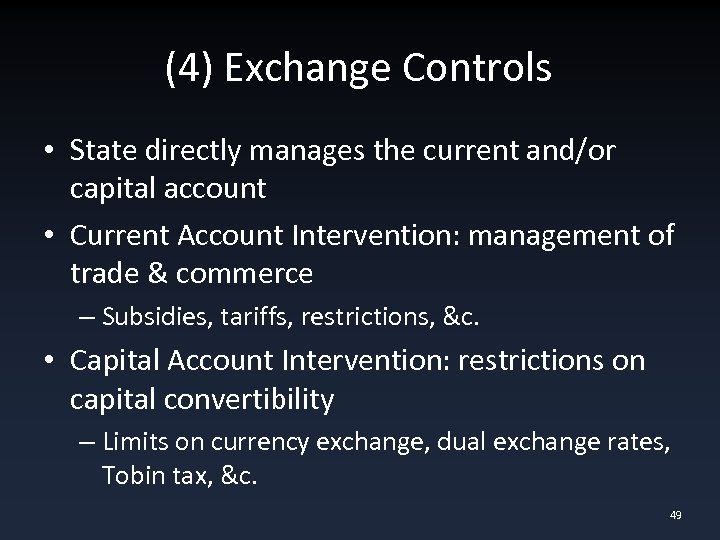
(4) Exchange Controls • State directly manages the current and/or capital account • Current Account Intervention: management of trade & commerce – Subsidies, tariffs, restrictions, &c. • Capital Account Intervention: restrictions on capital convertibility – Limits on currency exchange, dual exchange rates, Tobin tax, &c. 49
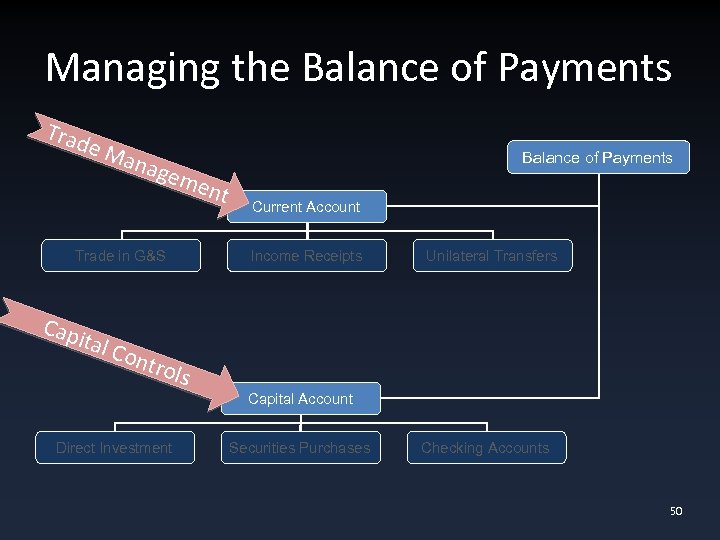
Managing the Balance of Payments Trad e. M ana gem Balance of Payments ent Trade in G&S Cap ital Current Account Income Receipts Unilateral Transfers Con trols Capital Account Direct Investment Securities Purchases Checking Accounts 50
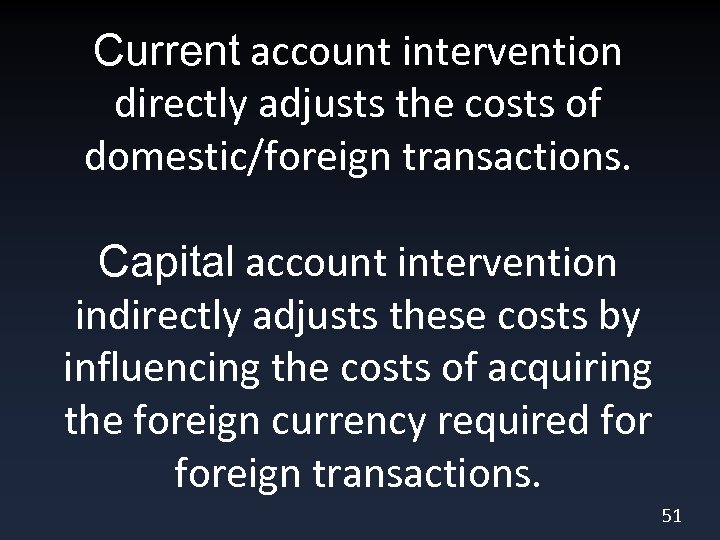
Current account intervention directly adjusts the costs of domestic/foreign transactions. Capital account intervention indirectly adjusts these costs by influencing the costs of acquiring the foreign currency required foreign transactions. 51
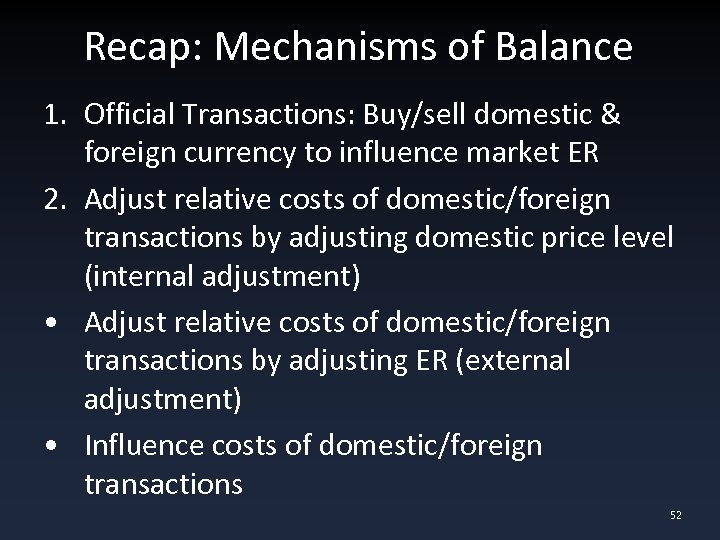
Recap: Mechanisms of Balance 1. Official Transactions: Buy/sell domestic & foreign currency to influence market ER 2. Adjust relative costs of domestic/foreign transactions by adjusting domestic price level (internal adjustment) • Adjust relative costs of domestic/foreign transactions by adjusting ER (external adjustment) • Influence costs of domestic/foreign transactions 52
Economic Constraints: The Balance of Payments I. Economic Constraints II. The Balance of Payments III. Choosing the Means to Achieve Balance IV. The Bo. P and the Current Financial Crisis 53
So, we have 4 different options… But don’t make the mistake of assuming that all of these responses are equal!! 54
“It cannot be too strongly emphasized that the structure and method of determining exchange rates have a vital bearing on almost every problem of international economic relations…The only other alternative to movements in exchange rates is direct control of foreign trade. Such control is therefore almost certain to be the primary technique adopted to meet substantial movements in conditions of international trade so long as exchange rates are maintained rigid. The implicit or explicit recognition of this fact is clearly one of the chief sources of difficulty in attempts to achieve a greater degree of liberalization of trade in Europe…” (Friedman, 196 -197) 55
Friedman, in fact, was following JM Keynes… 56
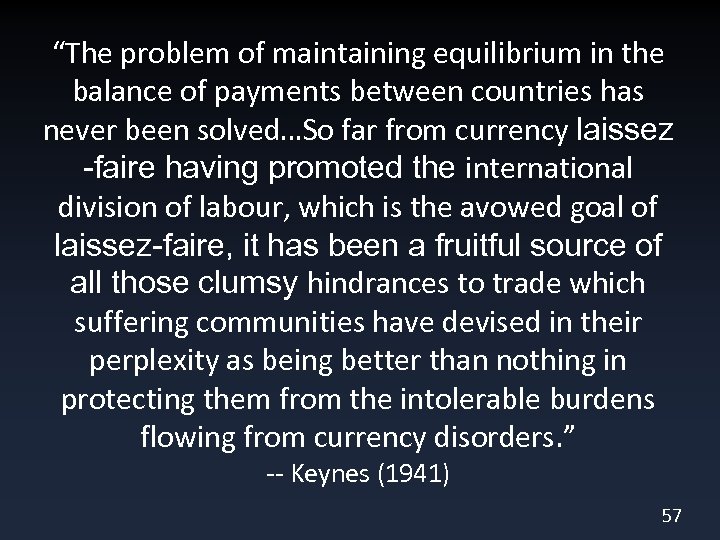
“The problem of maintaining equilibrium in the balance of payments between countries has never been solved…So far from currency laissez -faire having promoted the international division of labour, which is the avowed goal of laissez-faire, it has been a fruitful source of all those clumsy hindrances to trade which suffering communities have devised in their perplexity as being better than nothing in protecting them from the intolerable burdens flowing from currency disorders. ” -- Keynes (1941) 57
So, what does Friedman propose? 58
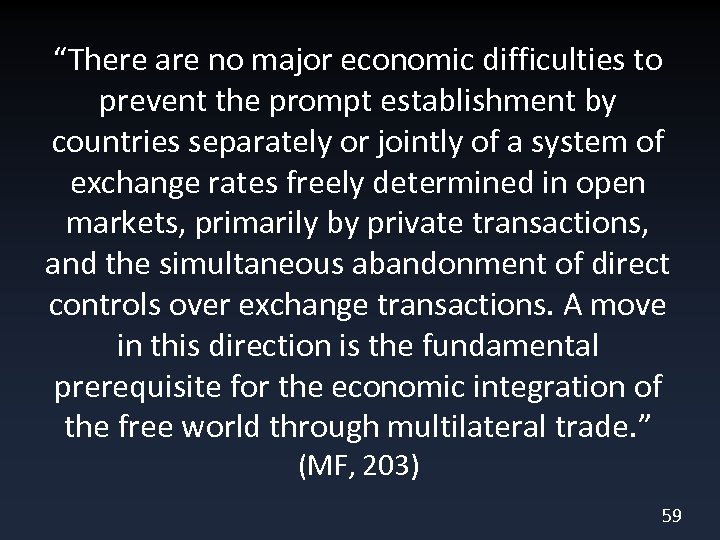
“There are no major economic difficulties to prevent the prompt establishment by countries separately or jointly of a system of exchange rates freely determined in open markets, primarily by private transactions, and the simultaneous abandonment of direct controls over exchange transactions. A move in this direction is the fundamental prerequisite for the economic integration of the free world through multilateral trade. ” (MF, 203) 59
So, policy makers have a variety of ways to ensure that their payments balance. And prominent theorists (Keynes; Friedman) suggest that some of those choices (flexible ERs) are better than others (exchange controls). 60
Economic Constraints: The Balance of Payments I. Economic Constraints II. The Balance of Payments III. Choosing the Means to Achieve Balance IV. The Bo. P and the Current Financial Crisis 61
“In my view…it is impossible to understand this crisis without reference to the global imbalances in trade and capital flows that began in the latter half of the 1990 s. ” -- Ben Bernanke, Speech at the Council on Foreign Relations. (March 2009) 62
We thus face two questions with extraordinary contemporary relevance: (1) what causes imbalances of payments in the first place? (2) what are the effects of sustained imbalances? 63
II. Imbalances: Causes & Consequences 1. Two Explanations 2. The Stakes: Contemporary Application 64
Doug Irwin has developed one perspective on this vital question: 65
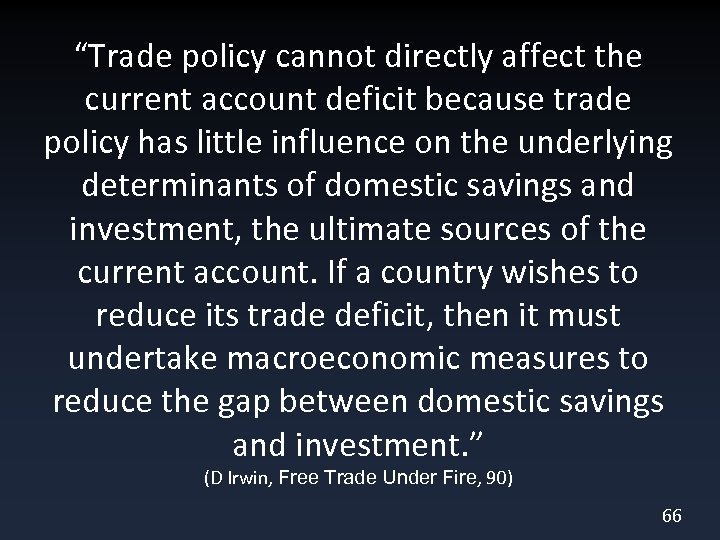
“Trade policy cannot directly affect the current account deficit because trade policy has little influence on the underlying determinants of domestic savings and investment, the ultimate sources of the current account. If a country wishes to reduce its trade deficit, then it must undertake macroeconomic measures to reduce the gap between domestic savings and investment. ” (D Irwin, Free Trade Under Fire, 90) 66
Hmm. Interesting. Now compare that to this… 67
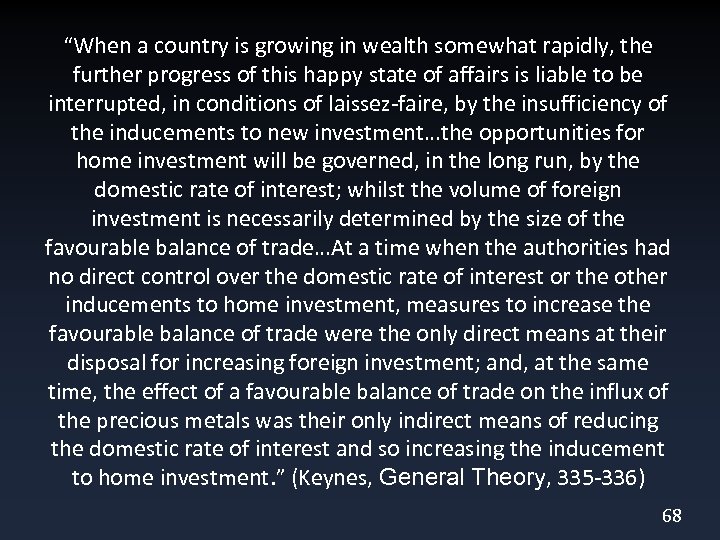
“When a country is growing in wealth somewhat rapidly, the further progress of this happy state of affairs is liable to be interrupted, in conditions of laissez-faire, by the insufficiency of the inducements to new investment…the opportunities for home investment will be governed, in the long run, by the domestic rate of interest; whilst the volume of foreign investment is necessarily determined by the size of the favourable balance of trade…At a time when the authorities had no direct control over the domestic rate of interest or the other inducements to home investment, measures to increase the favourable balance of trade were the only direct means at their disposal for increasing foreign investment; and, at the same time, the effect of a favourable balance of trade on the influx of the precious metals was their only indirect means of reducing the domestic rate of interest and so increasing the inducement to home investment. ” (Keynes, General Theory, 335 -336) 68
What is the relationship each theorist sees between macroeconomic (monetary) policy, the patterns of investment & saving, and the balance of trade (the current account)? 69
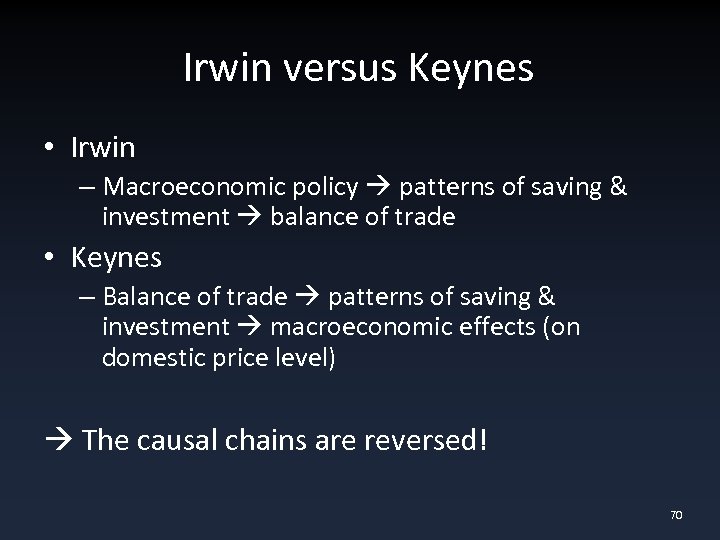
Irwin versus Keynes • Irwin – Macroeconomic policy patterns of saving & investment balance of trade • Keynes – Balance of trade patterns of saving & investment macroeconomic effects (on domestic price level) The causal chains are reversed! 70
II. The Cause of Imbalances of Payments 1. Two Explanations 2. The Stakes: Contemporary Application 71
This directly relates to the current global financial crisis. What caused the housing bubble that ripened conditions for the crisis? 72
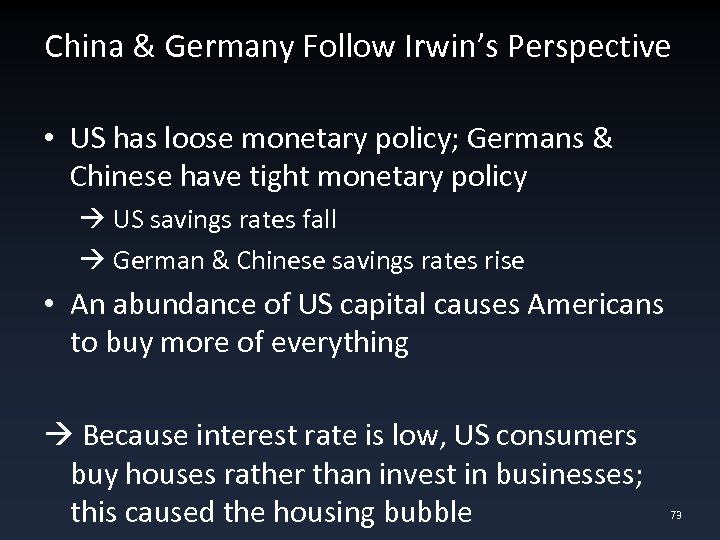
China & Germany Follow Irwin’s Perspective • US has loose monetary policy; Germans & Chinese have tight monetary policy US savings rates fall German & Chinese savings rates rise • An abundance of US capital causes Americans to buy more of everything Because interest rate is low, US consumers buy houses rather than invest in businesses; this caused the housing bubble 73
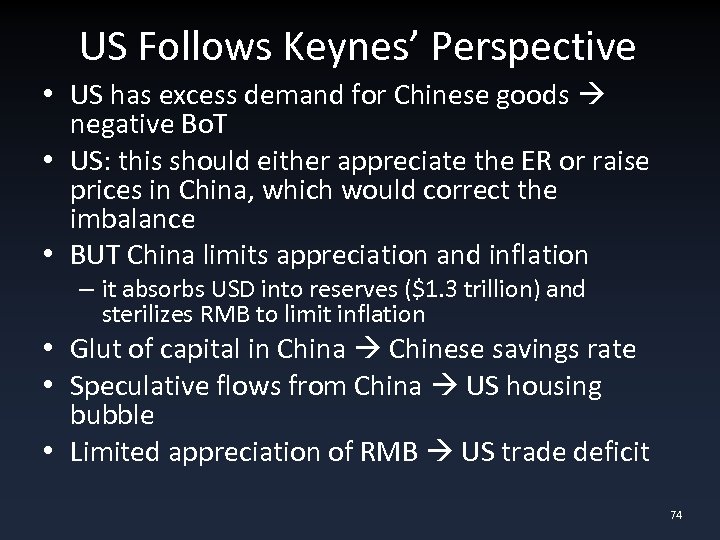
US Follows Keynes’ Perspective • US has excess demand for Chinese goods negative Bo. T • US: this should either appreciate the ER or raise prices in China, which would correct the imbalance • BUT China limits appreciation and inflation – it absorbs USD into reserves ($1. 3 trillion) and sterilizes RMB to limit inflation • Glut of capital in China Chinese savings rate • Speculative flows from China US housing bubble • Limited appreciation of RMB US trade deficit 74
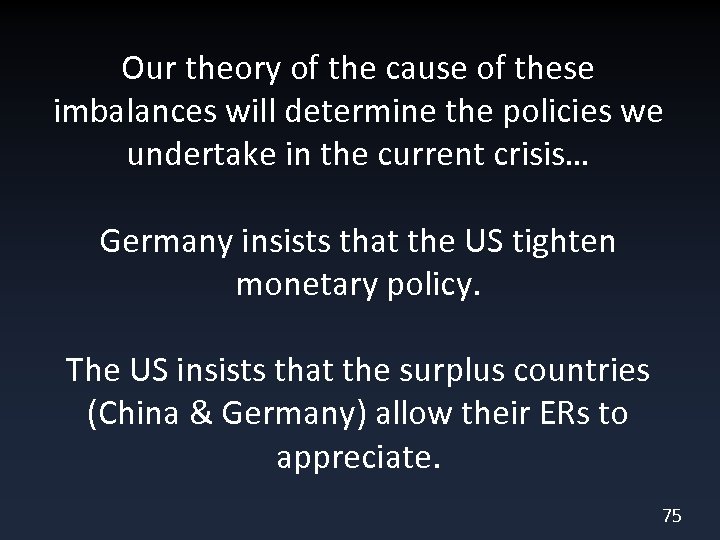
Our theory of the cause of these imbalances will determine the policies we undertake in the current crisis… Germany insists that the US tighten monetary policy. The US insists that the surplus countries (China & Germany) allow their ERs to appreciate. 75
Скачать презентацию Economic Constraints The Balance of Payments Milton Friedman
0e46e3938a7bb639955f67bfdb9e1d32.ppt