


 Скачать презентацию Economic Comparison Fr Clinic II Overview n
a3379f5f9fe2fee7909aca36d25d8554.ppt
- Количество слайдов: 19
 Economic Comparison Fr Clinic II
 Overview n n Economics and Engineers Time Value of Money Different types of Economic Analyses Comparing our filters – two examples
 Warning n The field of economic comparison is huge, I’ve left a lot out.
 Engineers and Economics n Engineers often must estimate the benefits and/or costs of their designs – Buildings, roads, landfills – New products – Communication systems – Refineries, oil platforms
 Time Value of Money n What would you rather have, $100 now or 5 years from now? – Assuming you don’t need the $100 to meet some immediate need, what is your answer? – Why?
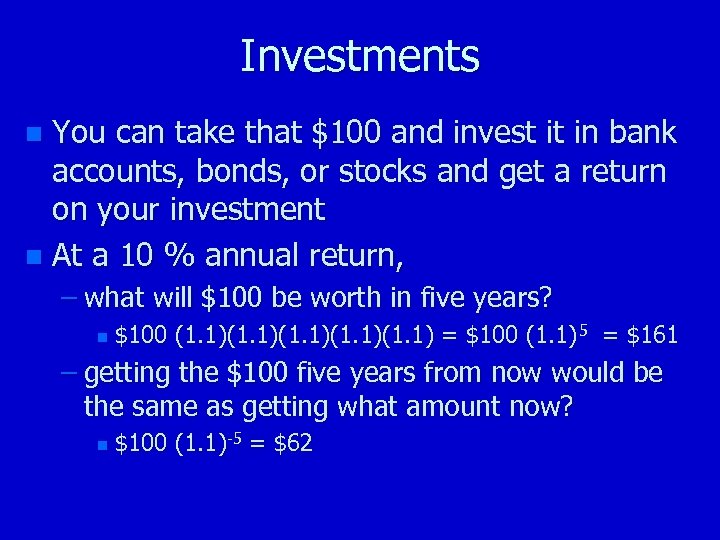 Investments You can take that $100 and invest it in bank accounts, bonds, or stocks and get a return on your investment n At a 10 % annual return, n – what will $100 be worth in five years? n $100 (1. 1)(1. 1) = $100 (1. 1) 5 = $161 – getting the $100 five years from now would be the same as getting what amount now? n $100 (1. 1)-5 = $62
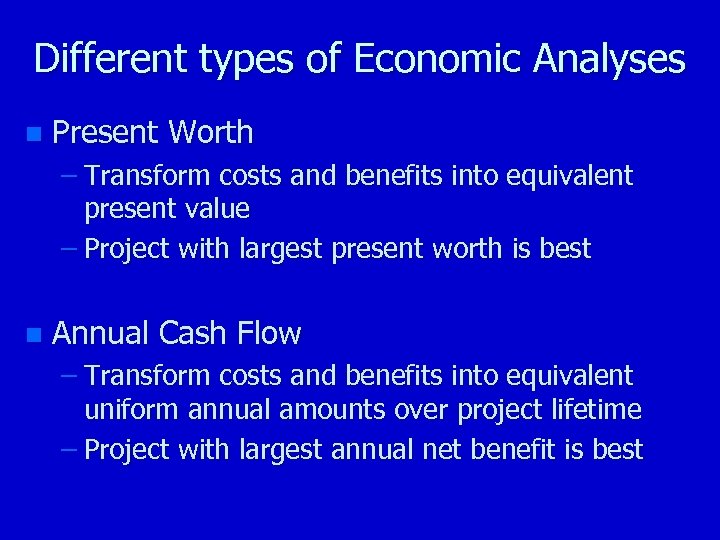 Different types of Economic Analyses n Present Worth – Transform costs and benefits into equivalent present value – Project with largest present worth is best n Annual Cash Flow – Transform costs and benefits into equivalent uniform annual amounts over project lifetime – Project with largest annual net benefit is best
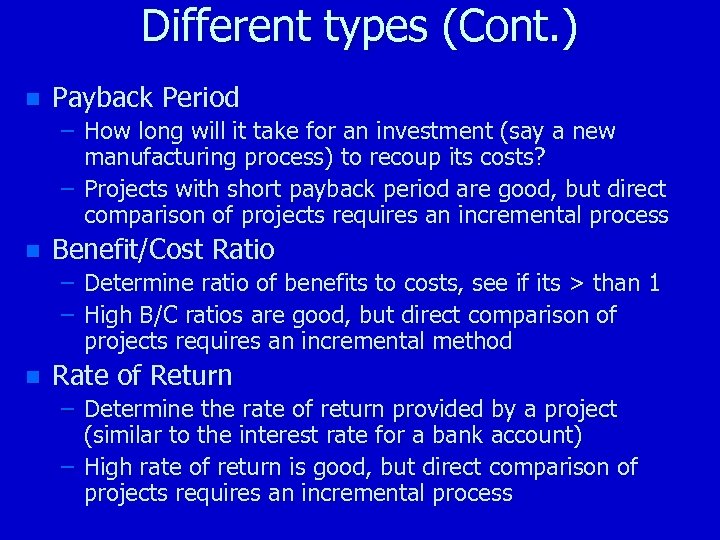 Different types (Cont. ) n Payback Period – How long will it take for an investment (say a new manufacturing process) to recoup its costs? – Projects with short payback period are good, but direct comparison of projects requires an incremental process n Benefit/Cost Ratio – Determine ratio of benefits to costs, see if its > than 1 – High B/C ratios are good, but direct comparison of projects requires an incremental method n Rate of Return – Determine the rate of return provided by a project (similar to the interest rate for a bank account) – High rate of return is good, but direct comparison of projects requires an incremental process
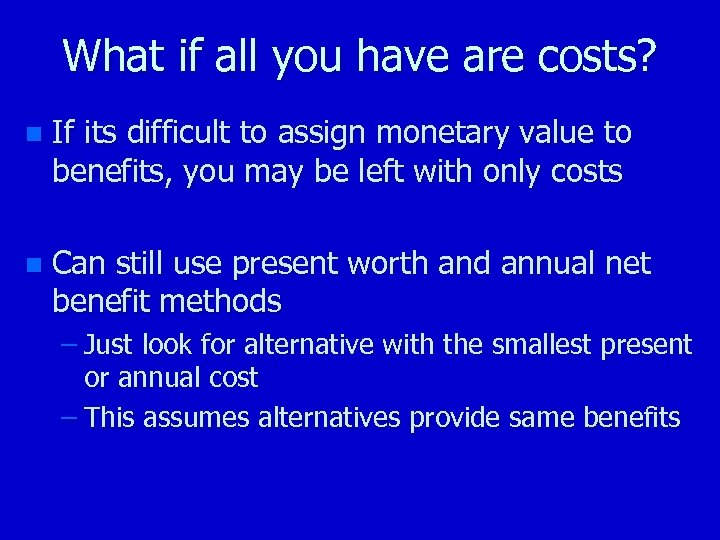 What if all you have are costs? n If its difficult to assign monetary value to benefits, you may be left with only costs n Can still use present worth and annual net benefit methods – Just look for alternative with the smallest present or annual cost – This assumes alternatives provide same benefits
 Comparing Filters n Without time value of money – Costs are purchase of (a) entire unit and (b) replacement cartridges – Costs can be related to volume of water treated n With time value of money – Must estimate rate at which water will be treated, to estimate cartridge replacement times
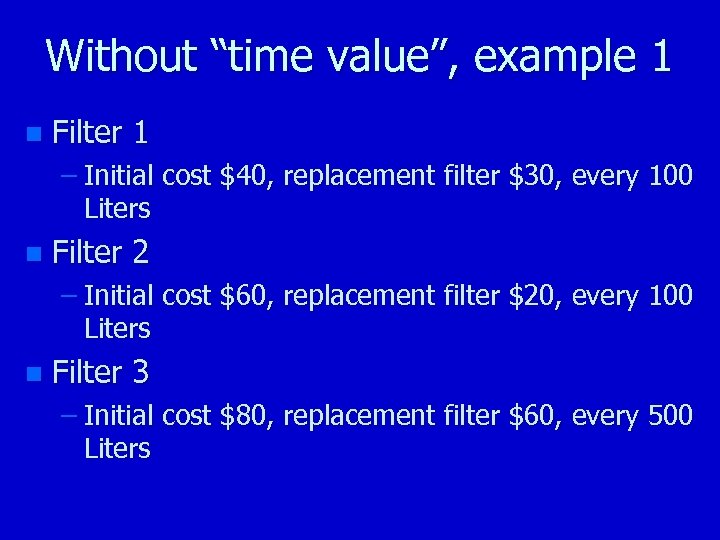 Without “time value”, example 1 n Filter 1 – Initial cost $40, replacement filter $30, every 100 Liters n Filter 2 – Initial cost $60, replacement filter $20, every 100 Liters n Filter 3 – Initial cost $80, replacement filter $60, every 500 Liters
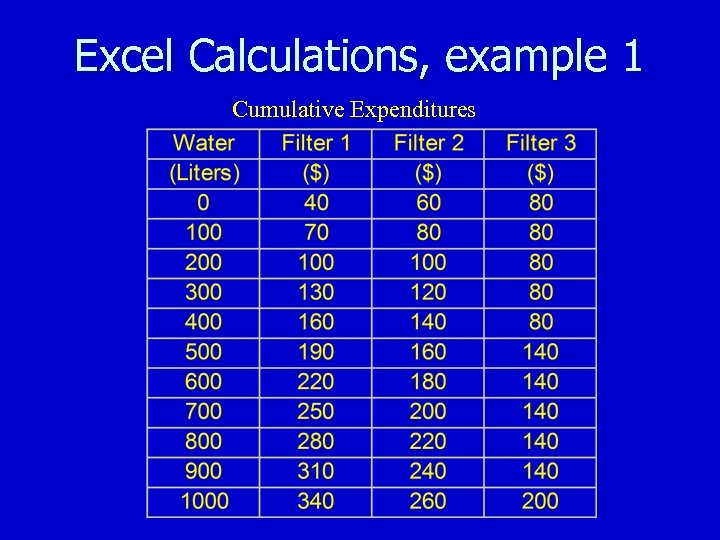 Excel Calculations, example 1 Cumulative Expenditures
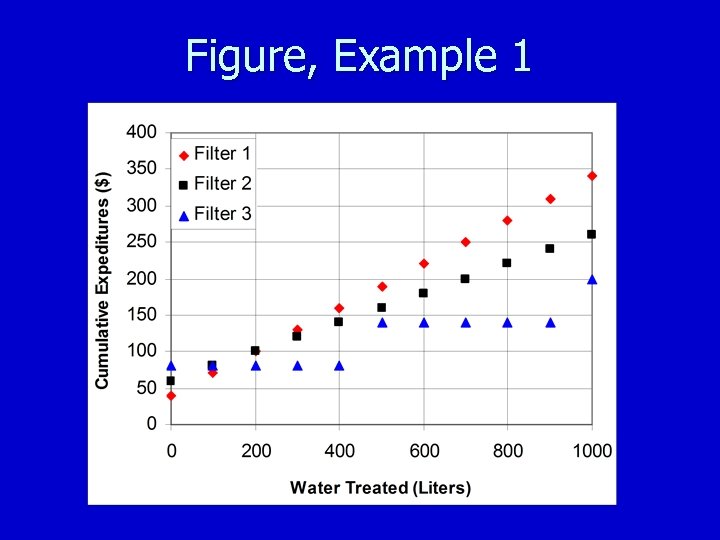 Figure, Example 1
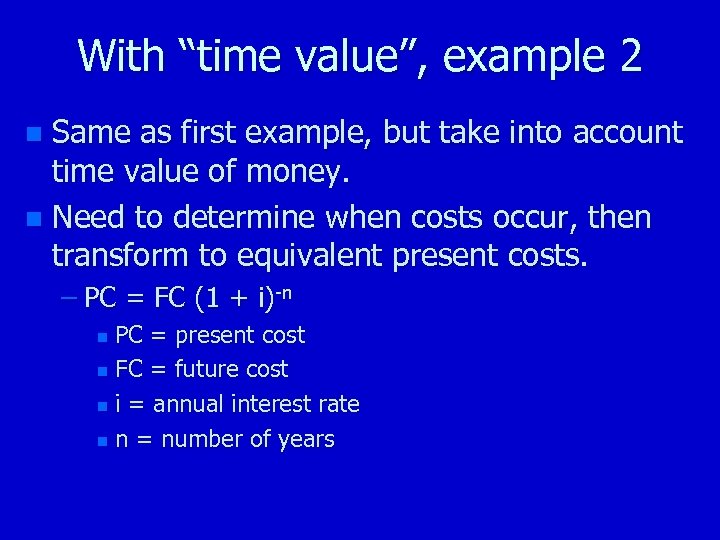 With “time value”, example 2 Same as first example, but take into account time value of money. n Need to determine when costs occur, then transform to equivalent present costs. n – PC = FC (1 + i)-n PC = present cost n FC = future cost n i = annual interest rate n n = number of years n
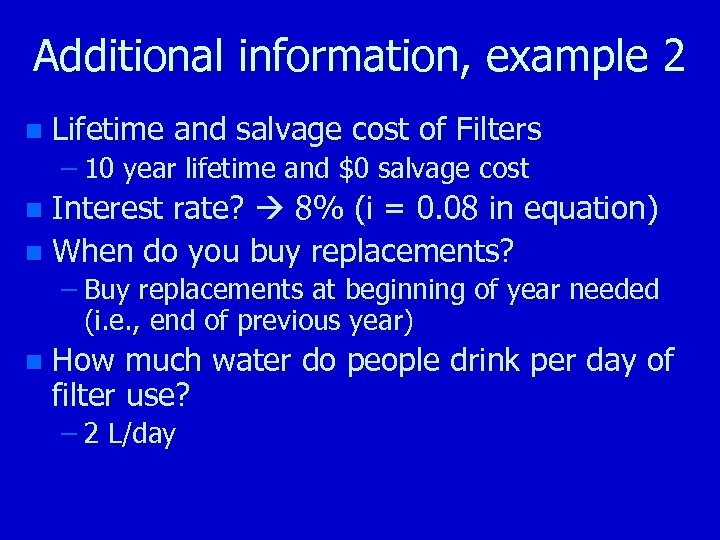 Additional information, example 2 n Lifetime and salvage cost of Filters – 10 year lifetime and $0 salvage cost Interest rate? 8% (i = 0. 08 in equation) n When do you buy replacements? n – Buy replacements at beginning of year needed (i. e. , end of previous year) n How much water do people drink per day of filter use? – 2 L/day
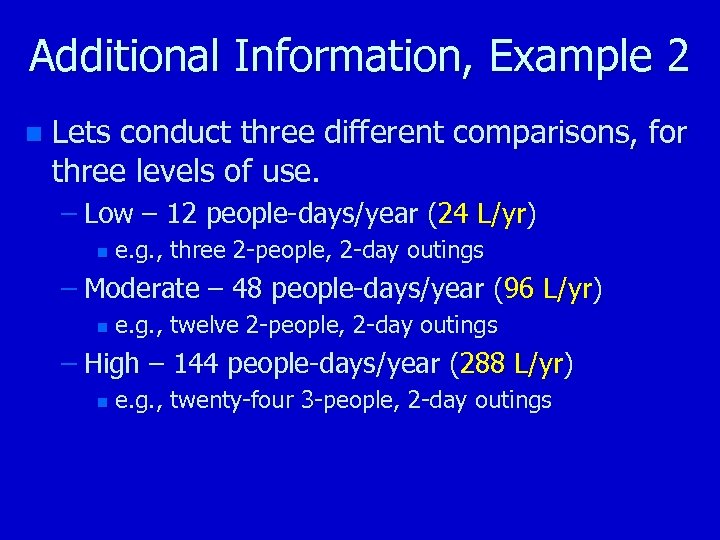 Additional Information, Example 2 n Lets conduct three different comparisons, for three levels of use. – Low – 12 people-days/year (24 L/yr) n e. g. , three 2 -people, 2 -day outings – Moderate – 48 people-days/year (96 L/yr) n e. g. , twelve 2 -people, 2 -day outings – High – 144 people-days/year (288 L/yr) n e. g. , twenty-four 3 -people, 2 -day outings
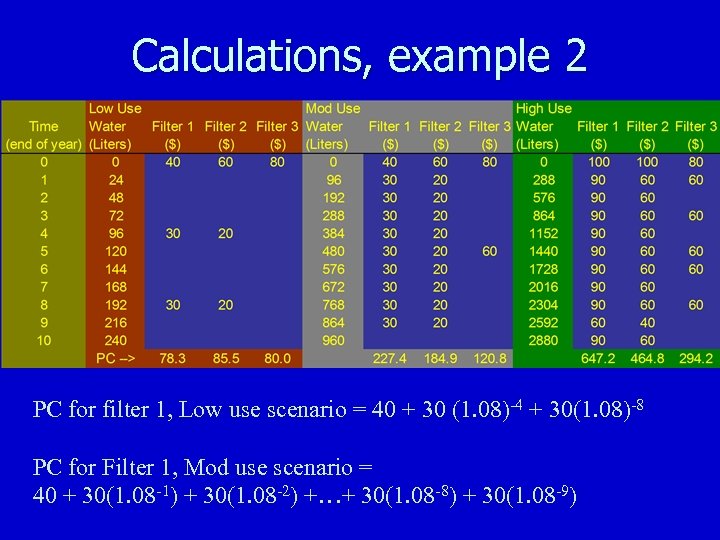 Calculations, example 2 PC for filter 1, Low use scenario = 40 + 30 (1. 08)-4 + 30(1. 08)-8 PC for Filter 1, Mod use scenario = 40 + 30(1. 08 -1) + 30(1. 08 -2) +…+ 30(1. 08 -8) + 30(1. 08 -9)
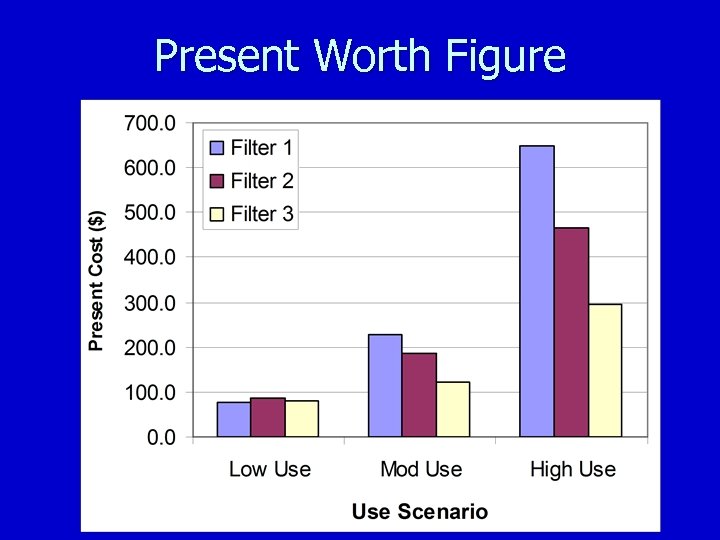 Present Worth Figure
 Conclusion n Conduct an economic comparison of the filters using both methods outlined here!