 Скачать презентацию Economic Analysis of B 2 B E-Commerce Michael
7902771defda8eee81064f4f13167523.ppt
- Количество слайдов: 22



Economic Analysis of B 2 B E-Commerce Michael J. Shaw Chandrasekar Subramaniam Department of Business Administration University of Illinois at Urbana-Champaign
Value of B 2 B E-Commerce • Web-enabled B 2 B e-commerce can enhance interorganizational coordination, resulting in lower transaction costs and business opportunities • What is the value of B 2 B e-commerce to an enterprise? How to measure this value? • What factors most affect the realization of the potential value of B 2 B e-commerce? • This research presents an integrated framework of economic analysis and empirical study for the valuation of B 2 B e-commerce
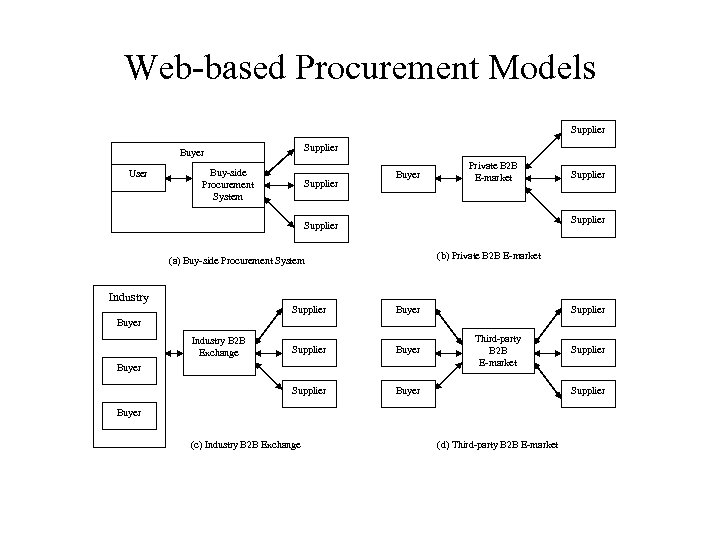
Web-based Procurement Models Supplier Buyer User Buy-side Procurement System Supplier Buyer Private B 2 B E-market Supplier (b) Private B 2 B E-market (a) Buy-side Procurement System Industry Supplier Buyer Industry B 2 B Exchange Buyer Third-party B 2 B E-market Supplier Buyer (c) Industry B 2 B Exchange Supplier (d) Third-party B 2 B E-market
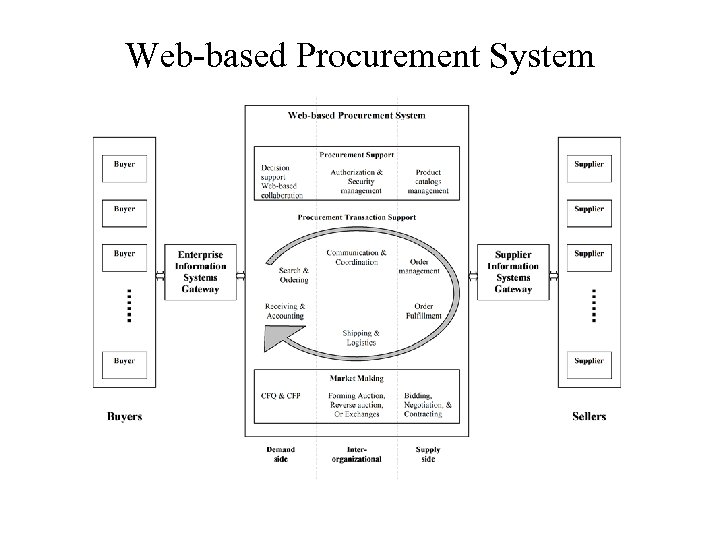
Web-based Procurement System
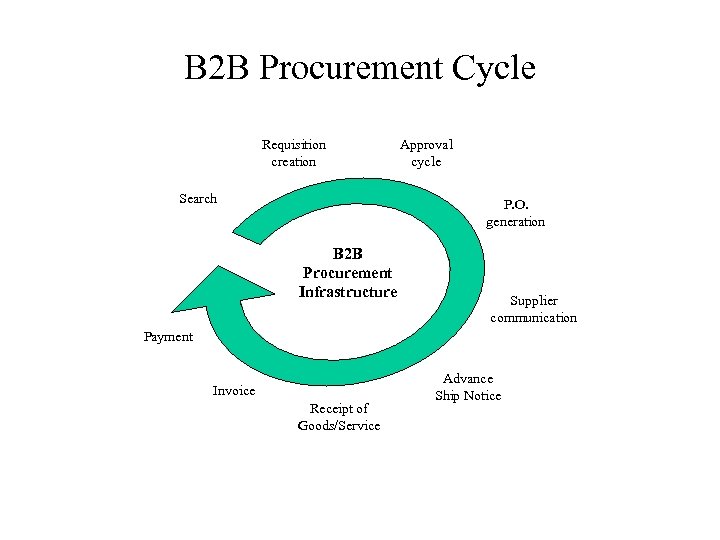
B 2 B Procurement Cycle Requisition creation Search Approval cycle P. O. generation B 2 B Procurement Infrastructure Supplier communication Payment Invoice Receipt of Goods/Service Advance Ship Notice
Research Objectives and Setting • Objectives – To study value of Web-based procurement, as a case of B 2 B e-commerce, using a theoretical framework – Integrating theoretical analysis with empirical study to come up with a comprehensive valuation model • Setting – A large organization proposing to implement a Web-based procurement system for its indirect purchases – Multinational enterprise, with several business units spread across the globe – Larger business units are highly decentralized with respect to their purchases – Organization deals with a large number of contracted suppliers with various generations of information technology and levels of integration – Need to motivate internal users and suppliers to participate in the Webbased system
Research Questions • What is the value of Web-based procurement to an organization? How do we measure this value? • What conditions affect the realization of the value? What are the relative importance of each of these conditions? • What implementation strategies are likely to increase the adoption of the Web-based system among the users and suppliers? What economic and other incentives need to provided to motivate adoption among users and suppliers?
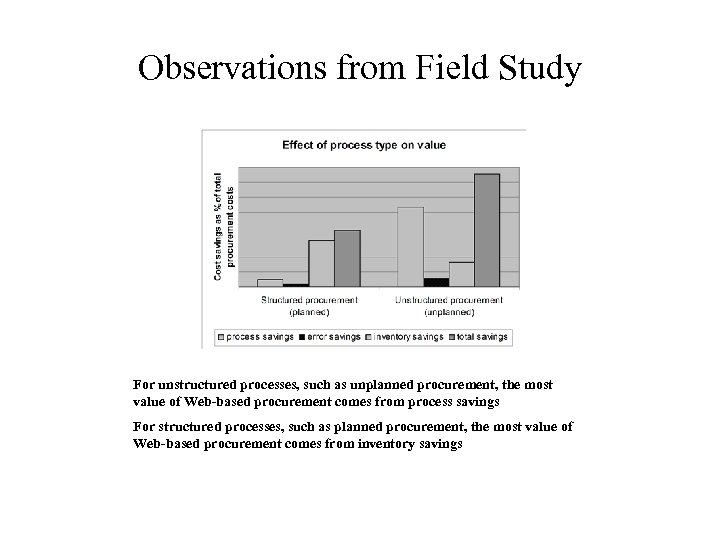
Observations from Field Study For unstructured processes, such as unplanned procurement, the most value of Web-based procurement comes from process savings For structured processes, such as planned procurement, the most value of Web-based procurement comes from inventory savings
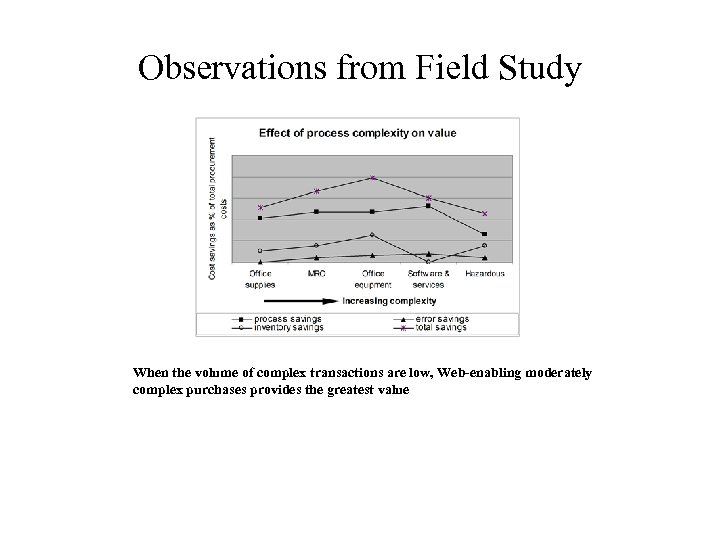
Observations from Field Study When the volume of complex transactions are low, Web-enabling moderately complex purchases provides the greatest value
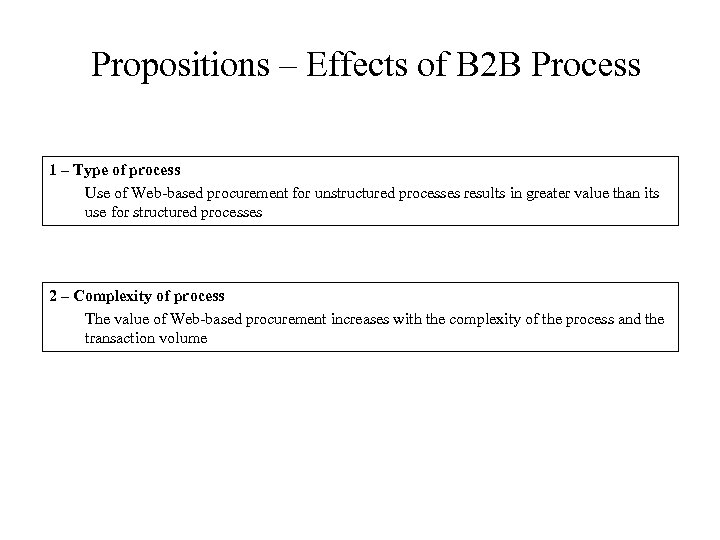
Propositions – Effects of B 2 B Process 1 – Type of process Use of Web-based procurement for unstructured processes results in greater value than its use for structured processes 2 – Complexity of process The value of Web-based procurement increases with the complexity of the process and the transaction volume
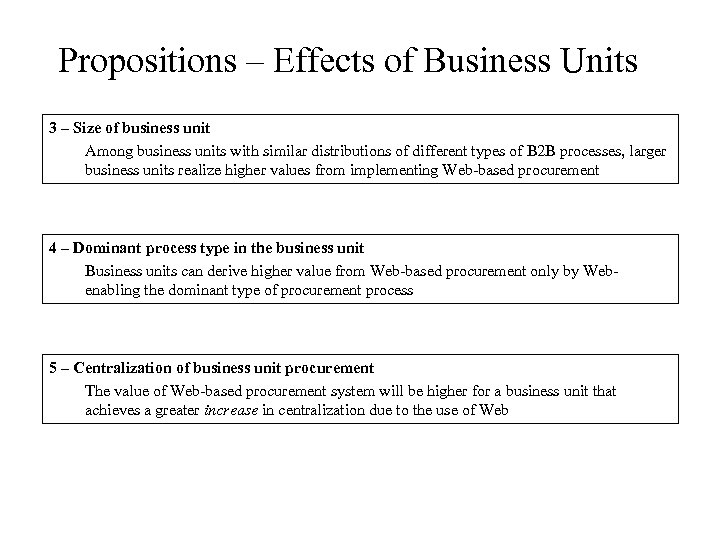
Propositions – Effects of Business Units 3 – Size of business unit Among business units with similar distributions of different types of B 2 B processes, larger business units realize higher values from implementing Web-based procurement 4 – Dominant process type in the business unit Business units can derive higher value from Web-based procurement only by Webenabling the dominant type of procurement process 5 – Centralization of business unit procurement The value of Web-based procurement system will be higher for a business unit that achieves a greater increase in centralization due to the use of Web
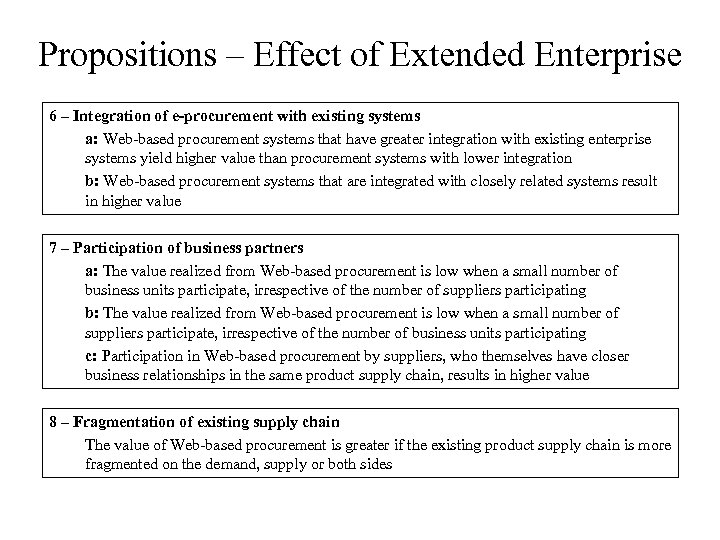
Propositions – Effect of Extended Enterprise 6 – Integration of e-procurement with existing systems a: Web-based procurement systems that have greater integration with existing enterprise systems yield higher value than procurement systems with lower integration b: Web-based procurement systems that are integrated with closely related systems result in higher value 7 – Participation of business partners a: The value realized from Web-based procurement is low when a small number of business units participate, irrespective of the number of suppliers participating b: The value realized from Web-based procurement is low when a small number of suppliers participate, irrespective of the number of business units participating c: Participation in Web-based procurement by suppliers, who themselves have closer business relationships in the same product supply chain, results in higher value 8 – Fragmentation of existing supply chain The value of Web-based procurement is greater if the existing product supply chain is more fragmented on the demand, supply or both sides
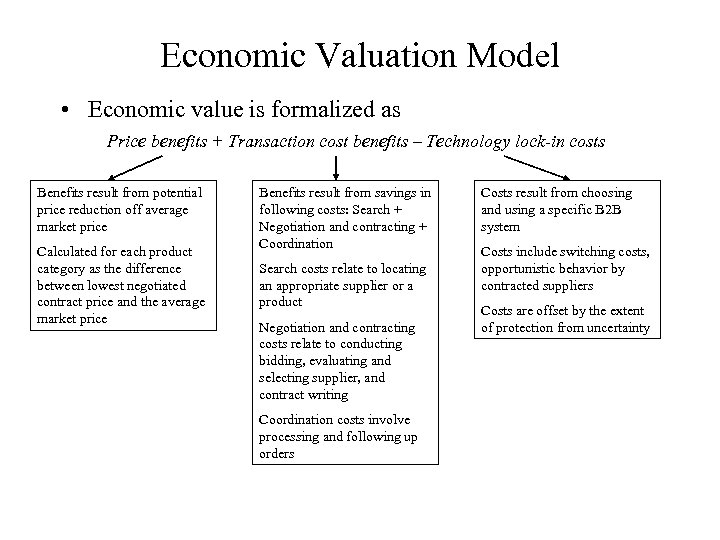
Economic Valuation Model • Economic value is formalized as Price benefits + Transaction cost benefits – Technology lock-in costs Benefits result from potential price reduction off average market price Calculated for each product category as the difference between lowest negotiated contract price and the average market price Benefits result from savings in following costs: Search + Negotiation and contracting + Coordination Search costs relate to locating an appropriate supplier or a product Negotiation and contracting costs relate to conducting bidding, evaluating and selecting supplier, and contract writing Coordination costs involve processing and following up orders Costs result from choosing and using a specific B 2 B system Costs include switching costs, opportunistic behavior by contracted suppliers Costs are offset by the extent of protection from uncertainty
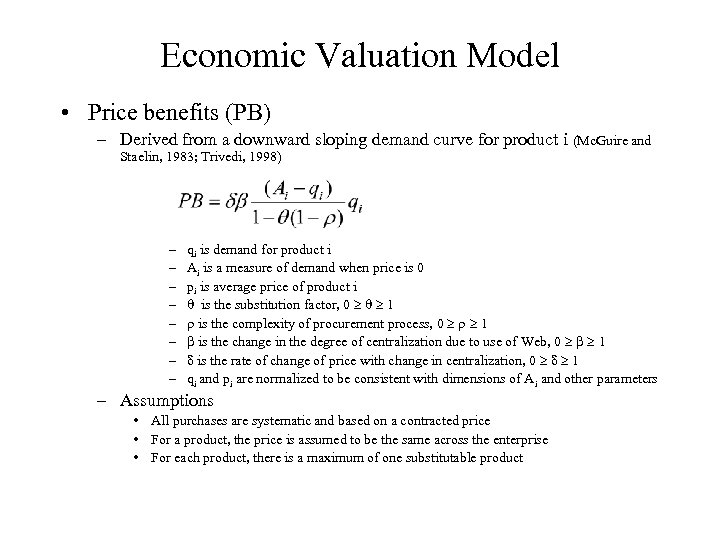
Economic Valuation Model • Price benefits (PB) – Derived from a downward sloping demand curve for product i (Mc. Guire and Staelin, 1983; Trivedi, 1998) – – – – qi is demand for product i Ai is a measure of demand when price is 0 pi is average price of product i is the substitution factor, 0 1 is the complexity of procurement process, 0 1 is the change in the degree of centralization due to use of Web, 0 1 δ is the rate of change of price with change in centralization, 0 δ 1 qi and pi are normalized to be consistent with dimensions of Ai and other parameters – Assumptions • All purchases are systematic and based on a contracted price • For a product, the price is assumed to be the same across the enterprise • For each product, there is a maximum of one substitutable product
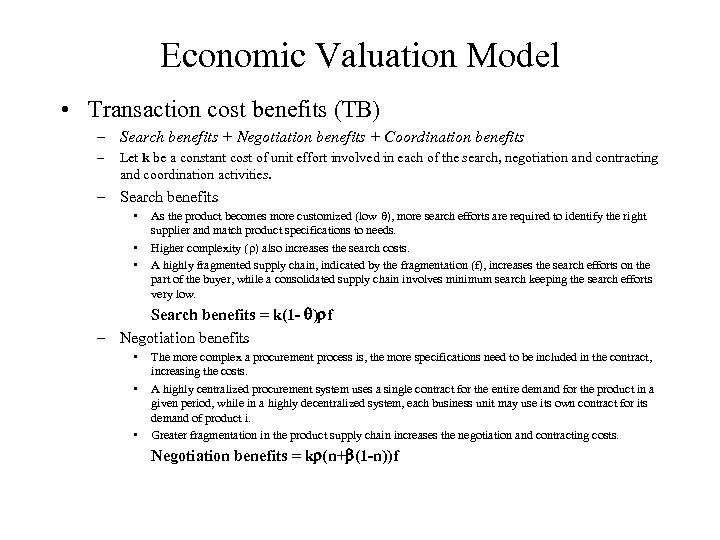
Economic Valuation Model • Transaction cost benefits (TB) – Search benefits + Negotiation benefits + Coordination benefits – Let k be a constant cost of unit effort involved in each of the search, negotiation and contracting and coordination activities. – Search benefits • • • As the product becomes more customized (low ), more search efforts are required to identify the right supplier and match product specifications to needs. Higher complexity ( ) also increases the search costs. A highly fragmented supply chain, indicated by the fragmentation (f), increases the search efforts on the part of the buyer, while a consolidated supply chain involves minimum search keeping the search efforts very low. Search benefits = k(1 - ) f – Negotiation benefits • • • The more complex a procurement process is, the more specifications need to be included in the contract, increasing the costs. A highly centralized procurement system uses a single contract for the entire demand for the product in a given period, while in a highly decentralized system, each business unit may use its own contract for its demand of product i. Greater fragmentation in the product supply chain increases the negotiation and contracting costs. Negotiation benefits = k (n+ (1 -n))f
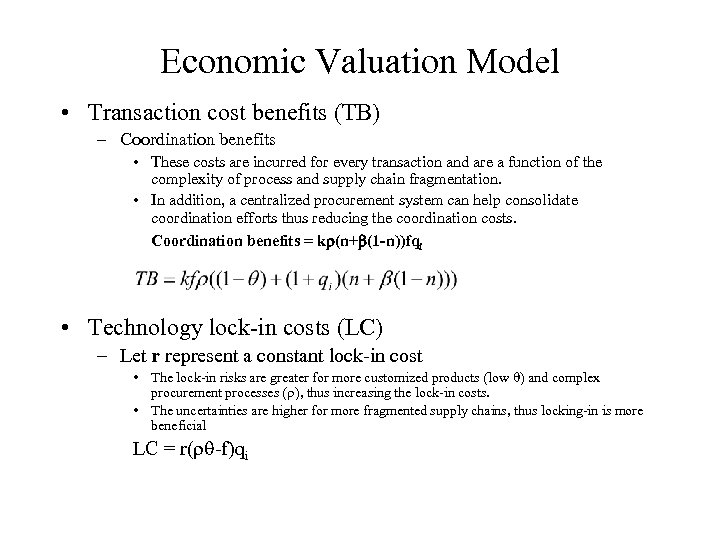
Economic Valuation Model • Transaction cost benefits (TB) – Coordination benefits • These costs are incurred for every transaction and are a function of the complexity of process and supply chain fragmentation. • In addition, a centralized procurement system can help consolidate coordination efforts thus reducing the coordination costs. Coordination benefits = k (n+ (1 -n))fqi • Technology lock-in costs (LC) – Let r represent a constant lock-in cost • The lock-in risks are greater for more customized products (low ) and complex procurement processes ( ), thus increasing the lock-in costs. • The uncertainties are higher for more fragmented supply chains, thus locking-in is more beneficial LC = r( -f)qi
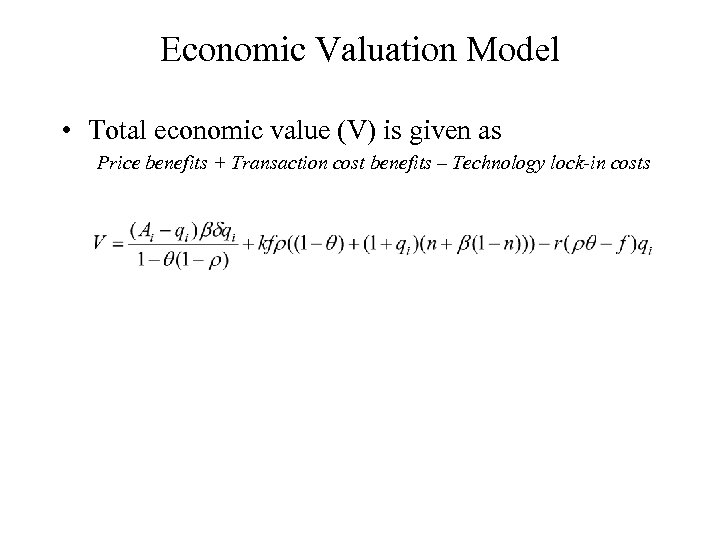
Economic Valuation Model • Total economic value (V) is given as Price benefits + Transaction cost benefits – Technology lock-in costs
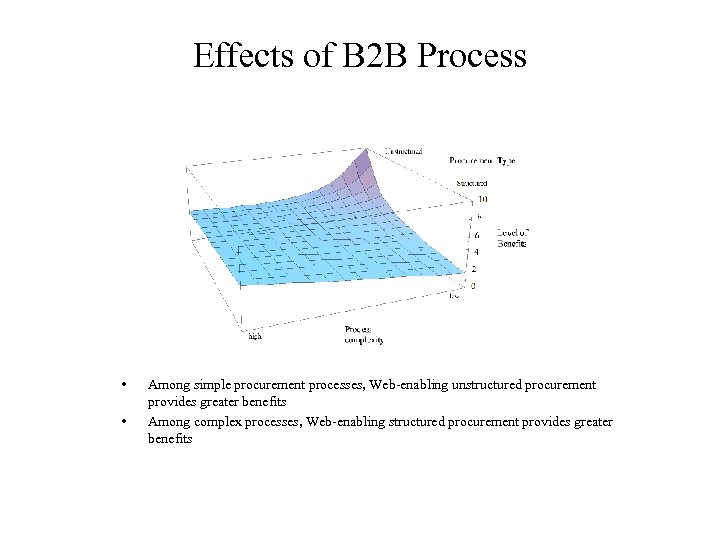
Effects of B 2 B Process • • Among simple procurement processes, Web-enabling unstructured procurement provides greater benefits Among complex processes, Web-enabling structured procurement provides greater benefits
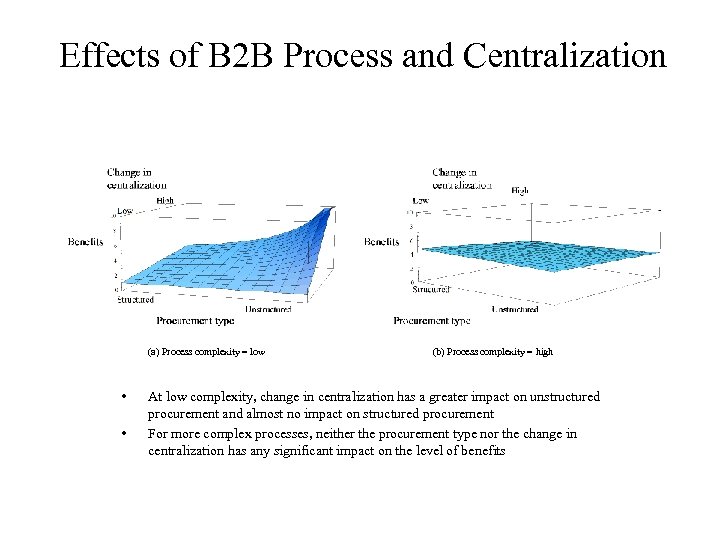
Effects of B 2 B Process and Centralization (a) Process complexity = low • • (b) Process complexity = high At low complexity, change in centralization has a greater impact on unstructured procurement and almost no impact on structured procurement For more complex processes, neither the procurement type nor the change in centralization has any significant impact on the level of benefits
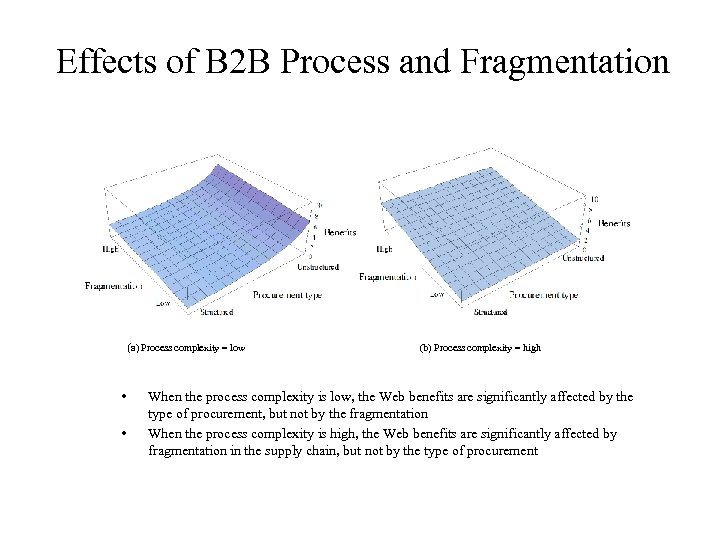
Effects of B 2 B Process and Fragmentation (a) Process complexity = low • • (b) Process complexity = high When the process complexity is low, the Web benefits are significantly affected by the type of procurement, but not by the fragmentation When the process complexity is high, the Web benefits are significantly affected by fragmentation in the supply chain, but not by the type of procurement
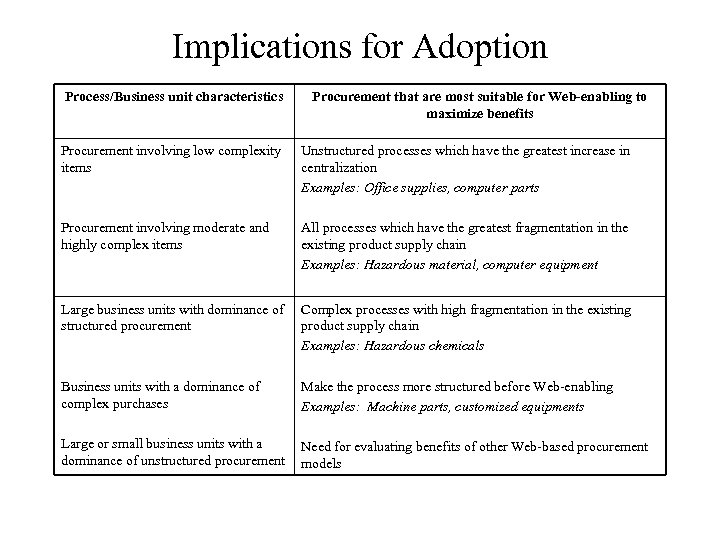
Implications for Adoption Process/Business unit characteristics Procurement that are most suitable for Web-enabling to maximize benefits Procurement involving low complexity items Unstructured processes which have the greatest increase in centralization Examples: Office supplies, computer parts Procurement involving moderate and highly complex items All processes which have the greatest fragmentation in the existing product supply chain Examples: Hazardous material, computer equipment Large business units with dominance of structured procurement Complex processes with high fragmentation in the existing product supply chain Examples: Hazardous chemicals Business units with a dominance of complex purchases Make the process more structured before Web-enabling Examples: Machine parts, customized equipments Large or small business units with a dominance of unstructured procurement Need for evaluating benefits of other Web-based procurement models
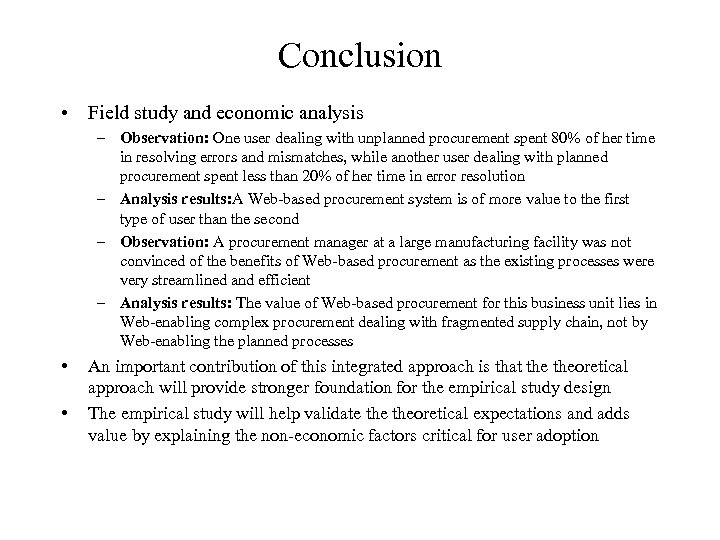
Conclusion • Field study and economic analysis – Observation: One user dealing with unplanned procurement spent 80% of her time in resolving errors and mismatches, while another user dealing with planned procurement spent less than 20% of her time in error resolution – Analysis results: A Web-based procurement system is of more value to the first type of user than the second – Observation: A procurement manager at a large manufacturing facility was not convinced of the benefits of Web-based procurement as the existing processes were very streamlined and efficient – Analysis results: The value of Web-based procurement for this business unit lies in Web-enabling complex procurement dealing with fragmented supply chain, not by Web-enabling the planned processes • • An important contribution of this integrated approach is that theoretical approach will provide stronger foundation for the empirical study design The empirical study will help validate theoretical expectations and adds value by explaining the non-economic factors critical for user adoption
Скачать презентацию Economic Analysis of B 2 B E-Commerce Michael
7902771defda8eee81064f4f13167523.ppt