


 Скачать презентацию ECON IS EASY HOW many kinds
7f4b6cf7336cf544530ae968b1df163a.ppt
- Количество слайдов: 15
 ECON IS EASY !!!!!
 HOW many kinds of Econ? ? ? • Microeconomics (individual parts of the economy & the actions of individuals and firms) • Macroeconomics (the economy as a whole) • Positive Economics (scientifically analyzes data to establish generalizations about economic behavior) • Normative Economics (involves value judgments about what the economy should be like)
 Economic Systems (sets of accepted behaviors, laws, and institutions concerning relationships and principles within economics) Traditional –prevalent in 3 rd world countries. Ex: passing down power, ownership, etc. through family lines. Command – Entity with absolute power makes decisions in the name of society Planning – Democratic process determines choices Market – free enterprise system. Also referred to as capitalism, private enterprise or free market systems. The rights of individuals and private ownership are strongly valued.
 BUY ME! • Capital (what you buy stuff with) • Market (where goods or services are exchanged) • Competition (“Buy mine!” “NO! Buy mine!”)
 “What you want, Baby, I got it…” • Law of Supply (quantity supplied directly related to the price, ceteris paribus) • Law of Demand (quantity demanded INVERSELY related to price, ceteris paribus) • Supply Side Economics (cuts would create economic growth, boosting tax revenues and shrink deficits)
 That’s GOOD! Complementary goods – goods usually sold together. EX: rugs and padding Substitute – product or service that satisfies the need of the consumer that another product would fulfill
 Wanna make something of it? ? ? Cost of production – the value of an object decided by the cost of the resources needed to make it Opportunity costs – real costs measured in terms of the real value that is foregone when a choice is made. EX: you choose to go to a movie instead of studying; the OPPORTUNITY COST is what you might have gained by studying. Production possibilities – many different combinations of goods and services that can be made by the same resources, ie, 3 cars and 2 tractors or 4 cars and one tractor
 Factors of Production Land (natural) resources Labor resources (human capital) – includes humans’ skills and knowledge Capital resources – goods produced to be used later in the production of final goods. EX: tools, nuts, bolts Entrepreneurial resources – the decision making involved in using resources to produce goods.
 Awwww, Gsss GNP – Gross National Product involves the value of the production of a nation’s PERMANENT residents. A US citizen working in Mexico is factored into the US GNP. GDP – Gross Domestic Product is the total market value of all the goods and services produced within the borders of a nation during a specific period. REAL GDP – the GDP after adjustment for inflation
 -ISMs Communism – collective property ownership Socialism – group voluntarily shares their resources for the common good Mercantilism – wealth is based on the amount of precious metals that a country prosseses
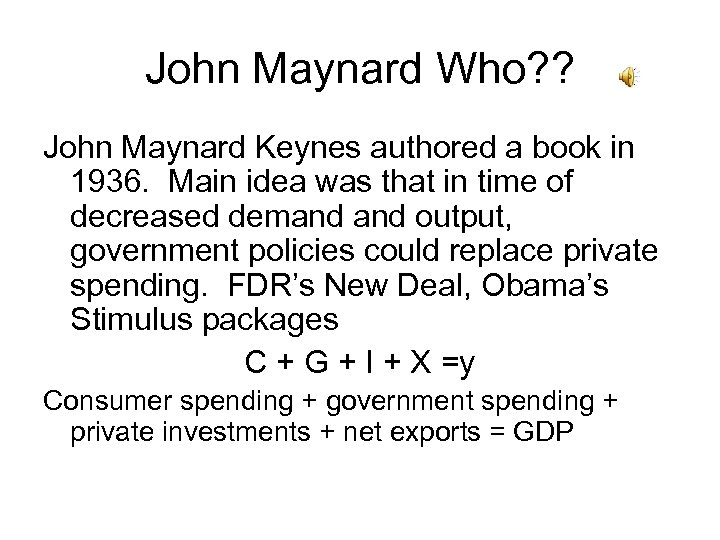 John Maynard Who? ? John Maynard Keynes authored a book in 1936. Main idea was that in time of decreased demand output, government policies could replace private spending. FDR’s New Deal, Obama’s Stimulus packages C + G + I + X =y Consumer spending + government spending + private investments + net exports = GDP
 Random Vocab Aggregate – a composite or total Tariff – government imposed taxes on imported OR exported goods Subsidies – monetary assistance to group or individual to aid the public (stimulus money) Incentive- when self-interest is used to get people to take risks
 MORE VOCAB? ? ? Ceteris paribus – “All things being equal”. When economists look at a change in the market, they isolate their focus by neutralizing changes in other areas Laissez-Faire – “Hands off”. Government does not interfere with private economic choices (think inverse of bail out) Oligopoly – a market that is controlled by just a few firms (think electronics)
 MORE VOCAB? ? Margin – difference between the cost of two alternatives OR the difference between two benefits Elasticity- relationship of change in price to the change in quantity demanded. EX: a diabetic’s demand for insulin is INELASTIC because the demand will not be affected by price change. Price ceiling – maximum LEGAL price of a commodity
 And Finally… TANSTAAFL There Ain’t No Such Thing As A Free Lunch CHOICES HAVE OUTCOMES!!!